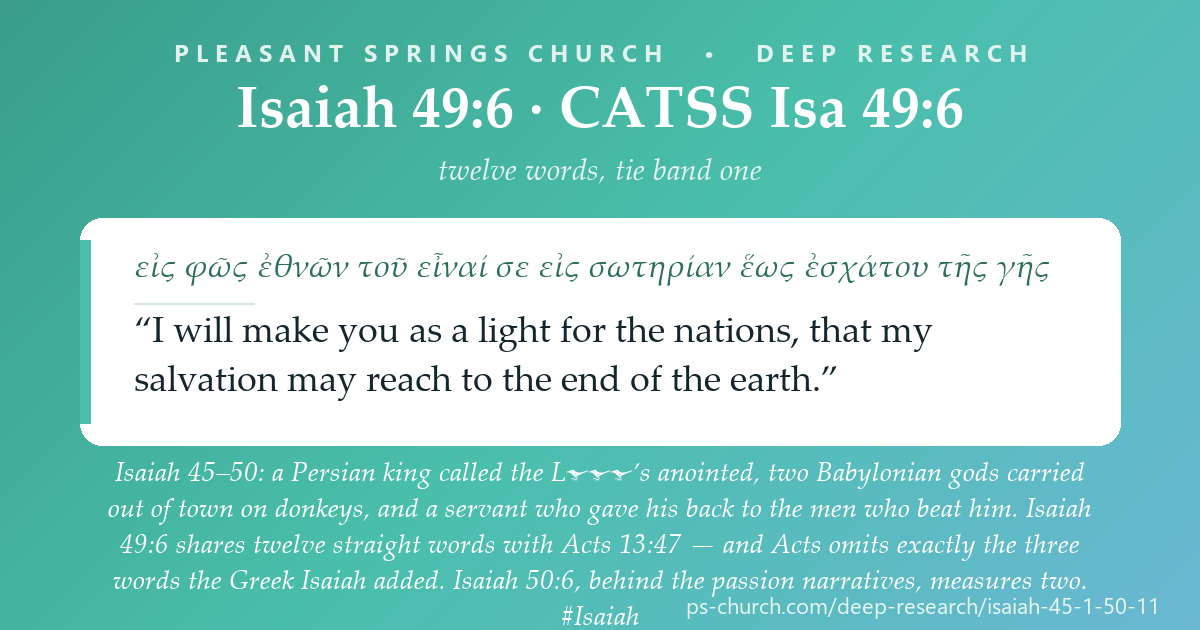
Six chapters, a hundred and twelve verses, and three things nobody expects to find together: a Persian king called the Lord’s anointed, two Babylonian gods loaded onto donkeys and carried out of town, and a servant who says he gave his back to the men who beat him. Run the whole passage against the 7,927 verses of the Greek New Testament and the deepest verbatim contact anywhere in it is twelve consecutive words — Isaiah 49:6 into Acts 13:47, tie band one — and the three words Acts leaves out are exactly the three the Greek Isaiah has that the Hebrew does not. Behind it, Isaiah 49:8 into 2 Corinthians 6:2 at ten, which is the whole of Paul’s quotation. And then the reversal: Isaiah 50:6, the verse every reader hears behind the passion narratives, measures two, with a tie band of seventy-one. Meanwhile the sharpest finding on the page is in Hebrew and has nothing to do with the New Testament at all: Babylon’s boast at 47:8 shares seven consecutive words with Zephaniah 2:15 — where the speaker is Nineveh. See the method →
Isaiah 45:1–50:11 — sixteen rows across all six chapters (the chapter and verse numbers agree in the Hebrew, the Greek and the ESV throughout these six chapters — 25, 13, 15, 22, 26 and 11 verses in every column; there is no offset here)
Hebrew (Masoretic) · Greek (CATSS/Rahlfs) · ESVThe Shape of the Passage
Sequence — eleven open-section units, and one sentence that changes speakersNothing on this page bears on the authorship of the book of Isaiah. These are the chapters over which that question is fought hardest — a named Persian king stands in the second word of 45:1 — and the two files on this disk cannot settle it. What follows reports who the text says is speaking and who it says is listening, and stops there. Where this page uses the phrase “the Cyrus oracle” it means the paragraph, not a theory about it.
Author
These six chapters carry no superscription. The book’s one heading stands at 1:1, and nothing between 45:1 and 50:11 names a prophet or a regnal year. What the passage does name is a king: כּוֹרֶשׁ, Cyrus, at 45:1 — and once before, at 44:28, just outside this page. Those two are the only two occurrences of the name in Isaiah, against three in Daniel, thirteen in Ezra and three in 2 Chronicles.
The speaker changes constantly and the text almost never labels the changes. 45:1–7 is divine speech addressed to Cyrus in the second person. 45:9–10 is a woe-cry in a human voice. 45:15 is somebody praying (truly you are a God who hides himself). 47:1–15 addresses a city as a woman. 48:16 ends with a first-person speaker who says he was sent — and who is not identified. 49:1–6 is the servant speaking about himself; 49:14 is Zion speaking; 50:4–9 is the servant again. Six changes of voice, none announced, and at 48:16 and 49:1 the text will not say who is talking.
What the Greek column adds, and what it does not. The CATSS file for Isaiah runs 1,289 rows against the Masoretic 1,291 verses. The whole difference is two rows: there is no row for Isaiah 2:22 and none for Isaiah 56:12, and everywhere else the two texts have chapter for chapter and verse for verse the same shape. Neither gap is in this passage — chapters 45 to 50 hold 25, 13, 15, 22, 26 and 11 verses in both files. Whether those two omissions belong to the Greek tradition or only to this edition is a question about manuscripts, and no manuscript evidence was consulted for this page.
The Greek column is used here as a witness to a second ancient text, never as evidence about who wrote the Hebrew one. Where the two disagree — and on this page they disagree at 45:3, 45:9, 46:1, 47:8, 47:10, 48:10, 49:6, 49:16 and 50:6 — the page prints both and names neither prior.
Audience
The addressee changes four times, and every change is visible in the text. 45:1 speaks to a Persian king who is not in the room. 45:9–25 speaks to Israel and then to “all the ends of the earth”. 47:1–15 turns and speaks to Babylon, addressed throughout in the feminine singular — שְׁבִי, רְדִי, שִׁמְעִי, all of them commands to a woman. 49:1 turns again: listen to me, O coastlands, and give attention, you peoples from afar. 50:10 ends on a question put to an individual: who among you fears the Lord?
The audience is a people who have lost an argument about power. The passage keeps saying the same two things to them: that the God who is speaking made everything, and that the gods who look like they won are objects that have to be carried. 46:1–2 puts those two claims side by side in one image — Bel and Nebo loaded onto pack animals, and the animals are tired. Then 46:3–4 turns the picture round: you who have been borne by me from before your birth… even to your old age I am he. One is carried; the other carries.
How it has been carried. 49:6 is read in the churches as a missionary commission and 50:4–9 is read as a passion prophecy. Both readings are older than any of us and neither is invented here. What this page adds is only the measurement, and the two measurements point opposite ways: 49:6 reaches twelve consecutive words into Acts 13:47, and 50:6 reaches two into the whole Greek New Testament. The page does not claim the measurements are the meaning.
Orient on Cyrus, Bel and Nebo, the servant songs, and the daughter of Babylon.
Which articles are relevant?
- Anchor Bible Dictionary — “Isaiah, Book of,” “Cyrus,” “Persia,” “Bel,” “Nebo (Deity),” “Dagon,” “Servant of the Lord,” “Babylon (Place).”
- Dictionary of the OT: Prophets (IVP) — “Isaiah: Book of,” “Servant of Yahweh,” “Idols, Idolatry, Gods,” “Exile,” “Nations,” “Divine Council.”
- NIDOTTE / TDOT — מָשִׁיחַ (māšîaḥ), עֶבֶד (ʿeḇeḏ), אֶפֶס (ʾepes), בָּרָא (bārāʾ), לִמּוּדִים (limmûḏîm).
- TDNT / EDNT — χριστός, παῖς, διαθήκη, σωτηρία — σωτηρία stands inside the twelve-word run at 49:6, and διαθήκη stands in the three words beside it that Acts does not carry.
The verse numbers — and there is no offset here
Isaiah 45 to 50 have 25, 13, 15, 22, 26 and 11 verses in the Masoretic text, in the CATSS Greek and in the ESV alike. Every reference on this page therefore means the same verse in every column. That is stated because this shelf states it even when the answer is nothing: several of its books — Joel, Jonah, Malachi, the Psalter, Jeremiah — are numbered differently in Greek and English, and a reader who has met those pages is entitled to know that this one has no such trap in it.
Across the whole book, the CATSS file and the Masoretic text differ in exactly two places. The Greek file holds 1,289 rows where the Hebrew holds 1,291 verses. It has no row for Isaiah 2:22 and none for Isaiah 56:12; the chapter maxima agree everywhere else, in all sixty-six chapters. Both of those were re-derived from the files on this disk for this page, not copied from a table.
One seam elsewhere in the book that a reader should know about. The Hebrew ends chapter 63 with a long verse 19 whose second half the English prints as 64:1, so English 64:2–12 correspond to Hebrew 64:1–11. That seam is fourteen chapters past the end of this passage and touches nothing here, but it is the one place in Isaiah where an English reference and a Hebrew reference can mean different verses.
What that does and does not mean. It is a statement about the file this shelf holds, not about ‘the Septuagint’. Whether the two omissions belong to the Greek tradition or only to this edition is a question about manuscripts, and no manuscript evidence was consulted for this page.
Bibliography surfaced:
- John N. Oswalt (NICOT), Brevard S. Childs (OTL), Joseph Blenkinsopp (Anchor Yale Isaiah 40–55), Claus Westermann (OTL), John Goldingay and David Payne (ICC), J. Alec Motyer, and Shalom M. Paul (Eerdmans Critical Commentary) on Isaiah 40–66.
- Amy Plantinga Pauw and Patricia Tull on the reception of the servant songs; Bernd Janowski and Peter Stuhlmacher, eds., The Suffering Servant.
- Lisbeth S. Fried, “Cyrus the Messiah? The Historical Background to Isaiah 45:1,” Harvard Theological Review 95 (2002) — cited from the secondary literature and not consulted directly for this page.
- Ronald L. Troxel, LXX-Isaiah as Translation and Interpretation; Arie van der Kooij and Mirjam van der Vorm-Croughs on the translator of Greek Isaiah — likewise cited and not consulted directly.
- James B. Pritchard, ed., Ancient Near Eastern Texts Relating to the Old Testament, 3rd ed. — this one WAS consulted directly; the Cyrus Cylinder is at pages 315–316 in A. L. Oppenheim’s translation and is quoted verbatim in stage 2.
A clay barrel from Babylon that names the same two gods, in the same order.
The Cyrus Cylinder — quoted, not summarised
The single most useful outside document for this passage is a barrel-shaped clay inscription of Cyrus, and this project holds a translation of it. A. L. Oppenheim’s English is printed in Pritchard’s Ancient Near Eastern Texts, 3rd edition, at pages 315–316. Two sentences from it matter here and both are quoted verbatim.
… I am Cyrus, king of the world, great king, legitimate king, king of Babylon, king of Sumer and Akkad, king of the four rims (of the earth) … whose rule Bel and Nebo love, whom they want as king to please their hearts.the Cyrus Cylinder, trans. A. L. Oppenheim, ANET 3rd ed., p. 316
May all the gods whom I have resettled in their sacred cities ask daily Bel and Nebo for a long life for me and may they recommend me (to him) …the Cyrus Cylinder, trans. A. L. Oppenheim, ANET 3rd ed., p. 316
Bel and Nebo. Isaiah 46:1 names the same two gods in the same order, one chapter after it names Cyrus. The cylinder has them loving Cyrus’ rule and being asked for his long life; Isaiah 46:1 has them stooping, and their images loaded onto pack animals. This page does not claim that either text knows the other. Both are held here, both name the pair, and a reader is entitled to see them on the same page.
The cylinder’s own account of how Cyrus came to power is that Marduk “scanned and looked (through) all the countries, searching for a righteous ruler willing to lead him” and then “pronounced the name of Cyrus… king of Anshan” (ANET 315). Oppenheim’s note on that passage flags the Akkadian idiom qātī NN ṣabātu, ‘to take the hand of’. Isaiah 45:1 says אֲשֶׁר־הֶחֱזַקְתִּי בִימִינוֹ, whose right hand I have grasped. Two texts using a hand-taking image for the same king is worth noticing and is not by itself evidence of contact — the idiom is widespread in Akkadian royal language, and this page has not screened Akkadian.
Bel and Nebo, and what the Greek column did with them
The Hebrew names two Babylonian gods. The CATSS Greek names one Babylonian god and one Philistine one.
| Hebrew (Masoretic) | Greek (CATSS) | |
|---|---|---|
| first god | בֵּל — Bel, i.e. Marduk | Βηλ |
| second god | נְבוֹ — Nebo, i.e. Nabu | Δαγων — Dagon |
| the verbs | כָּרַע / קֹרֵס — bows, stoops | ἔπεσε / συνετρίβη — fell, was shattered |
The counts. בֵּל stands in exactly three verses of the Hebrew Bible: Isaiah 46:1, Jeremiah 50:2 and Jeremiah 51:44. נְבוֹ stands in thirteen, and Isaiah 46:1 is the only one of the thirteen where it is a god: the rest are Mount Nebo, the Moabite town, the Judean village of the returnees, or part of a Babylonian personal name at Jeremiah 39:3. On the Greek side, Βηλ stands 28 times in the files held here and 27 of the 28 are in Bel and the Dragon; Isaiah 46:1 is the twenty-eighth. The Greek Jeremiah does not use the same form — at LXX Jeremiah 27:2 it declines the name as Βῆλος.
And Dagon. Δαγων stands 21 times in the Greek files held here, three of them inside the place-name Βηθδαγων. Twelve of the eighteen real occurrences are in 1 Samuel 5 — the chapter where the ark is set beside Dagon and Dagon is found πεπτωκὼς ἐπὶ πρόσωπον αὐτοῦ, fallen on his face, twice, with his head and hands broken off. The other six are Judges 16:23 in both the A and the B text — the temple where Samson dies — 1 Chronicles 10:10, 1 Maccabees 10:84 and 11:4, and Isaiah 46:1. Every occurrence except Isaiah 46:1 is Philistine. Measured word-form against word-form, Isaiah 46:1 shares exactly one word with 1 Samuel 5:3 and one with 1 Samuel 5:4 — the name itself. So the connection is a name, not a run, and this page says so rather than letting the reader assume otherwise.
What was NOT read for this page
The Babylonian New Year (akitu) festival texts, in which the images of Bel and Nabu are carried in procession, are printed in the same volume at ANET 331–334. They were located in the index and were not read. Isaiah 46:1–7 is routinely read against that procession in the commentaries; this page notes the reading and does not endorse it, because the primary text behind it was not consulted here.
Herodotus I.190–191 on the fall of Babylon, Xenophon’s Cyropaedia, and the Nabonidus Chronicle were likewise not consulted. No Akkadian, Ugaritic or Persian corpus was screened for this page. The only corpora screened are the three named at the foot: Masoretic Hebrew, CATSS Greek and MorphGNT.
Five words, and one sentence that three different mouths say.
39 occurrences, in 38 verses of the Masoretic corpus held here. 38 of the 39 are Israelite — Saul, David, the anointed priest of Leviticus, the king of the Psalter. Isaiah 45:1 is the one that lands on a foreign king.
48 occurrences across the 30,348 screened Greek Old Testament verse units held here. Isaiah 45:1 is the only one of the 48 inside Isaiah.
The word Babylon uses for ‘no other’ at 47:8 and 47:10. God never uses it of himself in this passage; God uses אֵין.
The unprefixed form stands in five verses of this passage: 45:4 and 49:3 (my servant), 48:20 and 50:10 (his servant), and 49:6. The CATSS Greek renders it παῖς at 49:6 and 50:10 but δοῦλος at 48:20.
Twice in one verse at 50:4 — a tongue of the taught and an ear that hears as the taught. The CATSS Greek collapses both into παιδεία, instruction.
The one sentence, and the three mouths that say it
This is the measured spine of the page. Two nearly identical sentences run through these chapters. One is God’s. One is a city’s. The Hebrew keeps them one word apart and the Greek keeps them one syllable apart.
| who says it | where | Hebrew | Greek (CATSS) |
|---|---|---|---|
| God | Isaiah 45:5, 45:6, 45:14, 45:18, 45:21, 45:22, 46:9 — seven times | וְאֵין עוֹד | καὶ οὐκ ἔστιν ἔτι / ἄλλος |
| Babylon | Isaiah 47:8, 47:10 — twice | אֲנִי וְאַפְסִי עוֹד | ἐγώ εἰμι καὶ οὐκ ἔστιν ἑτέρα |
| Nineveh | Zephaniah 2:15 — once | אֲנִי וְאַפְסִי עוֹד | ἐγώ εἰμι καὶ οὐκ ἔστιν μετ’ ἐμὲ ἔτι |
The counts, all of them exhaustive.
- וְאֵין עוֹד stands in nine verses of the 23,204-unit Masoretic corpus. Seven are Isaiah 45–46. The other two are Joel 2:27 and Ecclesiastes 9:5.
- אֲנִי וְאַפְסִי עוֹד stands in three: Isaiah 47:8, Isaiah 47:10 and Zephaniah 2:15. Never on God’s lips, anywhere.
- ἐγώ εἰμι καὶ οὐκ ἔστιν ἑτέρα stands in three places in the 30,348 Greek verse units screened here, all three in Isaiah 47.
- ἐγώ εἰμι καὶ οὐκ ἔστιν ἔτι — God’s version — stands in one: Isaiah 45:18.
- ἐγώ εἰμι καὶ οὐκ ἔστιν, the shared four words, stands in six: Deuteronomy 32:39, Isaiah 45:18, Isaiah 47:8, Isaiah 47:10 twice, and Zephaniah 2:15.
What this does not prove. It does not prove that Isaiah 47 is quoting Zephaniah 2, or Zephaniah 2 Isaiah 47, or that either writer had the other in front of him. Seven consecutive words with a tie band of one is a strong signal of shared language and a silent one about direction. The reading this page does offer is the one the counts support and no more: in the Hebrew Bible as it stands, the sentence ‘I am, and there is none besides me’ belongs to capital cities, and God does not say it.
Two more words where the columns simply differ
Isaiah 48:10. Hebrew צְרַפְתִּיךָ, I have refined you. CATSS Greek πέπρακά σε, I have sold you — followed by ἐξειλάμην δέ σε, but I redeemed you, which the Hebrew does not have. Neither column is treated as the corrector of the other on this page.
Isaiah 49:6. Hebrew נָקֵל, it is too slight a thing. CATSS Greek μέγα σοί ἐστιν, it is a great thing for you. The Hebrew is saying the servant’s first commission is not big enough; the Greek is saying it is an honour. These are opposite sentences, and they stand at the head of the verse that produces the deepest run on this page.
Every run, with its tie band, and every counter-example printed beside it.
Cross-corpus runs compare word FORMS, not lemmas, and apply MorphGNT's own spelling equivalences (ou/ouk/ouch, ek/ex, the movable nu) so a run is not cut at a word the two editions merely spell differently. Every figure below was measured on 31 August 2026 and nothing was copied from a sibling page.
The whole Greek New Testament against these 112 verses
The screen sentence, verbatim from the tool: “Across the 112 CATSS rows against 7,927 verses of the Greek New Testament: 109 reach two, 80 reach three, 27 reach four, 9 reach five, 3 reach six, 2 reach ten, 1 reach twelve, and nothing reaches 13.”
| Isaiah | run | tie band | where | what it is |
|---|---|---|---|---|
| 49:6 | 12 | 1 | Acts 13:47 | a marked citation — οὕτως γὰρ ἐντέταλται ἡμῖν ὁ κύριος |
| 49:8 | 10 | 1 | 2 Corinthians 6:2 | a marked citation — λέγει γάρ |
| 45:23 | 6 | 1 | Romans 14:11 | a marked citation — καθὼς γέγραπται |
| 45:11 | 5 | 1 | Revelation 1:8 | λέγει κύριος ὁ θεὸς ὁ — a title, not a citation |
| 45:16 | 5 | 1 | Luke 13:17 | an accident: πάντες οἱ ἀντικείμενοι αὐτῷ καί |
| 45:21 | 5 | 1 | Mark 12:32 | the scribe agreeing with Jesus about the Shema |
| 49:13 | 5 | 3 | Luke 7:16; Romans 11:1; Romans 11:2 | ὁ θεὸς τὸν λαὸν αὐτοῦ — a formula |
| 49:18 | 5 | 1 | Romans 14:11 | the FIRST half of the same Pauline verse |
| 49:21 | 5 | 1 | Romans 10:6 | an accident: ἐν τῇ καρδίᾳ σου τίς |
Read the two columns together. Of the nine rows that reach five or more, four are marked citations and five are not. Luke 13:17 shares five consecutive words with Isaiah 45:16 and is about a synagogue ruler being put to shame over a healing on the Sabbath. Romans 10:6 shares five with Isaiah 49:21 and is quoting Deuteronomy 30. A run of five is not evidence of a quotation. A run of five with a citation formula in front of it is.
The twelve-word run, opened up
Isaiah 49:6, CATSS Greek, end of the verse:
… ἰδοὺ τέθεικά σε εἰς διαθήκην γένους εἰς φῶς ἐθνῶν τοῦ εἶναί σε εἰς σωτηρίαν ἕως ἐσχάτου τῆς γῆς
Acts 13:47, MorphGNT:
οὕτως γὰρ ἐντέταλται ἡμῖν ὁ κύριος · Τέθεικά σε εἰς φῶς ἐθνῶν τοῦ εἶναί σε εἰς σωτηρίαν ἕως ἐσχάτου τῆς γῆς
The measured contact is 12 consecutive word-forms, tie band 1, and it is preceded by a separate run of 2. What separates them is three words — εἰς διαθήκην γένους — which the CATSS Greek has and the Hebrew of 49:6 does not. Acts omits exactly the words the Greek Isaiah has and the Hebrew does not. The page states that as an observation about two texts on this disk. It does not say that Luke “dropped” anything, because that would be a claim about which text he had in front of him, and the files cannot tell us that.
Why the run is 49:6 and not 42:6 or 51:4. εἰς φῶς ἐθνῶν stands in three verses of the screened Greek Old Testament: Isaiah 42:6, 49:6 and 51:4. Measured against Acts 13:47, 42:6 gives three, 51:4 gives three, and 49:6 gives twelve. The three-word phrase is ambiguous; the twelve-word run is not.
Where it is NOT decisive. The four words ἕως ἐσχάτου τῆς γῆς stand in five screened Greek Old Testament verses (Isaiah 8:9, 48:20, 49:6, 62:11, Psalms of Solomon 1:4) and in two Greek New Testament verses — Acts 1:8 and Acts 13:47. Acts 1:8 therefore has four Isaiah homes and measurement cannot pick one. A page that used the 49:6 run to claim Acts 1:8 for Isaiah 49 would be over-reading its own tool.
Romans 14:11 is two Isaiah verses stitched together — and only half the stitch holds
Romans 14:11: καθὼς γέγραπται · Ζῶ ἐγώ, λέγει κύριος, ὅτι ἐμοὶ κάμψει πᾶν γόνυ, καὶ πᾶσα γλῶσσα ἐξομολογήσεται τῷ θεῷ.
| half | Isaiah | run | band in this passage | band in the whole screened Greek OT |
|---|---|---|---|---|
| ζῶ ἐγώ λέγει κύριος ὅτι | 49:18 | 5 | 1 | 17 verses carry the formula — twelve of them in Ezekiel |
| ὅτι ἐμοὶ κάμψει πᾶν γόνυ καί | 45:23 | 6 | 1 | πᾶν γόνυ stands in exactly ONE verse — Isaiah 45:23 |
This is what a tie band is for. Both halves look equally distinctive at band 1, because band 1 was computed against the other 111 verses of this passage. Widen the screen to the whole 30,348-unit Greek Old Testament and the two halves come apart: ζῶ ἐγώ λέγει κύριος is an oath formula that Ezekiel uses twelve times, and πᾶν γόνυ occurs once in the entire corpus. Only the second half of Romans 14:11 can be tied to a specific Isaiah verse by measurement. This page prints its own limitation rather than letting a band of one do work it cannot do.
And Philippians 2:10–11. Every reader hears Isaiah 45:23 behind every knee shall bow… every tongue confess. Measured: Philippians 2:10 shares two word-forms with Isaiah 45:23 (πᾶν γόνυ), and Philippians 2:11 shares two (πᾶσα γλῶσσα). Paul changes the case, splits the clause across two verses and swaps the verb. The link is real and it is not a run.
The counter-examples, printed rather than buried
| what a reader expects | run | tie band | the honest reading |
|---|---|---|---|
| Isaiah 50:6 behind the passion narratives | 2 | 71 | and the partner is Romans 11:10, which is quoting Psalm 69. Against Matthew 26:67: 1. Mark 14:65: 1. Luke 22:63: 0. |
| Isaiah 49:6 behind the Nunc Dimittis, Luke 2:32 | 1 | — | The same author wrote Acts 13:47 at twelve and Luke 2:32 at one. Luke 2:32 says φῶς εἰς ἀποκάλυψιν ἐθνῶν — nearly the same idea, almost none of the same forms. |
| Isaiah 47:8 behind Revelation 18:7 | 4 | 3 | the run is ἐν τῇ καρδίᾳ αὐτῆς, and its other two ties are Luke 2:19 and Luke 2:51 — Mary treasuring things in her heart. The screen cannot tell Babylon’s boast from Mary’s meditation. |
| Isaiah 48:20 behind Revelation 18:4 | 1 | — | Come out of her, my people shares one word-form with Go out from Babylon: ἐκ. |
| Isaiah 46:1 behind Revelation 14:8 | 1 | — | Fallen, fallen is Babylon against Bel has fallen: one shared form, τά. The verb is not even shared. |
| Isaiah 45:9 behind Romans 9:20–21, the potter | 2 | — | μὴ ἐρεῖ. Against Romans 9:21: 1. |
| Isaiah 50:8–9 behind Romans 8:33–34 | 1 each | — | Who will contend with me? against Who shall bring any charge? — one shared form each, ὁ and τίς. |
| Isaiah 49:10 behind Revelation 7:16–17 | 2 / 1 | — | οὐ πεινάσουσιν, then one. |
Eight expected connections; the deepest of the eight is four, and it is tied with Mary. None of this says the connections are not there. It says they are not verbatim, and that a page which reports twelve at 49:6 owes its readers these numbers on the same screen.
The Hebrew screen: these 112 verses against the rest of the Hebrew Bible
Scope: Hebrew against Hebrew, over the 23,092 non-source verse units of the 39-book Masoretic corpus held here. Contiguous runs of whole consonantal word forms, never lemmas and never roots. The unigram fallback is OFF, so a row reported as 0 shares NO TWO CONSECUTIVE WORDS with any other verse in the Hebrew Bible — it does not mean the verse shares no words.
| Isaiah | run | tie band | partner |
|---|---|---|---|
| 49:18 | 8 | 1 | Isaiah 60:4 — שאי סביב עיניך וראי כלם נקבצו באו לך |
| 47:8 | 7 | 1 | Zephaniah 2:15 — and there the speaker is Nineveh |
| 49:26 | 7 | 1 | Isaiah 60:16 |
| 45:3 | 5 | 1 | Exodus 8:18 — a plague formula addressed to Pharaoh |
| 49:22 | 5 | 5 | Isaiah 65:13, Jeremiah 7:20, Ezekiel 37:12 and two more — thus says the Lord God behold, a formula |
| 48:11 | 4 | 1 | Isaiah 42:8 |
| 48:17 | 4 | 1 | Isaiah 44:24 |
| 49:8 | 4 | 1 | Isaiah 42:6 |
| 49:13 | 4 | 1 | Isaiah 52:9 |
| 50:7 | 4 | 1 | Genesis 20:6 — an accident |
| 45:18 | 4 | 44 | Joshua 7:13 and 43 others — כי כה אמר יהוה. This is what a formula looks like. |
Notice how much of the passage’s deepest Hebrew contact is with Isaiah itself. Of the eleven rows above, six point at another verse of Isaiah — 42:6, 42:8, 44:24, 52:9, 60:4 and 60:16 — and 60:4 and 60:16 are the two deepest. The measurement records that the language of these chapters is shared most densely with chapters 42 and 60 of the same book. It says nothing about how or when that happened.
Sixteen verses of the 112 return zero. 46:1, 46:5, 46:6, 47:2, 47:3, 47:12, 48:3, 48:4, 48:13, 48:18, 49:2, 49:10, 49:11, 49:14, 49:24 and 50:3. The first of them is the fall of Bel. All sixteen share individual words freely; what none of them shares is an adjacent pair.
The section-marker caveat, run both ways
The Masoretic file this shelf holds prints the scribal section markers {ס} and {פ} inside the verse text, and the frozen normaliser tokenises them as words. There are 31 of them in these 112 verses. The screen was therefore run twice, once as the file stands and once with the markers stripped.
Exactly three rows move. Isaiah 47:3 drops from 2 to 0; Isaiah 49:24 drops from 2 to 0; Isaiah 48:2 drops from 4 to 3. Nothing else changes, and none of the eleven rows in the table above is affected. All Hebrew figures printed on this page are the marker-stripped ones, which is why the zero count above is sixteen and not fourteen. normalize.py is frozen and was not edited.
What this page could not check, and where it is weakest.
What was NOT consulted — the honest list
- No critical apparatus for the Hebrew. The Hebrew is Sefaria’s Miqra according to the Masorah as it stands. BHS, BHQ and the Hebrew University Bible Project’s Isaiah were not opened.
- No Dead Sea Scroll was collated — and on THIS passage that is the sharpest limit on the page. 1QIsaᵃ is complete and contains all six of these chapters. It is known to differ from the Masoretic text in these chapters at points that commentators discuss. Nothing on this page reflects it. A reader who wants to know whether a divergence reported here is a Greek-side or a Hebrew-side matter will have to go to the scroll, and this page cannot help.
- No Greek manuscript evidence. “The CATSS Greek reads…” on this page means the digitised Rahlfs text on this disk. Whether the Dagon of 46:1 or the πέπρακά σε of 48:10 is early, late, or an editorial choice is a manuscript question, and no manuscript was consulted. The page never calls a Greek reading original or secondary.
- No Akkadian, Persian, Ugaritic or Aramaic corpus was screened. The Cyrus Cylinder appears here in an English translation, quoted with its page number. The hand-taking idiom is reported from Oppenheim’s footnote and was not verified in Akkadian.
- The akitu festival texts were not read. They are in the same volume at ANET 331–334; they were located and left unread, and the commonest reading of Isaiah 46:1–7 depends on them.
- The ESV column was not verified against a held ESV file. No ESV file for Isaiah exists on this disk and no Crossway API key exists in this project. The English was typed; its verse alignment rests on verse counts and chapter openings, both of which were checked. The Hebrew and Greek columns were pulled programmatically from the corpus files.
- The commentaries named in stage 1 were not read for this page. They are a bibliography, not a source list. The only sources behind the numbers are three files: Masoretic Hebrew, CATSS Greek, MorphGNT.
Three claims that were checked and withdrawn while this page was built
1. “The twelve-word run at 49:6 is the deepest on this shelf.” WITHDRAWN. It is not. Other pages on this shelf report runs of fourteen, seventeen and eighteen. Twelve is the deepest run in these six chapters, and that is all this page claims.
2. “Romans 14:11 quotes Isaiah 45:23.” NARROWED. Only half of it can be measured to 45:23. The other half is an oath formula that Ezekiel uses twelve times. The page now prints both halves with both bands.
3. “Isaiah 46:1 lies behind Revelation 14:8 and 18:2.” WITHDRAWN. The run is one word, and it is the article. Revelation’s ἔπεσεν ἔπεσεν Βαβυλών is closer to Isaiah 21:9 in sense and shares no measurable run with 46:1. The page reports 46:1’s Hebrew zero and its Greek Dagon, and stops.
Where this page is weakest
Three places, named so a reader can push back.
First, the Zephaniah 2:15 finding is the page’s best measurement and its most exposed claim. Seven consecutive words with a band of one is strong. But the reading built on it — that this sentence belongs to capital cities and God does not say it — rests on a distinction between אֵין and אֶפֶס that a lexicon might call stylistic rather than theological. The counts are firm; the interpretation is a reading.
Second, the structure diagram is Hebrew-side only. The eleven units are the open scribal sections of one printed edition. A different edition’s markers could give a different diagram, and the CATSS file has no markers at all. Nothing in the argument depends on the diagram, which is why it is safe to print — but it is not independent evidence.
Third, this page cannot tell allusion from silence. Isaiah 50:6 measuring two does not mean the evangelists were not thinking of it. It means the Greek words do not overlap. A tool that finds verbatim contact finds verbatim contact, and that is the whole of what any number here is evidence for.
Sources actually used:
- Consulted directly: James B. Pritchard, ed., Ancient Near Eastern Texts Relating to the Old Testament, 3rd ed. — the Cyrus Cylinder, trans. A. L. Oppenheim, pp. 315–316, quoted verbatim in stage 2.
- Named and NOT consulted: Oswalt, Childs, Blenkinsopp, Westermann, Goldingay and Payne, Motyer, Paul; Fried on Isaiah 45:1; Troxel and van der Kooij on Greek Isaiah; Janowski and Stuhlmacher on the servant. These are a bibliography, not sources.
- Text: Sefaria, Miqra according to the Masorah; Rahlfs’ Septuaginta as digitized by CATSS; SBLGNT as digitized by MorphGNT. These three files are the only evidence behind every number on this page.
- Screens run and reported: the whole-New-Testament run screen on all 112 CATSS rows; the whole-Hebrew-Bible run screen on all 112 Masoretic verses, twice (markers in, markers out); thirty-four named verse-pair screens; fifteen exhaustive phrase screens; seven exhaustive lexeme screens. An acrostic screen was also run on Isaiah 47 and returned negative — the chapter is not alphabetic and nothing on this page suggests it is.
What the measurements leave you holding.
The thing worth sitting with
God gives his glory to no one — and hands his title to a Persian. 48:11 says וּכְבוֹדִי לְאַחֵר לֹא־אֶתֵּן, my glory I will not give to another, four words shared with Isaiah 42:8 at a tie band of one. Three chapters earlier the same voice calls Cyrus מְשִׁיחוֹ, his anointed — a word that lands on Israelites 38 times and on a foreigner once. The book is not being inconsistent. It is drawing a line: God will lend a title and will not lend the glory.
The sentence Babylon says is the sentence Nineveh already said. Seven consecutive Hebrew words, tie band one, and the other end of the run is Zephaniah 2:15 — a different empire, a different century, the same boast: I am, and there is none besides me. Isaiah 45 and 46 have God saying something almost identical seven times. The difference between the two sentences, in Hebrew, is one word; in the Greek it is one syllable. Whatever else these chapters are doing, they are teaching a reader to hear the difference.
And the servant does not say he won. 50:4–9 is a man with a trained ear, a wakened morning, an unhidden face, and a back given to the people who hit him. Measured against the whole Greek New Testament that verse comes back at two, tie band seventy-one, and its partner is a Psalm. The connection the church has always heard there is not in the word-forms. It is in the shape of the thing, and the shape is not something a screen can count.
What the numbers are for. Not to prove the connections. The twelve at 49:6 was a citation before anyone counted it, and the two at 50:6 was a reading before anyone counted that. The numbers are for keeping the page honest about which claims rest on the text and which rest on the reader. Twelve words with a band of one is the text. The passion behind 50:6 is the reader, and this page has said so.
Every Deep Research page traces its passage across the whole sweep — the Old Testament, the Second-Temple world between the testaments (historical witnesses, not Scripture), and the New Testament. Follow the thread:
Pleasant Springs Church — Deep Research
Research method after Michael S. Heiser’s Bible Research Method (examine dictionaries → ancient literature → important words → textual connections → academic publications → share), with the Pleasant Springs “Author & Audience” foundation. Scripture set in the Hebrew, the Greek editions named on each page and the ESV (Old Testament), and the Greek New Testament and the ESV (New Testament), per the practice of Pleasant Springs Church. Isaiah research grounded in Oswalt (NICOT), Childs (OTL), Blenkinsopp (Anchor Yale), Westermann (OTL), Goldingay and Payne (ICC), Motyer and Shalom Paul; on the servant songs in Janowski and Stuhlmacher; on Greek Isaiah in Troxel and van der Kooij. The Cyrus Cylinder is quoted from A. L. Oppenheim’s translation in Pritchard, ANET 3rd ed., pp. 315–316, which WAS consulted directly; everything else in that list was not. Text: Hebrew from the Masoretic text as printed in the edition consulted — Sefaria’s Miqra according to the Masorah; no critical apparatus was consulted for the Hebrew and no Dead Sea Scroll was collated, 1QIsaᵃ included — which on this passage is the sharpest limit on the page, since that scroll carries all six of these chapters complete. Greek from Rahlfs’ Septuaginta as digitized by CATSS; Greek New Testament from the SBL edition as digitized by MorphGNT. The standing caution for this shelf applies: these pages say “the CATSS Greek text reads…” and never call a Greek reading early or late, and never say which text acted on which. ⚠️ Verse numbering. There is no offset in this passage. Masoretic, CATSS and ESV all give Isaiah 45, 46, 47, 48, 49 and 50 as 25, 13, 15, 22, 26 and 11 verses, in the same order, with the chapter breaks in the same places, so every reference on this page means the same verse in every column. Across the whole book the CATSS file holds 1,289 rows where the Hebrew holds 1,291 verses — it has no row for Isaiah 2:22 and none for Isaiah 56:12, and the chapter maxima agree in all sixty-six chapters otherwise. Both figures were re-derived from the files on this disk on 31 August 2026. One seam elsewhere in the book: the Hebrew ends chapter 63 with a long verse 19 whose second half English prints as 64:1, so ENGLISH 64:2–12 = HEBREW 64:1–11. That seam is fourteen chapters past this passage and touches nothing here. ⚠️ The ESV column was NOT verified against a held ESV text. No ESV file for Isaiah exists on this disk and no Crossway API key exists in this project; the English was typed and its verse alignment rests on verse counts and chapter openings. The Hebrew and Greek columns were pulled programmatically from the corpus files. The ESV is quoted here under Crossway’s standing permission; this page adds 23 verses of Isaiah to the shelf, taking the whole shelf’s Isaiah quotation to 238 verses of the book’s 1,292 — roughly a fifth, and an upper bound, since most rows quote a fragment rather than a whole verse. Well under the permitted half. ⚠️ Every cross-corpus run figure on this page was measured on 31 August 2026 and applies MorphGNT’s own spelling equivalences — οὐ/οὐκ/οὐχ, ἐκ/ἐξ and the movable nu — so that a shared run is not cut at a word the two editions merely spell differently. Figures published on this shelf before 30 August 2026 are lower for that reason; nothing was copied from a sibling page and every number above was re-measured. ⚠️ A run of zero on the Hebrew screen means NO TWO CONSECUTIVE WORDS. The Hebrew-side screen runs with the unigram fallback off, so max = 0 means the verse shares no adjacent word pair with any verse outside Isaiah 45–50 — it does not mean the verse shares no words. All sixteen zeros on this page share individual words freely. The Greek-side screen runs with the fallback ON, so the 1 reported for Luke 2:32 against Isaiah 49:6 means they share an isolated word and no adjacent pair at all. ⚠️ The Masoretic text held here counts the scribal section markers as words. {ס} and {פ} stand inside the verse text of the Sefaria file and the frozen normaliser tokenises them — at the end of 31 of this passage’s 112 verses. Stage 4 prints the screen both ways: exactly three rows move (47:3 and 49:24 drop from two to zero, 48:2 drops from four to three). The Hebrew tables on this page are the marker-stripped figures. normalize.py is frozen and was not edited. ⚠️ Greek Old Testament figures are scoped to the 64 CATSS files held here, 30,637 verse units, screened to 30,348 with the Odes excluded — which matters on an Isaiah page in particular, because two of the Odes are second copies of Isaiah, at 26:9–20 and 38:10–20, and counting them would double every Isaiah phrase count on this page. ⚠️ Three claims were withdrawn while this page was built and all three are named in stage 5. Typology is handled per the house position: what the text says, what the New Testament itself draws, and what we see from this side of the cross — with the seeing left to the reader.
Scripture quotations marked ESV are from the ESV® Bible (The Holy Bible, English Standard Version®), © 2001 by Crossway, a publishing ministry of Good News Publishers. ESV Text Edition: 2016. Used by permission. All rights reserved. The ESV text may not be quoted in any publication made available to the public by a Creative Commons license, and the ESV may not be translated in whole or in part into any other language. www.esv.org
|
Did this study bless you today? 💚 Give to Support PS Church100% of gifts go to the General Fund — thank you. |