The Template · Deep Research
Michael Heiser’s Bible Research Method
This page does two things at once. It lays out Michael Heiser’s six-stage research method as a reusable template, and it works that method all the way through on its first passage, Psalm 1. Each stage shows the method (in the blue panel) followed by the filled-in research. Every verse study in this library follows the same pattern.
Ψαλμὸς Αʹ · Psalm 1
Hebrew · LXX · ESVThe Shape of the Passage
Parallel panelsGet a quick lay of the land — and harvest the bibliography that points you to the real scholarship.
Search your best multivolume reference works by reference. Find every article that touches your passage, decide which to internalize, and mine their bibliographies for the books and journal articles worth chasing.
Which articles (in which dictionaries) are relevant to Psalm 1?
Because Psalm 1 is a wisdom-shaped torah poem set as the doorway to the Psalter, the richest hits come from the dedicated wisdom/poetry dictionary and from the theological wordbooks:
- Dictionary of the OT: Wisdom, Poetry & Writings (IVP; Longman & Enns) — the top-tier work here: “Psalm 1,” “Psalms 1 & 2,” “Blessing,” “Wisdom Psalms,” “Torah,” “Editorial Criticism of the Psalms.”
- Anchor Bible Dictionary — “Psalms, Book of,” “Blessings and Curses,” “Wisdom (OT),” “Two Ways.”
- TDOT (Botterweck–Ringgren) — root articles on אֶשֶׁר (ʻašrê), תּוֹרָה (tôrâ), הָגָה (hāgâ), דֶּרֶךְ (derek).
- NIDOTTE and the New Interpreter’s Dictionary of the Bible — semantic and canonical entries on the same roots and on “meditation.”
Did you locate bibliography items relevant to the passage?
Yes — they converge on the “shape of the Psalter” discussion and on wisdom-psalm form criticism:
- Gerald H. Wilson, The Editing of the Hebrew Psalter (SBLDS 76, 1985) — the case that untitled Psalms 1–2 open the Psalter.
- J. Clinton McCann (ed.), The Shape and Shaping of the Psalter (JSOTSup 159, 1993).
- Gunkel & Begrich, Introduction to Psalms; J. K. Kuntz on the wisdom psalms; R. N. Whybray, Reading the Psalms as a Book.
Religious and worldview parallels from the ancient Near East and Second-Temple Judaism.
Look for cognate texts that share cultural, literary, or linguistic ground with your passage. Ask what worldview they assume, and how the biblical text confirms, adapts, or subverts it.
Are there parallels that shed light on religion, worldview, or culture?
Psalm 1 sits on top of two deep streams of ancient tradition: the tree-by-water image and the two-ways worldview.
Egyptian wisdom — the Instruction of Amenemope. Amenemope contrasts the hot-tempered man, “like a tree growing in the open,” which loses its leaves and ends as driftwood, with the “truly silent man,” who is “like a tree growing in a garden — it flourishes and doubles its yield.” That is strikingly close to Psalm 1:3–4. The image is shared wisdom; the difference is decisive — Israel’s tree is rooted not in a temperament but in delight in YHWH’s Torah.
Second-Temple Judaism. The parallels here are religious, not merely literary:
- Psalms of Solomon 14 — “the Lord’s devout … are like trees of life planted, firmly rooted forever.” Psalm 1’s imagery alive in first-century-BC piety.
- 4QFlorilegium (4Q174), an eschatological midrash from Qumran, quotes Psalm 1:1 together with Psalm 2:1 — early evidence that Psalms 1 and 2 were received as a unit.
- The Community Rule (1QS) “Treatise on the Two Spirits” (truth vs. deceit; the Prince of Light vs. the Angel of Darkness) — the two-ways worldview in full Second-Temple dress, flowing on into the Didache and Barnabas.
Psalm 1 is not borrowing a foreign idea; it is baptizing a shared ancient wisdom pattern. What Israel does — and what Qumran, the Psalms of Solomon, and the Didache all inherit — is to make the branch-point of the two ways a person’s relationship to the revealed Torah of YHWH, and to make the verdict certain because “the Lord knows the way of the righteous” (v.6).
The vocabulary that carries the freight — read against worldview and the OT→NT relationship.
Work through the key vocabulary while holding the worldview findings in mind. Ask of each word: does it open onto a cultural parallel, and does it play a role in how the New Testament re-reads this text?
Not the priestly “bless” (בָּרַךְ) but a wisdom cry — “O the happinesses of!” LXX μακάριος → the Beatitudes.
“Instruction / Law” — the Mosaic Torah, and by placement perhaps the Psalter-as-torah itself. LXX νόμος.
“Mutter, murmur, recite” — an audible low sound (a growling lion, a cooing dove). Not silent thought but embodied, spoken meditation.
“Way / road” — the whole direction of a life. The hinge of the two-ways structure; it frames the poem.
“Transplanted” — a cultivated tree, deliberately set by someone. Flourishing is received, not self-made.
“Chaff” — the weightless husk winnowed off and blown away. The standard image of judgment (cf. Matt 3:12).
Do any words play a role in how the NT reinterprets the OT?
- אַשְׁרֵי → μακάριος. The Septuagint’s rendering of Psalm 1:1 supplies the exact form Jesus takes up in the Beatitudes (Matt 5:3–11; Luke 6:20–26, whose woes mirror Psalm 1’s wicked).
- דֶּרֶךְ “way.” The two-ways ethic resurfaces in Matthew 7:13–14 and becomes a name for the movement — “the Way” (Acts 9:2) — climaxing in “I am the way” (John 14:6).
- Tree & fruit. Psalm 1:3 feeds “by their fruits you will know them” (Matt 7:16–20) and the tree of life whose “leaves… heal the nations” (Rev 22:2).
- מֹץ “chaff.” John the Baptist’s winnowing oracle (Matt 3:12) is Psalm 1:4 turned into final judgment.
Writers are readers first. Trace the dependence in both directions — this is intertextuality.
Identify cross-references and weigh the actual relationship between the texts. Watch especially for how the NT repurposes the OT — and for surprising connections that change how you read. Then check whether Beale & Carson’s Commentary on the NT Use of the OT handles the passage.
Which cross-references matter, and what is the nature of the connection?
Psalm 1 is never formally quoted in the New Testament, yet few OT texts are more pervasively echoed — the relationship is pattern, typology, and fulfillment rather than citation:
- Joshua 1:8 — the book of the law, meditate (הָגָה) day and night, “then you will make your way prosperous.” Psalm 1 is almost a lyric setting of Joshua’s commission.
- Jeremiah 17:5–8 — the tightest parallel: cursed-shrub-in-the-desert vs. blessed-tree-planted-by-water.
- Psalm 92:12–14; Ezekiel 47:12; Genesis 2–3; Revelation 22:1–2 — the tree-of-life-by-the-water arc that brackets the canon.
- Matthew 7:13–27; Luke 6:20–49 — two ways, two trees, two builders: the Sermon restates Psalm 1’s structure.
The genuinely reorienting connection is Psalm 2. Both are untitled (rare in Book I); a “blessed” (אַשְׁרֵי) inclusio brackets them (1:1 / 2:12); 4QFlorilegium already quotes Psalm 1:1 with Psalm 2:1, and a Western reading of Acts 13:33 cites Psalm 2:7 as “the first psalm.” Read together, the Psalter opens with two doors: Torah (Ps 1) and Messiah-King (Ps 2) — the very Christological reading the church later drew out.
Beale & Carson — what does it add?
An instructive case in how the method self-corrects. Because Beale & Carson is organized around explicit NT quotations and Psalm 1 is not quoted, there is no dedicated Psalm 1 entry. Its relevance surfaces indirectly — under Matthew (the Sermon’s macarism and two-ways/tree-and-fruit) and under Revelation 22 (the tree of life by the water). The absence is itself a finding: Psalm 1’s NT afterlife is echo and typology, not proof-text.
“‘Blessed is the man’ — this is to be understood of our Lord Jesus Christ, the Lord-Man.”Augustine, Enarrationes in Psalmos 1
Commentaries summarize and point onward; journals and monographs go deepest.
Mine scholarly commentaries for text-critical discussion, topical digressions, and cultural/literary parallels; then go to journals (JSTOR, ATLA) and monographs for focused depth.
Which commentaries, and what did they contribute?
- Craigie & Tate, Psalms 1–50 (WBC 19) — text notes on the LXX, form-critical placement, the Amenemope and Jeremiah 17 parallels.
- Kraus, Psalms 1–59 (Continental); Hossfeld & Zenger, Psalms 1 (Hermeneia); Goldingay, Psalms Vol. 1; deClaissé-Walford et al., The Book of Psalms (NICOT).
- Classics: Augustine, Enarrationes; Calvin; Kidner, Psalms 1–72 (TOTC).
Text-critical issues worth remembering?
- The v.4 doublet: LXX οὐχ οὕτως, οὐχ οὕτως for MT’s single “not so.”
- “Scoffers” → “pestilent men.” LXX renders לֵצִים as λοιμῶν — the mocker read as socially contagious.
- Whether Psalms 1–2 were counted as one (4Q174; Acts 13:33 Western text) — it bears on where “Psalm 1” even begins.
Journals & monographs (real starting points):
- J. A. Durlesser, “The Poetic Style of Psalm 1 and Jeremiah 17:5–8” (Semitics 9, 1984).
- G. H. Wilson, “The Use of Untitled Psalms in the Hebrew Psalter” (ZAW 97, 1985); P. D. Miller, “The Beginning of the Psalter.”
- Monographs: Wilson, The Editing of the Hebrew Psalter; Whybray, Reading the Psalms as a Book; W. P. Brown, Seeing the Psalms; G. J. Brooke, Exegesis at Qumran (for 4Q174).
The goal of study is a changed life, not merely more information.
Name what you learned, why it matters, and the concrete step you’ll take — then share it (a class, a group, a conversation) to encourage others.
What should we carry away — and do?
- Blessing is rootedness, not achievement. The tree is planted and irrigated; fruit is the overflow of being rooted by the water — of delighting in God’s word.
- Watch the drift. Walk → stand → sit (counsel → way → seat) traces how the wrong way settles in by degrees.
- Psalm 1 opens onto Christ. The only Man who never walked in the counsel of the wicked is Jesus; Psalm 1 → the Beatitudes → the tree of life in Revelation 22 is one unbroken line.
Steps in response: adopt a day-and-night Scripture rhythm (the church’s LXX + ESV reading is exactly the הָגָה Psalm 1 commends); audit the “counsel / path / seat” you are drifting toward; and pair Psalm 1 with the Beatitudes for a teaching series.
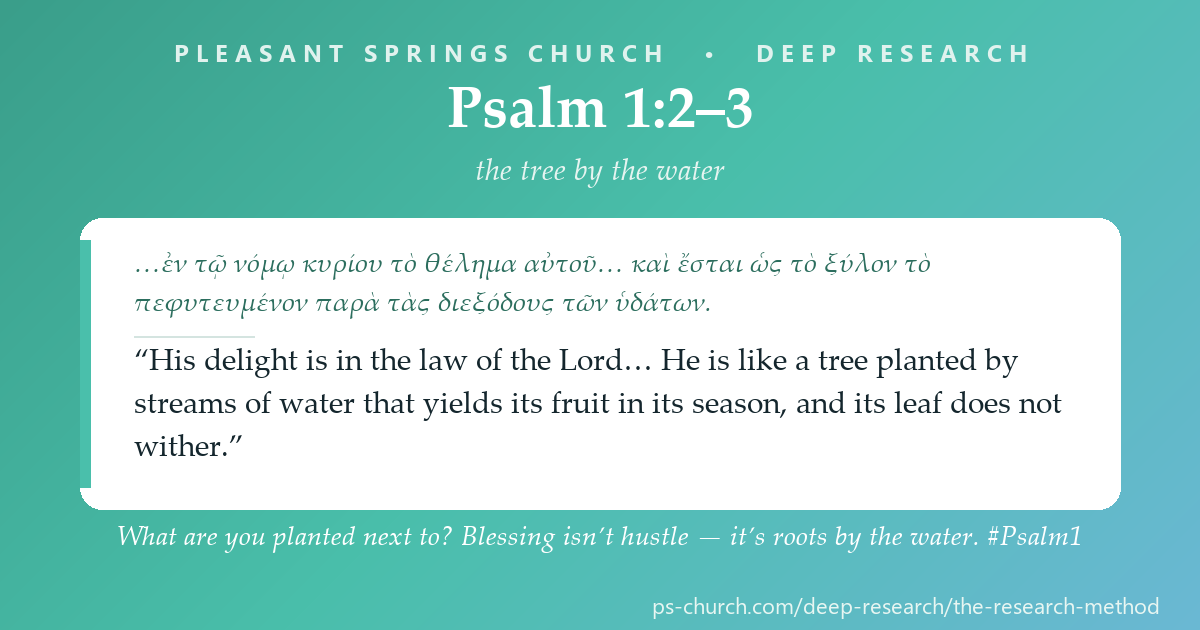
Psalm 1:2–3 · to share
Hebrew · LXX · ESVEvery Deep Research page traces its passage across the whole sweep — the Old Testament, the Second-Temple world between the testaments (historical witnesses, not Scripture), and the New Testament. Follow the thread:
Pleasant Springs Church — Deep Research
Research method after Michael S. Heiser’s Bible Research Method (examine dictionaries → ancient literature → important words → textual connections → academic publications → share), with the Pleasant Springs “Author & Audience” foundation. Scripture set in the Hebrew, the Greek editions named on each page and the ESV (Old Testament), and the Greek New Testament and the ESV (New Testament), per the practice of Pleasant Springs Church. Psalm 1 research grounded in Wilson, Craigie/Tate, Kraus, Hossfeld–Zenger, Durlesser, and Brooke; parallels verified against the Amenemope and Qumran sources.
Scripture quotations marked ESV are from the ESV® Bible (The Holy Bible, English Standard Version®), © 2001 by Crossway, a publishing ministry of Good News Publishers. ESV Text Edition: 2016. Used by permission. All rights reserved. The ESV text may not be quoted in any publication made available to the public by a Creative Commons license, and the ESV may not be translated in whole or in part into any other language. www.esv.org
|
Did this study bless you today? 💚 Give to Support PS Church100% of gifts go to the General Fund — thank you. |