The Psalter opens with a blessing on the one man who kept clear of sin and delighted in Torah — and for centuries Israel’s teachers blessed the wise, the upright, the strong. Then a carpenter-rabbi climbed a hill, sat down, and blessed the empty: the poor in spirit, the mourners, the meek. This study takes the Beatitudes all the way down — through the wisdom schools and the Dead Sea Scrolls to the mountain where the blessing of Psalm 1 finds its King. See the method →
Matthew 5:1–12
Greek NT · ESVThe Shape of the Passage
Parallel panelsWho wrote this, to whom, in what situation? The Beatitudes open Matthew’s first great discourse — and every line is staged: the mountain, the seated teacher, the opened mouth.
Author
Church tradition from Papias (early 2nd c.) onward names Matthew the tax collector, one of the Twelve (Matt 9:9; 10:3), as the evangelist. His Gospel is the most deliberately Jewish of the four — structured around five great discourses (chs. 5–7, 10, 13, 18, 23–25) — a structure many scholars hear as an echo of the five books of Moses.
The staging is theology. Jesus “went up on the mountain” and sat down — the posture of the authoritative teacher — and delivered Torah-like instruction. Matthew presents a new-Moses moment: not a new law replacing the old, but the Messiah declaring, with immediate authority (7:28–29), who is blessed in his kingdom.
Audience
A largely Jewish-Christian community (often located at Antioch, writing c. 60s–80s AD), living through the painful parting from the synagogue and under pressure from both sides. They knew their Scriptures — and they knew the macarism form from the Psalter’s first word (אַשְׁרֵי, μακάριος — see Psalm 1).
How they heard it. Psalm 1 blessed the man who avoided sinners and delighted in Torah; the wisdom tradition blessed the successful and upright. Jesus stands on that whole tradition and detonates it: the blessing lands on the poor in spirit, the mourning, the persecuted — his own hearers. For a harassed minority, vv.11–12 turned their reproach into the prophets’ pedigree.
Orient on the Beatitudes, the macarism form, and the Sermon.
Search by reference and topic: Beatitudes, Sermon on the Mount, blessing, kingdom of heaven, poor.
Which articles are relevant?
- Dictionary of Jesus and the Gospels (IVP) — “Sermon on the Mount,” “Beatitudes,” “Blessing and Woe,” “Kingdom of God/Heaven.”
- Anchor Bible Dictionary — “Beatitudes,” “Sermon on the Mount,” “Poor, Poverty.”
- NIDNTTE — μακάριος, πτωχός, πραΰς, δικαιοσύνη.
Bibliography surfaced:
- W. D. Davies & Dale Allison, Matthew 1–7 (ICC) — the fullest technical treatment of the Beatitudes’ form and parallels.
- R. T. France, The Gospel of Matthew (NICNT); Craig Keener, The Gospel of Matthew.
- Jonathan Pennington, The Sermon on the Mount and Human Flourishing — makarios as flourishing in the wisdom tradition.
- Hans Dieter Betz, The Sermon on the Mount (Hermeneia); Robert Guelich, The Sermon on the Mount.
Beatitudes before Jesus — the wisdom schools, Qumran, and the anawim.
The macarism was a well-worn form. Set Jesus’ series beside the Second-Temple examples — especially the Dead Sea Scrolls — and watch what he keeps and what he overturns.
Which parallels shed light on religion and worldview?
The wisdom macarism. From Psalm 1:1 through Proverbs (3:13; 8:34) and the Second-Temple wisdom book Sirach (a valued Jewish witness outside the 66-book canon; 14:1–2; 25:8–9), Judaism blessed the wise, the upright, the fortunate: “Blessed is the man who…” The form promises flourishing to a named kind of person.
Qumran’s Beatitudes — 4Q525. A wisdom scroll from Cave 4 carries a series of macarisms — “Blessed is the one who speaks truth with a pure heart… blessed are those who hold to her statutes…” — climaxing in the one who walks in the Torah of the Most High. Formally, it is the closest pre-Christian parallel to a chain of beatitudes; materially, its blessings still crown Torah-keeping wisdom (Émile Puech).
The “poor in spirit” at Qumran. The War Scroll speaks of God’s victory “by the poor in spirit” (ʿanwê rûaḥ, 1QM 14:7) — the humble covenant remnant. This is the closest known ancient parallel to Matthew 5:3’s phrase, alive in Jesus’ century: the anawim, the lowly ones who wait on God (Zeph 3:12; Pss 37; 69:32–33).
The dominant wisdom chains bless the capable — the wise, the pure, the Torah-observant (though Psalm 32:1–2 already blesses the forgiven sinner). Jesus keeps the form and inverts the ground: his first word lands on the empty — the poor in spirit, the mourners, the meek — and gives them not advice but the kingdom, on his own authority. The macarism becomes gospel: blessing declared over those who bring nothing, because the King has come to them (Isa 61:1).
The vocabulary that carries the Beatitudes — each word trailing an Old Testament story.
Watch where each key word has been before: Psalm 1’s makarios, Isaiah 61’s mourners, Psalm 37’s meek, Qumran’s poor in spirit.
The wisdom “blessed/flourishing” — the LXX’s word for אַשְׁרֵי in Psalm 1:1. Nine times here — a Psalter’s doorway rebuilt on a mountain.
“Poor in spirit” — beggared before God. Closest ancient parallel: the War Scroll’s ʿanwê rûaḥ (1QM 14:7), the anawim, the lowly remnant.
“Those who mourn” — Isaiah 61:2–3’s promise (“to comfort all who mourn”) claimed: the Servant’s jubilee has begun.
“The meek” — lifted near-verbatim from Psalm 37:11 LXX (36:11): “the meek shall inherit the earth.” Meekness is power that waits on God.
“Righteousness” — hungered for (v.6) and persecuted for (v.10): covenant life done God’s way, the Sermon’s keyword (5:20; 6:33).
“Kingdom of heaven” — Matthew’s distinctive idiom for God’s reign. Present tense (“theirs is”) brackets the eight: the kingdom is the blessing.
How this passage re-reads the Old Testament:
- μακάριος from Psalm 1. The Psalter opens by blessing the one man who avoids sin and delights in Torah; Jesus opens his teaching by blessing the broken who have nothing but need. Same form, same word — the blessing has moved from the doorway of the book to the door of the kingdom.
- Isaiah 61:1–3 stands under vv.3–4: good news to the poor (πτωχοῖς, LXX), comfort for all who mourn. Jesus reads his own commission (cf. Luke 4:18) into the Beatitudes’ first lines.
- Psalm 37:11 LXX (36:11) is v.5 nearly word-for-word — Matthew adds only the article: κληρονομήσουσιν τὴν γῆν. A psalm about not fretting over evildoers becomes the meek’s title-deed to the earth.
- Psalm 24:3–4 (LXX 23:3–4) (“Who shall stand in his holy place?… clean hands and a pure heart”) stands under v.8 — the temple-entrance question answered with the vision of God.
The web the Beatitudes gather — and Beale & Carson’s verdict.
Trace the OT texts under each beatitude, the Second-Temple middle terms, and the NT echoes outward — then check Beale & Carson, which treats this passage directly.
Which cross-references matter?
- Psalm 1 — the Psalter’s makarism doorway; Matthew 5 is its kingdom counterpart (and Luke 6:20–26 adds the woes, mirroring Psalm 1’s two ways).
- Isaiah 61:1–3 — the Servant’s jubilee under vv.3–4; Psalm 37:11 under v.5; Psalm 24:3–6 under v.8.
- 4Q525; 1QM 14:7; Sirach 14:1–2; 25:8–9 — the Second-Temple macarism chains and the anawim vocabulary between the testaments.
- Matthew 11:28–30; 23:12 — the meek King who is himself “gentle (πραΰς) and lowly in heart”: the Beatitudes are first a self-portrait.
- James 2:5; 1 Peter 3:14; 4:14; Revelation 7:16–17 — the apostles preaching the Beatitudes onward: the poor chosen, the persecuted blessed, the mourners comforted forever.
Here the commentary treats our text head-on: Matthew 5:5 is a near-verbatim citation of Psalm 37:11 LXX, and vv.3–4 are sustained allusions to Isaiah 61:1–3 — Jesus announcing the Servant’s program as present fact. That confirms what Stage 3 found lexically, and it closes the loop this library began at Psalm 1: the OT’s blessing, carried through the Second-Temple anawim, is handed by the Messiah to the empty-handed.
The commentaries and studies that go deepest on the Beatitudes.
Davies–Allison for the technical spade-work; Pennington for the wisdom frame; Puech for 4Q525.
Commentaries & studies:
- Davies & Allison, Matthew 1–7 (ICC) — forms, sources, and every ancient parallel, including 1QM’s “poor in spirit.”
- R. T. France (NICNT); Craig Keener; John Nolland (NIGTC); Grant Osborne (ZECNT).
- Jonathan Pennington, The Sermon on the Mount and Human Flourishing — makarios read inside the whole Jewish-Greek flourishing tradition.
- Émile Puech, “4Q525 et les péricopes des Béatitudes en Ben Sira et Matthieu,” Revue Biblique 98 (1991) — the Qumran beatitudes series.
- Classic: Augustine, On the Sermon on the Mount; Bonhoeffer, Discipleship.
Text & interpretation notes:
- The order of vv.4–5 is reversed in some Western witnesses (meek before mourners) — likely to snug v.5 up against v.3’s poor (Isa 61 pairs them); the standard order is well secured.
- “in spirit” (v.3) is Matthew’s precision, not a spiritualizing dodge: Luke’s “blessed are you poor” (6:20) and Matthew’s “poor in spirit” are the same anawim seen from two sides — social need and covenant humility.
- Eight or nine? Verses 3–10 form the balanced octave (kingdom bracketing both ends); vv.11–12 turn the form personal — “blessed are you” — welding the series to discipleship.
From the mountain to Monday.
Name what you learned, why it matters, and one concrete response.
What should we carry away — and do?
- The door is empty hands. The beatitude tradition typically blessed the accomplished; Jesus blesses the bankrupt. Entry to the kingdom is not competence but need brought to the King.
- The Beatitudes describe Jesus first. Poor, mourning, meek, merciful, pure, peacemaking, persecuted — he is the Blessed Man of Psalm 1 walking his own list to a cross and a kingdom.
- Reproach is a pedigree. Verses 11–12 file the mocked disciple among the prophets. The world’s verdict is not the last word spoken over you.
Step in response: pray back one beatitude each morning this week in the first person (“Lord, I am poor in spirit today…”) — and read Psalm 1 beside Matthew 5 to hear the whole arc of blessing in one sitting.
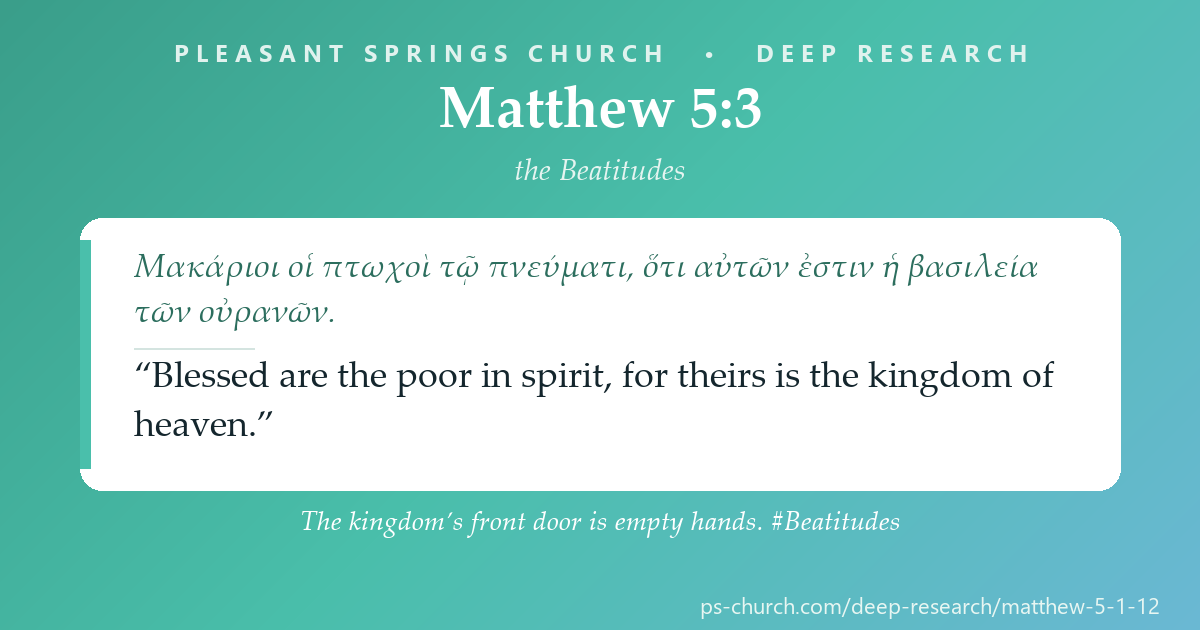
Matthew 5:3 · to share
Greek NT + ESVEvery Deep Research page traces its passage across the whole sweep — the Old Testament, the Second-Temple world between the testaments (historical witnesses, not Scripture), and the New Testament. Follow the thread:
Pleasant Springs Church — Deep Research
Research method after Michael S. Heiser’s Bible Research Method (examine dictionaries → ancient literature → important words → textual connections → academic publications → share), with the Pleasant Springs “Author & Audience” foundation. Scripture set in the Hebrew, the Greek editions named on each page and the ESV (Old Testament), and the Greek New Testament and the ESV (New Testament), per the practice of Pleasant Springs Church. Matthew 5:1–12 research grounded in Davies–Allison, France, Keener, Pennington, and Puech (4Q525); Dead Sea Scrolls parallels per 1QM 14:7 and 4Q525.
Scripture quotations marked ESV are from the ESV® Bible (The Holy Bible, English Standard Version®), © 2001 by Crossway, a publishing ministry of Good News Publishers. ESV Text Edition: 2016. Used by permission. All rights reserved. The ESV text may not be quoted in any publication made available to the public by a Creative Commons license, and the ESV may not be translated in whole or in part into any other language. www.esv.org
|
Did this study bless you today? 💚 Give to Support PS Church100% of gifts go to the General Fund — thank you. |