Once every fifty years, a trumpet blast turned Israel’s economy upside down: debts died, slaves walked free, land went home. Isaiah 61 takes that jubilee trumpet and puts it in the mouth of a Spirit-anointed herald — and long centuries later a hometown rabbi unrolled this very scroll in Nazareth and said, “Today.” This study works the Servant’s jubilee all the way down — through Leviticus, the Dead Sea Scrolls that were waiting for it, and the Beatitudes it feeds. See the method →
Isaiah 61:1–3
Hebrew · LXX · ESVThe Shape of the Passage
SequenceWho speaks here, to whom, in what situation? Isaiah 61 stands in the book’s final movement (chs. 56–66), addressed to a Zion that has returned from exile and found the ruins still smoking.
Author
The book presents itself as the vision of Isaiah (1:1), and the New Testament quotes from every part of it as “Isaiah” (John 12:38–41 cites chs. 6 and 53 together). Scholarship debates whether chs. 56–66 come from Isaiah’s own far-seeing ministry or from his prophetic school writing after the return; either way the church receives one Isaianic witness, and this passage’s voice is unique: an anointed figure speaking in the first person.
Who is the “me”? The speaker bears the Spirit like the Servant (42:1) and the shoot of Jesse (11:2), is anointed (מָשַׁח — the Messiah-verb), and does herald’s work. Israel’s readers heard the Servant; the synagogue at Nazareth heard something more (Luke 4:21).
Audience
“Those who mourn in Zion” (v.3) — the post-exilic community: home from Babylon, surrounded by rubble, poor, and wondering whether the glorious promises of chs. 40–55 had run out of fuel. Ashes on the head were their literal mourning dress.
How they heard it. The passage reaches back to the jubilee (Lev 25): the fiftieth year when debts released, slaves went free, and land came home — proclaimed with the word דְּרוֹר. Zion’s mourners are told that God’s anointed will proclaim a jubilee not of land-deeds but of persons: the poor gospeled, the brokenhearted bandaged, the captives freed, ashes traded for a crown. Hope with a legal shape.
Orient on anointing, jubilee, and the Servant.
Search by topic: anoint/Messiah, jubilee, liberty (deror), Servant of the LORD, good news.
Which articles are relevant?
- Anchor Bible Dictionary — “Jubilee, Year of,” “Messiah,” “Servant of Yahweh,” “Isaiah, Book of.”
- Dictionary of the OT: Prophets (IVP) — “Isaiah: Book of,” “Servant of Yahweh,” “Liberty,” “Spirit of Yahweh.”
- TDOT / NIDOTTE — מָשַׁח (māšaḥ), בָּשַׂר (bāśar), דְּרוֹר (dərôr), עָנָו (ʿānāw).
Bibliography surfaced:
- John Oswalt, Isaiah 40–66 (NICOT); Joseph Blenkinsopp, Isaiah 56–66 (AB); John Goldingay, Isaiah 56–66 (ICC).
- J. A. Sanders, “From Isaiah 61 to Luke 4” — the classic tradition-history study.
- John S. Bergsma, The Jubilee from Leviticus to Qumran: A History of Interpretation (VTSup 115) — deror’s legal background and its Second-Temple afterlife.
The jubilee behind it — and the Scrolls that were waiting for it.
Set the passage on its legal foundation (Leviticus 25; the ANE release-edicts), then read the two Dead Sea Scrolls that made Isaiah 61 the script of the end times.
Which parallels shed light on religion and worldview?
The legal bedrock. Mesopotamian kings occasionally proclaimed debt-release edicts (Akkadian andurāru — cognate to Hebrew דְּרוֹר) at their accession. Leviticus 25 turns the royal gesture into sacred law on a fixed clock: every fiftieth year, “proclaim liberty (דְּרוֹר) throughout the land” (Lev 25:10). Isaiah 61 picks up exactly that herald’s word — God’s Anointed accedes, and his edict is jubilee.
- 11QMelchizedek (11Q13) (Dead Sea Scrolls — sectarian interpretation, not Scripture) — weaves Isaiah 61 with Leviticus 25 and Deuteronomy 15 into an end-times timetable: in the tenth jubilee, the heavenly deliverer Melchizedek proclaims “liberty” to the captives, atones for the sons of light, and executes God’s judgments. Isaiah’s “year of favor” has become “the year of Melchizedek’s favor.” (Compare our standalone study, The Order of Melchizedek.)
- 4Q521, the “Messianic Apocalypse” (DSS, likewise non-canonical) — “heaven and earth will listen to His Messiah… [and the Lord] will heal the wounded, revive the dead, preach good news to the poor.” Scholars debate whether the doer is the Lord himself or His Messiah acting as the Lord’s agent — but either way, Isaiah 61 has become the script of the messianic age, with resurrection added. Strikingly close to Jesus’ answer to John the Baptist (Matt 11:5).
- Psalms of Solomon 17–18 (Pseudepigrapha — likewise not Scripture) — the era’s longing for an anointed son of David who gathers a holy people and shepherds them in righteousness.
A generation before Nazareth, some Jews were already reading Isaiah 61 as the script the Anointed would perform — jubilee, healing, good news to the poor, even resurrection (4Q521). So when Jesus unrolled this scroll and said “Today this Scripture has been fulfilled in your hearing” (Luke 4:21), he was claiming a role his era was already holding open — and the room knew it (Luke 4:22, 28–29).
Six words that carry the gospel before the Gospels.
Watch the Messiah-verb, the gospel-verb, the jubilee-word — and the wordplay that turns ashes into a crown.
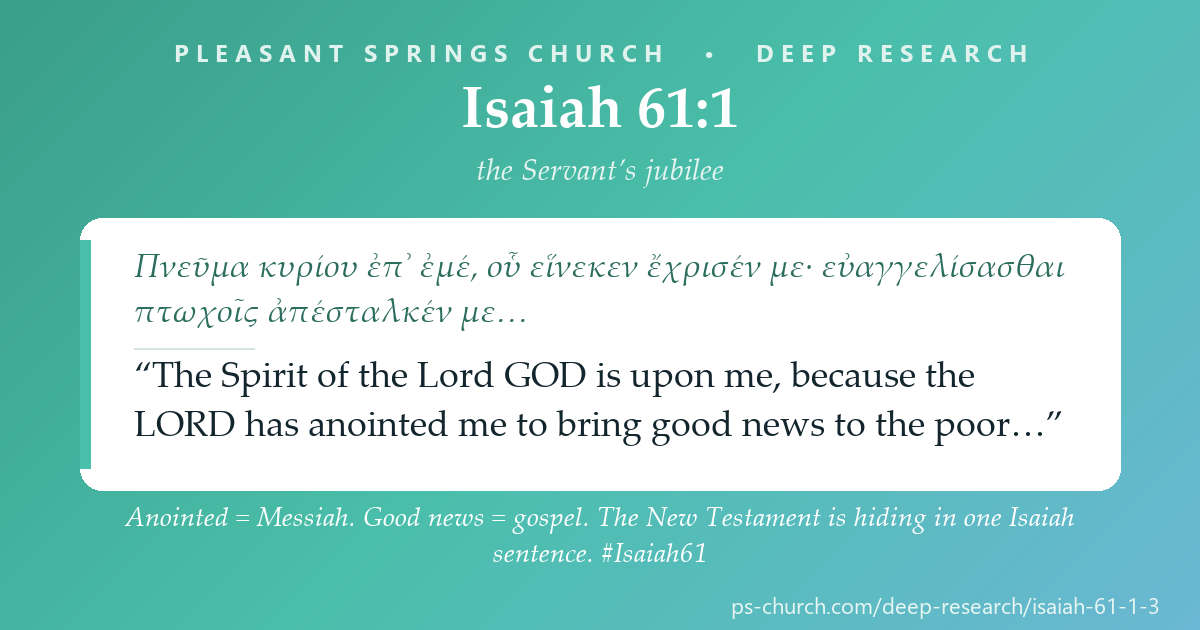
“Anointed” — the verb behind Māšîaḥ/Messiah; LXX ἔχρισεν, behind Christos. The verse names the office the New Testament names the Person.
“To herald good news” — the LXX’s εὐαγγελίσασθαι is the New Testament’s gospel verb. The gospel is older than Bethlehem.
“The poor/lowly” — the anawim; LXX πτωχοῖς. The word-thread that runs to Qumran’s “poor in spirit” and the first Beatitude.
“Liberty, release” — the technical jubilee proclamation of Lev 25:10 (cognate Akkadian andurāru). LXX ἄφεσις — the NT’s word for forgiveness.
“The year of favor” — jubilee as era. At Nazareth Jesus stops the reading here, before “the day of vengeance” — favor now, judgment held for his return.
“A headdress instead of ashes” — a Hebrew anagram (פאר/אפר): the same letters, re-ordered. Grace rearranges the very stuff of grief.
How the New Testament reuses this passage:
- Luke 4:16–21 — Jesus reads vv.1–2a in the Nazareth synagogue (following the LXX, including “sight to the blind”), rolls up the scroll, and declares it fulfilled today — and pointedly stops before “the day of vengeance.”
- Matthew 5:3–4 — the first Beatitudes bless the poor (πτωχοί) and the mourners with comfort: Isaiah 61:1–2 distributed to the crowd on the mountain.
- Matthew 11:4–5 — Jesus’ answer to the Baptist is an Isaiah-61 checklist (“the poor have good news preached to them”) — strikingly close to the one 4Q521 drew up.
- Acts 10:38; Luke 7:22 — “God anointed Jesus of Nazareth with the Holy Spirit”: the apostolic summary of v.1.
- 1 Peter 2:9; Revelation 1:6 — the jubilee people, freed to be priests — “oaks of righteousness, the planting of the Lord” (cf. the tree of Psalm 1).
From Leviticus’ trumpet to Nazareth’s scroll.
Trace the jubilee legislation behind the passage, the Servant songs beside it, and the Second-Temple middle terms — then note Beale & Carson’s treatment at Luke 4.
Which cross-references matter?
- Leviticus 25:8–13 — the jubilee statute: the trumpet, the fiftieth year, דְּרוֹר proclaimed “to all its inhabitants.”
- Isaiah 11:1–4; 42:1–7; 49:8–9 — the Spirit-bearing shoot and Servant who opens blind eyes and brings prisoners out: the figure this passage speaks as.
- Isaiah 40:1–2; 52:7 — “Comfort, comfort” and the herald of good news on the mountains: chapter 61 is those promises given a Person and a year.
- 11Q13; 4Q521 — the Scrolls’ end-times readings (Stage 2) — the bridge between Leviticus’ law and Nazareth’s sermon.
- Luke 4:16–21 → Luke 7:22 → Acts 10:38 — the New Testament’s straight line from this text to Jesus’ self-announcement.
The commentary’s Luke 4 treatment confirms the details: Jesus’ Nazareth reading follows the LXX of Isaiah 61:1–2a (with its “recovery of sight to the blind”), splices in Isaiah 58:6’s “set the oppressed free” (sharing the keyword ἄφεσις, release), and halts before the vengeance clause — a deliberate jubilee-first reading of the two-stage coming. Under Matthew 5:3–4 it likewise traces the first Beatitudes to this text, closing the loop with our Beatitudes study.
The scholarship on the jubilee, the Servant, and the Scrolls.
Oswalt/Goldingay/Blenkinsopp for exegesis; Bergsma for jubilee; the 11QMelch and 4Q521 literature for the Qumran readings.
Commentaries & studies:
- John Oswalt (NICOT), John Goldingay (ICC), Joseph Blenkinsopp (AB), Alec Motyer, The Prophecy of Isaiah.
- John Bergsma, The Jubilee from Leviticus to Qumran (VTSup 115) — deror, andurāru, and 11QMelchizedek in one arc.
- J. A. Sanders, “From Isaiah 61 to Luke 4,” in Christianity, Judaism and Other Greco-Roman Cults; Émile Puech on 4Q521 (RevQ 15, 1992).
- Merrill P. Miller, “The Function of Isa 61:1–2 in 11Q Melchizedek,” JBL 88 (1969).
Text & interpretation notes:
- The LXX’s “sight to the blind” (v.1) renders the difficult Hebrew פְּקַח־קוֹחַ (“opening” — of eyes? of prison?): the Greek chose eyes, and Luke 4 follows it — a case where the church’s LXX carried the reading Jesus preached.
- The Nazareth stop. Jesus ends the reading at “the year of the Lord’s favor,” leaving “the day of vengeance” unread — the classic warrant for the two advents: jubilee now, judgment at his return.
- The speaker debate (Servant? prophet? Messiah?) is real in the literature; the NT’s answer (Luke 4:21) is the church’s anchor, and 4Q521 shows the messianic reading predates Christian use.
From the jubilee trumpet to your own ashes.
Name what you learned, why it matters, and one concrete response.
What should we carry away — and do?
- The gospel is a jubilee edict. דְּרוֹר became ἄφεσις became forgiveness: release from debt is the Bible’s own picture of what Christ proclaims over you.
- We live in the year of favor. Jesus stopped the scroll mid-sentence on purpose — this era is jubilee, and the day of vengeance waits for his return. Urgency and mercy, both real.
- Ashes get rearranged. אֵפֶר to פְּאֵר — same letters, new order. God’s specialty is not discarding your grief but transfiguring it into a crown — until you stand an “oak of righteousness,” the planting of the Lord.
Step in response: read Isaiah 61:1–3, then Luke 4:16–21, aloud — and name one debt (owed to you or by you) to release this week, as a citizen of the year of favor.
Isaiah 61:1 · to share
LXX + ESVEvery Deep Research page traces its passage across the whole sweep — the Old Testament, the Second-Temple world between the testaments (historical witnesses, not Scripture), and the New Testament. Follow the thread:
Pleasant Springs Church — Deep Research
Research method after Michael S. Heiser’s Bible Research Method (examine dictionaries → ancient literature → important words → textual connections → academic publications → share), with the Pleasant Springs “Author & Audience” foundation. Scripture set in the Hebrew, the Greek editions named on each page and the ESV (Old Testament), and the Greek New Testament and the ESV (New Testament), per the practice of Pleasant Springs Church. Isaiah 61:1–3 research grounded in Oswalt, Goldingay, Blenkinsopp, Bergsma, Sanders, Miller, and Puech; Dead Sea Scrolls readings per 11QMelchizedek (11Q13) and 4Q521 (witnesses, not Scripture).
Scripture quotations marked ESV are from the ESV® Bible (The Holy Bible, English Standard Version®), © 2001 by Crossway, a publishing ministry of Good News Publishers. ESV Text Edition: 2016. Used by permission. All rights reserved. The ESV text may not be quoted in any publication made available to the public by a Creative Commons license, and the ESV may not be translated in whole or in part into any other language. www.esv.org
|
Did this study bless you today? 💚 Give to Support PS Church100% of gifts go to the General Fund — thank you. |