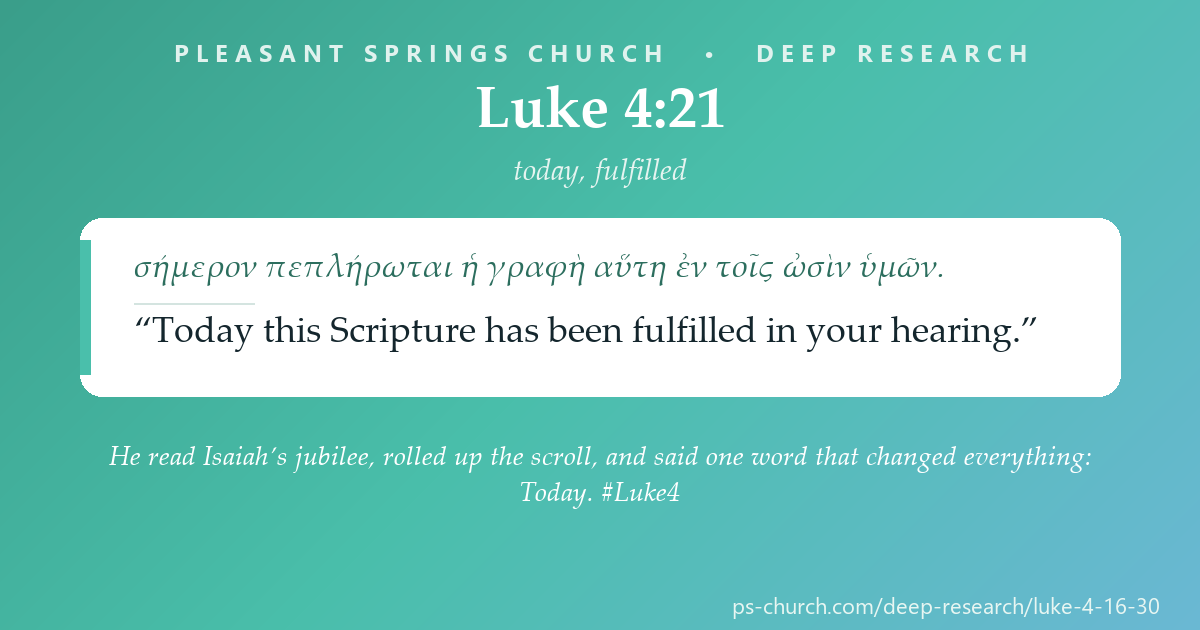
A hometown boy stood up in the synagogue, was handed the scroll of Isaiah, and read the jubilee promise many in Israel had long awaited — then rolled it up, sat down, and said, “Today this Scripture has been fulfilled in your hearing.” Within nine verses the wonder had turned to a mob at a cliff-edge. This study works Jesus’ keynote sermon all the way down — the Isaiah 61 jubilee he claimed, the vengeance-line he refused to read, and the grace-to-outsiders that nearly killed him. See the method →
Luke 4:16–30 (selections)
Greek NT · ESVThe Shape of the Passage
InclusioWho wrote this, to whom, and why place it first? Luke makes the Nazareth sermon the programmatic opening of Jesus’ ministry — the keynote that announces everything to follow.
Author
Luke — the physician, Paul’s companion (Col 4:14), writing an “orderly account” (Luke 1:1–4) for Theophilus. Where Matthew and Mark set a Nazareth rejection later and briefly, Luke places his at the front and expands it into a scene: the scroll, the reading, the declaration, the turn to rage. (Many read it as the same event, positioned for effect; others as a distinct earlier visit — either way, its placement makes it programmatic.) It is his overture — jubilee for the poor, welcome for outsiders, and a hometown that cannot bear it.
The deliberate stop. Luke has Jesus read Isaiah 61:1–2a and close the scroll precisely at “the year of the Lord’s favor” — omitting “and the day of vengeance of our God.” The first coming is jubilee; judgment waits for the return. The cut is the sermon.
Audience
Theophilus and a largely Gentile readership — for whom the Elijah/Elisha turn lands with force: in Luke’s Gospel of the outsider, Jesus’ first sermon already reaches past Israel to a Sidonian widow and a Syrian general. The good news was never going to stay in Nazareth.
How they heard it. A synagogue congregation knew Isaiah 61 as the jubilee hope — and, as the Dead Sea Scrolls show, some already read it as the Messiah’s program (see our Isaiah 61 study). To hear a hometown boy say “Today… in your hearing” was electric — until he reminded them the last time God sent prophets in days like these, the grace went to foreigners. Wonder curdled to murder in nine verses.
Orient on the synagogue, jubilee, and Luke’s programmatic scene.
Search by topic: synagogue, Sabbath reading/haftarah, jubilee, prophet, Nazareth.
Which articles are relevant?
- Dictionary of Jesus and the Gospels (IVP) — “Synagogue,” “Nazareth,” “Jubilee,” “Old Testament in the Gospels.”
- Anchor Bible Dictionary — “Synagogue,” “Jubilee, Year of,” “Luke, Gospel of.”
- Dictionary of NT Background — “Synagogues,” “Scripture Reading,” “Messianism.”
Bibliography surfaced:
- Joel Green, The Gospel of Luke (NICNT); Darrell Bock, Luke 1:1–9:50 (BECNT); François Bovon, Luke 1 (Hermeneia).
- J. A. Sanders, “From Isaiah 61 to Luke 4” — the jubilee reading and the omitted vengeance clause.
- James Sanders / Craig Evans (eds.), Luke and Scripture — Luke’s use of Isaiah.
The jubilee the room was waiting for — and the Scroll that scripted it.
Read the scene against synagogue practice and the Second-Temple expectation that Isaiah 61’s “year of favor” would be the Messiah’s jubilee.
Which parallels shed light on religion and worldview?
Synagogue reading. By the first century, Sabbath worship included a set reading from the Law and a chosen reading from the Prophets, expounded standing or seated. Jesus “stood up to read” and “sat down” to teach — exactly the expected posture. The novelty was not the form; it was the sentence: “Today this Scripture has been fulfilled.”
- 11QMelchizedek (11Q13) (Dead Sea Scrolls — a sectarian interpretation, not Scripture) — reads Isaiah 61’s “year of the Lord’s favor” as the end-times jubilee when a heavenly deliverer proclaims liberty and atonement: strong evidence that Isaiah 61’s year of favor was already being read as an end-times, messianic hope (see Isaiah 61).
- 4Q521 (DSS, likewise non-canonical) — the Messiah’s era marked by healing, good news to the poor, even resurrection: the checklist Jesus enacts and cites back to John (Luke 7:22).
- Leviticus 25:8–13 — the literal jubilee (release of debts and slaves) standing under “the year of favor”: Jesus announces the reality the trumpet foreshadowed.
- 1 Kings 17; 2 Kings 5 — the Elijah/Elisha episodes Jesus cites: prophetic grace crossing Israel’s border to a Sidonian widow and a Syrian leper.
Nazareth could rejoice at “the year of favor” — who wouldn’t? What broke the room was whom the favor was for. By citing Elijah and Elisha — the two times God’s prophets bypassed Israel to bless a pagan widow and a pagan general — Jesus warned that this jubilee would not be Nazareth’s private property. The same “year of favor” that comforts the poor offends the entitled. It is the Beatitudes’ reversal, delivered to his own village, and it nearly got him killed in his first sermon.
The vocabulary of fulfillment — today.
Watch Luke’s “today,” the perfect “fulfilled,” and the double edge of δεκτός (acceptable / unwelcome).
“Today” — Luke’s great word of fulfillment-now (2:11; 19:9; 23:43). The prophesied jubilee is not deferred; it steps into the room.
“Has been fulfilled” — perfect tense: a completed act with standing results. The Scripture is not merely illustrated but accomplished in the speaker.
“He anointed” — the verb behind Christos. Jesus reads Isaiah 61’s מָשַׁח and applies the Messiah’s anointing to himself.
“Release, liberty, forgiveness” — the LXX’s word for the jubilee דְּרוֹר, and the New Testament’s word for forgiveness of sins. The jubilee is now amnesty for the soul.
“Acceptable, favorable” — the same root binds “the acceptable year” (v.19) to “no prophet is acceptable in his hometown” (v.24): the year of welcome met with unwelcome.
“The year of the Lord’s favor” — where Jesus stops the reading, leaving “the day of vengeance” (Isa 61:2b) unread: mercy now, judgment held.
How this scene handles the Old Testament:
This is the New Testament reading the Old before our eyes. Jesus takes Isaiah 61:1–2a (in its LXX form, with “sight to the blind”), splices in Isaiah 58:6’s “set the oppressed free” on the shared keyword ἄφεσις, and closes the scroll before Isaiah’s “day of vengeance” — then says the text is fulfilled in him. It is a masterclass in the very method this library follows: the passage’s Old Testament roots, its Second-Temple reception, and its christological center, all in one synagogue reading. The jubilee word דְּרוֹר → ἄφεσις now means the forgiveness of sins Jesus came to proclaim.
The Isaiah 61 thread lands in Nazareth — and runs on.
Trace the text Jesus reads, the prophets he cites, and where the scene points across Luke-Acts — then note Beale & Carson’s treatment.
Which cross-references matter?
- Isaiah 61:1–2 (+ 58:6) — the text read, spliced, and cut at “the year of favor”: the sermon is an exposition of Isaiah 61.
- Leviticus 25:10 — the jubilee דְּרוֹר behind “liberty to the captives”; 1 Kings 17:8–24; 2 Kings 5:1–14 — the Elijah/Elisha grace to Gentiles Jesus invokes.
- Matthew 5:3–4; Luke 6:20–21 — the same jubilee-for-the-poor reversal, distributed to the crowd in the Beatitudes.
- Luke 7:22 — Jesus’ answer to John: the Isaiah-61 checklist “the poor have good news preached to them,” ticked off in deeds.
- Acts 10:38; 13:46–47; 28:28 — the Nazareth program unfolding: God anointed Jesus “with the Holy Spirit,” and the salvation Nazareth spurned goes to the nations.
The commentary’s Luke 4 treatment sets out exactly this: Jesus reads the LXX of Isaiah 61:1–2a, conflates it with Isaiah 58:6 (a standard Jewish exegetical technique linking texts by a shared word, here ἄφεσις), and stops before the vengeance clause to define his first coming as jubilee. It confirms the reading our Isaiah 61 study reached from the other side — the same seam, examined from the Old Testament and now from the New.
The scholarship on the Nazareth sermon.
Green, Bock, and Bovon for exegesis; Sanders for the Isaiah-61/jubilee reading and the vengeance omission.
Commentaries & studies:
- Joel Green (NICNT), Darrell Bock (BECNT), François Bovon (Hermeneia), I. H. Marshall (NIGTC).
- J. A. Sanders, “From Isaiah 61 to Luke 4,” in Christianity, Judaism and Other Greco-Roman Cults.
- Craig Evans & James Sanders, Luke and Scripture; Robert Tannehill on the programmatic function of the scene.
Text & interpretation notes:
- The composite quotation. Luke’s citation blends Isaiah 61:1–2 with 58:6 and omits “to heal the brokenhearted” — following the LXX and a purposeful, jubilee-shaped selection, not a slip.
- The omitted vengeance. Stopping at “the year of favor” is the interpretive key to Luke’s two-advent structure: grace proclaimed now, judgment reserved (cf. Acts 17:31).
- Programmatic placement. Luke sets the rejection at the opening (whether repositioning the event of Mark 6:1–6 // Matt 13:53–58, or narrating a distinct earlier visit) to make it the Gospel’s thesis statement: anointed for the poor, rejected at home, grace to the outsider.
From the Nazareth scroll to today.
Name what you learned, why it matters, and one concrete response.
What should we carry away — and do?
- “Today.” The jubilee is not a someday promise — Jesus stepped into the room and said it had arrived. The year of favor is open now (2 Cor 6:2).
- Mercy first, judgment held. He stopped the scroll on purpose. We live in the unclosed “year of the Lord’s favor” — a window of grace, not yet the day of vengeance.
- Grace offends the entitled. The sermon turned deadly the moment Jesus said the favor would reach outsiders. Familiarity with Jesus (“Joseph’s son”) can be its own barrier — the hometown missed him while a Sidonian widow would not have.
Step in response: receive the “today” personally — name one captivity you’ll bring into the year of favor this week — and, like Elijah sent to Zarephath, take the good news deliberately across one border you’d rather it stayed inside.
Luke 4:21 · to share
Greek NT + ESVEvery Deep Research page traces its passage across the whole sweep — the Old Testament, the Second-Temple world between the testaments (historical witnesses, not Scripture), and the New Testament. Follow the thread:
Pleasant Springs Church — Deep Research
Research method after Michael S. Heiser’s Bible Research Method (examine dictionaries → ancient literature → important words → textual connections → academic publications → share), with the Pleasant Springs “Author & Audience” foundation. Scripture set in the Hebrew, the Greek editions named on each page and the ESV (Old Testament), and the Greek New Testament and the ESV (New Testament), per the practice of Pleasant Springs Church. Luke 4:16–30 research grounded in Green, Bock, Bovon, Marshall, and Sanders; Second-Temple jubilee readings per 11QMelchizedek and 4Q521 (Dead Sea Scrolls — witnesses, not Scripture).
Scripture quotations marked ESV are from the ESV® Bible (The Holy Bible, English Standard Version®), © 2001 by Crossway, a publishing ministry of Good News Publishers. ESV Text Edition: 2016. Used by permission. All rights reserved. The ESV text may not be quoted in any publication made available to the public by a Creative Commons license, and the ESV may not be translated in whole or in part into any other language. www.esv.org
|
Did this study bless you today? 💚 Give to Support PS Church100% of gifts go to the General Fund — thank you. |