Luke tells the crucifixion the way a witness tells a trial — and then refuses, inside the chapter, to tell you which Scripture it fulfils. Screened verse by verse against the whole Greek Old Testament held locally, Luke 23’s fifty-five verses reach a ceiling of six, and the six is an administrative list in Nehemiah that nobody has ever called an allusion. Psalm 31:5, the psalm Jesus dies quoting, measures three. Psalm 22:18 measures two — where John, at the same cross, measures twelve. And the chapter contains no citation formula at all: one of only five chapters in Luke with none. What it does say, five times in five different mouths, is that the man had done nothing wrong. See the method →
Luke 23:4, 14, 22, 28, 30, 33–35, 38, 43–47, 53, 56
Greek NT · ESVThe Shape of the Passage
A sequence carrying a fivefold refrain — not a chiasmLuke writes the crucifixion as a miscarriage of Roman justice that God is nevertheless carrying out — and he refuses, inside the chapter, to tell you which Scripture it fulfils.
Author
Luke narrates this chapter the way a careful witness narrates a trial. He is the only evangelist who sends Jesus to Herod Antipas (23:6–12), the only one who reports the daughters of Jerusalem (23:27–31), the only one who records the dialogue between the two criminals (23:39–43), and the only one whose dying Jesus speaks Psalm 31:5 (23:46). And he is the only one who has a Roman magistrate say three times, in three different formulations, that he can find no ground of charge. That is a legal refrain, not a devotional one, and Luke keeps it going through two more mouths after Pilate has stopped speaking — a convicted felon and the centurion in command of the detail.
What Luke does not do here. He does not say “this was to fulfil.” Screened for nine words — graphō, graphē, plēroō, teleō, nomos, prophētēs, Mōusēs, Ēsaias, Dauid — Luke 23 returns zero, and it is one of only five chapters in the Gospel that do. One chapter earlier he had written “this Scripture must be fulfilled in me” (22:37); one chapter later he writes it thirteen times over. Inside the crucifixion itself he simply tells you what happened. The interpretation is deliberately placed outside the event — and then delivered, on the Emmaus road, by the risen Christ himself (Luke 24:13–35).
Audience
Theophilus and readers like him — people who need to know “the certainty of the things you have been taught” (1:4), and many of whom lived under Roman jurisdiction. To such a reader the threefold verdict matters enormously: the governor of Judea examined the charge of sedition (23:2, 5, 14) and could not sustain it. Luke will do the same thing again and again in Acts — Gallio, Festus, Agrippa, the tribune — and the pattern begins here. The movement was not seditious; it was condemned anyway.
And readers who would themselves be crucified in a persecution. The two sayings Luke alone preserves are the two a dying believer needs: “Father, forgive them” and “today you will be with me in Paradise.” When Stephen dies in Acts 7 he says both of them back — “Lord Jesus, receive my spirit” and “do not hold this sin against them” (Acts 7:59–60). Luke wrote the death of Jesus so that the death of a Christian would have a shape.
Orient on Roman provincial justice, crucifixion, Herod Antipas, and burial custom.
Search by topic: crucifixion, Pilate, Herod Antipas, Barabbas, Golgotha, centurion, burial and tombs, Sanhedrin, Roman provincial administration.
Which articles are relevant?
- Anchor Bible Dictionary — “Crucifixion,” “Pilate, Pontius,” “Herod Antipas,” “Barabbas,” “Golgotha,” “Burial.”
- Dictionary of Jesus and the Gospels — “Death of Jesus,” “Trial of Jesus,” “Roman Governors,” “Burial of Jesus.”
- NIDNTT / TDNT — αἴτιος (aitios, ground of charge), σταυρόω (stauroō, crucify), δίκαιος (dikaios, righteous), παράδεισος (paradeisos, paradise).
Bibliography surfaced:
- Darrell L. Bock (BECNT), I. Howard Marshall (NIGTC), Joseph A. Fitzmyer (Anchor Yale), Joel B. Green (NICNT), John Nolland (WBC) on Luke.
- Raymond E. Brown, The Death of the Messiah, 2 vols. — the standard passion-narrative reference.
- Martin Hengel, Crucifixion in the Ancient World; Craig Evans and others on first-century Jewish burial.
- Beale & Carson, Commentary on the New Testament Use of the Old Testament (Luke).
A provincial trial, a Roman execution, and a Jewish burial before sundown.
Read the chapter as three institutions in sequence — a governor’s tribunal, a legionary execution detail, and a Sabbath-eve burial — and note what each of them requires.
Which parallels shed light on religion and worldview?
A governor who cannot find a charge, and executes anyway. The charge laid at 23:2 is threefold and carefully framed for a Roman ear: perverting the nation, forbidding tribute to Caesar, and claiming to be a king. Only the third is actionable, and Pilate tests it directly (23:3). The word Luke gives him three times is αἴτιον — not ‘innocence’ in a moral sense but the ground of an indictment, the thing a magistrate must produce. Luke’s sentence at 23:24 is the coldest in the chapter: καὶ Πιλᾶτος ἐπέκρινεν γενέσθαι τὸ αἴτημα αὐτῶν — “and Pilate decided that their demand should be granted.” The verb ἐπικρίνω occurs nowhere else in the New Testament. It is the technical word for a magistrate’s ruling, used once, for this.
Herod Antipas. Luke alone stages the Herod hearing, and Luke alone has prepared for it: Herod “kept seeking to see him” (9:9) and the Pharisees warned that Herod wanted to kill him (13:31). The tetrarch of Galilee had no jurisdiction in Judea; the referral was courtesy, or the passing of a problem. Josephus knows Antipas as the man who executed John the Baptist (Antiquities 18.116–119), and he knows Pilate as a governor who twice provoked riots in Jerusalem and was finally removed for a massacre in Samaria (Antiquities 18.55–62, 85–89). Neither man in this chapter is behaving out of character.
Crucifixion and the two crucified with him. Luke calls them κακοῦργοι (kakourgoi, “evildoers”), not λῃσταί (bandits, the word Matthew and Mark use). Three of the four New Testament occurrences of κακοῦργος are in this chapter (23:32, 33, 39); the fourth is 2 Timothy 2:9, where Paul says he is chained “as a criminal.” Crucifixion was a servile and provincial punishment, deliberately public and deliberately slow; Cicero called the very word unfit for Roman ears (Pro Rabirio 16). The mockery at 23:35–39 follows the ancient script for the public shaming of the condemned.
Burial before sundown. 23:54 gives the clock: καὶ ἡμέρα ἦν παρασκευῆς, καὶ σάββατον ἐπέφωσκεν, “and it was the day of Preparation, and the Sabbath was dawning.” Deuteronomy 21:22–23 requires a hanged body to be taken down the same day; a Roman governor was not obliged to release a body at all, which is why Joseph has to ask. The women watch where he is laid, go home, prepare spices, and then stop — κατὰ τὴν ἐντολήν, “according to the commandment” (23:56). The last act of the chapter is Sabbath obedience.
- Deuteronomy 21:22–23 — the hanged body not left overnight: the legal frame of the burial (see Deuteronomy 19–21).
- Hosea 10:8 — “they shall say to the mountains, Cover us, and to the hills, Fall on us”: the words Jesus gives the daughters of Jerusalem (see Hosea 9–14).
- Psalm 31:5 · Psalm 22 · Psalm 69 — into your hands; the garments and the taunts; the vinegar (see Psalm 22, Psalm 69).
- Josephus, Antiquities 18.55–89, 116–119 — Pilate’s record and Antipas’s: witnesses, not Scripture.
- Wisdom 2:12–20 — “let us condemn him to a shameful death… for if the righteous man is God’s son, he will help him”: a Second-Temple text on the mocked righteous man. It is a witness, not Scripture. The CATSS Wisdom file is inside the 64-file corpus screened here, but no printed result on this page falls in it, and nothing on this page is derived from it.
Luke has a governor say three times that he has found no ground of charge, and then, in the same sentence in which the third denial is made, has him hand the prisoner over. That juxtaposition is the whole point. Roman justice is not shown failing to know the truth; it is shown knowing the truth and yielding anyway, because a crowd is louder than a verdict. Luke wants his readers — many of whom will stand before magistrates themselves — to see clearly that the state can be perfectly informed and perfectly unjust at once. And then he does something no other evangelist does: he keeps the refrain going after Pilate has finished with it. The next two people to say it are a man being executed beside Jesus and the officer executing him. The verdict passes out of the hands of the court and into the hands of the people actually at the cross, and it is there, not in the praetorium, that it finally becomes a confession. That is why Luke’s centurion says δίκαιος where Mark’s says ‘son of God.’ Both are true; Luke is finishing the sentence his chapter has been building since verse four.
The vocabulary of the verdict, the sneer, the sentence and the garden.
Every count below is from the MorphGNT lemma column over all 7,927 verses of the Greek New Testament, and from the 30,637 verse units of Greek Old Testament held locally. Where a stem is counted rather than a lemma, it says so.
“Ground of a charge.” The noun αἴτιος stands four times in the New Testament; three of them are here, all on Pilate’s lips. The fourth is Hebrews 5:9 — Christ the αἴτιος of eternal salvation. The man who could be given no ground of charge is himself the ground of our rescue.
“They turned up the nose at him.” ἐκμυκτηρίζω occurs twice in the New Testament and both are Luke — 16:14, the money-loving Pharisees, and here. In the Greek Old Testament the μυκτηρ- stem stands in 35 verses, six of them in the Psalter; Psalm 21:8 LXX (= 22:7) has ἐξεμυκτήρισάν με, “they sneered at me.” Luke’s form is imperfect where the psalm’s is aorist, so the run screen sees nothing. (The simple verb μυκτηρίζω occurs once more, at Galatians 6:7 — ‘God is not mocked.’)
“He gave sentence.” A New Testament hapax legomenon — this verb occurs nowhere else in the Greek New Testament. The magistrate’s ruling gets its own technical word, used once, for the moment Pilate grants the crowd τὸ αἴτημα αὐτῶν, “their demand.”
“Evildoer.” Four occurrences in the New Testament; three are in this chapter and the fourth is 2 Timothy 2:9. Matthew and Mark call the two λῃσταί (bandits, insurgents); Luke uses the flatter criminal-court word, which is also the word the second of them applies to himself and refuses to apply to Jesus.
“In Paradise.” A Persian loanword for a walled garden. Three occurrences in the New Testament — here, 2 Corinthians 12:4 and Revelation 2:7 — and this is the only one on the lips of Jesus in the Gospels (Revelation 2:7 stands inside the message the risen Christ dictates to Ephesus). In the Greek Old Testament it stands in 42 verses, twelve of them in Genesis 2–3 and a thirteenth at Genesis 13:10: it is the Septuagint’s word for the garden in Eden.
“Rock-hewn.” A New Testament hapax legomenon. In the Greek Old Testament the λαξευ- stem stands in thirteen verses, and its most familiar use is Exodus 34:1, 4 and Deuteronomy 10:1, 3 — cutting the two stone tablets. We report the overlap and stop there: one word in two contexts is not an allusion, and the measurement cannot make it one.
“Righteous” — the centurion’s word, and then Joseph’s. The ESV renders it “innocent” at 23:47 (with “righteous” in a footnote) and “righteous” at 23:50. Luke wrote the same Greek word both times, and it does not change between the two verses. Mark’s centurion says “son of God” and uses the Latin loanword κεντυρίων; Luke’s uses the Greek ἑκατοντάρχης, the same title he will give Cornelius in Acts 10.
One word that ties Luke’s first Scripture to his last:
βουνός (bounos, “hill”) occurs twice in the New Testament, and both are Luke. The first is 3:5, inside the Isaiah 40 quotation that opens his account of the ministry: “every mountain and hill shall be made low.” The second is 23:30, in the Hosea 10:8 words Jesus gives the daughters of Jerusalem: “and to the hills, Cover us.” No other New Testament writer uses the word at all. Luke’s two hills are the one that is levelled to make a road for God, and the one people beg to fall on them. We are reporting a distribution, not a design — the word is common enough in the Greek Old Testament (89 verses) that its rarity in the New is not evidence of a plan.
What the measurement found, what it missed, and what it cannot say.
Method: every one of Luke 23’s 55 Greek verse rows was screened for its longest run of consecutive shared word forms against (a) the whole Greek Old Testament held locally, 30,637 verse units in 64 files, and (b) the 6,778 verses of the Greek New Testament outside Luke. Normalisation is accent- and case-blind; the tie band beside each run is the number of target verses that reach the same depth. Greek-side screens count single words, so a 1 means “shares one word and no two in a row.”
How deep does Luke 23 run into the Greek Old Testament?
Not deep. Across the 55 rows: all 55 reach two, 45 reach three, 13 reach four, one reaches six, and nothing reaches five or seven. And the row that reaches six is not a quotation of anything.
Luke 23:13 — Πιλᾶτος δὲ συγκαλεσάμενος τοὺς ἀρχιερεῖς καὶ τοὺς ἄρχοντας καὶ τὸν λαὸν
“Pilate then called together the chief priests and the rulers and the people…”
2 Esdras 17:5 LXX (= Nehemiah 7:5 ESV/MT) — … συνῆξα τοὺς ἐντίμους καὶ τοὺς ἄρχοντας καὶ τὸν λαὸν …
“…and I gathered the nobles and the rulers and the people…”Six consecutive shared word forms, tie band 1 — the deepest contact Luke 23 makes with the entire Greek Old Testament, and the only place in 30,637 verse units where the sequence stands.
The shared words are καὶ τοὺς ἄρχοντας καὶ τὸν λαόν with the article before them — “and the rulers and the people.” It is an administrative list, and it is the sort of phrase that any Greek writer describing an assembly would produce. Nobody has ever proposed Nehemiah 7:5 as a background to Luke 23:13, and this page is not proposing it either. We print it because it is the deepest measured run in the chapter, and because the reader is entitled to see what ‘deepest’ is actually worth here. A six with a band of one, in a chapter whose real allusions measure four, three and two, is a warning about the method, not a discovery.
A second calibration, and a harder one. Luke 23:24 — the sentence in which Pilate actually passes judgement — is the most isolated verse in the chapter. Screened against the 6,778 non-Lukan verses of the Greek New Testament it returns one, meaning it shares no two consecutive words with any of them; it is the only row in the chapter that does. Screened against the Greek Old Testament it returns three, tie band 1:
Luke 23:24 — καὶ Πιλᾶτος ἐπέκρινεν γενέσθαι τὸ αἴτημα αὐτῶν
“And Pilate decided that their demand should be granted.”
Psalm 105:15 LXX (= Psalm 106:15 ESV/MT) — καὶ ἔδωκεν αὐτοῖς τὸ αἴτημα αὐτῶν καὶ ἐξαπέστειλεν πλησμονὴν εἰς τὰς ψυχὰς αὐτῶν
“And he gave them their request, and sent fullness into their souls.” The two columns part in the second half of this verse. The Greek reads πλησμονήν, ‘fullness, satiety’; the Masoretic Text reads רָזוֹן (rāzōn), ‘leanness’, which the ESV renders “but sent a wasting disease among them” (Psalm 106:15). We print the divergence and do not explain it; the three measured words stand in the first half, where the columns agree.Three consecutive shared word forms — τὸ αἴτημα αὐτῶν — tie band 1 across 30,637 verse units.
The pull of that one is much stronger than the Nehemiah six, because the sense lines up: a crowd’s demand is granted, and the granting is the judgement. And it is three words, with a common noun and two of the commonest words in Greek. Luke’s own verb here, ἐπέκρινεν, stands nowhere else in the New Testament and nowhere in the psalm. We print the contact and we do not call it an allusion. If the Nehemiah six teaches that a big number can mean nothing, this three teaches the harder lesson: that a small number landing on a resonant sense is exactly where a careful reader is most likely to talk themselves into something.
The famous quotations, measured
Luke 23:46 — Psalm 30:6 LXX (= Psalm 31:5 ESV/MT). Longest run: THREE.
Πάτερ, εἰς χεῖράς σου παρατίθεμαι τὸ πνεῦμά μου
εἰς χεῖράς σου παραθήσομαι τὸ πνεῦμά μουLuke 23:46 above; Psalm 30:6 LXX below.
And here the run number under-reports badly, and this page says so rather than hiding it. Six word forms are shared, in identical order, and they are broken at exactly one point: Luke writes παρατίθεμαι (present, “I commit”) where the Greek psalm has παραθήσομαι (future, “I will commit”). One tense, and the measured run falls from six to three. The screen finds verbatim contact; it does not find quotation. Nobody reading the two lines side by side would call this anything but a quotation, and the number three is the honest measurement of a thing the number three describes badly. The variation is not ours to explain, either — the SBLGNT editors themselves flag παρατίθεμαι as a place where the printed editions disagree.
Luke 23:34 — Psalm 21:19 LXX (= Psalm 22:18 ESV/MT). Longest run: TWO. Three of Luke’s nineteen word forms stand in the psalm verse: τά, ἱμάτια and ἔβαλον. The vocabulary is the same — διαμερίζω, ἱμάτιον, βάλλω, κλῆρος — but of those four, two stand in a different form in Luke than in the psalm.
John 19:24 narrates the same soldiers dividing the same garments. Measured against the same Greek psalm verse it returns TWELVE consecutive shared word forms — the entire psalm verse, unbroken — and it carries a citation formula, ἵνα ἡ γραφὴ πληρωθῇ, “that the Scripture might be fulfilled.” Same cross, same psalm, two Gospels: twelve against two. For completeness: Mark 15:24 also measures two, and Matthew 27:35 measures three. So the low numbers on this page are not an artefact of the tool and not a fact about the Greek psalter’s vocabulary. A Gospel writer who wants to quote Psalm 21:19 LXX can quote it, and one of them does. Luke, at the same moment in the same story, does not.
Where the measurement finds more than the number shows
Luke 23:30 — Hosea 10:8. Longest run: FOUR, tie band 1. The four are ἡμᾶς καὶ τοῖς βουνοῖς. But nine of Luke’s thirteen word forms stand in the Hosea verse, and the reason the run stops at four is worth printing:
Hosea 10:8 LXX — … καὶ ἐροῦσιν τοῖς ὄρεσιν Καλύψατε ἡμᾶς, καὶ τοῖς βουνοῖς Πέσατε ἐφ᾽ ἡμᾶς
Luke 23:30 — τότε ἄρξονται λέγειν τοῖς ὄρεσιν· Πέσετε ἐφ᾽ ἡμᾶς, καὶ τοῖς βουνοῖς· Καλύψατε ἡμᾶςThe mountains and the hills keep their order; the two imperatives change places.
Hosea tells the mountains to cover and the hills to fall; Luke tells the mountains to fall and the hills to cover. The run of four sits exactly across the seam — ἡμᾶς καὶ τοῖς βουνοῖς — the four words between the two exchanged imperatives. The verbal contact is real and the number four is the floor of it, not the ceiling. Both texts also differ from each other in the aorist imperative of ‘fall’: the Septuagint has πέσατε and Luke has πέσετε. We do not say who read whom, or in what direction the wording travelled. The measurement cannot establish that and neither can we.
And a third witness. Revelation 6:16 says the same thing at the great day: “they say to the mountains and to the rocks, Fall on us.” Measured against Hosea 10:8 it returns TWO — it keeps πέσετε with Luke against the Septuagint, but swaps the hills for rocks and καλύψατε for κρύψατε. Measured against Luke 23:30 it returns FOUR. On this measure Revelation 6:16 stands closer to Luke than to the Greek Hosea it is usually set beside — a fact about word forms, and nothing more.
The chapter’s deepest ties do not run upward. They run sideways.
The same 55 rows screened against the 6,778 verses of the Greek New Testament outside Luke give a completely different picture: 54 reach two, 42 reach three, 22 reach four, seven reach five, five reach six, three reach nine, and one reaches ten.
- Luke 23:3 ↔ Mark 15:2 — TEN, tie band 1. Σὺ εἶ ὁ βασιλεὺς τῶν Ἰουδαίων; ὁ δὲ ἀποκριθεὶς αὐτῷ — the question and the opening of the answer.
- Luke 23:44 ↔ Mark 15:33 — NINE, tie band 1. The darkness, from σκότος ἐγένετο to ἕως ὥρας ἐνάτης.
- Luke 23:52 ↔ Matthew 27:58 — NINE, tie band 1. Joseph going to Pilate and asking for the body.
- Luke 23:37 — SIX, tie band 3. σὺ εἶ ὁ βασιλεὺς τῶν Ἰουδαίων stands identically in Matthew 27:11, Mark 15:2 and John 18:33 — a band of three, and therefore a formula rather than a citation.
Read the ceilings against each other. The whole Greek Old Testament — 30,637 verse units — tops out at six against this chapter, and its six is an accident. Mark 15, 46 verses, tops out at ten. Matthew 27, 66 verses, tops out at nine. John 18–19, 82 verses and an independent passion narrative, tops out at six — the same ceiling as the entire Greek Old Testament, out of a corpus 373 times smaller. Corpus size cuts the other way from what the numbers look like. A bigger target has more chances to match by accident, so the Old Testament’s six is weaker evidence of contact than John’s six is, not stronger.
And no synoptic verdict falls out of this. Of the 55 rows, Matthew 27 alone holds the deepest hit on 11, Mark 15 alone on 7, John 18–19 alone on 6, and 18 rows tie all three ways. The ceilings differ; the row-by-row picture does not resolve. This page states no theory of Gospel dependence, in either direction.
The one thing Luke 23 does not contain
Screened for nine words — γράφω, γραφή, πληρόω, τελέω, νόμος, προφήτης, Μωϋσῆς, Ἠσαΐας and Δαυίδ — Luke 23 returns zero occurrences of any of them. It is one of only five chapters in the Gospel that do (8, 14, 15, 17 and 23), and it is the only one of the five that narrates the event the rest of the New Testament explains by Scripture more than any other.
On either side of it the language is thick. Luke 22 carries three: πληρωθῇ at 22:16, and at 22:37 both γεγραμμένον and τελεσθῆναι — “this Scripture must be fulfilled in me.” Luke 24 carries thirteen tokens across seven verses, ending at 24:46 with γέγραπται, “thus it is written.” Luke frames the crucifixion with fulfilment on both sides and puts none of it inside.
What that means is a judgement, and the measurement does not make it. But the shape is not in dispute: in Luke the meaning of the cross is not announced at the cross. It is announced two days later, on a road, by the man who died on it (Luke 24:13–35).
Cross-references worth following
- Mark 15:1–16:20 — the same events with a different centurion, a different confession, and a Psalm 22 cry Luke does not report (see the crucifixion and the endings of Mark).
- John 19:16–30 — the Gospel that does quote Psalm 21:19 LXX, with the formula (see It Is Finished).
- Luke 24:13–35 — “beginning with Moses and all the Prophets, he interpreted… the things concerning himself”: the fulfilment language Luke 23 withholds (see the Road to Emmaus).
- Luke 4:16–30 — “today this Scripture has been fulfilled in your hearing”; and the same crowd dynamic, nineteen chapters earlier (see Luke 4).
- Isaiah 52:13–53:12 — the Servant “numbered with the transgressors,” the line Luke 22:37 does quote by name (see the Suffering Servant).
- Acts 7:59–60 — Stephen dies saying both of Luke’s crucifixion sayings back: “receive my spirit” and “do not hold this sin against them.”
What was consulted, what was not, and where this page is weakest.
This is the section that makes the shelf trustworthy. It is written to be read by someone trying to catch us out.
Commentaries & studies:
- Darrell L. Bock (BECNT), I. Howard Marshall (NIGTC), Joseph A. Fitzmyer (Anchor Yale), Joel B. Green (NICNT), John Nolland (WBC) on Luke.
- Raymond E. Brown, The Death of the Messiah — the fullest treatment of every unit in this chapter.
- Bruce M. Metzger, A Textual Commentary on the Greek New Testament — on Luke 23:17, 23:34a and 23:45.
- Martin Hengel, Crucifixion in the Ancient World; Josephus, Antiquities 18, on Pilate and Antipas.
- Beale & Carson, Commentary on the New Testament Use of the Old Testament, on Luke 23:30, 23:46.
What this page could NOT check
- No manuscripts were consulted. Everything textual on this page comes from the SBLGNT edition as distributed in MorphGNT, and from the ESV’s printed decisions. We did not open a photograph of Vaticanus, Sinaiticus or P75, and we have not counted witnesses for or against Luke 23:17, 23:34a or the reading at 23:45. Where this page says a verse “is not in our Greek text,” that is a statement about one printed edition on one hard disk, not about the manuscript tradition.
- The SBLGNT sigla are an editorial-disagreement index, not a manuscript count. The marks we counted record where the SBL editors' text differs from at least one of four other printed editions. A verse with three marks is not thereby three times less certain than a verse with one. The 78.2% figure below should be read as “editors disagree here often,” nothing stronger.
- The Greek Old Testament screen used one Greek text per book. CATSS/Rahlfs as held locally. Where the Greek tradition itself varies — and in the Psalter it varies — a different base text would move some of these numbers. The Lucianic and Hexaplaric traditions were not consulted at all.
- Hebrew was not screened. This is a New Testament passage; the comparison corpus is Greek throughout. Nothing here is a claim about the Masoretic Text.
- Wisdom, 4 Maccabees and the Psalms of Solomon were swept by the machine, not read by anyone. All three CATSS files sit inside the 64-file, 30,637-unit corpus this page screens against — Wisdom verses come up among the deepest matches for eight of Luke 23’s rows, every one of them at two or three — so it is wrong to say they were excluded. What is true is that nobody read them: no printed number on this page falls in any of the three, and none of them was weighed as literature. The Testaments of the Twelve Patriarchs are not held here at all. Wisdom 2:12–20 is the Second-Temple text most often set beside this chapter; it is cited in Stage 2 as a witness and no number on this page depends on it.
- Aramaic and Latin were not consulted. No Targum, no Peshitta, no Vetus Latina, no Vulgate.
- No commentary was used to build the structure diagram. The shape in “The Shape of the Passage” was derived from counting αἴτιος, ἄτοπος and δίκαιος in the Greek. If it is wrong, it is wrong on the evidence shown, and the evidence is shown.
Where this page is weakest
- The Nehemiah six is the page’s riskiest sentence. A reader skimming could carry away “Luke 23 quotes Nehemiah.” It does not, and this page says so three times. It is printed as a calibration for the method, and if it cannot be read that way it should not be read at all.
- The ‘no citation formula’ result depends on a word list we chose. Nine lemmas. A different list — adding, say, δεῖ or καθώς — would return hits, though not citation formulas. The claim is exactly as strong as the list, and the list is printed above so it can be argued with.
- Chapter divisions are medieval. “Luke 23 contains no fulfilment formula” is a fact about a unit Luke did not mark. The nearest formula, 22:37, sits thirty-four verses before 23:1 and is about the same event. A reader who thinks the chapter boundary is doing too much work is not being unreasonable, and the page prints 22:37 rather than suppressing it.
- The λαξευτός observation is a word overlap and nothing more. That the Septuagint uses the stem for cutting the tablets does not make Luke’s rock-cut tomb an allusion to Sinai, and we do not say it does.
- The βουνός observation is a distribution, not a design. Two occurrences in one book is a small number and small numbers make patterns easily.
- Direction of influence is never asserted anywhere on this page — not between Luke and Hosea, not between Luke and Mark, not between Luke and Revelation. Where the wording differs we report the difference and stop.
One further measurement, offered with its own caveat
Counting the SBLGNT’s variation sigla verse by verse: 43 of Luke 23’s 55 verses carry at least one, or 78.2%. That is the highest of any chapter in Luke (the book as a whole runs 62.9%; the Greek New Testament as a whole runs 56.5%), and it ranks seventh among the 116 New Testament chapters of thirty verses or more. The honest counter-reading: the six chapters above it are five chapters of Mark plus John 18, and Mark runs 75.5% book-wide — so the top of that table is mostly a book effect, not a passion effect. What survives the correction is narrower and still worth saying: Luke 23 stands 15.3 points above its own book’s rate, and the flagged words include παρατίθεμαι at 23:46, τοῦ ἡλίου ἐκλιπόντος at 23:45, the whole of 23:34a, and σοι λέγω at 23:43 — the two words on either side of which the traditional comma in “truly I say to you today” is placed. The sigla mark word order there, not punctuation; ancient manuscripts of this period carry no punctuation at all, so the comma is in every case a modern editor’s decision and not a manuscript reading. We are not adjudicating it.
Five voices, one verdict, and a Sabbath kept.
Name what you learned, why it matters, and one concrete response.
What should we carry away — and do?
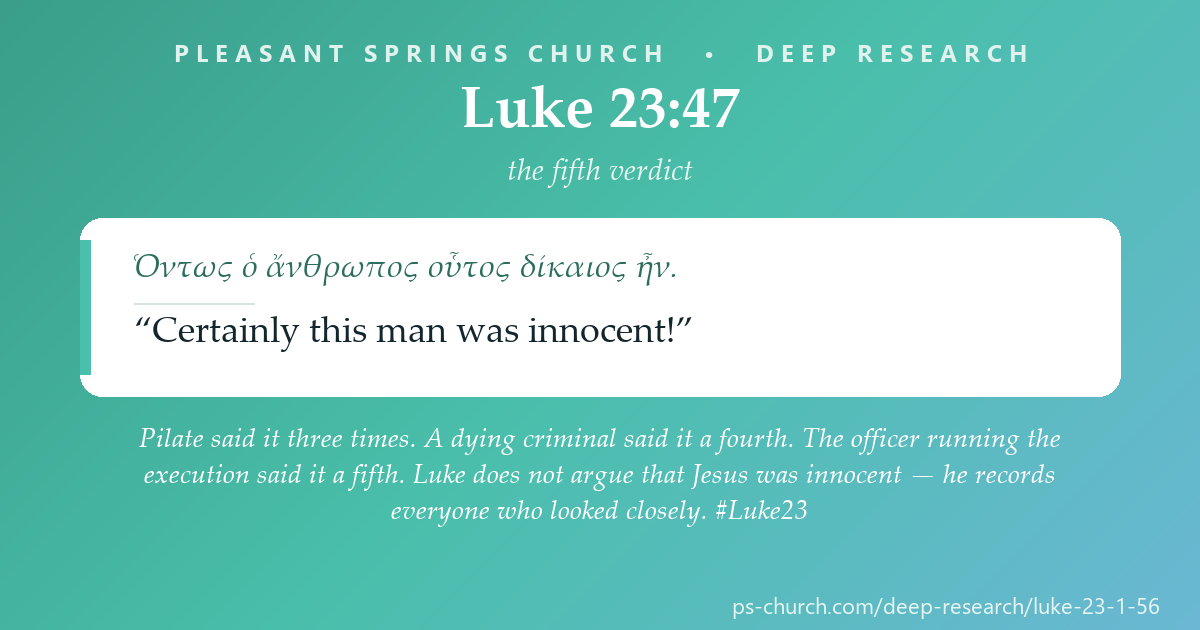
- The verdict was never in doubt. A Roman governor said three times he could find no ground of charge; a dying criminal said it a fourth time; the officer running the execution said it a fifth. Luke does not argue that Jesus was innocent. He simply records that everyone who looked closely said so.
- Luke tells you what happened before he tells you what it means. There is no ‘this was to fulfil’ in this chapter. The meaning comes later, from the risen Christ, on a road. That order is a lesson in how to read: watch first, interpret second, and let him do the interpreting.
- The measurement is a servant, not a judge. The deepest run in the chapter is an accident; the clearest quotation measures three. If a number ever tells you something your eyes contradict, trust the text and print the number anyway.
- The chapter ends with obedience. The women prepare spices and then stop, “according to the commandment.” Grief did not suspend the Sabbath. Neither should anything else suspend faithfulness in the ordinary things.
Step in response: read Luke 23 straight through in one sitting without cross-references, and count the times someone says he did nothing wrong. Then read Luke 24:13–35 and notice who finally explains why he died. Then go do the small faithful thing you have been putting off — the women went home and prepared spices.
Luke 23:47 · to share
Greek NT + ESVEvery Deep Research page traces its passage across the whole sweep — the Old Testament, the Second-Temple world between the testaments (historical witnesses, not Scripture), and the New Testament. Follow the thread:
Pleasant Springs Church — Deep Research
Research method after Michael S. Heiser’s Bible Research Method (examine dictionaries → ancient literature → important words → textual connections → academic publications → share), with the Pleasant Springs “Author & Audience” foundation. Scripture set in the Hebrew, the Greek editions named on each page and the ESV (Old Testament), and the Greek New Testament and the ESV (New Testament), per the practice of Pleasant Springs Church. Luke 23:1–56 research grounded in Bock, Marshall, Fitzmyer, Green and Nolland, with Raymond Brown on the passion narrative, Metzger on 23:17 / 23:34a / 23:45, Hengel on crucifixion and Josephus on Pilate and Antipas. Every number on this page was produced by screening the MorphGNT/SBLGNT text of Luke 23 against the 30,637 Greek Old Testament verse units and the 6,778 non-Lukan Greek New Testament verses held locally, with tie bands reported beside every run; no direction of influence is asserted anywhere. The literary structure is a sequence, labelled as a sequence, derived from counting αἴτιος in the Greek rather than from a commentary’s outline.
Scripture quotations marked ESV are from the ESV® Bible (The Holy Bible, English Standard Version®), © 2001 by Crossway, a publishing ministry of Good News Publishers. ESV Text Edition: 2016. Used by permission. All rights reserved. The ESV text may not be quoted in any publication made available to the public by a Creative Commons license, and the ESV may not be translated in whole or in part into any other language. www.esv.org
|
Did this study bless you today? 💚 Give to Support PS Church100% of gifts go to the General Fund — thank you. |