Two men go into the forest to cut wood. One swings the axe, the iron head slips off the handle, and his neighbour is dead — and Israel is told to measure the roads and set apart cities so that this man can run and live (19:5). That is where three of the hardest chapters in the Bible begin, and they are held together by a single phrase: innocent blood. “Lest innocent blood be shed in your land” (19:10) — “do not set the guilt of innocent blood in the midst of your people Israel” (21:8). Between those brackets stand asylum with due process, the boundary stone the men of old set, the law that no one may be condemned on one voice, the war laws of chapter 20 with their exemptions and their ḥerem, an orchard spared because “the trees in the field” are not human, and a town’s elders washing their hands over a heifer in a wadi because a body was found in their field and someone had to say something. It ends with a corpse taken down from a tree before sundown — the verse Paul quotes of the cross. See the method →
Deuteronomy 19:1–21:23 (selections) — MT = LXX = English
Hebrew · LXX · ESVThe Shape of the Passage
InclusioThese chapters sit inside the central law code (chs 12–26), just past the four offices of judge, king, priest and prophet (16:18–20; 18:15–19). The cities of refuge were first legislated in Numbers 35, and the war of the land was announced in Deuteronomy 7 — read those pages alongside this one. Ahead lie the household and assembly laws of chs 22–23.
Author
Moses, preaching on the plains of Moab. This is not a statute book read out by a clerk; it is preached law, delivered forty years on to the children of the generation that died in the wilderness. Its verbs are remember, hear, love, choose, today. The book as a whole carries the shape of an ancient suzerainty treaty — preamble, historical prologue, stipulations, witnesses, blessings and curses — and these chapters belong to the stipulations. That observation is about the form of the book, and scholars on every side of the dating question have used it, so we report the shape and leave the date where the text leaves it.
Why so many unlike cases share one section. A modern reader files asylum law, land surveying, court procedure, siege warfare and family discipline in five different drawers. Deuteronomy files them in one, and tells you why in the first and last verses of the frame: innocent blood. Blood wrongly shed is not a private matter between two households in this book; it settles on the land and on the people (19:10; 21:8–9, 23). That single conviction is what makes a slipping axe head, a moved boundary stone, a lying witness, a besieged orchard and an unclaimed corpse in a field all belong to the same sermon.
Audience
A people about to hold territory they did not build. Almost every law here presupposes the land: cities to be set apart and roads to be measured so a fugitive can reach one in time (19:2–3); boundary markers already standing in fields (19:14); walled cities to be approached, some near and some far (20:10–15); orchards outside a besieged wall (20:19); a body found “lying in the open country” between towns (21:1). These are the problems of settlement, given to people still camped east of the Jordan who have never yet had a field of their own.
And ordinary people with no advocate. Notice who the law keeps stepping in front of. The man who killed by accident, whom a grieving relative would otherwise run down “in hot anger” (19:6). The smallholder whose neighbour could quietly move a stone at night (19:14). The defendant a single enemy could destroy with a single accusation (19:15). The frightened conscript, whose fear is treated as a fact and not a crime (20:8). The captive woman with no family left to speak for her (21:14). The son of the wife a man does not love (21:17). Whatever else is hard in these chapters — and some of it is very hard — the direction of the legislation is consistently toward the person with the least power in the room.
Orient on asylum, bloodguilt, witnesses, talion, holy war, and the hanged body.
Search by topic: cities of refuge, asylum, avenger of blood (goʾel), bloodguilt, manslaughter and murder, boundary stone, witness and testimony, lex talionis, war (holy war), ḥerem / ban, siege, captive, firstborn, inheritance, hanging and impalement, curse.
Which articles are relevant?
- Anchor Bible Dictionary — “Refuge, Cities of,” “Avenger of Blood,” “Bloodguilt,” “Murder,” “Landmark,” “Witness,” “Talion,” “War, Holy War,” “Ban (ḥerem),” “Siege,” “Firstborn,” “Crucifixion,” “Curse.”
- Dictionary of the OT: Pentateuch — “Cities of Refuge,” “Blood, Avenger of,” “Law,” “Judges,” “War,” “Herem,” “Land,” “Family,” “Women,” “Death and Afterlife.”
- NIDOTTE / TDOT — דָּם (dām, blood), נָקִי (nāqî, innocent), גֹּאֵל (gōʾēl, redeemer/avenger), רָצַח (rāṣaḥ, kill/murder), עֵד (ʿēd, witness), חֵרֶם (ḥērem, devoted thing), בָּעַר (bāʿar, purge), קְלָלָה (qəlālāh, curse).
Bibliography surfaced:
- Peter C. Craigie (NICOT), Daniel I. Block (NIVAC), J. G. McConville (Apollos), Jeffrey H. Tigay (JPS), Duane L. Christensen (WBC), Richard D. Nelson (OTL), S. R. Driver (ICC), Patrick D. Miller (Interpretation), Eugene H. Merrill (NAC) on Deuteronomy.
- Studies of asylum and homicide law in Israel and the ancient Near East; of the biblical law of witnesses; of ḥerem and the conquest narratives; and of Deut 21:22–23 in Second-Temple sources and the New Testament.
- Bernard M. Levinson on Deuteronomy’s reworking of earlier legal material; Meredith G. Kline on the treaty form; G. K. Beale & D. A. Carson, Commentary on the New Testament Use of the Old Testament (Matthew; 1 Corinthians; Galatians).
Homicide, false testimony, talion, the ban, and the body left hanging — in the law of the neighbours.
Read each law beside the ANE material that shares its subject. Sometimes Israel’s law is plainly more humane; sometimes it is closely comparable; and once — the ban — it uses the same institution and the same word as its neighbours. Report all three honestly. Every source below is an ancient witness, never leveled with Scripture.
Which parallels shed light on religion and worldview?
Homicide, accidental and deliberate. The Hittite Laws §§1–4 (ANET 189) already distinguish killing “in a quarrel” from killing where “(only) his hand doing wrong” — the same intent/accident line Deuteronomy draws — but they settle both with compensation: the killer “shall give four persons… and pledge his estate as security.” A life could be bought. Israel’s law shares the distinction and refuses the price: “you shall accept no ransom for the life of a murderer” (Num 35:31). The refuge cities are the other half of that refusal — if you will not let a killing be settled with silver, you must give the accidental killer somewhere to run.
The unsolved death, measured out. The closest parallel to Deut 21:1–9 is startling. Hittite Laws §6 (ANET 189) rules that when a person dies on another man’s land, the landholder is liable; and the later version of the law sets a search radius — “a distance of three leagues in one direction and (a distance) of three leagues in the other direction (shall be taken) and whatever village is found to fall within it, he shall take those.” Deuteronomy also measures (21:2), and also fixes liability on the nearest community. What Deuteronomy adds is the part no Hittite scribe wrote: the elders come down to a wadi, break a heifer’s neck, wash their hands, and say a sentence to God. The Hittite law settles an account. The Israelite rite settles a conscience.
The lying witness and the eye for the eye. The Code of Hammurabi §§1, 3–4 (ANET 166) is the same law as Deut 19:16–21 in a different accent: “If a seignior came forward with false testimony in a case, and has not proved the word which he spoke, if that case was a case involving life, that seignior shall be put to death”; if the case involved “grain or money, he shall bear the penalty of that case.” That is talion applied to perjury, centuries before Moses spoke on the plains of Moab, and the honest thing to say is that Israel is not inventing the principle. Where the difference does show is one page later. Hammurabi §§196–201 (ANET 175) grades the eye: destroy the eye of an aristocrat and they destroy yours; destroy the eye of a commoner and you pay a mina of silver; destroy the eye of a slave and you pay half his value. Deuteronomy 19:21 has no such ladder. The formula is flat — life for life, eye for eye — and it is addressed to a court, not to a class. (ANET’s own footnote to §200 sends the reader to Deut 19:21.)
The ban was not unique to Israel. The Moabite Stone (Mesha Inscription, ANET 320–321; c. 830 BC) has King Mesha say of Nebo: “taking it and slaying all, seven thousand men, boys, women, girls and maid-servants, for I had devoted them to destruction for (the god) Ashtar-Chemosh.” The verb is the Moabite cognate of Hebrew ḥāram — the very word of Deut 20:17. This is not a comfortable parallel and should not be softened into one: ḥerem was a shared institution of the region, and a Moabite king used it against Israelites for his god exactly as Israel was told to use it against the Canaanites for hers. Deuteronomy does not claim to have invented the practice. What it does is bound it — to particular named peoples, in one land, at one moment, with a stated reason (20:18) — and everything Israel is not permitted to do (20:10–15, 19–20) is part of the same law. See the fence below.
Siege, and what a besieging army usually did. The Assyrian royal annals (ANET 274–301) advertise the systematic destruction of an enemy’s countryside — orchards cut down, groves burned, land salted with ruin — as an achievement worth carving in stone. Deut 20:19–20 forbids exactly that against fruit trees, and gives a reason that has nothing to do with military advantage: the tree is not the enemy. “Are the trees in the field human, that they should be besieged by you?”
The body left hanging. Public exposure of the executed was standard ANE deterrence — Assyrian reliefs display the impaled outside captured cities, and Hammurabi §153 (ANET 172) makes impalement itself the penalty for a wife who brought about her husband’s death. Deut 21:22–23 permits the display and then puts a clock on it: down before sundown, buried the same day. Second-Temple Judaism kept the clock. Josephus reports that “the Jews used to take so much care of the burial of men, that they took down those that were condemned and crucified, and buried them before the going down of the sun” (War 4.317).
- Hittite Laws §§1–6 (ANET 189) — intentional versus accidental killing, both compensated in persons; and the death on another man’s land, with the later version measuring a radius to find the liable village. The nearest ANE relative of Deut 19:4–6 and 21:1–3.
- Code of Hammurabi §§1, 3–5 (ANET 166) — the unproved murder charge and the false witness punished with the penalty of the case; and the judge who alters a sealed verdict, fined twelvefold and removed from the bench for life.
- Code of Hammurabi §§196–201 (ANET 175) — talion, but graded by class: an aristocrat’s eye for an eye, a commoner’s eye for silver, a slave’s eye for half his value. ANET’s own note cross-references Exod 21:23–25; Lev 24:19–20; Deut 19:21.
- The Moabite Stone / Mesha Inscription (ANET 320–321, trans. Albright) — Mesha “devoted” the population of Nebo to Ashtar-Chemosh, using the Moabite cognate of Hebrew ḥērem. The single most important comparandum for Deut 20:16–18, and not a flattering one.
- Middle Assyrian Laws (ANET 180–188) and Neo-Assyrian royal annals (ANET 274–301) — the legal and propagandistic world in which captives were property to be sold and orchards were felled as a matter of policy; the background against which Deut 20:19–20 and 21:14 read as restraints.
- Temple Scroll (11Q19) cols. 61–66, with 4Q524 and 4QpNahum (4Q169) (Dead Sea Scrolls — witnesses, not Scripture) — a Second-Temple community rewriting Deut 19–22 at length: witnesses, war, the captive woman, the rebellious son, and at 64:6–13 the hanging law rewritten so that the man is hung alive — that is, crucified — and “cursed by God and men.” Deut 21:22–23 was already being read toward crucifixion before the Gospels were written.
- Josephus, Antiquities 4.219 and War 4.317 (Second Temple — a witness, not Scripture) — “let not a single witness be credited; but three, or two at the least” (he adds restrictions the text does not have); and the Jewish practice of burying the crucified before sunset.
- Philo, Special Laws 4 (Second Temple — a witness, not Scripture) — the duties of judges and the law of testimony read as a philosophy of evidence.
- Mishnah, Makkot 1:6 and Sanhedrin 8:4 (rabbinic-era — witnesses, not Scripture) — the Pharisee–Sadducee argument over Deut 19:19 and 19:21 (the Sadducees read “life for life” to mean the false witness dies only if the accused already died; the Rabbis answer from 19:19 that the brother must still be alive); and the requirement that both parents act together in Deut 21:18–21, with a chain of further conditions.
A body is found in a field. Nobody knows who did it, there is no suspect, and in most legal systems ancient or modern the file simply stays open. Deuteronomy will not allow the file to stay open. The elders and judges come out and measure to the surrounding towns (21:2); the nearest town’s elders take a heifer that has never worked and never worn a yoke, bring it down to a wadi that is neither plowed nor sown, and break its neck there; the priests come forward; and the elders wash their hands over the animal and say, out loud, “Our hands did not shed this blood, nor did our eyes see it shed. Accept atonement, O Lord… and do not set the guilt of innocent blood in the midst of your people Israel” (21:7–8).
Two things are happening at once, and they pull in opposite directions on purpose. The declaration is a denial — these particular men did not do it and did not see it. But the rite is an admission — that a killing on their doorstep is nonetheless their business, that innocent blood does something to a place, and that the nearest community is the one that has to go stand in the wadi and say so. Nobody is punished here. Nobody is even accused. What the law refuses is the shrug. (Two ceremonies in the Gospels reach for the same gesture from opposite directions: Pilate washing his hands and saying “I am innocent of this man’s blood” — borrowing the ritual while doing the killing — and Peter telling Jerusalem in Acts 3 what it had done and calling it to repent.)
Innocent blood, the kinsman-avenger, ambush, two mouths, the ban, the purge, and the curse.
Watch dam naqi (the phrase that frames three chapters), goel haddam (the redeemer who is also the avenger), arav (the ambush that decides a man’s life), al-pi shenayim edim (the two mouths the New Testament quotes), cherem (the ban, shared with Israel’s neighbours), baar (the purge Paul turns into church discipline), and qilelat elohim (the curse Paul carries to the cross). Verse numbers here need no conversion: Hebrew, LXX and English agree throughout Deuteronomy 19–21.
“Innocent blood” — the phrase that brackets these three chapters, and the reason they are one unit. Nāqî means “clean, free of liability,” and the LXX renders it αἷμα ἀναίτιον, “blood without cause.” In this book blood does not stay where it was spilled: it comes “upon you” (19:10), it settles “in the midst of your people” (21:8), it “defiles your land” (21:23). That is why asylum, testimony, warfare and an unsolved corpse all belong to one sermon.
“The avenger of blood” (LXX ὁ ἀγχιστεύων τοῦ αἵματος, “the next of kin in the matter of blood”) — the same word gōʾēl that means redeemer: the relative whose job is to buy back the family field, ransom the enslaved kinsman, and answer for a killed relative. Deuteronomy does not abolish him; it outruns him. Roads are measured and cities set apart precisely so he cannot catch the wrong man “in hot anger” (19:6) — and when the killing was murder, the elders, not the family, hand the man over (19:12).
“To lie in wait, ambush” (LXX ἐνεδρεύσῃ) — the one word that decides whether a man lives in a refuge city or dies. Deuteronomy has no forensic vocabulary for intent, so it describes intent instead: he hated his neighbour, he lay in wait, he rose against him. Against that stands the negative formula of 19:4, 6 — “he did not hate him from yesterday and the day before” (mittəmōl šilšōm), the Hebrew idiom for “in the past.” Asylum is for the man with no history against the dead.
“On the mouth of two witnesses” — the LXX keeps the Hebrew idiom word for word, ἐπὶ στόματος δύο μαρτύρων, and that Greek phrasing is what Matt 18:16 (“that every charge may be established by the evidence of two or three witnesses”) and 2 Cor 13:1 carry over word for word — both keep ἐπὶ στόματος δύο μαρτύρων; 1 Tim 5:19 (ἐπὶ δύο ἢ τριῶν μαρτύρων) and Heb 10:28 (ἐπὶ δυσὶν ἢ τρισὶν μάρτυσιν) invoke the same rule in their own words. A single accusation, however confident, is not evidence. The rule protects the accused — and it costs something, because it means some real crimes go unpunished.
“Devoted thing, ban” — the Hebrew doubles the root for emphasis, haḥărēm taḥărîmēm, and the LXX matches it, ἀναθέματι ἀναθεματιεῖτε. The root means to put something wholly outside ordinary use by handing it over to God; the same word yields the noun for a thing irrevocably dedicated (Lev 27:28). It was not a uniquely Israelite institution — the Moabite king Mesha uses its cognate of his own campaign (ANET 320–321). Deuteronomy 20 restricts it to the six named peoples of the land and gives one reason: 20:18.
“To burn, consume — hence purge” (LXX ἐξαρεῖς, “you shall remove”) — the formula that closes case after case: “so you shall purge the evil from your midst.” Paul takes over its LXX clause in 1 Corinthians 5:13 — ἐξάρατε τὸν πονηρὸν ἐξ ὑμῶν αὐτῶν, the same words with the verb turned from a future (ἐξαρεῖς) into a command to the congregation — and there the purge is not an execution but the removal of an unrepentant man from the church’s table. That is the New Testament’s own transposition of this formula, and it is the only one it makes.
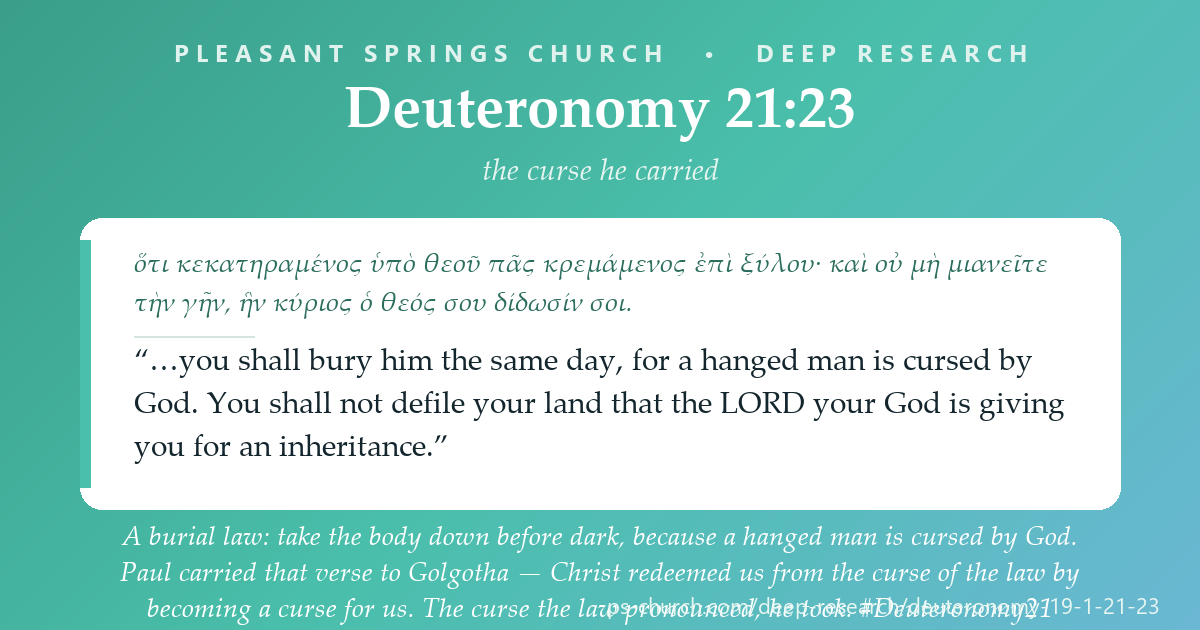
“A hanged man is a curse of God” — literally “a curse of God is one hanged.” The Hebrew is compressed enough that ancient readers debated whether the hanged man is cursed by God or is an affront to God; the LXX settles it one way, κεκατηραμένος ὑπὸ θεοῦ, “cursed by God.” Paul quotes the verse in Galatians 3:13 as ἐπικατάρατος πᾶς ὁ κρεμάμενος ἐπὶ ξύλου — keeping the operative clause, dropping ὑπὸ θεοῦ, and drawing his adjective from the curse formula of Deut 27:26 he has just cited three verses earlier.
Where the New Testament picks these words up:
- Matthew 18:16 — “take one or two others along with you, that every charge may be established by the evidence of two or three witnesses.” Jesus applies Deut 19:15 to the church’s handling of sin between believers, and the Greek follows the LXX wording of the verse.
- 2 Corinthians 13:1; 1 Timothy 5:19; Hebrews 10:28 — the same rule used to govern apostolic discipline, accusations against elders, and the argument from lesser to greater about rejecting Christ.
- Matthew 5:38–42 — “You have heard that it was said, ‘An eye for an eye and a tooth for a tooth.’ But I say to you, Do not resist the one who is evil.” The saying Jesus corrects is the courtroom formula of 19:21 being used by private people to settle private scores; see the fence below.
- 1 Corinthians 5:13 — “Purge the evil person from among you” takes over the LXX clause of Deut 19:19 / 21:21 — τὸν πονηρὸν ἐξ ὑμῶν αὐτῶν unchanged, with the future ἐξαρεῖς turned into the plural imperative ἐξάρατε — and Paul’s “purge” is exclusion from the fellowship meal, with restoration in view (2 Cor 2:5–8).
- Galatians 3:13 — “Christ redeemed us from the curse of the law by becoming a curse for us—for it is written, ‘Cursed is everyone who is hanged on a tree’” (Deut 21:23). Also Acts 5:30; 10:39; 1 Peter 2:24, all of which call the cross a tree (ξύλον) using this verse’s vocabulary.
Refuge and bloodguilt across the Torah; the war laws in their place; and the tree in the apostles’ hands.
Three threads. First the law of homicide and asylum from Exodus through Joshua. Then the war material in its canonical setting, held to what the text actually says. Then 21:22–23, followed to where the New Testament takes it.
Which cross-references matter?
- Numbers 35:9–34 — the foundational law of the six cities of refuge, the congregation’s trial of the manslayer, the ban on ransom for a murderer, and the return home at the death of the high priest: “you shall not pollute the land in which you live, for blood pollutes the land” (35:33). Deut 19 is that law preached and applied (see Numbers 34–35).
- Exodus 21:12–14; 23:1–9 — the altar as a first place of asylum, with the man who “lies in wait” dragged from it; and “you shall not join hands with a wicked man to be a malicious witness… do not kill the innocent and righteous” (see Exodus 21 and Exodus 23).
- Exodus 21:23–25; Leviticus 24:17–22 — the two other statements of talion, the second of which explicitly levels the law for citizen and sojourner: “You shall have the same rule for the sojourner and for the native” (see Leviticus 24).
- Deuteronomy 5:17, 20; 16:18–20; 17:2–13 — the sixth and ninth commandments standing behind these chapters, and the courts of chs 16–17 that this section presupposes: diligent inquiry, two or three witnesses, the hard case referred up (see Deut 5, Deut 16 and Deut 17).
- Deuteronomy 7:1–5; 9:4–6; 12:29–31 — the same war of the land, with the same stated reason (they will turn your sons away, they burn their sons and daughters to their gods) and the same explicit denial of Israelite merit: “not because of your righteousness… but because of the wickedness of these nations” (see Deut 7, Deut 9 and Deut 12).
- Deuteronomy 19:14; 27:17; Proverbs 22:28; 23:10; Hosea 5:10 — the boundary marker, from law to curse to proverb to prophetic indictment: “the princes of Judah have become like those who move the landmark.” A quiet theft with no witnesses is the test case for a law that cannot be enforced by watching.
- Joshua 20:1–9; 2 Samuel 14:1–11; 1 Kings 2:28–34 — the refuge cities actually designated; the wise woman of Tekoa pleading against the avenger of blood; and Joab dragged from the horns of the altar because he had lain in wait. The narratives test the law.
- Genesis 4:10–11; Numbers 35:33; 2 Kings 24:4; Joel 3:19 — blood that cries from the ground, blood that pollutes the land, and “the innocent blood that he had shed… and the Lord would not pardon.” The whole canon shares Deuteronomy’s conviction that innocent blood is not a private matter (see Genesis 4).
- Genesis 29:30–33; 37:3–4 — the loved wife and the unloved wife, and a father’s favourite son in a coat. Deut 21:15–17 legislates against exactly the household Genesis narrates, and Genesis shows the cost (see Genesis 29 and Genesis 37).
- Joshua 8:29; 10:26–27 — the law of 21:22–23 actually kept: “And at sunset Joshua commanded, and they took his body down from the tree” — the corpse hung as a public sign, and down before dark.
Deuteronomy 21:22–23 is a burial law. A man has been executed for a capital crime; his body may be hung up as a public sign; and it must come down before dark, because “a hanged man is cursed by God” and the land is not to be defiled. The verse is about a corpse and a sunset, and nothing in it is looking forward to anything. Then Paul, writing to Galatia about why Gentiles need not become Jews to be justified, quotes it: “Christ redeemed us from the curse of the law by becoming a curse for us—for it is written, ‘Cursed is everyone who is hanged on a tree’” (Gal 3:13). Three verses earlier he had quoted Deut 27:26 — “Cursed be everyone who does not abide by all things written in the Book of the Law” — and it is from that verse he takes the word ἐπικατάρατος. He also drops the LXX’s ὑπὸ θεοῦ, “by God,” from the quotation. Both moves are deliberate, and neither hides anything: the curse of the law falls, and it falls on him.
This is not a pattern we are imposing on Deuteronomy. It is a reading the apostle performs in front of us, and the vocabulary spread: Peter and Luke both call the cross a tree (ξύλον) in exactly this verse’s language (Acts 5:30; 10:39; 1 Pet 2:24), and the Qumran Temple Scroll shows the verse was already being read toward crucifixion before any of them wrote. What the New Testament does not do is soften the offence. To a first-century Jew, “the Messiah was hanged on a tree” was not an argument for Jesus; it was the single strongest argument against him. Paul does not answer it. He agrees with it — and says that is precisely the point. Everything in these three chapters that made a body defile a land, and made a community wash its hands in a wadi and beg, “do not set the guilt of innocent blood in the midst of your people,” comes to rest at a hill where the one man in the story who did not deserve to die takes the curse and the land is cleansed.
The scholarship — and the fence that has to go around chapters 20 and 21.
Craigie, Block, McConville, Tigay, Christensen, Nelson, Driver, Miller and Merrill on Deuteronomy; Levinson on its legal revision; Kline on the treaty form; Beale & Carson on the New Testament use; ANET for the comparanda.
Commentaries & studies:
- Peter C. Craigie, The Book of Deuteronomy (NICOT); Daniel I. Block, Deuteronomy (NIVAC); J. G. McConville, Deuteronomy (Apollos); Jeffrey H. Tigay, Deuteronomy (JPS); Duane L. Christensen, Deuteronomy (WBC); Richard D. Nelson, Deuteronomy (OTL); S. R. Driver (ICC); Patrick D. Miller (Interpretation); Eugene H. Merrill (NAC).
- Bernard M. Levinson on Deuteronomy’s reworking of earlier legal material (his case studies are the altar law, the Passover and the judiciary; the relation of Deut 19 to the altar-asylum of Exod 21:12–14 belongs to the same discussion); Meredith G. Kline, Treaty of the Great King, on the covenant form (reported as literary shape, not as a settled argument about date).
- J. B. Pritchard, ed., Ancient Near Eastern Texts (ANET) — Hittite Laws (188–197), Code of Hammurabi (163–180), Middle Assyrian Laws (180–188), the Moabite Stone (320–321), the Assyrian royal annals (274–301).
- G. K. Beale & D. A. Carson, eds., Commentary on the New Testament Use of the Old Testament (Matthew; 1 Corinthians; Galatians; 1 Peter) — for Deut 19:15 in Matt 18:16, Deut 19:19 in 1 Cor 5:13, and Deut 21:23 in Gal 3:13.
- Studies of Deut 21:22–23 in the Dead Sea Scrolls (the Temple Scroll 11Q19 64:6–13 and 4Q524) and in early Christian preaching — the pre-Christian reading of the verse toward crucifixion is one of the better-attested results in this field.
The fence — how this page reads the capital and war laws:
- Report the text plainly. Deuteronomy 20:16–18 commands the ḥerem — “you shall save alive nothing that breathes” — against the six named peoples of Canaan. Deuteronomy 21:18–21 prescribes death by stoning for the incorrigible son. Deuteronomy 20:10–15 governs the distant cities: terms of peace must be offered, and a city that accepts becomes forced labour (20:11); a city that refuses is besieged, “you shall put all its males to the sword” (20:13), and “the women and the little ones, the livestock, and everything else in the city, all its spoil, you shall take as plunder for yourselves” (20:14). That is the war of the ancient world, and this page reports it rather than stopping at 20:10. These are not metaphors, and this page does not soften them into something they are not.
- Locate it precisely. This is capital, theocratic criminal law and a divinely commanded war, given to one covenant nation with God as its immediate King, for one land, at a bounded moment in redemptive history. It is not general ethics, it is not a permanent policy, and it was never given to anyone else.
- Take the reason the text gives, and no more. Deuteronomy’s stated ground for the ban is not ethnicity and not Israelite merit: “that they may not teach you to do according to all their abominable practices that they have done for their gods” (20:18), and elsewhere, plainly, “not because of your righteousness… but because of the wickedness of these nations” (9:4–5), with child sacrifice named as the chief abomination (12:31). Where Scripture gives no further reason, we stop.
- Own the difficulty. The command still kills non-combatants, and no amount of context makes that comfortable. It is honest to say that this is one of the hardest things in the Old Testament, that Christians of every century have found it so, and that a reader who is troubled by it is reading it correctly. It is also worth noting, hedged, that ANE war reports of all nations — Israel’s included — use sweeping totalizing language as a convention of the genre (Joshua itself reports peoples “utterly destroyed” who reappear a chapter later). That is a genuine feature of the writing and worth knowing; it is not an escape hatch, and this page does not use it to make the command go away.
- Note where the law restrains. Chapter 20 restrains at point after point, though never into gentleness: fear is not punished but excused, and four kinds of men are sent home before a battle; terms of peace must be offered to every distant city before it is attacked at all (20:10) — though the terms are subjection, and refusal brings 20:13–14; and a fruit tree may not be cut down, because it is not the enemy (20:19–20). In the judicial laws the restraints are structural: never one witness (19:15), diligent inquiry (19:18), the malicious accuser punished with what he sought (19:19), and, in the rebellious-son case, the requirement that both parents act and that the matter go to the elders at the gate rather than be settled inside the house (21:19–20). That restraint is part of the text, not an apology for it.
- It is not a template, and it licenses nothing today. No church, movement, nation or individual may take these chapters as warrant for violence, coercion, vengeance or shunning. The New Testament settles this directly: “the weapons of our warfare are not of the flesh” (2 Cor 10:4); “we do not wrestle against flesh and blood” (Eph 6:12); “all who take the sword will perish by the sword” (Matt 26:52); and when disciples proposed fire from heaven on a village, Jesus “turned and rebuked them” (Luke 9:54–55). The one thing the New Testament does carry over is the purge formula itself — and in 1 Corinthians 5 it means exhortation and, at most, exclusion from the table, with restoration the goal.
Interpretation notes worth keeping:
- ‘Eye for eye’ is a ceiling, not a floor. In its own setting the talion formula is a limit on vengeance and a rule for courts: the penalty may not exceed the injury, and it is measured by a judge rather than by a family’s grief. Its context here is the sentencing of a convicted false witness (19:18–21), not a licence for anyone to collect. That is precisely the misuse Jesus addresses in Matt 5:38–42 — the courtroom formula quoted by private people about private slights — and his answer is not that the law was unjust but that his disciples are not to run their own courts.
- Refuge is asylum with due process, not sanctuary from justice. The fugitive is protected from the avenger and judged before he can be handed over — by the congregation in Num 35:12, 24, and by the elders of his own city in Deut 19:12. The one who lay in wait gets no shelter and is not left to a mob either: the elders send for him. A society that will not let grief execute is a society that must give the accused a road, a hearing, and a bench.
- The boundary stone is the test of a law nobody can watch. The neighbour’s landmark could be moved at night, quietly, by inches, with no witness — which is why 19:14 stands where it does, between a homicide law and a testimony law, and why the covenant curse of 27:17 is attached to it. The commandments most easily kept in public are not the ones that reveal a people.
- Chapter 20 is not a manual for any modern war. Its exemptions and its offer of terms have often been read as an early source for just-war thinking, and there is something in that; but the chapter’s premise is that the Lord himself goes out with the army of a covenant nation (20:4), and no modern state stands in that relation to God. What transfers is the moral pressure — that even in war there are things you may not do, and that the orchard, the frightened man and the newly married man are among them.
- 21:10–14 regulates; it does not commend. The law addresses a soldier in a conquered town who wants a captive woman, and it makes him wait, stop, and treat her as a person: she mourns her father and mother for a full month in his house; if he then takes her she is his wife, not property; and if he does not want her she goes free — she may not be sold, and she may not be kept as a slave, “since you have humiliated her” (21:14). Every one of those clauses is a restriction on him, and the last one names what happened to her honestly. That is restraint inside a brutal world, and it is not the same thing as approval. Readers who find this passage painful are not misreading it; the text itself concedes that she was humiliated, and the law exists because of what men do in war. And the two halves of this unit have to be held together: 20:16–18 leaves no captives from the cities of the land, so the woman of 21:10–14 comes out of the war of the distant cities — she is among the women 20:14 has just assigned as plunder. The law that hands her over is the same law that then forbids selling her.
- 21:15–17 protects a child from his father’s preference. The father may not promote the loved wife’s son over the unloved wife’s firstborn. The word “unloved” (śənūʾāh, literally “hated”) is the word used of Leah, and the narratives of Genesis show exactly what a favourite child costs a household. The law is a fence around the powerless member of a family, and there are more of those in this section than there are penalties.
- 21:18–21, handled briefly. The case is a grown, incorrigibly rebellious son, brought by both parents together to the elders in the public gate; nothing here is done privately, and nothing is a parent’s to carry out. Jewish tradition itself narrowed the case out of existence: a baraita preserved in b. Sanhedrin 71a states flatly that “there has never been a stubborn and rebellious son and there never will be… why then was it written? So that you may expound it and receive reward” — though the same page records R. Yonatan dissenting (“I saw one”), so it is a dominant view rather than a unanimous one, and the conditions that made it unenforceable are set out in m. Sanhedrin 8. We report the law, we fence it, and we do not linger on it.
- Where the unit lands. It does not land on a penalty. It lands on a body coming down from a tree before sundown so that the land is not defiled (21:22–23) — and that is the verse the apostle Paul picked up to explain the cross.
From a road kept clear for a frightened man to a curse carried by a willing one.
Name what you learned, why it matters, and one concrete response.
What should we carry away — and do?
- Build the road. Israel was told to measure the distances and prepare the way so that a man who killed by accident could get to safety before grief caught him (19:3). Mercy in this law is not a mood; it is infrastructure. Ask what road your household, your church, or your workplace has actually built for the person who will need it in a hurry.
- One accusation is not evidence. “A single witness shall not suffice.” The rule costs something — some real wrongs will go unproved — and Deuteronomy pays the price anyway, because the alternative is a world where any enemy can end you with a sentence. Before you repeat something damaging about a person, ask what you would have if the rule of 19:15 applied.
- Wanting the penalty for someone is how you earn it. The malicious witness “shall be done to as he had meant to do to his brother” (19:19). The law measures the accuser by what he was hoping would happen. It is worth being honest about what you have hoped would happen to someone.
- Are the trees in the field human? A besieging army, hungry and in a hurry, is told that the orchard is not its enemy. Restraint where nobody is watching and nothing would stop you — toward property, toward creation, toward the person who cannot fight back — is the shape of holiness in this chapter.
- Do not shrug. The elders of the nearest town had to walk out to a wadi and say aloud that this death was not nothing. A community that can pass a wrong on its doorstep without a word said has already decided something about itself.
- The curse landed on him. The last law in this unit exists so that a hanged body would not defile the land. Paul says Christ “became a curse for us” there (Gal 3:13). Everything in these chapters that had to be purged, atoned for, washed off, buried before dark — he took.
Step in response: pick one accusation you have believed on a single voice, and go and check it — or drop it. Then pick one person in your orbit who has no one to speak for them, and be the two witnesses they do not have.
Deuteronomy 21:23 · to share
LXX + ESVEvery Deep Research page traces its passage across the whole sweep — the Old Testament, the Second-Temple world between the testaments (historical witnesses, not Scripture), and the New Testament. Follow the thread:
Pleasant Springs Church — Deep Research
Research method after Michael S. Heiser’s Bible Research Method (examine dictionaries → ancient literature → important words → textual connections → academic publications → share), with the Pleasant Springs “Author & Audience” foundation. Scripture set in the Hebrew, the Greek editions named on each page and the ESV (Old Testament), and the Greek New Testament and the ESV (New Testament), per the practice of Pleasant Springs Church. Deuteronomy 19–21 research grounded in Craigie, Block, McConville, Tigay, Christensen, Nelson, Driver, Miller and Merrill, with Levinson on Deuteronomy’s legal revision, Kline on the treaty form (reported as the book’s literary shape, not as a settled argument about its date), and Beale & Carson on the New Testament use (Matthew; 1 Corinthians; Galatians; 1 Peter). ANE comparanda verified in ANET: Hittite Laws §§1–6 (189), Code of Hammurabi §§1, 3–5 (166) and §§196–201 (175), Middle Assyrian Laws (180–188), the Assyrian royal annals (274–301) and the Moabite Stone / Mesha Inscription (320–321), whose Moabite ḥrm is the cognate of Deut 20:17’s ḥerem — a comparandum reported as it stands, not softened. Second-Temple and rabbinic witnesses (the Temple Scroll 11Q19 cols. 61–66 with 4Q524; Josephus, Ant. 4.219 and War 4.317; Philo, Special Laws 4; m. Makkot 1:6; m. Sanhedrin 8 with b. Sanhedrin 71a) are read as witnesses, never leveled with Scripture. Versification: chapters 19, 20 and 21 have no MT/LXX offset — Hebrew, Rahlfs LXX and English number 19:1–21, 20:1–20 and 21:1–23 identically, so no conversion is needed anywhere on this page; the offset begins at the next chapter, where English 22:30 = MT/LXX 23:1 and English 23:1–25 = MT/LXX 23:2–26. Greek is Rahlfs, checked against Swete where the editions agree. The capital, theocratic and war legislation of chs 20–21 is read as law for a covenant nation in its land at a bounded moment in redemptive history — reported plainly, located precisely, its difficulty owned rather than dissolved, and fenced unmistakably: it is not a template for the church or any state and licenses no violence, coercion or shunning by anyone today (2 Cor 10:4; Eph 6:12; Matt 26:52; Luke 9:54–55), the New Testament’s own transposition of its purge formula being exclusion from the table with restoration in view (1 Cor 5:13; 2 Cor 2:5–8). The abiding substance — asylum with due process, a bar on conviction by one voice, restraint in war, the dignity of the powerless, and a community that will not shrug at innocent blood — is held as enduring.
Scripture quotations marked ESV are from the ESV® Bible (The Holy Bible, English Standard Version®), © 2001 by Crossway, a publishing ministry of Good News Publishers. ESV Text Edition: 2016. Used by permission. All rights reserved. The ESV text may not be quoted in any publication made available to the public by a Creative Commons license, and the ESV may not be translated in whole or in part into any other language. www.esv.org
|
Did this study bless you today? 💚 Give to Support PS Church100% of gifts go to the General Fund — thank you. |