One generation out of Eden, sin goes from a whisper to a weapon. Two brothers bring their worship; God receives one and not the other; and instead of mastering the anger crouching “at the door,” Cain lures his brother to a field and spills the first human blood — then shrugs: “Am I my brother’s keeper?” This study works the first worship and the first murder, and follows the crying blood all the way to the blood that speaks a better word. See the method →
Genesis 4:1–16 (selections)
Hebrew · LXX · ESVThe Shape of the Passage
Ring compositionSame Author and audience as Genesis 1:1 — the fall now spreads from the garden into the family, and the first death by human hands.
Author
The Torah of Moses shows sin’s second generation. Two brothers bring offerings; God “has regard” for Abel’s and not Cain’s. The text hints at why: Abel brings the firstborn of his flock and its fat portions (the best); Cain simply brings “fruit of the ground.” Hebrews reads the heart behind the gift — Abel offered “by faith” (Heb 11:4). God does not reject Cain but warns him: “sin is crouching at the door… you must rule over it” (4:7).
The crouching beast. Sin is pictured as a predator (רֹבֵץ, a “croucher”) at the door, with language echoing the curse of 3:16 — “its desire is for you, but you must master it.” Cain does not master it. He lures his brother to the field and kills him — and then meets God’s seeking question with a lie and a sneer: “am I my brother’s keeper?”
Audience
Israel — a people with a sacrificial system in which how and with what heart one approaches God matters (Lev 1–7), and a law that treats shed blood as crying out for justice (Num 35:33). Cain’s “keeper” (שֹׁמֵר) is the very word for Adam’s garden task (2:15): he refuses the vocation of guarding what is his to protect.
How they heard it. Worship is not neutral — it can be pleasing or not, and the difference runs to the heart. Anger unmastered becomes violence. And innocent blood is never silent before God: it “cries from the ground,” a theme that runs from Abel to the prophets to the cross.
Orient on sacrifice, sin, and the first murder.
Search by topic: sacrifice/offering, Cain, Abel, blood, sin, bloodguilt.
Which articles are relevant?
- Anchor Bible Dictionary — “Cain,” “Abel,” “Sacrifice and Offerings,” “Blood.”
- Dictionary of the OT: Pentateuch — “Cain and Abel,” “Sacrifice,” “Sin.”
- NIDOTTE / TDOT — מִנְחָה (minḥâ), חַטָּאת (ḥaṭṭāʾṯ), דָּם (dām, blood), שָׁמַר (šāmar).
Bibliography surfaced:
- Wenham, Genesis 1–15 (WBC); Hamilton (NICOT); Sarna (JPS); von Rad.
- Bruce Waltke, “Cain and His Offering” (WTJ) — why Abel’s was accepted.
- James Kugel, Traditions of the Bible — the rich Second-Temple afterlife of Cain and Abel.
Shepherd and farmer, and the blood that will not be silent.
Compare the ANE shepherd-vs-farmer motif and the Second-Temple retellings that made Cain the archetype of the wicked.
Which parallels shed light on religion and worldview?
Shepherd and farmer. Mesopotamian literature enjoyed the rivalry of herdsman and farmer — the Sumerian Dispute between Dumuzi (shepherd) and Enkimdu (farmer) has them vie for the goddess’s favor. Genesis is not about a trade rivalry, though: both vocations are honorable; the issue is the offering and the heart, and the story ends not in reconciliation but in blood.
- Sumerian “Dispute between the Shepherd-god and the Farmer-god” — the herdsman-vs-farmer motif Genesis reshapes toward worship and murder.
- Jubilees 4:1–12, 31–32 (Pseudepigrapha — a witness, not Scripture) — names Cain’s wife and Abel’s dates, and has Cain die when his own house of stones falls on him — the “instrument with which a man kills his neighbour” becoming the instrument of his own death (Jub 4:31–32).
- Wisdom of Solomon 10:3 (Apocrypha — likewise not Scripture) — “an unrighteous man… perished… when in rage he killed his brother”: Cain as the type of ruinous anger.
- Josephus, Antiquities 1.52–66; Philo, On the Sacrifices of Cain and Abel — the extensive first-century moralizing of the story.
- Targum Pseudo-Jonathan on 4:8 — expands the field scene into a theological quarrel between the brothers about justice and the world to come.
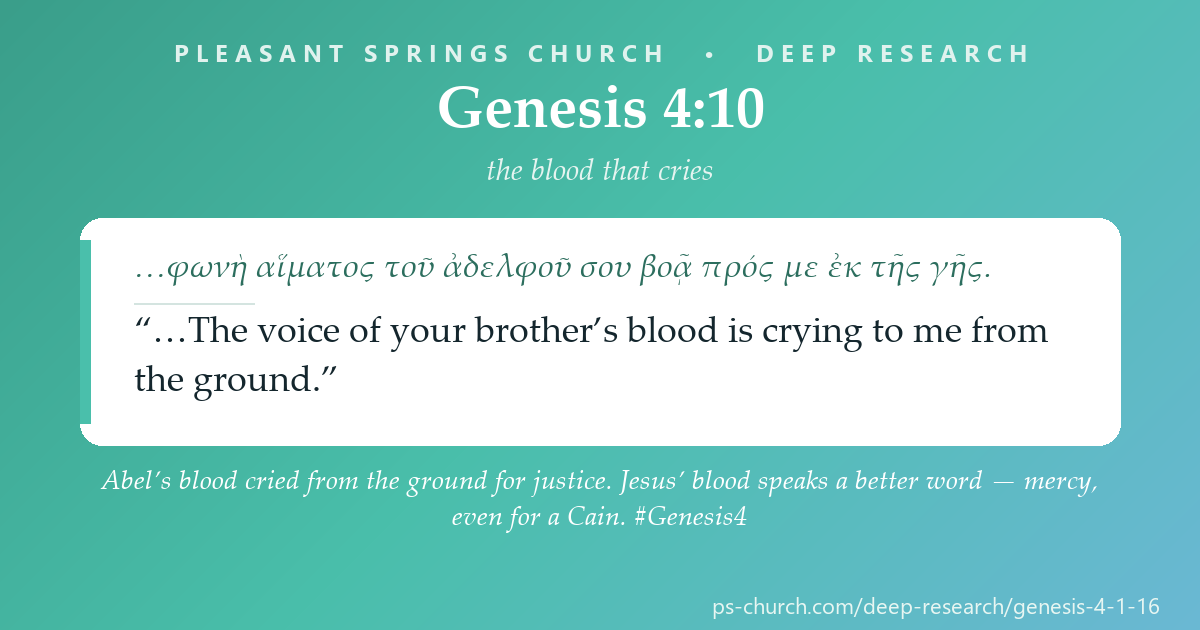
“The voice of your brother’s blood is crying to me from the ground” (4:10) begins a canon-long theme: innocent blood is never silent before God (Num 35:33; Ps 9:12; the martyrs’ cry, Rev 6:10). The New Testament sets Abel at the head of the line of righteous blood — “from the blood of righteous Abel to the blood of Zechariah…” (Matt 23:35) — and then names the one blood that answers it: Jesus’ blood “speaks a better word than the blood of Abel” (Heb 12:24). Abel’s blood cries for justice; Christ’s blood cries for mercy.
The vocabulary of worship, warning, and blood.
Watch the heart behind the offering, the crouching predator of sin, the denied “keeper,” and the crying blood.
“Offering / gift” — a tribute brought to a superior. Abel’s is of the firstborn and fat (the best); Cain’s is unspecified “fruit.” The gift reveals the heart.
“Had regard / looked with favor” — God “gazed upon” Abel’s offering. Acceptance is personal and heart-deep, not mechanical.
“Crouching” — sin as a predator (or demon) lying in wait at the door. Its “desire” (תְּשׁוּקָה) for Cain echoes 3:16: a beast to be mastered.
“Keeper / guardian” — the very verb of Adam’s calling to “keep” the garden (2:15). Cain denies the vocation he owed his brother.
“The voice of…blood…crying” — “bloods” is plural (bloodshed); it “cries out” like the oppressed to God (Exod 3:7). Innocent blood is never silent.
“Abel” — the name means “vapor, breath, fleeting” (the word of Ecclesiastes). The righteous brother’s very name foreshadows how briefly he lived.
How the New Testament reuses Cain and Abel:
- Hebrews 11:4 — “by faith Abel offered… a more acceptable sacrifice… and through his faith, though he died, he still speaks”: the reason Abel’s worship pleased God.
- Hebrews 12:24 — Jesus’ sprinkled blood “speaks a better word than the blood of Abel”: mercy answering the cry for justice.
- 1 John 3:11–12 — “We should not be like Cain, who was of the evil one and murdered his brother”: Cain as the anti-model of love.
- Jude 11; Matthew 23:35 — “the way of Cain”; and Abel heading the roll of martyred righteous blood, from him to Zechariah.
From Abel’s blood to the blood of the Lamb.
Trace the crying-blood theme and the faith/works contrast — then note the Beale & Carson trajectory at Hebrews 12.
Which cross-references matter?
- Genesis 3:16–19 — sin’s “desire” and the cursed ground reappear in 4:7–12: the fall metastasizing into the family.
- Numbers 35:33; Deuteronomy 21:1–9; Psalm 9:12 — shed blood polluting the land and crying for justice: the law behind 4:10.
- Hebrews 11:4; 12:24 — Abel’s faith and the “better blood” of Jesus: the two poles of the story’s NT reading.
- Matthew 23:35; Luke 11:51; Revelation 6:9–11 — the martyrs’ blood from Abel onward, crying “how long?” until the end.
- 1 John 3:11–18 — Cain as the warning, and self-giving love as the mark of those born of God.
The commentary’s Hebrews treatment draws the line sharply: Abel’s blood, crying from the ground of Genesis 4, is the Old Testament’s voice of unavenged innocence — and Jesus’ blood “speaks a better word” because it does not cry for the sinner’s judgment but secures the sinner’s pardon. The first murder poses the question the whole Bible answers at the cross: what can be done about innocent blood? Only the blood of the Lamb both satisfies justice and grants mercy.
The scholarship on Cain and Abel.
Waltke on the offering; the commentaries on 4:7; Kugel on the Second-Temple traditions.
Commentaries & studies:
- Bruce Waltke, “Cain and His Offering,” WTJ 48 (1986); Wenham (WBC), Hamilton (NICOT), Sarna (JPS).
- James Kugel, Traditions of the Bible (the Cain and Abel chapter); John Byron, Cain and Abel in Text and Tradition.
- On 4:7’s difficult syntax: the commentaries and the NIDOTTE entry on רֹבֵץ.
Interpretation notes worth keeping:
- Why Abel’s and not Cain’s? The narrative cues (firstborn + fat vs. unqualified “fruit”) plus Hebrews 11:4 (“by faith”) point to the heart and quality of worship, not to farming being inferior to herding.
- Verse 7 is famously hard Hebrew; the “sin crouching… its desire… rule over it” wording deliberately mirrors 3:16, framing Cain’s moment as a struggle for mastery he loses.
- The mark of Cain (4:15) is protective, not punitive — a sign of restraint on vengeance, part of the mercy that runs even through this judgment.
From the first murder to your own anger.
Name what you learned, why it matters, and one concrete response.
What should we carry away — and do?
- Worship is not neutral. God looks at the heart behind the gift. The question is never merely that we worship but how — “by faith,” with our best, or not.
- Master the croucher. God warned Cain before the murder: sin crouches, but “you must rule over it.” Anger unaddressed becomes something far worse; the door is where it’s stopped.
- There is better blood than Abel’s. Abel’s blood cries for justice; Jesus’ blood “speaks a better word” (Heb 12:24) — mercy for murderers, Cain included.
Step in response: name one resentment “crouching at the door” this week and master it before it grows — take a concrete step of reconciliation — and bring your worship as Abel did, your best, by faith.
Genesis 4:10 · to share
LXX + ESVEvery Deep Research page traces its passage across the whole sweep — the Old Testament, the Second-Temple world between the testaments (historical witnesses, not Scripture), and the New Testament. Follow the thread:
Pleasant Springs Church — Deep Research
Research method after Michael S. Heiser’s Bible Research Method (examine dictionaries → ancient literature → important words → textual connections → academic publications → share), with the Pleasant Springs “Author & Audience” foundation. Scripture set in the Hebrew, the Greek editions named on each page and the ESV (Old Testament), and the Greek New Testament and the ESV (New Testament), per the practice of Pleasant Springs Church. Genesis 4:1–16 research grounded in Waltke, Wenham, Hamilton, Sarna, and Kugel; ANE shepherd/farmer motif per the Sumerian Dumuzi–Enkimdu dispute; Second-Temple readings per Jubilees 4, Wisdom 10, Josephus, and Philo (read as witnesses, not Scripture).
Scripture quotations marked ESV are from the ESV® Bible (The Holy Bible, English Standard Version®), © 2001 by Crossway, a publishing ministry of Good News Publishers. ESV Text Edition: 2016. Used by permission. All rights reserved. The ESV text may not be quoted in any publication made available to the public by a Creative Commons license, and the ESV may not be translated in whole or in part into any other language. www.esv.org
|
Did this study bless you today? 💚 Give to Support PS Church100% of gifts go to the General Fund — thank you. |