In ten Hebrew words — three in Greek’s opening breath — the Bible answers the oldest question a human being can ask: where did all this come from? Genesis 1:1 is the doorway of Scripture, and every later verse walks through it. This study works that single sentence all the way down, from the Author who first spoke it, through the myths it quietly overthrows, to the Word of John 1:1 in whom it finds its end. See the method →
Genesis 1:1
Hebrew · LXX · ESVThe Shape of the Passage
Parallel panelsBefore anything else, ask the three foundational questions: who wrote this, to whom, and in what situation? Genesis 1:1 is the opening line of the Torah — the covenant preamble of Israel’s Scriptures — so its author and audience set the terms for everything that follows.
Author
By the witness of Scripture itself, the Torah is the Book of Moses — Jesus speaks of “the book of Moses, in the passage about the bush” (Mark 12:26), and “beginning with Moses… he interpreted… the things concerning himself” (Luke 24:27; cf. John 5:46–47). Whether one holds Mosaic authorship in the wilderness (15th–13th c. BC) or, with much modern criticism, assigns Genesis 1:1–2:3 to a later Priestly hand that reached final form near the exile, the theological voice is the same: a single author-editor presenting Israel’s God as the sole Creator.
Occasion. Genesis is not free-floating myth; it is the front porch of the covenant. Before Israel hears “I am the Lord your God, who brought you out of Egypt” (Exod 20:2), they are told who that God is: the One who made everything. Genesis 1:1 is deliberately placed to answer the first question any covenant people must settle — whose world is this?
Audience
The first hearers were Israel — a people freshly out of four centuries in Egypt, moving toward life among the Canaanites, and (if the final form is exilic) later reading these words under Babylon. Every one of those cultures had a vivid creation story: Egypt’s Atum rising from the waters of Nun, Canaan’s storm-god Baal, Babylon’s Marduk splitting the chaos-goddess Tiamat.
How they heard it. To that audience, Genesis 1:1 lands as a quiet thunderclap of polemic. There is no war in heaven, no rival god, no pre-existing divine matter to fight. One God, unnamed rivals reduced to his creatures, simply makes “the heavens and the earth.” For a people tempted to fear the gods of their neighbors — or, in exile, to think Marduk had beaten YHWH — the first line of the Bible is already good news: your God is not one power among many; he is the Maker of all.
“For if you believed Moses, you would believe me; for he wrote of me.”John 5:46 (ESV) — the NT’s own frame for reading MosesThe Research, Stage by Stage
Get the lay of the land on “creation,” “cosmogony,” and the key words — and harvest the bibliography.
Search your best reference works by reference and by topic. For Genesis 1:1 the load-bearing topics are creation, cosmogony/cosmology, the beginning, God (Elohim), and the doctrine of creatio ex nihilo.
Which articles (in which dictionaries) are relevant?
- Anchor Bible Dictionary — “Creation,” “Cosmogony, Cosmology,” “Genesis, Book of,” “God, Names of.”
- Dictionary of the OT: Pentateuch (IVP; Alexander & Baker) — the top-tier work here: “Creation,” “Cosmology,” “Image of God,” “Genesis, Book of.”
- TDOT / NIDOTTE — root articles on בָּרָא (bārāʾ), רֵאשִׁית (rēʾšîṯ), אֱלֹהִים (ʾĕlōhîm), שָׁמַיִם / אֶרֶץ.
- ISBE and New Interpreter’s Dictionary of the Bible — “Creation,” “Heaven,” “Earth,” “Beginning.”
Bibliography surfaced for deeper reading:
- Gordon J. Wenham, Genesis 1–15 (WBC 1); Claus Westermann, Genesis 1–11; Nahum Sarna, Genesis (JPS Torah Commentary).
- John H. Walton, Genesis 1 as Ancient Cosmology and The Lost World of Genesis One.
- Richard J. Clifford, Creation Accounts in the Ancient Near East (CBQMS 26); Jon D. Levenson, Creation and the Persistence of Evil; J. Richard Middleton, The Liberating Image.
The creation myths Israel’s neighbors told — and how Genesis 1:1 answers them.
Compare cognate texts from Mesopotamia and Egypt, and the Second-Temple writings that retell creation. Ask what worldview each assumes, and how Genesis confirms, adapts, or subverts it. Religious and worldview parallels come first.
Which parallels shed particular light on religion and worldview?
Mesopotamia — Enuma Elish. Babylon’s creation epic has the young god Marduk defeat the chaos-goddess Tiamat in combat and split her carcass to form sky and earth; humans are then made from a slain rebel god’s blood to be the gods’ slaves. Genesis shares the raw materials — primeval waters, a formless deep — but strips out the war: the Hebrew תְּהוֹם (təhôm, “the deep,” 1:2) is cognate to Tiamat yet is no goddess, just inert water God shapes at will. There is no theomachy, and humanity is no afterthought-slave but the crown of the work (1:26–28).
Egypt. Israel came out of Egypt, whose Heliopolitan myth has Atum self-generate from the waters of Nun, and whose Memphite Theology has the god Ptah create “by the thought of the heart and the word of the tongue.” That last motif — creation by speech — is exactly Genesis 1’s method (“And God said…”), but relocated to the one true God and stripped of Egypt’s many deities.
Genesis 1:1 uses the ancient world’s own furniture — primeval waters, creation by word, sky-and-earth — and quietly de-mythologizes all of it. The sun and moon are not named gods but a “greater” and “lesser light” (1:16); the sea-monsters are simply things God “created” (1:21). Some scholars (John Walton) add that the ANE frame is functional — a seven-day temple inauguration of the cosmos as God’s dwelling — not merely a report of manufacture.
Second-Temple reception — including Jubilees:
By the time of Christ, Jewish writers were expanding Genesis 1:1 in ways worth knowing:
- Jubilees 2 retells day one and adds that on it God created the angels — the angels of the presence, of sanctification, and of all natural forces — counting “seven great works” on the first day, and welding creation to the Sabbath and the 364-day calendar. (The book’s introduction is here.)
- Wisdom of Solomon 11:17 — God’s hand “created the world out of formless matter” (ἐξ ἀμόρφου ὕλης): a Hellenized reading that stops short of ex nihilo.
- 2 Maccabees 7:28 — “God made them out of things that did not exist” (ἐξ οὐκ ὄντων): the clearest early statement of creation from nothing.
- Philo, On the Creation, and 2 Enoch — Platonizing and apocalyptic expansions, the former reading the “beginning” through the Logos.
The vocabulary the commentators argue over — and the seams that open into the New Testament.
Work through the key words while holding the ANE parallels in mind. Ask of each: does it carry a worldview claim, and does it feed the way the New Testament re-reads this text?
“Beginning, first, chief.” LXX ἐν ἀρχῇ. Its grammar is the great crux (see below) — absolute (“In the beginning…”) or construct (“When God began…”).
In the OT this verb takes only God as subject and never names a raw material — the object is always the finished product. LXX ἐποίησεν.
Grammatically plural in form, but here with a singular verb (בָּרָא) — a plural of majesty/fullness, not many gods. LXX ὁ θεός.
The untranslatable sign of the definite direct object, before both “heavens” and “earth.” Composed of א (aleph) and ת (taw) — first and last letters (cf. Rev 1:8, Alpha and Omega, a devotional resonance).
Paired with אֶרֶץ (“earth”) as a merism: “heavens and earth” = the totality, the whole cosmos. LXX τὸν οὐρανὸν καὶ τὴν γῆν.
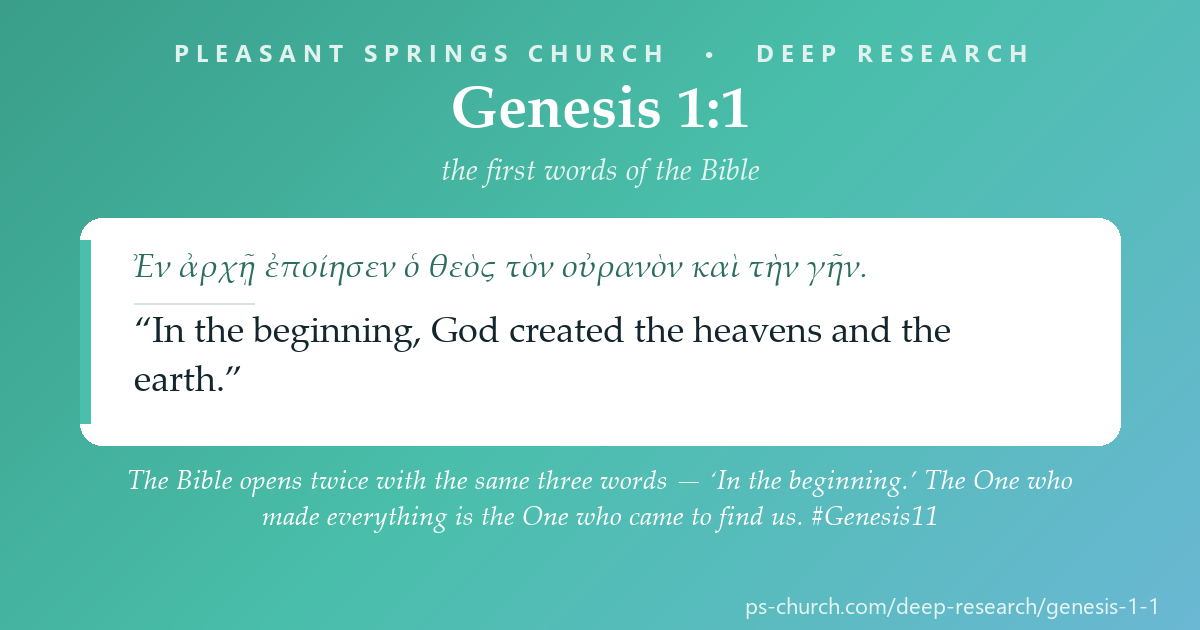
The Septuagint’s opening — the exact three words John reuses in John 1:1 (Ἐν ἀρχῇ ἦν ὁ λόγος) to rewrite Genesis with Christ the Word as agent.
The word that decides the doctrine — בָּרָא and the grammar of רֵאשִׁית:
Two lexical facts do enormous theological work. First, בָּרָא (bārāʾ) is reserved for God’s action alone and never specifies a material — it points to sovereign origination, not craftsmanship from a supply. (The doctrine of creatio ex nihilo rests on the whole canon — 2 Macc 7:28; Rom 4:17; Heb 11:3 — more than on this one word.) Second, the very first word, בְּרֵאשִׁית, can be read two ways:
- Absolute — “In the beginning, God created…” an independent main clause (so the LXX, Vulgate, Aquila, Josephus, and most English versions). This reading most naturally supports creation from nothing.
- Construct / dependent — “When God began to create… the earth was without form…” (so Rashi and NJPS), making v.1 a temporal clause and assuming a pre-existing formless state.
The ancient versions overwhelmingly took it as absolute; the church has read it so from the start. Either way, the sentence confesses a personal God as the origin of the cosmos.
How the New Testament reuses Genesis 1:1:
- John 1:1–3 — Ἐν ἀρχῇ ἦν ὁ λόγος: John opens with Genesis’ own words and identifies the Word (through whom “all things were made”) as the agent of Genesis 1. The Memphite “creation by word” is now a Person.
- Hebrews 11:3 — “the universe was created by the word of God, so that what is seen was not made out of things that are visible” — explicit ex nihilo.
- Colossians 1:16 — “by him all things were created… through him and for him.”
- 2 Corinthians 4:6 — “God who said, ‘Let light shine out of darkness’” now shines in the heart: Genesis 1 as the pattern of new creation.
- Revelation 21:1 — “a new heaven and a new earth”: the merism of Genesis 1:1 reopened at the end of the canon.
Where Genesis 1:1 reaches across the whole canon — and where the NT writers drew on it.
Trace cross-references in both directions and weigh the relationship. Then check whether Beale & Carson’s Commentary on the NT Use of the OT handles the connection.
Which cross-references matter, and what is the connection?
- Psalm 33:6–9 — “By the word of the Lord the heavens were made… he spoke, and it came to be.” Creation by word, sung.
- Isaiah 40–45 — the Creator polemic against idols; Isa 45:18, “he created (בָּרָא) the heavens… he did not create it empty (תֹּהוּ).”
- Exodus 20:11 — the Sabbath command grounded in the six days: Genesis 1 as the charter of Israel’s week.
- Proverbs 8:22–31 — Wisdom “at the beginning” of God’s way (LXX ἔκτισέν με ἀρχήν), the seedbed of later Wisdom-Christology.
- John 1:1–3; Colossians 1:15–17; Hebrews 1:2; 2 Peter 3:5; Revelation 4:11 — the NT’s sustained reading of creation through Christ.
Two links reframe the verse. (1) Proverbs 8:22 in the LXX — ἔκτισέν με, “he created me” — became the storm-center of the Arian controversy, precisely because it reads the divine Wisdom (identified with Christ) as “created” “at the beginning.” How you translate a creation word decided a Christological crisis. (2) Jubilees welds Genesis 1:1 to the angelic host and the sacred calendar — a Second-Temple witness that “the heavens” of day one were read as populated, the unseen realm created alongside the seen (cf. Col 1:16, ‘things visible and invisible’).
Beale & Carson — what does it add?
Here Beale & Carson is directly useful: its treatment of John 1:1 lays out how the Evangelist fuses Genesis 1:1 (ἐν ἀρχῇ) with the Wisdom/Logos tradition (Prov 8; Sirach 24; Wisdom of Solomon) to present Christ as the agent of creation — confirming the John–Genesis link identified above, and extending it through Colossians 1 and Hebrews 1. Genesis 1:1 is not quoted with a citation formula, but it is the deliberate template John rewrites.
The commentaries, monographs, and journals that go deepest on the first verse of the Bible.
Mine the major commentaries for text-critical and cultural detail, then go to the monographs and journals for the debates — here, the grammar of רֵאשִׁית, the ANE background, and the rise of creatio ex nihilo.
Commentaries — and what they contribute:
- Gordon Wenham, Genesis 1–15 (WBC) — the standard evangelical-critical treatment; defends the absolute reading of v.1.
- Claus Westermann, Genesis 1–11 — exhaustive on the history of interpretation and ANE background.
- Nahum Sarna, Genesis (JPS) — the Jewish reading, strong on the polemic against Mesopotamian myth.
- Victor Hamilton (NICOT), Kenneth Mathews (NAC), John Walton (NIVAC), and C. John Collins, Genesis 1–4 — the range of conservative options on days, cosmology, and grammar.
Text-critical & grammatical notes worth keeping:
- The LXX is a faithful, near-literal rendering of the Hebrew here; the Samaritan Pentateuch and Qumran Genesis fragments agree. The real crux is grammatical (absolute vs. construct רֵאשִׁית), not textual.
- The LXX chose ἐποίησεν (“made”) rather than ἔκτισεν (“created”) — a reminder that בָּרָא was not felt to be a technical “from-nothing” term at the lexical level.
Monographs & journals (starting points):
- John Walton, The Lost World of Genesis One and Genesis 1 as Ancient Cosmology — the “functional / cosmic-temple” case.
- Richard Clifford, Creation Accounts in the Ancient Near East; Jon Levenson, Creation and the Persistence of Evil; J. Richard Middleton, The Liberating Image (the image of God).
- Gerhard May, Creatio ex Nihilo — how the doctrine, rooted in Scripture (2 Macc 7:28; Heb 11:3), was philosophically articulated by the second century.
From the first verse of the Bible to a changed life this week.
Name what you learned, why it matters, and one concrete response — then share it.
What should we carry away — and do?
- It all belongs to him. If God made “the heavens and the earth,” then nothing is finally mine or autonomous — which turns life into stewardship and worship rather than ownership and anxiety.
- Matter is good. The Maker called it into being on purpose; the body and the world are not a prison to escape (against every gnostic instinct) but a gift to steward.
- No rival powers. The sun, the sea, the “gods” of the nations — and every modern fear dressed as fate — are creatures, not competitors. There is nothing to appease.
- The Beginner is the Re-creator. The God who said “Let there be light” is the same who shines new-creation light in the heart (2 Cor 4:6) and makes “a new heaven and a new earth” (Rev 21:1). Creation is the ground of hope.
Step in response: begin the day by receiving the world as made and given — “This is my Father’s world” — and read Genesis 1:1 next to John 1:1, letting the Word who made all things be the one you follow into the day.
Genesis 1:1 & John 1:1 · to share
LXX + ESVEvery Deep Research page traces its passage across the whole sweep — the Old Testament, the Second-Temple world between the testaments (historical witnesses, not Scripture), and the New Testament. Follow the thread:
Pleasant Springs Church — Deep Research
Research method after Michael S. Heiser’s Bible Research Method (examine dictionaries → ancient literature → important words → textual connections → academic publications → share), with the Pleasant Springs “Author & Audience” foundation. Scripture set in the Hebrew, the Greek editions named on each page and the ESV (Old Testament), and the Greek New Testament and the ESV (New Testament), per the practice of Pleasant Springs Church. Genesis 1:1 research grounded in Wenham, Westermann, Sarna, Walton, Clifford, Levenson and Middleton; ancient parallels drawn from Enuma Elish, the Egyptian cosmogonies, and the Second-Temple witnesses (Jubilees, Wisdom of Solomon, 2 Maccabees).
Scripture quotations marked ESV are from the ESV® Bible (The Holy Bible, English Standard Version®), © 2001 by Crossway, a publishing ministry of Good News Publishers. ESV Text Edition: 2016. Used by permission. All rights reserved. The ESV text may not be quoted in any publication made available to the public by a Creative Commons license, and the ESV may not be translated in whole or in part into any other language. www.esv.org
|
Did this study bless you today? 💚 Give to Support PS Church100% of gifts go to the General Fund — thank you. |