Between the first sentence of the Bible and the first sunrise lies one of Scripture’s most beautiful moments: the earth formless and dark, the Spirit of God brooding over the water, and a single spoken word — “Let there be light.” This study follows Genesis 1:1 into Day One, and hears how the neighbors’ chaos-myths are quietly undone. See the method →
Genesis 1:2–5
Hebrew · LXX · ESVThe Shape of the Passage
SequenceThe same Author and audience as Genesis 1:1 — Moses’ Torah, given to Israel among the creation-myths of Egypt, Canaan, and Babylon — but here the polemic sharpens into specific pictures the neighbors would recognize.
Author
As in verse 1, the voice is that of the Torah of Moses (Luke 24:27; John 5:46), presenting Israel’s God as the sole and sovereign Creator. Verse 2 does not describe a rival chaos God must defeat; it describes the raw canvas — unformed, empty, dark, watery — over which his Spirit already broods, waiting on his word.
Audience
To Israel — and to every neighbor whose gods were born from the primeval waters or the sun — verses 2–5 are pointed. The “deep” is not a goddess; the darkness is not a demon; and the light comes before the sun (which is not made until day four). The message: the God of Israel is himself the source of light, order, and life — the sun and sea his creatures, not his rivals.
Get the lay of the land on chaos, the Spirit, light, and the “days.”
Search by reference and topic: chaos/tohu wabohu, the deep, Spirit of God, light, creation days.
Which articles are relevant?
- Anchor Bible Dictionary — “Chaos,” “Creation,” “Spirit of God,” “Light.”
- Dictionary of the OT: Pentateuch — “Creation,” “Cosmology,” “Spirit of God.”
- TDOT / NIDOTTE — תֹּהוּ (tōhû), תְּהוֹם (təhôm), רוּחַ (rûaḥ), אוֹר (ʾôr).
Bibliography surfaced:
- Wenham, Genesis 1–15; Westermann, Genesis 1–11; Sarna, Genesis (JPS).
- David Tsumura, The Earth and the Waters in Genesis 1 and 2 (on tohu wabohu and the “deep”).
- Jon Levenson, Creation and the Persistence of Evil; John Walton, The Lost World of Genesis One.
The chaos-waters, the brooding wind, and light — against the neighbors’ myths.
Compare the Mesopotamian and Egyptian pictures of watery chaos and emerging light, and ask how Genesis demythologizes them.
Which parallels shed light on religion and worldview?
The “deep” that is not a goddess. Hebrew תְּהוֹם (təhôm, “the deep,” v.2) is linguistically related to Babylon’s Tiamat, the chaos-goddess Marduk splits to make the world in Enuma Elish. Genesis keeps the word and kills the myth: tehom is simply dark water, inert, no combat required. (Elsewhere — Ps 74:13–14; Isa 51:9 — Scripture can use the old chaos-combat imagery poetically; Genesis 1 pointedly does not.)
Light before the sun. In the neighbors’ myths the sun-god is a deity to be feared and served. Genesis withholds the sun until day four and lets light exist on day one by God’s word alone — a deliberate demotion of the sun from god to lamp (1:14–16).
“The Spirit of God was hovering” (מְרַחֶפֶת, məraḥep̄eṯ) — the same rare verb used of an eagle fluttering over its young (Deut 32:11). Where the myths have gods born from the waters or warring across them, Genesis has the personal Spirit of God tenderly poised over the formless deep, about to bring order and life. The Septuagint renders it ἐπεφέρετο (“was borne over”); the picture is care, not combat.
Second-Temple reception. Jubilees 2 retells this very day and adds that on it God also created the angels — of the presence, of sanctification, and of every natural force (winds, clouds, frost, the deeps) — reading day one as the creation of the unseen world alongside the seen. See our Jubilees 2 study for that retelling in full — and the book’s introduction for how to weigh the witness.
The words that decide how we picture the first day.
Watch tohu wabohu, the triple sense of ruach, and the cardinal “day one” — each has been read in very different ways.
“Wasteness and emptiness” — not evil chaos but the unformed, unfilled state the six days then form (days 1–3) and fill (days 4–6). LXX ἀόρατος καὶ ἀκατασκεύαστος.
The primeval water. Cognate to Babylon’s Tiamat — but here demythologized to mere dark sea. LXX ἄβυσσος (“abyss”).
רוּחַ means spirit, wind, breath all at once. LXX πνεῦμα θεοῦ — “the Spirit of God,” personal, brooding over the waters.
“Flutter, brood” — used of an eagle over its nest (Deut 32:11). Care and readiness, not conflict.
Light comes first, and God pronounces it טוֹב (“good”) — the refrain of the whole chapter. Creation is good by the Maker’s own verdict.
Not “the first day” but the cardinal “one day” (LXX ἡμέρα μία) — the day by which all others are measured.
“Was” or “became”? and the shape of the six days:
The verb in v.2, הָיְתָה (hāyəṯâ), normally means the earth simply “was” formless — the starting condition, not (as the old “gap theory” proposed) a ruined earth that “became” waste after a fall. Read straight, verses 2–5 set up the elegant logic of the whole chapter: the earth begins formless and empty (v.2), so God spends days 1–3 forming (light, sky/sea, land) and days 4–6 filling (lights, birds/fish, animals and humans). Day One’s light is the first act of form.
How the New Testament reuses Day One:
- 2 Corinthians 4:6 — “God who said, ‘Let light shine out of darkness,’ has shone in our hearts”: Day One as the pattern of conversion.
- John 1:4–5 — “the life was the light of men… the light shines in the darkness”: Genesis 1:3 becomes the coming of Christ.
- 1 John 1:5 — “God is light, and in him is no darkness at all.”
- The hovering Spirit reappears at Jesus’ baptism — the Spirit descending like a dove over the waters (Mark 1:10) — the dawn of new creation.
Where Day One echoes across the canon.
Trace the connections in both directions, and check Beale & Carson on the NT’s new-creation use of Genesis 1.
Which cross-references matter?
- Jeremiah 4:23 — “I looked on the earth, and behold, it was without form and void (תֹהוּ וָבֹהוּ)”: judgment pictured as creation reversed.
- Isaiah 45:18 — God “did not create it empty (תֹהוּ)”: the formless state was never the goal.
- Psalm 104:30 — “When you send forth your Spirit… you renew the face of the ground”: the brooding ruach, still at work.
- John 1:1–5; 2 Corinthians 4:6; 2 Peter 3:5 — the NT reading of light, word, and water.
- Revelation 21:23–25; 22:5 — the New Jerusalem needs “no sun… for the Lord God will be their light”: Day One’s light without the sun, fulfilled.
Day One’s light-before-the-sun is not a puzzle to be solved so much as a promise to be traced. Scripture ends where it began: in a city that needs no sun, lit by God himself (Rev 22:5). The first light and the last light are the same light — and John 1 tells us his name.
Beale & Carson:
Beale & Carson trace the NT’s new-creation theology — especially Paul’s in 2 Corinthians 4:6 and the Johannine light/darkness motif — back to Genesis 1:3. The verse is not quoted with a formula but is unmistakably the source; the darkness-to-light of the first day becomes the grammar of salvation.
The commentaries and studies on the first day.
Mine the commentaries for the tohu wabohu and “days” debates; then the monographs on the ANE waters and the framework of the six days.
Commentaries & studies:
- Wenham (WBC), Westermann (Continental), Sarna (JPS), Hamilton (NICOT), Mathews (NAC), Walton (NIVAC).
- David T. Tsumura, The Earth and the Waters in Genesis 1 and 2 — the case that tohu wabohu means “unproductive and uninhabited,” not evil chaos.
- Henri Blocher, In the Beginning — the “literary framework” reading of the six days.
Text-critical & interpretive notes:
- The LXX’s ἀόρατος καὶ ἀκατασκεύαστος (“invisible and unformed”) gave later Greek-reading interpreters (Philo, some Fathers) a Platonic doorway — a translation choice with a long theological afterlife.
- The debate over the “days” (24-hour, day-age, framework, functional) turns on יוֹם and the refrain “evening and morning” — a live and charitable in-house discussion, not a test of faith.
From the first morning to your own dark places.
Name what you learned, why it matters, and one concrete response.
What should we carry away — and do?
- God works over the formless. Before there was order, the Spirit was already hovering. He is not repelled by our chaos; he broods over it, ready to speak.
- Light before the sun. God is himself the source of light; he is not dependent on the very things people worship. Nothing you fear as “fate” is a rival to him.
- “And God saw that it was good.” Creation — and you in it — is pronounced good by the Maker before you ever performed. Worth precedes work.
Step in response: name the one “formless and void” corner of your life this week, and invite the same Spirit who hovered over the deep to begin his ordering work there — then read John 1:1–5 and watch Day One become the coming of Christ.
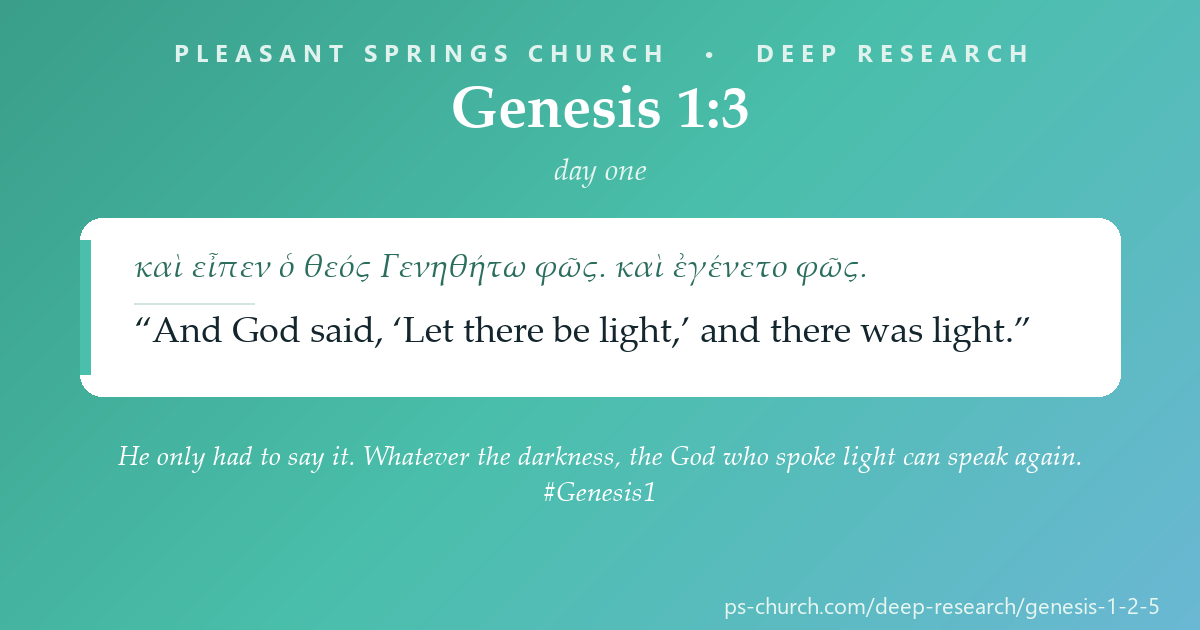
Genesis 1:3 · to share
LXX + ESVEvery Deep Research page traces its passage across the whole sweep — the Old Testament, the Second-Temple world between the testaments (historical witnesses, not Scripture), and the New Testament. Follow the thread:
Pleasant Springs Church — Deep Research
Research method after Michael S. Heiser’s Bible Research Method (examine dictionaries → ancient literature → important words → textual connections → academic publications → share), with the Pleasant Springs “Author & Audience” foundation. Scripture set in the Hebrew, the Greek editions named on each page and the ESV (Old Testament), and the Greek New Testament and the ESV (New Testament), per the practice of Pleasant Springs Church. Genesis 1:2–5 research grounded in Wenham, Westermann, Sarna, Tsumura, Blocher and Walton; ancient parallels from Enuma Elish and the Egyptian cosmogonies, read as polemic.
Scripture quotations marked ESV are from the ESV® Bible (The Holy Bible, English Standard Version®), © 2001 by Crossway, a publishing ministry of Good News Publishers. ESV Text Edition: 2016. Used by permission. All rights reserved. The ESV text may not be quoted in any publication made available to the public by a Creative Commons license, and the ESV may not be translated in whole or in part into any other language. www.esv.org
|
Did this study bless you today? 💚 Give to Support PS Church100% of gifts go to the General Fund — thank you. |