After the light, the architecture. Days two and three answer the drowned formlessness of verse 2 with a ceiling over the deep and a fence around the sea — the two powers the nations around Israel feared and worshiped, reduced to obedient construction by a few spoken words. This study follows Day One into the firmament, the gathered seas, and the first green shoots of a commissioned earth. See the method →
Genesis 1:6–13
Hebrew · LXX · ESVThe Shape of the Passage
Parallel panelsSame Author and audience as Genesis 1:1 — but days two and three speak straight into the ancient world’s two great terrors: the waters above, and the sea.
Author
The Torah of Moses continues the week with the two “forming” days that answer verse 2’s problem: the world was formless and drowned in water. Day two builds the great separation vertically (waters above / waters below); day three horizontally (seas / dry land) — and then, with land barely dry, the Author has God hand creation its first commission: “Let the earth sprout…”
Craft note. Day two is the only day of the six where the Masoretic text withholds “God saw that it was good” — most likely because the water-separation is unfinished business until day three bounds the seas; day three then receives the verdict twice (vv.10, 12).
Audience
Israel — a people whose neighbors deified both dangers. Above: the sky-ocean whose sluices could drown the world (the flood, Gen 7:11). Below and beside: the sea, home of chaos in Canaanite myth (Baal vs. Yamm, “Sea”) and Babylonian epic alike.
How they heard it. No battle, no rival: God speaks a ceiling over the deep, then draws a line in the sand the sea may not cross. For ex-slaves who would one day watch the sea itself stand aside on dry ground (יַבָּשָׁה, Exod 14:16, 22 — the same word as 1:9), days two and three were not cosmology trivia; they were the resume of the God who makes paths through every flood.
Orient on the firmament, the cosmic waters, and creation’s “kinds.”
Search by reference and topic: firmament, cosmology, sea, chaos, vegetation/kinds.
Which articles are relevant?
- Anchor Bible Dictionary — “Firmament,” “Cosmogony, Cosmology,” “Sea,” “Waters.”
- Dictionary of the OT: Pentateuch — “Cosmology,” “Creation,” “Chaos.”
- TDOT / NIDOTTE — רָקִיעַ (rāqîaʿ), בָּדַל (bādal), יָם (yām), מִין (mîn).
Bibliography surfaced:
- Wenham, Genesis 1–15 (WBC); Westermann; Sarna (JPS); Hamilton (NICOT).
- Paul H. Seely, “The Firmament and the Water Above,” Westminster Theological Journal 53 (1991) — the ancient solid-sky understanding documented.
- John Walton, Genesis 1 as Ancient Cosmology; David Tsumura, Creation and Destruction (chaos reassessed).
The sky that holds back an ocean, and the sea on a leash.
Compare the ANE pictures of sky and sea, then the Second-Temple retellings — Jubilees’ day two and three, 4 Ezra, and the Prayer of Manasseh’s shackled deep.
Which parallels shed light on religion and worldview?
The split sky — Enuma Elish. In Babylon’s epic, Marduk kills the sea-goddess Tiamat, splits her carcass “like a shellfish into two parts,” and sets half of her up as the sky — posting guards and a bar “so her waters could not escape.” Genesis shares the ancient picture (waters above, held back by a firm expanse) but has no corpse and no combat: the רָקִיעַ is spoken, not spoiled from a slain god. (Whether that is deliberate polemic or simply shared background is debated — Tsumura urges caution.)
The bounded sea. In the Canaanite and Babylonian myths Israel knew, the sea is the gods’ enemy; in Israel’s Scriptures it becomes a creature under house rules — “you fixed a boundary the waters may not pass” (Ps 104:9; Job 38:8–11; Prov 8:29; Jer 5:22). Genesis 1:9–10 is where that leash is first fastened. (Elsewhere Scripture does deploy the old combat imagery poetically — Ps 74:13–14; Isa 51:9 — but pointedly not here.)
- Jubilees 2:4–7 (Pseudepigrapha — a Second-Temple witness, not Scripture) — the retelling of these very days: day two’s only work is the firmament; day three counts four works — the gathered waters, the dry land… and the Garden of Eden planted on day three (Jubilees’ own expansion; Genesis first mentions Eden at 2:8). See our Jubilees 2 study.
- Prayer of Manasseh 2–4 (Apocrypha) — “you who shackled the sea by your word of command, who confined the deep and sealed it with your terrible and glorious name” — day three’s theology turned into a penitent’s praise.
- 4 Ezra 6:41–44 (2 Esdras, Apocrypha) — another day-by-day retelling: on day two the “spirit of the firmament” is commanded to divide the waters; on day three the waters are gathered into a seventh part of the earth so six parts can be inhabited and sown.
- Ugarit: Baal vs. Yamm (“Sea”) — Canaan’s storm-god must fight the sea for kingship; in Genesis the sea receives a name from its Maker (1:10) and a verdict: good.
Days two and three demote the ancient world’s two proudest powers — the sky-ocean and the sea — to obedient architecture. No wonder Israel’s poets kept returning here for comfort: the deep that terrifies is a creature on a leash, and the God who penned its boundary can also “make a way in the sea” (Isa 43:16).
The vocabulary that builds the world’s architecture.
Watch רָקִיעַ and its Greek afterlife, the priestly ring of בָּדַל, and the exodus echo sleeping in “dry land.”
“Expanse” — from רקע, to hammer/spread out (cf. Job 37:18, skies “hard as a cast metal mirror”; Ezek 1:22). LXX στερέωμα (“firm structure”) → Vulgate firmamentum → “firmament.”
“Separate, distinguish” — creation’s ordering verb, and later the priests’ own verb: distinguishing holy from common (Lev 10:10). The cosmos is ordered like a sanctuary.
“Dry land” — the same word on which Israel later crosses the sea (Exod 14:22) and the Jordan (Josh 4:22). Day three is the first exodus.
“Collection/gathering” of waters — the seas as a tidy plural under one name, not a pantheon. LXX συστήματα.
“According to its kind” (LXX κατὰ γένος) — ordered fruitfulness: seed faithfully yielding its own, the stability behind every harvest promise (Gen 8:22).
“Let the earth sprout” — mediate creation: God commissions the creature to produce. The world is granted real, delegated fruitfulness under the word.
The word that made the “firmament” — and what to do with it:
רָקִיעַ comes from a root meaning to hammer out (as a smith spreads metal — Exod 39:3), and the ancient versions heard solidity in it: LXX στερέωμα, Vulgate firmamentum. Ancient readers commonly pictured a firm vault holding back a heavenly ocean (Job 37:18; the flood’s “windows of heaven,” Gen 7:11), and Scripture speaks freely in that idiom (Seely, WTJ 53). The text’s claim is not a physics diagram but a theology: whatever holds the waters back, God spoke it, owns it, and named it — the sky is neither god nor goddess-corpse but ceiling-work. Scripture describes the world phenomenologically, as its first audience saw it, to say true things about its Maker.
How the New Testament reuses days two and three:
- 2 Peter 3:5 — “the earth was formed out of water and through water by the word of God”: Peter’s one-line summary of vv.6–10, aimed at scoffers who forget that the word which built the world can also judge it.
- Mark 4:39–41 — the Lord of day three asleep in a boat wakes and speaks to the sea; it obeys like a leashed creature, and the disciples ask the only sane question: “Who then is this?”
- Revelation 21:1 — “and the sea was no more”: in the new creation the last emblem of chaos is retired — day three’s leash ends in full peace.
- 1 Corinthians 15:38 — “God gives it a body as he has chosen, and to each kind of seed its own body”: Paul builds resurrection hope on day three’s seed-logic.
Where the firmament and the bounded sea echo across the canon.
Trace the boundary-of-the-sea texts, the dry-land exodus echoes, and the Second-Temple middle terms — then note where Beale & Carson picks up the thread.
Which cross-references matter?
- Job 38:8–11; Psalm 104:5–9; Proverbs 8:27–29; Jeremiah 5:22 — the sea’s boundary celebrated: “Thus far shall you come, and no farther.”
- Psalm 148:4 — “praise him… you waters above the heavens”: day two’s waters, drafted into the choir.
- Exodus 14:16–22; Joshua 4:22–24 — יַבָּשָׁה, dry land through the waters: redemption replays creation.
- Genesis 7:11 — the flood as day two run in reverse: the windows of heaven opened, the fountains of the deep burst — un-creation, before the ark’s new beginning.
- Jubilees 2:4–7; Prayer of Manasseh 2–4; 4 Ezra 6:41–44 — the Second-Temple middle terms (see Stage 2).
- 2 Peter 3:5–7 — the NT’s direct pickup: world formed through water, preserved for fire — the same word doing both.
The commentary’s treatment of 2 Peter 3:5–7 confirms the link: Peter is consciously retelling Genesis 1:6–10 (with the flood of Gen 7 as its undoing) to argue that history’s stability rests on God’s word, not nature’s momentum. Likewise its Revelation 21:1 discussion reads “no more sea” against the whole bounded-chaos tradition that begins at 1:9–10. Days two and three are quietly load-bearing for the New Testament’s doctrine of providence and new creation.
“You shackled the sea by your word of command; you confined the deep and sealed it with your terrible and glorious name.”Prayer of Manasseh 3 — Apocrypha, praying Genesis 1:9
The scholarship on the sky, the seas, and the LXX’s little differences.
Wenham and Westermann for the exegesis; Seely and Walton for the cosmology debate; Tsumura for the deflating of “chaos”; the Göttingen/Rahlfs apparatus for the LXX pluses.
Commentaries & studies:
- Wenham (WBC), Westermann, Sarna (JPS), Hamilton (NICOT), Mathews (NAC), Collins (Genesis 1–4).
- Paul Seely, “The Firmament and the Water Above,” WTJ 53 (1991) & 54 (1992) — the ancient understanding of רָקִיעַ.
- John Walton, Genesis 1 as Ancient Cosmology — function over materials; David Tsumura, Creation and Destruction — why Genesis’ waters are not mythic combat.
- J. van Ruiten, Primaeval History Interpreted — for Jubilees’ handling of these days.
Text-critical notes worth keeping:
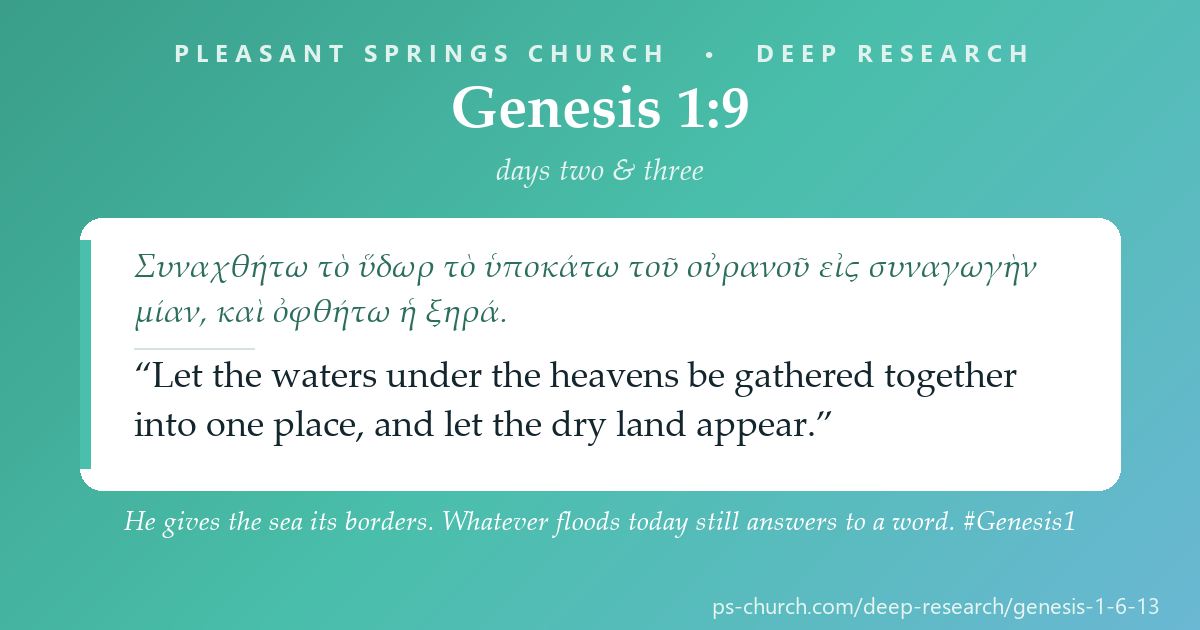
- Day two’s missing “good.” MT withholds the approval formula on day two — the LXX supplies it (v.8 καὶ εἶδεν ὁ θεὸς ὅτι καλόν). Rabbinic explanation: the waters’ work was unfinished until day three — which is why day three gets “good” twice (vv.10, 12).
- The v.9 LXX plus. The Greek adds the execution report (“and the water… was gathered, and the dry land appeared”) — and a Qumran Genesis manuscript (4QGenᵏ, 4Q10) may show Hebrew support for such a reading (the fragment is damaged): a live little window into the text’s transmission.
- συναγωγή for “gathering” (v.9 LXX) — the waters are collected into one synagōgē: Greek-speaking readers heard the word their own assemblies used.
From the world’s architecture to this week’s floods.
Name what you learned, why it matters, and one concrete response.
What should we carry away — and do?
- The deep has a ceiling and the sea has a fence — and both are words. Whatever feels oceanic in your life this week answers to the same voice (Mark 4:39).
- Some days end without “good” — and the week is still God’s. Day two’s verdict waited on day three’s completion. Unfinished is not abandoned.
- Fruit comes from rooted, seeded, patient order — “each according to its kind.” God builds fruitfulness into faithful structure, not spectacle (cf. Psalm 1:3).
Step in response: name your “sea” — the thing that feels boundless and threatening — and pray Job 38:11 over it: “Thus far shall you come, and no farther.” Then plant one seed-sized act of order in the flooded area and let day-three logic work.
Genesis 1:9 · to share
LXX + ESVEvery Deep Research page traces its passage across the whole sweep — the Old Testament, the Second-Temple world between the testaments (historical witnesses, not Scripture), and the New Testament. Follow the thread:
Pleasant Springs Church — Deep Research
Research method after Michael S. Heiser’s Bible Research Method (examine dictionaries → ancient literature → important words → textual connections → academic publications → share), with the Pleasant Springs “Author & Audience” foundation. Scripture set in the Hebrew, the Greek editions named on each page and the ESV (Old Testament), and the Greek New Testament and the ESV (New Testament), per the practice of Pleasant Springs Church. Genesis 1:6–13 research grounded in Wenham, Westermann, Sarna, Seely, Walton, and Tsumura; ancient parallels from Enuma Elish and Ugarit; Second-Temple witnesses per Jubilees 2, the Prayer of Manasseh, and 4 Ezra.
Scripture quotations marked ESV are from the ESV® Bible (The Holy Bible, English Standard Version®), © 2001 by Crossway, a publishing ministry of Good News Publishers. ESV Text Edition: 2016. Used by permission. All rights reserved. The ESV text may not be quoted in any publication made available to the public by a Creative Commons license, and the ESV may not be translated in whole or in part into any other language. www.esv.org
|
Did this study bless you today? 💚 Give to Support PS Church100% of gifts go to the General Fund — thank you. |