The ancient world agreed on one thing about the sea: no king, however great, commands it — the Jews of the era told with relish how God struck down a tyrant for imagining he could. Then, one evening on Galilee, a carpenter-rabbi stood up in a swamped fishing boat and gave the sea an order. This study takes the storm scene all the way down — from the fenced waters of Genesis 1:9 to the question that ends it: Who then is this? See the method →
Mark 4:35–41
Greek NT · ESVThe Shape of the Passage
ConcentricWho wrote this, to whom, in what situation? Mark’s storm story is told by someone who was either in the boat or heard it from someone who was — and told to a church in its own storm.
Author
Church tradition from Papias onward names Mark, “interpreter of Peter,” writing down Peter’s preaching — identified in the broader tradition with the John Mark of Acts 12:12, 25, companion of Paul and Barnabas. The scene reads like Peter’s own memory: the time of day, the “other boats,” taking Jesus “just as he was,” and above all the cushion (προσκεφάλαιον) — the kind of useless, unforgettable detail eyewitnesses keep.
Craft. Mark builds the story on three “greats”: a great windstorm, a great calm, a great fear — the last one aimed not at the weather but at the Person asleep in the stern.
Audience
Most locate Mark’s first readers in Rome in the 60s AD, a church learning what discipleship costs under Nero. They knew their Scriptures in Greek: the sea as the untamable power that only God bounds (Genesis 1:9–10; Ps 107), and the pagan claim — mocked in their own era — that a great king might “command the waves.”
How they heard it. A church “swamped” and wondering if the Teacher cares hears its own prayer in v.38 — and its answer in v.39. The disciples’ closing question, “Who then is this?”, is Mark’s question to every reader: the storm exists in the story so the Person can be identified.
Orient on the sea, miracles of nature, and Mark’s Christology.
Search by topic: sea (of Galilee), storm, miracles, Son of God in Mark, theophany.
Which articles are relevant?
- Dictionary of Jesus and the Gospels (IVP) — “Miracles and Miracle Stories,” “Sea of Galilee,” “Son of God,” “Faith.”
- Anchor Bible Dictionary — “Sea,” “Storm,” “Galilee, Sea of,” “Mark, Gospel of.”
- NIDNTTE — ἐπιτιμάω (rebuke), φιμόω (muzzle), πίστις.
Bibliography surfaced:
- R. T. France, The Gospel of Mark (NIGTC); Robert Guelich, Mark 1–8:26 (WBC); Joel Marcus, Mark 1–8 (AB).
- Richard Bauckham, Jesus and the Eyewitnesses — the case that Mark preserves Peter’s eyewitness testimony.
- Richard Hays, Reading Backwards / Echoes of Scripture in the Gospels — the storm-stilling as divine-identity Christology.
Who can command the sea? The ancient world’s answer — and its parodies.
The bounded sea is God’s signature act in Israel’s Scriptures. Set beside that the Second-Temple stories of storms, sleeping saints, and a king who thought the waves would obey him.
Which parallels shed light on religion and worldview?
The Old Testament baseline. Bounding, stilling, and treading the sea is divider-of-the-waters work that Scripture reserves for God alone: he “shut in the sea with doors” (Job 38:8–11), he “stills the roaring of the seas” (Ps 65:7), he “made the storm be still” for terrified sailors (Ps 107:29). That is the resume the disciples’ question reaches for.
- 2 Maccabees 9:8 (Apocrypha/Deuterocanon — a valued witness, not Scripture) — the arrogant Antiochus IV “thought in his superhuman arrogance he could command the waves of the sea” — and God struck him down. Second-Temple Jews told this story as the definition of blasphemous pride: only God commands the sea.
- Testament of Naphtali 6 (Pseudepigrapha, likewise non-canonical) — a storm scatters the patriarchs’ ship until the prayer of Levi ends it: the era’s pious storm-story shape — the saint prays, God calms. Jesus does not pray for calm; he issues orders.
- Jonah 1 — the canon’s own sleeping passenger in a deadly storm; the sea is stilled only when God is dealt with. Mark’s scene shadows it at point after point — sleeper, terrified crew, stilled sea, greater fear afterward — and Jesus is “greater than Jonah” (Matt 12:41).
- 1QH (Hodayot) X–XIV (Dead Sea Scrolls — a Second-Temple witness, not Scripture) — the Qumran psalmist repeatedly prays like “a sailor in the raging seas”: the storm as the era’s stock image of the righteous overwhelmed.
In Jewish telling after telling, the human in the storm prays up; the sea answers only to God. Antiochus is damned precisely for imagining the waves would take his orders. So when Jesus wakes and speaks directly to the sea — and it obeys — Mark’s first readers had no comfortable category left: prophets like Moses and Elisha prayed and God answered, but this man gives the sea its orders himself. Two live options remain: blasphemous madman, or the Maker of Genesis 1:9 in the stern. “Who then is this?” is the only question left.
The vocabulary of command — and the question it forces.
Watch the exorcism-verbs aimed at the weather, and the three “greats” that structure the scene.
A furious squall — the word used of Galilee’s sudden down-mountain windstorms. Mark’s storms are meteorologically at home.
“The cushion” — the boat’s stern-seat pad, remembered with the definite article. The eyewitness texture of Peter’s telling.
“Rebuked” — the same verb Mark uses when Jesus silences a demon (1:25). The hostile power is addressed, not negotiated with.
“Be muzzled!” — the very command given the unclean spirit in 1:25 (φιμώθητι). The sea is leashed like a snapping animal.
“A great calm” — answering the “great windstorm.” Not a lull: a flat, unnatural stillness with the wind still ringing in their ears.
“Who then is this?” — Mark’s hinge question. Psalm 107 answers it: the one the sailors cried to was the Lord.
The wording that carries the theology:
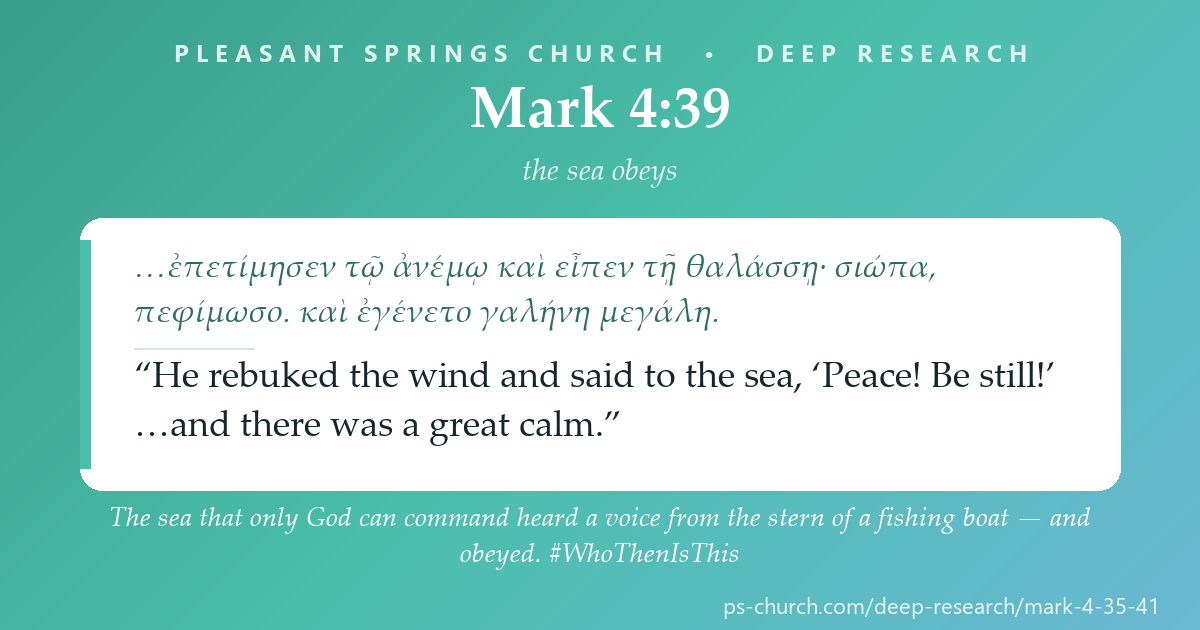
Mark gives the storm the grammar of an exorcism: Jesus “rebukes” (ἐπετίμησεν) the wind and “muzzles” (πεφίμωσο) the sea — the identical verbs used on the demon in Mark 1:25. That need not make the weather demonic; it means Jesus addresses the old emblem of chaos the way a master addresses something that has no vote. And the disciples’ fear grows after the danger passes — “they feared a great fear” (v.41) — because a stilled sea in the boat is more unsettling than a storm outside it: they are in the presence of the One Psalm 107 says the sailors cried to.
Psalm 107 in a fishing boat — the canon’s sea-thread lands here.
Trace the OT storm texts under the scene, the Jonah shadow, and where the thread runs next — then note the divine-identity reading the echoes force.
Which cross-references matter?
- Psalm 107:23–30 (LXX 106:23–30) — sailors in a storm cry to the Lord; “he made the storm be still, and the waves of the sea were hushed… and he brought them to their desired haven.” Mark 4 is this psalm enacted — with Jesus in the Lord’s role. (Mark’s ἐκόπασεν, “the wind ceased,” echoes Jonah 1:11–12 LXX, κοπάσει.)
- Jonah 1:4–16 — the sleeping passenger, the terrified crew, the sea gone quiet, the men who “feared a great fear” (Jonah 1:10 LXX = Mark 4:41’s wording; in 1:16 that fear turns to the Lord): the shadow-story Jesus outgrows.
- Genesis 1:9–10; Job 38:8–11; Psalm 65:7; 89:9 — the sea bounded and stilled as God’s signature.
- Mark 6:45–52 — the sequel: Jesus treads the sea (cf. Job 9:8) and says ἐγώ εἰμι — “It is I,” words that in this Job 9:8 setting carry the ring of the divine “I AM.”
- Revelation 21:1 — “the sea was no more”: the emblem of chaos finally retired by the same Lord.
From the fenced sea of Genesis 1:9, through the Second-Temple certainty that only God — never a king — commands the waves (2 Macc 9:8), the thread arrives at a wet fishing boat where a word does what Israel’s Scriptures insist only the Creator can do.
The commentaries and studies that go deepest here.
France and Marcus for exegesis; Bauckham for the eyewitness texture; Hays for the divine-identity echoes.
Commentaries & studies:
- R. T. France (NIGTC), Joel Marcus (AB), Robert Guelich (WBC), James Edwards (PNTC), William Lane (NICNT).
- Richard Bauckham, Jesus and the Eyewitnesses — Petrine detail and the “inclusio of eyewitness testimony.”
- Richard Hays, Echoes of Scripture in the Gospels — Psalm 107 and Job 38 as Mark’s answer to “Who then is this?”
Interpretation notes worth keeping:
- The exorcism-verbs (ἐπιτιμάω, φιμόω) are noted by all the majors; whether the storm is personal-hostile or merely creation-out-of-joint, the command-authority is the point.
- “Have you still no faith?” (v.40) — Mark’s disciples are chronically slow (8:17–21); the storm scene starts the Gospel’s long tutorial in trusting the sleeping King.
- Parallels: Matt 8:23–27 and Luke 8:22–25 tell the same event with their own accents (Matthew: “little-faiths”; Luke: “where is your faith?”).
From the stern cushion to your own squall.
Name what you learned, why it matters, and one concrete response.
What should we carry away — and do?
- A sleeping Jesus is not an absent Jesus. The disciples read sleep as indifference (“do you not care?”); it was actually the rest of the One who knew how the crossing would end.
- The sea still takes orders. Whatever is swamping the boat this week belongs to the category of things that obey him — the fence of Genesis 1:9 has not moved.
- The right fear displaces the wrong one. The storm-fear shrank when the Person-awe arrived. Reverence is the cure for panic.
Step in response: pray Psalm 107:28–30 over your loudest storm this week — then answer the boat’s question out loud, with Peter: “You are the Christ” (Mark 8:29).
Mark 4:39 · to share
Greek NT + ESVEvery Deep Research page traces its passage across the whole sweep — the Old Testament, the Second-Temple world between the testaments (historical witnesses, not Scripture), and the New Testament. Follow the thread:
Pleasant Springs Church — Deep Research
Research method after Michael S. Heiser’s Bible Research Method (examine dictionaries → ancient literature → important words → textual connections → academic publications → share), with the Pleasant Springs “Author & Audience” foundation. Scripture set in the Hebrew, the Greek editions named on each page and the ESV (Old Testament), and the Greek New Testament and the ESV (New Testament), per the practice of Pleasant Springs Church. Mark 4:35–41 research grounded in France, Marcus, Guelich, Bauckham, and Hays; Second-Temple storm material per 2 Maccabees 9:8, Testament of Naphtali 6, and the Qumran Hodayot (all read as witnesses, not Scripture).
Scripture quotations marked ESV are from the ESV® Bible (The Holy Bible, English Standard Version®), © 2001 by Crossway, a publishing ministry of Good News Publishers. ESV Text Edition: 2016. Used by permission. All rights reserved. The ESV text may not be quoted in any publication made available to the public by a Creative Commons license, and the ESV may not be translated in whole or in part into any other language. www.esv.org
|
Did this study bless you today? 💚 Give to Support PS Church100% of gifts go to the General Fund — thank you. |