Every reader hears the Psalter under Mark 15. The dereliction, the garments cast for by lot, the wagging heads, the taunt about a God who might rescue him — all of it sits in Psalm 22, in that order. So we measured it: sixty-six verses of Mark 15 and 16 screened against the whole Greek Old Testament on our disk, 30,637 verse units, tie bands reported. The deepest verbatim contact in the passage is four words. Psalm 22 measures three at the cry from the cross and two at the dividing of the garments — while John 19:24, narrating the same soldiers and the same garments, measures twelve, with a citation formula attached. Then there are the endings, of which our corpus holds three. See the method →
Mark 15:1–16:20
Greek NT · ESVThe Shape of the Passage
A sequence on a clock — and then an appendix outside the clockWho wrote this, to whom, in what situation? Mark 15–16 is the end of the shortest Gospel — and, on the text most editors print, the most abrupt ending in the New Testament.
Author
Church tradition from Papias (early 2nd c., via Eusebius, Hist. eccl. 3.39.15) names John Mark as Peter’s interpreter, writing down what Peter preached “accurately, though not in order.” The Gospel is anonymous; the tradition is early and reasonably consistent, and this page neither leans on it nor disputes it.
Two features of Mark’s writing are measurable and both matter here. First, he is a paratactic writer: 410 of Mark’s 673 verse rows begin with καί — 60.9%, counted across the whole Gospel. Second, he translates: μεθερμηνεύω occurs three times in Mark (5:41; 15:22; 15:34), and two of the three are in this passage. He assumes readers who need Aramaic explained and Latin words used without explanation.
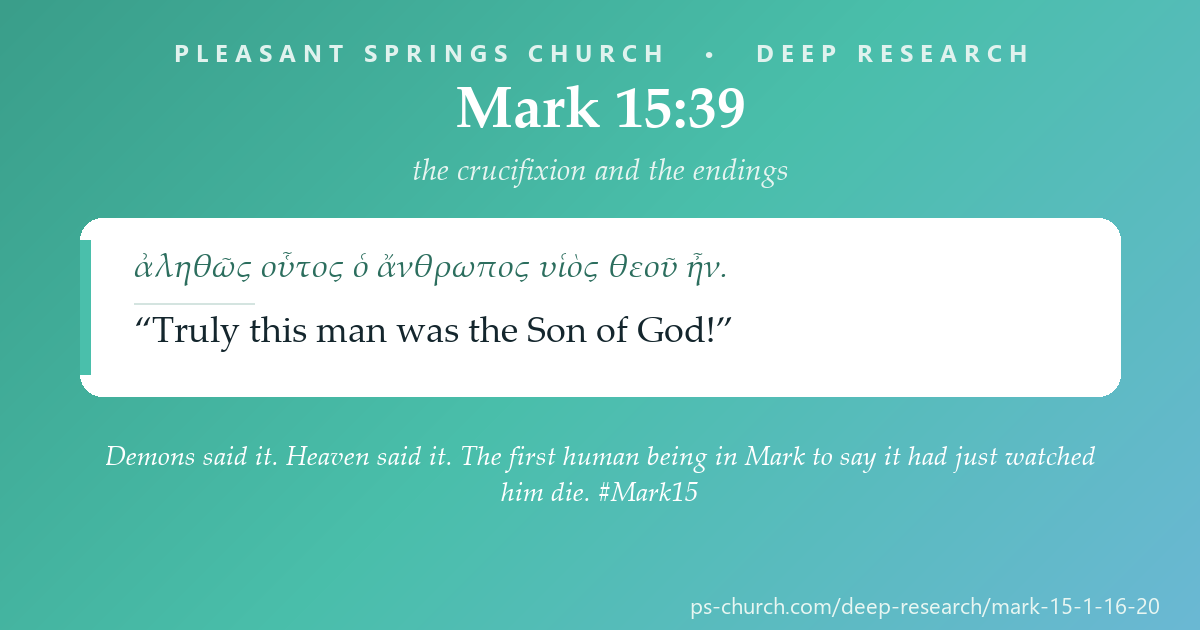
Placement matters. Mark has been withholding the confession the whole book. Demons say it (3:11; 5:7 — at 1:24 the unclean spirit says something else, ὁ ἅγιος τοῦ θεοῦ); the voice from heaven says it (1:11; 9:7); Peter says half of it and is rebuked (8:29–33). No human being in this Gospel calls Jesus υἱὸς θεοῦ until 15:39, and the man who does is the officer commanding the execution detail.
Audience
Gentile readers in a Roman environment, most often placed at Rome in the 60s AD though Syria and the mid-70s are seriously argued. Mark explains Jewish custom (7:3–4) and translates Aramaic, but he does not translate his Latin. Three Latin loanwords stand in this chapter alone: φραγελλόω (flagellare, 15:15), πραιτώριον (praetorium, 15:16) and κεντυρίων (centurio, 15:39, 44, 45); beside them the native Greek σπεῖρα is pressed into service for a Roman cohort at 15:16. The last of the three is worth pausing on: κεντυρίων occurs three times in the whole Greek New Testament and all three are in Mark 15. Matthew and Luke, narrating the same officer, both reach for the ordinary Greek noun instead — ἑκατόνταρχος at Matthew 27:54, ἑκατοντάρχης at Luke 23:47.
The audience is being told a story it can be killed by. If Mark writes near the Neronian persecution, then a narrative in which the hero is executed by the state, abandoned by his friends, and vindicated only after the fact is not a curiosity. The disciples in these chapters do nothing at all: no disciple is present anywhere in 15:1–16:8. Counted across the Gospel, μαθητής last occurs at 14:32 and Πέτρος at 14:72; neither word appears again until 16:7, and there they are the object of a message rather than people in the room. The people who stay are women watching from a distance (15:40–41), a member of the council who has to work up courage (15:43), and a pagan soldier.
And the audience is left holding a problem. At 14:28 Jesus promised, προάξω ὑμᾶς εἰς τὴν Γαλιλαίαν; at 16:7 the young man repeats it — the run between those two verses is four consecutive word forms, ὑμᾶς εἰς τὴν Γαλιλαίαν. On the text most editions print, the promised meeting is never narrated. Every ending Mark has ever been given is, in one way or another, an answer to that.
Orient on crucifixion, the Roman trial, Jewish burial practice, the empty tomb, and the textual problem of the endings.
Search by reference and by topic: crucifixion, Pontius Pilate, Barabbas, Golgotha, praetorium, centurion, veil of the temple, Joseph of Arimathea, burial, empty tomb, resurrection appearances, endings of Mark, textual criticism.
Which articles are relevant?
- Dictionary of Jesus and the Gospels (IVP) — “Death of Jesus,” “Trial of Jesus,” “Pilate,” “Burial of Jesus,” “Resurrection,” “Mark, Gospel of,” “Endings of Mark.”
- Anchor Bible Dictionary — “Crucifixion,” “Golgotha,” “Pilate, Pontius,” “Praetorium,” “Arimathea,” “Tomb,” “Sanhedrin.”
- NIDNTTE — σταυρόω, σχίζω, καταπέτασμα, ἐκπνέω, ἐγείρω, μνημεῖον, ἀπιστέω.
- Dictionary of New Testament Background (IVP) — “Crucifixion,” “Roman Law and Legal System,” “Burial Practices, Jewish,” “Josephus,” “Tacitus.”
- Metzger, A Textual Commentary on the Greek New Testament — the entry on Mark 16:9–20 is the single most useful dictionary-length treatment of the endings, and it prints all four forms of the ending side by side.
Bibliography surfaced:
- R. T. France, The Gospel of Mark (NIGTC); Joel Marcus, Mark 8–16 (AYB); Adela Yarbro Collins, Mark (Hermeneia); Robert Gundry; Craig Evans (WBC); Morna Hooker (BNTC).
- Raymond E. Brown, The Death of the Messiah, 2 vols. — the standard reference on every verse of the passion narratives, and the place to check any claim made here about Mark 15.
- Martin Hengel, Crucifixion in the Ancient World and the Folly of the Message of the Cross — the classic collection of the Greco-Roman evidence.
- Bruce Metzger & Bart Ehrman, The Text of the New Testament; James Kelhoffer, Miracle and Mission (on the longer ending); Nicholas Lunn, The Original Ending of Mark (arguing for authenticity, against the majority).
- N. Clayton Croy, The Mutilation of Mark’s Gospel, on the lost-ending hypothesis; and, on the other side, the essays collected in Perspectives on the Ending of Mark (B&H, 2008).
What a Roman execution was, what a Jewish burial required, and what the ancient world said about a crucified man.
Set each element beside its Roman and Second-Temple neighbours, then ask what Mark keeps and what he leaves out.
Which parallels shed light on religion and worldview?
Crucifixion was designed to be unspeakable, and the Romans said so. Cicero calls it crudelissimum taeterrimumque supplicium — “the most cruel and disgusting penalty” (In Verrem 2.5.165) — and in Pro Rabirio 16 says the very word crux should be kept far from the ears of Roman citizens. Josephus, who watched it happen at the siege of Jerusalem, calls it “the most wretched of deaths” (War 7.203) and reports the soldiers nailing captives in grotesque postures until there was no room for crosses (War 5.449–451). Seneca (Dialogues 6.20.3) describes the variety of the postures. Nothing in Mark’s account is presented as unusual; the horror of it is assumed and not described.
There is one piece of physical evidence. In 1968 an ossuary from Giv‘at ha-Mivtar, north of Jerusalem, was found to contain the heel bone of a man named Yehohanan with an iron nail still through it, bent on a knot in the wood. It remains, more than fifty years on, effectively the only skeletal evidence of a crucified man from Roman Judea — which is itself a comment on how rarely the crucified were buried at all.
And that is why Joseph of Arimathea is a scandal and not a detail. Roman practice was to leave the body on the cross; Horace and Juvenal both take carrion birds on a cross as a stock image. Against that stands Jewish law — Deuteronomy 21:22–23 requires a hanged body to be taken down before nightfall — and Josephus says explicitly that Jews took down and buried the crucified before sunset (War 4.317). Philo (Flaccus 83) records bodies released for burial on the emperor’s birthday. Mark’s Joseph has to τολμήσας — take courage — to ask; that verb is the narrator’s judgement on what he is doing.
The mockery scene reads like a Roman ritual, and scholars have said so for a century. Purple, a crown, an acclamation, a procession, a place of the skull, two flanking figures, wine offered and refused: T. E. Schmidt argued the whole sequence is a deliberate parody of a Roman triumph. The proposal is genuinely interesting and it is not a measurement — there is no verbatim contact to test, because the Roman triumph is a practice and not a text on our disk. We flag it as a literary-historical reading, and Stage 5 says why it stays a reading.
A righteous man mocked, with a taunt about God rescuing him, is a Second-Temple set piece. Wisdom of Solomon 2:12–20 has the wicked plotting against “the righteous man” and daring him: εἰ γάρ ἐστιν ὁ δίκαιος υἱὸς θεοῦ ἀντιλήμψεται αὐτοῦ — “for if the righteous man is God’s son, he will help him.” The vocabulary is startlingly close to the taunt in Mark 15:31–32 and closer still to Matthew 27:43. And here is the measurement: of the eighteen pairs — Mark 15:31 and 15:32 against each of Wisdom 2:12–20 — seventeen run one and one runs zero (15:31 against Wisdom 2:20, which on the Greek-side convention means they share no word form at all); Matthew 27:43 runs one against Wisdom 2:18. The parallel is real in substance and invisible to a run-length screen — see Stage 4.
Darkness at midday had a prophetic address. Amos 8:9 — δύσεται ὁ ἥλιος μεσημβρίας καὶ συσκοτάσει ἐπὶ τῆς γῆς ἐν ἡμέρᾳ τὸ φῶς — “the sun shall set at noon, and the light shall darken on the earth in the daytime.” Every commentator names it behind Mark 15:33. The measured run between them is one.
The striking thing about Mark 15 beside its neighbours is the omissions. There is no explanation of the darkness, no earthquake, no opened tombs, no dialogue with a repentant thief, no word to his mother, no “Father, forgive them,” and no “It is finished.” In these two chapters Jesus speaks exactly twice before the longer ending: two words to Pilate at 15:2 (Σὺ λέγεις), and one line from the cross in Aramaic at 15:34. Between 15:34 and the end of verse 8, where the earliest attested form of the Gospel stops, he says nothing at all. What the ancient parallels supply is context for the horror. What they cannot supply is the reason Mark tells it this bare.
The vocabulary of an execution — and the vocabulary that separates the endings.
Counts below are exhaustive over the SBLGNT held here (7,927 verses, MorphGNT lemma column) and the CATSS Greek Old Testament files held here (30,637 verse units in 64 files). Where a count is a negative, it is a negative on those corpora, and we say so.
“To crucify.” Eight verses of Mark carry this verb and every one of them is in this passage — 15:13, 14, 15, 20, 24, 25, 27 and 16:6. The word Mark’s whole book has been moving toward does not appear in it until the crowd shouts it. Its last occurrence is a perfect participle in the mouth of the young man at the tomb: τὸν ἐσταυρωμένον, “the crucified one” — a title, not an event.
“King.” Twelve verses in Mark; six of them here, and all six before the darkness. Screened as a phrase across the Greek New Testament, βασιλεύς τῶν Ἰουδαίων in its three cases stands in Mark at 15:2, 9, 12, 18 and 26, and βασιλεύς Ἰσραήλ at 15:32. Every one of the six is spoken by an enemy, a soldier, a mocker, or a signboard. Nobody who believes it says it.
The Latin centurio in Greek letters. Three verses in the entire Greek New Testament, and all three are Mark 15. Matthew 27:54 writes ἑκατόνταρχος and Luke 23:47 ἑκατοντάρχης instead. A writer who bothers to translate Talitha koum for his readers does not bother to translate centurio.
“To tear, rend.” Exactly two verses of Mark: 1:10, where Jesus sees the heavens σχιζομένους at his baptism, and 15:38, where the curtain ἐσχίσθη at his death. Matthew and Luke both use the gentler ἀνοίγω at the baptism. The distribution is a fact; what it means is Stage 5’s question.
“Curtain.” One verse of Mark. Mark never says which curtain — the outer one visible from the court, or the inner one before the Most Holy Place — and neither will we. Josephus (War 5.212–214) describes the outer veil as a Babylonian tapestry showing the heavens; that is a reason the ambiguity has been argued for centuries, not a solution to it.
“To breathe out, expire.” Three verses in the whole Greek New Testament — Mark 15:37, Mark 15:39 and Luke 23:46. Mark uses the flat clinical verb twice in three verses and never says “he died.” The centurion’s confession is triggered by how he expired: ὅτι οὕτως ἐξέπνευσεν.
“To translate.” Three verses in Mark (5:41; 15:22; 15:34), eight in the New Testament. Both of Mark’s uses here open a window on his readers: they need Golgotha glossed and they need Eloi Eloi lema sabachthani glossed. The gloss at 15:34 is the reason the deepest quotation in this passage cannot be measured by a Greek screen — see Stage 4.
“Hour.” Ten verses in Mark. The last three are these, and they run third, sixth, ninth — a three-hour grid laid over six hours of dying. Mark is the only evangelist who dates the crucifixion to the third hour. There is no ὥρα anywhere in 16:9–20.
Four verses of Mark, and no follower of Jesus is named anywhere in the Gospel after 16:9. The only other name in these chapters is Peter, at 16:7 and again inside the shorter ending. She sees him die (15:40), sees where he is laid (15:47), comes to anoint him (16:1) — and then the longer ending introduces her all over again at 16:9 as the woman “from whom he had cast out seven demons,” a fact the previous 661 verse rows of Mark never mention. That reintroduction is one of the seams Stage 5 discusses.
“Young man.” Exactly two verses of Mark: 14:51, the young man who runs away naked when Jesus is arrested, and 16:5, the young man sitting in the tomb in a white robe. Two occurrences, seventy-two verse rows apart, at the two ends of the passion. Commentators have made a great deal of that; a word count can only say that it is true.
“To go, journey.” Three verses of Mark, and all three are inside the longer ending. The Gospel that has moved people around for 662 verse rows has done it with other verbs. Matthew uses πορεύομαι 29 times, Luke 51. This is the sharpest single lexical datum in the endings question — and Stage 6’s companion section shows why it is not, by itself, decisive.
“For.” It stands 66 times in Mark, across 63 verses; not one of them is in 16:9–20. And 16:8 ends on it: ἐφοβοῦντο γάρ. Screened across the whole Greek New Testament as we hold it, exactly one verse ends with γάρ — John 13:13 — because MorphGNT files the shorter ending inside the 16:8 row. Cut the row where verse 8 ends and there are two.
“To disbelieve.” Two verses of Mark, both in the longer ending. Its relatives cluster there too: ἀπιστία at 16:14, πιστεύω four times in five verses (16:13, 14, 16, 17). Whatever the longer ending is, its subject is unbelief — which is a reasonable thing to write if you are reaching for an ending to a book that stops at frightened silence.
What the word counts actually show
Ten lemmas in the whole Greek New Testament occur nowhere outside these two chapters — counted exhaustively over the 7,927 verses held here: κεντυρίων (15:39, 44, 45), Σαλώμη (15:40; 16:1), στασιαστής — “rebel,” 15:7 — σμυρνίζω — “to mix with myrrh,” 15:23 — οὐά, the jeer “Aha!” at 15:29, ἐλωΐ (15:34), προσάββατον — “the day before the Sabbath,” 15:42 — ἐνειλέω, “to wrap,” 15:46, θανάσιμον, “deadly,” 16:18, and δύσις, “west,” which stands only inside the shorter ending filed in the 16:8 row. Most of them are the kind of small concrete detail Mark reaches for when the story slows down.
The titles trade places at the darkness. Before 15:33 the only thing anyone calls Jesus is “King” — six times, and never sincerely. After 15:33 the word is gone and what stands in its place is υἱὸς θεοῦ, once, from the centurion. Mark has been holding that phrase back from every human mouth in the book. That is a claim about distribution and it is checkable: υἱός occurs in 32 verses of Mark, and 15:39 is the last of them.
The connective profile of 16:9–20 does not look like Mark, and the vocabulary profile does. That is the double result this page was built around, and both halves are printed in full in The Three Endings, Measured. In one sentence: the hapax count of the longer ending is unremarkable for Mark, while its particles are not.
καταπέτασμα at 15:38 has no agreed referent and we are not going to invent one. Herod’s temple had two great curtains: an outer one at the entrance to the sanctuary, visible from the court, and an inner one before the Most Holy Place, seen once a year by one man. The outer reading makes the tearing a public sign that pagans could witness — and puts it next to a pagan’s confession in the very next verse. The inner reading makes it a statement about access, which is how Hebrews 10:19–20 later reads the veil. Mark says neither. He uses the word once, without an article of specification, and moves straight to the centurion. The measurable facts, which do not settle it: the word occurs once in Mark; the verb attached to it occurs twice in Mark and the other is the sky at his baptism; and the passive ἐσχίσθη names no agent.
Sixty-six verses of crucifixion and resurrection, screened against thirty thousand verses of Greek scripture, with a ceiling of four.
Method: every verse of Mark 15 and 16 was screened for its longest run of consecutive shared word forms against the CATSS Greek Old Testament held here — 30,637 verse units in 64 files, every canonical book plus the deuterocanon, both Greek forms of Joshua and Judges, and both Greek Daniels kept as separate columns and never merged — using the shelf’s frozen normaliser (accents, breathings and final sigma folded; word order not). The tie band is the number of target verses reaching the same depth. A run without its band is misleading, so the band is printed every time.
What the screen returned
Start with the distribution, because the distribution is the finding.
| Longest run of consecutive shared word forms | Mark 15:1–16:8 54 verses | Mark 16:9–20 12 verses | All 66 |
|---|---|---|---|
| 4 words | 3 | 2 | 5 |
| 3 words | 27 | 5 | 32 |
| 2 words | 24 | 5 | 29 |
| 5 words or more | 0 | 0 | 0 |
The ceiling is four. Nothing in sixty-six verses reaches five. For scale: the same screen over Matthew’s Olivet Discourse returned a ceiling of six, and seventeen verses elsewhere in Matthew reach seven or more, one of them twenty-four. Mark’s passion and resurrection narrative — the passage a reader is most likely to describe as “saturated with the Old Testament” — never gets past four consecutive words.
And the five verses that do reach four are all formulas. Every one, with its band:
- 15:27 — 4, band 1, with 2 Chronicles 3:17: ἕνα ἐκ δεξιῶν καί. The two robbers crucified on either side share their deepest run in the Greek Old Testament with the two bronze pillars Solomon set up in front of the temple. Unique in 30,637 verse units, and meaningless.
- 15:29 — 4, band 3: τὰς κεφαλὰς αὐτῶν καί, shared with 3 Kingdoms 21:32, Ezekiel 32:27 and Judith 4:11. Psalm 21:8, the verse actually behind the head-wagging, is not among them.
- 15:34 — 4, band 15: ὁ θεός μου ὁ, shared with fifteen verses including 2 Kingdoms 22:47, Psalm 43:5, Psalm 143:1 and Micah 7:7. A band of fifteen is the signature of a formula.
- 16:17 — 4, band 2: ἐν τῷ ὀνόματί μου, with Jeremiah 36:23 and Psalm 88:25.
- 16:19 — 4, band 27: εἰς τὸν οὐρανὸν καί, shared with twenty-seven verses. The nearest is 1 Maccabees 2:58, Elijah ἀνελήμφθη εἰς τὸν οὐρανόν — the same verb Mark 16:19 uses of Jesus. That one is at least interesting; it is still a band of twenty-seven.
Now the backgrounds every commentary names, each with what it measures.
| Mark | The background everyone names | Run | Band | Note |
|---|---|---|---|---|
| 15:24 | Psalm 21:19 LXX = 22:18 ESV/MT — dividing the garments | 2 | — | Pair run, no band. John 19:24 measures 12 against the same verse. |
| 15:29 | Psalm 21:8 LXX = 22:7 — wagging their heads | 1 | — | The one shared form is οἱ. |
| 15:31–32 | Psalm 21:9 LXX = 22:8 — “let him deliver him” | 0 / 1 | — | 15:31 shares no word form at all with Psalm 21:9 (Greek-side screen, so 0 here means no word). |
| 15:34 | Psalm 21:2 LXX = 22:1 — “my God, my God” | 3 | — | Against the whole Greek OT, 15:34’s best is 4, band 15 — a formula, not this psalm. |
| 15:36 | Psalm 68:22 LXX = 69:21 — sour wine | 1 | — | The shared form is καί. |
| 15:27 | Isaiah 53:12 — numbered with transgressors | 1 | — | The verse that says so, 15:28, is not in our text. |
| 15:33 | Amos 8:9 — the sun sets at noon | 1 | — | Named by every commentary; measured at one word. |
| 15:46 | Deuteronomy 21:22–23 — taken down before night | 2 | — | A legal background, not a quotation. |
| 16:19 | Psalm 109:1 LXX = 110:1 — sat at the right hand | 2 | — | ἐκ δεξιῶν. Its best against the whole Greek OT is 4, band 27. |
Read that table honestly. The screen finds verbatim contact, not allusion. Psalm 22 is behind Mark 15 — the dereliction, the garments, the head-wagging and the taunt all sit in the same psalm in the same order. The measurement is not saying the psalm is absent. It is saying Mark does not quote it, and that the difference is measurable to the word.
Twelve against two: the same garments, the same psalm, two Gospels
This is the cleanest demonstration on the shelf of what the instrument is for, and it happens at one cross on one afternoon.
Psalm 21:19 LXX (= 22:18 ESV/MT):
διεμερίσαντο τὰ ἱμάτιά μου ἑαυτοῖς καὶ ἐπὶ τὸν ἱματισμόν μου ἔβαλον κλῆρον
Mark 15:24:
καὶ σταυροῦσιν αὐτὸν καὶ διαμερίζονται τὰ ἱμάτια αὐτοῦ, βάλλοντες κλῆρον ἐπ’ αὐτὰ τίς τί ἄρῃ
John 19:24:
εἶπαν οὖν πρὸς ἀλλήλους· Μὴ σχίσωμεν αὐτόν, ἀλλὰ λάχωμεν περὶ αὐτοῦ τίνος ἔσται· ἵνα ἡ γραφὴ πληρωθῇ ἡ λέγουσα· Διεμερίσαντο τὰ ἱμάτιά μου ἑαυτοῖς καὶ ἐπὶ τὸν ἱματισμόν μου ἔβαλον κλῆρον. Οἱ μὲν οὖν στρατιῶται ταῦτα ἐποίησαν
- Mark 15:24 against Psalm 21:19 LXX: run of 2 — τὰ ἱμάτια. Mark has the present tense διαμερίζονται, the psalm the aorist διεμερίσαντο; Mark has his garments, the psalm has my garments. The forms do not match, so the run stops at two.
- John 19:24 against the same verse: run of 12 — the psalm verse entire, all twelve of its word forms in order, διεμερίσαντο τὰ ἱμάτιά μου ἑαυτοῖς … — introduced by ἵνα ἡ γραφὴ πληρωθῇ, “that the Scripture might be fulfilled.”
- Matthew 27:35 against the same verse: run of 3. Matthew narrates it as Mark does, without the formula.
Same event. Same psalm. Twelve against two. The difference is not that one evangelist knew the psalm and the other did not — Mark has arranged his whole scene along it. The difference is that John quotes and Mark narrates, and a run-length screen can tell those apart at a glance.
The deepest quotation in the passage is not in Greek
Mark 15:34 is the one place in these sixty-six verses where a line of the Old Testament is put into Jesus’ mouth as a quotation. And it is not in Greek.
καὶ τῇ ἐνάτῃ ὥρᾳ ἐβόησεν ὁ Ἰησοῦς φωνῇ μεγάλῃ· Ἐλωῒ ἐλωῒ λεμὰ σαβαχθάνι; ὅ ἐστιν μεθερμηνευόμενον Ὁ θεός μου ὁ θεός μου, εἰς τί ἐγκατέλιπές με
Transliterated Aramaic, then ὅ ἐστιν μεθερμηνευόμενον — “which is translated” — and then Mark’s own Greek rendering. A screen that compares Greek word forms cannot see the quotation at all; it can only see the translation Mark supplies afterwards. That is the sharpest limit of this instrument anywhere on the shelf, and it sits on the page’s central verse.
Psalm 21:2 LXX (= 22:1 ESV/MT):
ὁ θεὸς ὁ θεός μου πρόσχες μοι ἵνα τί ἐγκατέλιπές με μακρὰν ἀπὸ τῆς σωτηρίας μου οἱ λόγοι τῶν παραπτωμάτων μου
Matthew 27:46, the parallel:
περὶ δὲ τὴν ἐνάτην ὥραν ἀνεβόησεν ὁ Ἰησοῦς φωνῇ μεγάλῃ λέγων· Ἠλὶ ἠλὶ λεμὰ σαβαχθάνι; τοῦτ’ ἔστιν· Θεέ μου θεέ μου, ἱνατί με ἐγκατέλιπες
Set the two Greek glosses against the Septuagint and something unexpected falls out. Mark’s rendering runs 3 against Psalm 21:2 LXX (ὁ θεός μου); Matthew’s runs 1. Matthew has the vocative θεέ μου where the Septuagint and Mark both have the nominative-for-vocative ὁ θεός. The two evangelists also transliterate the cry differently — Mark writes Ἐλωῒ ἐλωῒ λεμὰ σαβαχθάνι and Matthew writes Ἠλὶ ἠλὶ λεμὰ σαβαχθάνι — and Mark 15:34 against Matthew 27:46 runs only 4, ὁ Ἰησοῦς φωνῇ μεγάλῃ, in two verses telling the same sentence. We are not asserting that Mark used a Greek psalter and Matthew did not, or anything at all about direction of influence. What is measured is that of the two Greek glosses of one Aramaic cry, the shorter Gospel’s is the one that lines up with the Septuagint.
Where the passage IS verbally deep — and it is not vertical
If the Old Testament ceiling is four, what are these verses close to? We ran the identical screen against the whole Greek New Testament with Mark excluded — 7,254 verses. The result is not close:
- Mark 15:2 — 10 consecutive word forms, band 1, with Luke 23:3. Two and a half times the deepest Old Testament contact in the passage.
- Mark 15:33 — 9, band 1, with Luke 23:44 (the darkness). Mark 16:1 — 9, band 1, with Matthew 27:56.
- Mark 16:7 — 8, band 1, with Matthew 28:7. Mark 15:20 — 7, band 1, with Matthew 27:31. Mark 15:29 — 7, band 1, with Matthew 27:39.
- Sixteen of the fifty-four verses of 15:1–16:8 reach five or more against the other Gospels. Zero of the twelve verses of 16:9–20 do. That second figure is the hinge of the next section.
Say what this does and does not show. It shows that the verbal relationships of Mark’s passion are horizontal — among the Gospels — far more than vertical, back into Israel’s scriptures. It does not show who wrote first, who used whom, or whether all of them drew on an earlier passion narrative. That is the synoptic problem, and a run-length screen has no opinion about it.
The literature, the real cruxes, and an honest list of this page's weak points.
Brown and Marcus for the passion; Metzger, Kelhoffer and Croy for the endings. Then the limits — because a page that only reports what it found is not reporting.
Commentaries & studies:
- Raymond E. Brown, The Death of the Messiah, 2 vols. — the reference work against which any claim on this page about Mark 15 should be checked.
- Joel Marcus, Mark 8–16 (AYB); R. T. France (NIGTC); Adela Yarbro Collins (Hermeneia); Craig Evans (WBC); Morna Hooker (BNTC); Robert Gundry.
- Martin Hengel, Crucifixion in the Ancient World; John Granger Cook, Crucifixion in the Mediterranean World.
- Bruce Metzger, A Textual Commentary on the Greek New Testament, on Mark 16:9–20; James A. Kelhoffer, Miracle and Mission; N. Clayton Croy, The Mutilation of Mark’s Gospel; Nicholas P. Lunn, The Original Ending of Mark (the minority case, argued seriously).
- T. E. Schmidt, “Mark 15.16–32: The Crucifixion Narrative and the Roman Triumphal Procession,” NTS 41 (1995) — the triumph-parody reading named in Stage 2.
- Classic: Chrysostom, Homilies on Matthew 87–88 (covering the parallel scene); Augustine, De consensu evangelistarum 3.13–25; Jerome, Epistle 120.3, which records that the longer ending was absent from almost all the Greek copies he knew.
Genuine cruxes, not smoothed over:
- Did Mark end at 16:8? Three live positions: (a) 16:8 is the intended ending, and the abruptness is the point; (b) the original ending was lost, physically or by accident, and every ending we have is a repair; (c) 16:9–20 is original and was dropped. Position (a) is the modern majority; (c) is a minority with real defenders. This page does not settle it, and the measurements below cut both ways.
- Which curtain tore? Outer or inner. Mark does not say. See Stage 3.
- Is the cry of dereliction the whole psalm or the first line only? The “whole psalm” reading — that quoting the opening invokes Psalm 22 entire, including its turn to praise — is attractive and very common. It is also unfalsifiable from the text, and the measurement gives it no support of the kind it would need: Mark never quotes the rest of the psalm.
- Was the burial historical? Joseph of Arimathea is in all four Gospels; the practice of releasing a crucified body is attested (Josephus, War 4.317; Philo, Flaccus 83) and also contested in the literature. The debate turns on Roman practice and archaeology, not on wording, and no measurement here bears on it.
- What did the centurion mean? υἱὸς θεοῦ is anarthrous. “A son of God” on a pagan’s lips, in a world where the emperor was divi filius, is a defensible reading of the Greek; so is a full confession. Mark places it where a full confession belongs and words it in a way that leaves the officer’s own understanding open. The Greek does not decide it, and neither will we.
What this page could not check — and where it is weakest
- No Hebrew screen was run for this page. Every measurement above is Greek-to-Greek. Psalm 22 exists in Hebrew, and the cry from the cross is Aramaic. We did not screen either, and we hold no Aramaic corpus at all. No claim on this page rests on Hebrew or Aramaic wording, and none should be read as one. This is the single largest gap in the page: the verse the whole study turns on is in a language we cannot measure.
- We did not consult a critical apparatus. We hold the SBLGNT via MorphGNT — its editor’s variant markers, not an apparatus, and no manuscript images, collations or patristic citation database. Every statement about what is “absent” is a statement about this file. That bears directly on Mark 15:28, on 16:9–20 and on the shorter ending, and it means the page reports manuscript facts at second hand from Metzger and the standard handbooks while measuring only what is on our disk.
- A ceiling of four is a negative result, and negative results are the easiest to over-read. It does not mean Psalm 22 is not behind Mark 15, that Mark was not thinking of Isaiah 53, or that the passion narrative is un-scriptural. It means one specific thing: contiguous verbatim overlap of five or more word forms does not occur, on this normaliser, against these 30,637 verse units. Structure, imagery, sequence and theme are all invisible to this instrument — and Mark 15 is built out of exactly those.
- Word FORMS, never lemmas — and this cost us a real parallel. John 19:29 measures 0 against Psalm 68:22 LXX (Greek-side convention: it shares no word form at all), even though both verses are about ὄξος, sour wine — because John has the genitive ὄξους and the psalm the accusative ὄξος. One inflection, and the instrument goes blind. Read every zero on this page with that in mind.
- The Wisdom of Solomon parallel is the clearest case of the screen missing something real. Wisdom 2:12–20 and Mark 15:31–32 share a whole scene — the righteous man taunted with his claim on God — and of the eighteen pairs we measured, seventeen returned 1 and one returned 0. So did Matthew 27:43 against Wisdom 2:18, which is the verse most often printed as a direct parallel in the commentaries. We print that against our own instrument.
- The triumph-parody reading of 15:16–20 cannot be tested here at all. A Roman triumph is a practice, not a text on our disk; there is nothing to run a screen against. It is included because it is a serious proposal, and flagged because it is unmeasured.
- Our shortest-ending measurements depend on a file-format decision we did not make. MorphGNT places the double-bracketed shorter ending inside the 16:8 verse row. Every 16:8 quotation on this page slices the first eighteen words programmatically; but any figure elsewhere on the shelf computed over “Mark 16:8” without that slice silently includes the shorter ending. We found one: the count of New Testament verses ending in γάρ is 1 with the row intact and 2 with it cut, and the page says both.
- The style measurements in the next section prove less than they look like they prove. Twelve verses is a very small sample, the windows we compare them against overlap each other heavily, and a passage’s vocabulary is driven by its subject matter as much as by its author. We report the figures and the control together, and we do not convert them into a verdict.
- Nothing here establishes direction of influence, and the page never asserts one. That Mark 15:2 shares ten consecutive word forms with Luke 23:3 is a fact about two texts. Which way the borrowing ran, or whether both drew on a common passion narrative, this measurement cannot decide and will not pretend to.
- We did not read the rabbinic or patristic sources in the original. Jerome’s remark about the Greek copies, Eusebius’ Quaestiones ad Marinum and the Papias tradition are all cited from standard secondary discussions.
From a ceiling of four to Monday.
Name what you learned, why it matters, and one concrete response.
What should we carry away — and do?
- Mark does not argue from the Old Testament here; he tells the story in its shape. A ceiling of four is a measured fact, and it should change how the chapter is preached. Psalm 22 supplies the sequence — dereliction, garments, head-wagging, taunt — and Mark never once says “as it is written.” The one verse that would have said it, 15:28, is not in the text we hold.
- Quotation and allusion are different things, and the difference is countable. John 19:24 measures twelve with a citation formula; Mark 15:24 measures two, narrating the same action. If you have ever been told that the New Testament “quotes” the Old at a certain point, this is what checking it looks like.
- The confession Mark withholds all book long is finally spoken by the man who killed him. Demons say it, the heavens say it, Peter half-says it. No human being calls Jesus υἱὸς θεοῦ until 15:39, and it takes watching him die to produce it. Mark’s Gospel is arranged so that the cross, not the miracles, is what makes the title sayable.
- The people who stay are the ones with nothing to gain. No disciple is present anywhere in Mark 15:1–16:8; the words μαθητής and Πέτρος do not occur between 14:72 and 16:7. What Mark records instead is women watching from a distance, a councillor who has to work up courage, and a centurion. Read 15:40–41 and notice that Mark waits until the very end to tell you these women had been following and providing for him the whole time.
- And the book ends on fear, in the middle of a sentence-shaped silence. ἐφοβοῦντο γάρ. Whatever you conclude about the endings, notice what the earliest form of this Gospel asks of a reader: it hands you a promise that has not yet been kept in the text, and stops.
Step in response: read Mark 15:1–16:8 aloud, in one sitting, and stop where verse 8 stops. Do not read on. Then sit with it for five minutes before you go looking for the ending. That silence is where the first readers of this Gospel were standing, and it is very hard to feel it any other way.
Mark 15:39 · to share
Greek NT + ESVOur corpus holds three endings of Mark, and this section measures the longest one against the rest of the Gospel. Two tests, and they disagree. One of them is the page’s own counter-example, and it is printed first.
What is actually on our disk
The SBLGNT via MorphGNT gives Mark 673 verse rows, and the last of them is 16:20. Three endings are present in the file:
- The ending at 16:8 — eighteen words closing on ἐφοβοῦντο γάρ.
- The “shorter ending,” filed by MorphGNT inside the same verse row as 16:8, marked with double brackets: Πάντα δὲ τὰ παρηγγελμένα τοῖς περὶ τὸν Πέτρον συντόμως ἐξήγγειλαν. μετὰ δὲ ταῦτα καὶ αὐτὸς ὁ Ἰησοῦς ἀπὸ ἀνατολῆς καὶ ἄχρι δύσεως ἐξαπέστειλεν δι’ αὐτῶν τὸ ἱερὸν καὶ ἄφθαρτον κήρυγμα τῆς αἰωνίου σωτηρίας. ἀμήν. — “And all that had been commanded them they told briefly to those around Peter. And after this Jesus himself sent out through them, from east to west, the sacred and imperishable proclamation of eternal salvation. Amen.”
- The longer ending, 16:9–20 — twelve verse rows, 167 word tokens.
Manuscript facts about which ending stands where are not measurable from our files and are reported here at second hand from the standard handbooks: 16:9–20 is absent from Codex Sinaiticus and Codex Vaticanus and from the Sinaitic Syriac; Eusebius (Quaest. ad Marinum 1) and Jerome (Ep. 120.3) both say it was missing from most Greek copies known to them. We hold no manuscript. We hold one printed edition in a text file, and we say so.
TEST ONE — the vocabulary argument, and why it fails
The most commonly repeated argument against the longer ending is that its vocabulary is not Markan. It is easy to state and easy to check, so we checked it.
Result: sixteen lemmas in Mark 16:9–20 occur nowhere else in Mark. They are: βεβαιόω, βλάπτω, θανάσιμον, θεάομαι, μορφή, παρακολουθέω, πενθέω, πορεύομαι, συνεργέω, ἀναλαμβάνω, ἀπιστέω, ἐπακολουθέω, ἕνδεκα, ἕτερος, ὄφις, ὕστερον.
Sixteen sounds like a lot. It is not. We built the control the argument needs and almost never gets: every one of Mark’s 662 contiguous twelve-verse windows was scored the same way — how many of its lemmas occur nowhere else in the Gospel.
- Mean unique lemmas per twelve-verse window: 12.45. Median: 12. Range: 2 to 28.
- 187 of the 662 windows reach sixteen or more. The longer ending sits at the 72nd percentile — high, and nowhere near unusual.
- The most lexically distinctive twelve verses in Mark are 14:3–14, at 28, followed by 15:15–26 at 26 — both of them undisputed Mark, and the second of them is on this very page.
- Normalised per hundred word tokens, the longer ending is 9.58. The top of the Gospel is 15:15–26 at 15.85, then 15:16–27 at 15.19 and 15:13–24 at 14.46. By this measure the crucifixion narrative in the codex above is lexically stranger for Mark than the longer ending is.
This is the page’s counter-example and it deserves to be stated flatly. A raw count of ‘words not found elsewhere in Mark’ does not distinguish Mark 16:9–20 from Mark. Any argument of the form “the longer ending contains N words Mark never uses” needs a control, and when it gets one the number stops being surprising. New subject matter brings new words: serpents, poison, and being taken up into heaven were never going to reuse the vocabulary of Galilean exorcisms. If we had run only this test, the honest headline would have been the vocabulary argument does not work.
TEST TWO — the particles, which do not behave
The second test is not about rare words but about the commonest ones — the connective habits a writer does not think about. Here the result goes the other way, and it goes hard.
- Verses opening with καί. Mark: 410 of 673 rows — 60.9%. Mark 16:1–8: 6 of 8. Mark 16:9–20: 1 of 12. Of the Gospel’s 662 twelve-verse windows, 17 have one or fewer, and the longer ending is one of them — the bottom 2.6%. The honest qualifier: the other low windows are real Mark, in the discourse material of chapters 10 and 13, where the narrative parataxis naturally thins.
- εὐθύς — Mark’s signature adverb — stands 42 times in 41 verses of the Gospel (one of them, 1:3, the adjective “straight”) and 0 times in the longer ending.
- γάρ stands 66 times in Mark, in 63 verses, and 0 times in the longer ending’s 167 words. The book’s previous sentence had ended on it.
- πορεύομαι occurs in 3 verses of Mark and all three are here (16:10, 12, 15). Zero in the other 661 rows.
- κύριος stands 18 times in Mark, in 16 verses; the last two verses are 16:19 and 16:20, and 16:19 is the only place in the Gospel where the title is joined to the name: ὁ μὲν οὖν κύριος Ἰησοῦς.
And a third, independent line: the longer ending is verbally isolated from the very texts it narrates. Screened against the whole Greek New Testament with Mark excluded, 16:9–20 has a ceiling of four and not one of its twelve verses reaches five — while 15:1–16:8 reaches ten, and sixteen of its fifty-four verses reach five or more. The twelve verses that summarise the appearances of Luke 24 and John 20 share almost no wording with them. Its single deepest run, 16:15 at four with a band of one, matches Luke 13:32 — καὶ εἶπεν αὐτοῖς πορευθέντες, the opening of “go and tell that fox.” Against Matthew 28:19, the Great Commission it most resembles, the run is 1.
Take them as a pair or not at all. Test one says the longer ending’s rare words are ordinary for Mark. Test two says its common words are not. Those are compatible — and together they are worth roughly this much: whoever wrote 16:9–20 was writing a summary, in his own connective habits, of resurrection material he knew but was not copying. That is as far as measurement goes, and it is not far enough to decide the question. The case about the endings is decided, if it is decided at all, on manuscripts, on the patristic testimony, and on the seam at 16:9 — where the subject of ἀναστὰς is unstated and Mary Magdalene is introduced, with a biographical note found nowhere else in Mark, as though she had not already been named at 15:40, 15:47 and 16:1. None of those are things a word count can see. What a word count can do is retire one bad argument and sharpen one good one, and that is what this section has tried to do.
A closing honesty
Every ending Mark has been given — the shorter, the longer, the Freer logion, and the silence — is an answer to the same problem: the promise of 14:28 and 16:7 is never narrated. He is going before you to Galilee; there you will see him. The text most editors print stops before that happens.
Whatever you conclude about the manuscripts, notice what the earliest attested form of this Gospel does. It ends by handing the reader an unkept promise and a group of frightened women, and then it stops talking. The one thing the measurement can say for certain is that nothing in these two chapters is trying to tie the story off.
Every Deep Research page traces its passage across the whole sweep — the Old Testament, the Second-Temple world between the testaments (historical witnesses, not Scripture), and the New Testament. Follow the thread:
Pleasant Springs Church — Deep Research
Research method after Michael S. Heiser’s Bible Research Method (examine dictionaries → ancient literature → important words → textual connections → academic publications → share), with the Pleasant Springs “Author & Audience” foundation. Scripture set in the Hebrew, the Greek editions named on each page and the ESV (Old Testament), and the Greek New Testament and the ESV (New Testament), per the practice of Pleasant Springs Church. Mark 15:1–16:20 research grounded in Raymond Brown, The Death of the Messiah, with Joel Marcus, R. T. France, Adela Yarbro Collins and Craig Evans; crucifixion in the Roman world per Martin Hengel and John Granger Cook, with Cicero, In Verrem 2.5.165 and Josephus, War 5.449–451 and 4.317; the endings of Mark per Bruce Metzger’s Textual Commentary, James Kelhoffer and N. Clayton Croy, with Eusebius, Quaestiones ad Marinum, and Jerome, Epistle 120.3. All run lengths, tie bands and word counts on this page were produced by the shelf’s own measurement substrate against the SBLGNT (MorphGNT) and the CATSS Greek Old Testament files held locally, and are re-derivable; the frozen normaliser folds accents, breathings and final sigma.
Scripture quotations marked ESV are from the ESV® Bible (The Holy Bible, English Standard Version®), © 2001 by Crossway, a publishing ministry of Good News Publishers. ESV Text Edition: 2016. Used by permission. All rights reserved. The ESV text may not be quoted in any publication made available to the public by a Creative Commons license, and the ESV may not be translated in whole or in part into any other language. www.esv.org
|
Did this study bless you today? 💚 Give to Support PS Church100% of gifts go to the General Fund — thank you. |