Nine chapters of the Wisdom of Solomon, set against every verse of the Greek New Testament, never share five consecutive words with it — not in these 196 verses, and not in the whole book’s 435. Of the 58 Greek Old Testament texts this shelf screens, Wisdom is the largest whose deepest contact with the New Testament stops at four. And yet Wisdom is the only book in the 30,348 Greek Old Testament verse units held here where into the world is said; these nine chapters are the only place where the counsel of God is said in that form; and they hold twenty-one words that the Greek Old Testament has nowhere outside Wisdom and the New Testament also uses — among them apaugasma, the radiance of Hebrews 1:3, and skēnos, the tent of 2 Corinthians 5, each found in the New Testament in one passage. Measured by depth, Wisdom is among the farthest books on the shelf. Measured by rarity, it holds twenty-one words that the Greek Old Testament has only in Wisdom and the New Testament also has — and no other book on the shelf has been screened that way, so the page does not rank it. This page prints both measurements side by side and does not let either stand for the other. The book was composed in Greek, so there is no Hebrew Wisdom to set beside it, and that is not a gap. It is not Scripture for us: it is read here as a Second-Temple witness, and nothing taught at Pleasant Springs rests on it. See the method →
The Wisdom of Solomon is a Jewish book written in Greek, commonly dated between the late first century BC and the early first century AD and commonly placed in Alexandria. Its first six chapters argue that the righteous do not finally die and the ungodly do not finally win; chapters 7–9 are a king’s first-person praise of wisdom and his prayer for her; chapters 10–19, the subject of a companion page, turn to history and to idolatry. It is canonical in the Roman Catholic and Orthodox churches, was printed among the Apocrypha in the King James Bible of 1611, and is absent from the Hebrew Bible. It is not Scripture for us. We read it as a window into the Greek-speaking Judaism the New Testament was written in — critically, gratefully for the light it throws, and testing everything by the canon.
⚠️ What this page can and cannot measure — read this first.
HELD: the Greek of Wisdom in full (CATSS Wisdom.mlxx, Rahlfs’ text: 435 rows, 6,943 words; this page’s chapters 1–9 are 196 rows and 2,962 words); the Greek New Testament (SBLGNT, 7,927 verses); the Greek Old Testament for comparison (63 CATSS files, 30,348 verse units screened of 30,637 held — the Odes are held and not screened); the King James Apocrypha text of Wisdom (436 verses); the Clementine Vulgate’s Sapientia (439 rows); and the Masoretic text, used here only for one canonical parallel (Isaiah 3:10).
NOT HELD — AND NOT A GAP: a Hebrew Wisdom. The book was composed in Greek — that is the consensus of scholarship, and nothing on this disk bears against it — so there is no Hebrew original to hold, and the Hebrew-side screens (acrostic, Masoretic parallels) have nothing to run on.
NOT HELD — AND THESE ARE GAPS: the Göttingen critical edition of Wisdom and its apparatus; Philo of Alexandria; any Old Latin beyond the Clementine text; any manuscript evidence at all. This shelf holds no ESV text of this book and is licensed for none, and none is printed. The New Testament verses compared below are given in Greek with the page’s own literal gloss, marked as a gloss. Italic English set beside a Greek phrase of Wisdom is either the KJV’s exact words, checked against the file when the page is built, or the page’s own literal gloss — and there is no healing in (2:1) is a gloss, and so is in holiness and righteousness (9:3), where the KJV reads according to equity and righteousness. The slashes inside the Latin lines are the Clementine edition’s own line-break marks, printed as the file has them.
Wisdom of Solomon 1:1–9:18 — eleven rows
Greek (CATSS / Rahlfs) · English: KJV Apocrypha (1769 standard text, public domain) · Latin: Clementine VulgateThe book opens in the imperative, addressed to the judges of the earth. Second-person plural imperatives: seven in chapter 1, eight in chapter 6, and none anywhere else in chapters 1–9. The four bolded words are also the last four of Greek Psalm 2:10 — a run of four, tie band 1 across the 29,913 Greek Old Testament units outside Wisdom.
VULGATE 1:1 Diligite justitiam, qui judicatis terram./ Sentite de Domino in bonitate,/ et in simplicitate cordis quærite illum :/
θάνατος stands four times in chapters 1–9 — 1:12, 1:13, 2:20 and 2:24 — and not again in these chapters (it returns at 12:20 and in chapters 16–19). The nouns for immortality and incorruption stand seven times, and never before 2:23 — though the adjective ἀθάνατός, immortal, already stands at 1:15. See the structure diagram.
VULGATE 1:13 Quoniam Deus mortem non fecit,/ nec lætatur in perditione vivorum./
ἴδωμεν εἰ — let us see whether — stands twice in the 30,348 Greek Old Testament units (here, and Song of Songs 7:13, of vines in flower) and twice in the 7,927 New Testament verses: Matthew 27:49 and Mark 15:36, both at the cross. Two words: this row’s deepest New Testament contact is two, with a tie band of 23. The Latin carries a clause the Greek row lacks: et sciemus quæ erunt novissima illius.
VULGATE 2:17 Videamus ergo si sermones illius veri sint,/ et tentemus quæ ventura sunt illi,/ et sciemus quæ erunt novissima illius./
The nominative υἱὸς beside θεοῦ, in either order, stands once in the Greek Old Testament — here. The New Testament has it four times: Mark 15:39 and Luke 1:35 in this order, Matthew 14:33 and 27:54 reversed. Matthew 27:43 — the verse this shelf’s own Mark 15 page sets beside this one — has a longest unbroken run of one word against it, while sharing five word forms with it. The Latin reads verus filius Dei, a true son of God.
VULGATE 2:18 Si enim est verus filius Dei, suscipiet illum,/ et liberabit eum de manibus contrariorum./
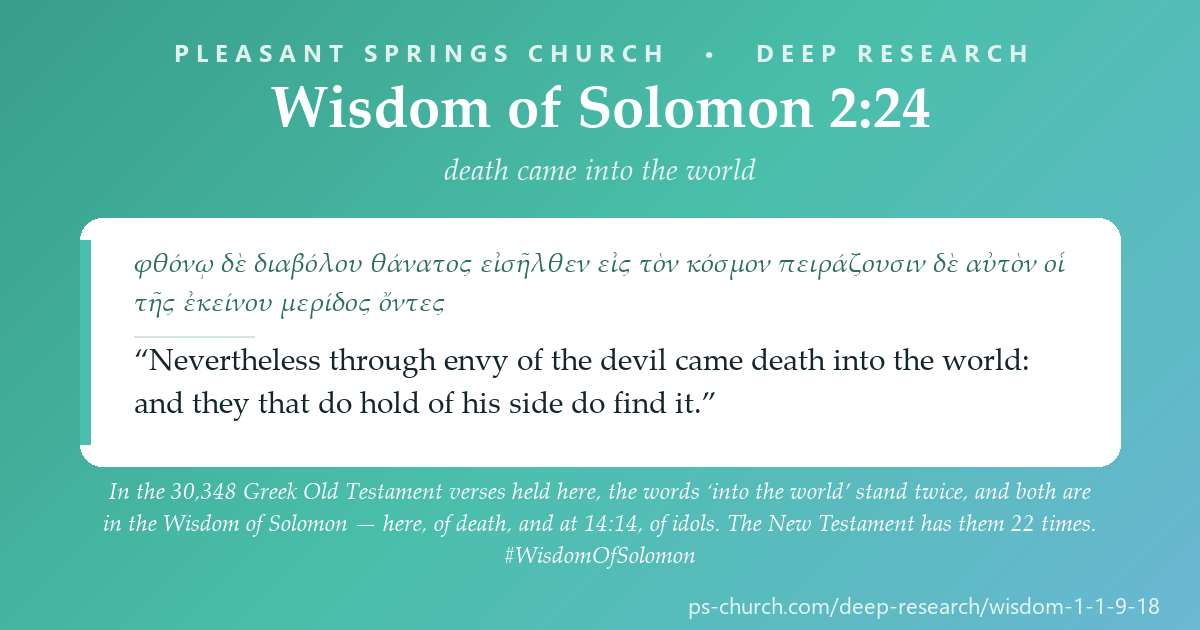
εἰς τὸν κόσμον — into the world — stands twice in the 30,348 Greek Old Testament units, and both are in Wisdom: here, of death, and at 14:14, of idols. The New Testament has it 22 times. Romans 5:12 carries all four bolded words with the verb moved to the end, and the run engine, which counts only unbroken order, scores it three. The Latin divides this one Greek row into two verses, 2:24 and 2:25.
VULGATE 2:24–25 Invidia autem diaboli mors introivit in orbem terrarum :/ imitantur autem illum qui sunt ex parte illius.
Three witnesses, and only one names death. The Greek row has βάσανος, torment; the KJV has torment; the Latin has tormentum mortis, the torment of death. The bolded four words stand nowhere else in the Greek Old Testament held here. Against the New Testament this row reaches three, tie band 13, on function words.
VULGATE 3:1 Justorum autem animæ in manu Dei sunt,/ et non tanget illos tormentum mortis./
τὴν βουλὴν τοῦ θεοῦ — the counsel of God — stands once in the Greek Old Testament held here, in this verse (9:13 has it without the articles). In the New Testament: Luke 7:30 and Acts 20:27. Screened from the New Testament side, Luke 7:30, Acts 20:27 and Ephesians 1:11 each find their single deepest Greek Old Testament partner in this verse — four words, tie band 1, all three — Luke and Acts on the counsel of God, Ephesians 1:11 on κατὰ τὴν βουλὴν τοῦ, according to the counsel of — in Ephesians, of his will, not of God. The Latin numbers this verse 6:5, and reads secundum voluntatem Dei, according to the will of God.
VULGATE 6:5 Quoniam cum essetis ministri regni illius,/ non recte judicastis, nec custodistis legem justitiæ,/ neque secundum voluntatem Dei ambulastis./
The KJV verse numbered 7:22 is not the Greek row numbered 7:22. It opens with the last clause of Greek 7:21 (For wisdom, which is the worker of all things, taught me) and closes with the first two words of Greek 7:23 (which cannot be letted, ready to do good); the Latin 7:22 ends where the KJV does. μονογενές — one only in the KJV, unicus in the Latin — is the third of twenty single-word attributes that run from here into 7:23.
VULGATE 7:22 Est enim in illa spiritus intelligentiæ,/ sanctus, unicus, multiplex, subtilis,/ disertus, mobilis, incoinquinatus, certus,/ suavis, amans bonum, acutus,/ quem nihil vetat, benefaciens,/
ἀπαύγασμα stands once in the Greek Old Testament held here, and once in the Greek New Testament: Hebrews 1:3. The run between the two verses is that one word. The run engine’s best New Testament partner for this verse is not Hebrews at all but 2 Peter 3:12, on three function words, τῆς τοῦ θεοῦ, tie band 1. The Latin reads candor here; the Clementine Hebrews 1:3 reads splendor gloriæ. In Latin, the one shared word is gone.
VULGATE 7:26 candor est enim lucis æternæ,/ et speculum sine macula Dei majestatis,/ et imago bonitatis illius./
ἐν ὁσιότητι καὶ δικαιοσύνῃ — in holiness and righteousness — four words, tie band 1, and the one partner is Luke 1:75, in the song of Zechariah. Once in the Greek Old Testament held here, once in the New Testament; uniqueness is already complete at two words, ὁσιότητι καὶ. The Latin has in æquitate et justitia here and in sanctitate et justitia in Luke.
VULGATE 9:3 ut disponat orbem terrarum in æquitate et justitia,/ et in directione cordis judicium judicet :/
σκῆνος — tent, the body as a tent — stands once in the Greek Old Testament held here, and in the New Testament only at 2 Corinthians 5:1 and 5:4, as σκήνους and σκήνει. Because the case forms differ, the run engine scores both pairs at one — and the one word it finds is γὰρ. The Latin reads terrena inhabitatio.
VULGATE 9:15 corpus enim quod corrumpitur aggravat animam,/ et terrena inhabitatio deprimit sensum multa cogitantem./
⚠️ Read the flags as measurements, not as a list of quotations. Nothing in these nine chapters reaches five consecutive words with any verse of the Greek New Testament. What the flags record is something else: rarity — words and short phrases that the Greek Old Testament held here carries only in Wisdom, and that the New Testament also carries. Stage 4 sets the two measurements side by side and does not let either stand for the other.
Versification — stated, as on every page here, in a third state: no Masoretic text, and no ESV held.
There is no Masoretic/Septuagint offset to report, because there is no Masoretic Wisdom; the shelf’s versification table has no entry for the book, and the page will not manufacture one. The offsets that exist are between the three witnesses printed, and all of them are counted:
• Greek (CATSS / Rahlfs), chapters 1–9: 16 · 24 · 19 · 20 · 23 · 25 · 30 · 21 · 18 = 196 rows; the whole book 435. Every label is a plain chapter:verse; no lettered or verse-only labels.
• KJV Apocrypha (1769): the same count in all nine chapters — and a different division at eight seams. The words at the end of Greek 2:14, 3:12, 4:14, 7:1 and 7:21 stand at the start of the next KJV verse; the words at the start of Greek 4:19, 5:4 and 7:23 stand at the end of the previous KJV verse. At four of the eight (2:14–15, 3:12–13, 5:3–4, 7:22–23) the KJV divides as the Clementine Latin does; at the other four the Latin divides as the Greek does. Whole book: KJV 436 verses against the Greek’s 435, the difference falling in chapter 17 (21 against 20), outside this page.
• Clementine Vulgate: 16 · 25 · 19 · 20 · 24 · 27 · 30 · 21 · 19 = 201 rows; the whole book 439. Five extra rows, each located: Latin 2:25 is the second half of Greek 2:24; Latin 5:14 (Talia dixerunt in inferno hi qui peccaverunt) has no Greek counterpart, so Greek 5:14–23 is Latin 5:15–24; Latin 6:1 (Melior est sapientia quam vires) and 6:23 (diligite lumen sapientiæ) have none either, so Greek 6:4 is Latin 6:5 and Greek 6:22–25 is Latin 6:24–27; and Latin 9:19 carries the last clause of Greek 9:18 with more besides. The Latin also prints the two halves of Greek 2:4 in the other order across its 2:3–4.
• Canonical verses cited: Greek Psalm 115:7 = Hebrew and English Psalm 116:16; Greek Psalm 37:8 = Hebrew 38:8; Greek Psalm 89:14 = Hebrew 90:14; Greek Song of Songs 7:13 = English 7:12. Genesis, Deuteronomy, Chronicles, Isaiah and Jeremiah citations carry the same numbers in every column.
The Shape of the Passage
Ring frame (measured) for 1:1–6:21, then a sequence of voicesAnd one crossing the counts draw by themselves: death, θάνατος, stands four times in chapters 1–9 and not again in these chapters after 2:24; the nouns immortality and incorruption, ἀθανασία and ἀφθαρσία, stand seven times and never before 2:23. The two cross once, in consecutive verses — the first noun at 2:23, the last death at 2:24 — and never stand in the same verse; the one exception to the clean division is the adjective ἀθάνατός, immortal, at 1:15, inside the range of death. And σοφία, the word in the book’s title, stands twenty-four times in these chapters — three times in chapters 1–5 and twenty-one times from 6:9 on.
⚠️ This is NOT offered as a chiasm. The measured pairs are A with A′ and B with B′. Chapters 3–4 are drawn in the middle because that is where they fall, not because anything measured here makes them a centre, and no row is marked as a pivot. From 6:22 the shape is a plain sequence of voices — I, then you — and is labelled as one.
⚠️ Where this page sits. The Wisdom of Solomon is canonical in the Roman Catholic and Orthodox churches, was printed among the Apocrypha in the King James Bible of 1611 and the other Reformation-era Protestant Bibles, and is absent from the Hebrew Bible. This library reads it as a Second-Temple witness and files it under Apocrypha / Deuterocanon. Nothing taught at Pleasant Springs rests on it.
Author
Anonymous — and he speaks as Solomon without once writing Solomon’s name. The CATSS text capitalises proper names. In all 435 rows of Wisdom exactly two words are capitalised: the book’s first word, and Pentapolis at 10:6. In chapters 1–9 no person, people or city is named — no Solomon, no David, no Israel, no Jerusalem. The speaker of chapters 7–9 is a king (9:7), the builder of a temple (9:8), son of thine handmaid (9:5); the reader supplies the name.
He writes Greek as a Greek writer, not as a translator. Composition in Greek is the scholarly consensus. What this page can show is the vocabulary: the four virtues of 8:7 — σωφροσύνην, φρόνησιν, δικαιοσύνην καὶ ἀνδρείαν — are commonly identified with the four virtues of Greek philosophy, and the ἀνδρείαν noun and adjective (courage) occur zero times in the 7,927 verses of the Greek New Testament; the cognate verb ἀνδρίζεσθε stands once, at 1 Corinthians 16:13.
And his sentences share wording with the Greek Bible — the only Greek held here to test them against. Screened against every other Greek Old Testament unit held here, these chapters run deepest into the Greek Psalter (eight words, 9:5) and the Greek Isaiah (six words, 2:12) — and the six Isaiah words are in the Greek of Isaiah 3:10 and not in its Hebrew. Stage 2 prints both, and says what that does and does not show.
Audience
Rulers, on the page. Fifteen imperatives in chapters 1 and 6 address judges of the earth, ye kings, and twice τύραννοι — tyrants, in the old neutral sense. The address is commonly read as literary, with the real readership Greek-speaking Jews, usually placed in Alexandria; the page reports that reading and does not test it.
People who had been told this life is all there is. Chapter 2 gives that view its own voice, at length and persuasively — let us enjoy the good things that are present — and then lets it turn, in the same voice, into a plot to torture a righteous man and see whether God rescues him.
People burying the young. But though the righteous be prevented with death, yet shall he be in rest (4:7). The book never says whose death it is answering. It answers it anyway.
Orient on the book, its language, and the questions the articles will raise.
Search by topic: Wisdom of Solomon; Book of Wisdom; Sapientia Salomonis; personified Wisdom; immortality; Alexandrian Judaism; Philo; Apocrypha.
Which articles are relevant?
- Anchor Bible Dictionary — “Wisdom of Solomon,” “Wisdom,” “Apocrypha, Old Testament,” “Philo of Alexandria.”
- Eerdmans Dictionary of Early Judaism — “Wisdom of Solomon,” “Afterlife,” “Alexandria.”
- Dictionary of New Testament Background (IVP) — “Wisdom of Solomon,” “Apocrypha and Pseudepigrapha.”
- On the text — any article that distinguishes Rahlfs’ hand edition (the text printed here) from the Göttingen critical edition and its apparatus. This page cannot see a single manuscript variant, and says so in Stage 5.
Bibliography surfaced:
- David Winston, The Wisdom of Solomon (Anchor Bible 43) — a full-length English commentary.
- Chrysostome Larcher, Le Livre de la Sagesse ou la Sagesse de Salomon — the large French commentary.
- Lester L. Grabbe, Wisdom of Solomon (Guides to Apocrypha and Pseudepigrapha) — a short orientation.
- John J. Collins, Jewish Wisdom in the Hellenistic Age — Wisdom beside Sirach and the wider wisdom literature.
- Joseph Ziegler, ed., Sapientia Salomonis (the Göttingen Septuagint) — the critical text. Not held here.
- NETS (A New English Translation of the Septuagint), Wisdom of Salomon — a modern English made from the Greek. Not the English quoted on this page; named because it is the obvious next step for a reader.
A Greek book whose wording runs deepest into the Greek Old Testament — and whose vocabulary is commonly compared with Greek philosophy’s.
Two bodies of material stand behind these chapters: the Greek Old Testament, which this shelf can measure, and Greek philosophy, which it cannot. The page keeps them apart.
What does the Greek Old Testament screen find?
Every row of Wisdom 1–9 screened against the 29,913 Greek Old Testament units outside Wisdom: 189 reach two, 103 reach three, 28 reach four, 4 reach five, 2 reach six, 1 reaches eight, and nothing reaches nine. Against the New Testament the same 196 rows never reach five. The book’s wording runs deeper into the Greek Old Testament than into the New, and Stage 4 needs that contrast.
- Wisdom 9:5 → Greek Psalm 115:7 — eight words, tie band 1. ἐγὼ δοῦλος σὸς καὶ υἱὸς τῆς παιδίσκης σου — I thy servant and son of thine handmaid. Greek Psalm 115:7 is Hebrew and English Psalm 116:16; the Greek Psalter counts Psalm 116 as two psalms. The deepest contact these nine chapters make with anything held here is a line of the Psalter set inside the king’s prayer.
- Wisdom 2:12 → Greek Isaiah 3:10 — six words, tie band 1. τὸν δίκαιον ὅτι δύσχρηστος ἡμῖν ἐστιν — the righteous one, because he is troublesome to us (gloss). Those six words stand in two units of the Greek Old Testament, these two, and in no verse of the New Testament. See below: they are in the Greek of Isaiah and not in its Hebrew.
- Wisdom 2:1 → Greek Psalm 37:8 (Hebrew 38:8) — five words, tie band 1. καὶ οὐκ ἔστιν ἴασις ἐν — and there is no healing in. The psalmist says it of his own flesh; the ungodly of Wisdom 2 say it of death.
- Wisdom 3:7 → Greek Jeremiah 6:15 — five words, tie band 1. καὶ ἐν καιρῷ ἐπισκοπῆς αὐτῶν — and in the time of their visitation. In Jeremiah that is the moment the faithless fall; in Wisdom it is the moment the righteous shall shine.
- Wisdom 1:1 → Greek Psalm 2:10 — four words, tie band 1. οἱ κρίνοντες τὴν γῆν — you who judge the earth. And the other half of the same psalm verse stands at the other end of the frame: Psalm 2:10 has βασιλεῖς σύνετε, kings, understand, and Wisdom 6:1 has βασιλεῖς καὶ σύνετε. The engine scores 6:1 against the psalm at one, because καὶ stands between the two words; a reader can see both halves.
The Greek Isaiah 3:10, as held here: εἰπόντες δήσωμεν τὸν δίκαιον ὅτι δύσχρηστος ἡμῖν ἐστιν τοίνυν τὰ γενήματα τῶν ἔργων αὐτῶν φάγονται
Gloss: “saying, Let us bind the righteous one, because he is troublesome to us; therefore they shall eat the produce of their works.”
The Masoretic Isaiah 3:10, as held here: אִמְר֥וּ צַדִּ֖יק כִּי־ט֑וֹב כִּֽי־פְרִ֥י מַעַלְלֵיהֶ֖ם יֹאכֵֽלוּ׃
Gloss: “Say of the righteous that it is well, for they shall eat the fruit of their deeds.”
The Hebrew has no bind and no troublesome to us; the Greek has both, and Wisdom 2:12 shares six consecutive words with the Greek. That is a statement about what three columns contain. It is not a statement about how the Greek Isaiah came to read as it does, and it is not a claim that the author of Wisdom was reading one rather than the other — only that his sentence and the Greek sentence share their wording, and the Hebrew sentence does not share it.
And the Greek philosophy — what can be said without measuring it?
Reported, not measured. The speech of 2:1–9 — we came to be by chance, the breath in our nostrils is smoke, let us crown ourselves with rosebuds — is commonly read as a caricature of Epicurean or popular hedonist talk. The list of attributes in 7:22–23, and the wisdom that passeth and goeth through all things, are commonly read as Stoic vocabulary. The body that weighs the soul down in 9:15, and the good soul that came into a body undefiled in 8:20, are commonly compared with Plato. The chain of 6:17–20 — desire, then love, then keeping her laws, then incorruption, then nearness to God — has the shape of the rhetorical figure called a sorites.
Measured, and narrow: the courage word of 8:7, ἀνδρείαν, stands in Wisdom twice (8:7, 8:15), in 4 Maccabees twelve times and in eight other Greek Old Testament texts nineteen times, and never in the Greek New Testament. The New Testament can name three of the four virtues of 8:7; it never uses the noun for the fourth (its cognate verb stands once, at 1 Corinthians 16:13).
- Philo of Alexandria — the Alexandrian Jewish writer commonly compared with Wisdom. Not held on this disk in any language; no comparison is made.
- Psalm 2, Isaiah 3, the Psalter — held, and measured above: Wisdom’s deepest verbatim contacts are with the Greek of these books.
- Genesis 1–3 — set beside 2:23–24, where man is made to be an image of his own eternity and death comes in by the devil’s envy. Genesis does not name a devil; Wisdom does. Stage 3 counts the word.
Eight words, two of them found nowhere else in the Greek Old Testament — and a table of twenty-one that are.
Every count below is over the Greek Old Testament files held on this disk — 30,348 verse units, the Odes excluded — and the 7,927 verses of the Greek New Testament. Counts are of word FORMS matched by a stem that was checked to catch only the word named; where a count is also given for dictionary lemmas, it says so. None of it is a count over “the Septuagint.”
Once in the 30,348 Greek Old Testament verse units held here — Wisdom 7:26 — and once in the 7,927 verses of the Greek New Testament: Hebrews 1:3. Counted twice, as forms and as dictionary lemmas, and the counts agree: 1 and 1. The Clementine Latin has candor in Wisdom and splendor in Hebrews, so the pair is visible only in Greek.
Once in the Greek Old Testament held here — Wisdom 9:15 — and twice in the New Testament, both in one paragraph: 2 Corinthians 5:1 and 5:4. Lemma counts agree: 1 and 2. This is not the ordinary tent of the Greek Old Testament, the tabernacle word; that is a different noun, and it is everywhere. This one stands once.
Three words. Twice in the 30,348 Greek Old Testament units, both in Wisdom (2:24, of death; 14:14, of idols), and 22 times in 21 verses of the New Testament, 14 of them in John. Uniqueness completes at three words: the two-word τὸν κόσμον stands 15 times in the Greek Old Testament, five of them in Wisdom. Read in context, the ten outside Wisdom are an ornament (seven) or the array of the heavens (three); none of them is the world.
Seven times in the Greek Old Testament held here: five in Wisdom, two in 4 Maccabees, nowhere else. Its partner ἀφθαρσία (incorruption): five times, three in Wisdom and two in 4 Maccabees. Twelve occurrences between them, all in two books. The New Testament has the first three times (1 Corinthians 15:53, 54; 1 Timothy 6:16) and the second seven.
Four times in chapters 1–9 — 1:12, 1:13, 2:20, 2:24 — and not again within them (it returns six times in chapters 12–19, the companion page’s range). From chapter 3 to chapter 9, when the righteous die the text uses other words: τεθνάναι (3:2, they seemed to die), τελευτῆσαι (4:7). In these chapters the noun is kept for the thing God did not make.
Twenty-two occurrences of the noun in the Greek Old Testament held here (the vocative at Zechariah 3:2 included), thirteen of them in Job 1–2, where it is the Greek for the satan. Wisdom has it once, at 2:24 — the only Greek Old Testament verse held here that puts the devil and death in the same sentence (the New Testament does so at Hebrews 2:14 and Revelation 2:10). The New Testament has the noun 34 times.
Thirteen units of the Greek Old Testament held here — Judges 11:34 and three Tobit passages are counted in both of their Greek forms — and nine verses of the New, where five are in John and 1 John. In the Greek Old Testament it is often an only child (Jephthah’s daughter, Sarah in Tobit); Wisdom 7:22 is the one place it is said of a spirit, third in a list of twenty attributes. A count, not a christology: the page draws no line from 7:22 to John 1.
Twenty-four times in chapters 1–9 — and three of those in chapters 1–5. The title word of the book is almost absent from its first five chapters, which argue about death and justice; it arrives in force at 6:9 and stands twenty-one times in the last three and a half chapters of this range.
Twenty-one words of Wisdom 1–9 that the Greek Old Testament held here has only in Wisdom — and the New Testament also has:
| Wisdom | the word, as it stands at the first reference | New Testament | NT |
|---|---|---|---|
| 1:11 | καταλαλιᾶς | 2 Corinthians 12:20; 1 Peter 2:1 | 2 |
| 2:6 | σπουδαίως | Luke 7:4; Philippians 2:28; 2 Timothy 1:17; Titus 3:13 | 4 |
| 2:17, 8:8, 11:14 | ἐκβάσει | 1 Corinthians 10:13; Hebrews 13:7 | 2 |
| 3:10 | ἐπιτιμίαν | 2 Corinthians 2:6 | 1 |
| 3:18 | διαγνώσεως | Acts 25:21 | 1 |
| 3:18 | παραμύθιον | Philippians 2:1 | 1 |
| 4:3 | νόθων | Hebrews 12:8 | 1 |
| 4:10, 9:10 | εὐάρεστος | Romans 12:1; Romans 12:2; Romans 14:18; 2 Corinthians 5:9; Ephesians 5:10; Philippians 4:18; Colossians 3:20; Titus 2:9; Hebrews 13:21 | 9 |
| 5:18, 18:15 | ἀνυπόκριτον | Romans 12:9; 2 Corinthians 6:6; 1 Timothy 1:5; 2 Timothy 1:5; James 3:17; 1 Peter 1:22 | 6 |
| 5:22 | ἀποτόμως | 2 Corinthians 13:10; Titus 1:13 | 2 |
| 5:23 | περιτρέψει | Acts 26:24 | 1 |
| 6:10 | ἀπολογίαν | Acts 22:1; Acts 25:16; 1 Corinthians 9:3; 2 Corinthians 7:11; Philippians 1:7; Philippians 1:16; 2 Timothy 4:16; 1 Peter 3:15 | 8 |
| 6:12 | ἀμάραντός | 1 Peter 1:4 | 1 |
| 6:15, 7:23 | ἀμέριμνος | Matthew 28:14; 1 Corinthians 7:32 | 2 |
| 7:17 | ἀψευδῆ | Titus 1:2 | 1 |
| 7:22 | φιλάγαθον | Titus 1:8 | 1 |
| 7:24 | καθαρότητα | Hebrews 9:13 | 1 |
| 7:25 | εἰλικρινής | Philippians 1:10; 2 Peter 3:1 | 2 |
| 7:26 | ἀπαύγασμα | Hebrews 1:3 | 1 |
| 9:11 | σωφρόνως | Titus 2:12 | 1 |
| 9:15 | σκῆνος | 2 Corinthians 5:1; 2 Corinthians 5:4 | 2 |
Every one of the twenty-one stands, in the 30,348 Greek Old Testament units, only in Wisdom — seventeen of them exactly once — and every one stands in the Greek New Testament. Where they land in the New Testament is not where the Gospels are: seven of the twenty-one stand in 2 Corinthians, six in Titus — a letter of 46 verses — and five each in Hebrews and Philippians; the four Gospels have two between them (Matthew 28:14, Luke 7:4), and John has none. That is a distribution, not an explanation, and the page offers none.
⚠️ The table is checked, not exhaustive. It was surfaced by a screen of the corpus’s dictionary-form column, which offered twenty-four candidates; each was then checked on word forms, and twenty-one survived. Stage 5 names the three that did not and why. There may be more; there are not fewer. And not one of the twenty-one is a deep run. Every pair scores one word on the run engine, or nothing, except two that score two (9:10 with Colossians 3:20, εὐάρεστόν ἐστιν, is well-pleasing; 9:11 with Titus 2:12, σωφρόνως καὶ, soberly and); otherwise a single shared word, or a shared word in two different case forms, is all there is.
Counted here, not assumed:
- Chapters 1–9: 196 Greek rows, 2,962 words; per chapter 16 · 24 · 19 · 20 · 23 · 25 · 30 · 21 · 18. The whole book: 435 rows, 6,943 words.
- Second-person plural imperatives: 7 in chapter 1, 8 in chapter 6, 0 in chapters 2–5 and 7–9. Let us subjunctives: 15, all in chapter 2. First-person singular verbs: none in chapters 1–5; the first at 6:22; 6 in chapter 6, 16 in 7, 20 in 8, 3 in 9. Second-person singular imperatives: 3, all in chapter 9, all addressed to God; the three third-person singular imperatives of chapters 1–9 (2:7, 2:9, 2:11) are all in the speech of chapter 2.
- No capitalised name in chapters 1–9. In the whole book CATSS capitalises one: Pentapolis, 10:6 (Hades, 1:14 and 2:1, and the Red Sea, 10:18 and 19:7, stand in lower case). The name Solomon occurs 0 times.
- Death and the immortality nouns meet only at 2:23–24, and never in one verse (the adjective immortal stands earlier, at 1:15): θάνατος 1:12, 1:13, 2:20, 2:24; the immortality and incorruption nouns 2:23, 3:4, 4:1, 6:18, 6:19, 8:13, 8:17.
- The two speeches mirror on the page: ἑαυτοῖς 2:1 and 5:3; shadow 2:5 and 5:9; trace 2:4 and 5:10; smoke 2:2 and 5:14; son of God 2:18 and among the sons of God 5:5. Each pair: once in each speech and nowhere else in chapters 1–9.
- Twenty attributes in 7:22–23 — twelve after πνεῦμα in 7:22 and eight in 7:23 — and then a participle, going through all understanding, pure, and most subtil, spirits. Count the participle and the list is twenty-one; the page prints both counts and chooses neither.
Measured by depth, among the farthest books on the shelf. Measured by rarity, twenty-one words the Greek Old Testament has only in Wisdom.
Every row of Wisdom screened against all 7,927 verses of the Greek New Testament: contiguous runs of whole word forms, accents and breathings dropped, the two editions’ spelling differences (ek/ex, ou/ouk, movable nu) folded. The tie band — how many verses on the other side reach the same depth — is printed beside every run, and for every run that matters it is printed from both sides: the Wisdom row’s band among New Testament verses, and the New Testament verse’s band among the 30,348 Greek Old Testament units. The screen finds verbatim contact. It does not find allusion.
The distribution, and where it puts Wisdom on the shelf:
Wisdom 1–9, 196 rows against 7,927 New Testament verses: 187 reach two, 70 reach three, 7 reach four, and nothing reaches five. Nine rows share no two consecutive words with any New Testament verse; none shares no word at all.
The whole book, 435 rows: 413 reach two, 129 reach three, 10 reach four, and nothing reaches five. So chapters 10–19, the subject of a companion page, never reach five either.
Across the 58 Greek texts screened here (63 CATSS files; Genesis, the Psalms, Isaiah, Jeremiah and Ezekiel each come in two), seven never reach five against the New Testament — Joshua (A), Wisdom, 3 Maccabees, the Song of Songs, Susanna in both Greek forms, and Obadiah. Wisdom, at 435 rows, is the largest of the seven; the next is 3 Maccabees at 228. And Wisdom’s share of rows reaching four — 10 of 435 — is the lowest of the 58 but one: Joshua (A), a 96-row file, reaches no four at all.
| Greek text screened | rows | words per row | deepest NT run | rows reaching four |
|---|---|---|---|---|
| Wisdom of Solomon, whole book | 435 | 16.0 | 4 | 10 (2.3%) |
| — chapters 1–9, this page | 196 | 15.1 | 4 | 7 (3.6%) |
| 3 Maccabees | 228 | 22.4 | 4 | 8 (3.5%) |
| Song of Songs | 117 | 17.3 | 4 | 5 (4.3%) |
| Proverbs | 939 | 11.9 | 11 | 23 (2.4%) |
| 4 Maccabees | 479 | 16.4 | 9 | 19 (4.0%) |
| Job | 1,083 | 12.5 | 5 | 50 (4.6%) |
| Sirach | 1,402 | 13.3 | 5 | 74 (5.3%) |
| Psalms | 2,534 | 13.8 | 20 | 408 (16.1%) |
| Tobit (BA) | 248 | 22.2 | 6 | 61 (24.6%) |
| all 30,348 units | 30,348 | 20.4 |
A shorter row has fewer places for a run to start. Wisdom’s rows average 16.0 words against 20.4 across the whole screened corpus, so length could depress its numbers — and on the share of rows reaching four, it tracks them: across the 58 texts the two move together (correlation 0.77), and of the seven texts whose rows are shorter than Wisdom’s, five are about as low — Joshua (A) 0.0%, Proverbs 2.4%, Lamentations 2.6%, Job 4.6%, Sirach 5.3% — while the Psalms (13.8 words, 16.1%) and the Psalms of Solomon (15.9 words, 15.8%) are not. Length does not explain the ceiling: Proverbs, Job, Sirach and the Psalms all have shorter rows than Wisdom (11.9, 12.5, 13.3, 13.8 words) and all of them reach deeper. The page offers no explanation beyond that: it reports that a book written in this Greek shares less continuous wording with the New Testament than almost anything else held here, and that its short rows go with the low share and do not account for the ceiling.
The seven runs of four — formula or rarity? Both sides, every one:
- 8:21 → Mark 12:30, 12:33; Luke 10:27 — band 3. ἐξ ὅλης τῆς καρδίας, with the whole heart. A formula: the Greek Old Testament has it at 15 other units, and from the New Testament side those verses run deepest into Deuteronomy 6:5 (Mark 12:30, 21 words; Luke 10:27, 11) and 2 Chronicles 15:12 (Mark 12:33, 8), not into Wisdom.
- 8:16 → five verses — band 5. Into my house (four of them) or having entered into the house (Luke 7:36). A formula; Luke 7:36, one of the five, ties with 29 Greek Old Testament units at the same depth.
- 1:14 → Colossians 2:8, Acts 4:12 — band 2. Function words — of the world and not, and there is not in. Accident.
- 9:9 → Revelation 2:2 — band 1. τὰ ἔργα σου καὶ, your works and. A tie band of one that is still a formula: from Revelation’s side the same four words stand in nine Greek Old Testament units, Wisdom 9:9 one of them. This is the page’s counter-example to itself — a band of 1 measured from one side only proves nothing.
- 4:2 → Mark 10:30, Luke 18:30 — band 2. καὶ ἐν τῷ αἰῶνι, and in the age. Unique in the Greek Old Testament already without the and (the dative τῷ αἰῶνι stands only in Wisdom, here and at 18:4), while the New Testament has ἐν τῷ αἰῶνι four times; from the New Testament side Mark 10:30 ties eight ways at four and Luke 18:30 runs five words into Deuteronomy 10:10. Not distinctive from the New Testament side.
- 6:4 → Luke 7:30, Acts 20:27, Ephesians 1:11 — band 3 from Wisdom’s side, band 1 from each New Testament verse’s side. τὴν βουλὴν τοῦ θεοῦ, the counsel of God, shared by Luke 7:30 and Acts 20:27; Ephesians 1:11 shares the four words before it, κατὰ τὴν βουλὴν τοῦ, and goes on of his will. The counsel of God: once in the Greek Old Testament; twice in the New. Uniqueness completes at three words, βουλὴν τοῦ θεοῦ; Wisdom 9:13 has the anarthrous βουλὴν θεοῦ, and the Greek Old Testament elsewhere says the counsel of the Lord. For each of the three New Testament verses, Wisdom 6:4 is its single deepest partner in the whole Greek Old Testament.
- 9:3 → Luke 1:75 — band 1 from Wisdom’s side, band 2 from Luke’s. ἐν ὁσιότητι καὶ δικαιοσύνῃ, in holiness and righteousness. Luke 1:75’s other four-word partner is Greek Psalm 89:14, on different words (all our days). The pair of nouns joined this way stands once in the Greek Old Testament and once in the New; Ephesians 4:24 has them reversed, ἐν δικαιοσύνῃ καὶ ὁσιότητι, which the Greek Old Testament never has. The Odes — held but not screened — carry the phrase at Ode 9:75, which is the Benedictus itself, Luke matching Luke.
The two that do not dissolve are 6:4 and 9:3 — one in the address to kings, who did not walk according to the counsel of God, and one in the king’s prayer, for humankind made to order the world in holiness and righteousness. Neither is a citation. No New Testament writer introduces either as one. Neither direction of influence is measurable, and none is asserted: two Greek-speaking writers may simply have reached for the same pairing.
The parallels this shelf’s own pages draw — measured:
Wisdom 2:24 → Romans 5:12. Wisdom: θάνατος εἰσῆλθεν εἰς τὸν κόσμον, death entered into the world. Romans: ἡ ἁμαρτία εἰς τὸν κόσμον εἰσῆλθεν, sin into the world entered (gloss). The same four words, with the verb moved to the end — and the run engine, which counts only unbroken order, scores three. From Romans’ side three ties nine ways, Wisdom 2:24 and 14:14 among them; from Wisdom’s side three ties 27 ways. But the rarity measurement says more than the depth: the four-word phrase in Wisdom’s order stands in the Greek Old Testament only at Wisdom 2:24 and 14:14 and in the New Testament nowhere; in Paul’s order, in the New Testament only at Romans 5:12 and in the Greek Old Testament nowhere. Wisdom has death enter by the devil’s envy; Paul has sin enter through one man, and death through sin. The page reports both sentences and adjudicates neither.
Wisdom 7:26 → Hebrews 1:3. ὃς ὢν ἀπαύγασμα τῆς δόξης, who being the radiance of the glory (gloss). The run is one word, and it is the only place either corpus has that word. ⚠️ The page’s own counter-example: screened blind, Wisdom 7:26’s best New Testament partner is 2 Peter 3:12 (three function words, band 1), and Hebrews 1:3’s best Greek Old Testament partner is Greek Isaiah 3:20 — τῆς δόξης καὶ, in a list of the ornaments of the daughters of Zion (three words, band 1). Two bands of one, in both directions, and both meaningless; the link a reader can see is a single noun the engine ranks below them.
Wisdom 9:15 → 2 Corinthians 5:1–4. φθαρτὸν γὰρ σῶμα βαρύνει ψυχήν … τὸ γεῶδες σκῆνος, the corruptible body weighs down the soul … the earthy tent. 2 Corinthians 5:4: οἱ ὄντες ἐν τῷ σκήνει στενάζομεν βαρούμενοι, we who are in the tent groan, being weighed down (gloss). A rare noun and a verb of weight in common, and the run engine sees one word — for. βαρύνει and βαρούμενοι are different verbs; σκῆνος and σκήνει are different case forms. Wisdom 9:15’s best New Testament partner is Matthew 10:28, on soul and, band 1. Another counter-example, and the clearest on the page of a shared rare word the instrument cannot register.
Wisdom 2:12–20 → the passion narratives. The nine rows of the plot against the righteous one reach two words against the New Testament at eight rows and three at one (2:18, on for is the, band 7). Matthew 27:43, the verse this shelf’s Mark 15 page sets beside 2:18, has a longest unbroken run of one word against it — though it carries son and of God too, in the other order with a verb between them, among five word forms the two verses share — and its own deepest Greek Old Testament contact is three words, upon God, tied nine ways with neither Wisdom nor Greek Psalm 21 (English 22) among them. What does measure is two short phrases at the rarity level: ἴδωμεν εἰ, let us see whether — Greek Old Testament twice (Wisdom 2:17; Song of Songs 7:13), New Testament twice, Matthew 27:49 and Mark 15:36, both in the mockery at the cross; and υἱὸς θεοῦ, son of God without the article — Greek Old Testament once, here; New Testament at Mark 15:39, the centurion, and Luke 1:35. Two words each. The page prints them because they are what the measurement actually finds, and prints their size beside them so nobody mistakes them for quotation.
- Wisdom 5:17–18 → Ephesians 6:13–14 — one word each. πανοπλίαν (full armour) and θώρακα (breastplate). In Wisdom God puts on the armour; in Ephesians believers do. Neither word is rare: the Greek Old Testament has the first eleven times and the second fifteen.
- Wisdom 4:10 → Hebrews 11:5 — one word. Wisdom’s unnamed man who pleased God and was translated is commonly read as Enoch. Hebrews 11:5’s own deepest Greek Old Testament contact is Genesis 5:24, four words, band 1. The wording of Hebrews here measures closest to Genesis, not to Wisdom.
- Wisdom 3:1–9 — the souls of the righteous in the hand of God. No row reaches beyond three against the New Testament, and every three is on function words, a short phrase around God or time, or the formula for ever. 3:1 against Revelation 14:13, 3:6 against 1 Peter 1:7, 3:7 against Matthew 13:43, 3:8 against 1 Corinthians 6:2: one word each.
Each Greek contact above is a matter of one to four shared words, and in the Clementine Latin every one of them comes apart. Wisdom 7:26 candor est enim lucis æternæ / Hebrews 1:3 splendor gloriæ. Wisdom 2:24 introivit in orbem terrarum / Romans 5:12 in hunc mundum intravit. Wisdom 6:4 (Latin 6:5) voluntatem Dei / Luke 7:30 and Acts 20:27 consilium Dei. Wisdom 9:3 in æquitate et justitia / Luke 1:75 in sanctitate et justitia.
And at one place the Latin is closer than the Greek. At 2:13 the Greek row has παῖδα κυρίου, child (or servant) of the Lord, and the KJV has the child of the Lord; the Latin has filium Dei se nominat — he names himself son of God — the same two words, in another case, as the Clementine Mark 15:39, Vere hic homo Filius Dei erat. Four witnesses, and the verbal links between Wisdom and the New Testament are a property of the Greek columns. A reader of the Latin alone would see a different set.
What this page could not check, the tool faults found while building it, and where it is weakest.
This is the section that makes the shelf trustworthy. Read it before quoting any number above.
⚠️ Faults found while building this page — reported, not buried:
- The Greek corpus’s lemma column cannot be trusted for compound verbs. The rare-word table in Stage 3 was first drawn from the dictionary-form column of the CATSS files, which splits prefixes off verbs inconsistently — sometimes printing a compound as one word, sometimes as a simple verb plus a prefix. Taken at its word, that column offered ἐμφανίζεται (he shows himself, 1:2) as a Wisdom-only verb; on forms the same verb stands at Exodus 33:13 — ἐμφάνισόν — and in five more units outside Wisdom. ἐξετάσει (he will examine, 6:3) failed the same way. The third failure is of another kind: ταρσῶν, the strokes of a bird’s wings at 5:11, matched the New Testament’s Tarsus, which is a different word. So every candidate was re-checked on forms, the three that failed were dropped, and the table is called checked rather than complete.
- A dictionary built on verse labels loses rows that share a label. The Psalms of Solomon carries seventeen unnumbered title rows, all labelled 0:0; any result keyed by label — as the run screen’s output is — keeps one of them. It does not touch Wisdom, whose 435 labels are all distinct, but the shelf-wide comparison table in Stage 4 was computed row by row for that reason rather than from the keyed output.
- The run engine cannot see an inflected rare word. σκῆνος in Wisdom and σκήνους in 2 Corinthians are one word in two cases, and the engine, which matches whole forms, scores the pair at one — on for. This is by design, and it is why the page reports a separate rarity measurement instead of trusting depth alone.
⚠️ What this page could NOT check:
- A single manuscript variant. The Greek is Rahlfs’ hand edition as digitised by CATSS. The Göttingen edition and its apparatus are not held. Every count on this page is a count of one printed text.
- The commentaries named in this study. Winston, Larcher, Grabbe, Collins and Ziegler are named in Stage 1 for the reader; no commentary text is held on this disk, none was consulted for this page, and no ‘commonly read as’ on this page is cited to a page of any of them.
- Philo. The Alexandrian writer commonly compared with Wisdom is not on this disk in any language. No comparison is made, and none is implied.
- The Greek philosophy of Stage 2. The Epicurean, Stoic and Platonic readings are reported as readings commonly made, not from any commentary held here. No Greek philosophical text is held, and none was measured.
- The date and place. The late first century BC to the early first century AD, and Alexandria, are the usual answers; nothing on this page depends on them and nothing here tests them.
- Composition in Greek. Reported as the consensus. This disk holds no evidence for or against a Semitic original for any part of the book, and the page treats the question as outside its reach.
- Allusion. Shared ideas — immortality, the righteous sufferer vindicated, wisdom as the agent of creation — are invisible to a verbatim screen. A run of one is not evidence of independence any more than a run of six would be evidence of copying.
⚠️ Where this page is weakest:
- The shelf-wide comparison is not controlled for genre. Row length was checked (Stage 4): it goes with the low share of rows reaching four and does not account for the ceiling; nothing else was checked. Narrative books share narrative formulas with the Gospels and Acts, and Wisdom is not narrative.
- The rare-word table is a table of checked words, not a census. It says at least twenty-one, and means it.
- The English column is quotation, not a licensed parallel. It is the 1769 King James text, verbatim, aligned to the Greek by reading. Its verse numbers match the Greek’s in all nine chapters by count and differ by division at eight seams, listed in the versification note; the page flags the one seam it prints.
- The structure diagram claims only what it counts. The A/A′ and B/B′ pairs are measured; the centre is not claimed; the second half is labelled a sequence.
- One sentence on another page of this shelf, set beside the measurement. The Mark 15 study says the vocabulary of Wisdom 2:12–20 is “closer still to Matthew 27:43”. Measured, Matthew 27:43 has a longest unbroken run of one word with 2:18 — as the Mark 15 page itself prints — while sharing five word forms with it (if, for, son, of God, him) and the verb rescue in another form. Mark 15:36 and 15:39 each share a two-word phrase with Wisdom 2:17–18: let us see whether (15:36), which the Greek Old Testament also has at Song of Songs 7:13, and son of God (15:39), which it has only at Wisdom 2:18. The two pages measure different things and do not contradict each other; nothing here settles anything about either Gospel.
Commentaries & studies:
- David Winston, The Wisdom of Solomon (Anchor Bible 43).
- Chrysostome Larcher, Le Livre de la Sagesse ou la Sagesse de Salomon.
- Lester L. Grabbe, Wisdom of Solomon (Guides to Apocrypha and Pseudepigrapha).
- John J. Collins, Jewish Wisdom in the Hellenistic Age.
- Joseph Ziegler, ed., Sapientia Salomonis (Göttingen Septuagint). Not held.
A book that shares little continuous wording with the New Testament, and a list of rare words with it.
Name what you learned, why it matters, and one concrete response.
What should we carry away — and do?
- Depth and closeness are different questions. Wisdom never shares five consecutive words with the New Testament, and it is still the only place in the Greek Old Testament held here where into the world is said. Ask which measurement a claim rests on before you repeat it.
- The links measured on this page are mostly one word long. Radiance in Hebrews 1:3, tent in 2 Corinthians 5 — single nouns, each found once in the Greek Old Testament and in one New Testament passage. A machine that counts runs cannot see them; a reader can.
- A book that never names its speaker. The Wisdom of Solomon does not contain the word Solomon. Whatever authority the voice has, it does not claim it by name.
- Read it beside Scripture, not instead of it. Wisdom says God made not death and that death came in through envy of the devil. Genesis 3 and Romans 5:12 are Scripture and tell it their own way. Notice where the witness and the canon use the same words, and where they do not.
- One concrete response. The prayer of chapter 9 asks for one thing: Give me wisdom. James 1:5 — Scripture — tells you to ask for exactly that. Ask, this week, by name, for the one situation where you most need it.
Wisdom of Solomon 2:24 · to share
Greek (CATSS / Rahlfs) · KJV Apocrypha (1769) · Clementine VulgateVULGATE 2:24–25 Invidia autem diaboli mors introivit in orbem terrarum :/ imitantur autem illum qui sunt ex parte illius.
Every Deep Research page traces its passage across the whole sweep — the Old Testament, the Second-Temple world between the testaments (historical witnesses, not Scripture), and the New Testament. Follow the thread:
Pleasant Springs Church — Deep Research
Research method after Michael S. Heiser’s Bible Research Method (examine dictionaries → ancient literature → important words → textual connections → academic publications → share), with the Pleasant Springs “Author & Audience” foundation. Scripture set in the Hebrew, the Greek editions named on each page and the ESV (Old Testament), and the Greek New Testament and the ESV (New Testament), per the practice of Pleasant Springs Church. ⚠️ Status: the Wisdom of Solomon is not part of the Protestant canon. It is canonical in the Roman Catholic and Orthodox churches, was printed among the Apocrypha in the King James Bible of 1611, and is absent from the Hebrew Bible. This study is filed under Apocrypha / Deuterocanon and nothing taught at Pleasant Springs rests on it. Greek text: the CATSS morphologically analysed Septuagint (Rahlfs), file Wisdom.mlxx, quoted at verse level with attribution; every row, word count, run depth and tie band on this page was derived from that file for this study and is re-derived by its self-check. Greek New Testament: the SBLGNT via MorphGNT, edition sigla removed for display. English: the King James Apocrypha, standardised 1769 text, public domain (the verse-per-line edition held on this disk), quoted verbatim and aligned to the Greek by content. This page prints no ESV text: the shelf holds none for this book and is licensed for none, and the New Testament verses compared are given in Greek with the page’s own gloss, marked as such. Latin: the Clementine Vulgate (public domain), a fourth witness with its own numbering, never a source for the English. Hebrew: the Masoretic text (Sefaria, Miqra according to the Masorah) for Isaiah 3:10 only; there is no Hebrew Wisdom. ⚠️ Not held: the Göttingen edition and apparatus, Philo, any Greek philosophical text, any Old Latin beyond the Clementine. Direction of influence is nowhere asserted. Commentaries named for the reader: Winston, Larcher, Grabbe and Collins (none held on this disk, none consulted for this page).
Scripture quotations marked ESV are from the ESV® Bible (The Holy Bible, English Standard Version®), © 2001 by Crossway, a publishing ministry of Good News Publishers. ESV Text Edition: 2016. Used by permission. All rights reserved. The ESV text may not be quoted in any publication made available to the public by a Creative Commons license, and the ESV may not be translated in whole or in part into any other language. www.esv.org
|
Did this study bless you today? 💚 Give to Support PS Church100% of gifts go to the General Fund — thank you. |