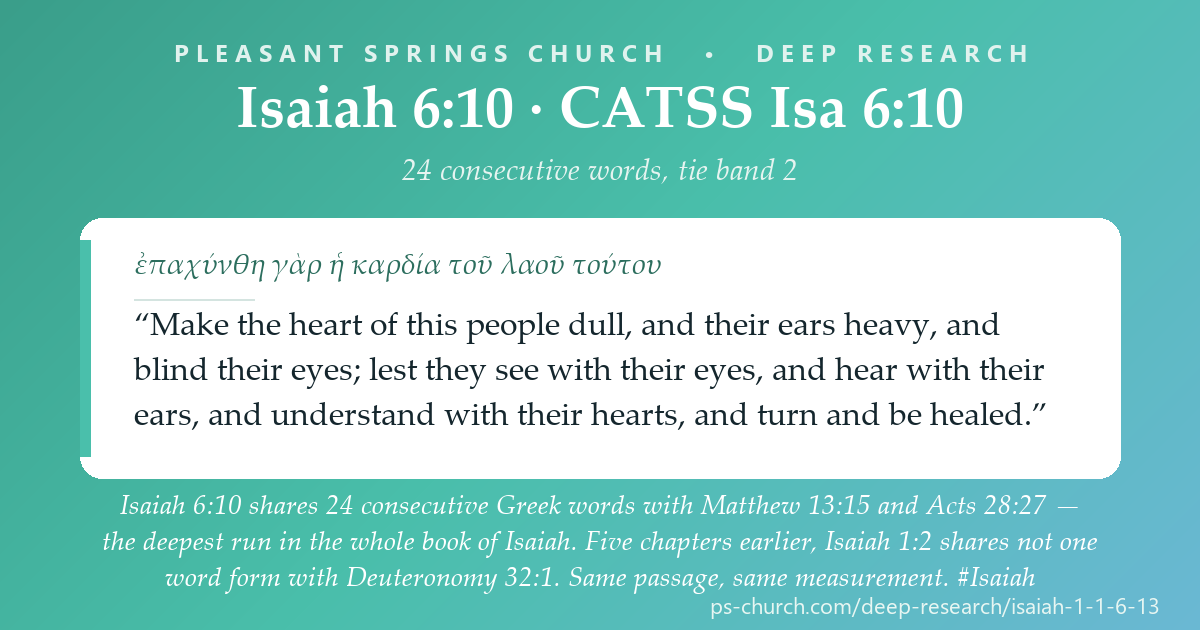
These six chapters hold both extremes of what this shelf can measure, and they hold them a few pages apart. Isaiah 6:10 shares twenty-four consecutive Greek words with Matthew 13:15 and with Acts 28:27 — the deepest contiguous run in the entire book of Isaiah, out of all 1,289 of its rows screened against all 7,927 verses of the Greek New Testament. Turn back five chapters and the same screen goes blind. Isaiah 1:2 and Deuteronomy 32:1 share not one word form — zero — though both summon heaven and earth with the same two verbs. Isaiah 5:2, the vineyard the parable of the tenants is built on, reaches a longest run of exactly one word with Mark 12:1 — they share four word forms and no two of them adjacent — because four verbs changed grammatical person. And Mark 4:12, which quotes Isaiah 6:9–10 by any reasonable account, measures 2 against the very row that measures 24 in Matthew, and 1 against 6:9. One passage, one measurement, and the numbers 24, 2, 1 and 0 all mean something different. See the method →
Isaiah 1:1–6:13 (selections)
Hebrew (Masoretic) · Greek (CATSS, Rahlfs’ Septuaginta) · ESV⚠️ The one seam in the book of Isaiah is nowhere near this passage. Over the whole book the shapes are Masoretic 1,291 verses and CATSS 1,289; the two chapters where they disagree are 2 and 56. The English, on the printed chapter divisions rather than on any file held here, adds one more at the 63/64 seam, where the Hebrew ends 63 with a long verse 19 whose second half English prints as 64:1 — putting ESV Isaiah at 1,292 verses. That last figure is read, not measured. None of that touches chapters 1–6.
The Shape of the Passage
Sequence — two headings, six movements, and one measured verbal bracket. Not a chiasm.These six chapters carry two superscriptions and two dates, and they do not agree about where the book begins. 1:1 heads a vision spanning four reigns; 2:1 heads a word about the same subject with no reign named; and 6:1 dates a call to the year one of those kings died. A call narrative in chapter 6 rather than chapter 1 is the plain shape of the text, and this page reports the shape without settling what produced it.
Author
A name, a father, and a Greek spelling that swallows three Hebrew names. יְשַׁעְיָהוּ is YHWH is salvation. His father is אָמוֹץ, Amoz — and the Greek column spells him Αμως. That exact form stands 22 times across the 64 CATSS files held here, and it covers three different Hebrew names: seven times for the prophet עָמוֹס in the book of Amos, six times for Isaiah’s father אָמוֹץ (Isaiah 1:1, 2:1, 13:1, 37:2, 37:21, 38:1), twice for King אָמוֹן in Jeremiah 1:2 and 25:3, and the rest in Kings, Chronicles and Tobit.
The New Testament names him 22 times — more than any other writing prophet, and fewer than Elijah, who wrote nothing. Counted over all 7,927 MorphGNT verses, every inflected form: Ἠσαΐας 22 (10 nominative, 9 genitive, 2 accusative and 1 dative), against Jonah 9, Jeremiah 3, and one each for Daniel, Elisha, Hosea and Joel — while Ἠλίας stands 29 times and Μωυσῆς 79. Two of Isaiah’s 22 are in this passage’s own reception: Matthew 13:14 says the prophecy of Isaiah is fulfilled and Romans 9:29 says as Isaiah predicted, and both are quoting verses printed in the codex above.
Audience
Judah and Jerusalem — named twice, in both headings. 1:1 and 2:1 both say עַל יְהוּדָה וִירוּשָׁלִָם. This is not an oracle against a foreign power; the vineyard of 5:7 is spelled out as the house of Israel and the men of Judah, and the woes of chapter 5 fall on landowners, drinkers and judges at home.
Under the eighth century, before the Assyrian crisis breaks. Uzziah, Jotham, Ahaz and Hezekiah are the four reigns of 1:1. This page does not date the chapters individually and does not adjudicate whether 6:1 marks the beginning of the ministry or a second commissioning. Neither question can be settled from the text files this page measures, and stage 5 says so.
Orient on the call narrative, the vineyard, and a versification question with exactly one answer.
Search by topic: Isaiah, book of; Isaiah 1–39 / Proto-Isaiah; call narratives; seraphim; Holy One of Israel; vineyard imagery; woe oracles; Day of the Lord; hardening; remnant; Branch (צֶמַח); Zion tradition.
Which articles are relevant?
- Anchor Bible Dictionary — “Isaiah, Book of,” “Seraph,” “Holy One of Israel,” “Zion Tradition,” “Remnant,” “Woe.”
- Dictionary of the OT: Prophets (IVP) — “Isaiah: Book of,” “Call / Commission Narratives,” “Vineyard, Vine,” “Divine Council,” “Day of the Lord.”
- NIDOTTE — קָדוֹשׁ, כֶּרֶם, צֶמַח, הוֹי, שְׁאָר.
- Dictionary of NT Use of the OT (Beale & Carson) — on Matthew 13:14–15, Mark 4:12, John 12:40, Acts 28:26–27 and Romans 9:29, all of which reach into these six chapters.
Settle the numbering — no offset, and one absent verse
Isaiah 1–6 is one of the easiest passages on this shelf to number and one of the easiest to get wrong in a single place.
| ch 1 | ch 2 | ch 3 | ch 4 | ch 5 | ch 6 | total | |
|---|---|---|---|---|---|---|---|
| Masoretic | 31 | 22 | 26 | 6 | 30 | 13 | 128 |
| CATSS Greek | 31 | 21 | 26 | 6 | 30 | 13 | 127 |
| ESV | 31 | 22 | 26 | 6 | 30 | 13 | 128 |
Every chapter number and every verse number in these six chapters is the same in all three columns. The single exception is that Masoretic and English 2:22 has no CATSS row. This was derived from the files on this disk, verse by verse at the seam, and not copied from a numbering table: Greek 2:19, 2:20 and 2:21 correspond word for word to Hebrew 2:19, 2:20 and 2:21, so nothing after the gap is displaced. The Greek chapter simply ends one verse sooner.
⚠️ The ESV row of that table is the one row not derived from a file on this disk. No ESV text of Isaiah 1–6 is held here — the English in the codex above was typed by hand from the printed edition — so the ESV verse counts are the printed English chapter divisions, which for these six chapters are the same as the Masoretic. The Masoretic and CATSS rows were measured; the ESV row was read.
Over the whole book of Isaiah the corpora disagree in only two chapters — 2 and 56, each one verse — giving Masoretic 1,291 verses and CATSS 1,289. The printed English adds a verse at the 63/64 seam and comes to 1,292, which is read and not measured. The famous Isaiah numbering trap is the 63/64 seam and it is fifty-seven chapters away from this passage.
A vineyard song copied twice into the same Greek corpus, six woes, and a title this passage invents.
The Song of the Vineyard survives twice in the Greek Old Testament, and the two copies do not agree
Greek Isaiah 5:1–9 also stands, as a standalone canticle, in the Odes — the appendix of hymns carried in Greek Old Testament manuscripts. It is Ode 10. The two copies were compared word by word for this page, on the accented forms as the two files print them.
| verse | Isaiah 5 | Ode 10 | words matched |
|---|---|---|---|
| 1 | 19 words | 19 | 18 |
| 2 | 28 | 27 | 24 |
| 3 | 19 | 19 | 19 — identical |
| 4 | 18 | 18 | 15 |
| 5 | 26 | 26 | 26 — identical |
| 6 | 30 | 30 | 28 |
| 7 | 27 | 27 | 25 |
| 8 | 22 | 21 | 20 |
| 9 | 26 | 9 | 7 |
| total | 215 | 196 | 182 |
Two of the nine verses are word for word the same; the other seven are not; and Ode 10 stops in the middle of verse 9. Some of the differences are small — ἐγενήθη against ἐγένετο at verse 1, οἶκος τοῦ Ισραηλ against οἶκος Ισραηλ at verse 7. Some are not: the Ode does not have καὶ ἐχαράκωσα, and I fenced it with a palisade, in verse 2, and it reorders verse 4.
What this is and is not evidence of. It is evidence that a single Greek Old Testament tradition transmitted this poem along two routes and that the two routes drifted apart. It is not evidence about which reading is earlier, and this page does not say. The Odes are excluded from every run figure on this shelf — the Greek Old Testament here holds 64 CATSS files and 30,637 verse units, but a run screen sees 30,348, because the Odes are held out. They have to be: Ode 9 is Luke 1 and Ode 13 is Luke 2, copied into a Greek Old Testament manuscript, and ten more Odes are second copies of Exodus 15, Deuteronomy 32, 1 Samuel 2, Habakkuk 3, Isaiah 26, Jonah 2, Daniel 3, Isaiah 5 and Isaiah 38. Left in, they would hand every one of those passages a spurious perfect match with itself.
Six woes in one chapter, and where the woe-word lives
The interjection הוֹי stands 49 times in the Hebrew Bible. Twenty-two of them are in Isaiah — nearly half the book’s share of a word spread across ten books.
| book | occurrences of הוֹי |
|---|---|
| Isaiah | 22 |
| Jeremiah | 8 |
| Habakkuk | 5 |
| Zechariah | 4 |
| Ezekiel | 3 |
| Amos · Zephaniah | 2 each |
| 1 Kings · Micah · Nahum | 1 each |
Eight of Isaiah’s twenty-two stand inside these six chapters, and six of those eight are stacked in chapter 5 — 5:8, 5:11, 5:18, 5:20, 5:21 and 5:22 — with 1:4 and 1:24 before them. The Greek column renders every one of the six with οὐαί, which is also the word the Gospels use for the woes on the scribes and Pharisees and the word Revelation uses for its three woes. That is shared vocabulary and nothing more; the page draws no line from these six to any of them.
The Holy One of Israel — a title that begins here
The exact two-word form קְדוֹשׁ יִשְׂרָאֵל stands 22 times in the Masoretic corpus. Nineteen are in Isaiah. Three are not: 2 Kings 19:22, Jeremiah 50:29 and Psalm 71:22.
And 2 Kings 19:22 is the Sennacherib narrative, which stands again in Isaiah 37:23 — so of the three occurrences outside Isaiah, one is the twin of an Isaiah verse. The first of the nineteen is Isaiah 1:4, in this passage, and two more are here: 5:19 and 5:24. A prefixed variant, וְלִקְדוֹשׁ יִשְׂרָאֵל, adds three more — Isaiah 55:5, 60:9 and Psalm 89:19 — and this page prints the exact-form count and names the variant rather than quietly folding it in.
Chapter 6 never uses the title. It says the thing the title is made of — קָדוֹשׁ קָדוֹשׁ קָדוֹשׁ — and this page notes the juxtaposition without claiming that one produced the other.
What could be checked about the eighth century, and what could not
Uzziah’s death, Assyrian pressure on Judah, and the agricultural law behind the woe of 5:8 are all outside what this page can measure. No cuneiform source was consulted. No Assyrian annals, no Judean seal or ostracon, no archaeological report on eighth-century estate consolidation. The woe of 5:8 — who join house to house, who add field to field — is often read against land-accumulation practices attested in the period; this page names that as the reading it has heard and not as something checked.
A branch that is not in the Greek, a seed that is not in the Hebrew, and two puns nothing can carry.
Isaiah 1:9. The Greek row has σπέρμα, seed, not a survivor — and it is σπέρμα that Romans 9:29 carries, inside a sixteen-word run.
Isaiah 4:2, the Branch of the Lord. Absent from the CATSS row, which has ἐπιλάμψει ὁ θεός, God will shine out. The bare consonants צמח stand as a whole word 8 times in the Masoretic corpus — six of them this noun, two of them the verb; the title use runs on into Jeremiah 23:5 and Zechariah 3:8 and 6:12.
Isaiah 5:7, one consonant away from מִשְׁפָּט, justice — the word occurs nowhere else in the Hebrew Bible. The row gives the sense, ἀνομίαν, and loses the pun.
Isaiah 6:1. The row has no robe: πλήρης ὁ οἶκος τῆς δόξης αὐτοῦ, the house was full of his glory — which makes the Greek column end 6:1 and 6:3 with the same phrase.
Isaiah 6:13, the last three words of this study. The CATSS row stops before them. The Greek ends ἀπὸ τῆς θήκης αὐτῆς and carries no seed and no stump.
Isaiah 6:10. An indicative about the people where the Hebrew has an imperative to the prophet (הַשְׁמֵן, make dull). Matthew 13:15 and Acts 28:27 both begin their quotation with this word.
Two puns, and what a translation can do with them
Isaiah 5:7 ends with two pairs of words that differ by one consonant each, and the Greek column keeps the meaning of all four and the sound of none.
| looked for | found | the row |
|---|---|---|
| מִשְׁפָּט mishpat, justice | מִשְׂפָּח mispach, bloodshed | κρίσιν / ἀνομίαν |
| צְדָקָה tsedaqah, righteousness | צְעָקָה tseʿaqah, an outcry | δικαιοσύνην / κραυγήν |
English versions have tried — he looked for justice, but saw injustice; for right, but heard a riot — and the ESV does not: it gives justice / bloodshed and righteousness / an outcry plainly. The page reports the sound as a feature of the Hebrew consonants only. A reader in Greek or in English is not being denied a meaning; they are being denied a joke that only works in one alphabet.
His ways, or his way
Isaiah 2:3 has two plurals in the Hebrew and two singulars in the row.
Hebrew: וְיֹרֵנוּ מִדְּרָכָיו וְנֵלְכָה בְּאֹרְחֹתָיו — that he may teach us of his ways and we may walk in his paths. Row: καὶ ἀναγγελεῖ ἡμῖν τὴν ὁδὸν αὐτοῦ καὶ πορευσόμεθα ἐν αὐτῇ — and he will announce to us his way, and we will walk in it. And the verb has changed too: teach in the Hebrew, announce in the row.
The parallel at Micah 4:2 has the same Hebrew plurals. The page notes the difference between the columns and asserts nothing about how it arose — not a variant, not an interpretation, not a mistake.
The deepest run in Isaiah, and three echoes the same screen cannot see.
Isaiah 6:10 — twenty-four words, tie band two
All 1,289 CATSS rows of Isaiah were screened against all 7,927 verses of the Greek New Testament for this page. The deepest row in the book is 6:10, and it falls inside this study.
| row | deepest NT partner | run | tie band |
|---|---|---|---|
| Isa 6:10 | Matthew 13:15 · Acts 28:27 | 24 | 2 |
| Isa 54:1 | Galatians 4:27 | 23 | 1 |
| Isa 53:8 | Acts 8:33 | 20 | 1 |
| Isa 1:9 | Romans 9:29 | 16 | 1 |
| Isa 66:1 | Acts 7:49 | 15 | 1 |
| Isa 11:10 | Romans 15:12 | 13 | 1 |
| Isa 40:3 | Matthew 3:3 · Mark 1:3 · Luke 3:4 | 13 | 3 |
| Isa 6:9 | Matthew 13:14 · Acts 28:26 | 13 | 2 |
Two of the eight deepest rows in the book of Isaiah are Isaiah 6:9 and 6:10, and a fourth is Isaiah 1:9. Nothing in Isaiah reaches 25.
How close is 24 out of 35? CATSS Isaiah 6:10 is 35 words. Matthew 13:15 is 34 and Acts 28:27 is 34, and Matthew 13:15 and Acts 28:27 are word for word identical to each other. The whole difference from the Isaiah row is one pronoun: the row has τοῖς ὠσὶν αὐτῶν where both New Testament verses have τοῖς ὠσίν. That single dropped word is what stops the run at 24 instead of 34.
And 6:9 shows the other thing a contiguous screen does. CATSS Isaiah 6:9 and Acts 28:26 are both 21 words. Two things differ: the row’s καὶ εἶπεν is Acts’ λέγων, and the phrase to this people stands on opposite sides of the verb — row: πορεύθητι καὶ εἰπὸν τῷ λαῷ τούτῳ; Acts: πορεύθητι πρὸς τὸν λαὸν τοῦτον καὶ εἰπόν. The same three words, moved — and re-inflected: dative in the row, accusative with πρός in Acts. The run is 13, not 20, because reordering does not count.
Now the counter-examples — and this page prints them
Three of the clearest echoes in this passage measure 1, 1 and 0 on exactly the same screen that gave Isaiah 6:10 a 24. If the runs above are read as more than they are, these are the correction.
| pair | run | the shared words |
|---|---|---|
| CATSS Isa 6:9 vs Mark 4:12 | 1 | καί |
| CATSS Isa 6:10 vs Mark 4:12 | 2 | ἐπιστρέψωσιν καί |
| CATSS Isa 6:9 vs Luke 8:10 | 1 | καί |
| CATSS Isa 6:10 vs John 12:40 | 4 | ἴδωσιν τοῖς ὀφθαλμοῖς καί |
| CATSS Isa 5:2 vs Mark 12:1 | 1 | καί |
| CATSS Isa 5:2 vs Matthew 21:33 | 2 | καὶ φραγμόν |
| CATSS Isa 5:2 vs Luke 20:9 | 1 | καί |
| MT Isa 1:2 vs MT Deuteronomy 32:1 | 0 | nothing — not one shared word form |
Mark 4:12 is quoting Isaiah 6:9–10 and the screen gives it a one against 6:9 and a two against 6:10. Mark reads ἵνα βλέποντες βλέπωσιν καὶ μὴ ἴδωσιν καὶ ἀκούοντες ἀκούωσιν καὶ μὴ συνιῶσιν — every idea of Isaiah 6:9 in a different order with different verb forms. Luke 8:10 is shorter still. The same two verses of Isaiah reach 24 in one Gospel and 1 and 2 in another. John 12:40 reaches four with 6:10 and uses two verbs — τετύφλωκεν, ἐπώρωσεν — that stand nowhere in this Isaiah row.
The vineyard is the sharpest case, because the reason the screen fails is visible. Greek Isaiah 5:2 and Mark 12:1 share four verb lemmas — plant, put around, build, dig — and not one shared verb form, because Isaiah’s row has them in the first person and the parable has them in the third.
| CATSS Isaiah 5:2 | Mark 12:1 | Matthew 21:33 | |
|---|---|---|---|
| plant | ἐφύτευσα | ἐφύτευσεν | ἐφύτευσεν |
| put around | περιέθηκα | περιέθηκεν | περιέθηκεν |
| build | ᾠκοδόμησα | ᾠκοδόμησεν | ᾠκοδόμησεν |
| dig | ὤρυξα | ὤρυξεν | ὤρυξεν |
| the winepress | προλήνιον | ὑπολήνιον | ληνόν |
| shared word forms | — | καί · ἐν · φραγμόν · πύργον | καί · ἐν · αὐτῷ · φραγμόν · πύργον |
Four verbs, four matching lemmas, zero matching forms. A run screen counts forms and is therefore blind to the single clearest piece of scriptural furniture in the Synoptic parables. And there is a further twist the page prints because it cuts both ways: the hedge, φραγμόν, stands in the planting sequence of the Greek Isaiah 5:2 and of Mark 12:1 and Matthew 21:33 — and the Hebrew has no hedge there at all, only at 5:5, where it is removed. The page does not say which column anyone was reading.
And Isaiah 1:2 against Deuteronomy 32:1 is a clean zero. The Hebrew screen on this shelf uses unigram_fallback=False, so 0 means “no two consecutive words shared” — but here the intersection is empty at the level of single words too. Isaiah has שִׁמְעוּ · שָׁמַיִם · וְהַאֲזִינִי · אֶרֶץ; Deuteronomy has הַאֲזִינוּ · הַשָּׁמַיִם · וְתִשְׁמַע · הָאָרֶץ. The verbs are crossed, the nouns are articulated in one and bare in the other, and not one of the four forms matches.
Isaiah 2:2–4 and Micah 4:1–3 — and where it stops
The mountain oracle stands in two books. It was measured on the Hebrew side, verse against verse, across the whole of Isaiah 2 against the whole of Micah 4.
| Isaiah 2 | best partner in Micah 4 | longest shared run |
|---|---|---|
| 2:1 | 4:14 | 1 |
| 2:2 | 4:1 | 4 |
| 2:3 | 4:2 | 10 |
| 2:4 | 4:3 | 5 |
| 2:5 | 4:1 | 1 — בית |
| 2:6–22 | various | 0–2 — 2:8 and 2:18 share nothing |
Three verses of dense overlap, then a cliff. This is the same shape Obadiah’s overlap with Jeremiah 49 has: real for a stretch, and then it simply stops. Isaiah 2:5 goes on to O house of Jacob, come, let us walk in the light of the LORD; Micah 4:4 goes on to every man under his vine and under his fig tree. Neither has any counterpart in the other.
Inside the overlap, the differences are small and one of them is a swap.
| where | Isaiah | Micah |
|---|---|---|
| 2:2 / 4:1 | אֵלָיו כָּל הַגּוֹיִם to it, all the nations | עָלָיו עַמִּים upon it, peoples; and Micah adds הוּא |
| 2:3 / 4:2 | עַמִּים peoples | גּוֹיִם nations — the two words are exchanged |
| 2:4 / 4:3 | לְעַמִּים רַבִּים for many peoples | לְגוֹיִם עֲצֻמִים עַד רָחוֹק for strong nations far away |
Isaiah 2:3 and Micah 4:2 are 24 words each and differ in three, one of which is a spelling (וְיֹרֵנוּ / וְיוֹרֵנוּ) and one of which is a conjunction. Where Isaiah says peoples Micah says nations, and one verse later they trade back. ⚠️ The page reports the overlap, its extent and its edge, and asserts nothing whatever about which book had it first — not that Micah borrowed, not that Isaiah borrowed, not that both drew on a third source. All three are held.
Two runs of five with a tie band of one, and the page will not build on either
Five rows in this passage reach exactly five consecutive words against a single New Testament verse and no other — 2:2, 2:8, 5:9, 5:14 and 6:8. Two of them are printed here because the theme lines up as well, and neither is offered as a connection.
| row | NT partner | run | tie band | the shared words |
|---|---|---|---|---|
| Isa 2:2 | Acts 2:17 | 5 | 1 | ἔσται ἐν ταῖς ἐσχάταις ἡμέραις |
| Isa 5:9 | James 5:4 | 5 | 1 | εἰς τὰ ὦτα κυρίου σαβαωθ |
Acts 2:17 is Peter quoting Joel, and it does not begin the way Greek Joel begins. CATSS Joel 3:1 — English Joel 2:28 — opens καὶ ἔσται μετὰ ταῦτα, and it shall be after these things. Acts 2:17 opens καὶ ἔσται ἐν ταῖς ἐσχάταις ἡμέραις, and it shall be in the last days. That four-word phrase stands in exactly one verse of the 30,348-row Greek Old Testament screening corpus, and it is Isaiah 2:2.
James 5:4 is a woe on rich landowners, and Isaiah 5:9 sits in the middle of one. James: the cries of the harvesters have reached the ears of the Lord of hosts. Isaiah 5:9, three verses into the woe on those who join house to house: these things were heard in the ears of the Lord of hosts. The five-word phrase stands in one verse of the whole screened Greek Old Testament and in one verse of the New Testament.
What is claimed, and it is deliberately small. A run of five with a tie band of one is distinctive. It is not a citation, and neither Acts nor James signals one here. The page prints the two measurements, notes that in each case the theme also lines up, and stops. It does not say that Peter reached for Isaiah’s phrase to open a Joel quotation, or that James had Isaiah’s woe in mind — both are readings, and readings are what the counter-examples above exist to restrain.
Where the passage is quietest, and one run that is a formula
Chapters 3 and 4 — 32 verses — reach nothing. Screened against the whole Greek New Testament, the deepest row in those two chapters is 4, and the two rows that reach it do so on a date formula: ἐν τῇ ἡμέρᾳ ἐκείνῃ at 3:7 (tie band 6) and 3:18 (tie band 4). A run of four with a band of six is a formula, and the page labels it one. The only row in those two chapters that reaches four with a tie band of one is 3:24 against Revelation 2:2 on τὰ ἔργα σου καί — four common words, and the page draws nothing from it.
And the refrain of chapter 2 produces a run the page will not attribute. 2 Thessalonians 1:9 shares eight consecutive words with the Greek column — κυρίου καὶ ἀπὸ τῆς δόξης τῆς ἰσχύος αὐτοῦ. But it shares them equally with Isaiah 2:10, 2:19 and 2:21, because the row is identical in all three places. The measurement cannot say which verse, and neither can this page. What it can say is why the run is eight and not twelve: 2 Thessalonians reads ἀπὸ προσώπου τοῦ κυρίου and the Isaiah rows read ἀπὸ προσώπου τοῦ φόβου κυρίου — one extra word, φόβου, breaks the sequence.
Two more runs from this passage, printed so they are not mistaken for signals. Isaiah 2:3 reaches five with Matthew 12:4, Mark 2:26 and Luke 6:4 on εἰς τὸν οἶκον τοῦ θεοῦ — a tie band of three, and all three are David eating the bread of the Presence, which has nothing to do with the mountain of the LORD. Isaiah 5:14 reaches five with Revelation 6:15, tie band one, on καὶ οἱ πλούσιοι καὶ οἱ. Neither is a connection. Both are what four or five common Greek words look like when they happen to line up.
What this page could not check, and where it is weakest.
The largest gap: the Dead Sea Isaiah scrolls, and this passage is exactly where it hurts
No Qumran material was consulted, and for Isaiah 1–6 that is the single worst gap on this page. The Great Isaiah Scroll (1QIsaa) is the best-known biblical manuscript in the world and it carries all six of these chapters complete. It is not held on this shelf and nothing here has been checked against it.
Three findings on this page are precisely the kind a Qumran reading could bear on, and a reader should treat each as a two-column observation and not a three-column one:
- Isaiah 2:22 — the verse with no CATSS row. What any Qumran witness reads there is not known to this page.
- Isaiah 6:13 — the holy seed is its stump, present in the Masoretic column and absent from the CATSS row. This is a well-known crux and it is discussed in the literature with the scroll evidence in hand. This page has the two columns and no third.
- Isaiah 4:2 — the Branch that is in one column and not the other.
What is stated on this page about all three is only this: the Masoretic column as printed in the edition used has the words, and the CATSS row as digitized does not. No claim is made about which is earlier, what either witness once read, or what produced the difference.
What else was not consulted
No Hebrew or Greek critical apparatus — not BHS, not BHQ, not the Göttingen Isaiah. The Greek here is Rahlfs as digitized by CATSS, which is one edition and not a critical reconstruction, and where this page says “the row does not have it” it means that file and no more. No Targum Jonathan, no Peshitta, no Vulgate, no Aquila, Symmachus or Theodotion. No rabbinic material, and none of the patristic reception of Isaiah 6 — which is substantial, and which turns on exactly the imperative-versus-report difference this page prints at 6:10.
The Odes comparison is a comparison of two digitized files, not of two manuscripts. CATSS Isaiah 5 against CATSS Odes 10, word for word, on this disk. It shows that the corpus carries the poem twice and that the two copies differ in 33 of 215 words — 31 of them once accent-only differences are folded, as every run screen on this shelf folds them. It says nothing about which manuscripts stand behind either, and the page does not name a manuscript it has not seen.
The literary structure is a reading, and one bracket in it is a measurement. The כאלה bracket between 1:30 and 6:13 was screened over the whole Masoretic corpus and the count is exact. Everything else in the diagram — the six movements, the pairing of 2:2–5 with 4:2–6 — is a reading of the text, is labelled as one, and is not drawn as a chiasm. No commentary’s outline was copied.
Two questions this page deliberately does not answer. Whether chapter 6 records the beginning of Isaiah’s ministry or a later commissioning, and whether Isaiah 2:2–4 or Micah 4:1–3 came first. Both are live in the literature and neither can be settled from the text files this page measures. A page that answered them would be repeating something it had read.
What the measurement cannot do, restated for this passage
The run screen finds verbatim contact. It does not find allusion, and this passage is the best demonstration of that on the shelf. It gave Isaiah 6:10 a 24 and Mark 4:12 a 2 — and 6:9 a 1 — for the same prophecy. It gave the Song of the Vineyard a 1 against the parable built on it. It gave Isaiah 1:2 a 0 against Deuteronomy 32:1. Every one of those low numbers is correct as a measurement and misleading as a conclusion, which is why they are printed beside the 24 and not buried under it.
Conversely, a high number is not automatically a citation. It is here — Matthew 13:14 says the prophecy of Isaiah is fulfilled and Romans 9:29 says as Isaiah predicted, so the texts themselves signal it. Where a text does not signal it, this page reports shared words and stops.
Reading list
- Joseph Blenkinsopp, Isaiah 1–39 (Anchor Yale Bible 19).
- H. G. M. Williamson, Isaiah 1–5 and Isaiah 6–12 (International Critical Commentary).
- John Goldingay on Isaiah — series and volume not verified against any catalogue held on this shelf; the ICC Isaiah volumes named above are Williamson’s.
- Ronald E. Clements, Isaiah 1–39 (New Century Bible).
- Ken M. Penner, Isaiah (Septuagint Commentary Series) — for the Greek column.
- None of these were consulted for the measurements on this page, which were run on the text files named in the footer.
A tree at both ends, and a number that means nothing on its own.
The terebinth at both ends
Chapter 1 ends with a tree: you shall be like an oak whose leaf withers, and like a garden without water… and none shall quench them. Six chapters later the passage ends with the same Hebrew word: like a terebinth or an oak, whose stump remains when it is felled. The ESV renders that one word אֵלָה as oak at 1:30 and as terebinth at 6:13, so the bracket stands in the Hebrew and not in the English. Those are the only two places in the Hebrew Bible where those four consonants mean a tree rather than the pronoun these.
Between them the book has burned everything: the sacrifices, the city, the vineyard, the leadership, the pride of chapter 2, and finally the people themselves down to a tenth. And where the first tree is a dying one with fire nobody puts out, the last is a felled one with something still in the ground.
The Greek column does not have the last three words. The Hebrew ends זֶרַע קֹדֶשׁ מַצַּבְתָּהּ — a holy seed is its stump. The CATSS row stops one clause earlier. Whichever column a reader is holding, the passage ends with the tree cut down; only one of them tells you what is left. This page prints both and takes no position on the difference.
And a number that means nothing on its own
Twenty-four consecutive words is the deepest verbatim contact anywhere in the sixty-six chapters of Isaiah, and it is here, at 6:10. Then Mark quotes the same two verses and the same measurement gives him a two against 6:10 and a one against 6:9.
Both numbers are true and neither is the whole account. Matthew and Luke-Acts reproduce the Greek sentence; Mark says the same thing in his own words. A screen that counts word forms in order can see the first and is deaf to the second, and if this shelf printed only the twenty-four it would be teaching people to mistake a copying relationship for a theological one.
This study closes the last dark chapters in the book of Isaiah on this shelf — 1–6, alongside the existing studies at 7:14, 9:6–7, 52:13–53:12 and 61:1–3.
Every Deep Research page traces its passage across the whole sweep — the Old Testament, the Second-Temple world between the testaments (historical witnesses, not Scripture), and the New Testament. Follow the thread:
Pleasant Springs Church — Deep Research
Research method after Michael S. Heiser’s Bible Research Method (examine dictionaries → ancient literature → important words → textual connections → academic publications → share), with the Pleasant Springs “Author & Audience” foundation. Scripture set in the Hebrew, the Greek editions named on each page and the ESV (Old Testament), and the Greek New Testament and the ESV (New Testament), per the practice of Pleasant Springs Church. Isaiah research grounded in Blenkinsopp (Anchor Yale), Williamson (ICC), Goldingay and Clements. Text: Hebrew from the Masoretic text as printed in the edition consulted — Sefaria’s Miqra according to the Masorah; no critical apparatus was consulted for the Hebrew and no Qumran manuscript was consulted at all. Greek from Rahlfs’ Septuaginta as digitized by CATSS; Greek New Testament from the SBL edition via MorphGNT. The standing caution for this shelf applies: these pages say “the CATSS Greek row reads…” and never call a Greek reading early or late. ⚠️ VERSE NUMBERING — no offset in Isaiah 1–6, and one absent verse. Derived from the files on this disk. Masoretic 31 / 22 / 26 / 6 / 30 / 13 = 128; CATSS 31 / 21 / 26 / 6 / 30 / 13 = 127; ESV 128. Every chapter and verse number agrees across all three columns except that Masoretic and English 2:22 has no CATSS row, verified verse by verse at the seam — Greek 2:19–21 answer to Hebrew 2:19–21, so nothing downstream is displaced. Over the whole book: Masoretic 1,291 verses, CATSS 1,289 (the two disagreements are chapters 2 and 56), ESV 1,292 on the printed English chapter divisions and not from a file held here, because no ESV text of Isaiah is on this disk (the extra verse is at the 63/64 seam, fifty-seven chapters from this passage). ⚠️ The Greek measurement, in full. Greek against Greek. CATSS FORM column (cols 0–24), beta-code transliterated first; MorphGNT field 6, the normalised word — the column that already resolves elision and the movable nu. Both sides lowercased, accents and breathings dropped, final sigma folded, then filtered to Greek letters — the same filter applied to both corpora. Word forms, never lemmas. As of 30 August 2026 cross-corpus runs apply MorphGNT’s own spelling equivalences (ou / ouk / ouch, ek / ex, the movable nu), so figures here are higher than anything a page written before that date reports; nothing on this page was copied from a sibling page and every run was re-measured. Corpus: the 1,289 CATSS rows of Isaiah — 127 of them in chapters 1–6 — against 7,927 verses across 27 MorphGNT files. Exhaustive and deterministic; nothing sampled, so no seed applies. ⚠️ The Greek Old Testament corpus, and why the Odes are held out. The shelf holds 64 CATSS files, 30,637 verse units; a run screen sees 30,348, because the Odes are excluded. Ode 9 is Luke 1 and Ode 13 is Luke 2, copied into a Greek Old Testament manuscript, and ten more Odes are second copies of Exodus 15, Deuteronomy 32, 1 Samuel 2, Habakkuk 3, Isaiah 26, Jonah 2, Daniel 3, Isaiah 5 and Isaiah 38. The Isaiah 5 comparison on this page is the one place the Odes are opened deliberately, and it is labelled. ⚠️ What a zero means here. The Hebrew-side screen runs with unigram_fallback=False, so 0 means “shares no two consecutive words”. At Isaiah 1:2 against Deuteronomy 32:1 the intersection is empty at the single-word level as well, and the page says so explicitly rather than leaving the convention to be guessed. ⚠️ Direction of influence is never asserted. Nothing here says that Isaiah 2:2–4 precedes Micah 4:1–3 or follows it; that Mark or Matthew read the Greek column or the Hebrew at Isaiah 5:2; that Isaiah 1:2 depends on Deuteronomy 32:1; which copy of the Vineyard Song is earlier; or what produced any column difference — the missing Branch at 4:2, the missing holy seed at 6:13, the imperative that became a report at 6:10, the survivor that became a seed at 1:9, or the absent verse at 2:22. Typology is handled per the house position: what the text says, what the New Testament itself draws, and what we see from this side of the cross — with the seeing left to the reader.
Scripture quotations marked ESV are from the ESV® Bible (The Holy Bible, English Standard Version®), © 2001 by Crossway, a publishing ministry of Good News Publishers. ESV Text Edition: 2016. Used by permission. All rights reserved. The ESV text may not be quoted in any publication made available to the public by a Creative Commons license, and the ESV may not be translated in whole or in part into any other language. www.esv.org
|
Did this study bless you today? 💚 Give to Support PS Church100% of gifts go to the General Fund — thank you. |