For to us a child is born, to us a son is given.” Into the darkness of a threatened people, Isaiah promises a Davidic child who carries the government on his shoulder and four names that outrun any king: “Wonderful Counselor, Mighty God, Everlasting Father, Prince of Peace.” His reign of peace will have “no end… on the throne of David… forevermore.” Gabriel gave this promise to Mary; the child is Jesus. This study works Isaiah 9 — the four throne-names and the endless kingdom — from the Hebrew and the Greek to the manger. See the method →
Isaiah 9:6–7 (English) = MT/LXX 9:5–6
Hebrew · LXX · ESVThe Shape of the Passage
Parallel panelsIsaiah prophesied to Judah under Assyrian threat (8th c. BC). Amid the gloom of 8:22, a great light dawns (9:1–2, the verses Matthew cites of Jesus’ Galilee), and a child is promised to sit on David’s throne. See also the Suffering Servant and Isaiah 61.
Author
The prophet Isaiah speaks into darkness — the northern tribes overrun by Assyria — and promises light. A child will be born, a son given, who carries “the government… upon his shoulder” and four names that describe him: Wonderful Counselor, Mighty God, Everlasting Father, Prince of Peace. His reign, established “on the throne of David,” will grow endlessly in justice and peace, and its guarantee is God’s own passion: “the zeal of the Lord of hosts will do this.”
A divine child. The names outrun any ordinary king. “Mighty God” (ʾEl Gibbor) is the very title used of the Lord himself in the next chapter (Isa 10:21); “Everlasting Father” (“Father of eternity”) names one who is the timeless, fatherly protector of his people. Whatever measure of hope an eighth-century royal birth first stirred, the words reach for a King the New Testament names as Jesus.
Audience
Judah in fear of the empires — a people walking “in darkness” and the “shadow of death.” To them the promise of a Davidic child whose peace has no end was defiant hope: the throne of David, seemingly doomed, would not merely survive but expand forever under a ruler God himself would provide.
How they heard it. Isaiah’s child-king oracles (7:14; 9:6–7; 11:1–10) fed Israel’s messianic hope. Matthew opens Jesus’ Galilean ministry with the light of Isaiah 9:1–2 (Matt 4:15–16); Gabriel promises Mary a son to whom “the Lord God will give… the throne of his father David… and of his kingdom there will be no end” (Luke 1:32–33) — Isaiah 9:7 echoing in the angel’s mouth.
Orient on the messianic child, the throne-names, and David’s throne.
Search by topic: Messiah, throne-names, Davidic king, Prince of Peace, Immanuel.
Which articles are relevant?
- Anchor Bible Dictionary — “Isaiah,” “Messiah,” “Immanuel,” “Names, Theophoric.”
- Dictionary of the OT: Prophets — “Isaiah, Book of,” “Messiah,” “Royal / Davidic Hope,” “Peace.”
- NIDOTTE / TDOT — מִשְׂרָה (miśrâ, government), אֵל גִּבּוֹר (ʾēl gibbôr, Mighty God), שַׂר־שָׁלוֹם (śar-šālôm, Prince of Peace), קִנְאָה (qinʾâ, zeal).
Bibliography surfaced:
- John Oswalt (NICOT), Alec Motyer (The Prophecy of Isaiah), Brevard Childs (OTL), H. G. M. Williamson (ICC, Isaiah 6–12).
- Studies of the throne-names and their NT reception; R. Troxel on the Old Greek’s “Messenger of Great Counsel.”
- Beale & Carson, Commentary on the NT Use of the OT (Matthew; Luke).
Throne-names, the divine child, and the LXX’s single title.
Read the fourfold name against royal naming custom, weigh the Greek divergence, then follow the child to the manger and the throne.
Which parallels shed light on religion and worldview?
Names that crown. Ancient Near Eastern kings were given elaborate throne-names at their accession, proclaiming the character of their reign. Isaiah’s child receives four — but their content bursts the royal convention: not merely “the god is my counselor” but the child is “Wonderful Counselor, Mighty God” (ʾEl Gibbor, the Lord’s own title, 10:21), “Everlasting Father, Prince of Peace.” The naming idiom is shared furniture; the divine claim is Isaiah’s own.
The Greek that reads differently. The Old Greek (Septuagint) of this verse does not render the four names; it reads a single title, Μεγάλης βουλῆς ἄγγελος, “Messenger of Great Counsel,” and adds “for I will bring peace upon the rulers.” It is an early Jewish interpretation — the child as God’s authoritative envoy of the divine counsel. (Some later Greek manuscripts do expand the list toward the Hebrew, but the standard critical LXX keeps the single title.) Because this study shows both LXX and ESV, the divergence is displayed, not hidden — and the Hebrew’s fuller names remain the richest witness to who the child is.
- Isaiah 7:14; 11:1–10 — Immanuel (“God with us”) and the shoot from Jesse: Isaiah’s companion child-king oracles.
- Isaiah 10:21 — “the mighty God” (ʾEl Gibbor) used of the Lord himself: the internal-Isaiah key to reading 9:6’s title.
- The Great Isaiah Scroll (1QIsaᵃ) (Dead Sea Scrolls — a manuscript witness) — preserves the Hebrew of 9:5–6 (Eng 9:6–7), reading wəqārāʾ (“and he called”) at the naming: the text the church reads was in hand before Christ.
- ANE royal throne-name custom — kings crowned with names declaring their reign’s character: the idiom Isaiah adopts and transcends.
The New Testament announces the child of Isaiah 9 born in Jesus. Matthew opens the Galilean ministry with the light of the preceding verses — “the people dwelling in darkness have seen a great light” (Matt 4:16; Isa 9:1–2) — anchoring the whole oracle to Christ. Gabriel echoes Isaiah 9:7 to Mary: her son “will reign over the house of Jacob forever, and of his kingdom there will be no end” (Luke 1:32–33) — Luke’s own words are “οὐκ ἔσται τέλος” (“there will be no end”), echoing the same endless-kingdom hope that Isaiah’s Greek voices with a different word, “οὐκ ἔστιν ὅριον” (of his peace there is no boundary). And the fourfold name is fulfilled in him: he is the Wisdom of God (“Wonderful Counselor”), the “Mighty God” whose deity the New Testament confesses (John 1:1; Titus 2:13), the everlasting one who fathers a people forever, and the Prince of Peace who “himself is our peace” (Eph 2:14), making peace “by the blood of his cross” (Col 1:20). A note of care: “Everlasting Father” means the child is the eternal, fatherly protector of his people — not that the Son is the person of the Father; the persons of the Trinity are not confused.
The vocabulary of the throne-names and the endless kingdom.
Watch the four names — and the “no end” of the government of peace.
“Wonderful Counselor” — peleʾ is a word for God’s own miraculous acts (Exod 15:11); a King whose wisdom and plans are a wonder.
“Mighty God” — the identical phrase names the Lord in Isa 10:21. The strongest internal signal that the child shares in deity.
“Everlasting Father” — “Father of eternity”: the timeless, fatherly protector of his people. An idiom, not a claim that the Son is the person of the Father.
“Prince of Peace” — the one title the Greek preserves in sense (“I will bring peace”); fulfilled in the Christ who “is our peace” (Eph 2:14).
“Of the increase… (there is no end)” — a famous Masoretic oddity: written with a final (closed) mem ם in the middle of the word, unique in the Hebrew Bible — as if the endless kingdom is sealed shut against decay.
How the New Testament reuses the child-king:
- Matthew 4:15–16 — “the people dwelling in darkness have seen a great light” (Isa 9:1–2): the oracle’s dawn applied to Jesus’ ministry.
- Luke 1:32–33 — “the throne of his father David… of his kingdom there will be no end”: Isaiah 9:7 in Gabriel’s announcement.
- John 1:1–14; Titus 2:13 — the Word who is God, “our great God and Savior”: the “Mighty God” confessed.
- Ephesians 2:14–17; Colossians 1:20; Luke 2:14 — “he himself is our peace”; peace made “by the blood of his cross”: the Prince of Peace.
From the child on David’s throne to the King whose kingdom has no end.
Trace the Davidic child through Isaiah’s messianic oracles into the Gospels.
Which cross-references matter?
- Isaiah 7:14; 11:1–10; 16:5 — Immanuel, the shoot from Jesse, the throne established in steadfast love: Isaiah’s child-king cluster.
- 2 Samuel 7:12–16; Micah 5:2–5 — the everlasting Davidic throne and the ruler from Bethlehem (see 2 Samuel 7, Micah 5).
- Psalm 2; Psalm 110 — the anointed Son and the priest-king enthroned (see Psalm 2, Psalm 110).
- Matthew 4:15–16; Luke 1:32–33; John 1:1–14 — the light, the endless Davidic kingdom, the divine Word made flesh.
- Ephesians 2:14; Revelation 11:15 — “our peace”; the King who “shall reign forever and ever.”
Matthew and Luke frame the story of Jesus with Isaiah 9. Matthew formally cites the oracle’s opening (Isa 9:1–2) at the start of the Galilean ministry, so that the “great light” dawning on the darkened tribes is Christ (Matt 4:15–16); the child-king of the following verses is thereby claimed by literary context. Luke echoes Isaiah 9:7 (together with 2 Samuel 7:12–16 and Daniel 7:14) in Gabriel’s mouth — “the throne of his father David… and of his kingdom there will be no end” — the same endless-kingdom promise Isaiah voices as “of his peace there is no limit” (with a different Greek word than Luke’s). The four throne-names then find their fulfillment across the New Testament’s confession of Christ as Wisdom, as God, as the eternal one, and as the peace of the world. And the guarantee Isaiah gives — “the zeal of the Lord of hosts will do this” — is why the promise does not fail: the endless kingdom rests not on human strength but on God’s own jealous love for his purpose.
The scholarship on Isaiah 9:6-7.
The commentators on Isaiah; the studies of the throne-names and the Old Greek; Beale & Carson.
Commentaries & studies:
- John N. Oswalt (NICOT), J. Alec Motyer (The Prophecy of Isaiah), Brevard S. Childs (OTL), H. G. M. Williamson (ICC, Isaiah 6–12).
- Ronald L. Troxel, LXX-Isaiah as Translation and Interpretation (on “Messenger of Great Counsel”).
- G. K. Beale & D. A. Carson, eds., Commentary on the New Testament Use of the Old Testament.
Interpretation notes worth keeping:
- Versification. English 9:6–7 = Hebrew and Greek 9:5–6 (English 9:1 = MT 8:23); a reader checking BHS or a Rahlfs LXX should look one verse lower.
- “Mighty God” is deity. ʾEl Gibbor names the Lord himself in Isa 10:21; the child’s throne-name is the strongest internal argument for a divine reading, confirmed by the NT’s confession of Christ.
- The LXX single title. The Old Greek reads “Messenger of Great Counsel,” not the four names — an early interpretive rendering to be disclosed, not concealed; the Hebrew remains the fuller witness.
From the four names to your own hope.
Name what you learned, why it matters, and one concrete response.
What should we carry away — and do?
- The child is God. The one laid in a manger bears the name “Mighty God.” Christmas is not the birth of a good man but the coming of God as a child — and everything in the four names is true of him.
- His kingdom has no end. Empires rise and fall; his government of peace only increases. Your allegiance is to a reign that will never be overturned.
- He is your peace. The Prince of Peace does not merely broker peace but is it — reconciling you to God at the cost of his own blood. Where you lack peace, come to him.
Step in response: take one of the four names that meets your need this week — the Counselor for a decision, the Mighty God for a fear, the Everlasting Father for loneliness, the Prince of Peace for conflict — and bring that need to the child who is all four. Rest in a kingdom whose increase has no end.
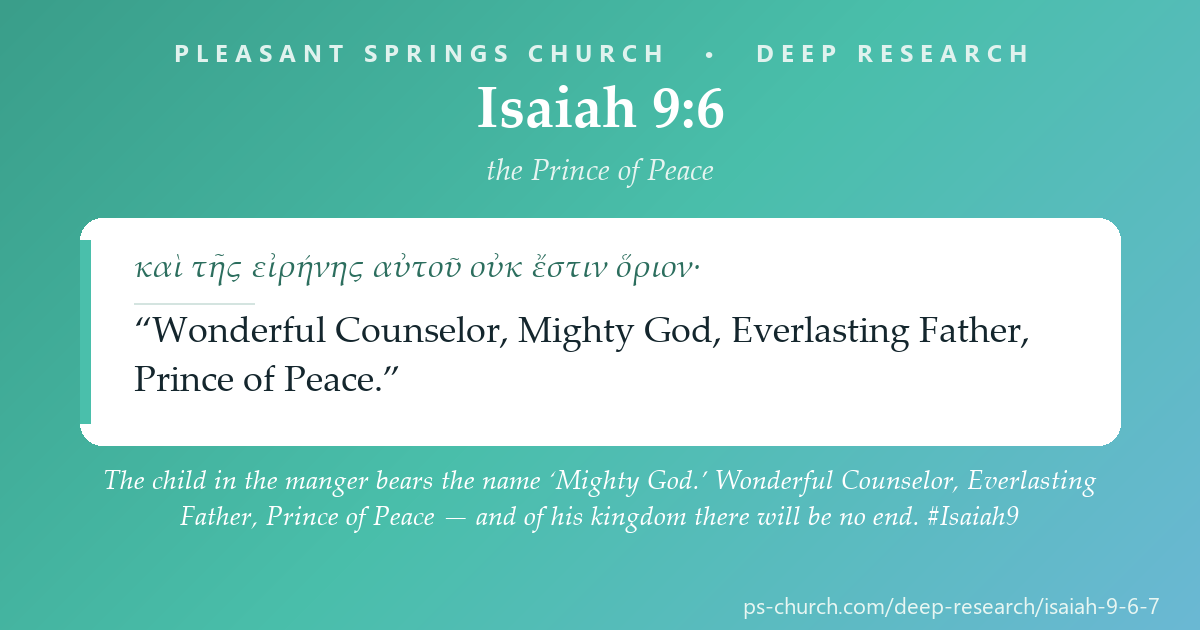
Isaiah 9:6 · to share
ESVEvery Deep Research page traces its passage across the whole sweep — the Old Testament, the Second-Temple world between the testaments (historical witnesses, not Scripture), and the New Testament. Follow the thread:
Pleasant Springs Church — Deep Research
Research method after Michael S. Heiser’s Bible Research Method (examine dictionaries → ancient literature → important words → textual connections → academic publications → share), with the Pleasant Springs “Author & Audience” foundation. Scripture set in the Hebrew, the Greek editions named on each page and the ESV (Old Testament), and the Greek New Testament and the ESV (New Testament), per the practice of Pleasant Springs Church. Isaiah 9:6–7 research grounded in Oswalt, Motyer, Childs, Williamson, and Troxel, with Beale & Carson on the New Testament use; ANE throne-name background; the Old Greek and 1QIsaᵃ as translation/manuscript witnesses.
Scripture quotations marked ESV are from the ESV® Bible (The Holy Bible, English Standard Version®), © 2001 by Crossway, a publishing ministry of Good News Publishers. ESV Text Edition: 2016. Used by permission. All rights reserved. The ESV text may not be quoted in any publication made available to the public by a Creative Commons license, and the ESV may not be translated in whole or in part into any other language. www.esv.org
|
Did this study bless you today? 💚 Give to Support PS Church100% of gifts go to the General Fund — thank you. |