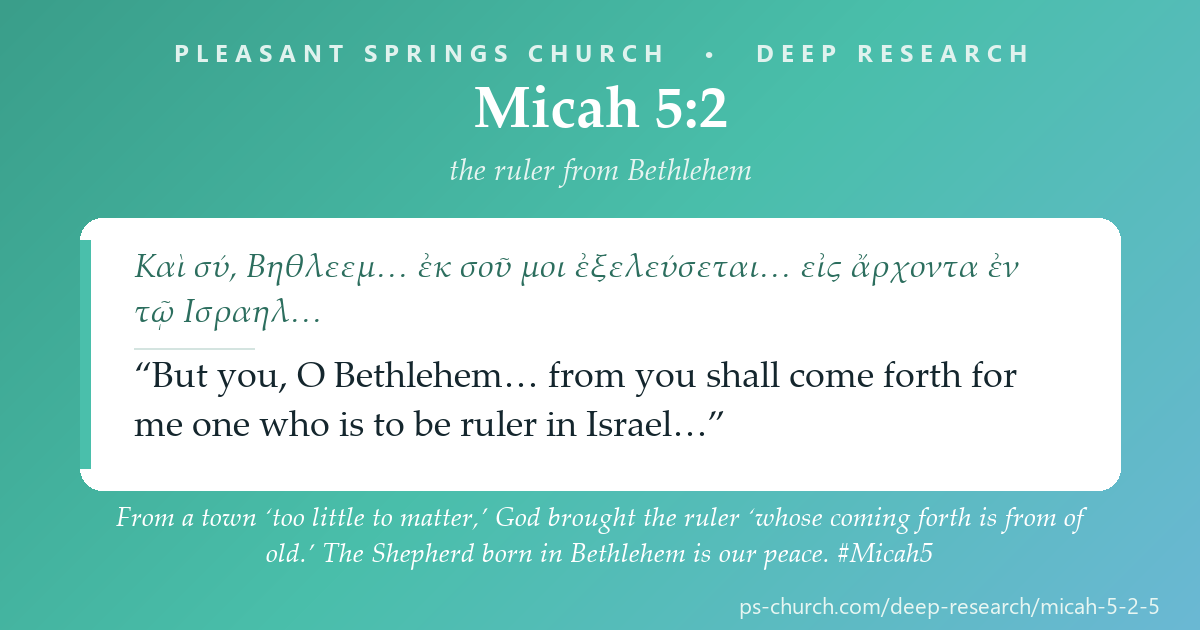
But you, O Bethlehem Ephrathah… from you shall come forth for me one who is to be ruler in Israel.” From David’s little hometown, “too little to be among the clans of Judah,” God promises a Shepherd-King “whose coming forth is from of old, from ancient days” — one who will be great to the ends of the earth and “be their peace.” It is the prophecy Herod’s scribes quoted, and that Jesus fulfilled. This study works Micah 5 from little Bethlehem to the Shepherd who is our peace. See the method →
Micah 5:2–5a (selections)
Hebrew · LXX · ESVThe Shape of the Passage
SequenceMicah, a prophet of Judah in the eighth century BC (a contemporary of Isaiah), announced judgment and hope. Amid oracles of siege and a fallen ruler comes this promise of a coming Shepherd-King from Bethlehem.
Author
The prophet Micah ministered as Assyria threatened Judah. His book alternates judgment and hope; chapter 5 promises deliverance when the nation seems crushed. Against the backdrop of a besieged Jerusalem and a struck “judge of Israel” (5:1), God points past the failing present to a future ruler — not from the capital or the palace, but from tiny Bethlehem, David’s birthplace. The promise reaches back (“from ancient days”) and forward (“to the ends of the earth”), and its center is a shepherd who brings peace.
From of old. The ruler’s “coming forth… from of old, from ancient days” names, at the least, his ancient Davidic origins; the New Testament and the church read in it a deeper note — the eternal origin of the one who was “in the beginning” (John 1:1). Micah promises a king rooted in David and reaching beyond time.
Audience
Judah under threat — a people watching their leaders fail and their enemies close in. To them the promise of a ruler from David’s own village was hope with an address: God had not abandoned the covenant with David, and the deliverer would come from where David came.
How they heard it. The Bethlehem prophecy became a fixed point of messianic expectation. By Jesus’ day it was common knowledge that the Christ would be born in Bethlehem (John 7:42), and the chief priests and scribes could quote Micah 5:2 to Herod without hesitation (Matt 2:5–6). The shepherd-image and the promise of peace shaped Israel’s hope for a king who would feed his flock, not fleece it.
Orient on Bethlehem, the shepherd-ruler, and messianic prophecy.
Search by topic: Bethlehem, Messiah, shepherd, ruler, Micah.
Which articles are relevant?
- Anchor Bible Dictionary — “Bethlehem,” “Micah,” “Messiah,” “Shepherd.”
- Dictionary of the OT: Prophets — “Micah, Book of,” “Messiah,” “Shepherd,” “Peace.”
- NIDOTTE / TDOT — מוֹשֵׁל (môšēl, ruler), מוֹצָאָה (môṣāʾâ, going forth/origin), רָעָה (rāʿâ, shepherd), שָׁלוֹם (šālôm, peace).
Bibliography surfaced:
- Bruce Waltke (A Commentary on Micah), Kenneth Barker (NAC), Delbert Hillers (Hermeneia) on Micah.
- Studies of the Bethlehem prophecy and its use in Matthew 2; the shepherd-king motif.
- Beale & Carson, Commentary on the NT Use of the OT (Matthew).
Little Bethlehem, the shepherd-king, and the ruler from ancient days.
Read the choice of Bethlehem and the shepherd-image against their background, then follow the prophecy into the Gospel.
Which parallels shed light on religion and worldview?
God chooses the small. Bethlehem was insignificant — “too little to be among the clans of Judah” — which is exactly why God chooses it, as he chose the youngest son of Jesse there (1 Sam 16). The pattern runs through Scripture: God brings his greatest works from the overlooked, so that the glory is plainly his.
The king as shepherd. Across the ancient Near East, kings were called “shepherds” of their people, responsible to protect and provide. Israel’s prophets used the image to indict bad shepherds (Ezek 34) and to promise a true one — a coming David who would “shepherd” the flock (Ezek 34:23). Micah’s ruler is that shepherd, feeding his flock “in the strength of the Lord,” and his reign is not conquest but peace.
- 1 Samuel 16:1–13 — David, the shepherd-boy, anointed at Bethlehem: the pattern the Bethlehem-ruler renews.
- Ezekiel 34:23–24; 2 Samuel 5:2 — the promised David who will “shepherd” God’s people (see the Davidic covenant).
- ANE royal ‘shepherd’ language — kings as shepherds of their peoples: the shared idiom Micah fills with a true and gentle King.
- Targum of Micah; John 7:42 — the settled expectation that the Messiah would come from Bethlehem, of David’s line.
Matthew opens his Gospel’s second chapter with this prophecy on the lips of Jesus’ enemies. When the magi seek “the king of the Jews,” Herod’s scribes answer from Micah: “And you, O Bethlehem… from you shall come a ruler who will shepherd my people Israel” (Matt 2:6) — and Jesus is born there. The details Micah names are fulfilled in him: he comes from Bethlehem, of David’s line; he is the true Shepherd (“I am the good shepherd,” John 10:11); he is great “to the ends of the earth” as the gospel goes to the nations; and he “is our peace” (Eph 2:14), making peace between God and sinners and between divided peoples by his cross. The ruler “from ancient days” is the eternal Son who entered a small town to shepherd the world.
The vocabulary of Bethlehem, the ruler, and the shepherd of peace.
Watch little Bethlehem, the “coming forth from of old,” and the shepherd who is our peace.
“Bethlehem Ephrathah” — lit. “house of bread” in the district of Ephrathah; David’s hometown (1 Sam 16), too small to matter — which is why God chooses it.
“Ruler” — one who governs; here a coming king from David’s village, quoted of Christ in Matthew 2:6 (rendered “ruler / governor”).
“His coming forth from of old” — his origins “from ancient days”: at least his ancient Davidic roots; the church hears the eternal origin of the Son (John 1:1).
“And he shall shepherd” — feed, tend, protect; the royal shepherd-image fulfilled in the good shepherd who lays down his life (John 10:11).
How the New Testament reuses the Bethlehem prophecy:
- Matthew 2:1–6 — the scribes quote Micah 5:2 to Herod; Jesus is born in Bethlehem, “a ruler who will shepherd my people Israel.”
- John 7:40–42 — the crowd’s expectation that the Christ comes from Bethlehem, of David’s offspring.
- John 10:11–16; Hebrews 13:20; 1 Peter 2:25; 5:4 — Jesus the good, great, chief Shepherd of the flock.
- Ephesians 2:14–18; Luke 2:14 — “he himself is our peace”; the peace the shepherd-ruler brings.
From David’s village to the Shepherd who is our peace.
Trace Bethlehem and the shepherd-king from David through Micah to Christ.
Which cross-references matter?
- 1 Samuel 16:1–13; Ruth 4:11–22 — Bethlehem, David’s town and line: the roots of the promised ruler.
- 2 Samuel 5:2; 7:12–16; Ezekiel 34:23–24 — the Davidic shepherd-king (see the Davidic covenant).
- Isaiah 9:6–7; 11:1–10 — the child born, the Prince of Peace, the shoot from Jesse: companion messianic promises.
- Matthew 2:1–6; John 7:42 — the prophecy fulfilled in Jesus’ birth at Bethlehem.
- John 10:11; Ephesians 2:14 — the good Shepherd who “is our peace.”
Matthew cites Micah 5:2 as a geographical prophecy fulfilled to the letter — the Christ is born in Bethlehem — but he does something more by splicing in a phrase from 2 Samuel 5:2, “who will shepherd my people Israel.” The blend is deliberate: it fuses the place (Bethlehem, David’s town) with the office (the Davidic shepherd-king), so the newborn is announced as the true David. Matthew’s slight adjustments to the wording underline the point — Bethlehem is “by no means least,” because the ruler makes the little town great. And the prophecy’s reach beyond geography — “from ancient days,” “great to the ends of the earth,” “he shall be their peace” — is taken up across the New Testament in the eternal Son, the good Shepherd, and the peace of the cross.
The scholarship on the Bethlehem prophecy.
The commentators on Micah; the studies of Matthew’s use of Micah 5; the shepherd-king motif.
Commentaries & studies:
- Bruce K. Waltke, A Commentary on Micah; Kenneth L. Barker (NAC); Delbert R. Hillers (Hermeneia).
- Studies of Micah 5:2 in Matthew 2 and its conflation with 2 Samuel 5:2; the messianic shepherd theme.
- G. K. Beale & D. A. Carson, eds., Commentary on the New Testament Use of the Old Testament.
Interpretation notes worth keeping:
- “From of old, from ancient days” at minimum names the ruler’s ancient Davidic origin; the wording legitimately opens toward the eternal origin of the Son, though it is not by itself a technical proof of pre-existence.
- Matthew’s wording. Matthew adjusts “too little” to “by no means least” and adds “shepherd my people Israel” (from 2 Sam 5:2) — interpretive fulfillment, not misquotation: the ruler makes the small town great.
- Peace, not conquest. The ruler’s greatness is a shepherd’s care and a reign of shalom — the kind of kingship the cross would define.
From little Bethlehem to your own hope.
Name what you learned, why it matters, and one concrete response.
What should we carry away — and do?
- God works from the small. He brought the King of the world from a town “too little to matter.” Your overlooked place and small faithfulness are exactly where God loves to work.
- You have a Shepherd, not a tyrant. The ruler feeds his flock; he does not fleece it. To belong to this King is to be led, fed, and guarded by one who gave his life for the sheep.
- He is your peace. Not merely a peace-broker but peace himself — reconciling you to God and to others by his cross. Where you long for peace, come to the one who is our peace.
Step in response: bring one place of conflict or anxiety — with God, or with another person — to the Shepherd who “is our peace,” and take one concrete step of reconciliation this week in the strength he supplies. And do not despise your small, hidden faithfulness; Bethlehem was small too.
Micah 5:2 · to share
LXX + ESVEvery Deep Research page traces its passage across the whole sweep — the Old Testament, the Second-Temple world between the testaments (historical witnesses, not Scripture), and the New Testament. Follow the thread:
Pleasant Springs Church — Deep Research
Research method after Michael S. Heiser’s Bible Research Method (examine dictionaries → ancient literature → important words → textual connections → academic publications → share), with the Pleasant Springs “Author & Audience” foundation. Scripture set in the Hebrew, the Greek editions named on each page and the ESV (Old Testament), and the Greek New Testament and the ESV (New Testament), per the practice of Pleasant Springs Church. Micah 5:2–5a research grounded in Waltke, Barker, and Hillers, with Beale & Carson on Matthew’s use; ANE shepherd-king background; Second-Temple material per the Targum and the expectation reflected in John 7:42 (read as witnesses, not Scripture).
Scripture quotations marked ESV are from the ESV® Bible (The Holy Bible, English Standard Version®), © 2001 by Crossway, a publishing ministry of Good News Publishers. ESV Text Edition: 2016. Used by permission. All rights reserved. The ESV text may not be quoted in any publication made available to the public by a Creative Commons license, and the ESV may not be translated in whole or in part into any other language. www.esv.org
|
Did this study bless you today? 💚 Give to Support PS Church100% of gifts go to the General Fund — thank you. |