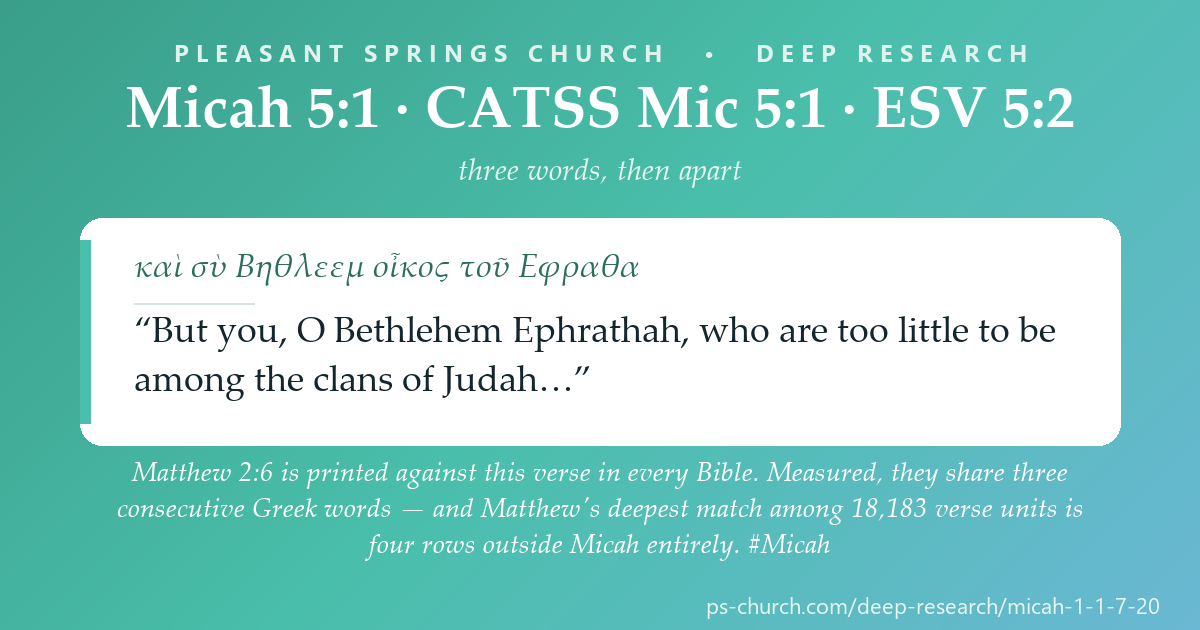
Matthew 2:6 is printed against Micah 5:1 in every reference Bible. Measured for shared wording, the two share three consecutive words — καὶ σὺ Βηθλεεμ — and then part. Neither is the other's deepest partner. Screened against all 7,927 New Testament verses, the Micah row's deepest match is Luke 2:34 at four. Screened against all 30,637 CATSS verse units, Matthew 2:6 reaches five — with four rows tied, and not one of them in Micah: 2 Samuel 5:2, 1 Chronicles 11:2, 1 Kings 8:16 and 1 Kings 16:2. The reason is visible in the columns: Matthew 2:6's second clause is about shepherding a people, and the Micah row has no such clause at all. The connection between these two verses is real and a contiguous-run test is not the instrument that finds it. See the method →
Micah 1:1–7:20 (selections, Hebrew numbering)
Hebrew · Greek (CATSS, Rahlfs’ Septuaginta) · ESV⚠️ And that verse shares three words with Matthew 2:6. Neither is the other’s deepest partner. Stage 2 has the screen.
The Shape of the Passage
Sequence — three rounds of judgment and hopeMicah is the only writing prophet another book of the Hebrew Bible quotes and names. Jeremiah 26:18 cites Micah 3:12 and credits “Micah of Moresheth, in the days of Hezekiah.” The CATSS Greek of Jeremiah reached this shelf on 2026-08-19, so that pair is now measured, in Stage 4: LXX Micah 3:12 and LXX Jeremiah 33:18 (= MT 26:18) share six consecutive Greek words, and nothing else in 30,637 Greek Old Testament verse units reaches that depth with either row.
Author
1:1 places him in Moresheth, a small town in the Judean lowlands. Isaiah, his contemporary, is a Jerusalem figure; Micah is not, and chapters 1–3 read from outside the capital looking in.
Chapter 1 runs on the sounds of town names. Gath and tell, Beth-le-aphrah and dust, Lachish and steeds. None of it survives into Greek, and none of it survives into English either — a limit of translation the columns show plainly.
Audience
6:1–2 puts the mountains and the foundations of the earth on the jury. The address widens past Judah at both ends of the book: 1:2 calls all peoples, 6:2 calls the hills, and 4:1–3 has many nations walking up the mountain of their own accord.
And the last five verses turn to the first person plural. “Who is a God like you, pardoning iniquity…” — a play on the prophet’s own name, and the only place the book prays.
Orient on Moresheth, Bethlehem Ephrathah, and one verse seam.
Search by topic: Micah, book of; Moresheth-gath; Bethlehem Ephrathah; covenant lawsuit (rîb); Micah and Isaiah 2; chapter and verse divisions, history of.
Which articles are relevant?
- Anchor Bible Dictionary — “Micah, Book of,” “Moresheth,” “Bethlehem,” “Ephrathah.”
- Dictionary of the OT: Prophets (IVP) — “Micah: Book of,” “Justice and Righteousness,” “Zion Traditions,” “Messiah.”
- Dictionary of NT Use of the OT (Beale & Carson) — on Matthew 2:6, Matthew 10:35–36 and Luke 12:53.
- NIDOTTE — מוֹשֵׁל, צָעִיר, חֶסֶד, מִשְׁפָּט.
Settle the numbering — the seam falls one verse before Bethlehem
Micah has one Hebrew/English offset, and it opens the unit the Bethlehem verse sits in.
| Hebrew & CATSS | ESV | opening words |
|---|---|---|
| 4:13 | 4:13 | arise and thresh, O daughter of Zion… |
| 4:14 | 5:1 | now muster your troops, O daughter of troops… |
| 5:1 | 5:2 | but you, O Bethlehem Ephrathah… |
| 5:14 | 5:15 | and in anger and wrath I will execute vengeance… |
| 6:1 | 6:1 | hear what the Lord says… |
Chapter counts — Masoretic and CATSS 16 / 13 / 12 / 14 / 14 / 16 / 20; the ESV 16 / 13 / 12 / 13 / 15 / 16 / 20. 105 verses either way. Established from content at the seam rather than assumed. So “Micah 5:2” is an English reference and the same sentence is Micah 5:1 in Hebrew — which matters here, because that is the row the whole study turns on.
Where the screen sends Matthew 2:6.
Micah 5:1 and Matthew 2:6, checked from both ends
The two verses laid side by side:
CATSS Micah 5:1 — καὶ σὺ Βηθλεεμ οἶκος τοῦ Εφραθα ὀλιγοστὸς εἶ τοῦ εἶναι ἐν χιλιάσιν Ιουδα ἐκ σοῦ μοι ἐξελεύσεται τοῦ εἶναι εἰς ἄρχοντα ἐν τῷ Ισραηλ…
Matthew 2:6 — Καὶ σύ Βηθλέεμ γῆ Ἰούδα οὐδαμῶς ἐλαχίστη εἶ ἐν τοῖς ἡγεμόσιν Ἰούδα ἐκ σοῦ γὰρ ἐξελεύσεται ἡγούμενος ὅστις ποιμανεῖ τὸν λαόν μου τὸν Ἰσραήλ
| screened | maximum | tie band |
|---|---|---|
| Micah 5:1 against all 7,927 NT verses | 4 — Luke 2:34 | 1 |
| Matthew 2:6 against all 30,637 CATSS units | 5 | 4 — 2 Samuel 5:2, 1 Chronicles 11:2, 1 Kings 8:16, 1 Kings 16:2 |
| Micah 5:1 against Matthew 2:6 directly | 3 — καὶ σὺ Βηθλεεμ | — |
Matthew 2:6 stands closer, on this measurement, to four rows outside Micah than to the Micah row itself. All four are places where someone is told he will shepherd God’s people Israel. Matthew 2:6 ends ὅστις ποιμανεῖ τὸν λαόν μου τὸν Ἰσραήλ; there is no shepherding clause in the Micah row at all, so those words can only match elsewhere.
The page reports what the screen returns and stops there. It does not say that Matthew 2:6 is drawing on 2 Samuel or 1 Chronicles, or which text anyone was working from. What it shows is that a contiguous-run test, pointed at one of the most securely identified connections in the New Testament, does not find it.
Three columns, three sizes, and three titles
The differences inside the verse are worth reading straight off.
| the town | its size | who comes out | |
|---|---|---|---|
| Hebrew 5:1 | בֵּית־לֶחֶם אֶפְרָתָה | צָעִיר — little | מוֹשֵׁל — ruler |
| CATSS row | Βηθλεεμ οἶκος τοῦ Εφραθα | ὀλιγοστὸς εἶ — you are least | ἄρχοντα |
| Matthew 2:6 | Βηθλέεμ γῆ Ἰούδα | οὐδαμῶς ἐλαχίστη εἶ — by no means least | ἡγούμενος |
Three readings of the town’s name, three of its size — one of them negated where the others are not — and three different words for the one who comes out. All three are printed here as their files have them, and the page does not order them or explain any of them.
What the whole book returns
All 105 CATSS rows of Micah against all 7,927 verses of the Greek New Testament.
| run reached | rows of the 105 |
|---|---|
| 2 or more | 105 — all of them |
| 3 or more | 76 |
| 4 or more | 14 |
| 5 or more | 2 |
| 6 | 1 |
This is the flattest book measured on this shelf so far. The deepest run in Micah is six, at 7:7 against Luke 1:47 — and even that is shared, because Habakkuk 3:18 carries the same six words and ties with it from the Luke side.
What the measurement is, and its scope. Contiguous runs of word forms, Greek against Greek: the CATSS FORM column (cols 0–24, beta-code transliterated) across 30,637 verse units in 64 .mlxx files, against the MorphGNT normalised-word column (field 6) across 7,927 verses in 27 files. Both sides lowercased, accents and breathings dropped, final sigma folded, then filtered to Greek letters — the same filter on both corpora. Word forms, never lemmas. The Greek of Isaiah and Jeremiah reached this shelf on 2026-08-19, so the two comparisons this page once had to decline — Micah 4:1–3 against Isaiah 2:2–4, and Micah 3:12 against Jeremiah 26:18 (= LXX 33:18) — are measured in Stage 4. The Greek New Testament corpus has not grown, and every run and every distribution figure on this page against it reproduces as first published. One tie band does not, and is corrected below at 6:8, with the reason it is not a consequence of the fix described next.
⚠️ A cross-edition fix, 2026-08-30, and why nothing here moved. MorphGNT folds the two spellings of the negative (οὐκ, οὐχ → οὐ), of the preposition (ἐξ → ἐκ) and of the movable nu into one form in the column measured here; CATSS does not. For a stretch this shelf compared the two corpora without that equivalence, and every cross-corpus run that reached such a word was cut short there. The comparison layer now applies MorphGNT’s own equivalence table — 106 pairs the edition itself declares — to both sides. The error could only ever break a run, never invent one, so every figure it touched was too low. This page’s distribution was taken before that regression and is unaffected: 105, 76, 14, 2 and 1 are what the corrected screen returns today, and the deepest row is still 7:7 at six. Two rows inside the book moved up under the fix — 4:12 from two to four (Hebrews 3:10, αὐτοὶ δὲ οὐκ ἔγνωσαν, band of one) and 2:5 from two to three — neither of them a row this page prints.
The ploughshares, in two directions.
Micah 4:3, Joel 4:10 and Isaiah 2:4 — three ploughshare rows, three vocabularies
All three sentences are on this shelf now, all three are measurable, and the overlap between any two of them is small.
| first pair | second pair | |
|---|---|---|
| Micah 4:3 | τὰς ῥομφαίας → εἰς ἄροτρα swords into ploughs | τὰ δόρατα → εἰς δρέπανα spears into pruning hooks |
| Joel 4:10 | τὰ ἄροτρα → εἰς ῥομφαίας ploughs into swords | τὰ δρέπανα → εἰς σειρομάστας pruning hooks into pikes |
| Isaiah 2:4 | τὰς μαχαίρας → εἰς ἄροτρα swords into ploughs | τὰς ζιβύνας → εἰς δρέπανα pikes into pruning hooks |
The first pair uses the same two words in each row, with the direction of the sentence the other way round. The second pair does not: Micah’s δόρατα becomes Joel’s σειρομάστας, so the two rows are not mirror images even in vocabulary.
Measured for shared wording, the two rows have a longest run of two. The relation a reader sees between them is not something a contiguous-run test registers. Which of the two is prior is not a question these columns settle, and the page does not raise it.
The Isaiah row could not be printed here until 2026-08-19, when the CATSS Greek of Isaiah reached this shelf. It runs the same direction as Micah and uses neither of Micah’s two weapon words — μαχαίρας for Micah’s ῥομφαίας, ζιβύνας for δόρατα. Micah 4:3 against Isaiah 2:4 has a longest run of 4, reached three separate times; Joel 4:10 against Isaiah 2:4 has a longest run of 1. Three rows, three vocabularies, and no direction of influence asserted between any of them.
6:8, and what a thirty-seven-way tie looks like
Micah 6:8 is the verse this book is most often reduced to. Against all 7,927 verses of the Greek New Testament its longest run is two, and thirty-seven verses are tied at that depth.
A tie band of thirty-seven is what the bottom of this distribution looks like: at a run of two the screen is not distinguishing anything at all. All 105 rows of Micah reach two. The measurement has nothing to say about this verse, and saying so is more useful than not running it.
⚠️ This band was published as thirty-one and is thirty-seven. The number is corrected here rather than swapped in silence. It is not a consequence of the cross-edition fix of 2026-08-30 described in Stage 2: re-measured on the pre-fix substrate, on the post-fix substrate, and on the MorphGNT surface column this page was originally built from, Micah 6:8 returns a maximum of two with a band of thirty-seven every time. The first figure does not reproduce by any route, and where it came from is not recoverable. Nothing the paragraph above argues depends on which of the two numbers is right — a band of thirty-one and a band of thirty-seven are both the bottom of the distribution — but the shelf prints the history rather than the tidier number.
Both columns are worth reading side by side anyway. The Hebrew asks for עֲשׂוֹת מִשְׁפָּט וְאַהֲבַת חֶסֶד וְהַצְנֵעַ לֶכֶת; the row asks for ποιεῖν κρίμα καὶ ἀγαπᾶν ἔλεον καὶ ἕτοιμον εἶναι τοῦ πορεύεσθαι — to be ready to walk where the Hebrew has to walk humbly.
Two more places the columns carry different words
| verse | Hebrew | CATSS Greek row |
|---|---|---|
| 3:8 | אָנֹכִי מָלֵאתִי כֹחַ — I am filled with power | ἐὰν μὴ ἐγὼ ἐμπλήσω ἰσχύν — unless I fill with strength |
| 4:14 | בַת־גְּדוּד — daughter of troops | θυγάτηρ Εφραιμ — daughter of Ephraim |
| 4:14 | שֹׁפֵט יִשְׂרָאֵל — the judge of Israel | τὰς φυλὰς τοῦ Ισραηλ — the tribes of Israel |
Each is printed as its file has it. Why any of them stands as it does is not something these columns can settle.
Two Gospels on one verse, and one phrase shared with Habakkuk.
Micah 7:6 — Luke measures deeper than Matthew
Matthew 10:35–36 and Luke 12:53 are both printed against Micah 7:6. Measured, they do not come out level.
| New Testament verse | run | the shared words |
|---|---|---|
| Luke 12:53 | 4 | νύμφη ἐπὶ τὴν πενθεράν |
| Matthew 10:35 | 1 | αὐτῆς |
| Matthew 10:36 | 1 | ἐχθροί |
Micah 7:6’s maximum of four is a three-way tie — Luke 12:53, Acts 11:13 and Hebrews 3:2 all reach it, and the last two are not about families at all. At a depth of four this screen is already close to noise, and the page prints the band rather than the one member that fits.
Micah 7:7 and Habakkuk 3:18 carry the same six words
The deepest run in Micah is six words, and it is not unique to Micah.
ἐπὶ τῷ θεῷ τῷ σωτῆρί μου
Micah 7:7 and Habakkuk 3:18 both carry it, and both reach six against Luke 1:47. From the Luke side the band has two members and the screen does not separate them. The Habakkuk study on this shelf reports the same tie from the other direction.
Both Hebrew verses say something close: Micah’s לֵאלֹהֵי יִשְׁעִי and Habakkuk’s בֵּאלֹהֵי יִשְׁעִי differ in one letter, the preposition.
Two connections this page could not measure — measured now
⚠️ This section has been rewritten because the corpus grew. When this page was first published the Greek of Isaiah and Jeremiah was not held here, and it reported both comparisons as unavailable rather than negative. The CATSS Greek of Isaiah, Jeremiah, Lamentations, Ezekiel and both Greek Daniels was fetched on 2026-08-19, taking this shelf from 35 files and 18,183 verse units to 44 files and 23,061. Both pairs are measured below. Nothing measured against the Greek New Testament changed — that corpus did not grow.
⚠️ And the shelf grew a second time on 2026-08-30 — Exodus, Leviticus, Numbers, Joshua (A and B) and the whole deuterocanon, taking it to 64 files and 30,637 verse units. Every measurement on this page was re-run against the larger corpus, and every one of them held unchanged. Micah 4:2 and Isaiah 2:3 are still thirteen words and still one-to-one from both sides; Micah 3:12 and LXX Jeremiah 33:18 are still six and still one-to-one from both sides; Matthew 2:6’s maximum is still five in a band of the same four rows, and still not one of them in Micah. Adding 7,576 verse units did not disturb a single figure here — which is worth saying plainly, because on two of this shelf’s other pages the same growth broke a headline claim. A number that survives a corpus expansion is better evidence than the same number was before.
Micah 4:1–3 against Isaiah 2:2–4 — and one run of thirteen.
| rows | run | the shared words |
|---|---|---|
| Micah 4:1 ↔ Isaiah 2:2 | 4 | ὑπεράνω τῶν βουνῶν καὶ |
| Micah 4:2 ↔ Isaiah 2:3 | 13 | ἀναβῶμεν εἰς τὸ ὄρος κυρίου καὶ εἰς τὸν οἶκον τοῦ θεοῦ Ιακωβ καὶ |
| Micah 4:3 ↔ Isaiah 2:4 | 4 | καὶ κρινεῖ ἀνὰ μέσον — and two more 4s inside the ploughshare clause |
Thirteen consecutive word forms, and the tie band is one from both sides. Screened against all 30,637 Greek Old Testament verse units, Micah 4:2’s maximum outside its own book is 13 and Isaiah 2:3 is the only row that reaches it; run from the other end, Isaiah 2:3’s maximum outside Isaiah is 13 and Micah 4:2 is the only row that reaches it. That is more than double the deepest run this page reports anywhere else — the whole book’s maximum against the Greek New Testament is six.
The three rows are not identical, and the differences are worth printing. Micah 4:1 has μετεωρισθήσεται where Isaiah 2:2 has ὑψωθήσεται, and ends σπεύσουσιν πρὸς αὐτὸ λαοί against Isaiah’s ἐπ' αὐτὸ πάντα τὰ ἔθνη. Micah 4:2 has δείξουσιν ἡμῖν and ἐν ταῖς τρίβοις αὐτοῦ where Isaiah 2:3 has ἀναγγελεῖ ἡμῖν and ἐν αὐτῇ. And in the ploughshare sentence the weapons are different words: Micah 4:3 beats τὰς ῥομφαίας and τὰ δόρατα, Isaiah 2:4 τὰς μαχαίρας and τὰς ζιβύνας — which is why the run there stops at four.
On the Hebrew side the same pair runs shallower. Masoretic Micah 4:2 against Masoretic Isaiah 2:3 gives 10 — מִדְּרָכָ֔יו וְנֵלְכָ֖ה בְּאֹֽרְחֹתָ֑יו כִּ֤י מִצִּיּוֹן֙ תֵּצֵ֣א תוֹרָ֔ה וּדְבַר יְהֹוָ֖ה מִירוּשָׁלִָֽם — and the earlier breaks are small: גּוֹיִ֣ם against עַמִּ֣ים, וְאֶל against אֶל, and וְיוֹרֵ֙נוּ֙ against וְיֹרֵ֙נוּ֙. Why the two Greek rows stand closer to each other than the two Hebrew rows do is not something this page settles, and no direction of influence is asserted in either language.
Micah 3:12 and Jeremiah 26:18 — and a chapter number that points somewhere else. Greek Jeremiah relocates the Oracles Against the Nations, so MT Jeremiah 26:18 is LXX Jeremiah 33:18, while the Greek file’s own 26:18 is MT 46:18 — ζῶ ἐγώ λέγει κύριος ὁ…, Tabor and Carmel. The alignment used here was derived from the content of the rows, not copied from a printed table: LXX Jeremiah 33:17–19 is the elders standing up, Micah the Morashtite, and Hezekiah.
| rows | run | the shared words |
|---|---|---|
| LXX Micah 3:12 ↔ LXX Jeremiah 33:18 | 6 | Σιων ὡς ἀγρὸς ἀροτριαθήσεται καὶ Ιερουσαλημ |
| the same pair, a second run of the same depth | 6 | ἔσται καὶ τὸ ὄρος τοῦ οἴκου |
| Hebrew Micah 3:12 ↔ Hebrew Jeremiah 26:18 | 5 | תִּֽהְיֶ֔ה וְהַ֥ר הַבַּ֖יִת לְבָמ֥וֹת יָֽעַר |
Six, and one-to-one from both sides. Across all 30,637 Greek Old Testament verse units nothing outside Micah reaches six with Micah 3:12 except Jeremiah 33:18, and nothing outside Jeremiah reaches six with Jeremiah 33:18 except Micah 3:12. The Greek run stops where the two rows stop saying the same thing: Micah has Jerusalem become ὡς ὀπωροφυλάκιον, like a watchman’s hut; Jeremiah has εἰς ἄβατον, into a trackless place. On the Hebrew side the break falls one word earlier, and on spelling rather than sense: וִירוּשָׁלִַ֙ם֙ against וִירוּשָׁלַ֙יִם֙, and עִיִּ֣ין against עִיִּ֣ים. Which row is prior, and why either reads as it does, is not something these columns settle.
Where this page is weakest, and what was not reached.
The limits, and they are unusually visible here
This is the study where the measurement most clearly fails to find something real, and it is published for that reason. Matthew 2:6 and Micah 5:1 are connected by an explicit citation formula in Matthew — for so it is written by the prophet. The screen returns three, and sends the verse elsewhere. The connection is not in doubt; the instrument is simply not built to see it.
Two of the book’s most important parallels were outside the corpus, and are not any more. Isaiah 2 and Jeremiah 26 were both absent from the 35 files when this page was first published. The CATSS Greek of Isaiah, Jeremiah, Lamentations, Ezekiel and both Greek Daniels was fetched on 2026-08-19 and the shelf went to 44 files and 23,061 verse units, so Stage 4 now carries both numbers: 13 for Micah 4:2 against Isaiah 2:3, 6 for Micah 3:12 against LXX Jeremiah 33:18, each one-to-one across the whole Greek Old Testament. The limit that stood here was the corpus, not the instrument — which is worth saying plainly, because the limit at Matthew 2:6 above is the instrument, and no fetch will fix that one.
And a flat distribution is easy to over-read. That Micah’s maximum is six says something about this book against this New Testament on this measurement. It says nothing about how much of Micah the New Testament writers knew.
What could not be checked at all
No Hebrew or Greek critical apparatus. No Qumran material — there is Micah among the Minor Prophets finds, and the scroll from Nahal Hever bears on the Greek of these books; neither was consulted. No Targum, Syriac, Vulgate, Aquila, Symmachus or Theodotion. No text-critical work on Matthew 2:6, whose form differs from both the Hebrew and the Greek row at several of the points measured above.
And nothing about the town-name wordplays of chapter 1. They depend on Hebrew sound and are invisible in both the Greek column and the English one. A word-form screen cannot register them and this page does not pretend to.
Three words, and then the columns part.
The most certain connection in the book is the one the screen loses
Matthew says outright that he is quoting a prophet, and every Bible prints Micah 5:2 beside it. The two verses share three consecutive Greek words and then go different ways. Matthew’s deepest partners among twenty-three thousand verse units are four rows about shepherding Israel, none of them in Micah — because Micah’s row does not contain that clause.
And inside those three words the columns are already parting: the Hebrew calls Bethlehem little, the Greek row calls it least, and Matthew calls it by no means least.
Micah is the flattest book measured on this shelf against the Greek New Testament — 105 rows, a maximum of six, and even that six is shared with Habakkuk. Turn the same screen on the Greek Old Testament and it is not flat at all: Micah 4:2 and Isaiah 2:3 share thirteen consecutive Greek words, Micah 3:12 and LXX Jeremiah 33:18 share six, and both are one-to-one across 30,637 verse units. Neither could be run on this page until the Greek of Isaiah and Jeremiah reached this shelf on 2026-08-19, and both were re-run when Exodus, Leviticus, Numbers, Joshua and the deuterocanon arrived on 2026-08-30 and the shelf reached 30,637 units. Both held. What this page can show is where a measurement stops — and, now, which of those stops was the corpus rather than the instrument.
Ninth study on the Minor Prophets shelf, and the whole of Micah in one page. Six books complete: Hosea, Joel, Amos, Jonah, Micah, Habakkuk.
Every Deep Research page traces its passage across the whole sweep — the Old Testament, the Second-Temple world between the testaments (historical witnesses, not Scripture), and the New Testament. Follow the thread:
Pleasant Springs Church — Deep Research
Research method after Michael S. Heiser’s Bible Research Method (examine dictionaries → ancient literature → important words → textual connections → academic publications → share), with the Pleasant Springs “Author & Audience” foundation. Scripture set in the Hebrew, the Greek editions named on each page and the ESV (Old Testament), and the Greek New Testament and the ESV (New Testament), per the practice of Pleasant Springs Church. Micah research grounded in Andersen & Freedman (Micah, Anchor), Waltke (NICOT), Smith (WBC) and Mays (OTL). Text: Hebrew from the Masoretic text as printed in the editions consulted — Sefaria’s Miqra according to the Masorah; no critical apparatus was consulted for the Hebrew. Greek from Rahlfs’ Septuaginta as digitized by CATSS; Greek New Testament from the SBL edition. The standing caution for this shelf applies: these pages say “the CATSS Greek row reads…” and never call a Greek reading early or late. ⚠️ VERSE NUMBERING — one seam, one verse before the Bethlehem line. Masoretic and CATSS Micah run 16 / 13 / 12 / 14 / 14 / 16 / 20 = 105 verses; the ESV runs 16 / 13 / 12 / 13 / 15 / 16 / 20 = 105. Hebrew 4:14 = ESV 5:1, so Hebrew 5:1–14 = ESV 5:2–15 and the Bethlehem verse is 5:1 in Hebrew and 5:2 in English. Established from content at the seam, not assumed. ⚠️ The run measurement, in full. Greek against Greek. CATSS FORM column (cols 0–24), beta-code transliterated first; MorphGNT field 6, the normalised word (the column that already resolves elision and the movable nu). Both sides lowercased, accents and breathings dropped, final sigma folded, then filtered to Greek letters — the same filter applied to both corpora. Contiguous runs of whole word FORMS, never lemmas. Corpus: 30,637 CATSS verse units across 64 .mlxx files and 7,927 verses across 27 MorphGNT files (the Greek Old Testament side grew from 18,183 units in 35 files on 2026-08-19 to 23,061 in 44, and again to 30,637 in 64 on 2026-08-30, when Exodus, Leviticus, Numbers, Joshua and the deuterocanon arrived; every figure on the page was re-run at 30,637 and held. The MorphGNT side did not change). Exhaustive and deterministic — nothing sampled, so no seed applies. ⚠️ Every maximum is printed with its tie band, checked on both sides — and none of them here is one-to-one. Matthew 2:6’s maximum against the 30,637 units is 5 with a band of four (2 Samuel 5:2, 1 Chronicles 11:2, 1 Kings 8:16, 1 Kings 16:2, printed with the file’s own header names 2Sam/K 5:2, 1Chr 11:2, 1/3Kgs 8:16, 1/3Kgs 16:2). Micah 7:6’s maximum of 4 is a band of three. Micah 4:2’s 5 is a band of three. Micah 7:7’s 6 ties with Habakkuk 3:18 from the Luke 1:47 side. Matthew 2:6’s figure was re-run after the Greek Old Testament grew on 2026-08-19 and is unchanged — the 4,878 verse units added bring nothing closer to it than those same four rows. ⚠️ This page publishes a measurement failing on a certain connection. Matthew 2:6 cites a prophet explicitly and the screen returns 3, sending the verse elsewhere. That is reported as a limit of the instrument, not as evidence about the texts. Across the 105 Micah rows: all 105 reach two, 76 reach three, 14 four, 2 five, 1 six. ⚠️ Two comparisons were unavailable and are now measured. Micah 4:1–3 against Isaiah 2:2–4, and Micah 3:12 against Jeremiah 26:18, could not be run when this page was first published because the Greek of Isaiah and Jeremiah was not held here; it was fetched on 2026-08-19 and both stand in Stage 4. Micah 4:2 ↔ Isaiah 2:3 = 13, tie band 1 checked from both sides; Micah 3:12 ↔ LXX Jeremiah 33:18 = 6, tie band 1 checked from both sides. The Jeremiah reference needs its offset: MT Jeremiah 26:18 is LXX Jeremiah 33:18, and the Greek file’s own 26:18 is MT 46:18. That alignment was derived here from the content of the rows and not copied from a printed table; the shelf’s versification module still marks Greek Jeremiah as a whole PROVISIONAL, and this page claims only the rows it checked. ⚠️ Direction of influence is never asserted. Nothing here says which text is prior, that anyone quoted, adapted, followed or altered anything, or why any reading stands as it does — including the three sizes at 5:1 (little / least / by no means least), the two ploughshare sentences at Micah 4:3 and Joel 4:10, and the differences at 3:8 and 4:14. All are printed side by side and left there. Typology is handled per the house position: what the text says, what the New Testament itself draws, and what we see from this side of the cross — with the seeing left to the reader.
Scripture quotations marked ESV are from the ESV® Bible (The Holy Bible, English Standard Version®), © 2001 by Crossway, a publishing ministry of Good News Publishers. ESV Text Edition: 2016. Used by permission. All rights reserved. The ESV text may not be quoted in any publication made available to the public by a Creative Commons license, and the ESV may not be translated in whole or in part into any other language. www.esv.org
|
Did this study bless you today? 💚 Give to Support PS Church100% of gifts go to the General Fund — thank you. |