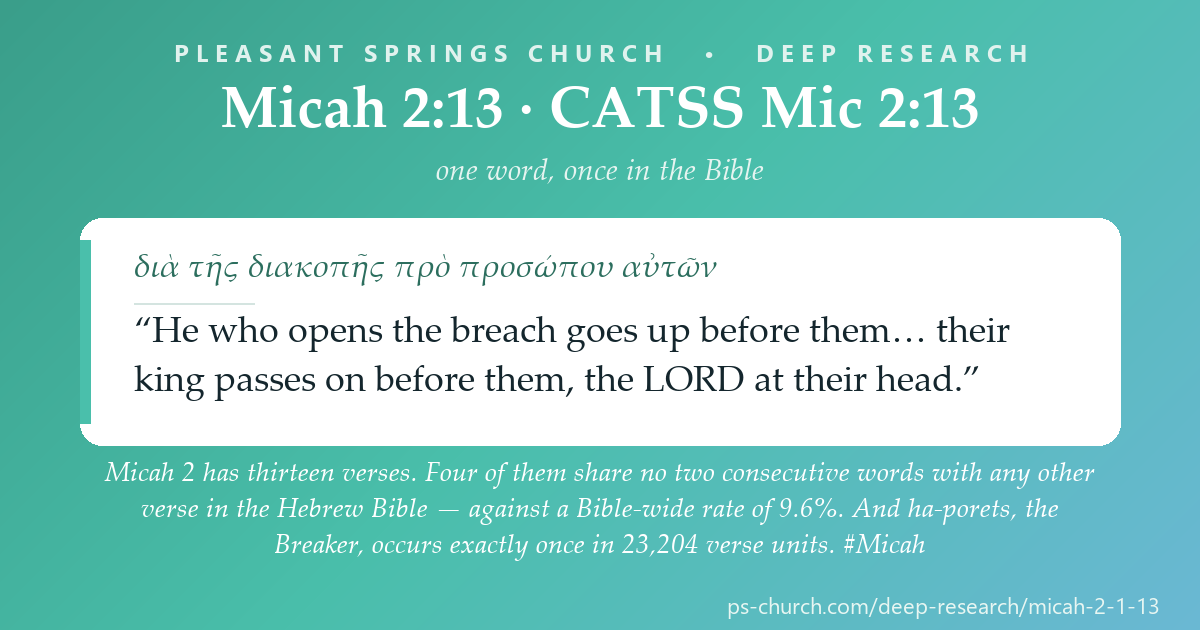
Micah 2 has thirteen verses. Four of them share no two consecutive words with any other verse in the Hebrew Bible. Screened against all 23,204 verse units of the Masoretic corpus, 2:2, 2:6, 2:8 and 2:9 come back at zero — not zero shared words, but zero shared pairs. The rate across the whole Hebrew Bible is 2,247 verses in 23,204, or 9.7%. This chapter runs at 30.8%, the highest of Micah's seven chapters and third among the sixty-three Minor Prophet chapters of ten verses or more.
And then the page prints what cuts against it. Ninety-seven other chapters beat Micah 2 on the same measure, a third of them in Job. The chapter's deepest run in either language — seven Greek words at 2:3 — is a messenger formula in a band of ten. The parallel every commentary draws, Micah 2:2 against Naboth's vineyard, measures zero in every verse of 1 Kings 21. What is left after all of that is still worth having: a chapter about land being taken away that does not sound like anything else in the book it belongs to.
Micah 2:1–13 — the whole chapter
Hebrew · Greek (CATSS, Rahlfs’ Septuaginta) · ESV⚠️ FOUR ZERO ROWS IN THIRTEEN. 2:2, 2:6, 2:8 and 2:9 share no two consecutive words with any of the other 23,191 verse units of the Masoretic corpus. The rate across the whole Hebrew Bible is 9.7%. Stage 4 has the number, the band, and the reasons not to over-read it.
The Shape of the Passage
Sequence with two five-verse returns — parallel, NOT a chiasmMicah 2 is the last chapter of this book to reach the shelf, and it is the chapter of Micah that shares least with the rest of the Hebrew Bible. Those two facts are unrelated — the order the shelf was built in has nothing to do with the measurement — but the coincidence is worth naming, because a page that saves its surprise for last invites the suspicion that the surprise was chosen. It was not. The screen was run on all seven chapters of Micah before a word of this page was written, and chapter 2 came out on top.
Author
Micah of Moresheth, a lowland town about twenty-five miles south-west of Jerusalem. 1:1 dates him to Jotham, Ahaz and Hezekiah. Chapter 2 is a village man’s complaint about what the capital’s creditors were doing to village land.
The charge in 2:1–2 is not theft in the night but foreclosure at dawn. “When the morning dawns, they perform it” — the seizure happens in daylight, lawfully, at the hour the courts open. What 2:1 calls wickedness is something that could be done because it is in the power of their hand.
Audience
2:6 records the audience answering back. It is one of the few places in the prophets where the objection is quoted rather than described: do not preach. The chapter then quotes what they would rather hear — 2:11, a man who preaches wine and strong drink.
And the people wronged are named twice as God’s own. עַמִּי, my people, in 2:8 and again in 2:9 — the women driven from their houses and the children stripped of what 2:9 calls my splendour. Both verses are zero rows.
Orient on Moresheth, land tenure, the remnant, and the numbering.
Search by topic: Micah, book of; Moresheth-gath; land tenure in ancient Israel; inheritance (naḥalah); latifundia, eighth-century Judah; remnant; Nazirite; chapter and verse divisions, history of.
Which articles are relevant?
- Anchor Bible Dictionary — “Micah, Book of,” “Moresheth,” “Land,” “Inheritance,” “Remnant.”
- Dictionary of the OT: Prophets (IVP) — “Micah: Book of,” “Justice and Righteousness,” “Land,” “Remnant.”
- NIDOTTE — נַחֲלָה, חֶבֶל, מְנוּחָה, שְׁאֵרִית, נטף, פָּרַץ.
- Dictionary of NT Use of the OT (Beale & Carson) — on Revelation 18:4 and its Old Testament background.
Settle the numbering — there is no offset here, and saying so is the point
Micah 2 is numbered identically in all three columns.
| Hebrew & CATSS | ESV | verses |
|---|---|---|
| Micah 2:1–13 | Micah 2:1–13 | 13 / 13 / 13 |
Chapter counts — Masoretic and CATSS Micah 16 / 13 / 12 / 14 / 14 / 16 / 20; the ESV 16 / 13 / 12 / 13 / 15 / 16 / 20. 105 verses either way. The single seam is at Hebrew 4:14 = ESV 5:1, so Hebrew 5:1–14 = ESV 5:2–15. Chapters 1, 2 and 3 are unaffected, and so is every reference on this page. It is stated because this shelf states the offset on every page including the ones that have none — silence about numbering reads as ignorance of it.
The seam was established from the content of the rows at 4:13–5:1, not assumed from a printed table. The companion whole-book study on this shelf, Micah 1:1–7:20, prints the working.
Fields, foreclosure, and two Greek phrases that lead somewhere unexpected.
The land charge, and the parallel that measures nothing
Micah 2:2 is the classic prophetic land-seizure text, and it is a zero row.
| Micah 2:2 against | Hebrew run | shared |
|---|---|---|
| 1 Kings 21:2 — Ahab asks for the vineyard | 0 | — |
| 1 Kings 21:15 — Jezebel says take possession | 0 | — |
| 1 Kings 21:16 — Ahab goes down to take it | 0 | — |
| 1 Kings 21:19 — have you killed and also taken possession? | 0 | — |
| Isaiah 5:8 — woe to those who join house to house | 0 | — |
| Isaiah 5:8 against Micah 2:1 — the woe itself | 1 | הוֹי |
Naboth’s vineyard is the right cultural background and the wrong kind of evidence. The two texts describe the same crime and do not share a single pair of consecutive words. That is the counter-example this page prints against itself: if a zero can sit under an obvious connection, then a zero elsewhere in this chapter is not proof of isolation either. It is proof of unshared wording, which is a narrower thing.
The law behind the charge is not in doubt and is not measured here. Leviticus 25 makes a family holding inalienable; the word Micah 2:2 uses for what is taken is נַחֲלָה, the allotted inheritance, and 2:5 says the punishment in the same vocabulary: no one left to cast the surveyor’s cord.
Two Greek phrases that go somewhere the Hebrew does not
Micah 2:11 and the Nazirite vow.
| phrase | occurrences in 30,348 CATSS units |
|---|---|
| οἶνον καὶ μέθυσμα καὶ (4 words) | 3 — Judges B 13:4, Judges B 13:7, Micah 2:11 |
| οἶνον καὶ μέθυσμα (3 words) | 6 — 1 Samuel 1:11, 1:15, Hosea 4:11, Judges B 13:4, 13:7, Micah 2:11 |
Four of the six sit in Nazirite contexts — Hannah’s vow and her answer to Eli, and the angel’s instruction to Samson’s mother. Micah 2:11 is the one place the phrase is what a false prophet promises. The page reports the distribution and does not claim that the Micah row is alluding to Judges or that anyone intended the contrast.
Micah 2:1 and Hosea 7:14 — the same four Greek words, twice in the whole corpus.
| rows | run | tie band | shared |
|---|---|---|---|
| CATSS Mic 2:1 ↔ CATSS Hos 7:14 | 4 | 1 | ἐν ταῖς κοίταις αὐτῶν |
| Hebrew Micah 2:1 ↔ Hebrew Hosea 7:14 | 2 | 23 | עַל־מִשְׁכְּבוֹתָם |
Read the second row carefully. Micah 2:1’s Hebrew maximum against the whole corpus is 2 in a tie band of 23, and Hosea 7:14 is one of the 23. The pair עַל־מִשְׁכְּבוֹתָם itself stands in four verses — Isaiah 57:2, Hosea 7:14, Micah 2:1 and Psalm 149:5. A phrase count and a tie band are different numbers, and both are given here.
Both books put wrongdoing on a bed. The Greek side is the tighter of the two: ἐν ταῖς κοίταις αὐτῶν occurs exactly twice in 30,348 verse units, while the Hebrew עַל־מִשְׁכְּבוֹתָם occurs four times — Isaiah 57:2, Hosea 7:14, Micah 2:1 and Psalm 149:5. Neither figure says which text is prior or whether either writer knew the other.
The Breaker — what this page can and cannot say
What is measured: the form הַפֹּרֵץ occurs once in 23,204 Masoretic verse units, at Micah 2:13. The Greek row does not have a person there at all — διὰ τῆς διακοπῆς, through the breach. The noun διακοπή and its verb stand 27 times across 17 of the 30,348 CATSS verse units screened here. Micah 2:13 is not the only prophetic row among them — Amos 9:1 and Habakkuk 3:14 carry the verb as well. The other fourteen are Baal-perazim (2 Samuel 5:20, 1 Chronicles 14:11), Perez-uzzah (2 Samuel 6:8, 1 Chronicles 13:11 and 15:13), 1 Kings 2:35f, 2 Kings 3:26, Judges A 5:17, Judges A and B 21:15, Job 28:4, Proverbs 6:15, CATSS Psalm 28:7 (= ESV 29:7) and Judith 2:23. The root does not occur at all in the 7,927 verses of the Greek New Testament.
⚠️ NOT CHECKED HERE. Micah 2:13 is widely reported to be read messianically in later Jewish tradition — the Poretz who goes up first. No rabbinic corpus is held on this shelf and no such text was consulted. The claim is named so that a reader who has met it knows the page did not verify it, and it carries no weight in anything measured above.
Five words counted across the whole corpus.
One occurrence in the Hebrew Bible: Micah 2:13. A definite active participle of פרץ, to burst through. The same root gives Perez, Baal-perazim and the breach in a wall. The next word in the verse, פָּרְצוּ, is the same root as a plural verb — the Breaker breaks and then they break.
In Micah only at 2:5 and 2:10. At 2:5 it is the surveyor’s cord that assigns land; at 2:10 the same three consonants carry destruction — תְּחַבֵּל וְחֶבֶל נִמְרָץ. The Greek row keeps them apart: σχοινίον at 2:5, φθορᾷ at 2:10.
Five of this verb’s causative forms in the Hebrew Bible stand in Micah 2 — three in 2:6, two in 2:11. The others are Amos 7:16, Amos 9:13 and Ezekiel 21:2 and 21:7 (Hebrew numbering — ESV 20:46 and 21:2). The literal sense is dripping; the derived sense is holding forth. The Greek row at 2:6 took the literal one and made it tears.
Three occurrences of the definite form: Deuteronomy 12:9, Isaiah 28:12, Micah 2:10. Deuteronomy says they have not yet come to it; Isaiah says this is the rest; Micah says this is not the rest. Micah 2:10 and Isaiah 28:12 share two consecutive words and nothing more.
The Greek row uses it in two adjacent verses: at 2:5 nobody will cast it, and at 2:4 the mourners say μερὶς λαοῦ μου κατεμετρήθη ἐν σχοινίῳ — my people’s portion was measured out with a cord. The Hebrew of 2:4 has no cord in it.
The remnant vocabulary, counted
| phrase | corpus | occurrences |
|---|---|---|
| שְׁאֵרִית יִשְׂרָאֵל | Masoretic, 23,204 units | 7 — Jeremiah 6:9, 31:7, Ezekiel 9:8, 11:13, Micah 2:12, Zephaniah 3:13, 2 Chronicles 34:9 |
| τοὺς καταλοίπους τοῦ Ισραηλ | CATSS, 30,348 units | 3 — Ezekiel 9:8, Ezekiel 11:13, Micah 2:12 |
The two Ezekiel verses are the same cry in different words — 9:8 asks whether God will wipe out (ἐξαλείφεις) the remnant of Israel, 11:13 whether he is bringing it to an end (εἰς συντέλειαν). Micah 2:12 is the only one of the three where the remnant is being gathered rather than feared for. No direction of influence is asserted; the three rows are simply the three places the phrase stands.
The zero rows, the bands, and the reasons not to over-read either.
Four of thirteen — the measurement, in full
Every verse of Micah 2 against every other verse of the Masoretic corpus.
| verse | longest Hebrew run | tie band | the shared words |
|---|---|---|---|
| 2:1 | 2 | 23 | רע על |
| 2:2 | 0 | — | — |
| 2:3 | 5 | 6 | לכן כה אמר יהוה הנני |
| 2:4 | 2 | 200 | ביום ההוא |
| 2:5 | 3 | 7 | לא יהיה לך |
| 2:6 | 0 | — | — |
| 2:7 | 2 | 68 | בית יעקב |
| 2:8 | 0 | — | — |
| 2:9 | 0 | — | — |
| 2:10 | 2 | 240 | כי לא |
| 2:11 | 2 | 81 | לו איש |
| 2:12 | 2 | 6 | שארית ישראל |
| 2:13 | 2 | 1 | לפניהם ויהוה — 2 Chronicles 20:17 |
What a zero means on this screen. The Hebrew-side screen on this shelf runs with the unigram fallback OFF, so 0 means the verse shares no two consecutive word forms with any other verse. It does not mean the verse shares no words. All four zero rows share plenty of individual words — עַמִּי alone stands in 2:8 and 2:9 and seven other places in Micah. The Greek-side screens on this page run with the fallback ON, where a 0 would mean something different; no Greek zero is reported here, because there is none.
How unusual is four in thirteen? — with the reasons it is less unusual than it looks
The base rate had to be computed before the figure meant anything.
| scope | zero rows | rate |
|---|---|---|
| the whole Masoretic corpus | 2,247 of 23,204 | 9.7% |
| Micah, all seven chapters | 15 of 105 | 14.3% |
| Micah 2 | 4 of 13 | 30.8% |
| Micah 4 | 0 of 14 | 0% |
Among the 63 Minor Prophet chapters of ten verses or more, Micah 2 is third.
| # | chapter | zero rows | rate |
|---|---|---|---|
| 1 | Habakkuk 3 | 9 of 19 | 47.4% |
| 2 | Nahum 2 | 5 of 14 | 35.7% |
| 3 | Micah 2 | 4 of 13 | 30.8% |
| 4 | Hosea 14 | 3 of 10 | 30.0% |
| =5 | Hosea 4 and Nahum 3 | 5 of 19 each | 26.3% |
⚠️ And now the four reasons this figure is weaker than it reads.
One — the sample is thirteen verses. On a binomial with the Bible-wide rate of 9.7%, four or more zero rows in thirteen has a probability of about 0.030. That is not a significance test: this chapter was chosen after the screen had been run on all seven, which is exactly the procedure that makes a 3% tail meaningless. The number is printed as a description, not as a result.
Two — ninety-seven chapters beat it. Of the 863 chapters in the Hebrew Bible with ten verses or more, Micah 2 ranks 98th. The top of that list is Job 18 at 61.9%, and Job holds most of the first dozen places. What the measure partly tracks is vocabulary richness and genre — poetry with rare words scores high — and not anything about a chapter’s message.
Three — a zero can sit under an obvious connection. Micah 2:2 is a zero row and it is also the verse everyone reads beside Naboth’s vineyard. Both things are true at once. Unshared wording is not isolation.
Four — the Greek side cannot be used to confirm it. None of the four rows is a zero in Greek: 2:2, 2:8 and 2:9 all reach four and 2:6 reaches three. That looks like a finding and is not one, because the Greek Old Testament’s own zero-row rate on the same bigram convention is 0.76% — 231 rows in 30,348, against the Hebrew corpus’s 9.7%. A Greek row almost never comes out at zero, whatever it says. The comparison across the two languages is worthless and is printed so that nobody makes it.
The chapter against the Greek Old Testament — and the deepest run is the emptiest
All 13 CATSS rows against the other 30,243 Greek Old Testament verse units (Micah’s own 105 rows excluded).
| verse | run | band | where |
|---|---|---|---|
| 2:3 | 7 | 10 | διὰ τοῦτο τάδε λέγει κύριος ἰδοὺ ἐγώ — Ezekiel 5:8, 25:16, 26:3, 29:8; Jeremiah 6:21, 9:6 (ESV 9:7), 11:11, 23:15 and more, all CATSS numbering |
| 2:1 | 4 | 1 | ἐν ταῖς κοίταις αὐτῶν — Hosea 7:14 |
| 2:9 | 4 | 1 | διὰ τὰ πονηρὰ ἐπιτηδεύματα — Deuteronomy 28:20 |
| 2:11 | 4 | 2 | οἶνον καὶ μέθυσμα καὶ — Judges B 13:4, 13:7 |
| 2:12 | 4 | 3 | τοὺς καταλοίπους τοῦ Ισραηλ — Ezekiel 9:8, 11:13; CATSS Hosea 2:2 (= ESV Hosea 1:11) reaches the same four on different words |
| 2:13 | 4 | 4 | καὶ ἐξῆλθεν ὁ βασιλεὺς — 2 Samuel 15:16, 15:17; 2 Kings 3:6; Numbers 14:9 reaches the same four on different words |
| 2:2 | 4 | 9 | καὶ τὸν οἶκον αὐτοῦ — a formula |
| 2:8 | 4 | 4 | ὁ λαός μου εἰς — Esther 7:4; Jeremiah 18:15; Joel 2:26, 2:27 |
| 2:4 | 4 | 208 | ἐν τῇ ἡμέρᾳ ἐκείνῃ |
| 2:5 | 3 | 27 | διὰ τοῦτο οὐ |
| 2:6 | 3 | 4 | ἐπὶ τούτοις οὐ |
| 2:7 | 3 | 93 | τὰ ἐπιτηδεύματα αὐτοῦ |
| 2:10 | 3 | 66 | ἀνάστηθι καὶ πορεύου |
The deepest run in the chapter is the one that tells you least. Seven consecutive Greek words at 2:3, in a band of ten, all of them Jeremiah and Ezekiel oracles opening the same way. Beside it sit two runs of four with a band of one — 2:1 with Hosea 7:14, 2:9 with Deuteronomy 28:20 — which are three words shallower and far more interesting. This is why the band is printed beside every run on this shelf, and why a page that gave you only the maximum would have misled you here.
The chapter against the Greek New Testament — one band of one, at a depth of three
All 13 CATSS rows against all 7,927 verses of the Greek New Testament: all 13 reach two, 11 reach three, 1 reaches four, and nothing reaches five.
| verse | run | band | where |
|---|---|---|---|
| 2:4 | 4 | 4 | ἐν τῇ ἡμέρᾳ ἐκείνῃ — Matthew 13:1, Luke 10:12, Acts 2:41, 2 Thessalonians 1:10 |
| 2:8 | 3 | 1 | ὁ λαός μου — Revelation 18:4 |
| 2:5 | 3 | 2 | Luke 14:20, John 12:39 |
| 2:11 | 3 | 3 | τοῦ λαοῦ τούτου — Matthew 13:15, Acts 13:17, Acts 28:27 |
| 2:7 | 3 | 8 | μετὰ αὐτοῦ καί |
| 2:10 | 3 | 9 | ἀνάστηθι καὶ πορεύου — Acts 8:26, and eight more |
| 2:13 | 3 | 10 | καὶ ἐξῆλθεν ὁ |
| 2:2 | 3 | 10 | τὸν οἶκον αὐτοῦ |
| 2:12 | 3 | 11 | ἐπὶ τὸ αὐτό |
| 2:3 | 3 | 12 | καὶ οὐ μή |
| 2:1 | 3 | 22 | πρὸς τὸν θεόν |
| 2:9 | 2 | 174 | διὰ τοῦτο |
| 2:6 | 2 | 82 | μὴ κλαίετε (Luke 8:52, 23:28) and other pairs |
Revelation 18:4 is the only band of one in the chapter, and it is only three words deep. ὁ λαός μου in exactly that form stands once in the whole Greek New Testament: come out of her, my people. Micah 2:8 opens but lately my people have risen up as an enemy, and 2:10 says arise and go, for this is no place to rest. Three words is shallow, and this page will not build on it. A band of one at that depth is a curiosity worth printing and nothing more; the shelf’s own rule is that a run of three is where formula and contact become indistinguishable.
The cross-corpus figures on this page are higher than the same measurement would have produced before 2026-08-30. Greek runs on this page — CATSS against CATSS as well as CATSS against MorphGNT — now apply the editions’ own spelling equivalences — οὐ / οὐκ / οὐχ, ἐκ / ἐξ and the movable nu — so a run is no longer cut at a word the two editions merely spell differently. Every figure here was measured after that change; none was copied from an older page.
What was not consulted, what could not be checked, and where this page is weakest.
Where this page is weakest
The headline is a description of thirteen verses, and thirteen is a small number. Four zero rows in thirteen is 30.8%; three would have been 23% and five would have been 38%. One verse either way moves the figure by eight points. The rank — third of sixty-three Minor Prophet chapters, ninety-eighth of eight hundred and sixty-three — is more stable than the percentage and is the number to trust.
The measure is not measuring what the word ‘unique’ suggests. Job holds most of the top of the zero-row table. A chapter scores high when it uses rare words in unrepeated combinations, which correlates with poetry and with a large vocabulary, and correlates with nothing theological at all. Micah 2 scoring high is a fact about its wording, and the page should not be read as saying that its message is unparalleled.
One observation on this page is an eye judgment and not a measurement, and it has a counter-example. The four zero rows — 2:2, 2:6, 2:8, 2:9 — are also four of the places where the Hebrew and Greek columns printed above say least alike: orphans appearing, preaching becoming weeping, a robe becoming a flayed skin, women becoming leaders. It is tempting to join those two facts. 2:11 forbids it: the Greek row there opens you were pursued with no one pursuing, which has no Hebrew counterpart whatever, and 2:11 is not a zero row. The correlation is imperfect, no cause is proposed, and no direction between the columns is asserted.
⚠️ A known fault in the substrate was checked against this page’s headline, and it survives. The Sefaria text carries the Masoretic section markers {ס} and {פ}, and the shelf’s tokeniser reads them as bare words. They stand at the end of 3,380 verses corpus-wide, including Micah 2:2 and 2:13. A spurious extra token can only create a match, never destroy one, so it can turn a true zero into a false non-zero and not the other way round — which means the four zero rows here cannot be artefacts of it. The base rate can be, so it was recomputed with the markers stripped from both sides: the Bible-wide zero-row count rises from 2,247 to 2,310 (9.68% → 9.96%), Micah 2 stays at 4 of 13, its rank among the 863 chapters moves from 98th to 104th, its rank among the 63 Minor Prophet chapters is unchanged at 3rd, and the binomial tail moves from 0.030 to 0.033. Every figure in Stage 4 is the marker-kept version, and every one of them moves by less than a rank place per point. The corrected pair is printed here rather than silently substituted, because a reader is owed both.
And the New Testament section rests on three words. Revelation 18:4 is a band of one, which is the strongest kind of result this shelf reports — at a depth of three, which is the weakest. Both halves of that sentence are true and the page prints both.
What was not consulted at all
No Hebrew or Greek critical apparatus. No Qumran or Judaean Desert material — the Wadi Murabba‘at Minor Prophets scroll carries Micah, and the Greek Minor Prophets scroll from Naḥal Ḥever bears directly on the Greek of these books; neither was consulted, and both would bear on exactly the verses this page calls difficult. No Targum Jonathan, no Peshitta, no Vulgate, no Aquila, Symmachus or Theodotion.
No rabbinic literature, which is why the messianic reading of הַפֹּרֵץ in 2:13 is named in Stage 2 as unchecked rather than reported as background. No commentaries were consulted for the literary structure — the two five-verse returns were found by counting word forms in the chapter, which is also why the diagram is labelled a sequence and not a chiasm.
The standing works on this book — Andersen & Freedman’s Micah in the Anchor Bible, Waltke’s A Commentary on Micah, Smith in WBC, Mays in OTL — are listed in the attribution as the frame the study was done inside. No figure on this page is taken from any of them. Every number here was produced by the screens named in the footer and can be re-derived from the same files.
What could not be checked from local corpora
NOT VERIFIABLE FROM LOCAL CORPORA: whether the Greek translator of Micah 2 was working from a text that differed from the Masoretic one, or was reading the same consonants differently. The columns show that they differ; nothing held here can say why, and the page never says.
NOT VERIFIABLE FROM LOCAL CORPORA: whether the five-verse interval between חֶבֶל at 2:5 and 2:10, and between נטף at 2:6 and 2:11, is compositional design. The interval is a fact; the intention is not measurable.
NOT VERIFIABLE FROM LOCAL CORPORA: whether Micah 2:12–13 stood with 2:1–11 from the beginning. It is the standard question about this chapter — a salvation oracle at the end of a judgment oracle — and a word-form screen has nothing to say about it either way. The page prints the chapter as its files have it.
A chapter about land taken away, that does not sound like anything else.
Fields seized, a flock gathered
Micah 2 opens with men lying awake planning a foreclosure and ends with a gate broken open from the inside. Between those two pictures the chapter takes away every kind of holding a person can have — a field in 2:2, a share in the assembly’s land in 2:5, a house in 2:9, a resting place in 2:10 — and then, in two verses, gives back something nobody in the chapter asked for: a flock with a king in front of it.
The measurement found one thing worth carrying away. Four of these thirteen verses share no two consecutive words with any of the other 23,191 verses of the Hebrew Bible, against a Bible-wide rate of 9.7%. Two of the four are the verses about the women driven out of their houses and the children stripped of what God calls my splendour. Nobody else in the Bible says those sentences.
And the page prints its own limits beside that. Ninety-seven chapters score higher, a third of them in Job and most of the rest in Psalms and Proverbs. The chapter’s deepest run is a messenger formula in a band of ten. The Naboth parallel every reader expects measures zero. A number that survives being argued against is worth more than a number that is only announced.
This study closes Micah. All seven chapters of the book are now represented on the shelf, alongside the whole-book study and the Bethlehem passage.
Every Deep Research page traces its passage across the whole sweep — the Old Testament, the Second-Temple world between the testaments (historical witnesses, not Scripture), and the New Testament. Follow the thread:
Pleasant Springs Church — Deep Research
Research method after Michael S. Heiser’s Bible Research Method (examine dictionaries → ancient literature → important words → textual connections → academic publications → share), with the Pleasant Springs “Author & Audience” foundation. Scripture set in the Hebrew, the Greek editions named on each page and the ESV (Old Testament), and the Greek New Testament and the ESV (New Testament), per the practice of Pleasant Springs Church. Micah research grounded in Andersen & Freedman (Micah, Anchor), Waltke (A Commentary on Micah), Smith (WBC) and Mays (OTL) — as a frame, not as a source of figures. Text: Hebrew from the Masoretic text as printed in the editions consulted — Sefaria’s Miqra according to the Masorah; no critical apparatus was consulted for the Hebrew. Greek from Rahlfs’ Septuaginta as digitized by CATSS; Greek New Testament from the SBL edition via MorphGNT. The standing caution for this shelf applies: these pages say “the CATSS Greek row reads…” and never call a Greek reading early or late. ⚠️ VERSE NUMBERING — no offset in this chapter. Hebrew Micah 2 = CATSS Mic 2 = ESV Micah 2, thirteen verses in each. Micah’s one seam falls at Hebrew 4:14 = ESV 5:1 and does not touch this page. Chapter counts: Masoretic and CATSS 16 / 13 / 12 / 14 / 14 / 16 / 20 = 105; ESV 16 / 13 / 12 / 13 / 15 / 16 / 20 = 105. ⚠️ The Hebrew measurement, in full. Hebrew against Hebrew over the 23,204 verse units of the 39-book Masoretic corpus (23,191 non-source units for a Micah 2 row). Markup stripped; the qere was read; cantillation and vowel points removed; final letter-forms folded to medial; maqqef treated as a word separator and never as a weld. Contiguous runs of whole consonantal word forms, never lemmas and never roots. The unigram fallback is OFF on this screen, so a reported 0 means the verse shares no two consecutive words with any other verse — it does not mean the verse shares no words. Exhaustive and deterministic; nothing sampled, so no seed applies. ⚠️ The Greek measurements, in full. Greek against Greek. CATSS FORM column (cols 0–24), beta-code transliterated first; MorphGNT field 6, the normalised word. Both sides lowercased, accents and breathings dropped, final sigma folded, then filtered to Greek letters — the same filter applied to both corpora. Contiguous runs of whole word FORMS, never lemmas. Corpus: 30,348 CATSS verse units screened. The 64 .mlxx files on disk hold 30,637 units; the Odes are excluded from every run screen on this page, because Ode 9 is Luke 1 and Ode 13 is Luke 2 copied into a Greek Old Testament manuscript, and ten further Odes are second copies of Exodus 15, Deuteronomy 32, 1 Samuel 2, Habakkuk 3, Isaiah 26, Jonah 2, Daniel 3, Isaiah 5 and Isaiah 38. Screening against them would manufacture matches. New Testament side: 7,927 verses across 27 MorphGNT files. Every Greek run and screen on this page — CATSS against CATSS as well as CATSS against MorphGNT — applies MorphGNT’s own spelling equivalences — οὐ/οὐκ/οὐχ, ἐκ/ἐξ, and the movable nu — so figures here are higher than the same measurement produced before 2026-08-30; nothing was copied from an older page. ⚠️ Every maximum is printed with its tie band. Micah 2:3’s 7 is a band of 10 and is a messenger formula. Micah 2:4’s 4 is a band of 208 in the Greek Old Testament and 4 in the New. The only bands of one on this page are Micah 2:1 ↔ Hosea 7:14 at four, Micah 2:9 ↔ Deuteronomy 28:20 at four, Micah 2:13 ↔ 2 Chronicles 20:17 at two in Hebrew, and Micah 2:8 ↔ Revelation 18:4 at three. ⚠️ The headline figure is post-hoc and is labelled as such. Micah 2 was selected after the zero-row screen had been run on all seven chapters of the book, so the binomial tail of 0.030 quoted in Stage 4 is a description and not a significance test. The rank — 3rd of 63 Minor Prophet chapters of ten verses or more, 98th of 863 such chapters in the whole Hebrew Bible — is the more stable number. Ninety-seven chapters score higher — 33 in Job, 31 in Psalms, 18 in Proverbs — and the page prints that beside the claim. ⚠️ The cross-language comparison is disowned on the page that makes it. None of the four Hebrew zero rows is a zero in Greek. That is not evidence, because the Greek Old Testament’s own zero-row rate on the same bigram convention is 0.76% (231 of 30,348) against the Hebrew corpus’s 9.7% (2,247 of 23,204). Both base rates were computed here and both are printed. ⚠️ Direction of influence is never asserted. Nothing here says which text is prior, that anyone quoted, adapted, followed or altered anything, or why any reading stands as it does — including the Breaker at 2:13 against the breach in the Greek row, the women of 2:9 against the leaders, the preaching of 2:6 against the weeping, and the orphans the Greek row has at 2:2. Typology is handled per the house position: what the text says, what the New Testament itself draws, and what we see from this side of the cross — with the seeing left to the reader.
Scripture quotations marked ESV are from the ESV® Bible (The Holy Bible, English Standard Version®), © 2001 by Crossway, a publishing ministry of Good News Publishers. ESV Text Edition: 2016. Used by permission. All rights reserved. The ESV text may not be quoted in any publication made available to the public by a Creative Commons license, and the ESV may not be translated in whole or in part into any other language. www.esv.org
|
Did this study bless you today? 💚 Give to Support PS Church100% of gifts go to the General Fund — thank you. |