What happened on the first day of creation? Genesis says: light. The Book of Jubilees, retelling the week a century and a half before Christ, says: light — and the whole invisible world: angels of the presence, angels of fire and wind and frost, the ministers of every season, all waking on day one to serve their Maker. This study weighs that retelling beside Genesis 1 and carries it forward to the New Testament’s verdict: all of it — seen and unseen — was made through the Word. See the method →
As with all of Jubilees, chapter 2 is an extrabiblical Second-Temple witness — not Scripture, but a precious window into how Jews a century and a half before Christ read Genesis 1. We read it eagerly and test it by the canon (Acts 17:11). For the book’s full introduction — author, date, calendar program, and how to weigh it — see Jubilees, Prologue & 1.
Jubilees 2 (selections)
Geʻez · EnglishThe Shape of the Passage
SequenceSame author and audience as the book’s opening (see Jubilees, Prologue & 1) — but ask the sharper question here: why does this writer retell Genesis 1 this way? Every addition is aimed at his second-century-BC readers.
Author
The anonymous priestly author (c. 160–150 BC) puts the whole creation week in the mouth of the angel of the presence, dictating to Moses on Sinai. His retelling is tidy and purposeful: he counts twenty-two works across the six days (seven on day one, one on day two, four on day three…), matching the twenty-two generations from Adam to Jacob — creation aimed at Israel from the first evening.
The two big edits. (1) The angels are created on day one — whole orders of them, including angels over fire, winds, clouds, frost, and seasons. (2) The sun alone is appointed “for days and for sabbaths and for months and for feasts” (2:9) — the moon is pointedly not a calendar marker, because the author’s 364-day solar calendar is the banner of his reform.
Audience
Jews under Hellenizing pressure, tempted to blur Sabbath, calendar, and covenant distinctives. To them the chapter says: the Sabbath is not a late rule — it is woven into creation itself, kept by God and the two highest angelic orders in heaven (2:17–18), and given to Israel as the sign of election.
How they heard it. A world thick with unseen servants of God — every wind and season ministered by a spirit — and a week whose seventh day joined earth to heaven’s own liturgy. That supernatural worldview is the air the New Testament breathes; the calendar polemic and the Israel-only Sabbath are where we will weigh him against the canon below.
Orient on Jubilees 2’s three loads: angelology, calendar, Sabbath.
Search by topic: angels, Sabbath, calendars, creation in early Judaism, rewritten Bible.
Which articles are relevant?
- Anchor Bible Dictionary — “Jubilees, Book of” (VanderKam), “Angels,” “Sabbath,” “Calendars (Ancient Israelite and Early Jewish).”
- Eerdmans Dictionary of Early Judaism — “Angels,” “Creation,” “Calendars,” “Jubilees.”
- Dictionary of New Testament Background (IVP) — “Jubilees,” “Angels of the Nations,” “Sabbath.”
Bibliography surfaced:
- James C. VanderKam, Jubilees (Hermeneia, 2 vols) — the standard commentary; detailed notes on the twenty-two works and the angel classes.
- J. T. A. G. M. van Ruiten, Primaeval History Interpreted: The Rewriting of Genesis 1–11 in the Book of Jubilees (Brill).
- James L. Kugel, A Walk Through Jubilees; Michael Segal, The Book of Jubilees.
Jubilees 2 among the Second-Temple retellings of creation — and against the rabbis.
Set the chapter beside Genesis 1 itself, the Qumran copies, the other creation retellings, and the later rabbinic counter-move — each comparison shows what the author is doing.
Which parallels shed light on the world of the text?
Beside Genesis 1. Read our Genesis 1:1 and Day One studies side-by-side with this chapter and the additions leap out: Genesis says nothing about angels in the creation week; Jubilees fills day one with them. Genesis gives sun and moon “for signs and seasons” (1:14); Jubilees hands the calendar to the sun alone (2:9). Genesis grounds Sabbath in God’s rest (2:2–3; Exod 20:11); Jubilees adds a heavenly Sabbath liturgy and restricts the gift to Israel (2:19–21, 31).
- 4Q216 (4QJubileesᵃ) — Hebrew fragments of this very chapter from Qumran Cave 4 (DJD XIII): the earliest physical witness, and proof the Hebrew original circulated where the 364-day calendar was prized.
- 1 Enoch 72–82 (the Astronomical Book) — the same solar-calendar cosmology Jubilees assumes; the two books travel together at Qumran.
- 4 Ezra 6:38–54 and 2 Enoch 24–30 — other Second-Temple day-by-day creation retellings, each with its own program.
- Genesis Rabbah 1:3 — the rabbis’ counter-move: R. Yohanan puts the angels’ creation on day two, R. Hanina on day five — and both agree on one thing: not day one, “lest you say Michael stretched out the firmament,” i.e. lest anyone imagine God had helpers in creating. A later rabbinic counter to pictures like the one Jubilees paints.
Jubilees 2 shows us a live Second-Temple debate about the unseen realm’s place in creation. The New Testament lands with striking precision: it affirms a real angelic host present at creation’s founding (Job 38:7; Heb 1:7) yet insists the Son alone is Creator — “all things were created through him… visible and invisible, whether thrones or dominions or rulers or authorities” (Col 1:16). The angels Jubilees celebrates are real; they are also creatures, on the made side of the line (see John 1:3).
The load-bearing ideas of the chapter — watched in English, weighed against Scripture.
Jubilees survives complete only in Geʻez, so we track concepts: the angel classes, the works-count, the sun-sign, the shared Sabbath.
The dictating angel and the highest class — “of the presence/face” (cf. Isa 63:9). At Qumran these become the liturgical companions of the community.
Angels set over fire, winds, clouds, frost, seasons — nature run by ministers. Echoes Ps 104:4, “who makes his messengers winds, his ministers a flaming fire” (quoted of angels in Heb 1:7).
Heaven, earth, waters, the serving spirits, the abysses, darkness (eventide and night), and light (dawn and day) — part of the book’s 22-works scheme matching Adam→Jacob’s 22 generations.
The sun alone marks “days, sabbaths, months, feasts, years” — the 364-day solar year, every feast on a fixed weekday, the moon demoted.
God, the angels of the presence, and the angels of sanctification keep Sabbath — the seventh day as heaven’s own liturgy, then given to Israel as election’s sign.
Where the chapter presses on Scripture’s own words:
Two of Jubilees’ ideas ride on real biblical texts. The nature-angels of 2:2 are a systematization of Psalm 104:4 — “who makes his messengers winds (רוּחוֹת), his ministers a flaming fire” — the very verse Hebrews 1:7 quotes about angels, in order to rank them below the Son. And the heavenly Sabbath of 2:17–18 presses Genesis 2:2–3 (God himself rested) into a full liturgy. The New Testament’s verdict on both: yes to the unseen host, yes to a rest that is God’s own (Heb 4:9–10; though Scripture never shows angels keeping a weekly Sabbath) — but the Sabbath was “made for man” (Mark 2:27), not for one nation only, and the angels worship the Son, not the schedule.
Where Jubilees 2 touches the canon — behind it and after it.
Trace what the chapter rewrites (Genesis 1–2; Exodus) and where the New Testament confirms, transforms, or corrects its picture.
Which connections matter?
- Genesis 1:1 and Genesis 1:2–5 — the text being rewritten; the additions are the author’s theology made visible.
- Job 38:4–7 — “when I laid the foundation of the earth… all the sons of God shouted for joy”: the Bible’s own hint of an angelic audience at creation — the seed Jubilees grows into day one.
- Psalm 104:4 → Hebrews 1:7 — winds and fire as God’s ministers; the NT quotes it of angels precisely to exalt the Son above them.
- Colossians 1:16 & John 1:3 — “all things… visible and invisible” made through Christ: the angels of Jubilees 2 are inside the “all things.”
- Exodus 20:11; Genesis 2:2–3 — the Sabbath’s creation grounding, which Jubilees embraces — and Mark 2:27–28, where the Son of Man is Lord of a Sabbath “made for man” — a word that stands against any Israel-only restriction like Jubilees 2:31’s.
- Hebrews 4:9–10 — “a Sabbath rest remains for the people of God”: the heavenly Sabbath Jubilees glimpsed, fulfilled in Christ rather than in a calendar.
Jubilees 2 stands between the Genesis creation and the New Testament’s cosmic Christ: it voices the Second-Temple conviction that day one made an unseen world — and the apostles answer that every rank of that unseen world was made through the Word and holds together in him.
The scholarship that opens the chapter up.
VanderKam’s Hermeneia commentary is the anchor; van Ruiten for the rewriting technique; DJD XIII for the Qumran fragments.
Editions & studies:
- James C. VanderKam, Jubilees 1–21 (Hermeneia) — text-critical and exegetical detail on every clause of ch. 2.
- J. van Ruiten, Primaeval History Interpreted — a clause-by-clause map of how Jubilees rewrites Genesis 1–11.
- H. Attridge et al. (eds.), Qumran Cave 4.VIII (DJD XIII) — the 4Q216 fragments of Jubilees 2.
- James L. Kugel, A Walk Through Jubilees; Michael Segal, The Book of Jubilees (redaction and ideology).
Text & interpretation notes:
- 4Q216 preserves Hebrew of Jubilees 2 — showing the Geʻez faithfully transmits a genuine second-century-BC Hebrew work, not a later fantasy.
- The 22-works / 22-generations scheme (2:23) is the author’s signature move: creation counted so that it lands on Jacob — election written into arithmetic.
- The angels-on-day-one question stayed live for centuries: Genesis Rabbah 1:3 deliberately relocates them to day two or five to guard creation’s solo Creator — the same instinct Col 1:16 secures Christologically.
What a Second-Temple creation week gives a disciple now.
Name what you learned, why it matters, and one concrete response.
What should we carry away — and do?
- The world is thicker than it looks. Scripture itself hints at morning stars singing at the foundation (Job 38:7); Jubilees shows how vividly Jesus’ contemporaries believed it. Materialism is the odd view out.
- But the host is not the Maker. Every angel Jubilees names sits inside Col 1:16’s “all things… invisible” — made through the Son, for the Son. Wonder at the unseen realm should end in worship of Christ, never of calendars or angels (Col 2:16–18!).
- Sabbath is bigger than Jubilees knew. He was right that rest is heaven’s own rhythm — and too small in fencing it to Israel. “The Sabbath was made for man” (Mark 2:27), and its rest is now a Person (Matt 11:28; Heb 4:9–10).
Step in response: read Jubilees 2:2 beside Psalm 104 and Colossians 1:16 — let the crowded, ministered world enlarge your worship — and take one real Sabbath rest this week as a citizen of the rest that remains.
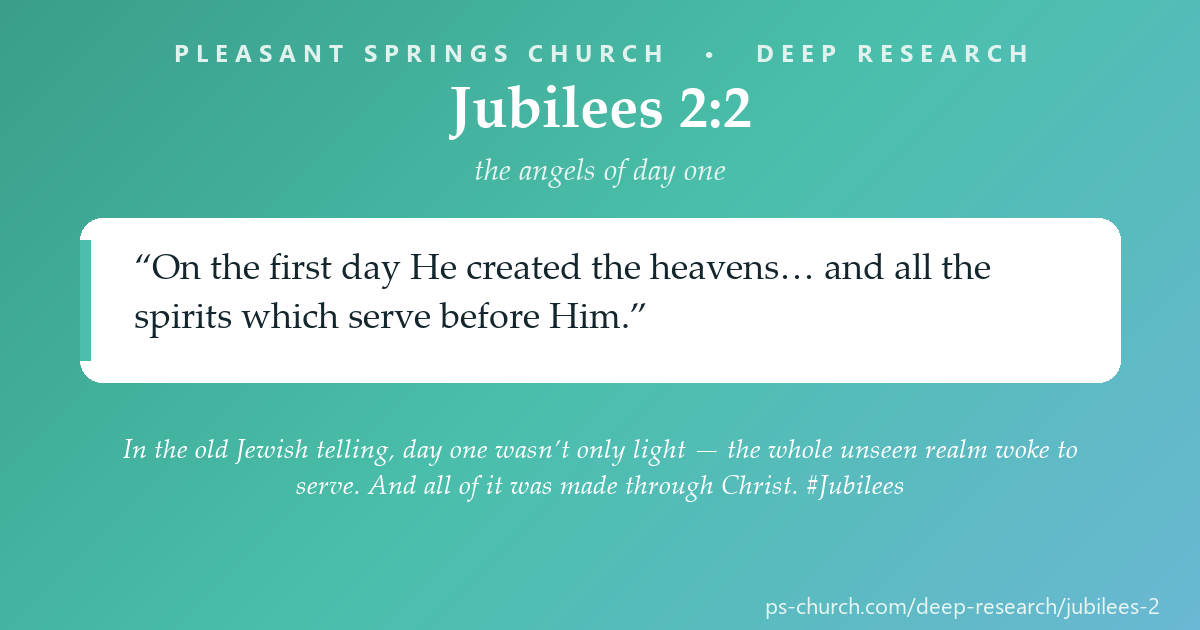
Jubilees 2:2 · to share
EnglishEvery Deep Research page traces its passage across the whole sweep — the Old Testament, the Second-Temple world between the testaments (historical witnesses, not Scripture), and the New Testament. Follow the thread:
Pleasant Springs Church — Deep Research
Research method after Michael S. Heiser’s Bible Research Method (examine dictionaries → ancient literature → important words → textual connections → academic publications → share), with the Pleasant Springs “Author & Audience” foundation. Scripture set in the Hebrew, the Greek editions named on each page and the ESV (Old Testament), and the Greek New Testament and the ESV (New Testament), per the practice of Pleasant Springs Church. Jubilees studied as a Second-Temple witness, not as Scripture; text from R. H. Charles (1913, public domain); scholarship after VanderKam (Hermeneia), van Ruiten, Kugel, and Segal. Read critically and tested by the biblical canon.
Scripture quotations marked ESV are from the ESV® Bible (The Holy Bible, English Standard Version®), © 2001 by Crossway, a publishing ministry of Good News Publishers. ESV Text Edition: 2016. Used by permission. All rights reserved. The ESV text may not be quoted in any publication made available to the public by a Creative Commons license, and the ESV may not be translated in whole or in part into any other language. www.esv.org
|
Did this study bless you today? 💚 Give to Support PS Church100% of gifts go to the General Fund — thank you. |