The Bible has two doorways, and both open with the same three words. Genesis 1:1 says “In the beginning… God”; John 1:1 says “In the beginning… the Word” — and then tells us the Word was God, and made all things, and became flesh to find us. This study works John’s prologue all the way down, and threads it back to the creation it re-tells. See the method →
John 1:1–5
Greek NT · ESVThe Shape of the Passage
Staircase parallelismWho wrote this, to whom, and in what situation? John’s prologue is a deliberate overture — every word chosen to be heard against both the Hebrew Scriptures and the Greek world of its readers.
Author
The historic church names the author John the apostle, the “disciple whom Jesus loved” (John 21:20–24), writing from Ephesus late in the first century (c. AD 85–95). He writes as an eyewitness — “we have seen his glory” (1:14) — and states his aim plainly: “that you may believe that Jesus is the Christ, the Son of God, and that by believing you may have life” (20:31).
Method. John writes deceptively simple Greek loaded with double meanings, and he opens not with a genealogy (Matthew) or a wilderness voice (Mark) but before creation itself — reaching back past Genesis 1:1 to the Word who already “was.”
Audience
A mixed Jewish and Gentile readership in Roman Asia, late in the century — after the synagogue and church had painfully parted, and as an early docetism (which denied Jesus’ true humanity) was stirring. John’s λόγος is a bridge word built for exactly this audience.
How they heard “the Word.” A Jewish reader heard the creating word of the Lord (Ps 33:6, LXX 32:6), the Aramaic Memra of the Targums, and personified Wisdom (Prov 8; Sirach 24). A Greek reader heard the philosophers’ λόγος — the rational principle ordering the cosmos. John takes both and says: this Word is not a principle or an emanation but a Person, who “was God” and “became flesh.”
Get the lay of the land on the Logos, the prologue, and John’s Christology.
Search by reference and topic: Logos/Word, prologue, Wisdom, pre-existence, incarnation.
Which articles are relevant?
- Anchor Bible Dictionary — “Logos,” “John, Gospel of,” “Wisdom (in the NT),” “Word.”
- Dictionary of Jesus and the Gospels and Dictionary of the Later NT & Its Developments (IVP) — “Logos Christology,” “Prologue,” “Light.”
- New International Dictionary of NT Theology and Exegesis — λόγος, ζωή, φῶς, ἀρχή.
Bibliography surfaced:
- D. A. Carson, The Gospel According to John (PNTC); Andreas Köstenberger, John (BECNT).
- C. H. Dodd, The Interpretation of the Fourth Gospel; Daniel Boyarin, “The Gospel of the Memra” (on the Word/Memra background).
- Richard Bauckham, Jesus and the God of Israel — on divine identity and pre-existence.
The Jewish and Greek streams that flow into the word “Logos.”
Trace the cognate concepts — the creating word, personified Wisdom, the Targumic Memra, Philo’s Logos, and the Greek philosophical λόγος — and ask how John confirms, adapts, or subverts each.
Which parallels shed light on religion and worldview?
The Hebrew “word” that creates. “By the word of the Lord the heavens were made” (Ps 33:6); God’s word “shall not return empty” (Isa 55:11). John’s Logos is first of all this word — the same divine speech that said “Let there be light” in Genesis 1.
Personified Wisdom. In Proverbs 8:22–31, Sirach 24, and the Wisdom of Solomon 7–9, Wisdom is with God “at the beginning,” the agent of creation, seeking to dwell among people. John transfers Wisdom’s whole résumé to the Word — and then does what the Wisdom tradition never dared: he says the Word was God and became flesh.
- Targumic Memra — the Aramaic paraphrases speak of “the Word (Memra) of the Lord” acting where the Hebrew has God himself; a Jewish idiom John’s hearers knew from the synagogue.
- Philo of Alexandria — a Hellenized Jew who made the λόγος God’s chief mediating power; John shares the vocabulary but not Philo’s abstraction.
- Greek philosophy — the Stoic λόγος, the rational order of the cosmos; John answers the Greek longing for cosmic reason with a face and a name.
- Qumran (1QS) — the light/darkness dualism of the “two spirits” is the very air John 1:5 breathes.
- Jubilees 2 — day one retold with the angels created alongside the light: the “all things” John says were made through the Word (1:3) included the unseen host (cf. Col 1:16). See our Jubilees 2 study.
Every stream — Hebrew word, Jewish Wisdom, Targumic Memra, Greek Logos — had a mediator between God and the world. John takes the richest word available in both cultures and makes a claim none of the sources make: the Mediator is not a lesser being between God and creation but is himself fully God (1:1) and fully flesh (1:14). He out-narrates the whole ancient conversation.
The verbs and nouns on which the whole doctrine of Christ turns.
Watch the tenses especially: John distinguishes what always was from what came to be. That single contrast carried the church through the Arian crisis.
“Word, reason, account.” John fuses the Hebrew creating word, personified Wisdom, and the Greek λόγος into one Person.
Imperfect of continuous being — the Word already was. Contrast ἐγένετο (“came to be”) used of creatures in v.3; the Word is uncreated.
“Toward / face-to-face with God” — not merely beside but in relationship. Distinct person, yet turned wholly toward the Father.
The predicate θεός lacks the article by word order, not to say “a god” — Colwell’s rule: a fronted definite predicate drops the article. The Word is fully God, distinct from the Father.
“In him was life, and the life was the light of men” — the creation-light of Genesis 1:3 now the saving light of Christ (John 8:12).
A double meaning: the darkness neither grasped/understood nor overpowered the light. Both are true.
The grammar that answered a heresy:
Two features of John’s Greek became load-bearing in the fourth-century fight over Christ’s deity. First, the contrast between ἦν (“was,” continuous, of the Word) and ἐγένετο (“came to be,” of created things, v.3) — Athanasius pressed exactly this against Arius’ slogan “there was when he was not.” The Word never “came to be”; he simply was. Second, θεὸς ἦν ὁ λόγος — “the Word was God.” The absence of the article before θεός is a rule of Greek word order (Colwell), not a downgrade to “a god”; John has just said the Word was with the Father (distinct person) and now says he is God (same being).
How John reuses Genesis 1:
- “In the beginning” (ἐν ἀρχῇ) — a verbatim echo of Genesis 1:1 (LXX).
- “All things were made through him” (v.3) — the Word is the agent of Genesis 1’s “And God said…”
- Light and darkness (vv.4–5) — Genesis 1:3–4 (“Let there be light… God separated the light from the darkness”) becomes the drama of salvation.
The web of passages John 1 gathers up — and where the NT elsewhere says the same.
Trace the connections in both directions, and check Beale & Carson on John’s use of the OT.
Which cross-references matter?
- Genesis 1:1–5 — beginning, creating word, light dividing darkness: John’s template.
- Colossians 1:15–17 & Hebrews 1:1–3 — the same high Christology: all things created through and for the Son, who upholds them by his word.
- Proverbs 8:22–31; Sirach 24; Wisdom 7–9 — the Wisdom background the Word fulfills.
- 1 John 1:1–5 — “the word of life… God is light”: the same author’s echo of his own prologue.
- Revelation 19:13 — the rider whose name is “The Word of God”: the prologue’s Logos at the end of the story.
Beale & Carson’s treatment of John (Köstenberger) sets out precisely how John 1 fuses Genesis 1:1 with the Wisdom tradition (Prov 8; Sirach 24; Wisdom of Solomon) to present Christ as the pre-existent agent of creation — the same trajectory this library traced from the Genesis side. Read together, the two prologues (Genesis and John) are one confession from two ends of the canon.
“And the Word became flesh and dwelt among us, and we have seen his glory.”John 1:14 — where the prologue is heading
The commentaries and studies that go deepest on the prologue.
Mine the major commentaries for the Logos background and the grammar of v.1; then the monographs on divine identity and the Wisdom tradition.
Commentaries & studies:
- D. A. Carson, John (PNTC); Andreas Köstenberger, John (BECNT); Craig Keener, The Gospel of John (2 vols).
- Raymond Brown, The Gospel According to John (AB); Rudolf Schnackenburg; Herman Ridderbos.
- Richard Bauckham, Jesus and the God of Israel; C. H. Dodd, The Interpretation of the Fourth Gospel; Martin Hengel, The Son of God.
Grammatical / text-critical notes:
- Colwell’s rule (JBL 52, 1933) and its careful modern qualification (definite anarthrous predicate nouns before the verb) — the technical basis for translating “the Word was God,” not “a god.”
- The punctuation of vv.3–4 (“…not any thing made. That which was made, in him was life…” vs. the ESV’s division) — an ancient variant reading discussed in the apparatus.
From the eternal Word to the darkness of this week.
Name what you learned, why it matters, and one concrete response.
What should we carry away — and do?
- Jesus is not a creature. He “was,” before all things “came to be.” Every teaching that makes him a lesser or created being runs aground on John’s first sentence.
- The Maker came to find us. The Word through whom “all things were made” is the one who “became flesh” (1:14). The God of Genesis 1:1 has a human face.
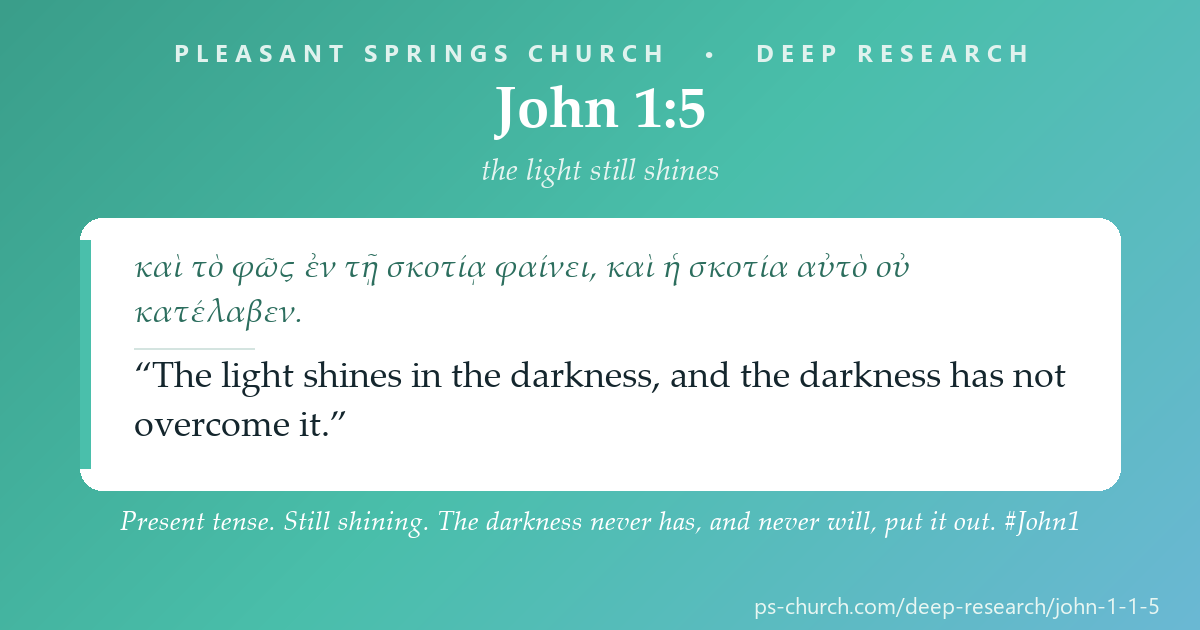
- The darkness has not won. “The light shines in the darkness, and the darkness has not overcome it” — present tense: it is still shining, whatever this week holds.
Step in response: read John 1:1–5 beside Genesis 1:1 — the Bible’s two “in the beginning” doorways — and bring one dark corner of your life into the light that Person is.
John 1:5 · to share
Greek NT + ESVEvery Deep Research page traces its passage across the whole sweep — the Old Testament, the Second-Temple world between the testaments (historical witnesses, not Scripture), and the New Testament. Follow the thread:
Pleasant Springs Church — Deep Research
Research method after Michael S. Heiser’s Bible Research Method (examine dictionaries → ancient literature → important words → textual connections → academic publications → share), with the Pleasant Springs “Author & Audience” foundation. Scripture set in the Hebrew, the Greek editions named on each page and the ESV (Old Testament), and the Greek New Testament and the ESV (New Testament), per the practice of Pleasant Springs Church. John 1:1–5 research grounded in Carson, Köstenberger, Keener, Brown, Bauckham and Dodd; the Logos background drawn from the Wisdom tradition, the Targumic Memra, and Philo.
Scripture quotations marked ESV are from the ESV® Bible (The Holy Bible, English Standard Version®), © 2001 by Crossway, a publishing ministry of Good News Publishers. ESV Text Edition: 2016. Used by permission. All rights reserved. The ESV text may not be quoted in any publication made available to the public by a Creative Commons license, and the ESV may not be translated in whole or in part into any other language. www.esv.org
|
Did this study bless you today? 💚 Give to Support PS Church100% of gifts go to the General Fund — thank you. |