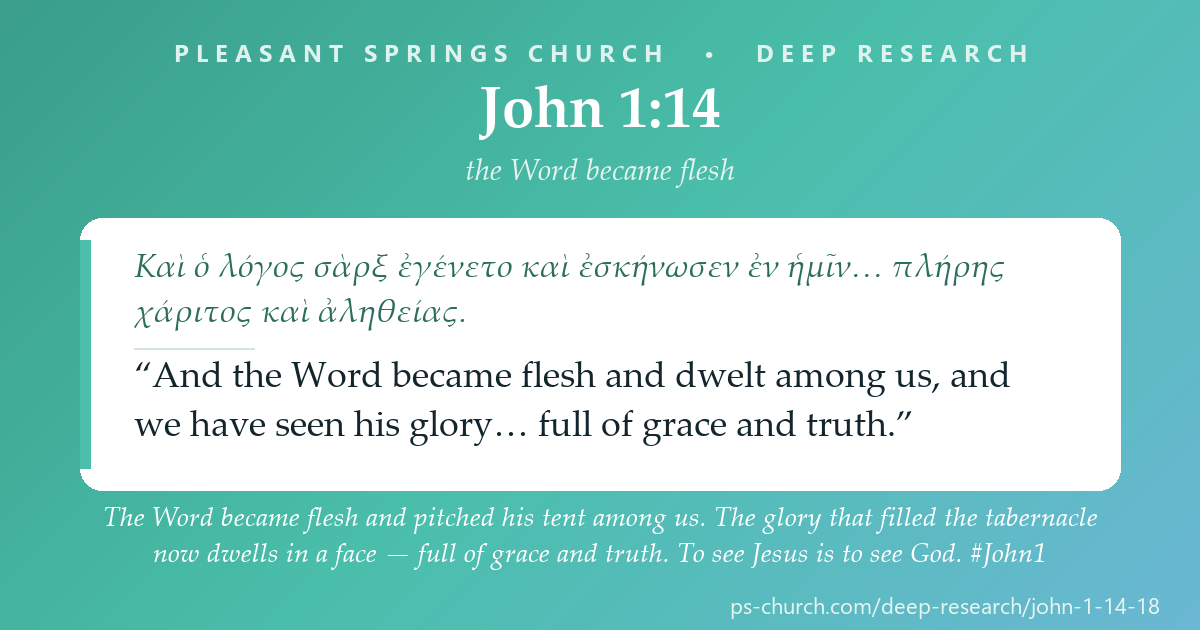
And the Word became flesh and dwelt among us.” The prologue that opened “In the beginning was the Word… and the Word was God” reaches its summit: the eternal God took flesh and tabernacled among us, so that “we have seen his glory… full of grace and truth” — the very kindness and faithfulness God proclaimed at Sinai. And the one who makes the unseen God known is himself “the only God” at the Father’s side. This study works John 1:14–18 — the incarnation, the glory, grace and truth — from the tabernacle to the face of Christ. See the method →
John 1:14, 17–18
Greek NT · ESVThe Shape of the Passage
InclusioJohn’s prologue (1:1–18) rises from “In the beginning was the Word” to its stunning turn: that Word became flesh. These verses (14–18) are the summit — the incarnation, the glory, grace and truth, and the Son who reveals the Father. See the prologue’s opening in John 1:1-5.
Author
John has said the Word was in the beginning, was with God, and was God (1:1). Now comes the hinge of history: “the Word became flesh” (σὰρξ ἐγένετο) — the eternal God, without ceasing to be God, took a real human nature. And he “dwelt among us” — tabernacled, pitched his tent among us, as the Lord once dwelt in the tent in the wilderness. John, an eyewitness, adds: “we have seen his glory.”
Grace and truth, and the God made known. The incarnate Word is “full of grace and truth” — the covenant kindness and faithfulness God proclaimed at Sinai (Exod 34:6). The law came through Moses, a true gift; but grace and truth in their fullness came through Jesus Christ. And where “no one has ever seen God” (Exod 33:20), the Son — himself “the only God” at the Father’s side — has “made him known” (ἐξηγήσατο, the word behind “exegesis”). Jesus is God’s own explanation of himself.
Audience
John writes so that readers “may believe that Jesus is the Christ, the Son of God, and that by believing you may have life in his name” (20:31). The prologue frames everything: the one who walked among them, whom they touched and heard, is the eternal Word made flesh — the fullness of God’s glory and grace in a human life.
How it was heard. John’s language draws on the Old Testament’s tabernacle and glory (Exod 40) and its grace-formula (Exod 34:6), and on the Wisdom tradition in which Wisdom “pitched her tent” in Israel (Sirach 24) — but it goes beyond them all: the Word is not a personified attribute but a Person, God himself come in flesh. The earliest manuscripts’ reading “the only God” (1:18) makes the confession explicit.
Orient on the Word, the incarnation, glory, grace and truth.
Search by topic: Logos / Word, incarnation, glory (Shekinah), grace and truth, only-begotten / monogenes.
Which articles are relevant?
- Anchor Bible Dictionary — “Logos,” “Incarnation,” “Glory,” “John, Gospel of.”
- Dictionary of Jesus and the Gospels — “Logos,” “Incarnation,” “Glory,” “Son of God.”
- NIDNTT / TDNT — σκηνόω (skēnoō, tabernacle), δόξα (doxa, glory), μονογενής (monogenēs, one and only), χάρις / ἀλήθεια (grace / truth).
Bibliography surfaced:
- D. A. Carson (Pillar), Craig Keener (2 vols.), Raymond Brown (Anchor Yale), Andreas Köstenberger (BECNT), Herman Ridderbos, J. Ramsey Michaels (NICNT) on John.
- Bruce M. Metzger, A Textual Commentary on the Greek NT (the 1:18 variant); Murray J. Harris, Jesus as God.
- Richard Bauckham, Jesus and the God of Israel; Beale & Carson, NT Use of the OT.
The tabernacle glory, grace and truth, and the God no one has seen.
Hear the tabernacle and Sinai behind John’s words, weigh the 1:18 reading, then let the Son reveal the Father.
Which parallels shed light on religion and worldview?
The Word tabernacling. When John says the Word “tabernacled among us” and “we have seen his glory,” he is deliberately echoing the tabernacle of the exodus, where “the glory of the Lord filled the tabernacle” (Exod 40:34; see the glory fills the tabernacle). The σκηνή (tent) even chimes with the Hebrew shekinah, God’s dwelling presence. The point is fulfillment: God’s presence, once housed in a tent of skins and later a temple of stone, now dwells bodily in a Person. The true tabernacle is Jesus.
Grace and truth — a Hebrew pair in Greek. “Full of grace and truth” is not abstract Greek philosophy; it renders the great covenant pair of Exodus 34:6, ḥesed we-emet — the Lord “abounding in steadfast love and faithfulness” (see the Name proclaimed). (Tellingly, John reaches behind the usual Greek of the Septuagint to the Hebrew word-pair itself.) What Moses heard proclaimed as the character of God, John says he saw in Jesus: the glory of God is his goodness, and that goodness was full in Christ.
The reading of 1:18. The last verse carries a well-known text-critical difference. The earliest and best manuscripts (the papyri P66 and P75, and the great codices Sinaiticus and Vaticanus) read “the only God” (μονογενὴς θεός); the later, majority tradition reads “the only Son” (μονογενὴς υἱός). The ESV follows the earliest reading and footnotes the other. It is a weighty reading: it calls the one at the Father’s side God, forming a perfect frame with 1:1, “the Word was God.” Either way the Son’s deity stands; the earliest manuscripts simply say it outright.
- Exodus 33:18–23; 34:5–7; 40:34–35 — Moses asks to see God’s glory; the Lord proclaims his name (“merciful and gracious… abounding in steadfast love and faithfulness”); the glory fills the tabernacle.
- Exodus 33:20; Deuteronomy 4:12; 1 Timothy 6:16 — “no one can see God and live”: the Sinai principle John restates and then resolves in the Son.
- Sirach 24:8–12 (Ben Sira, 2nd c. BC — a Second-Temple witness, not Scripture) — personified Wisdom commanded to “pitch her tent” (κατασκήνωσον) in Israel: the tabernacling-Wisdom motif John fulfills in a Person.
- Proverbs 8:22–31 — Wisdom present with God “in the beginning,” his agent in creation: the Wisdom tradition the Logos absorbs and surpasses.
The prologue ends where it began — with the deity of the Word — but now adds the reason he came: to make the unseen God known. “No one has ever seen God” is the settled truth of the Old Testament; even Moses saw only God’s “back” (Exod 33:23). Yet John says the Son, “the only God, who is at the Father’s side” — in the place of closest intimacy — “has made him known.” The verb is ἐξηγήσατο, from which we get “exegesis”: the Son explains, narrates, exegetes God. Jesus is not one more prophet describing God from a distance; he is God’s own self-disclosure, God explaining God. And the manner of it is grace: the same one who is “full of grace and truth” makes the Father known not to an elite but to all who receive him. Two guardrails keep the reading true. First, the Word “became flesh” — really, bodily human, not a phantom (against every docetism); and yet he remains fully God, so that in Jesus we meet not a demigod but the Lord himself. Second, μονογενής means “one and only, unique,” not “only-begotten” in the sense of a created origin; the Son is eternal, of one being with the Father. To see Jesus is to see the glory of God — full of grace and truth.
The vocabulary of the tabernacling Word, glory, and grace.
Watch the tabernacle behind “dwelt,” and the Exodus 34 grace-formula behind “grace and truth.”
“To pitch a tent, tabernacle, dwell” — ἐσκήνωσεν, “he tabernacled among us.” Evokes the tent where God’s glory dwelt (Exod 40:34) and the Hebrew shekinah. The incarnate Word is God’s dwelling presence.
“Glory” — the Greek for Hebrew kavod, the glory that filled the tabernacle (Exod 40:34) and that Moses longed to see (Exod 33:18). “We have seen his glory” — an eyewitness claim.
“One and only, unique” (from monos + genos, “kind”) — not “only-begotten” in a sense of created origin. The older “only-begotten” fed Arian misreadings; the word means the Son is one of a kind, unique.
“Grace and truth” — the Greek of the Hebrew covenant pair ḥesed we-emet, “steadfast love and faithfulness” (Exod 34:6). Covenant language, not abstract philosophy: God’s loyal love and reliability, full in Christ.
“To make known, narrate, expound” — the root of “exegesis.” The Son “exegetes” the unseen God: Jesus is God’s own explanation of himself.
How the rest of the New Testament confirms it:
- John 1:1–5; 20:28 — “the Word was God”; Thomas’ confession, “My Lord and my God”: the deity that frames the Gospel (see John 1:1-5).
- Colossians 1:15–19; 2:9; Hebrews 1:1–3 — “the image of the invisible God”; “in him the whole fullness of deity dwells bodily”; “the exact imprint of his nature.”
- 1 John 1:1–3; 4:2 — “that which we have seen with our eyes… the word of life”; “Jesus Christ has come in the flesh”: the incarnation against docetism.
- 2 Corinthians 4:6; John 14:9 — “the glory of God in the face of Jesus Christ”; “whoever has seen me has seen the Father.”
From the glory in the tent to the glory in the face of Christ.
Trace God’s dwelling presence and grace from the tabernacle into the incarnate Word.
Which cross-references matter?
- Exodus 34:6–7; 40:34–35; John 1:14, 17 — steadfast love and faithfulness; the glory filling the tent; grace and truth in Christ (see Exodus 34, Exodus 40).
- Isaiah 40:5; Ezekiel 43:1–5; John 2:19–21 — the glory revealed; the glory returning to the temple; Jesus the true temple.
- Colossians 1:15–20; Hebrews 1:1–3 — the image of God, the fullness of deity, the exact imprint: the deity John confesses.
- John 1:18; Matthew 11:27; John 14:9 — the Son who alone reveals the Father; “seen me… seen the Father.”
- 2 Corinthians 3:18; 4:6; Revelation 21:22–23 — beholding his glory; the glory in Christ’s face; the Lamb the glory of the city.
John 1:14–18 gathers the whole Old Testament’s hope of God’s dwelling presence and declares it fulfilled in a Person. The exodus longing — that God would tabernacle among his people, that his glory would fill the sanctuary, that the God who proclaimed his goodness at Sinai might be truly known — is answered not by a return of the cloud but by the Word made flesh. What Israel had in shadow (a tent, a glory-cloud, a name proclaimed), the church has in substance (a Person, a seen glory, a Father made known). Scholars note how carefully John frames the deity: the prologue opens “the Word was God” (1:1) and closes “the only God… has made him known” (1:18), an inclusio no reader can miss. And the point of the deity is revelation and grace: the infinite God, whom no one can see, has drawn near in a face we can behold, “full of grace and truth.” The right response is the prologue’s own: to receive him, to believe in his name, and to become children of God (1:12). The glory that filled the tent now fills a life — and offers to fill ours.
The scholarship on John 1:14-18.
The commentators on John; the studies of the incarnation and the 1:18 text.
Commentaries & studies:
- D. A. Carson (Pillar), Craig S. Keener (2 vols.), Raymond E. Brown (Anchor Yale, John I–XII), Andreas J. Köstenberger (BECNT), J. Ramsey Michaels (NICNT) on John.
- Bruce M. Metzger, A Textual Commentary on the Greek New Testament (the 1:18 variant); Murray J. Harris, Jesus as God.
- Richard Bauckham, Jesus and the God of Israel; G. K. Beale & D. A. Carson, eds., Commentary on the NT Use of the OT.
Interpretation notes worth keeping:
- ‘Dwelt’ = tabernacled. ἐσκήνωσεν evokes the tabernacle and the shekinah glory (Exod 40:34); the incarnate Word is God’s dwelling presence, the true temple.
- ‘Grace and truth’ = ḥesed we-emet. The Exodus 34:6 covenant pair, not Greek abstraction; John reaches to the Hebrew word-pair behind the usual Septuagint wording.
- The 1:18 reading. The earliest manuscripts read “the only God” (μονογενὴς θεός); the ESV follows it, footnoting “the only Son.” A strong witness to the Son’s deity, framing 1:1.
- Law and grace, not opposed. 1:17 marks redemptive-historical progression (the law a true gift through Moses; grace and truth realized fully in Christ), not a Marcionite rejection of the law.
From the Word made flesh to the God made known.
Name what you learned, why it matters, and one concrete response.
What should we carry away — and do?
- God came near. The infinite, unseen God did not stay at a distance; the Word became flesh and pitched his tent among us. The gospel is not advice about reaching up but news of God reaching down.
- The glory of God is grace. What Moses heard — “abounding in steadfast love and faithfulness” — we see in Jesus. To know God’s glory is to meet his grace and truth in Christ.
- To see Jesus is to see God. No one has seen God; the Son has made him known. Stop guessing at God from a distance — look at Jesus.
Step in response: when you wonder what God is really like, do what John did — look at Jesus, “full of grace and truth,” and let his face, not your fears, tell you the character of God. Then, this week, receive him again (1:12): believe in his name, and live as one in whom the tabernacling Word has come to dwell.
John 1:14 · to share
Greek NT + ESVEvery Deep Research page traces its passage across the whole sweep — the Old Testament, the Second-Temple world between the testaments (historical witnesses, not Scripture), and the New Testament. Follow the thread:
Pleasant Springs Church — Deep Research
Research method after Michael S. Heiser’s Bible Research Method (examine dictionaries → ancient literature → important words → textual connections → academic publications → share), with the Pleasant Springs “Author & Audience” foundation. Scripture set in the Hebrew, the Greek editions named on each page and the ESV (Old Testament), and the Greek New Testament and the ESV (New Testament), per the practice of Pleasant Springs Church. John 1:14–18 research grounded in Carson, Keener, Brown, and Köstenberger, with Metzger on the 1:18 text and Harris and Bauckham on the Son’s deity; the Exodus 34 / 40 background and the Wisdom (Sirach 24) reception as canonical and Second-Temple context.
Scripture quotations marked ESV are from the ESV® Bible (The Holy Bible, English Standard Version®), © 2001 by Crossway, a publishing ministry of Good News Publishers. ESV Text Edition: 2016. Used by permission. All rights reserved. The ESV text may not be quoted in any publication made available to the public by a Creative Commons license, and the ESV may not be translated in whole or in part into any other language. www.esv.org
|
Did this study bless you today? 💚 Give to Support PS Church100% of gifts go to the General Fund — thank you. |