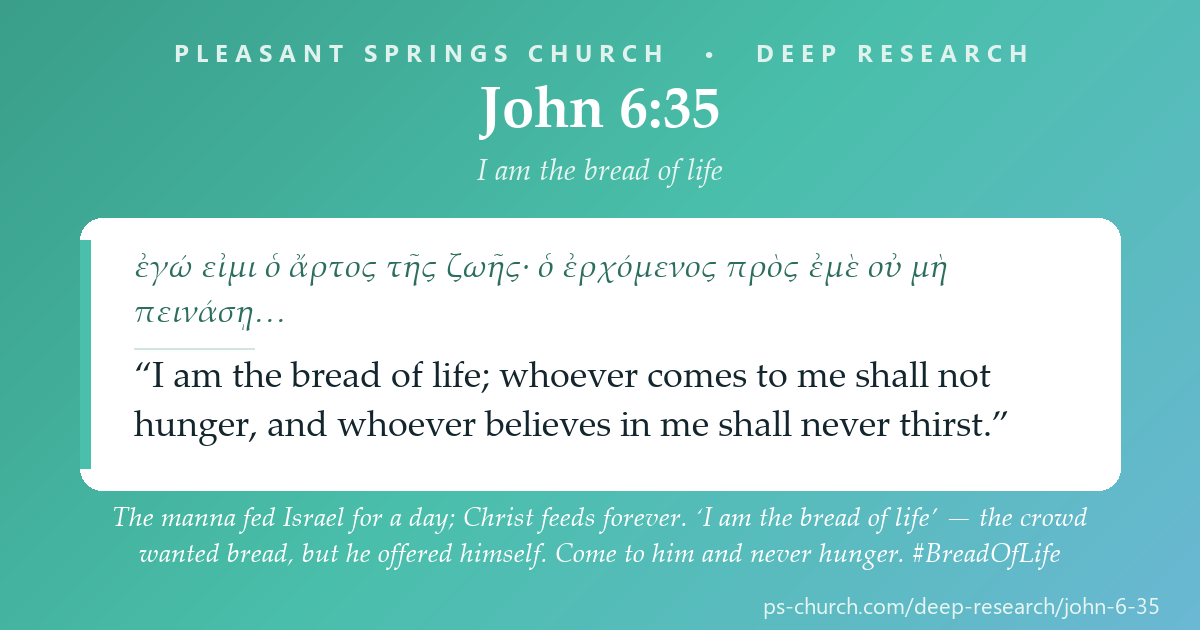
I am the bread of life.” The morning after feeding the five thousand, the crowd wants another free meal and remembers the manna. Jesus answers with the first of his great “I am” sayings: the manna kept Israel alive for a day — “your fathers ate… and died” — but he is the living bread from heaven that gives life forever, “my flesh… for the life of the world.” And this bread is received not first by the mouth but by faith: “whoever comes to me… whoever believes in me.” This study works John 6:35 — the bread of life — from the manna to the cross. See the method →
John 6:35, 49, 51
Greek NT · ESVThe Shape of the Passage
SequenceAfter Jesus feeds the five thousand (John 6:1–14), the crowd follows him for more bread. He redirects them from the perishable food to himself — the true bread from heaven — in the great “bread of life” discourse. The manna Jesus fulfills was Israel’s wilderness food (Exod 16).
Author
John sets the discourse against the manna. The crowd, wanting a sign like Moses gave, quotes Scripture: “he gave them bread from heaven to eat” (6:31; Ps 78:24). Jesus corrects and transcends the memory: it was not Moses but the Father who gave the true bread, and the manna was only a shadow. “I am the bread of life” — the first of the seven great “I am” sayings in John, each with a predicate that reveals what Jesus is for his people.
Surpassing the manna. The contrast is stark: “your fathers ate the manna… and died” (6:49); but “whoever eats of this bread will live forever” (6:51). The manna met a day’s hunger; the living bread meets death itself. And the climax scandalizes the crowd: “the bread that I will give for the life of the world is my flesh” — the incarnate Son, given in death, is the food of eternal life.
Audience
A crowd that wanted their stomachs filled — and everyone who seeks from Jesus lesser gifts than himself. He will not be reduced to a bread-king (6:15). He offers something the manna never could: not a meal but a Person, not a day’s life but eternal life, received by coming and believing.
How to eat this bread. Jesus defines it: “whoever comes to me shall not hunger, and whoever believes in me shall never thirst” (6:35). To eat the bread of life is to come to Christ and trust him. And when the flesh-and-blood language shocks them, he explains: “the words that I have spoken to you are spirit and life” (6:63) — this feeding is spiritual and by faith, not a mere transaction of the flesh.
Orient on the manna, bread from heaven, the I-am sayings, and eternal life.
Search by topic: manna, bread from heaven, I am sayings, eternal life, believe / come.
Which articles are relevant?
- Anchor Bible Dictionary — “Manna,” “Bread,” “I Am,” “Eternal Life.”
- Dictionary of Jesus and the Gospels — “‘I Am’ Sayings,” “Bread,” “Eucharist,” “Life.”
- NIDNTT / TDNT — ἄρτος (artos, bread), ζωή (zōē, life), σάρξ (sarx, flesh), מָן (mān, manna).
Bibliography surfaced:
- D. A. Carson (Pillar), Craig Keener (2 vols.), Raymond Brown (Anchor Yale), Andreas Köstenberger (BECNT), Herman Ridderbos on John.
- Studies of the bread-of-life discourse and its manna background (Exod 16; Ps 78); the “I am” sayings.
- Beale & Carson, Commentary on the NT Use of the OT (John).
The manna surpassed, the bread from heaven, and the flesh given.
Read the manna behind the discourse, weigh the “flesh” language, then come and eat by faith.
Which parallels shed light on religion and worldview?
The true bread from heaven. Israel remembered the manna as the great miracle of provision: “he rained down manna… and gave them the grain of heaven” (Ps 78:24). But Moses himself taught that the manna had a deeper lesson: “man does not live by bread alone, but… by every word that comes from the mouth of the Lord” (Deut 8:3 — the very verse Jesus quotes against the tempter, see Matthew 4). Jesus fulfills both: he is the bread and the word from God’s mouth. The manna sustained mortal life for a day; the living bread gives life forever. This is not a rejection of the old gift but its surpassing fulfillment.
‘My flesh for the life of the world.’ The discourse climbs to a claim that offends: “the bread that I will give for the life of the world is my flesh” (6:51); “unless you eat the flesh of the Son of Man and drink his blood, you have no life in you” (6:53). The little word “for” (ὑπέρ, “on behalf of”) is the language of sacrifice: the incarnate Son gives his flesh in death for the world’s life (cf. 10:11; 1 John 3:16). Christians have long read this passage with the Lord’s Supper in view — and have differed, sincerely and sharply, over how the bread and the body relate. This study does not settle that centuries-old debate; it holds the ground all sides share: that eternal life comes only through the incarnate, crucified Christ, received by faith.
Received by faith. Jesus himself guards against a crude, magical reading. When the crowd stumbles over “eat my flesh,” he says: “It is the Spirit who gives life; the flesh is no help at all. The words that I have spoken to you are spirit and life” (6:63). And he has already defined the eating: “whoever comes to me… whoever believes in me” (6:35). To feed on the bread of life is to trust the crucified and risen Son — to receive him, not merely a wafer.
- Exodus 16:4, 15; Psalm 78:24–25; Nehemiah 9:15 — the manna, “bread from heaven,” “the grain of heaven”: the wilderness food Jesus fulfills.
- Deuteronomy 8:3 — “man does not live by bread alone… but by every word… from the mouth of the Lord”: the manna’s deeper lesson (see Matthew 4).
- Isaiah 55:1–3; Proverbs 9:5; Sirach 24:19–21 — “come, buy and eat… that your soul may live”; Wisdom’s banquet invitation (Sirach a Second-Temple witness): the invitation to feed on God’s gift.
- John 6:51–58, 63; 1 John 3:16 — the flesh given “for the life of the world”; “the flesh is no help… the words… are spirit and life”; “he laid down his life for us.”
The bread-of-life discourse presses one question: what are you seeking from Jesus? The crowd wanted bread for their stomachs, a Moses to feed them again. Jesus offers infinitely more — himself. “I am the bread of life” is a predicated “I am”: not the bare divine Name of 8:58 (see before Abraham was, I am), but a self-revelation of what the Son is for us — the food without which the soul starves, and with which it never hungers again. The manna is the perfect foil: a real gift, from heaven, daily — and yet those who ate it died. Jesus is the bread the manna only pictured, and the difference is eternal life. The climax — “my flesh… for the life of the world” — grounds it all in the incarnation and the cross: this bread is the crucified body of the Son, given up in love. On how that bread is received in the Supper, believers have long differed, and this study leaves that debate where the church has left it — unsettled among faithful Christians — while holding fast to what none of them dispute: that Christ himself, incarnate and crucified, is our only true food, and that we feed on him by coming and believing. He will not be reduced to a giver of lesser gifts. He is the gift. “Whoever comes to me shall not hunger” — so come.
The vocabulary of bread, life, and the flesh given.
Watch the predicated “I am,” the manna surpassed, and the flesh given “for” the world.
“I am the bread of life” — a predicated “I am” (a self-revelation metaphor), the first of John’s seven; distinct from the absolute divine-Name “I am” of 8:58.
“Bread” — the staple of life; here the true “bread from heaven” that the manna (Exod 16) only foreshadowed. Jesus is what the manna pictured.
“Manna” (Hebrew mān, “what is it?” Exod 16:15) — the wilderness bread that sustained mortal life for a day; “your fathers ate… and died.” The living bread gives life forever.
“Flesh” — “the bread that I will give for the life of the world is my flesh”: the incarnate Son given in death. Grounds the discourse in the incarnation (1:14) and the cross.
“For, on behalf of” — sacrificial language: the flesh given for the life of the world. The same word for the shepherd who lays down his life “for” the sheep (10:11).
How the New Testament fills out the bread of life:
- John 6:37–40, 44–47 — “whoever comes to me I will never cast out”; “everyone who… believes in him should have eternal life”: coming and believing.
- 1 Corinthians 10:1–4, 16–17; 11:23–26 — the fathers’ spiritual food; the bread we break, a participation in Christ’s body: the Supper.
- John 6:63; 4:14; 7:37–39 — “the words… are spirit and life”; the living water; the Spirit given: feeding by faith.
- Deuteronomy 8:3; Matthew 4:4 — man lives “by every word… from the mouth of God”: Jesus the bread and the word (see Matthew 4).
From the manna in the wilderness to the living bread from heaven.
Trace the bread from heaven from the wilderness through the discourse into the life of faith.
Which cross-references matter?
- Exodus 16; Psalm 78:23–25; Deuteronomy 8:3 — the manna and its lesson: bread from heaven, and life by God’s word.
- Isaiah 55:1–3; Proverbs 9:1–6 — the Lord’s and Wisdom’s free invitation to come, eat, and live.
- John 1:14; 6:51–58 — the Word made flesh; the flesh given for the life of the world: the incarnation feeding us (see the Word made flesh).
- John 8:58; 8:12; 10:11; 11:25; 14:6; 15:1 — the “I am” sayings, absolute and predicated (see before Abraham was, I am).
- 1 Corinthians 11:23–26; Revelation 2:17; 22:1–2 — the Lord’s Supper; the hidden manna; the tree of life: the feast fulfilled.
The bread-of-life discourse is one of the richest and most disputed chapters in John, and reading it well means holding two things at once. On one hand, its center is gloriously clear and undisputed: Jesus is the true bread from heaven, the manna was only its shadow, and eternal life is found by coming to him and believing — the same faith the whole Gospel calls for. On the other hand, the flesh-and-blood language of 6:51–58 has been read across the centuries with the Lord’s Supper in view, and sincere Christians — Catholic, Lutheran, Reformed, and others — have differed deeply over how the sacrament relates to these words. A faithful study neither pretends the Eucharistic resonance is absent nor uses the passage to win a debate the text itself does not settle. What the text does settle is decisive: Jesus himself, incarnate and crucified (“my flesh… for the life of the world”), is the only food of eternal life; and this feeding is fundamentally spiritual, “for the words that I have spoken to you are spirit and life” (6:63). Whatever one believes about the Supper, the summons is the same — come to Christ, believe in him, feed on him — and the promise is the same: you shall never hunger again.
The scholarship on John 6:35.
The commentators on John 6; the studies of the manna background and the ‘I am’ sayings.
Commentaries & studies:
- D. A. Carson (Pillar), Craig S. Keener (2 vols.), Raymond E. Brown (Anchor Yale), Andreas J. Köstenberger (BECNT), Herman Ridderbos on John.
- Studies of the bread-of-life discourse, the manna typology (Exod 16; Ps 78), and John 6:51–58 and the Supper.
- G. K. Beale & D. A. Carson, eds., Commentary on the NT Use of the OT.
Interpretation notes worth keeping:
- Predicated, not absolute. “I am the bread of life” is a self-revelation metaphor (the first of seven), distinct from the absolute divine-Name “I am” of 8:58.
- Surpassing, not rejecting. The manna was a true gift, but those who ate it died; the living bread gives eternal life. Fulfillment, not supersessionist scorn.
- The Supper, un-adjudicated. Note the Eucharistic resonance of 6:51–58 honestly, but do not settle the Reformed/Lutheran/Catholic debate; hold the shared core (life through the incarnate, crucified Christ, received by faith).
- Received by faith. Jesus defines the eating as coming and believing (6:35), and guards against a fleshly reading (6:63, “the flesh is no help… the words… are spirit and life”).
From the manna that ran out to the bread that never fails.
Name what you learned, why it matters, and one concrete response.
What should we carry away — and do?
- Stop seeking lesser gifts. The crowd wanted bread; Jesus offered himself. He will not be reduced to a means to your comfort — he is the gift, and only he satisfies.
- He is bread that never runs out. The manna fed a day; Christ feeds forever. Whatever hunger drives you, the living bread meets it — “whoever comes to me shall not hunger.”
- Feed on him by faith. To eat this bread is to come and believe. Not a ritual you perform but a Person you receive — the incarnate, crucified Son, given for the life of the world.
Step in response: name the hunger you keep trying to fill with lesser things, and bring it to the bread of life — “come” and “believe” this week rather than merely admiring him from the crowd. Feed on Christ in the Word and, as your church practices it, at his Table, trusting that the One given “for the life of the world” is given for you.
John 6:35 · to share
Greek NT + ESVEvery Deep Research page traces its passage across the whole sweep — the Old Testament, the Second-Temple world between the testaments (historical witnesses, not Scripture), and the New Testament. Follow the thread:
Pleasant Springs Church — Deep Research
Research method after Michael S. Heiser’s Bible Research Method (examine dictionaries → ancient literature → important words → textual connections → academic publications → share), with the Pleasant Springs “Author & Audience” foundation. Scripture set in the Hebrew, the Greek editions named on each page and the ESV (Old Testament), and the Greek New Testament and the ESV (New Testament), per the practice of Pleasant Springs Church. John 6:35 research grounded in Carson, Keener, Brown, and Köstenberger, with Beale & Carson on the manna background; the Exodus 16 / Psalm 78 typology as canonical context; the Eucharistic debate of 6:51–58 presented but left un-adjudicated among faithful Christians.
Scripture quotations marked ESV are from the ESV® Bible (The Holy Bible, English Standard Version®), © 2001 by Crossway, a publishing ministry of Good News Publishers. ESV Text Edition: 2016. Used by permission. All rights reserved. The ESV text may not be quoted in any publication made available to the public by a Creative Commons license, and the ESV may not be translated in whole or in part into any other language. www.esv.org
|
Did this study bless you today? 💚 Give to Support PS Church100% of gifts go to the General Fund — thank you. |