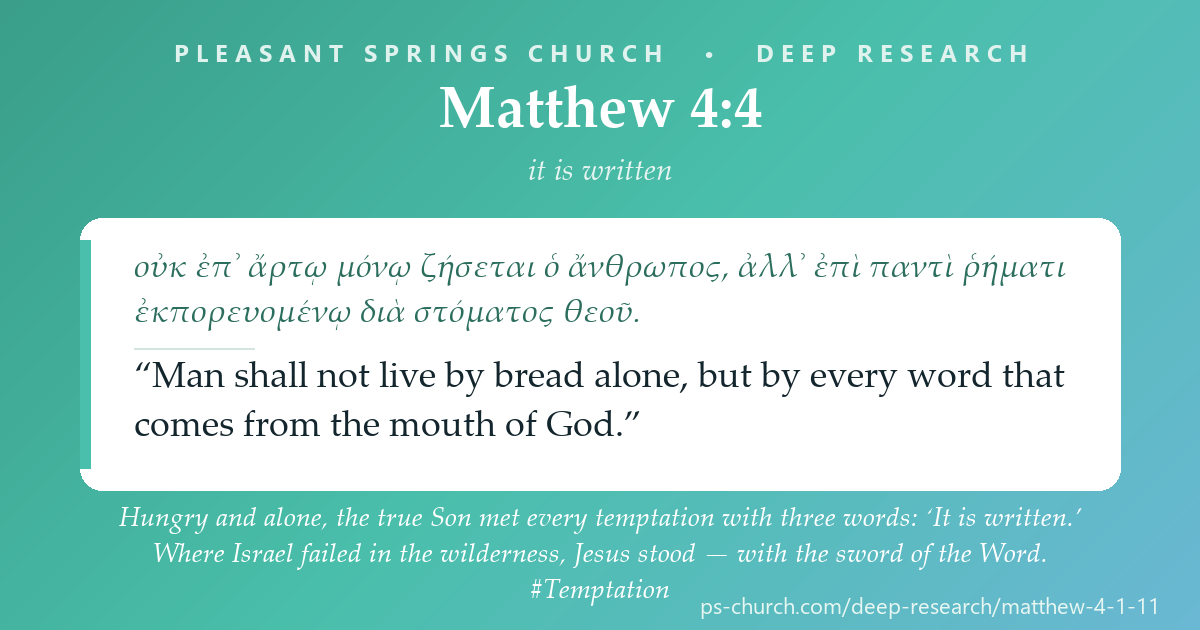
Man shall not live by bread alone.” Led into the wilderness and fasting forty days, Jesus is tempted three times — and answers every time from Deuteronomy, the book of Israel’s wilderness. Where Israel spent forty years and failed the very tests — craving bread, testing God, courting false worship — the true Son passes them. Even when the devil quotes Scripture, Jesus wields it rightly: “It is written.” This study works Matthew 4:1–11 — the temptation, the true Israel, the sword of the Word — from the wilderness to the victory that is credited to all who are his. See the method →
Matthew 4:4, 7, 10 — the three answers
Greek NT · ESVThe Shape of the Passage
Parallel panelsImmediately after the baptism, where the Father called Jesus his beloved Son (see Matthew 3), the Spirit leads him into the wilderness to be tempted. The devil’s taunts begin “If you are the Son of God” — testing the identity heaven has just declared.
Author
Matthew tells the temptation as a re-run of Israel’s wilderness — but with a different ending. Jesus fasts forty days, as Israel wandered forty years and Moses fasted forty days on Sinai. And the three temptations map onto Israel’s three great wilderness failures: craving food (the manna, Exod 16), putting God to the test (at Massah, Exod 17), and the pull toward false worship (the golden calf, Exod 32). Where Israel — God’s “son” (Exod 4:22) — failed each test, Jesus the true Son stands.
Answered from Deuteronomy. Strikingly, Jesus answers all three temptations with words from Deuteronomy — Moses’ sermon about the wilderness (Deut 8:3; 6:16; 6:13). He does not debate the devil or perform on demand; he simply stands on Scripture: “It is written.” The Son who is the Word made flesh defeats the tempter with the written word.
Audience
Matthew writes to disciples who will face temptation, and shows them how the Master met it: hungry, weak, alone — and armed only with the Word of God, rightly used. Jesus’ victory is not a display of divine immunity but a real battle really won.
How the church has read it. The scene is rich typology — Jesus as the true Israel and the new Moses, reversing the wilderness failures — and a lesson in handling Scripture: the devil, too, can quote the Bible (he cites Psalm 91), but he rips it from its context of trust, while Jesus wields it whole. The reality of the temptation is not softened: he was “in every respect tempted as we are, yet without sin” (Heb 4:15).
Orient on temptation, the wilderness, the devil, and Jesus as true Israel.
Search by topic: temptation of Jesus, wilderness, Satan / devil, Son of God, true Israel / new Moses.
Which articles are relevant?
- Anchor Bible Dictionary — “Temptation of Jesus,” “Satan,” “Wilderness,” “Son of God.”
- Dictionary of Jesus and the Gospels — “Temptation of Jesus,” “Demon, Devil, Satan,” “Son of God,” “Old Testament in the Gospels.”
- NIDNTT / TDNT — πειράζω (peirazō, test/tempt), διάβολος (diabolos, devil), προσκυνέω (proskyneō, worship), γέγραπται (gegraptai, it is written).
Bibliography surfaced:
- R. T. France (NICNT), W. D. Davies & Dale Allison (ICC), Ulrich Luz (Hermeneia), Donald Hagner (WBC), John Nolland (NIGTC), Grant Osborne (ZECNT) on Matthew.
- Dale C. Allison, The New Moses: A Matthean Typology; N. T. Wright, Jesus and the Victory of God.
- Richard B. Hays, Echoes of Scripture in the Gospels; Beale & Carson, NT Use of the OT.
The wilderness re-run, the misused Scripture, and the true Son.
Read the temptation as Israel’s test replayed, weigh the Scripture-handling, then follow the true Son’s victory.
Which parallels shed light on religion and worldview?
Israel’s test, replayed. The whole scene is framed by Deuteronomy 8:2: “you shall remember all the way that the Lord your God has led you these forty years in the wilderness… testing you.” Jesus’ forty days deliberately echo it. And the three temptations retrace Israel’s three failures: they craved bread and grumbled (Exod 16) — the Son refuses to command bread; they tested God at Massah (Exod 17) — the Son refuses to make God prove himself; they turned to false worship (Exod 32) — the Son worships God alone. Israel, called God’s “son” (Exod 4:22; Hos 11:1), failed; Jesus the true Son obeys (see Hosea 11).
When the devil quotes the Bible. The second temptation is a lesson in handling Scripture. The devil himself cites the Word — Psalm 91:11–12, “he will command his angels concerning you… they will bear you up” — but he weaponizes it, quietly omitting the psalm’s own words “to guard you in all your ways” and twisting a promise of God’s protection into a dare to presume on it. Jesus does not answer by rejecting Scripture but by using it rightly: “You shall not put the Lord your God to the test” (Deut 6:16). The Bible can be misquoted by the enemy of souls; it is answered not with less Scripture but with Scripture read whole and in context.
A note on the third answer. Jesus’ final reply, “You shall worship the Lord your God and him only shall you serve,” draws on Deuteronomy 6:13. In the Hebrew (and the standard Greek), that verse reads “you shall fear the Lord”; Jesus (with Luke) renders it “worship” and adds “only” — drawing out that the fear of God owed to him alone is exclusive worship. It is a faithful rendering of the command’s heart, shown here rather than smoothed over.
- Deuteronomy 8:2–3; 6:16; 6:13 — the forty years’ testing; “man does not live by bread alone”; “do not test the Lord”; “fear/worship the Lord… and serve him” (see the Shema).
- Exodus 16; 17:1–7; 32 — the manna and grumbling; the testing at Massah; the golden calf: the three failures the Son reverses.
- Psalm 91:11–12 — the promise the devil quotes (and clips): “he will command his angels… to guard you in all your ways.”
- Jubilees 17:15–18:19 (2nd c. BC — a Second-Temple witness, not Scripture) — the tester-prince Mastema provokes the testing of God’s servant: the named-tempter tradition around the Gospels.
The temptation shows us the Son of God winning our battle from the inside. He does not brush the devil aside with raw omnipotence; he stands, hungry and weak after forty days, exactly where we stand — and he stands on the Word of God. Each answer defends a truth the tempter attacks: that life is more than appetite (Deut 8:3), that faith trusts God without demanding proof (Deut 6:16), and that God alone is to be worshiped, whatever the cost or the shortcut offered (Deut 6:13). And each is the reversal of a fall. Where the first Adam, offered food, took and ate, the last Adam, offered bread, refused to grasp; where Israel tested God in the wilderness, the true Son would not; where the nations bow to power for its rewards, the Son bows to God alone. Two guardrails keep the reading true. First, the temptation was real: he was genuinely tested, genuinely hungry — “tempted as we are, yet without sin” (Heb 4:15). His sinlessness is not a cheat that made the battle easy but the victory that makes it count; and it holds in mystery alongside James 1:13 (“God cannot be tempted with evil”), for here the God-man is tested in his true humanity. Second, “If you are the Son of God” is the devil’s probe of an identity that is already and eternally true; Jesus does not need to prove his sonship, and refusing to perform on demand is itself the obedience of the Son. He met the tempter with “It is written,” and won — so that in him, armed with the same Word, we may stand too.
The vocabulary of testing, the written word, and worship.
Watch the threefold “It is written” — and the one thing owed to God alone.
“It is written / it stands written” — Jesus’ whole defense, spoken three times. Not argument or display but the settled authority of Scripture, wielded against the tempter.
“To test, tempt, try” — the same root frames the scene (“to be tempted,” 4:1; “the tempter,” 4:3) and Jesus’ answer (“you shall not test,” ekpeirazō, 4:7). Israel’s wilderness testing replayed.
“Word, utterance” — “by every word that comes from the mouth of God” (Deut 8:3). Man lives not by bread but by God’s speech; the Son embodies it.
“To worship, bow down” — what the devil demands (4:9) and what belongs to God alone (4:10). Jesus renders Deut 6:13’s “fear” as “worship,” adding “only.”
“Be gone, Satan!” — Jesus’ dismissal (the earliest text; not “Get behind me,” which he says to Peter in 16:23). The tempter is commanded away, and angels then minister to the victor.
How the New Testament reads the temptation:
- Hebrews 4:15; 2:18 — “in every respect tempted as we are, yet without sin”; “because he himself has suffered when tempted, he is able to help those who are being tempted.”
- Romans 5:18–19; 1 Corinthians 10:1–13 — the one man’s obedience; Israel’s wilderness testings written “for our instruction”: the true Son where the first failed.
- James 4:7; Ephesians 6:11–17 — “resist the devil, and he will flee”; the armor of God and “the sword of the Spirit, which is the word of God.”
- Matthew 16:23; 26:39–42 — “Get behind me, Satan” (to Peter); Gethsemane, where the Son again chooses the Father’s will over the easier way.
From Israel’s failed test to the true Son’s victory.
Trace the true-Israel typology from Deuteronomy through the temptation into the obedience of Christ.
Which cross-references matter?
- Deuteronomy 8:2–3; 6:13–16; Exodus 4:22; Hosea 11:1 — the wilderness testing; the commands Jesus quotes; Israel God’s son called from Egypt (see the Shema, Hosea 11).
- Genesis 3:1–7; Romans 5:12–19 — the first Adam’s fall to the tempter; the last Adam’s obedience: the reversal (see the serpent and the lie).
- Matthew 3:16–17; 16:21–23; 26:36–46 — the beloved Son declared, then tested; the temptation to avoid the cross resisted again (see the baptism).
- Psalm 91; Deuteronomy 6:16 — the promise misused and the command that answers it: Scripture read whole vs Scripture clipped.
- Hebrews 2:14–18; 4:14–16; Revelation 12:11 — the Son who shares our flesh, sympathizes with our weakness, and overcomes the accuser.
Matthew has already cast Jesus as the true Israel — called out of Egypt as God’s son (2:15; Hos 11:1), passing through the waters at his baptism — and the temptation completes the pattern: forty days in the wilderness, tested as Israel was tested, answering from the very book (Deuteronomy) that recalls Israel’s wilderness. Where the nation grumbled, presumed, and bowed to idols, the Son trusts, waits, and worships God alone. This is not merely a good example; it is the obedience the whole story needed. The first Adam and the old Israel failed their tests, and the world lay under the consequences; the last Adam and the true Israel passes his, beginning the great reversal that the cross and resurrection will complete. The temptation also arms the disciple: Jesus meets the enemy exactly as we must — not with visions or feelings but with “It is written,” the Word rightly handled. That the devil can quote the Bible warns us that Scripture can be twisted; that Jesus answers with Scripture teaches us that the cure for a misused text is not less Bible but more — read whole, in context, and obeyed. The Son fasted and stood so that his people, filled and strengthened by him, might stand too.
The scholarship on Matthew 4:1-11.
The commentators on Matthew; the studies of the true-Israel typology and the Deuteronomy quotations.
Commentaries & studies:
- R. T. France (NICNT), W. D. Davies & Dale C. Allison (ICC), Ulrich Luz (Hermeneia), Donald A. Hagner (WBC), John Nolland (NIGTC), Grant R. Osborne (ZECNT) on Matthew.
- Dale C. Allison, The New Moses: A Matthean Typology; N. T. Wright, Jesus and the Victory of God; Richard B. Hays, Echoes of Scripture in the Gospels.
- G. K. Beale & D. A. Carson, eds., Commentary on the NT Use of the OT.
Interpretation notes worth keeping:
- True Israel / new Moses. Forty days for forty years; the three failures reversed; all three answers from Deuteronomy. Present it as the typology Matthew intends — Jesus succeeding where Israel fell.
- Real temptation, without sin. The hunger and the testing are real (Heb 4:15); his sinlessness is the victory, not a cheat. Hold the mystery alongside James 1:13 — the God-man truly tested in his humanity.
- Not adoptionism. “If you are the Son of God” probes an identity already and eternally true; Jesus need not prove his sonship, and refusing to perform is itself the Son’s obedience.
- Deut 6:13, honestly. MT and the standard Greek read “fear”; Jesus (and Luke) render “worship” and add “only” — drawing out the exclusive allegiance the command requires. And print the earliest “Be gone, Satan” (not “Get behind me”).
- Real but usurped. The “kingdoms of the world” the devil offers are a real but usurped, derivative authority (cf. Luke 4:6, “it has been given to me”) — a creature’s borrowed, temporary sway, not a kingdom co-equal with God’s. No cosmic dualism.
From the Son’s wilderness victory to your own testing.
Name what you learned, why it matters, and one concrete response.
What should we carry away — and do?
- Jesus won where we lose. The true Son passed the tests Adam and Israel failed — and did it hungry, weak, and alone. His obedience is now credited to all who are his.
- The Word is the weapon. Jesus met temptation not with willpower or feelings but with “It is written,” used rightly. Hidden Scripture is armor; learn to wield it whole.
- Worship God alone. Every temptation is finally a bid for your worship — comfort, security, power as a shortcut. Answer as the Son did: him only.
Step in response: memorize one verse this week that answers a temptation you actually face, so that when the moment comes you can say, with Jesus, “It is written.” And when Scripture is quoted to justify something that dishonors God, do what he did — read it whole, in context, and worship God alone.
Matthew 4:4 · to share
Greek NT + ESVEvery Deep Research page traces its passage across the whole sweep — the Old Testament, the Second-Temple world between the testaments (historical witnesses, not Scripture), and the New Testament. Follow the thread:
Pleasant Springs Church — Deep Research
Research method after Michael S. Heiser’s Bible Research Method (examine dictionaries → ancient literature → important words → textual connections → academic publications → share), with the Pleasant Springs “Author & Audience” foundation. Scripture set in the Hebrew, the Greek editions named on each page and the ESV (Old Testament), and the Greek New Testament and the ESV (New Testament), per the practice of Pleasant Springs Church. Matthew 4:1–11 research grounded in France, Davies & Allison, Luz, and Hagner, with Allison’s New Moses, Wright, and Hays on the true-Israel typology; the Deuteronomy 8 and 6 backgrounds and the Deut 6:13 fear/worship rendering shown honestly.
Scripture quotations marked ESV are from the ESV® Bible (The Holy Bible, English Standard Version®), © 2001 by Crossway, a publishing ministry of Good News Publishers. ESV Text Edition: 2016. Used by permission. All rights reserved. The ESV text may not be quoted in any publication made available to the public by a Creative Commons license, and the ESV may not be translated in whole or in part into any other language. www.esv.org
|
Did this study bless you today? 💚 Give to Support PS Church100% of gifts go to the General Fund — thank you. |