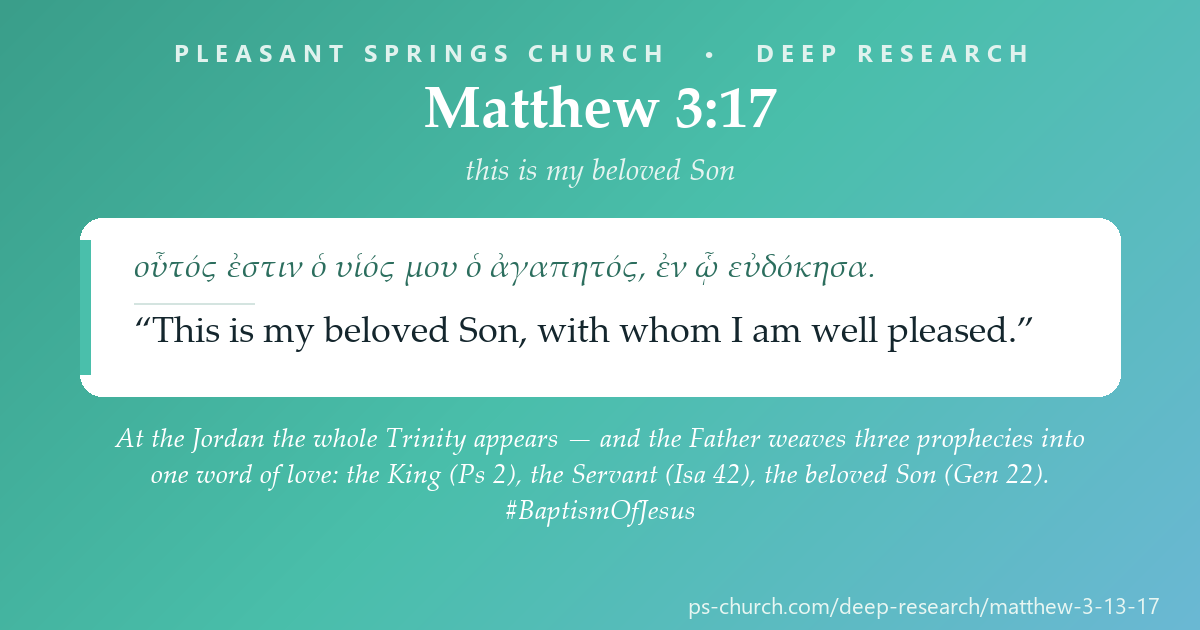
This is my beloved Son, with whom I am well pleased.” At the Jordan the whole Trinity appears at once — the Son baptized, the Spirit descending like a dove, the Father’s voice from heaven — the clearest window in the Gospels into the triune God. The sinless Son is baptized to “fulfill all righteousness,” standing with the sinners he came to save; and the Father’s words fuse three prophecies — the King of Psalm 2, the Servant of Isaiah 42, the beloved son of Genesis 22 — so that the crown and the cross are joined from the start. This study works Matthew 3:13–17 — the baptism, the Trinity, the fused voice. See the method →
Matthew 3:15–17
Greek NT · ESVThe Shape of the Passage
SequenceJohn the Baptist is baptizing a baptism of repentance at the Jordan when Jesus comes to be baptized. John objects — the sinless One does not need it — but Jesus insists, and heaven answers. This is the inauguration of Jesus’ public ministry; the temptation follows immediately (see Matthew 4).
Author
Matthew presents the baptism as the moment the Father publicly declares who Jesus is. John is right that the order seems backward — “I need to be baptized by you” (3:14) — but Jesus answers that it is “fitting… to fulfill all righteousness.” He is baptized not to wash away his own sin (he has none) but to stand where sinners stand, identifying with the people he came to redeem and taking up the whole saving righteousness of God.
Heaven opens. As he comes up from the water, three things happen at once: the heavens open, the Spirit of God descends like a dove and rests on him, and a voice from heaven declares, “This is my beloved Son, with whom I am well pleased.” It is the clearest window in the Gospels into the triune God: Father, Son, and Spirit, together, in one scene.
Audience
Matthew writes to a church that must know exactly who Jesus is: not merely a teacher or a prophet, but the beloved Son, anointed by the Spirit and owned by the Father’s own voice. The baptism sets the seal on the confession the Gospel will unfold.
How to hear the voice. The Father’s words are woven from Scripture. “My Son” is the language of Psalm 2:7, the enthroned messianic King (see Psalm 2). “With whom I am well pleased” is the language of Isaiah 42:1, the chosen Servant on whom God puts his Spirit. And “the beloved” carries the note of Genesis 22 — the only, beloved son offered up. So at the very start, the King is identified as the Suffering Servant, and the Servant as the beloved Son given for the world.
Orient on baptism, the Trinity, the Son of God, and the Servant.
Search by topic: baptism of Jesus, Trinity, Son of God, Servant of the LORD, Holy Spirit / dove.
Which articles are relevant?
- Anchor Bible Dictionary — “Baptism,” “Son of God,” “Servant of the Lord,” “Holy Spirit.”
- Dictionary of Jesus and the Gospels — “Baptism,” “Son of God,” “Servant of Yahweh,” “Holy Spirit.”
- NIDNTT / TDNT — δικαιοσύνη (dikaiosynē, righteousness), ἀγαπητός (agapētos, beloved/only), εὐδοκέω (eudokeō, be well pleased), περιστερά (peristera, dove).
Bibliography surfaced:
- W. D. Davies & Dale Allison (ICC), R. T. France (NICNT), Ulrich Luz (Hermeneia), Donald Hagner (WBC), John Nolland (NIGTC), Grant Osborne (ZECNT) on Matthew.
- Richard B. Hays, Echoes of Scripture in the Gospels (the fused Psalm 2 / Isaiah 42 voice).
- Beale & Carson, NT Use of the OT (Matthew).
The Trinity at the Jordan, the dove, and the fused voice.
Read the triune scene, the dove as a sign, and the Father’s words as woven Scripture.
Which parallels shed light on religion and worldview?
The whole Trinity in one scene. The baptism is the Gospels’ clearest revelation of the triune God: the Son standing in the Jordan, the Spirit descending upon him, the Father’s voice from heaven — three distinct persons, present together, one God. This is not three roles played by one actor (the ancient error of modalism); it is Father, Son, and Spirit, eternally one, revealed in the flesh. The church reads its doctrine of the Trinity not as speculation but as the plain shape of this scene.
The dove. The Spirit descends “like a dove” (ὡσεὶ περιστεράν) — a simile for the visible manner of his coming, not a claim that the Spirit is a bird. Many hear an echo of creation, where “the Spirit of God was hovering over the face of the waters” (Gen 1:2), and of Noah’s dove over the cleansed world (Gen 8): the baptism inaugurates a new creation, the Spirit brooding over the waters again as God begins to make all things new in his Son.
A voice woven from Scripture. “This is my beloved Son, with whom I am well pleased” is not a single quotation but a fusion. “My Son” comes from Psalm 2:7, the Lord’s decree to the anointed King, “You are my Son.” “With whom I am well pleased” comes from Isaiah 42:1, “my chosen, in whom my soul delights… I have put my Spirit upon him” — the first Servant Song. And “the beloved” (ὁ ἀγαπητός) is the very word the Greek Old Testament uses for the “only” son of Genesis 22. In one sentence the Father joins three threads — the royal Son, the chosen Servant, the beloved only son given up — so that the enthroned King is, from the outset, the one who will suffer.
- Psalm 2:7 — “You are my Son; today I have begotten you”: the royal-messianic decree behind “my Son” (see Psalm 2).
- Isaiah 42:1 — “my chosen, in whom my soul delights; I have put my Spirit upon him”: the Servant behind “with whom I am well pleased” and the Spirit’s anointing.
- Genesis 22:2 (LXX τὸν ἀγαπητόν) — “your son, your only son… whom you love”: the beloved/only son behind “the beloved” (see the binding of Isaac).
- Genesis 1:2; 8:8–12 — the Spirit hovering over the waters; Noah’s dove over the cleansed world: the new-creation echo of the descending dove.
The baptism answers the question the whole Gospel asks: who is Jesus? The Father himself answers, and he answers with Scripture — three prophecies fused into one word of love. Jesus is the King of Psalm 2, God’s anointed Son set on Zion; he is the Servant of Isaiah 42, chosen and Spirit-anointed to bring justice gently to the nations; and he is the beloved son of Genesis 22, the only son whom the Father will not spare. That the King is the Servant, and the Servant the beloved Son given up, is the gospel in miniature at the very threshold of his ministry. Two guardrails keep the reading true. First, the voice reveals, it does not make: Jesus does not become the Son at his baptism — he is the eternal Son (John 1:1, 14), now publicly declared and anointed by the Spirit for his mission. To read “my Son” as adoption is to miss that the Son who steps into the Jordan is the one who made the Jordan. Second, “to fulfill all righteousness” does not mean Jesus had sins to wash; the sinless One stands in the sinner’s place, beginning at his baptism the great exchange he will finish at the cross. The heavens open over him so that, in him, they may open over us.
The vocabulary of righteousness, the dove, and the beloved Son.
Watch the three fused prophecies in the Father’s single sentence.
“To fulfill all righteousness” — the sinless Son is baptized not for his own sin but to identify with sinners and accomplish God’s whole saving right order. Dikaiosynē (righteousness) is a great Matthean theme.
“Like a dove” — a simile for the manner of the Spirit’s descent, not a claim that the Spirit is a bird. Echoes the Spirit hovering over the waters (Gen 1:2) and Noah’s dove (Gen 8): a new creation.
“My Son” — the language of Psalm 2:7, the anointed messianic King. In Matthew the Father says “This is” (to the witnesses); in Mark/Luke, “You are” (to Jesus).
“The beloved” — the Greek word the Septuagint uses for the “only” son of Genesis 22:2. Carries the note of the only, beloved son given up.
“With whom I am well pleased” — the language of Isaiah 42:1, the chosen Servant “in whom my soul delights.” The King is named the Suffering Servant.
How the New Testament echoes the baptism:
- Matthew 17:5 — at the Transfiguration, the Father’s voice again: “This is my beloved Son, with whom I am well pleased; listen to him” (adding Deut 18:15).
- Acts 10:38; Luke 4:18 — “God anointed Jesus of Nazareth with the Holy Spirit”: the Spirit’s anointing at the baptism for his ministry (see Luke 4, Isaiah 61).
- 2 Peter 1:17 — “this is my beloved Son, with whom I am well pleased”: the apostolic memory of the voice.
- Romans 6:3–4; Matthew 28:19 — baptized into Christ’s death and resurrection; baptized “in the name of the Father and of the Son and of the Holy Spirit”: the triune name.
From the King anointed to the Servant who suffers.
Trace the fused Son-and-Servant from Psalm 2 and Isaiah 42 through the baptism into the passion.
Which cross-references matter?
- Psalm 2:6–9; Isaiah 42:1–4; Genesis 22:2, 12 — the anointed Son, the chosen Servant, the beloved only son: the three threads the voice weaves (see Psalm 2, Genesis 22).
- Isaiah 11:2; 61:1; Matthew 12:18–21 — the Spirit resting on the shoot from Jesse; the Servant anointed; Matthew’s later citation of Isaiah 42 (see Isaiah 61).
- Matthew 4:1–11; 17:1–8 — the Spirit leads the beloved Son into temptation; the voice repeats at the Transfiguration (see the temptation).
- Isaiah 53; Matthew 20:28; 27:46 — the Servant who suffers; the Son who gives his life a ransom (see Isaiah 53).
- Matthew 28:19; Romans 8:14–17 — the triune name; the Spirit by whom we cry “Abba” as adopted children of the Father.
Scholars of Matthew note the artistry of the Father’s words: a single sentence that gathers the royal psalms, the Servant Songs, and the Aqedah into one confession. This is not proof-texting but a symphony — Matthew’s way of saying that all the Old Testament’s hopes converge on this one figure. He is the Davidic King (Psalm 2), and therefore his enemies will rage; he is the Spirit-anointed Servant (Isaiah 42), and therefore he will not break a bruised reed; he is the beloved, only son (Genesis 22), and therefore he will be given up. The baptism thus programs the whole Gospel: enthronement and suffering held together from the first, so that no reader can separate the crown from the cross. And the triune revelation grounds the church’s deepest confession — that the God who saves is Father, Son, and Spirit — not as a later doctrine imposed on the text but as the plain reading of what happened at the Jordan. The Son goes down into the sinners’ water and comes up under the open heaven and the Father’s delight — and by baptism into him, so do we.
The scholarship on Matthew 3:13-17.
The commentators on Matthew; the studies of the fused voice and the baptism.
Commentaries & studies:
- W. D. Davies & Dale C. Allison (ICC), R. T. France (NICNT), Ulrich Luz (Hermeneia), Donald A. Hagner (WBC), John Nolland (NIGTC), Grant R. Osborne (ZECNT) on Matthew.
- Richard B. Hays, Echoes of Scripture in the Gospels (the Psalm 2 / Isaiah 42 fusion in the baptism voice).
- G. K. Beale & D. A. Carson, eds., Commentary on the NT Use of the OT.
Interpretation notes worth keeping:
- The Trinity, plainly. Son, Spirit, and Father together — three distinct persons at once (against modalism); the clearest Trinitarian scene in the Gospels.
- Not adoptionism. The voice reveals and anoints; it does not constitute. Jesus does not become the Son at his baptism — he is the eternal Son (John 1:1, 14).
- ‘Fulfill all righteousness.’ The sinless Son is baptized to identify with sinners and accomplish God’s saving righteousness — not to cleanse his own (non-existent) sin.
- The fused voice. “My Son” (Ps 2:7) + “beloved” (Gen 22:2 LXX) + “with whom I am well pleased” (Isa 42:1): King, only son, and Servant in one. Matthew’s “This is” vs Mark/Luke’s “You are.”
From the open heaven over Jesus to the open heaven over you.
Name what you learned, why it matters, and one concrete response.
What should we carry away — and do?
- God is Father, Son, and Spirit. At the Jordan the triune God is unveiled. The God who saves you is not a lonely monad but a communion of love, and he has drawn you into it.
- The King is the Servant. From his first public moment, Jesus is named both the enthroned Son and the suffering Servant. The crown and the cross belong together; do not take the one without the other.
- The Father’s delight rests on the Son — and on you in him. “This is my beloved Son” is spoken over Jesus; by baptism into him, the Father’s “beloved… well pleased” is spoken over all who are his.
Step in response: if you are in Christ, hear the Father’s voice over you before you do a single thing to earn it — beloved, well pleased — and let that, not your performance, be the ground you stand on this week. Then live as one anointed by the same Spirit, sent as the Son was sent, to serve.
Matthew 3:17 · to share
Greek NT + ESVEvery Deep Research page traces its passage across the whole sweep — the Old Testament, the Second-Temple world between the testaments (historical witnesses, not Scripture), and the New Testament. Follow the thread:
Pleasant Springs Church — Deep Research
Research method after Michael S. Heiser’s Bible Research Method (examine dictionaries → ancient literature → important words → textual connections → academic publications → share), with the Pleasant Springs “Author & Audience” foundation. Scripture set in the Hebrew, the Greek editions named on each page and the ESV (Old Testament), and the Greek New Testament and the ESV (New Testament), per the practice of Pleasant Springs Church. Matthew 3:13–17 research grounded in Davies & Allison, France, Luz, and Hagner, with Hays on the fused Psalm 2 / Isaiah 42 voice; the Psalm 2, Isaiah 42, and Genesis 22 backgrounds as canonical context.
Scripture quotations marked ESV are from the ESV® Bible (The Holy Bible, English Standard Version®), © 2001 by Crossway, a publishing ministry of Good News Publishers. ESV Text Edition: 2016. Used by permission. All rights reserved. The ESV text may not be quoted in any publication made available to the public by a Creative Commons license, and the ESV may not be translated in whole or in part into any other language. www.esv.org
|
Did this study bless you today? 💚 Give to Support PS Church100% of gifts go to the General Fund — thank you. |