Jesus walks out of the temple, and his disciples stop to point at the stonework. What follows is the longest continuous block of prophecy in the Gospels — ninety-seven verses about desolation, tribulation, the darkening of the sun, the coming of the Son of Man, and a throne with a flock in front of it. This study measures it rather than describing it: every verse of Matthew 24 and 25 screened against the whole Greek Old Testament on our disk, 30,637 verse units, tie bands reported. And the result is a surprise in the wrong direction. The deepest verbatim contact in ninety-seven verses is six words. Seventeen verses in Matthew reach seven or more, and not one of them is here. The single place where Matthew names his prophet measures four. See the method →
Matthew 24:1–25:46
Greek NT · ESVThe Shape of the Passage
Two panels and a hinge — a sequence, not a chiasmWho wrote this, to whom, in what situation? Matthew 24–25 is the fifth and last of the Gospel’s five teaching blocks, and it is delivered in the last week, sitting on a hillside opposite the building he has just walked out of.
Author
Church tradition from Papias (early 2nd c.) onward names Matthew the tax collector (Matt 9:9; 10:3). This Gospel argues from the Scriptures harder than any of the four: thirteen verses carry the formal “what was spoken” citation formula (ῥηθέν, the aorist passive participle) (1:22; 2:15, 17, 23; 3:3; 4:14; 8:17; 12:17; 13:35; 21:4; 22:31; 24:15; 27:9), counted here across the whole Gospel.
Placement matters, and here it is structural. Matthew builds his Gospel around five discourses, each closed by the same formula (“when Jesus had finished these sayings…” — 7:28; 11:1; 13:53; 19:1; 26:1). This is the fifth and last, and the closing formula at 26:1 is the longest of the five: “when Jesus had finished all these sayings.” The next sentence begins the passion. Nothing more is taught.
One quiet fact worth holding through the whole study. Of the twelve of those formulas that stand before the passion, the twelfth is 24:15 — and it is the only one in these ninety-seven verses. Matthew, the evangelist who quotes most, quotes least here.
Audience
A largely Jewish-Christian community (often located at Antioch, writing c. 60s–80s AD), living through the parting from the synagogue and, on most reckonings, through or just after the destruction of the temple in AD 70. Inside the story the audience has narrowed sharply: chapter 23 was delivered to the crowds and the Pharisees; 24:3 says the disciples came to him κατ’ ἰδίαν, privately. From here to the end of chapter 25 there are no opponents in the room.
The question they ask is three questions, and it matters. “When will these things be” (the stones), “what will be the sign of your παρουσία,” and “συντελείας τοῦ αἰῶνος” — the close of the age. Whether Jesus answers them as one event or as several is the single largest interpretive fork in the passage, and this page does not pretend to close it. What the page can do is measure the vocabulary: παρουσία occurs four times in the whole of Matthew and all four are in this chapter (24:3, 27, 37, 39) — and the word occurs nowhere else in any Gospel. The disciples supply a term the narrative has never used before, and after chapter 24 it disappears from the Gospels entirely.
The audience is also being warned about itself. Every one of the four readiness units after the hinge is about an insider: a servant of the household, ten bridesmaids who are all invited, three servants entrusted with their master’s money, and a court that is astonished at its own verdict. The danger in these chapters is never persecution. It is delay.
Orient on the discourse, the desolating sacrilege, the Son of Man, and the judgement of the nations.
Search by reference and by topic: Olivet Discourse, eschatology, apocalyptic, abomination of desolation, parousia, Son of Man, day of the Lord, tribulation, talents, sheep and goats, works of mercy.
Which articles are relevant?
- Dictionary of Jesus and the Gospels (IVP) — “Apocalyptic Teaching,” “Destruction of Jerusalem,” “Eschatology,” “Son of Man,” “Parousia,” “Judgment,” “Parables.”
- Anchor Bible Dictionary — “Abomination of Desolation,” “Son of Man,” “Eschatology, Early Jewish,” “Temple, Jerusalem,” “Talent (weight).”
- NIDNTTE — παρουσία, συντέλεια, βδέλυγμα, θλῖψις, ἐκλεκτός, γρηγορέω, κόλασις, αἰώνιος.
- Dictionary of New Testament Background (IVP) — “Apocalypticism,” “Daniel, Book of (in Early Judaism),” “Destruction of the Temple,” “Josephus,” “Messianic Movements.”
Bibliography surfaced:
- W. D. Davies & Dale Allison, Matthew 19–28 (ICC) — the fullest technical treatment of both chapters.
- R. T. France, The Gospel of Matthew (NICNT) and Jesus and the Old Testament; Craig Keener; John Nolland (NIGTC); Ulrich Luz, Matthew 21–28 (Hermeneia); Grant Osborne (ZECNT).
- George Beasley-Murray, Jesus and the Last Days — the standard history of interpretation of Mark 13 and its parallels.
- Klyne Snodgrass, Stories with Intent, on the three parables; Sherman Gray, The Least of My Brothers: Matthew 25:31–46, A History of Interpretation.
- Lars Hartman, Prophecy Interpreted, on the discourse as a midrashic weave rather than a chain of quotations — a thesis this page’s measurement is directly relevant to.
The temple, the sacrilege, the messianic woes, and a judgement of works — all of them live before Matthew wrote.
Set each unit beside its Second-Temple and Greco-Roman neighbours, then ask what is being kept and what is being turned.
Which parallels shed light on religion and worldview?
The buildings were worth pointing at. Herod’s temple platform was one of the largest artificial precincts in the ancient world, and Josephus describes stones of extraordinary size and a facade that from a distance looked like a snow-covered mountain (War 5.184–227; Antiquities 15.380–425). The disciples’ gesture at 24:1 is not naive tourism; it is a claim about permanence. Josephus also reports that the temple was burned in AD 70 and the site levelled (War 6.249–266; 7.1–4).
“The abomination of desolation” already had a history when Jesus used it. 1 Maccabees 1:54 reports that in 167 BC Antiochus IV built βδέλυγμα ἐρημώσεως — “a desolating sacrilege” — on the altar of burnt offering; 1 Maccabees 6:7 records the Maccabees tearing it down. The phrase is Daniel’s (9:27; 11:31; 12:11), and the crisis of 167 BC is the event Daniel’s readers connected it to. Jesus uses a term with a known referent and applies it to something still future.
And there had been a near-miss inside living memory. In AD 40 the emperor Gaius (Caligula) ordered a colossal statue of himself erected in the Jerusalem temple. Josephus devotes a long account to the crisis and to the Jewish delegations that stalled it until Gaius died (Antiquities 18.261–309; War 2.184–203); Philo’s Legatio ad Gaium 184–348 is the other primary witness. Whatever “let the reader understand” means, Matthew’s first readers had a live category for a pagan object standing in the holy place.
The “birth pangs” are a technical term. The idea that the age turns through a fixed sequence of calamities — wars, famine, earthquake, apostasy — is standard Second-Temple furniture: 4 Ezra 5:1–13 and 6:18–28; 2 Baruch 25–30 and 70:2–10; 1 Enoch 99–100; the Sibylline Oracles 3:796–808. Later rabbinic tradition names the period chevlei mashiach, the birth pains of the Messiah (b. Sanhedrin 97a; b. Ketubot 111a). Jesus keeps the sequence and then does something unusual with it: “the end is not yet” (v.6), “the beginning of the birth pains” (v.8). The signs are decisively downgraded as timing indicators.
A judgement seated on a throne, deciding by deeds, was familiar. 1 Enoch 62–63 seats the Son of Man on the throne of glory and judges the kings of the earth; Daniel 7:9–14 sets thrones and gives dominion to one like a son of man. Sorting the righteous from the wicked at the end appears in 4 Ezra 7:33–44 and Testament of Abraham 12–13, where a scale weighs deeds. And feeding the hungry, clothing the naked and sheltering the homeless as the substance of true religion is Isaiah 58:7 and Job 31:16–22, and it is spelled out in Tobit 1:16–18 and 4:16 and in Sirach 7:32–35 and 4:1–10.
Every one of these frames is kept and then bent at one joint. The messianic woes are kept and demoted — they are the beginning, not the end. Daniel’s sacrilege is kept and moved forward in time. The enthroned judge of 1 Enoch is kept, and then the criterion of judgement is not allegiance or knowledge but six ordinary acts, none of them religious. And the ancient works-of-mercy list — hungry, thirsty, stranger, naked, sick, imprisoned — is kept intact and then identified with the judge himself: ἐμοὶ ἐποιήσατε. That identification is what has no clear precedent in the literature above.
The vocabulary that carries the discourse — and one word that appears exactly once.
Counts below are exhaustive over the SBLGNT held here (7,927 verses) and the CATSS Greek Old Testament files held here (30,637 verse units in 64 files). Where a count is a negative, it is a negative on those corpora, and we say so.
“Arrival, presence, royal visit.” In the ordinary Greek of the day it is the technical word for a king’s or governor’s state visit to a city. It occurs in 24 verses of the Greek New Testament, four of them in Matthew — and all four are in chapter 24. Counted exhaustively over the SBLGNT: the word occurs nowhere else in any Gospel. The disciples introduce it at v.3; after v.39 no evangelist uses it again.
“Completion, consummation.” The noun occurs in six verses of the Greek New Testament, and five of them are Matthew (13:39, 40, 49; 24:3; 28:20) — the sixth is Hebrews 9:26. Mark 13:4 and Acts 21:27, often listed with them, carry the verb συντελέω, not this noun. In Matthew it is always the phrase συντέλεια τοῦ αἰῶνος, “the close of the age,” and its last occurrence is the last clause of the Gospel.
“Abomination, detestable thing” — in the Greek Old Testament the standard word for an idol. Six verses in the Greek New Testament: Matthew 24:15, Mark 13:14, Luke 16:15, Revelation 17:4, 17:5, 21:27. The full phrase τὸ βδέλυγμα τῆς ἐρημώσεως occurs in exactly two New Testament verses — Matthew 24:15 and Mark 13:14 — and in exactly one verse of the Greek Old Testament held here. See Stage 4.
“Pressure, crushing, tribulation.” 43 verses in the Greek New Testament; four in Matthew, and three of the four are in this chapter (the other is 13:21). Note the sequence the word itself makes: tribulation delivered to them (v.9), tribulation great and unrepeatable (v.21), and then “after the tribulation of those days” (v.29).
“Chosen.” Three occurrences, all in the tightest twelve verses of the discourse, and each one does different work: the days are shortened for their sake (v.22), the deception is aimed at them (v.24), and the angels gather them (v.31). Matthew uses the word four times in the Gospel; the fourth is 22:14.
“Radiance, beam.” Not the ordinary word for light. Three verses in the Greek New Testament — Matthew 24:29, Mark 13:24, Luke 11:33 — and 24 verse units in the Greek Old Testament held here, among them Joel 2:10 and Joel 4:15 (= 3:15 ESV), both of them about the heavenly bodies going dark. This one noun is where the deepest run in chapter 24 stops. See Stage 4.
In the middle voice, “to beat the breast, to mourn aloud.” The form κόψονται occurs in exactly three verses of the Greek New Testament — Matthew 24:30, Revelation 1:7, Revelation 18:9 — and in five verse units of the Greek Old Testament held here, one of which is Zechariah 12:10. It is a single word, and it is the only lexical thread from 24:30 to Zechariah. A run-length screen cannot see it.
“Stay awake, keep watch.” 22 verses in the Greek New Testament. Six of them are Matthew, and they fall in two places only: three times here (24:42; 24:43; 25:13), and then three times in Gethsemane (26:38, 40, 41). The imperative γρηγορεῖτε is four of the six — 24:42, 25:13, 26:38, 26:41; 24:43 has the indicative ἐγρηγόρησεν and 26:40 the infinitive γρηγορῆσαι. The command issued on the Mount of Olives is the command failed on the Mount of Olives two chapters later. That is a fact about where the word occurs, not a claim about what Matthew intended by it.
“Hour.” Exactly four occurrences in the ninety-seven verses, and the first is the hinge. There is no ὥρα in 24:1–35 at all. Every one of the four is attached to not knowing.
A weight of silver, not a coin — roughly 6,000 denarii, something like twenty years of a labourer’s wages. Eight verses in the Greek New Testament, and all eight are Matthew (18:24 and seven in this chapter). Revelation 16:21’s talent-weight hailstones use the adjective ταλαντιαῖος, not this noun. The English word “talent” meaning ability derives from this parable, which is a nice historical fact and a bad exegetical guide: in the story it is money, and it is the master’s.
“Young goat, kid.” Two verses in the Greek New Testament — Matthew 25:32 and Luke 15:29 (the elder brother’s complaint) — against 33 verse units in the Greek Old Testament held here. Worth noting: Ezekiel 34:17, the passage usually named as the background, does not use this word. Its Greek reads κριῶν καὶ τράγων, rams and he-goats.
“Least, smallest.” Twelve verses in the Greek New Testament, four of them Matthew: 2:6 (Bethlehem is by no means least), 5:19 (whoever relaxes the least commandment), and 25:40 and 45. In Matthew the superlative keeps being applied to the thing that turns out to matter most.
“Brother.” The word occurs exactly once in the entire ninety-seven-verse discourse, and it is the single most contested word in it: ἑνὶ τούτων τῶν ἀδελφῶν μου τῶν ἐλαχίστων. It is absent from the parallel sentence at v.45, which reads only ἑνὶ τούτων τῶν ἐλαχίστων.
“Punishment, correction.” Two verses in the whole Greek New Testament — Matthew 25:46 and 1 John 4:18 (“fear has to do with punishment”); Acts 4:21 has the verb κολάζω, not this noun. The collocation κόλασιν αἰώνιον occurs once in the New Testament and nowhere in the Greek Old Testament held here. αἰώνιος occurs in five Matthean verses: 18:8, 19:16, 19:29, 25:41, 25:46.
What the word counts actually show
Three ‘Christs’ in ninety-seven verses, and every one of them is false. Counted exhaustively: χριστ- words occur three times in the discourse — 24:5 (“many will come in my name saying I am the Christ”), 24:23 (“look, here is the Christ”), and 24:24 (ψευδόχριστοι). Jesus does not once use the title of himself here. What he uses is ὁ υἱὸς τοῦ ἀνθρώπου, seven times — 24:27, 24:30 twice, 24:37, 24:39, 24:44, and 25:31.
The same holds of ‘prophet.’ The plain noun προφήτης occurs once, at 24:15, of Daniel. The other two prophet-words in the discourse are ψευδοπροφῆται (24:11, 24:24). In a passage about the future, the only true prophet named is a dead one, and the only living prophets mentioned are counterfeits.
The vocabulary changes at 24:36 and does not change back. κύριος does not appear once in the first forty-one verses and then appears nineteen times. δοῦλος and its forms appear ten times, all of them inside the two servant parables. ὥρα appears four times, all of them after the hinge. That is not a devotional observation; it is what the concordance does when you run it over the two chapters, and it is the reason the structure diagram above draws a line at v.36 rather than at a chapter break.
τῶν ἀδελφῶν μου at 25:40 has no agreed referent and we are not going to invent one. The three standard readings are: (a) all the needy, on the general humanitarian sense; (b) Christians in general, since ἀδελφός elsewhere in Matthew usually means a disciple (12:48–50; 18:15–35; 23:8; 28:10); (c) missionaries and messengers specifically, on the ground that Matthew 10:40–42 has already said receiving them is receiving Christ, and uses μικρῶν in the same breath. Sherman Gray’s history of interpretation shows the reading has swung across all three over nineteen centuries. The measurable facts, which do not settle it: the word occurs exactly once in the discourse; it is dropped in the parallel at v.45; and it is the only kinship word in either chapter.
Ninety-seven verses of prophecy, screened against thirty thousand verses of Greek scripture, with a ceiling of six.
Method: every verse of Matthew 24 and 25 was screened for its longest run of consecutive shared word forms against the CATSS Greek Old Testament held here — 30,637 verse units in 64 files, which is every canonical book plus the deuterocanon, both Greek forms of Judges, and both Greek Daniels kept as separate columns and never merged — using the shelf’s frozen normaliser (accents, breathings and final sigma folded; word order not). The tie band is the number of target verses that reach the same depth. A run without its band is misleading, so the band is printed every time.
What the screen returned
Start with the distribution, because the distribution is the finding. Across the 97 verses of Matthew 24–25 screened against the whole Greek Old Testament held here:
| Longest shared run | Verses reaching it | Which ones |
|---|---|---|
| 6 | 2 | 24:29 (Isaiah 13:10) and 24:30 (Genesis 28:14) |
| 5 | 1 | 24:35 — ὁ οὐρανὸς καὶ ἡ γῆ, tie band 3 |
| 4 | 25 | including 24:15, the one named citation |
| 3 | 46 | the bulk of the discourse |
| 2 | 22 | — |
| 1 | 1 | 24:25, ἰδοὺ προείρηκα ὑμῖν — tie band 1,704 |
The ceiling is six. Nothing in ninety-seven verses reaches seven. To see how unusual that is, we ran the identical screen over the whole Gospel of Matthew — 1,068 verses against the same 30,637 verse units. Exactly seventeen verses in Matthew reach a run of seven or more, and here they are, all of them: 1:23, 1:25, 3:3, 4:4, 4:6, 11:10, 12:4, 12:40, 12:47, 13:14, 13:15, 15:8, 19:5, 19:19, 21:16, 21:42, 22:44.
Not one of the seventeen is in chapters 24 or 25. Matthew’s deepest contacts with the Greek Old Testament are 13:15 at twenty-four words (Isaiah 6:10, band 1) and 22:44 at fourteen (Psalm 109:1 LXX = 110:1 ESV/MT, band 1) — both of which this shelf has already studied. And after chapter 22, this Gospel never again touches the Greek Old Testament deeper than six. The block that sounds most like the prophets is the block that quotes them least.
Now the individual claims, each with its band.
| In Matthew | The text usually named behind it | Run | Tie band | What the number means |
|---|---|---|---|---|
| 24:15 named citation | Daniel 12:11 (Old Greek) | 4 | 1 | Unique in 30,637 verse units — and only four words long. Against Theodotion the run is 1. |
| 24:21 great tribulation | Daniel 12:1 (Theodotion) | 4 | 4 | Against the Old Greek the run is 2. The band of four means three unrelated verses tie it. |
| 24:29 sun and moon | Isaiah 13:10 | 6 | 1 | The deepest in the discourse, tied with 24:30. Isaiah 34:4 — the falling stars — measures 1. |
| 24:30 the tribes mourn | Zechariah 12:10–12 | 1 | — | A single καί. The verse’s deepest match is Genesis 28:14 — see the counter-examples. |
| 24:30 on the clouds | Daniel 7:13 (Old Greek) | 5 | 3 | Against Theodotion it is 4 — Theodotion reads μετά where the Old Greek and Matthew read ἐπί. Five is not this verse’s maximum — six is — and two other verse units also reach five: Genesis 12:3 and Psalm 71:17. |
| 24:31 the four winds | Zechariah 2:10 LXX/MT = 2:6 ESV | 4 | 1 | Deuteronomy 30:4 and Isaiah 27:13, the other two texts usually named, each measure 1. |
| 25:32 sheep and goats | Ezekiel 34:17 | 1 | — | A single καί. Ezekiel 34:20 also measures 1, and does not use Matthew’s word for goat. |
| 25:35–36 works of mercy | Isaiah 58:7 | 1 | — | Isaiah 58:7 supplies three of Matthew’s six — bread to the hungry, the homeless poor housed, the naked clothed — and none of the wording. |
| 25:46 eternal life | Daniel 12:2 (both Greek texts) | 3 | 4 | Theodotion shares εἰς ζωὴν αἰώνιον; the Old Greek shares a different three. |
Read that table honestly. The screen finds verbatim contact, not allusion. Three of the nine rows measure one — a single καί — and yet Ezekiel 34 really is a shepherd separating his flock, Zechariah 12 really is a mourning over one who was pierced, and Isaiah 58 really does make bread for the hungry, shelter and clothing the substance of true religion. The measurement is not saying those backgrounds are wrong. It is saying they are not quotations, and that the difference is measurable. Lars Hartman argued half a century ago that the discourse is a woven midrash rather than a chain of citations. This screen is consistent with that; it does not prove it.
The one place Matthew names his prophet
Verse 15 is the only citation formula in the ninety-seven verses: τὸ βδέλυγμα τῆς ἐρημώσεως τὸ ῥηθὲν διὰ Δανιὴλ τοῦ προφήτου — “the abomination of desolation spoken of by Daniel the prophet.” The measured run is four, tie band 1.
Four words is short. But the band of one is doing real work, and here is why. Screened as a phrase across the whole Greek Old Testament held here:
- The anarthrous βδέλυγμα ἐρημώσεως occurs in three verse units: 1 Maccabees 1:54, Daniel 11:31 (Old Greek), and Daniel 12:11 (Theodotion).
- The articled form Matthew has — τὸ βδέλυγμα τῆς ἐρημώσεως, with both articles — occurs in exactly one: Daniel 12:11 in the Old Greek.
- In the Greek New Testament the articled phrase occurs in exactly two verses: Matthew 24:15 and Mark 13:14. Matthew’s run against Mark 13:14 is 5, tie band 1.
- Daniel 9:27 and Daniel 11:31 — the other two verses everyone cites — measure 1 against Matthew 24:15 in both Greek columns. So do all three references in Theodotion except the single word βδέλυγμα itself at 12:11.
Set the two Greek Daniels side by side at 12:11 and the whole difference is visible in one line each. Old Greek:
ἀφ' οὗ ἂν ἀποσταθῇ ἡ θυσία διὰ παντὸς καὶ ἑτοιμασθῇ δοθῆναι τὸ βδέλυγμα τῆς ἐρημώσεως ἡμέρας χιλίας διακοσίας ἐνενήκοντα
Theodotion:
καὶ ἀπὸ καιροῦ παραλλάξεως τοῦ ἐνδελεχισμοῦ καὶ τοῦ δοθῆναι βδέλυγμα ἐρημώσεως ἡμέραι χίλιαι διακόσιαι ἐνενήκοντα
Matthew 24:15:
Ὅταν οὖν ἴδητε τὸ βδέλυγμα τῆς ἐρημώσεως τὸ ῥηθὲν διὰ Δανιὴλ τοῦ προφήτου ἑστὸς ἐν τόπῳ ἁγίῳ, ὁ ἀναγινώσκων νοείτω
The four-word phrase that Matthew attributes to Daniel stands, in the form Matthew has it, in one of the two Greek Daniels on our disk — the Old Greek, not Theodotion. Most printed Septuagints give Theodotion for Daniel, which means a reader checking Matthew 24:15 against an ordinary Septuagint will find the phrase without its articles and may not notice the difference. We are not asserting that Matthew used an Old Greek scroll, and we are not asserting a direction of influence. Text-critically the picture is genuinely tangled: the ‘Theodotionic’ Daniel is widely thought to rest on a pre-Christian Greek revision, quotations of Daniel in the New Testament do not line up neatly with either column, and we hold two files, not a manuscript tradition. What is measured, and exhaustively so, is the distribution: one verse unit in 30,637 carries the articled phrase, and it is in the Old Greek column.
The literature, the genuine cruxes, and an honest list of this page's weak points.
Davies–Allison, France, Luz and Nolland for the technical spade-work; Beasley-Murray for the history of interpretation; Gray for 25:31–46. Then the limits — because a page that only reports what it found is not reporting.
Commentaries & studies:
- Davies & Allison, Matthew 19–28 (ICC); R. T. France (NICNT); Ulrich Luz, Matthew 21–28 (Hermeneia); John Nolland (NIGTC); Craig Keener; Grant Osborne (ZECNT).
- George R. Beasley-Murray, Jesus and the Last Days: The Interpretation of the Olivet Discourse — still the best single survey of two centuries of argument.
- Lars Hartman, Prophecy Interpreted: The Formation of Some Jewish Apocalyptic Texts and of the Eschatological Discourse Mark 13 par.
- N. T. Wright, Jesus and the Victory of God (a thoroughgoing AD 70 reading) against, e.g., Craig Blomberg and D. A. Carson (a mixed reading). Both positions are represented here, neither is adopted.
- Sherman W. Gray, The Least of My Brothers: Matthew 25:31–46, A History of Interpretation; Klyne Snodgrass, Stories with Intent.
- Classic: Chrysostom, Homilies on Matthew 75–79; Augustine, Letter 199 (On the End of the World); Calvin, Harmony of the Evangelists.
Genuine cruxes, not smoothed over:
- “This generation” (24:34) is the hardest verse in the discourse, and this page does not solve it. ἡ γενεὰ αὕτη is read as (a) the contemporaries of Jesus, with “all these things” fulfilled in AD 70; (b) the generation that sees the final signs; (c) the Jewish people; (d) this kind of person. Reading (a) has the plainest Greek and the hardest theology; reading (d) has the easiest theology and the weakest lexical support. We name the options and stop.
- Is the discourse one event or two? The disciples ask three questions at v.3. Whether Jesus answers with one horizon (the fall of Jerusalem, standing also for the end), two horizons in sequence, or a deliberately interwoven double answer, is the fork on which nearly every other disagreement hangs. It is a question about literary intent, not about vocabulary, and no measurement on this page bears on it either way.
- “Nor the Son” (24:36). The words οὐδὲ ὁ υἱός stand in the text on our disk and are absent from a large part of the Byzantine tradition. This is a real variant with real doctrinal weight, and the majority of modern critical editions print it. We hold the SBLGNT’s variant markers, not an apparatus — see the limits below.
- “All the nations” (25:32). Whether πάντα τὰ ἔθνη means all humanity or the Gentiles specifically decides who is being judged. The measurable datum: the exact phrase occurs in fifteen verses of the Greek New Testament, and in Matthew only twice — here and at 28:19, “make disciples of all nations.” That is data. It cuts both ways, and we present it as data.
- “Eternal punishment” (25:46). κόλασις can carry the sense of corrective as well as retributive punishment in Greek generally, which is the hinge of a long argument about the final state. What the verse itself supplies is a grammatical symmetry: the same adjective αἰώνιος governs both the punishment and the life. Any reading that weakens it on one side has to answer for the other.
What this page could not check — and where it is weakest
- No Hebrew screen was run for this page. Matthew is a Greek text and every measurement above is Greek-to-Greek. Daniel 12:11 exists in Hebrew, Zechariah 12 in Hebrew, Isaiah 13 in Hebrew — and we did not screen any of them. No claim on this page rests on Hebrew wording, and none should be read as one.
- The Daniel finding is the strongest claim here and it is also the most fragile. We hold two files, DanielOG.mlxx and DanielTh.mlxx, from CATSS. We do not hold Ziegler’s critical edition, the Papyrus 967 evidence, or any manuscript apparatus for either Greek Daniel. The relationship between the ‘Theodotionic’ text and a pre-Christian revision is a live scholarly question that our two flat files cannot address. Treat the Old Greek result as a fact about these files — which is exactly how it is worded above.
- We did not consult a critical apparatus for Matthew. The SBLGNT on our disk carries its editor’s variant markers but not the apparatus itself, and we did not open one. This bears directly on 24:36 (“nor the Son”) and on 24:7 (“and pestilences”, absent from our text and present in the majority tradition). Where a variant would change a number, we would rather say so than quietly report one figure.
- A ceiling of six is a negative result, and negative results are the easiest to over-read. It does not mean the discourse is unscriptural, that Jesus was not thinking of Daniel, or that the prophets are not present. It means one specific thing: contiguous verbatim overlap of seven or more word forms does not occur, on this normaliser, against these 30,637 verse units. Allusion, imagery, structure and theme are all invisible to this instrument.
- Forty-four of the ninety-seven verses have a tie band of ten or more at their own maximum. That is nearly half the discourse whose deepest ‘contact’ is a formula shared with a dozen or more Greek Old Testament verses. Only twenty of the ninety-seven have a band of one. The corpus is large and Greek is repetitive; uniqueness at four words is cheap. Stage 4’s counter-examples exist to keep that in view.
- The tie band is a property of the corpus searched, not of the ancient world. Our Greek Old Testament includes the deuterocanon and some Greek pluses with no Hebrew counterpart at all (one match reported by our tooling sits at ‘3 Kingdoms 12:24m’, an expansion found only in Greek). A band of one over these files is not a claim about every Greek text that existed.
- We did not read the rabbinic sources in the original. The Talmudic references in Stage 2 (b. Sanhedrin 97a; b. Ketubot 111a) are cited from standard secondary discussions and postdate Matthew by centuries in compiled form. They evidence a shared stock of discourse, not a source.
- Nothing here establishes direction of influence, and the page never asserts one. That Matthew 24:50 shares seventeen consecutive word forms with Luke 12:46 is a measured fact about two texts. Which way the borrowing ran, or whether both drew on a common form, is a synoptic question this measurement cannot decide and will not pretend to.
- We did not attempt to date the discourse. Whether v.15 or v.2 was written with AD 70 in view is a historical judgement that the vocabulary cannot settle, and the page takes no position on it.
From the ceiling of six to Monday.
Name what you learned, why it matters, and one concrete response.
What should we carry away — and do?
- The most prophetic passage in Matthew is the least quoting one. That is a measured fact and it should change how the chapter is preached. Jesus is not assembling proof-texts on the Mount of Olives. He is speaking in the prophets’ idiom, which is a different thing from quoting them — and the difference shows up as a ceiling of six.
- The signs are demoted, not promoted. Wars, famines, earthquakes, false messiahs: “the end is not yet” (v.6), “the beginning of the birth pains” (v.8). Every use the discourse makes of a sign is to tell you what it does not prove. Anyone who reads this chapter as a timetable has read it against the grain of its own vocabulary.
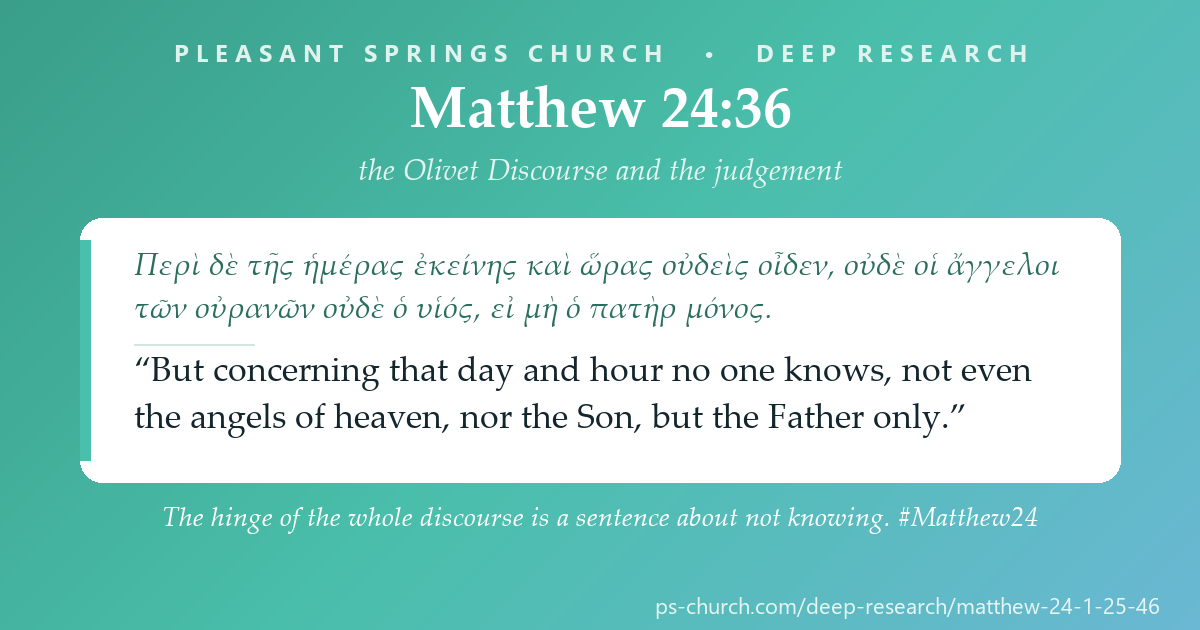
- The hinge is a sentence about ignorance, and everything after it obeys. οὐδεὶς οἶδεν — no one knows. Four parables follow, and not one of them is about calculating. They are about a servant who assumes there is time, ten women who assume they have enough, a man who buries what he was given, and a court that never knew it was serving the king.
- Every failure in these two chapters is an insider’s failure. The wicked servant is on the staff. The five foolish virgins are invited. The third servant is trusted with real money. And the goats are not accused of a single thing they did — only of what they did not do. Matthew’s judgement language, here as at 8:12 and 22:13, falls on people who thought they were safe.
- The command in the discourse is “stay awake,” and it is failed two chapters later on the same hill. γρηγορεῖτε at 24:42 and 25:13; γρηγορεῖτε again at 26:38 and 26:41, with γρηγορῆσαι at 26:40 — “could you not watch with me one hour?” Six Matthean verses carry the verb, and those are all six.
Step in response: take the six actions in 25:35–36 — food, drink, welcome, clothing, care in sickness, presence in prison — and pick the one you are least likely to do this month. Then read 25:37 and notice that the righteous do not remember doing any of it. Whatever this passage is measuring, it is not measuring what you can recall.
Matthew 24:36 · to share
Greek NT + ESVTwo verses in this discourse reach six, and both are stopped by a single word. This section looks at exactly where the contact starts and where it breaks — because that is where the interesting textual information lives, and because one of the two is the page’s own best counter-example.
24:29 — the run stops at one noun, and the noun is in Joel
Isaiah 13:10 LXX (no versification offset; Isaiah is aligned chapter-for-chapter):
οἱ γὰρ ἀστέρες τοῦ οὐρανοῦ καὶ ὁ Ὠρίων καὶ πᾶς ὁ κόσμος τοῦ οὐρανοῦ τὸ φῶς οὐ δώσουσιν καὶ σκοτισθήσεται τοῦ ἡλίου ἀνατέλλοντος καὶ ἡ σελήνη οὐ δώσει τὸ φῶς αὐτῆς
Matthew 24:29:
Εὐθέως δὲ μετὰ τὴν θλῖψιν τῶν ἡμερῶν ἐκείνων ὁ ἥλιος σκοτισθήσεται, καὶ ἡ σελήνη οὐ δώσει τὸ φέγγος αὐτῆς, καὶ οἱ ἀστέρες πεσοῦνται ἀπὸ τοῦ οὐρανοῦ, καὶ αἱ δυνάμεις τῶν οὐρανῶν σαλευθήσονται
The shared run is καὶ ἡ σελήνη οὐ δώσει τό — six forms, tie band 1, the deepest anything in the discourse reaches. And it stops at the very next word. Isaiah says the moon will not give τὸ φῶς, its light. Matthew says the moon will not give τὸ φέγγος, its radiance.
Where does φέγγος come from? It occurs in 24 verse units of the Greek Old Testament held here, and two of them are the Joel oracles about the darkening of the heavens: Joel 2:10 and Joel 4:15 (= 3:15 ESV; Hebrew and Greek Joel have four chapters where English has three). Joel 2:10 reads τὰ ἄστρα δύσουσιν τὸ φέγγος αὐτῶν — the same verb and the same noun, of the stars rather than the moon. Matthew’s run against Joel 2:10 is 3.
Stated as carefully as it deserves: what is measured is that the deepest run in the discourse breaks at one noun, and that the noun it breaks to is the noun Joel uses in the same cosmic register. We are not claiming Matthew merged two texts, and we cannot check whether some Greek witness of Isaiah 13:10 read φέγγος — we hold one Isaiah file, not an apparatus. Mark 13:24 has the identical wording; Matthew’s run against Mark there is 11, tie band 1, which is nearly twice its deepest contact with any Old Testament text.
24:30 — a counter-example against our own case, printed in full
A page that only prints the numbers supporting its thesis is not measuring anything. Here is the biggest one cutting the other way, and it is the joint-deepest run on the page.
Matthew 24:30 says κόψονται πᾶσαι αἱ φυλαὶ τῆς γῆς — “all the tribes of the earth will mourn.” Every commentary reads Zechariah 12:10–12 behind it. Against Zechariah 12:10 the run is 1. Against Zechariah 12:12 the run is 1.
The verse’s deepest match in the whole Greek Old Testament is 6, tie band 1 — and it is Genesis 28:14, Jacob at Bethel:
καὶ ἔσται τὸ σπέρμα σου ὡς ἡ ἄμμος τῆς γῆς καὶ πλατυνθήσεται ἐπὶ θάλασσαν καὶ ἐπὶ λίβα καὶ ἐπὶ βορρᾶν καὶ ἐπ' ἀνατολάς καὶ ἐνευλογηθήσονται ἐν σοὶ πᾶσαι αἱ φυλαὶ τῆς γῆς καὶ ἐν τῷ σπέρματί σου
Six identical forms: πᾶσαι αἱ φυλαὶ τῆς γῆς καί. Screened as a phrase, πᾶσαι αἱ φυλαὶ τῆς γῆς occurs in exactly three verse units of the Greek Old Testament held here — Genesis 12:3, Genesis 28:14, and Psalm 71:17 (= 72:17 ESV/MT) — and in all three the tribes of the earth are blessed. In Matthew they mourn.
- Nobody thinks Matthew 24:30 is quoting Jacob’s ladder. The six-word run is a stock Septuagint formula for the totality of humanity, and it happens to be the longest verbatim sequence in the discourse. Verbal depth is not citation.
- And the case for Zechariah, which the screen cannot see, is nonetheless real. It rests on a single verb: κόψονται, which occurs in five verse units of the Greek Old Testament held here — one of them Zechariah 12:10 — and in three verses of the Greek New Testament: Matthew 24:30, Revelation 1:7 and Revelation 18:9. One word, no contiguity, invisible to a run-length screen. This is the clearest illustration on the shelf of what our instrument cannot detect.
- Revelation 1:7 spells out the composite that Matthew leaves implicit — clouds, ἐξεκέντησαν (“pierced,” from Zechariah 12:10), and then the same five words πᾶσαι αἱ φυλαὶ τῆς γῆς. Matthew’s pair run against Revelation 1:7 is 5 — and a pair run carries no tie band, so here is the band that matters: screened against the whole Greek New Testament outside Matthew, 24:30’s deepest run is 6, tie band 2, and the two verses tying it are Mark 13:26 and Luke 21:27, not Revelation. That two New Testament writers assemble the same pieces is a fact about the texts. Which way it ran, or whether both inherited a formed tradition, the measurement cannot say and neither will we.
- Three more four-word runs with a tie band of one, offered against ourselves. Matthew 25:41’s “eternal fire” shares εἰς τὸ πῦρ τό uniquely with Jeremiah 43:23 LXX (= 36:23 ESV/MT), where King Jehoiakim cuts up a scroll and throws it in a brazier. Matthew 24:19’s “in those days” matches Judith 8:1, a genealogy. Matthew 25:21 and 25:23 — “well done, good and faithful servant” — match Judith 2:15, Holofernes numbering his troops “as his lord had commanded him.” All three are unique in 30,637 verse units. All three are meaningless. Uniqueness is a property of a corpus, not of an author.
What the discourse is actually closest to
If the Old Testament ceiling is six, it is worth asking what these ninety-seven verses are verbally close to. We ran the same screen against the whole Greek New Testament with Matthew excluded — 6,859 verses. The result is not close:
- Matthew 24:50 — 17 consecutive word forms, tie band 1, with Luke 12:46. Nearly three times the deepest Old Testament contact in the discourse.
- Matthew 24:19 — 13, band 1, with Mark 13:17. Matthew 24:34 — 13, band 1, with Luke 21:32.
- Matthew 24:32 — 12, band 1, with Mark 13:28 (the fig tree). Matthew 24:29 — 11, band 1, with Mark 13:24.
- Matthew 25:30 — 9, band 1, with Luke 13:28 — and that is the deepest anything in chapter 25 reaches anywhere outside Matthew. The four parables of chapter 25 are the most verbally isolated material in the whole discourse.
Say what this does and does not show. It shows that the verbal relationships of this material are horizontal — between the Gospels — far more than vertical, back into Israel’s scriptures. It does not show who wrote first, who used whom, or whether all three drew on something earlier. That is the synoptic problem, and a run-length screen has no opinion about it.
The temptation with a passage like this is to treat every image as a quotation and then argue from the source. The measurement says: you cannot do that here. Of the nine named backgrounds tabulated in Stage 4, only five reach four words or more, three of them measure a single καί, and the deepest run in the whole discourse points at a blessing formula in Genesis. What the discourse does instead is speak in the prophets rather than from them — sun, moon, stars, clouds, trumpet, gathering, tribes, throne — and then bend the whole apparatus toward a single practical point that no prophet had made in this form: you will not know the hour, so be found doing the work. That is what the numbers support. It is less than a proof-text chain and, on any honest reading, considerably more interesting.
Every Deep Research page traces its passage across the whole sweep — the Old Testament, the Second-Temple world between the testaments (historical witnesses, not Scripture), and the New Testament. Follow the thread:
Pleasant Springs Church — Deep Research
Research method after Michael S. Heiser’s Bible Research Method (examine dictionaries → ancient literature → important words → textual connections → academic publications → share), with the Pleasant Springs “Author & Audience” foundation. Scripture set in the Hebrew, the Greek editions named on each page and the ESV (Old Testament), and the Greek New Testament and the ESV (New Testament), per the practice of Pleasant Springs Church. Matthew 24:1–25:46 research grounded in Davies–Allison, France, Luz, Nolland and Keener; the history of interpretation per George Beasley-Murray, Jesus and the Last Days, and Sherman Gray on 25:31–46; the temple, Caligula’s statue and the fall of Jerusalem per Josephus, War 5.184–227, 6.249–266 and Antiquities 18.261–309, with Philo, Legatio ad Gaium 184–348. All run lengths, tie bands and word counts on this page were produced by the shelf’s own measurement substrate against the SBLGNT (MorphGNT) and the CATSS Greek Old Testament files held locally — with the Old Greek and Theodotion of Daniel kept as separate columns — and are re-derivable; the frozen normaliser folds accents, breathings and final sigma.
Scripture quotations marked ESV are from the ESV® Bible (The Holy Bible, English Standard Version®), © 2001 by Crossway, a publishing ministry of Good News Publishers. ESV Text Edition: 2016. Used by permission. All rights reserved. The ESV text may not be quoted in any publication made available to the public by a Creative Commons license, and the ESV may not be translated in whole or in part into any other language. www.esv.org
|
Did this study bless you today? 💚 Give to Support PS Church100% of gifts go to the General Fund — thank you. |