Four beasts rise from the sea — the empires that terrorize history — and then heaven’s court convenes. The Ancient of Days takes his throne, and “one like a son of man” comes with the clouds of heaven to receive a kingdom that shall never be destroyed. It is the scene Jesus cited at his trial — and the title, “the Son of Man,” he loved most. This study works Daniel 7 (in its original Aramaic) from the courtroom of heaven to the throne of the risen Christ. See the method →
Daniel 7:9–14 (selections)
Aramaic · Greek (Theodotion) · ESVThe Shape of the Passage
Parallel panelsDaniel 7 is the first of Daniel’s visions (chs. 7–12), given to exiles under pagan empires. Four beasts rise from the sea; then heaven’s court convenes, and a human figure receives the kingdom the beasts could not keep.
Author
The book of Daniel sets its visions in the Babylonian and Persian courts, addressing God’s people living under hostile empires. Chapter 7 — the hinge of the book, and its second half’s overture — shows four monstrous beasts (world empires) rising from the chaotic sea, then a heavenly courtroom: the Ancient of Days seated in blazing glory, the beasts judged, and “one like a son of man” brought on the clouds to receive dominion, glory, and an indestructible kingdom. The vision answers the exiles’ question: who really rules history? Not the beasts, but the one enthroned by God.
Corporate and individual. Within the chapter, the everlasting kingdom is given both to the “one like a son of man” (7:14) and to “the saints of the Most High” (7:18,27). The figure both represents God’s people and is a distinct heavenly individual who receives the kingdom on their behalf — a both/and the New Testament resolves in Christ, the head who shares his reign with his people.
Audience
God’s people under empire — tempted to think the beasts hold final power. To them the vision promises that the pagan kingdoms are on a leash, their time is measured, and the kingdom will be given to a human figure and to the saints “forever, forever and ever” (7:18). Faithfulness now is not futile; the verdict of heaven’s court is already cast.
How they heard it. The “one like a son of man” captured Second-Temple imagination: some texts developed him into a pre-existent, heavenly deliverer. When Jesus made “the Son of Man” his chosen self-designation — and, at his trial, claimed he would come “with the clouds of heaven” — his hearers understood the enormity of the claim, and condemned him for it (Mark 14:62–64).
Orient on the Son of Man, the Ancient of Days, and the kingdom.
Search by topic: Son of Man, Ancient of Days, kingdom of God, Daniel, apocalyptic.
Which articles are relevant?
- Anchor Bible Dictionary — “Son of Man,” “Ancient of Days,” “Daniel,” “Apocalypticism.”
- Dictionary of the OT: Prophets — “Son of Man,” “Daniel, Book of,” “Kingdom of God,” “Visions.”
- Lexica — בַּר אֱנָשׁ (bar ʾĕnāš, Aramaic “son of man/human”), שָׁלְטָן (šolṭān, dominion), עֲנָנִין (ʿănānîn, clouds), עַלְמָא (ʿalmāʾ, everlasting).
Bibliography surfaced:
- John Goldingay (WBC), Tremper Longman (NIVAC), John Collins (Hermeneia) on Daniel.
- Studies of the “Son of Man” figure and its NT use (Dan 7 + Ps 110); the 1 Enoch Similitudes debate.
- Beale & Carson, Commentary on the NT Use of the OT (the Gospels; Revelation).
Riding the clouds, the heavenly Son of Man, and the trial of Jesus.
Read the cloud-coming and the Son-of-Man figure against their background, then follow them to Jesus’ self-claim.
Which parallels shed light on religion and worldview?
Coming on the clouds. In the Old Testament, riding or coming “with the clouds” is a divine prerogative — the Lord “makes the clouds his chariot” (Ps 104:3; cf. Isa 19:1). That the “one like a son of man” comes this way, and receives the service due to God (7:14 uses the Aramaic pelach, the very verb for the religious service owed to God, Dan 3:28; 6:16) and an everlasting dominion, marks him as far more than an ordinary human — a figure who shares in the glory of God. (Ancient Near Eastern storm-god imagery lies in the deep background, but Daniel bends it wholly toward the God of Israel and the one he enthrones.)
The heavenly Son of Man. Later Jewish texts took up Daniel’s figure and developed him into a pre-existent, heavenly deliverer who judges and reigns. These witnesses show a live expectation of an exalted “Son of Man” in the Second-Temple world — the horizon against which Jesus’ use of the title would be heard — though their exact dates and their relation to the Gospels are debated, and the New Testament does not depend on them.
- Psalm 104:3; Isaiah 19:1 — the Lord who “makes the clouds his chariot” and comes “riding on a swift cloud”: the divine mode of coming the Son of Man shares.
- 1 Enoch 37–71 (the “Similitudes”) (Pseudepigrapha — a witness, not Scripture) — a pre-existent, enthroned “Son of Man / Elect One” who judges; likely first-century, its dating debated.
- 4 Ezra 13 (Pseudepigrapha — a witness, not Scripture) — “something like the figure of a man” who flies with the clouds and delivers: a kindred reading of Daniel 7.
- The Old Greek and Theodotion of Daniel — two Greek versions; the church used Theodotion, which reads at 7:13 “ὡς υἱὸς ἀνθρώπου… came to the Ancient of Days.”
“Son of Man” was Jesus’ favorite way of speaking of himself — used more than any other title in the Gospels. Often it stresses his humanity and his suffering; but at the climax it is unmistakably Daniel 7. Before the high priest, asked if he is the Christ, Jesus answers: “I am, and you will see the Son of Man seated at the right hand of Power, and coming with the clouds of heaven” (Mark 14:62) — fusing Daniel 7:13 with Psalm 110:1. The high priest tears his robes and cries blasphemy (14:63–64), because Jesus has placed himself on the clouds of God and at God’s right hand. Revelation completes the picture: the exalted Christ is “coming with the clouds” (Rev 1:7), and John sees “one like a son of man” whose head and hair are “white, like white wool” (Rev 1:13–14) — the very glory Daniel saw on the Ancient of Days now shining on the Son. The kingdom the beasts could not hold is his, and it shall not be destroyed.
The vocabulary of the Son of Man, the clouds, and the everlasting kingdom.
Watch “like a son of man,” the “Ancient of Days,” the “clouds,” and the “everlasting dominion.”
“Like a son of man” — Aramaic for a human figure, over against the beasts; he comes on the clouds and receives dominion. Jesus’ chosen self-title (Th ὡς υἱὸς ἀνθρώπου).
“Ancient of Days” — God enthroned in glory, white as snow (7:9 uses the absolute form יוֹמִין, 7:13 the determined יוֹמַיָּא). Revelation applies the same white-haired imagery to the exalted Christ (Rev 1:14).
“Clouds of heaven” — the divine way of coming (Ps 104:3); that the Son of Man comes thus marks him as sharing God’s glory.
“Everlasting dominion” — a kingdom that “shall not pass away” and “shall not be destroyed”: the reign the beasts’ empires only counterfeit.
How the New Testament reuses the Son of Man:
- Mark 14:61–64; Matthew 26:63–66 — Jesus cites Daniel 7:13 (with Ps 110:1) at his trial; the claim is judged blasphemy. Luke 22:69 gives the Ps 110:1 “right hand” element without the cloud-coming.
- Mark 13:26; Matthew 24:30; 25:31 — the Son of Man “coming in clouds with great power and glory” to gather and to judge.
- Acts 7:56 — Stephen sees “the Son of Man standing at the right hand of God.”
- Revelation 1:7, 13–14; 14:14 — “coming with the clouds”; “one like a son of man” crowned with the Ancient-of-Days glory.
From Daniel’s night vision to the throne of the Lamb.
Trace the Son of Man and the everlasting kingdom through the Gospels to Revelation.
Which cross-references matter?
- Daniel 7:18, 27 — the kingdom given to “the saints of the Most High”: the figure represents God’s people, who reign with him.
- Psalm 110:1; 2:6–9 — the enthroned Lord at God’s right hand and the anointed King, fused with Daniel 7 in the NT.
- Mark 14:62; Matthew 26:64 — Jesus’ self-identification as the coming Son of Man.
- Revelation 1:7, 13–14; 5:12–13; 11:15 — the Son of Man’s everlasting kingdom, worshiped with the Father.
- 1 Corinthians 15:24–28; Daniel 2:44 — the kingdom that fills the earth and never ends, handed at last to God.
The New Testament’s “Son of Man” Christology is rooted in Daniel 7. The Gospels use the title in three registers — the earthly ministry, the suffering-and-rising, and the coming in glory — but the third makes the Daniel background explicit: Jesus will be seen “coming with the clouds of heaven” (Mark 14:62). That claim is the hinge of his trial: to come on the clouds and sit at God’s right hand is to claim a share in God’s own glory, which is why it is charged as blasphemy. Revelation then reads the vision christologically to its end: the exalted Jesus wears the white-haired glory Daniel saw on the Ancient of Days (Rev 1:13–14) and receives the worship and the everlasting kingdom of Daniel 7:14. And the chapter’s corporate note is not lost: the saints who suffer under the beasts will share the dominion of the Son of Man — the head and his body reigning together in a kingdom that shall not be destroyed.
The scholarship on the Son of Man.
The commentators on Daniel; the Son-of-Man debate; Beale & Carson on the NT use.
Commentaries & studies:
- John E. Goldingay (WBC), Tremper Longman III (NIVAC), John J. Collins (Hermeneia) on Daniel.
- Studies of the “one like a son of man” (corporate vs. individual) and the 1 Enoch Similitudes; the Old Greek vs. Theodotion of Daniel.
- G. K. Beale & D. A. Carson, eds., Commentary on the New Testament Use of the Old Testament.
Interpretation notes worth keeping:
- Both/and, not either/or. Daniel 7 gives the kingdom to the “son of man” figure (7:14) and to the saints (7:18,27); he represents God’s people and is a distinct heavenly individual — fulfilled in Christ the head and his people.
- Coming on clouds = deity. The mode of the figure’s coming is elsewhere God’s alone; Daniel presents a human-yet-divine figure whom the NT identifies as Jesus.
- Aramaic and Theodotion. Daniel 2:4b–7:28 is written in Aramaic; the church read the Greek of Theodotion (not the Old Greek) for Daniel. The NT’s Daniel wording often agrees with “Theodotion” against the Old Greek — explained by a pre-Christian proto-Theodotion (kaige) text-form; the exact relationship is debated.
From heaven’s courtroom to the kingdom you belong to.
Name what you learned, why it matters, and one concrete response.
What should we carry away — and do?
- The beasts do not have the last word. Empires and powers seem to rule, but heaven’s court has already ruled: the kingdom belongs to the Son of Man. History is going his way.
- Jesus is the Son of Man on the clouds. The title he loved is a claim to divine glory and everlasting reign. To follow him is to follow the King the beasts could not defeat.
- The saints reign with him. The kingdom is given to the Son of Man and to his people. Your faithfulness under pressure is not wasted; you are an heir of a dominion that will not be destroyed.
Step in response: when the “beasts” of your day loom large — fears, powers, headlines — lift your eyes to heaven’s courtroom, where the verdict is already given, and live this week as a citizen of the Son of Man’s kingdom: unafraid, faithful, and sure of the reign that has no end.
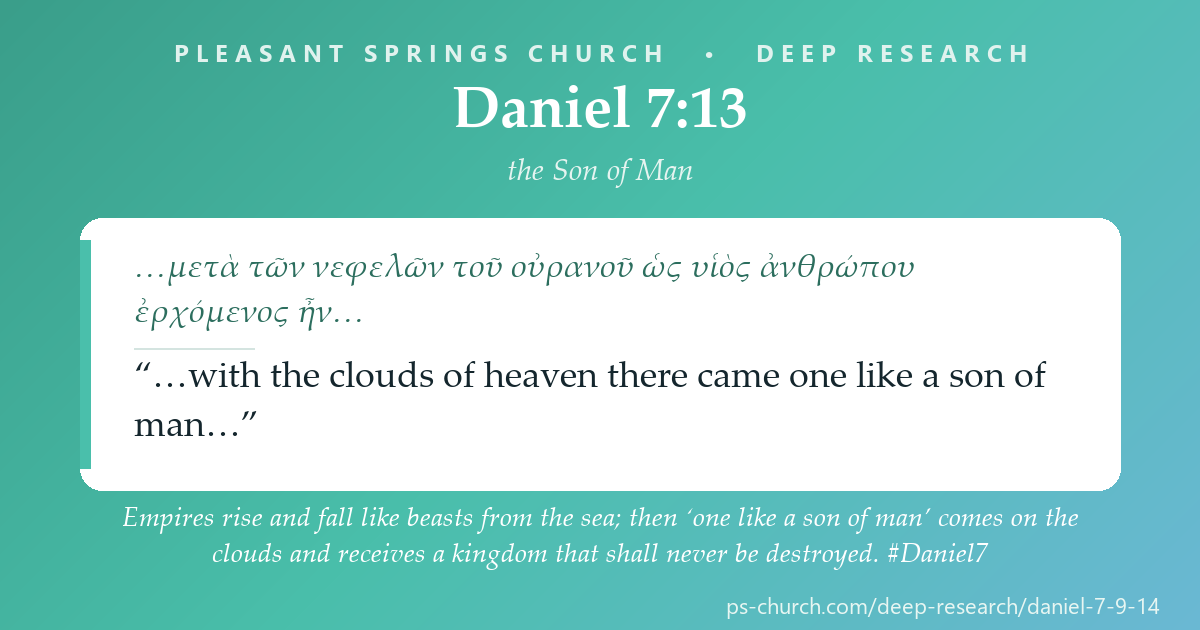
Daniel 7:13–14 · to share
Theodotion + ESVEvery Deep Research page traces its passage across the whole sweep — the Old Testament, the Second-Temple world between the testaments (historical witnesses, not Scripture), and the New Testament. Follow the thread:
Pleasant Springs Church — Deep Research
Research method after Michael S. Heiser’s Bible Research Method (examine dictionaries → ancient literature → important words → textual connections → academic publications → share), with the Pleasant Springs “Author & Audience” foundation. Scripture set in the Hebrew, the Greek editions named on each page and the ESV (Old Testament), and the Greek New Testament and the ESV (New Testament), per the practice of Pleasant Springs Church. Daniel 7:9–14 research grounded in Goldingay, Longman, and Collins, with Beale & Carson on the New Testament use; the Aramaic text and Theodotion Greek; Second-Temple material per 1 Enoch and 4 Ezra (read as witnesses, not Scripture).
Scripture quotations marked ESV are from the ESV® Bible (The Holy Bible, English Standard Version®), © 2001 by Crossway, a publishing ministry of Good News Publishers. ESV Text Edition: 2016. Used by permission. All rights reserved. The ESV text may not be quoted in any publication made available to the public by a Creative Commons license, and the ESV may not be translated in whole or in part into any other language. www.esv.org
|
Did this study bless you today? 💚 Give to Support PS Church100% of gifts go to the General Fund — thank you. |