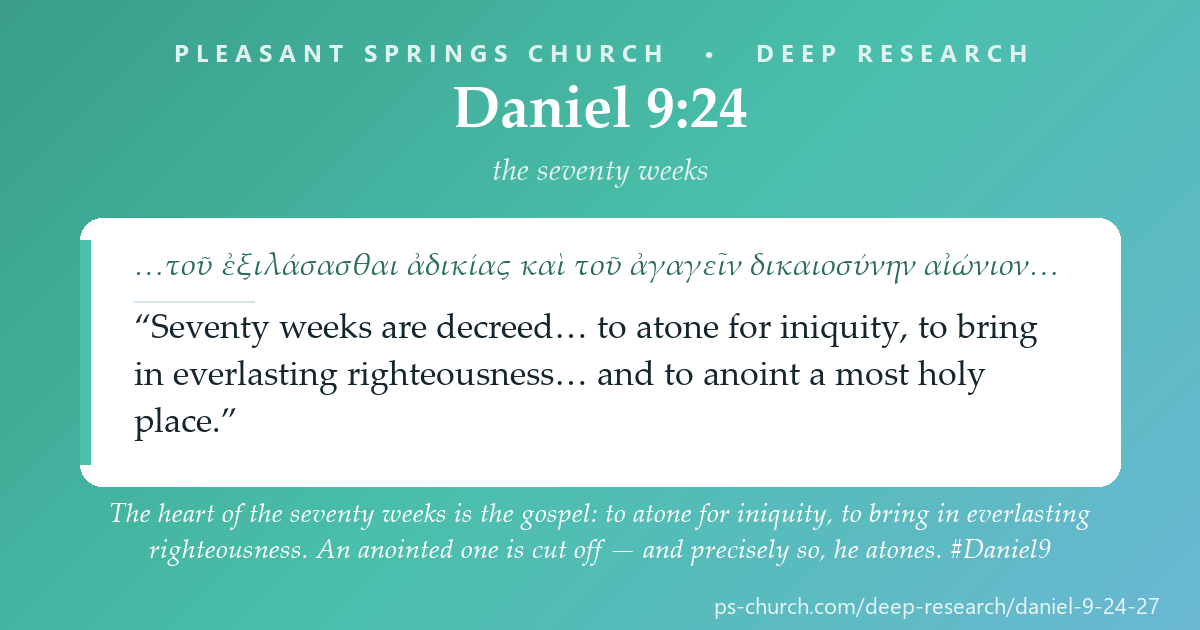
Seventy weeks are decreed… to atone for iniquity, to bring in everlasting righteousness.” As Daniel prays over Jeremiah’s seventy years of exile, Gabriel reveals a deeper timetable: seventy “sevens” to make a final end of sin — and at its center, “an anointed one shall be cut off.” The chronology of the seventy weeks is among the most debated passages in the Bible, and this study holds the major frameworks honestly rather than forcing one. But the heart is sure: a Messiah cut off, iniquity atoned, everlasting righteousness brought in — the gospel, decreed and, at the cross, accomplished. This study works Daniel 9:24–27 with care. See the method →
Daniel 9:24–26 (same numbering in MT, LXX & English)
Hebrew · Greek (Theodotion) · ESVThe Shape of the Passage
SequenceDaniel, praying in exile over Jeremiah’s “seventy years” (9:2; Jer 25:11–12), confesses his people’s sin and pleads for Jerusalem. Gabriel answers with the prophecy of the “seventy weeks” — God’s longer timetable to deal with sin once for all. See the Son of Man of Daniel 7.
Author
Daniel has been praying (9:3–19) a great confession, moved by Jeremiah’s promise that the exile would last seventy years. While he prays, Gabriel comes and reveals a deeper answer: not seventy years but “seventy weeks” (literally “seventy sevens”) are decreed to accomplish six things — to finish transgression, put an end to sin, atone for iniquity, bring in everlasting righteousness, seal vision and prophet, and anoint a most holy place (9:24). These are not the goals of a mere return from Babylon; they are the goals of redemption.
An anointed one cut off. Within the timetable, “an anointed one, a prince” comes (9:25), and then “an anointed one shall be cut off and shall have nothing” (9:26). The Hebrew mashiach (“anointed one,” Messiah) and the verb yikkaret (“cut off,” a word of violent death) together sketch a Messiah who dies — and whose death, in the logic of verse 24, is how iniquity is atoned.
Audience
Daniel and the exiles — and every reader who has asked how long sin and desolation will last. The answer is not a date to calculate but a purpose to trust: God has “decreed” a set time to make a final end of sin. The seventy weeks give the assurance that redemption is not adrift but scheduled by God.
How it was read. Second-Temple Jews read Daniel’s “abomination that makes desolate” (9:27) of Antiochus IV’s desecration of the temple (167 BC; 1 Macc 1:54), and framed history in Daniel’s sabbatical “weeks.” Jesus took up the same phrase — “the abomination of desolation spoken of by the prophet Daniel” — of a crisis still to come (Matt 24:15). And the church has always heard the heart of the prophecy — a Messiah cut off, iniquity atoned — fulfilled in the cross.
Orient on the seventy weeks, the anointed one, atonement, and the abomination.
Search by topic: Daniel, seventy weeks, Messiah / anointed one, abomination of desolation, atonement.
Which articles are relevant?
- Anchor Bible Dictionary — “Daniel,” “Seventy Weeks,” “Messiah,” “Abomination of Desolation.”
- Dictionary of the OT: Prophets — “Daniel, Book of,” “Apocalyptic,” “Messiah,” “Chronology.”
- NIDOTTE / TDOT — שָׁבוּעַ (šāḇûaʿ, week/seven), מָשִׁיחַ (māšîaḥ, anointed one), כָּרַת (kāraṯ, cut off), שִׁקּוּץ (šiqqûṣ, abomination).
Bibliography surfaced:
- John J. Collins (Hermeneia), James Montgomery (ICC), John Goldingay (WBC), Carol Newsom (OTL), Joyce Baldwin (TOTC), Stephen Miller (NAC), Andrew Steinmann (Concordia) on Daniel.
- Meredith G. Kline, “The Covenant of the Seventieth Week”; Roger Beckwith, “Daniel 9 and the Date of Messiah’s Coming.”
- Beale & Carson, NT Use of the OT (Matthew; the abomination of desolation).
The seventy sevens, the debated chronology, and the messianic core.
Hold the interpretive frameworks even-handedly — and hold firmly to the redemption at the center.
Which parallels shed light on religion and worldview?
Seventy sevens. Daniel prayed over Jeremiah’s “seventy years” of exile; Gabriel answers with “seventy sevens” — a sabbatical framework (seven times seventy, echoing the jubilee reckoning of Leviticus 25–26). Second-Temple Judaism loved such schemes (the “Apocalypse of Weeks” in 1 Enoch; the jubilee-chronology at Qumran), reading history as a countdown to God’s decisive act of atonement and restoration. Daniel’s seventy weeks belong to that world — but with a sharper center: a Messiah who is cut off.
The chronology, held honestly. How the seventy weeks are counted is one of the most disputed questions in Scripture, and faithful Christians read it in at least three ways. (1) A traditional messianic reading runs the “sevens” from a Persian decree to rebuild Jerusalem down to Christ, whose death “cuts off” the Anointed One near the end of the sixty-ninth “week.” (2) A dispensational reading sees a gap before a still-future seventieth “week” in which a coming figure makes and breaks a covenant. (3) A historical reading locates the desolation in Antiochus IV’s persecution (167 BC). This study does not set dates or crown one system; the arithmetic depends on contested choices (which decree, whether the “weeks” are literal years, where the accents fall). What all Christian readings share is the messianic core, and that is where the weight belongs.
- Jeremiah 25:11–12; 29:10; Leviticus 25–26; 2 Chronicles 36:21 — the “seventy years” and the sabbatical/jubilee framework Gabriel expands into “seventy sevens.”
- Daniel 8:9–14; 11:31; 12:11 — the “abomination that makes desolate” in Daniel’s other visions: the near horizon of Antiochus and the pattern beyond.
- 1 Maccabees 1:54 (Apocrypha — a Second-Temple witness, not Scripture) — “they erected a desolating sacrilege (βδέλυγμα ἐρημώσεως) on the altar”: how Second-Temple Jews read Daniel’s abomination, of Antiochus.
- The Old Greek vs Theodotion — the church received Theodotion’s Daniel (all the New Testament’s Daniel wording matches it); the Old Greek of 9:24–27 is textually confused. This study prints Theodotion.
Strip away the chronological debates and the prophecy’s heart shines clearly — and it is the gospel. The six goals of verse 24 are the goals of redemption: to finish transgression, to put an end to sin, to atone for iniquity (Hebrew kaphar, the temple word for atonement), to bring in everlasting righteousness, to seal up prophecy, and to anoint the most holy. And the means, in verse 26, is a death: “an anointed one shall be cut off.” The New Testament announces exactly this fulfilled in Christ: God “put forward” Jesus “as a propitiation by his blood” (Rom 3:25); by a single offering he “put away sin” and brought in a righteousness that is everlasting (Heb 9:26; 10:12–14; Rom 3:21–22). The Messiah is cut off — and precisely in being cut off, he atones. Jesus also took up Daniel’s other note, the “abomination of desolation” (Matt 24:15), of a coming crisis for Jerusalem and the temple — a phrase Second-Temple Jews had already applied to Antiochus and would see again in AD 70. On the timing of the seventy weeks, humility is wisdom: the details are genuinely debated among those who love the Scriptures, and date-setting has a long record of failure. But the center is sure — a Messiah cut off for our iniquity, everlasting righteousness brought in — and it is finished at the cross.
The vocabulary of the sevens, the anointed one, and atonement.
Watch the anointed one cut off — and the atonement that is the goal of the whole prophecy.
“Weeks” / literally “sevens” (heptads) — “seventy sevens.” A sabbatical unit; most read them as sevens of years. The framework echoes the jubilee reckoning (Lev 25).
“Anointed one” (Messiah) — anarthrous (“an anointed one”). Named twice: the coming “anointed one, a prince” (v.25) and the “anointed one” who is cut off (v.26). Theodotion: χριστός / χρῖσμα.
“Shall be cut off” (from kāraṯ) — a word for violent death or being excommunicated from the living. The Messiah’s death; Theodotion ἐξολεθρευθήσεται.
“To atone for iniquity” — kaphar, the temple word for making atonement (Lev 16). One of the six goals of the seventy weeks; fulfilled in the blood of Christ (Rom 3:25).
“Abominations that make desolate” — a detestable defilement of the sanctuary (MT 9:27 has the plural, “on the wing of abominations”); applied to Antiochus (1 Macc 1:54), and by Jesus to a coming crisis (Matt 24:15). Theodotion βδέλυγμα τῶν ἐρημώσεων.
How the New Testament uses Daniel 9:
- Matthew 24:15; Mark 13:14 — “the abomination of desolation spoken of by the prophet Daniel”: Jesus names Daniel of a coming crisis (following Theodotion’s wording).
- Romans 3:21–26; Hebrews 9:24–28; 10:12–14 — iniquity atoned, everlasting righteousness brought in, sin put away “once for all”: the six goals fulfilled at the cross.
- Luke 21:20–24 — “Jerusalem surrounded by armies… its desolation”: Luke reads Daniel’s desolation of the fall of Jerusalem.
- 2 Thessalonians 2:3–4 — the “man of lawlessness” who exalts himself in the temple: a thematic heir of Daniel’s desolator.
From the seventy weeks to the atonement finished at the cross.
Trace the anointed one and the atonement from Daniel through the Gospels into the epistles.
Which cross-references matter?
- Jeremiah 25:11–12; Leviticus 16; 25–26 — the seventy years; the day of atonement; the jubilee: the background to the “sevens” and the “atone for iniquity” (see the Day of Atonement).
- Isaiah 53:8; Psalm 22:16–18 — “cut off out of the land of the living”; the pierced sufferer: the Messiah who dies (see Isaiah 53, Psalm 22).
- Daniel 7:13–14; 12:1–3, 11 — the Son of Man; the resurrection; the abomination: Daniel’s wider vision (see Daniel 7).
- Matthew 24:15; Romans 3:21–26; Hebrews 9–10 — the abomination named by Jesus; atonement and everlasting righteousness in Christ.
- Revelation 11:2–3; 12:6, 14; 13:5 — the “time, times, and half a time” / 1,260 days: the “half a week” motif carried into the Apocalypse.
Daniel 9 rewards careful reading and punishes over-confidence. The passage is dense, its Hebrew is difficult, and honest interpreters — all holding a high view of Scripture — divide over the counting of the weeks, the identity of the “anointed one(s),” the antecedent of “he” who makes the covenant in verse 27, and whether the seventieth week is fulfilled or future. A wise study lays out the options rather than pretending the matter is simple, and it resists the perennial temptation to set dates — a temptation that has embarrassed the church in every generation. What restraint on the details frees us to see clearly is the prophecy’s unmistakable heart. Seventy weeks are decreed to make a full end of sin and to bring in a righteousness that lasts forever; an Anointed One is cut off; and the whole movement is toward atonement. The New Testament does not resolve every chronological question, but it does declare the center accomplished: the Messiah has been cut off, iniquity has been atoned, everlasting righteousness has come — “it is finished.” Whatever remains to be fulfilled, the decisive work is done.
The scholarship on Daniel 9:24-27.
The commentators on Daniel; the studies of the seventy weeks and the text of Theodotion.
Commentaries & studies:
- John J. Collins (Hermeneia), James A. Montgomery (ICC), John E. Goldingay (WBC), Carol A. Newsom (OTL), Joyce G. Baldwin (TOTC), Stephen R. Miller (NAC), Andrew E. Steinmann (Concordia) on Daniel.
- Meredith G. Kline, “The Covenant of the Seventieth Week”; Roger T. Beckwith, “Daniel 9 and the Date of Messiah’s Coming.”
- G. K. Beale & D. A. Carson, eds., Commentary on the NT Use of the OT.
Interpretation notes worth keeping:
- Hebrew, not Aramaic. Daniel 9 is Hebrew; the Aramaic portion of Daniel is only 2:4b–7:28. The chapters of visions (8–12) return to Hebrew.
- Theodotion, not the Old Greek. The church received Theodotion’s Daniel; the New Testament’s Daniel wording (e.g. “abomination of desolation”) matches it. The Old Greek of 9:24–27 is textually disordered.
- The athnach crux (v.25). The Masoretic accent divides “seven weeks” from “sixty-two weeks” (so ESV/RSV: “…an anointed one, a prince, there shall be seven weeks. Then for sixty-two weeks…”); older versions run them together (“sixty-nine weeks”). The counting turns partly on this.
- Hold systems humbly. Traditional-messianic, dispensational, and historical readings all exist among faithful Christians; the messianic core (an anointed one cut off, atonement, everlasting righteousness) is what they share — and it is fulfilled in Christ. No date-setting.
From the decreed weeks to the finished atonement.
Name what you learned, why it matters, and one concrete response.
What should we carry away — and do?
- Redemption is on a schedule — God’s. Sin and desolation are not endless; a set number of “weeks” was decreed “to make an end of sin.” History is going somewhere, by appointment.
- The Messiah was cut off — for you. The heart of the prophecy is a death that atones. When you cannot follow the chronology, follow the cross: iniquity atoned, everlasting righteousness brought in.
- Hold the details humbly. Faithful readers differ on the timing; certainty about dates is a trap. Be confident about the gospel and gracious about the calendar.
Step in response: resist the pull to obsess over end-times timetables, and rest instead in the finished center — a Messiah cut off to atone for your iniquity, everlasting righteousness now counted to you by faith. Then live this week as one who belongs to a redemption already decreed and, at the cross, already accomplished.
Daniel 9:24 · to share
ESVEvery Deep Research page traces its passage across the whole sweep — the Old Testament, the Second-Temple world between the testaments (historical witnesses, not Scripture), and the New Testament. Follow the thread:
Pleasant Springs Church — Deep Research
Research method after Michael S. Heiser’s Bible Research Method (examine dictionaries → ancient literature → important words → textual connections → academic publications → share), with the Pleasant Springs “Author & Audience” foundation. Scripture set in the Hebrew, the Greek editions named on each page and the ESV (Old Testament), and the Greek New Testament and the ESV (New Testament), per the practice of Pleasant Springs Church. Daniel 9:24–27 research grounded in Collins, Montgomery, Goldingay, Baldwin, Miller, and Steinmann, with Kline and Beckwith on the seventy weeks; Theodotion printed as the church’s Daniel; 1 Maccabees as a Second-Temple witness; the chronological systems presented even-handedly, no date-setting.
Scripture quotations marked ESV are from the ESV® Bible (The Holy Bible, English Standard Version®), © 2001 by Crossway, a publishing ministry of Good News Publishers. ESV Text Edition: 2016. Used by permission. All rights reserved. The ESV text may not be quoted in any publication made available to the public by a Creative Commons license, and the ESV may not be translated in whole or in part into any other language. www.esv.org
|
Did this study bless you today? 💚 Give to Support PS Church100% of gifts go to the General Fund — thank you. |