Michael stands. A time of trouble comes such as never has been. Many who sleep in the dust awake, the wise shine like the sky, the book is sealed, and a man in linen swears by him who lives forever that it will be for a time, times and half a time. Then two numbers, and an old man told to go his way and rest. This chapter survives in two Greek translations, the Old Greek and Theodotion, and this page measured both against the whole Greek New Testament. The three verses the New Testament touches at four words or more, outside stock phrases, do not agree on a column. Revelation 12:14 runs six words with the Old Greek of 12:7, and three with Theodotion. Matthew 24:15 and Mark 13:14 run four with the Old Greek of 12:11, and one with Theodotion. Mark 13:19 and Matthew 24:21 run four with Theodotion’s 12:1, and two with the Old Greek. And in Hebrew the chapter’s central sentence — the one the church has read as the Old Testament’s plainest promise of resurrection — shares no two consecutive words with any other verse in the Hebrew Bible. Every run is printed with its tie band, and the counter-examples are printed beside them. See the method →
Daniel 12:1–13 (all thirteen verses)
Hebrew (Masoretic) · Greek (Theodotion, then Old Greek, each named) · ESVOLD GREEK καὶ κατὰ τὴν ὥραν ἐκείνην παρελεύσεται Μιχαηλ ὁ ἄγγελος ὁ μέγας ὁ ἑστηκὼς ἐπὶ τοὺς υἱοὺς τοῦ λαοῦ σου ἐκείνη ἡ ἡμέρα θλίψεως οἵα οὐκ ἐγενήθη ἀφ' οὗ ἐγενήθησαν ἕως τῆς ἡμέρας ἐκείνης καὶ ἐν ἐκείνῃ τῇ ἡμέρᾳ ὑψωθήσεται πᾶς ὁ λαός ὃς ἂν εὑρεθῇ ἐγγεγραμμένος ἐν τῷ βιβλίῳ12:1“At that time shall arise Michael, the great prince who has charge of your people. And there shall be a time of trouble, such as never has been since there was a nation till that time. But at that time your people shall be delivered, everyone whose name shall be found written in the book.”Translation noteThe first of the three verses that split the two Greek Daniels. Theodotion’s θλῖψις οἵα οὐ γέγονεν ἀφ' runs four words with Mark 13:19 (the first four) and four with Matthew 24:21 (the last four) — and those two verses are the whole of its tie band (band 2). The Old Greek of the same clause, θλίψεως οἵα οὐκ ἐγενήθη, runs two with either. ⚠️ And the Old Greek’s deepest New Testament run in this verse is not there at all: καὶ ἐν ἐκείνῃ τῇ ἡμέρᾳ runs five words with John 16:23, band 1 — a sequence that stands in exactly one verse of the Greek Old Testament screened here and one of the Greek New Testament, and that has nothing to do with Daniel. Stage 4 prints it as the page’s first counter-example. In Hebrew the verse reaches 3, band 1 (עַד הָעֵת הַהִיא, with Nehemiah 6:1).
OLD GREEK καὶ πολλοὶ τῶν καθευδόντων ἐν τῷ πλάτει τῆς γῆς ἀναστήσονται οἱ μὲν εἰς ζωὴν αἰώνιον οἱ δὲ εἰς ὀνειδισμόν οἱ δὲ εἰς διασπορὰν καὶ αἰσχύνην αἰώνιον12:2“And many of those who sleep in the dust of the earth shall awake, some to everlasting life, and some to shame and everlasting contempt.”Translation noteThe Hebrew of this verse shares no two consecutive words with any of the 23,191 other verses of the Hebrew Bible screened. Its usual partners are Isaiah 26:19 and 66:24; measured, it shares one word form with the first (עָפָר) and none with the second. לְחַיֵּי עוֹלָם, everlasting life, stands nowhere else in the Hebrew Bible, with or without a prefix. The rare noun לְדִרְאוֹן is Stage 3’s subject. In Greek both columns share εἰς ζωὴν αἰώνιον with Matthew 25:46 — three words, but the sequence stands in nine New Testament verses, and with two more verses sharing and many of the (Acts 18:8, Revelation 8:11) and, for Theodotion, three sharing eternal life and, this verse’s band at three is 14 (Theodotion) and 11 (Old Greek). John 5:28–29, a passage often set beside it, measures 1 in Theodotion and 2 in the Old Greek — and the two words are οἱ δὲ.
OLD GREEK καὶ οἱ συνιέντες φανοῦσιν ὡς φωστῆρες τοῦ οὐρανοῦ καὶ οἱ κατισχύοντες τοὺς λόγους μου ὡσεὶ τὰ ἄστρα τοῦ οὐρανοῦ εἰς τὸν αἰῶνα τοῦ αἰῶνος12:3“And those who are wise shall shine like the brightness of the sky above; and those who turn many to righteousness, like the stars forever and ever.”Translation noteThe two Greek columns shine in two different New Testament verses. Theodotion’s ἐκλάμψουσιν ὡς stands in one verse of the Greek Old Testament — this one — and in one of the New: Matthew 13:43, “the righteous will shine like the sun”. The Old Greek has a different verb and a different noun, and its ὡς φωστῆρες stands, likewise, once in each corpus: Philippians 2:15, “you shine as lights in the world”. Two words each, and the Old Greek’s matches Philippians, Theodotion’s matches Matthew. ⚠️ The deeper runs in this row are formulas: the Old Greek’s εἰς τὸν αἰῶνα τοῦ αἰῶνος runs five with Hebrews 1:8 (band 1) and stands in 24 verses of the Greek Old Testament; Theodotion’s εἰς τοὺς αἰῶνας καὶ runs four with Luke 1:33 (band 1) and stands in 8. The Hebrew screen reports 3, but one of the three is the section mark {פ} the Masoretic file carries at the verse’s end; the true word run is two, לְעוֹלָם וָעֶד, and six other verses have it.
OLD GREEK καὶ σύ Δανιηλ κάλυψον τὰ προστάγματα καὶ σφράγισαι τὸ βιβλίον ἕως καιροῦ συντελείας ἕως ἂν ἀπομανῶσιν οἱ πολλοὶ καὶ πλησθῇ ἡ γῆ ἀδικίας12:4“But you, Daniel, shut up the words and seal the book, until the time of the end. Many shall run to and fro, and knowledge shall increase.”Translation noteThe seal, and the one place it touches Revelation is a single word form. Theodotion’s imperative σφράγισον is the form the voice from heaven uses at Revelation 10:4, “Seal up what the seven thunders have said” — its only occurrence in the Greek New Testament; the Old Greek has the middle σφράγισαι. Measured as runs, Revelation 10:4 reaches 1 against either column and Revelation 22:10, “Do not seal up the words”, reaches 2 against Theodotion (τοὺς λόγους) and 1 against the Old Greek. In Hebrew עַד־עֵת קֵץ runs three, band 1, with Daniel 11:35; the three words stand in exactly three verses of the Hebrew Bible, and the third is 12:9.
OLD GREEK καὶ εἶδον ἐγὼ Δανιηλ καὶ ἰδοὺ δύο ἕτεροι εἱστήκεισαν εἷς ἔνθεν τοῦ ποταμοῦ καὶ εἷς ἔνθεν12:5“Then I, Daniel, looked, and behold, two others stood, one on this bank of the stream and one on that bank of the stream.”Translation noteThe Hebrew opening וְרָאִיתִי אֲנִי דָנִיֵּאל runs three words, band 1, with Daniel 10:7 — the same seer and the same formula. Here the two Greek Daniels agree for ten consecutive words, the joint-deepest agreement between them anywhere in the chapter (12:1 also reaches ten), and then part: Theodotion goes on to the lip of the river, twice; the Old Greek stops after καὶ εἷς ἔνθεν.
OLD GREEK καὶ εἶπα τῷ ἑνὶ τῷ περιβεβλημένῳ τὰ βύσσινα τῷ ἐπάνω πότε οὖν συντέλεια ὧν εἴρηκάς μοι τῶν θαυμαστῶν καὶ ὁ καθαρισμὸς τούτων12:6“And someone said to the man clothed in linen, who was above the waters of the stream, ‘How long shall it be till the end of these wonders?’”Translation noteThe first question. עַד־מָתַי קֵץ — until when, the end? The Hebrew how long is common furniture (the verse’s band at two is 29). The two Greek columns share two consecutive words and no more (ὧν εἴρηκας): Theodotion asks ἕως πότε τὸ πέρας, the Old Greek πότε οὖν συντέλεια — and only the Old Greek adds καὶ ὁ καθαρισμὸς τούτων.
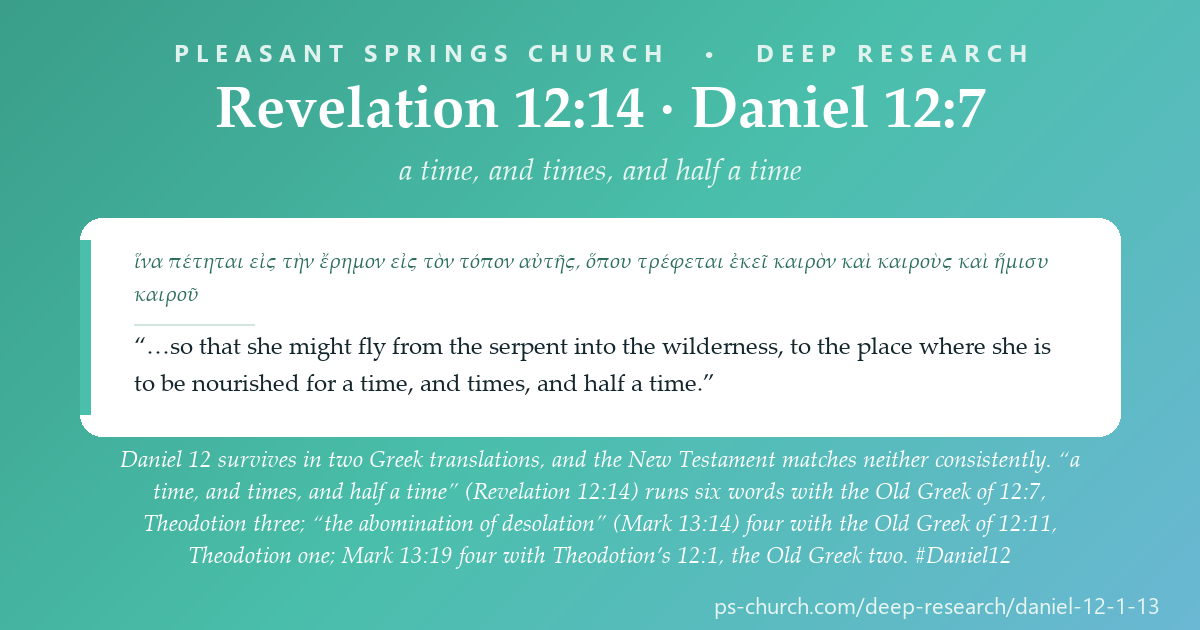
OLD GREEK καὶ ἤκουσα τοῦ περιβεβλημένου τὰ βύσσινα ὃς ἦν ἐπάνω τοῦ ὕδατος τοῦ ποταμοῦ ἕως καιροῦ συντελείας καὶ ὕψωσε τὴν δεξιὰν καὶ τὴν ἀριστερὰν εἰς τὸν οὐρανὸν καὶ ὤμοσε τὸν ζῶντα εἰς τὸν αἰῶνα θεὸν ὅτι εἰς καιρὸν καὶ καιροὺς καὶ ἥμισυ καιροῦ ἡ συντέλεια χειρῶν ἀφέσεως λαοῦ ἁγίου καὶ συντελεσθήσεται πάντα ταῦτα12:7“And I heard the man clothed in linen, who was above the waters of the stream; he raised his right hand and his left hand toward heaven and swore by him who lives forever that it would be for a time, times, and half a time, and that when the shattering of the power of the holy people comes to an end all these things would be finished.”Translation noteThe deepest New Testament run in the chapter. The Old Greek’s καιρὸν καὶ καιροὺς καὶ ἥμισυ καιροῦ runs six consecutive words with Revelation 12:14, tie band 1, and the six-word sequence stands in exactly one verse of each corpus — this one and that one. Theodotion measures 3: it writes καιρὸν καιρῶν, a time of times, with no καὶ. Daniel 7:25 has the same opening in both Greek columns, in the genitive (καιροῦ καὶ καιρῶν), and measures 3 and 2 against Revelation 12:14. ⚠️ A second figure on this row depends on the edition. Theodotion’s καὶ ὤμοσεν ἐν τῷ ζῶντι and Revelation 10:6’s καὶ ὤμοσεν τῷ ζῶντι differ by one word, and the SBL text carries a variant mark on the verb immediately before the gap; what the variant reads cannot be checked here, because the apparatus is not held. As printed, the oath clause shares only two words at a time, and the verse’s longest run with Revelation 10:6 comes from a later clause (τὸν οὐρανὸν καὶ, which the Old Greek shares too): 3; with ἐν inserted after the verb it would be 5. The page reports both and adopts neither.
OLD GREEK καὶ ἐγὼ ἤκουσα καὶ οὐ διενοήθην παρ' αὐτὸν τὸν καιρὸν καὶ εἶπα κύριε τίς ἡ λύσις τοῦ λόγου τούτου καὶ τίνος αἱ παραβολαὶ αὗται12:8“I heard, but I did not understand. Then I said, ‘O my lord, what shall be the outcome of these things?’”Translation noteThe second question, and the seer’s own. Where the first asked how long, Daniel asks מָה אַחֲרִית אֵלֶּה, what is the after of these? Theodotion renders it τί τὰ ἔσχατα τούτων; the Old Greek asks instead τίς ἡ λύσις τοῦ λόγου τούτου and adds καὶ τίνος αἱ παραβολαὶ αὗται. ⚠️ The Old Greek’s τοῦ λόγου τούτου runs three, band 1, with Acts 15:6 — and stands in six verses of the Greek Old Testament. Another formula.
OLD GREEK καὶ εἶπέν μοι ἀπότρεχε Δανιηλ ὅτι κατακεκαλυμμένα καὶ ἐσφραγισμένα τὰ προστάγματα ἕως ἂν12:9“He said, ‘Go your way, Daniel, for the words are shut up and sealed until the time of the end.”Translation noteThe answer repeats the command of 12:4 almost word for word. עַד־עֵת קֵץ again — the third and last time the Hebrew Bible has it — and the same pair of verbs, now as passive participles. Theodotion keeps the participles plural and masculine, agreeing with the words (ἐμπεφραγμένοι καὶ ἐσφραγισμένοι οἱ λόγοι), the Old Greek neuter (κατακεκαλυμμένα καὶ ἐσφραγισμένα τὰ προστάγματα). (The Old Greek file ends this verse mid-clause, on ἕως ἂν, and finishes the sentence at 12:10. The labels still agree; see the footer.)
OLD GREEK πειρασθῶσι καὶ ἁγιασθῶσι πολλοί καὶ ἁμάρτωσιν οἱ ἁμαρτωλοί καὶ οὐ μὴ διανοηθῶσι πάντες οἱ ἁμαρτωλοί καὶ οἱ διανοούμενοι προσέξουσιν12:10“Many shall purify themselves and make themselves white and be refined, but the wicked shall act wickedly. And none of the wicked shall understand, but those who are wise shall understand.”Translation note⚠️ One place the eye sees more than the screen. The three verbs here — יִתְבָּרְרוּ וְיִתְלַבְּנוּ וְיִצָּרְפוּ — are built on the same three roots as the three infinitives of Daniel 11:35 (לִצְרוֹף, וּלְבָרֵר וְלַלְבֵּן), in a different order. Measured, the two verses share not one word form: the pair run is 0. The וְהַמַּשְׂכִּלִים, the wise, are the people of 12:3 and of 11:33 and 11:35. Theodotion and the Old Greek share two consecutive words here and no more.
OLD GREEK ἀφ' οὗ ἂν ἀποσταθῇ ἡ θυσία διὰ παντὸς καὶ ἑτοιμασθῇ δοθῆναι τὸ βδέλυγμα τῆς ἐρημώσεως ἡμέρας χιλίας διακοσίας ἐνενήκοντα12:11“And from the time that the regular burnt offering is taken away and the abomination that makes desolate is set up, there shall be 1,290 days.”Translation noteThe second verse that splits the two Greek Daniels — and the other way. The Old Greek’s τὸ βδέλυγμα τῆς ἐρημώσεως runs four words with Matthew 24:15 and four with Mark 13:14, band 2: the articled phrase stands in exactly one verse of the Greek Old Testament screened here, this one, and in exactly those two of the New. Theodotion writes βδέλυγμα ἐρημώσεως without the articles and measures 1. And here, as at 11:31, the two Greek columns share no two consecutive words — six single words in common, among them βδέλυγμα ἐρημώσεως, but never two in a row — the thinnest agreement between them in the chapter. The Old Greek’s ἡμέρας χιλίας διακοσίας runs three with Revelation 11:3 and 12:6, and then the number changes: Daniel’s is 1,290, Revelation’s is 1,260. Hebrew: אֶלֶף מָאתַיִם runs two with seven census lines in Ezra 2 and Nehemiah 7 — a numeral, band 7.
OLD GREEK μακάριος ὁ ἐμμένων καὶ συνάξει εἰς ἡμέρας χιλίας τριακοσίας τριάκοντα πέντε12:12“Blessed is he who waits and arrives at the 1,335 days.”Translation note⚠️ A counter-example in Hebrew. שְׁלֹשׁ מֵאוֹת שְׁלֹשִׁים and the overlapping מֵאוֹת שְׁלֹשִׁים וַחֲמִשָּׁה run three words with four census lines (the first with Ezra 2:65 and Nehemiah 7:67 (LXX 2 Esdras 17:67), the second with Ezra 2:67 and Nehemiah 7:68). Numerals share words; that is all a band of four means here. The two Greek columns agree on the six words that carry the number (εἰς ἡμέρας χιλίας τριακοσίας τριάκοντα πέντε) and differ on the man: Theodotion’s ὑπομένων (the verb of Matthew 24:13 and Mark 13:13, though no run reaches two), the Old Greek’s ἐμμένων.
OLD GREEK καὶ σὺ βάδισον ἀναπαύου ἔτι γάρ εἰσιν ἡμέραι καὶ ὧραι εἰς ἀναπλήρωσιν συντελείας καὶ ἀναπαύσῃ καὶ ἀναστήσῃ ἐπὶ τὴν δόξαν σου εἰς συντέλειαν ἡμερῶν12:13“But go your way till the end. And you shall rest and shall stand in your allotted place at the end of the days.”Translation noteThe second verse in the chapter whose Hebrew shares no two consecutive words with any other verse. The last verb of the book is וְתַעֲמֹד, and you shall stand — the verb of Michael in 12:1. Both Greek columns render it ἀναστήσῃ, you shall rise — the verb the Old Greek used for the sleepers of 12:2. Theodotion sends him εἰς τὸν κλῆρόν σου, to his lot; the Old Greek ἐπὶ τὴν δόξαν σου, to his glory.
• 12:7 ↔ Revelation 12:14 — Old Greek 6, Theodotion 3. Tie band 1.
• 12:11 ↔ Matthew 24:15 and Mark 13:14 — Old Greek 4, Theodotion 1. Tie band 2, and the two are those two verses.
• 12:1 ↔ Mark 13:19 and Matthew 24:21 — Theodotion 4, Old Greek 2. Tie band 2, and the two are those two verses.
Mark 13:14 and Mark 13:19 stand five verses apart in one discourse, and each matches a different Greek Daniel. So do Matthew 24:15 and 24:21. The page’s sibling studies of Mark 13 and Matthew 24–25 found the same split from the other side; this page measures it from Daniel’s, and adds the deepest of the three, which is in Revelation. Across all 837 rows of both Greek Daniels — the whole book, both columns — three rows reach six against the New Testament and none goes higher. Old Greek 12:7 is one of the three, and, with Theodotion 6:28 (ESV 6:27, a sequence in two Greek Old Testament verses), one of the two that are not a stock phrase.
And the Hebrew. All thirteen verses against the 23,191 other verses of the Masoretic corpus. Daniel 12:2 — many of those who sleep in the dust of the earth shall awake — shares no two consecutive words with any of them. Neither does 12:13. No verse in the chapter reaches four.
Bold marks exactly the words each row’s note measures — a run the screen returned, or a word whose occurrences it counts — and nothing else. No direction of influence is asserted on this page. “Matches” means the run is longer against that file; it does not say which Greek lay on any writer’s desk.
The Shape of the Passage
Two questions inside mirrored vocabulary — partial, and labelled soWhat the shape does is visible even with the breaks. The chapter asks how long? twice and is answered twice, and each answer is a seal before it is a number. The word קֵץ, end, sounds five times in four verses (12:4, 12:6, 12:9, and twice in 12:13), and the last two are said to one man: go your way till the end… at the end of the days. The book closes on a personal promise, not a timetable.
This page completes Daniel on the shelf. Its neighbours: 1:1–6:28, 7:9–14, 8:1–11:45 (whose last verse this chapter continues without a break) and 9:24–27. Chapter 12 is the end of the speech that resumes at 10:20 (where the ESV opens its quotation); the ESV opens 12:1 with a continuing quotation mark and closes it at 12:4.
Author
The speaker is the man in linen, and he is finishing what he began in chapter 10. The vocabulary of chapter 12 belongs to the chapters before it: the wise (11:33, 35; 12:3, 10), until the time of the end (11:35; 12:4, 9), Michael (10:13, 21; 12:1), and the abomination (9:27; 11:31; 12:11). And yet the chapter’s central verse has no neighbour anywhere. Daniel 12:2 shares no two consecutive words with any other verse in the Hebrew Bible. The writer had a word for contempt that only one other verse uses, Isaiah 66:24, and an expression for everlasting life that no other verse uses at all.
He is also the one writer in the Hebrew Bible who names angels. Gabriel twice and Michael three times as an angel, every one of them in this book. This page does not use either fact to argue a date or a redaction.
Audience
People who would die before it was over. The promise of 12:2 is made to the dead first. It is a word to readers who had watched the faithful killed — 11:33 and 11:35 have the wise stumble by sword and flame — and needed to know that death was not the last thing that would be said about them.
People who wanted a number, and were given three. A time, times and half a time; 1,290 days; 1,335 days. The text never reconciles them, and every generation since has tried to. The arithmetic has been used to set dates many times; none of those dates has come to pass, and the chapter itself ends by telling its one named reader to go his way and rest.
And the readers of the New Testament. Three of its books share runs of four words or more with this chapter that are not stock phrases or coincidences: Matthew, Mark and Revelation. Which of Daniel’s two Greek translations those words agree with is the page’s first finding.
Orient on resurrection in the Old Testament, on Michael, on the two Greek Daniels, and on the numbers.
Search by topic: resurrection; afterlife in the Old Testament; Michael; angels, named; prince (הַשַּׂר); divine council; book of life; abomination of desolation; Theodotion; Old Greek Daniel; apocalyptic numbers.
Which articles are relevant?
- Anchor Bible Dictionary — “Resurrection (Early Judaism),” “Michael,” “Daniel, Book of,” “Abomination That Makes Desolate,” “Theodotion.”
- Dictionary of Deities and Demons in the Bible (van der Toorn, Becking, van der Horst) — “Michael,” “Prince,” “Sons of (the) God(s).” The standard reference for the divine-council vocabulary this chapter opens with.
- NIDOTTE / TDOT — דֵרָאוֹן (contempt, abhorrence), the roots behind יָקִיצוּ (awake), מִיְּשֵׁנֵי (sleep), וְהַמַּשְׂכִּלִים (be wise), יַעֲמֹד (stand), קֵץ (end), סְתֹם and וַחֲתֹם (shut up, seal) — each printed as it stands in this chapter.
- On the Greek — any introduction to the Septuagint will explain that Daniel survives in two substantially different Greek forms and that the churches came to read Theodotion’s. The critical editions (Ziegler–Munnich) are not held here; the Greek on this page is the CATSS digitisation of Rahlfs. See Stage 5.
Bibliography surfaced:
- John J. Collins, Daniel (Hermeneia, 1993); John E. Goldingay, Daniel (WBC); Carol A. Newsom, Daniel (OTL); James A. Montgomery (ICC); Joyce G. Baldwin (TOTC); Stephen R. Miller (NAC); Andrew E. Steinmann (Concordia).
- George W. E. Nickelsburg, Resurrection, Immortality, and Eternal Life in Intertestamental Judaism; N. T. Wright, The Resurrection of the Son of God — the two standard treatments of Daniel 12:2 in its world.
- Michael S. Heiser, The Unseen Realm (2015) — the divine-council reading of the princes of Daniel 10–12 and of Deuteronomy 32:8–9.
- George Eldon Ladd, The Blessed Hope (1956) and A Commentary on the Revelation of John (1972) — the modern statement of historic premillennialism. John F. Walvoord, Daniel: The Key to Prophetic Revelation (1971) — the dispensational reading, named so it can be described accurately.
- Hippolytus, On Daniel and Treatise on Christ and Antichrist; Irenaeus, Against Heresies 5 (ANF 1 and 5, held in this church’s research library); Jerome, Commentary on Daniel, which preserves Porphyry (not held).
Michael among the princes, the first readers of 12:2, and three ancient ways of reading the numbers.
Read Daniel 10:13, 10:20–21 and 12:1 together, then Deuteronomy 32:8–9. Ask who the princes are before asking when the end is.
Who is “Michael, the great prince”?
The text answers in three steps, and every step is in Daniel. At 10:13 he is מִיכָאֵל אַחַד הַשָּׂרִים הָרִאשֹׁנִים — “Michael, one of the chief princes” — one of a class. At 10:20 the class has members on the other side: “the prince of Persia” and “the prince of Greece”, whom the speaker must fight. At 10:21 Michael is שַׂרְכֶם, “your prince” — the Hebrew suffix is plural, the prince of Daniel’s people. And at 12:1 he is הַשַּׂר הַגָּדוֹל הָעֹמֵד עַל־בְּנֵי עַמֶּךָ, “the great prince who has charge of your people”. In the Greek, Theodotion keeps the title ὁ ἄρχων ὁ μέγας; the Old Greek calls him ὁ ἄγγελος ὁ μέγας, the great angel, as it called him the angel at 10:21 (Μιχαηλ ὁ ἄγγελος).
Heiser’s divine-council method reads the princes against Deuteronomy 32:8–9, where the nations are apportioned by the Most High and Israel is the Lord’s own portion. That verse is a place where the Hebrew and the Greek differ, and the page prints both. The Masoretic text reads לְמִסְפַּר בְּנֵי יִשְׂרָאֵל, according to the number of the sons of Israel; the Rahlfs Septuagint held here reads κατὰ ἀριθμὸν ἀγγέλων θεοῦ, according to the number of the angels of God; and the ESV prints “according to the number of the sons of God”. The Qumran manuscript usually cited for the ESV’s reading (4QDeutj) is not held here and was not checked. On that reading, Daniel 10–12 shows the arrangement at work: nations with heavenly princes, and contests among them that the seer is allowed to hear about but not to see. What the text itself says is narrower, and the page keeps to it: Michael is one of a class of princes; the others have nations; Michael stands over Daniel’s people; and when he stands, the time of trouble comes and the people are delivered. Daniel never calls him an archangel. Jude 9 does (Μιχαὴλ ὁ ἀρχάγγελος), and Revelation 12:7 gives him angels of his own (ὁ Μιχαὴλ καὶ οἱ ἄγγελοι αὐτοῦ). Measured, neither verse runs more than two words with 12:1 in either Greek column.
Who else voiced the hope of 12:2, and how?
Second-Temple texts voice the same hope, and one of them shares Daniel’s own Greek words. Psalms of Solomon 3:12 (a witness, not Scripture) says of those who fear the Lord ἀναστήσονται εἰς ζωὴν αἰώνιον — they shall rise to everlasting life. Against Theodotion 12:2 it runs four words, against the Old Greek three; and εἰς ζωὴν αἰώνιον stands in exactly three verses of the Greek Old Testament screened here: the two Greek Daniels at 12:2, and this psalm. (4 Maccabees 15:3 has the pair the other way round, αἰωνίαν ζωὴν; that is a fourth verse with the idea and not with the sequence.) 2 Maccabees 7 (a witness, not Scripture) puts the same hope in the mouths of martyrs: the second brother tells the king that the King of the world εἰς αἰώνιον ἀναβίωσιν ζωῆς ἡμᾶς ἀναστήσει — will raise us up to an everlasting renewal of life (7:9) — and the fourth tells him σοὶ μὲν γὰρ ἀνάστασις εἰς ζωὴν οὐκ ἔσται — for you there will be no resurrection to life (7:14). Against 12:2 each runs one or two words. The idea is everywhere in that literature; the wording, in the Greek files held here, stands only in the two Greek Daniels and in one psalm outside the canon.
And the abomination had already happened once. 1 Maccabees 1:54 (a witness, not Scripture) reports ᾠκοδόμησεν βδέλυγμα ἐρημώσεως on the altar in 167 BC — the two words without articles, as the Old Greek of 11:31 and Theodotion’s 12:11 have them, and not with the articles that the Old Greek of 12:11 and the Gospels share.
Three ancient ways of reading the numbers — and their heirs
| reading | who held it | what 12:1–13 is about |
|---|---|---|
| Historical (Antiochene) | Porphyry in the third century, known through Jerome’s Commentary on Daniel (not held); most modern critical commentators (Collins, Montgomery, Newsom — named, not consulted). | The crisis of 167–164 BC. Michael’s standing and the awakening of 12:2 are the deliverance the book expected at the end of Antiochus IV; the numbers count from the stopping of the daily offering. On this reading the two different figures of 12:11–12 are often explained as successive recalculations — a hypothesis this page names and does not adopt. |
| Futurist | Hippolytus of Rome (c. 200) in part; in the modern form, J. N. Darby, the Scofield Reference Bible and Walvoord. | A last enemy still to come. Hippolytus — held here, ANF 5 — takes a time, times and half a time as the three and a half years of Antichrist (Scholia on Daniel, ch. 12), divides Daniel’s one week into two halves (On Daniel §39), and speaks of two abominations, one that Antiochus set up and one still to come (§40). The dispensational system builds from these numbers a seven-year tribulation separated from the church’s history, preceded by a secret removal of the church. Pleasant Springs rejects that system. |
| Historic premillennial (the church’s frame) | Irenaeus (Against Heresies 5.34.2, ANF 1) and Hippolytus (Treatise on Christ and Antichrist §65, ANF 5); in the twentieth century George Eldon Ladd. | Two horizons in one text. The book was read of Antiochus, and the New Testament speaks in its words of something still ahead — Jesus applies the abomination to a coming crisis (Matthew 24:15), and Revelation gives the woman in the wilderness a time, and times, and half a time under God’s protection. Irenaeus cites 12:13 — Daniel standing in his lot at the consummation — for the kingdom that follows the resurrection, beside Revelation 20:6. Hippolytus sets 12:2 beside Isaiah 26:19 and Revelation 20:6, introducing it as Daniel’s word concerning the resurrection and the kingdom of the saints. The numbers are God-measured limits on the suffering of his people, not a calendar. |
The church read Theodotion’s Daniel, and on the whole of the book the New Testament’s Daniel is usually said to be Theodotion’s. In this chapter, measured, it is more often the other one.
Of the three verses the New Testament touches at four words or more outside stock phrases, two match the Old Greek — 12:7 in Revelation (6 against 3) and 12:11 in Matthew and Mark (4 against 1) — and one matches Theodotion, 12:1 in Mark and Matthew (4 against 2). The textual history of Greek Daniel in the first century is genuinely unsettled; the Old Greek survives in very few witnesses; and nothing here shows which form any New Testament writer had. What the measurement shows is that no single file on this disk accounts for all three.
Many, dust, everlasting life, a word for contempt that only two verses have, and the verb that ends the book.
Every count below is an exhaustive search of the corpus named beside it — 23,204 Masoretic verse units, 30,348 screened Greek Old Testament verse units, 7,927 Greek New Testament verses — and every only, once and nowhere was tested twice: anchored on the form, and unanchored so that prefixes, augments and other inflections could not hide a second occurrence.
“And many.” The resurrection sentence does not say all. It says וְרַבִּים מִיְּשֵׁנֵי, many from among the sleepers — the preposition is partitive. Both Greek columns keep it: πολλοὶ τῶν καθευδόντων. Readers divide on what the partitive means. (1) A restricted resurrection — some of the dead, perhaps those whose faithfulness or apostasy in the crisis demanded it. (2) An inclusive one, with many as the Hebrew idiom for a great multitude, as in Isaiah 53:11–12. John 5:28 has “all who are in the tombs”, and Revelation 20:5 says “The rest of the dead did not come to life until the thousand years were ended”. The page does not settle the grammar. It notes that the word sounds four times in this chapter — 12:2, 12:3, 12:4, 12:10 — and that the wise of 12:3 turn the many to righteousness.
“Of those who sleep in the ground of dust.” Two nouns from the making and the sentence of Adam — the ground and the dust of Genesis 2:7 and 3:19 — joined in one construct chain. Measured, Daniel 12:2 shares one word form with Genesis 3:19 (“to dust you shall return”). The connection is lexical, not verbal, and the page says so. Theodotion has ἐν γῆς χώματι — χώματι, dust, mound, in three verses of the Greek Old Testament held here; the Old Greek ἐν τῷ πλάτει τῆς γῆς, in the breadth of the earth.
“To everlasting life.” The expression stands in no other verse of the Hebrew Bible — tested on every word form ending in life followed by every form ending in everlasting, so prefixes cannot hide a second one. In Greek, ζωὴν αἰώνιον stands in three verses of the Greek Old Testament screened here (both Daniels at 12:2, and Psalms of Solomon 3:12 (a witness, not Scripture)) and in 31 verses of the Greek New Testament. No claim is made that the New Testament phrase comes from here; it is reported that in the Greek Old Testament files screened here the phrase stands only in this verse, in both columns, and in Psalms of Solomon 3:12.
“To contempt.” The noun stands in exactly two verses of the Hebrew Bible — this one and Isaiah 66:24, דֵרָאוֹן. Tested unanchored, with and without prefixes, on the read text and on the written text: two, and only two. ⚠️ But the two verses share no word form — Daniel has the noun with a preposition, Isaiah without — so the pair run is 0, and the screen that found nothing for 12:2 was right by its own definition. And the link is invisible in every other column on this page. The ESV has “everlasting contempt” in Daniel and “an abhorrence to all flesh” in Isaiah; both Greek Daniels have αἰσχύνην αἰώνιον, and the Septuagint of Isaiah εἰς ὅρασιν, a spectacle. One Hebrew word ties the last verse of Isaiah to the resurrection verse of Daniel, and no translation on the page lets a reader see it.
“Shall shine.” This form occurs once in the Hebrew Bible, and so does the noun beside it, כְּזֹהַר. The root’s noun stands once more, at Ezekiel 8:2, of the brightness of a figure in vision; everywhere else the verb built on these letters means to warn or be warned (Exodus 18:20, Ezekiel 3 and 33, and five other Hebrew verses, plus the Aramaic of Ezra 4:22). The two Greek columns translate differently, and each ends up matching a different New Testament verse (see the 12:3 row).
“For a time, times, and half.” The Hebrew sequence stands in no other verse; the same idea at Daniel 7:25 is Aramaic, עַד־עִדָּן וְעִדָּנִין וּפְלַג עִדָּן, and cannot be screened against a Hebrew corpus. The Greek columns divide — εἰς καιρὸν καὶ καιροὺς καὶ ἥμισυ καιροῦ (Old Greek), εἰς καιρὸν καιρῶν καὶ ἥμισυ καιροῦ (Theodotion) — and Revelation 12:14 has the Old Greek’s six words exactly. The page offers no arithmetic for the phrase. Hippolytus counted it as three and a half years; the text does not count it at all.
“The abomination of desolation.” With both articles, this sequence stands in one verse of the Greek Old Testament screened here — the Old Greek of 12:11 — and in two of the New, Matthew 24:15 and Mark 13:14. Without the articles, βδέλυγμα ἐρημώσεως stands in three: 1 Maccabees 1:54 (a witness, not Scripture), the Old Greek of 11:31 and Theodotion’s 12:11. Daniel 9:27 has the plural in both columns (βδέλυγμα τῶν ἐρημώσεων). ἐρημώσεως occurs in the New Testament in exactly those two Gospel verses; the noun stands once more, in the nominative, at Luke 21:20, of Jerusalem surrounded by armies. Matthew names Daniel; the page reports the words he prints, not where he found them.
“You shall rise.” The Hebrew is וְתַעֲמֹד, you shall stand, the root of Michael’s standing in 12:1. Both Greek Daniels translate it with the verb of resurrection. Theodotion uses the same verb for Michael too (ἀναστήσεται Μιχαηλ), so in his column the chapter’s first and last verbs are one Greek word; the Old Greek has Michael παρελεύσεται Μιχαηλ, pass by, and keeps the verb for the sleepers of 12:2 (ἀναστήσονται) and for Daniel.
Counted here, not assumed:
- The Hebrew of Daniel 12, verse by verse, against the rest of the Hebrew Bible. Longest run per verse: 3, 0, 3, 3, 3, 2, 2, 2, 3, 2, 2, 3, 0. Six verses at three, five at two, two at zero (12:2 and 12:13), none above three; mean 2.15. ⚠️ One of the threes is an artefact: the screen counts the Masoretic section mark at the end of 12:3 as a word, and the true run there is two. Without it the mean is 2.08. On this screen a zero means “no two consecutive words shared with any other verse” — both zeros still share single words.
- The two Greek Daniels against each other, verse by verse. Longest shared run: 10, 5, 3, 6, 10, 2, 7, 5, 2, 2, 1, 6, 4 for 12:1–13; median 5. The thinnest is 12:11, a run of one — the verse the Gospels match.
- The Greek New Testament screen. Old Greek, 13 rows: one reaches six, two five, one four, five three, four two. Theodotion, 13 rows: three reach four, three three, seven two. On the Greek screen a 1 means only isolated words and a 0 no word at all; no row of Daniel 12 falls below 2.
- The whole of both Greek Daniels, for scale. 413 Old Greek rows and 424 Theodotion rows against the New Testament: nothing exceeds six, and three rows reach it — Old Greek 12:7 (Revelation 12:14, band 1), Old Greek 4:37 (τὸν οὐρανὸν καὶ τὴν γῆν καὶ, band 3, a formula in ten Greek Old Testament verses) and Theodotion 6:28 (ESV 6:27; Matthew 28:18, band 1, treated on the Daniel 1–6 study).
- Hebrew roots that frame the chapter. קֵץ, end: five times in four verses (12:4, 6, 9, 13 twice). Stand: four times in three (12:1 twice, 12:5, 12:13). The wise: 12:3 and 12:10. עַד־עֵת קֵץ: 11:35, 12:4, 12:9 and nowhere else.
- The time of trouble. עֵת צָרָה stands with no prefix only here; with a prefix, or with the second noun inflected, the same pair stands in eight more verses (Judges 10:14, Isaiah 33:2, Jeremiah 14:8, 15:11, 30:7, Psalm 37:39 (LXX 36:39), Job 38:23, Nehemiah 9:27 (LXX 2 Esdras 19:27)). Jeremiah 30:7 (LXX 37:7), the closest in sense (a time of distress from which Jacob is saved), is one of them, and the screen gives it 1, because of the conjunction glued to the first word. The ESV says “a time of trouble” in Daniel and “a time of distress” in Jeremiah.
Twelve New Testament contacts, both Greek columns beside each, and the counter-examples that keep the deep ones honest.
Read Revelation 12:14 beside the Old Greek of 12:7, then beside Theodotion’s. Read Mark 13:14 and Mark 13:19 beside 12:11 and 12:1 in both columns. Count the shared words yourself.
Every contact the page names, with both columns:
| Daniel 12 | New Testament | Old Greek | Theodotion | tie band (deeper column) | shared words |
|---|---|---|---|---|---|
| 12:7 | Revelation 12:14 | 6 | 3 | 1 | καιρὸν καὶ καιροὺς καὶ ἥμισυ καιροῦ |
| 12:11 | Matthew 24:15; Mark 13:14 | 4 | 1 | 2 — the two Gospel verses | τὸ βδέλυγμα τῆς ἐρημώσεως |
| 12:1 | Mark 13:19 | 2 | 4 | 2 — Mark 13:19 and Matthew 24:21 | θλῖψις οἵα οὐ γέγονεν |
| 12:1 | Matthew 24:21 | 2 | 4 | (same band) | οἵα οὐ γέγονεν ἀφ' |
| 12:11 | Revelation 11:3; 12:6 | 3 | 1 | — (pair runs) | ἡμέρας χιλίας διακοσίας — then 1,290 against 1,260 |
| 12:2 | Matthew 25:46 | 3 | 3 | 11 / 14 — a phrase in nine NT verses | εἰς ζωὴν αἰώνιον |
| 12:7 | Revelation 10:5–6 | 3 | 3 (5 with ἐν) | — (pair runs) | εἰς τὸν οὐρανὸν |
| 12:3 | Matthew 13:43 | 1 | 2 | — (pair runs; the pair is unique in both corpora) | ἐκλάμψουσιν ὡς |
| 12:3 | Philippians 2:15 | 2 | 1 | — (pair runs; the pair is unique in both corpora) | ὡς φωστῆρες |
| 12:2 | John 5:29 | 2 | 1 | — | οἱ δὲ |
| 12:1 | Revelation 12:7; Jude 9 | 2 | 2 | — | ἐν τῷ (Revelation); Μιχαὴλ ὁ (Jude) |
| 12:4, 12:9 | Revelation 10:4; 22:10 | 1 | 1–2 | — | one word form, σφράγισον, with Revelation 10:4 |
Reading the table. The first four rows are the finding. The fifth shares a numeral and then disagrees about the number. The sixth and seventh measure three (a phrase in nine New Testament verses, and an edition-dependent run). The rest are the famous links that measure two or less — John 5:29, Revelation 10:4 and 22:10, Revelation 12:7, Jude 9 — printed so that a reader who expects them to be deep can see that they are not. A thematic heir and a verbal one are different things, and the screen can only see the second.
The counter-examples, printed on purpose:
- ⚠️ Old Greek 12:1 ↔ John 16:23 — run 5, band 1. καὶ ἐν ἐκείνῃ τῇ ἡμέρᾳ / καὶ ἐν ἐκείνῃ τῇ ἡμέρᾳ. Deeper than either Gospel contact in the table, a narrower tie band (1, against their 2), and the sequence stands in exactly one verse of each corpus. It means nothing: Jesus tells the disciples that in that day they will ask him nothing. This row is why the four-word runs above are not read by depth alone. Rarity in both corpora is not contact.
- Old Greek 12:3 ↔ Hebrews 1:8 — run 5, band 1. εἰς τὸν αἰῶνα τοῦ αἰῶνος. The phrase stands in 24 verses of the Greek Old Testament; Hebrews has it because it is quoting a psalm, and says so (Septuagint Psalm 44:7 = Hebrew 45:7 = ESV 45:6). A band of 1 in a small corpus can sit on a formula from a large one.
- Theodotion 12:3 ↔ Luke 1:33 — run 4, band 1. εἰς τοὺς αἰῶνας καὶ, in 8 Greek Old Testament verses. A formula.
- Theodotion 12:7 — run 4, band 4. αὐτοῦ εἰς τὸν οὐρανὸν καὶ — four of these five words, in one alignment or the other, tie John 17:1, Mark 16:19 and Luke 15:18 and 15:21. Lifting a hand toward heaven and a prodigal son sinning against it share four words. That is what a band of four looks like.
- Old Greek 12:8 ↔ Acts 15:6 — run 3, band 1. τοῦ λόγου τούτου, in six Greek Old Testament verses.
- Hebrew 12:11 and 12:12 ↔ Ezra 2 and Nehemiah 7. The day-counts share words with census lists (bands 7 and 4). Numerals.
- Hebrew 12:10 ↔ 11:35 — pair run 0, with three shared roots. The eye sees an obvious repetition; the screen sees nothing, because no word form recurs. Runs are a floor, not a ceiling.
- Revelation 10:6 — the edition changes the number. 3 as the SBL text prints it, 5 if a preposition stood after the verb. The page cannot read the variant and reports both.
And the Hebrew parallels usually set beside the chapter:
- Daniel 12:2 ↔ Isaiah 26:19 — “You who dwell in the dust, awake and sing for joy!” Hebrew run 1 (עָפָר). The verbs are the same root in different forms (הָקִיצוּ / יָקִיצוּ). In Greek, the Old Greek of 12:2 shares ἀναστήσονται οἱ with Septuagint Isaiah 26:19 (run 2); Theodotion shares 1.
- Daniel 12:2 ↔ Isaiah 66:24 — Hebrew run 0; one shared noun, the rarest word in either verse. Greek run 1 in both columns. See Stage 3.
- Daniel 12:4 and 12:9 ↔ Daniel 11:35 — עַד־עֵת קֵץ, three words, band 1. The only verses in the Hebrew Bible with the three.
- Daniel 12:5 ↔ Daniel 10:7 — וְרָאִיתִי אֲנִי דָנִיֵּאל, three words, band 1.
- Daniel 12:1 ↔ Daniel 10:13, 10:21 — the name only (pair runs 1, and 10:13 against 10:21 is also 1). In Hebrew, Michael is never described in the same two words twice; in Theodotion 10:13 and 12:1 share ὁ ἄρχων.
What was not consulted, what could not be checked, and where this page is weakest.
Named first, because the honesty of the rest depends on it.
Named but not consulted:
- Collins (Hermeneia), Goldingay (WBC), Newsom (OTL), Montgomery (ICC), Baldwin (TOTC), Miller (NAC), Steinmann — the commentary range. None is held here; none was consulted. The description of the Antiochene reading in Stage 2, including the successive recalculation explanation of 12:11–12, is a summary of a well-known position, not a report of what any one of them argues.
- Nickelsburg and Wright on resurrection; Heiser, The Unseen Realm; Ladd; Walvoord. Named so the reader can find the arguments. Not quoted, not consulted. The divine-council paragraph in Stage 2 keeps to what Daniel 10–12 and Deuteronomy 32:8 actually say on the files held here.
- Jerome’s Commentary on Daniel, and so Porphyry. Not held. Porphyry’s Antiochene reading is reported from its general reputation, not from his text.
- Ziegler–Munnich’s Göttingen Daniel, McLay on the two Greek versions, NETS Daniel. Not held. These are the works that could say why the two Greek Daniels differ and which readings are early.
What this page cannot do, stated plainly:
- It cannot say which Greek Daniel any New Testament writer used. The finding is that, on two files, Revelation 12:14 and Matthew 24:15 / Mark 13:14 run deeper with the Old Greek and Mark 13:19 / Matthew 24:21 with Theodotion. Whether a first-century form of Greek Daniel stood between the two — or whether the evangelists and John translated from Hebrew and Aramaic themselves — is the question the critical editions exist to answer, and none is on this disk. The page reports the profile and refuses the explanation.
- The Old Greek’s textual base is thin. It survives in very few witnesses, and CATSS/Rahlfs carries no apparatus. The page’s deepest finding rests on its thinnest text. Where it says the Old Greek reads, it means the file on this disk reads.
- It could not read the SBLGNT apparatus. Revelation 10:6 carries a variant mark that changes one run from 3 to 5. The other New Testament verses on this page were not checked for variants.
- It could not check Qumran. 4QDanc and the other Daniel scrolls, and 4QDeutj for Deuteronomy 32:8, are not held. Every Hebrew figure is a figure about the Masoretic text alone.
- The Hebrew zero for 12:2 is a statement about word forms. Hebrew glues prepositions and conjunctions to words, so two verses can share a phrase and not a form — the time of trouble in Jeremiah 30:7 is exactly that case. The zero is real and it is a floor. The rare-word links (לְדִרְאוֹן, the dust, the verb awake) are reported separately for that reason.
- It found a fault in the screen and did not fix it. The Masoretic section mark at the end of 12:3 is counted as a word by the frozen normaliser. The figure is printed both ways here. The normaliser is frozen because every published number depends on it; the fault is reported for the people who maintain it.
- It disagrees with a sibling page. The shelf’s Daniel 9:24–27 study says that the New Testament’s “abomination of desolation” follows Theodotion’s wording. On the files held here it does not: Matthew 24:15 measures 1 against Theodotion at 9:27, 11:31 and 12:11 alike, and 4 against the Old Greek of 12:11. The Mark 13 and Matthew 24–25 studies agree with this page.
- The readings in Stage 2 are summaries. Three positions, each with many internal variants, compressed into a table. The page has a position and labels it; it has tried to describe the others as their holders would, and a reader who holds one of them should check the description against its own literature.
- Tooling scope. The Greek Old Testament corpus is 64 CATSS files holding 30,637 verse units, of which 30,348 are what a screen sees; the Odes are excluded as second copies (two of them are close to Daniel 3 — identical to Theodotion at 41 of 57 rows, to the Old Greek at 27, to neither at 14). The Greek New Testament is MorphGNT/SBLGNT, compared with the edition’s own spelling folds (ou/ouk/ouch, ek/ex, the movable nu).
Two Greek Daniels, one hope, and the instruction to go your way.
Name what you learned, why it matters, and one concrete response.
What should we carry away — and do?
- The New Testament does not hand us a single Greek Daniel, and that is a reason for humility, not for worry. In one chapter, three contacts, two columns. The church has read Daniel mostly through translations; the measurement shows that even the apostolic writings stand beside more than one. What they agree on is the substance: a time of trouble, a desolating abomination, a limited time for the enemy, and the dead raised.
- The resurrection sentence of the Old Testament has no verbal parent. Daniel 12:2 shares no two consecutive words with any other verse in the Hebrew Bible, and לְחַיֵּי עוֹלָם stands nowhere else. The hope that the dead will be raised is not pieced together here from older phrases; it is said, in this verse, in words of its own. And it is said in the vocabulary of Adam’s ground and dust, which is the vocabulary of the mortality every one of us inherits. The church confesses that mortality as our inheritance from Adam, and confesses with this verse that it is not the last word.
- The church’s frame, labelled as ours. Pleasant Springs holds historic premillennialism and rejects the Darby–Scofield dispensational system. We read 12:1–3 as fulfilled finally at Christ’s return — the resurrection of the dead, the righteous to everlasting life — with Irenaeus, who cites 12:13 for the kingdom after the resurrection, and with Revelation 20:4–6. We do not build a date or a countdown out of a time, times and half a time, 1,290 or 1,335. The text gives three figures and reconciles none of them; we take them as what they are on the page — God’s measured limits on the suffering of his people.
- Michael stands, and the people are delivered. Read through Daniel 10, the princes are real and the contest is real, and it is not fought by the seer. Daniel’s part is to understand what he is given, to be wise, to turn many to righteousness — and to go his way.
- One concrete response. When someone offers you a date from Daniel 12, read them 12:13: “But go your way till the end. And you shall rest and shall stand in your allotted place at the end of the days”. The last word of the book to its one named reader is not a number. It is a promise to rise.
Daniel 12:7 and Revelation 12:14 · to share
Greek (Old Greek, then Theodotion) · Greek NT · ESVTHEODOTION καὶ ἤκουσα τοῦ ἀνδρὸς τοῦ ἐνδεδυμένου τὰ βαδδιν ὃς ἦν ἐπάνω τοῦ ὕδατος τοῦ ποταμοῦ καὶ ὕψωσεν τὴν δεξιὰν αὐτοῦ καὶ τὴν ἀριστερὰν αὐτοῦ εἰς τὸν οὐρανὸν καὶ ὤμοσεν ἐν τῷ ζῶντι τὸν αἰῶνα ὅτι εἰς καιρὸν καιρῶν καὶ ἥμισυ καιροῦ ἐν τῷ συντελεσθῆναι διασκορπισμὸν χειρὸς λαοῦ ἡγιασμένου γνώσονται πάντα ταῦταDan 12:7“And I heard the man clothed in linen, who was above the waters of the stream; he raised his right hand and his left hand toward heaven and swore by him who lives forever that it would be for a time, times, and half a time, and that when the shattering of the power of the holy people comes to an end all these things would be finished.”
Every Deep Research page traces its passage across the whole sweep — the Old Testament, the Second-Temple world between the testaments (historical witnesses, not Scripture), and the New Testament. Follow the thread:
Pleasant Springs Church — Deep Research
Research method after Michael S. Heiser’s Bible Research Method (examine dictionaries → ancient literature → important words → textual connections → academic publications → share), with the Pleasant Springs “Author & Audience” foundation. Scripture set in the Hebrew, the Greek editions named on each page and the ESV (Old Testament), and the Greek New Testament and the ESV (New Testament), per the practice of Pleasant Springs Church. VERSE NUMBERING — Daniel 12. There is no offset in this chapter, and that was derived from the files on this disk. The Masoretic text, the Old Greek (DanielOG.mlxx) and Theodotion (DanielTh.mlxx) each carry 13 verses in chapter 12, labelled 12:1–12:13, and the ESV numbers the chapter the same way; every reference on this page means the same verse in all four columns. One boundary differs inside the verses, not in their numbers: the Old Greek file ends 12:9 in mid-clause and completes the sentence at the start of 12:10. Daniel as a book does carry offsets elsewhere — both Greek columns insert the Prayer of Azariah and the Song of the Three inside chapter 3, and chapters 4–6 differ in length between the columns — and Susanna and Bel stand as Greek chapters 13 and 14, which this disk holds as separate files and which are not part of this study. The New Testament references are SBLGNT numbering, which the ESV follows for every verse cited here. Text: Hebrew from Sefaria’s Miqra according to the Masorah, the qere read, markup and section marks stripped for display; Greek Old Testament from the CATSS digitisation of Rahlfs, both Greek Daniels printed and named on every codex line; Greek New Testament from MorphGNT/SBLGNT, apparatus sigla removed for display; ESV from Crossway’s API. No Greek or Hebrew on this page was typed by hand; every string is a slice of those files taken at build time. The measurements: the Hebrew screen ran all 13 verses against the 23,191 other verse units of the 39-book Masoretic corpus, points and cantillation removed, final forms folded, maqqef treated as a separator; a zero there means no two consecutive words shared. The Greek screen ran all 13 rows of each Greek Daniel against all 7,927 verses of the Greek New Testament with the cross-edition spelling folds, and the whole of both Greek Daniels (413 and 424 rows) for scale. Lexical counts are exhaustive over 30,348 screened Greek Old Testament verse units and 7,927 New Testament verses, and every uniqueness claim was tested anchored and unanchored. Every run is printed with its tie band, and the counter-examples — John 16:23, Hebrews 1:8, Luke 1:33, Acts 15:6, the census lists, Daniel 11:35, Revelation 10:6 — are printed in Stage 4 so the findings are not read as more than they are. No direction of influence is asserted anywhere on this page: Matthew names Daniel, and the page still reports only the words he shares with each file. The literary shape is labelled partial, with its two breaks printed. Collins, Goldingay, Newsom, Montgomery, Baldwin, Miller, Steinmann, Nickelsburg, Wright, Heiser, Ladd, Walvoord, Jerome and the Qumran manuscripts are named and were not consulted; Hippolytus and Irenaeus were read in the ANF translation held in this church’s research library. The prophetic frame of Stages 2 and 6 is Pleasant Springs’ historic premillennialism, labelled as ours.
Scripture quotations marked ESV are from the ESV® Bible (The Holy Bible, English Standard Version®), © 2001 by Crossway, a publishing ministry of Good News Publishers. ESV Text Edition: 2016. Used by permission. All rights reserved. The ESV text may not be quoted in any publication made available to the public by a Creative Commons license, and the ESV may not be translated in whole or in part into any other language. www.esv.org
|
Did this study bless you today? 💚 Give to Support PS Church100% of gifts go to the General Fund — thank you. |