Hebrews 11 ends its roll of the faithful with people who — in our own literal rendering of the Greek — were tortured, not accepting the release, that they might attain a better resurrection. Older commentators on Hebrews — Bengel, the Meyer and Ellicott commentary series, the Expositor’s Greek Testament — read that line as the story told in chapters 6 and 7 here: Eleazar, a scribe of ninety, and seven brothers with their mother. On the wording, measured, Hebrews 11:35 shares not two consecutive words with any of the 555 verses of 2 Maccabees. What it shares is a root. Its verb, ἐτυμπανίσθησαν, is the only word of that family in the Greek New Testament. In the Greek Old Testament the noun, τύμπανον, stands in twenty verse units: eighteen times beside music or dancing, where it is the hand-drum, and twice in 2 Maccabees 6, where it is what Eleazar walks to. 4 Maccabees, which tells the same deaths at length, never uses it. This page measures that, and the rest of chapters 6–10: the deepest New Testament run (a creation formula ten Greek Old Testament units carry), a three-word phrase about creation that nothing else in either Greek corpus carries, the death of Antiochus IV, and the purification of the temple. It is not Scripture for us: 2 Maccabees is filed with the Apocrypha, and nothing taught here rests on it. There is no Hebrew 2 Maccabees on this disk and no ESV of it that we hold or may print; the English is the King James Apocrypha of 1769. See the method →
2 Maccabees is a Second-Temple Jewish history, written in Greek, abridging a lost five-volume work by Jason of Cyrene (2:23), and covering the years of the crisis under Antiochus IV and the first Maccabean victories, roughly 180–161 BC. It is canonical in the Roman Catholic and Orthodox churches, was printed among the Apocrypha in the Protestant Bibles of the Reformation era, and is absent from the Hebrew Bible. It is not Scripture for us. We read it as a witness — to the persecution the New Testament’s Jewish world remembered, to how martyrdom and resurrection were spoken of before the Gospels, and to the origin of a feast commonly identified with the Dedication of John 10:22 (see Stage 4) — and we test everything by the canon.
On the violence. Chapters 6, 7 and 10 describe killings, including the torture of a family. This page quotes mainly the speeches rather than the descriptions, and describes the deaths only as far as the argument requires.
⚠️ What this page can and cannot measure — read this first.
HELD: the Greek of 2 Maccabees in full (CATSS 2Macc.mlxx, 555 rows, 15 chapters, every label parsing), and of 1, 3 and 4 Maccabees; the whole Greek Old Testament as CATSS holds it, 30,348 verse units screened of 30,637 held (the Odes are left out of every screen by house rule, because they duplicate canonical canticles and Luke 1–2); the Greek New Testament (SBLGNT, 7,927 verses); the KJV Apocrypha’s 2 Maccabees (555 verses); the Clementine Vulgate’s (558 verses).
NOT HELD: any Hebrew or Aramaic 2 Maccabees — the book is not in the Tanakh, and the Masoretic corpus on this disk has 39 books and no Apocrypha; the critical Greek edition (the Göttingen Septuagint) and its apparatus; the Old Latin and the Syriac; an ESV 2 Maccabees we may print — Crossway’s permission to this shelf covers the sixty-six-book canon, and no ESV text of this book is held here. And the five books of Jason of Cyrene that 2:23 says this book abridges: no copy of them survives anywhere, here or elsewhere.
CONSEQUENCE: the Hebrew-side screens cannot run on this book at all, and every number below is Greek against Greek — contiguous runs of whole word forms, with the tie band beside every run. A run finds shared wording. It cannot see allusion, and this page’s whole subject is the gap between the two.
2 Maccabees 6–10 — eleven verses, three witnesses
Greek: CATSS (Rahlfs) · English: KJV Apocrypha (1769 standard text, public domain) · Latin: Clementine VulgateThree witnesses, two cities. The Greek row sends γέροντα Ἀθηναῖον, an old man, an Athenian; the KJV, an old man of Athens; the Clementine Latin, senem quemdam Antiochenum — an old man of Antioch. The page prints all three and does not choose.
VULGATE 6:1 Sed non post multum temporis, misit rex senem quemdam Antiochenum, qui compelleret Judæos ut se transferrent a patriis et Dei legibus :
The first of the two verses on which this page turns. Eleazar goes ἐπὶ τὸ τύμπανον — and the KJV says to the torment, the Latin ad supplicium. Neither says drum. And the English verse runs into the next Greek row: KJV 6:19 carries spit it forth, which the Greek has at the head of 6:20 (προπτύσας).
VULGATE 6:19 At ille gloriosissimam mortem magis quam odibilem vitam complectens, voluntarie præibat ad supplicium.
The second, and the last time the word stands in the book. And ἀπευθανατίζειν — to die well — stands in no other unit of the 30,348 Greek Old Testament verse units screened here.
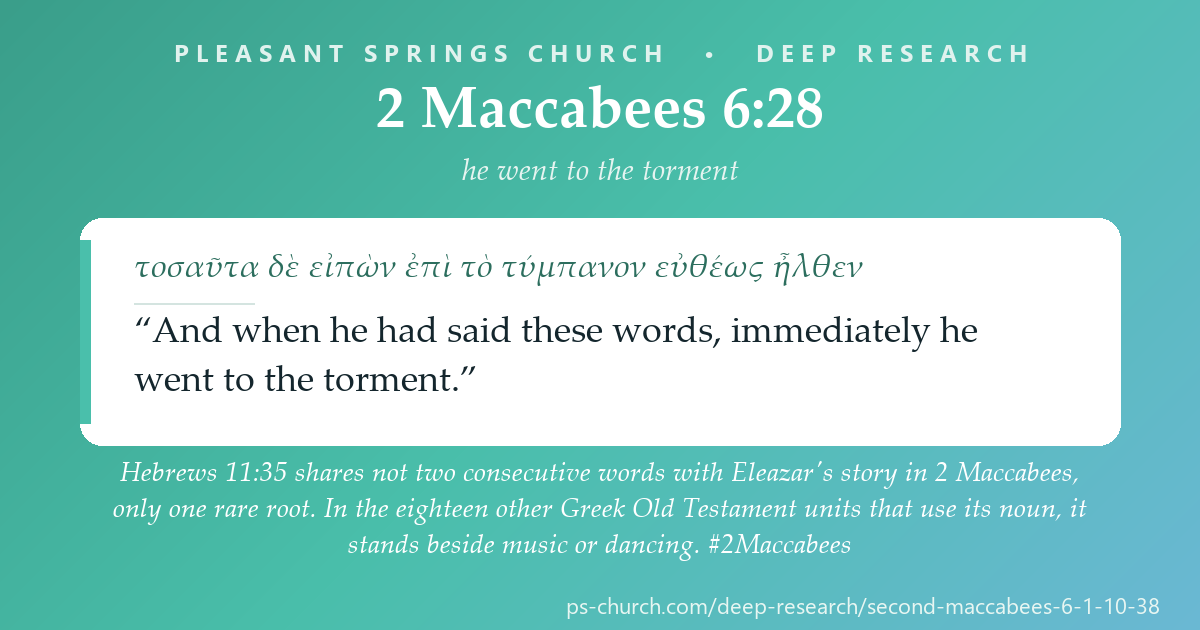
VULGATE 6:28 adolescentibus autem exemplum forte relinquam, si prompto animo ac fortiter pro gravissimis ac sanctissimis legibus honesta morte perfungar. His dictis, confestim ad supplicium trahebatur.
ἀναβίωσιν, a living-again, stands once in the 30,348 Greek Old Testament units — here — and nowhere in the Greek New Testament. The brother’s word for the king, ἀλάστωρ, is not unique: it stands in four units, the other three in 4 Maccabees (9:24, 11:23, 18:22) — see Stage 4.
VULGATE 7:9 et in ultimo spiritu constitutus, sic ait : Tu quidem scelestissime in præsenti vita nos perdis : sed Rex mundi defunctos nos pro suis legibus in æternæ vitæ resurrectione suscitabit.
The noun ἀνάστασις stands in six of the 30,348 Greek Old Testament units, and this is the only one where it is followed by to life. The Greek New Testament has the noun 42 times.
VULGATE 7:14 Et cum jam esset ad mortem, sic ait : Potius est ab hominibus morti datos spem exspectare a Deo, iterum ab ipso resuscitandos : tibi enim resurrectio ad vitam non erit.
Three witnesses, three wordings. Greek: not out of things that were. KJV: of things that were not. Latin: ex nihilo, out of nothing. And the Latin divides the sentence elsewhere: its 7:28 stops at et hominum genus, and its 7:29 opens ita fiet.
VULGATE 7:28 Peto, nate, ut aspicias ad cælum et terram, et ad omnia quæ in eis sunt, et intelligas quia ex nihilo fecit illa Deus, et hominum genus :
The youngest brother’s last request: that the Almighty’s wrath, justly brought on the nation, may stop in me and my brothers. The page reports what the sentence says and makes no further identification. See 8:5.
VULGATE 7:38 In me vero et in fratribus meis desinet Omnipotentis ira, quæ super omne genus nostrum juste superducta est.
The hinge of the five chapters, in the text’s own words. The wrath of the Lord had turned to mercy. Measured: the noun for wrath does not occur again anywhere in 2 Maccabees after this verse.
VULGATE 8:5 At Machabæus, congregata multitudine, intolerabilis gentibus efficiebatur : ira enim Domini in misericordiam conversa est.
The sixth and last word of the splanchn- family in the whole book — the first four were the forced sacrificial meal of chapters 6 and 7. KJV bowels, Latin viscera. And the Latin verse runs on into the Greek’s 9:7: licet ille nullo modo a sua malitia cessaret stands where the Greek opens 9:7 with ὁ δ' οὐδαμῶς τῆς ἀγερωχίας ἔληγεν.
VULGATE 9:6 et quidem satis juste, quippe qui multis et novis cruciatibus aliorum torserat viscera, licet ille nullo modo a sua malitia cessaret.
Five words shared with 1 Maccabees — the date. τῇ πέμπτῃ καὶ εἰκάδι τοῦ stands at 1 Maccabees 4:52 for the rededication and at 1:59 for the sacrificing on the altar set over the altar. Both books say the two days coincided: 2 Maccabees here, and 1 Maccabees 4:54, κατὰ τὴν ἡμέραν ἐν ᾗ ἐβεβήλωσαν αὐτὸ τὰ ἔθνη, on the day on which the nations had profaned it.
VULGATE 10:5 Qua die autem templum ab alienigenis pollutum fuerat, contigit eadem die purificationem fieri, vigesima quinta mensis qui fuit Casleu.
KJV palms also; Latin palmas. The Greek word is φοίνικας, not the βαΐα of John 12:13, though John’s verse also has τῶν φοινίκων, the same palm word as 10:7 in another form — see Stage 4.
VULGATE 10:7 Propter quod thyrsos, et ramos virides, et palmas præferebant ei qui prosperavit mundari locum suum.
Versification — stated, as on every page here, including where the usual frame does not exist.
There is no Masoretic text of 2 Maccabees and no ESV of it, so there is no MT/LXX/ESV offset to report. The shelf’s versification table has no entry for this book, and the page does not manufacture one. The offsets that do exist are between the three witnesses printed, and each was counted:
• Greek (CATSS) against the KJV Apocrypha. Identical chapter by chapter through all fifteen chapters: 555 verses each, and 31 · 42 · 36 · 29 · 38 in chapters 6–10. Aligned by content, label for label, at every line this page prints — but agreement of count is not agreement of division: KJV 6:19 carries words the Greek has at 6:20 (flagged on the line).
• Greek against the Clementine Vulgate. 558 verses against 555: the Latin has one more verse than the Greek in chapters 2, 12 and 15, and the same count in chapters 6–10. Inside equal counts the Latin sometimes divides a sentence elsewhere (7:28–29 and 9:6–7 are flagged on the lines above).
• Verse-only and lettered labels: none in this book; every one of the 555 CATSS labels is chapter:verse and parses.
• Canonical verses cited are given in the Greek Old Testament’s own numbering, with the English number where it differs: Psalm 37:8 (English 38:7), Psalm 134:14 (English 135:14), Psalm 67:26 (English 68:25), the title of Psalm 65 (English Psalm 66), 1 Samuel 21:14 (English 21:13), Daniel 3:95 in the Old Greek (English 3:28), 2 Esdras 6:16 and 22:27 as Ezra 6:16 and Nehemiah 12:27.
The Shape of the Passage
Sequence, with the narrator’s seams — not a chiasm• splanchn-, entrails: six occurrences in the whole of 2 Maccabees, all between 6:7 and 9:6 — four for the forced sacrificial meal (6:7, 6:8, 6:21, 7:42), then two for the king’s own entrails (9:5, 9:6). 9:6 draws the line itself.
• basan-, torment: 7:8, 7:13 and 7:17 of the brothers — the fifth says God βασανιεῖ, will torment, the king and his seed — then 9:5 and 9:6 of the king. (Its only other occurrence in the book is 1:28.)
• hyperephan-, pride: the youngest at 7:36 says the king will bear the penalty τῆς ὑπερηφανίας; the next three occurrences in the book are 9:4, 9:7 and 9:11.
And the hinge is the text’s own sentence, not ours. The noun for wrath, used of God, stands at 5:20, at 7:38 (the youngest prays it may stop in him and his brothers) and at 8:5 (turned to mercy); it is used of men twice before that (4:25, 4:40); and it stands nowhere in 2 Maccabees after 8:5. The verb is the same: God is angered for a little while at 5:17 and again at 7:33 (βραχέως ἐπώργισται), and never after. The diagram claims no more than those counts.
⚠️ Where this page sits. 2 Maccabees is canonical in the Roman Catholic and Orthodox churches, was printed among the Apocrypha in the Reformation-era Protestant Bibles, and is absent from the Hebrew Bible. This library reads it as a Second-Temple witness, not as Scripture, and files it under Apocrypha / Deuterocanon. Nothing taught at Pleasant Springs rests on it.
Author
An abridger, and he says so. At 2:23 he names his source: ὑπὸ Ἰάσωνος τοῦ Κυρηναίου δεδηλωμένα διὰ πέντε βιβλίων — set out by Jason of Cyrene in five books — which he will try to cut down into one. The KJV: “All these things, I say, being declared by Jason of Cyrene in five books, we will assay to abridge in one volume.”
He steps out of the story three times in these five chapters. At 6:12 in the first person (παρακαλῶ, I urge) to tell the reader how to take what follows; at 7:42 to close the martyrdoms; at 10:10 to open a new section (δηλώσομεν, we shall show). He writes Greek and tells you when his speakers do not: the mother and her sons speak τῇ πατρίῳ φωνῇ, in the ancestral language, at 7:8, 7:21 and 7:27. Measured: that three-word phrase stands five times in the 30,348 Greek Old Testament units screened, and all five are in 2 Maccabees.
Audience
Jews keeping a feast far from Jerusalem. The two letters that open the book are addressed τοῖς ἀδελφοῖς τοῖς κατ' Αἴγυπτον Ιουδαίοις, to the brothers, the Jews in Egypt (1:1), and the purification this page studies ends with the decree that the whole nation keep these days every year (10:8). The book explains a festival to people who keep it.
And readers who might lose heart. The narrator’s first aside is addressed to exactly them: “Now I beseech those that read this book, that they be not discouraged for these calamities” (6:12, KJV). The deaths of chapters 6 and 7 are told so that the reader learns to read suffering as discipline, and the death of the king in chapter 9 is told in the same words, turned round.
Previous and next. This is the middle of three studies of the book: 2 Maccabees 1:1–5:27 before it, 11:1–15:39 after it.
Orient on the book, the persecution under Antiochus IV, martyrdom, and the feast.
Search by topic: Maccabees, Second Book of; Antiochus IV Epiphanes; Jason of Cyrene; martyr, martyrdom; resurrection in Second-Temple Judaism; Hanukkah / Dedication; 4 Maccabees.
Which articles are relevant?
- Anchor Bible Dictionary — “Maccabees, Books of,” “Antiochus,” “Martyr, Martyrdom,” “Resurrection (Early Judaism),” “Dedication, Feast of.”
- Eerdmans Dictionary of Early Judaism — “2 Maccabees,” “4 Maccabees,” “Martyrdom,” “Hanukkah.”
- Dictionary of New Testament Background (IVP) — “Maccabean Literature,” “Hellenistic Judaism,” “Resurrection.”
- On the text — any article that distinguishes the Greek editions (Rahlfs; the Göttingen edition) from the English traditions. The KJV Apocrypha does not always agree with the Greek printed here: two verses in these chapters show it (Stage 5), and which text the English followed is not examined here.
- The article headings above are suggested by topic; they were not checked against the volumes.
Bibliography surfaced:
- Jonathan A. Goldstein, II Maccabees (Anchor Bible 41A, 1983).
- Robert Doran, 2 Maccabees: A Critical Commentary (Hermeneia, 2012).
- Daniel R. Schwartz, 2 Maccabees (Commentaries on Early Jewish Literature, 2008).
- Jan Willem van Henten, The Maccabean Martyrs as Saviours of the Jewish People: A Study of 2 and 4 Maccabees (1997).
- NETS (the New English Translation of the Septuagint), 2 Maccabees and 4 Maccabees. Not the edition quoted here; named as the obvious next step for a reader.
- Named, not consulted for this page — see Stage 5.
Three deaths of one king, a retelling in its own sentences, and a feast with two names.
Where a text is held on this disk it is measured. Where it is not, it was checked online on 2026-10-09 at the source named, and is reported, not measured.
How did Antiochus IV die? Three ancient answers, and a fourth in the same book:
- 2 Maccabees 9 (this page): struck in the entrails on the road to Jerusalem, thrown from his chariot, eaten by worms, a vow to become a Jew, a letter to the Jews, a death in the mountains.
- 1 Maccabees 6:1–17 (held): he hears of his armies’ defeat in Judea, takes to his bed with grief, confesses the wrong done in Jerusalem, hands the kingdom to Philip, and dies in Persia. Measured: of the 29 rows of 2 Maccabees 9, none shares more than two consecutive words with any of the 17 rows of 1 Maccabees 6:1–17; fifteen reach two and fourteen reach only one. Two accounts of the same death that share no phrase longer than τὴν Περσίδα, ‘Persia.’
- 2 Maccabees 1:13–16 (held, the same book): the second of the opening letters (it begins at 1:10) has “the leader” and Antiochus killed by the priests of Nanea in her temple, stoned through a hidden door in the ceiling and dismembered. The letter gives him no epithet — measured, no form of Epiphanes stands in 1:11–17 — and whether it means the same king is a question this page does not settle.
- Polybius, Histories 31.9 (not held; checked online in W. R. Paton’s Loeb translation at LacusCurtius): Antiochus, short of money, marched on the sanctuary of Artemis in Elymais, was turned back by the local tribes, and died at Tabae in Persia, “smitten with madness, as some people say,” because of manifestations of divine displeasure at the attempt.
- Josephus, Antiquities 12.9.1 (Whiston’s numbering; not held; checked online): follows the 1 Maccabees line — Elymais, repulse, illness, a confession that he suffered for what he had done to the Jews — and then argues with Polybius by name: a purpose not carried out, Josephus says, does not deserve punishment, so the king more probably died for robbing the temple at Jerusalem.
A temple, a failure, and a death in the east. The temple is Jerusalem’s in 1 and 2 Maccabees, Artemis’s in Polybius, Nanea’s in the opening letter. Only 2 Maccabees 9 has the worms, the chariot and the vow. Measured on the two Maccabean texts held here: no shared wording longer than two words. Reported, not measured, for the two Greek historians.
Which parallels shed light on the world of the text?
- 4 Maccabees (held, a witness, not Scripture) — a philosophical discourse that retells Eleazar, the seven and their mother as proof that devout reason rules the passions: ὁ εὐσεβὴς λογισμός (1:1). Measured: it names Eleazar 14 times in 479 rows, and uses the word for reason (λογισμός and its forms) 73 times; chapters 6–7 of 2 Maccabees use it twice. Stage 4 measures how much wording the two books share.
- Deuteronomy 32:36 (held) — at 7:6 the brothers name Moses and his song, and the six words that follow, καὶ ἐπὶ τοῖς δούλοις αὐτοῦ παρακληθήσεται, stand verbatim in Deuteronomy 32:36. See Stage 4 for the second verse that also carries them.
- Daniel 12:2 (held, in both Greek texts) — in our own rendering of the Old Greek, many of those who sleep in the breadth of the earth shall arise, some to everlasting life. Measured: 7:14 shares two consecutive words with it in either Greek, εἰς ζωὴν; 7:9 shares one.
- 1 Maccabees 4:36–59 (held) — the rededication, eight days, 25 Chislev, ordered to be kept yearly. Its word for the feast is τὸν ἐγκαινισμὸν (4:56, 4:59); 2 Maccabees 10:1–8 calls the same act τὸν καθαρισμὸν, the purification. Stage 4 asks which of the two words John 10:22 uses.
- Greek ‘noble death’ — the vocabulary of dying γενναίως, nobly (the genna- family six times in 2 Maccabees 6–7), is the vocabulary in which Greek writers praised a good death, and studies of these chapters read them against that tradition — for example the sourcebook of Jan Willem van Henten and Friedrich Avemarie, Martyrdom and Noble Death (2002). Reported, not consulted, not measured.
A drum that is a rack, a resurrection with two words for it, and three words for creation.
Every count below is over the CATSS Greek Old Testament files held here — 30,348 verse units screened, the Odes excluded — and the 7,927 verses of the SBLGNT. It is not a count over ‘the Septuagint’. Counts are of word tokens unless the sentence says verse units.
The noun stands in 20 of the 30,348 Greek Old Testament units screened here. In 18 of them the same verse names another instrument, a dance, a song or players — Miriam at Exodus 15:20, Jephthah’s daughter at Judges 11:34 (in each of the two Greek texts of Judges), Psalm 150:4. The other two are 2 Maccabees 6:19 and 6:28, and in them it is what Eleazar walks to. The standard lexicon (Liddell–Scott–Jones, checked online) gives a second sense, instrument of torture or execution, and cites 2 Maccabees 6:19 for it. The root occurs once in the Greek New Testament: Hebrews 11:35.
Six Greek Old Testament units carry the noun: 2 Maccabees 7:14 and 12:43, Daniel (OG) 11:20, Lamentations 3:63, the title of Psalm 65 and Zephaniah 3:8. The Greek New Testament has it 42 times. Only 7:14 says resurrection to life. 4 Maccabees, retelling the same deaths, has no form of this noun, and of the whole family only one verb, at 6:8, of Eleazar made to get up when he falls — and it has two each of immortality (14:5, 16:13) and incorruption (9:22, 17:12).
One occurrence in the 30,348 Greek Old Testament units, and it is 7:9; none in the Greek New Testament. The second brother’s whole phrase, εἰς αἰώνιον ἀναβίωσιν ζωῆς, to an everlasting living-again of life, stands nowhere else in either corpus.
Three words. They stand once in the 30,348 Greek Old Testament units — here — and in none of the 7,927 New Testament verses. Romans 4:17 has τὰ μὴ ὄντα ὡς ὄντα [our literal gloss: the things that are not as things that are]; Hebrews 11:3 has μὴ ἐκ φαινομένων [our literal gloss: not out of things that appear]. Neither shares a run of two with 7:28. Three ways of saying something close, in three wordings.
Three occurrences in the Greek Old Testament, all in 2 Maccabees (6:7, 6:21, 7:42). With the verb at 6:8 and the plain noun for the king’s own entrails at 9:5 and 9:6, the family stands six times in the book, all between 6:7 and 9:6. The structure diagram is built on it.
Twice for Eleazar (6:28, 6:31): he dies to leave a noble example to the young. Five Greek Old Testament units carry the word (2 Maccabees 6:28, 6:31; 4 Maccabees 17:23; Sirach 44:16; Ezekiel 42:15) and six New Testament verses, among them James 5:10, the prophets as an example of suffering. Measured: 6:28 against James 5:10 is a run of one — the word itself.
Counted here, not assumed:
- The tympan- root, every form: 25 tokens in 24 Greek Old Testament units, and one New Testament verse. The noun 21 times in 20 units (two in Exodus 15:20); the simple verb once, ἐτυμπάνιζεν at 1 Samuel 21:14 (English 21:13), David drumming on the doors of the city; the compound beat to death twice, ἀποτυμπανισθήσεται (3 Maccabees 3:27) and ἀπετυμπανίσθη (Daniel OG 7:11, of the beast); and women drummers once (Psalm 67:26). Hebrews’ form, ἐτυμπανίσθησαν, stands in no Greek Old Testament unit at all.
- The phrase ἐπὶ τὸ τύμπανον: two units, 6:19 and 6:28. Nowhere else.
- Words standing once in the 30,348 units, and here: ἀπευθανατίζειν (6:28), ἀναβίωσιν (7:9), θεομαχεῖν (7:19) — whose noun θεομάχοι, fighters against God, is Gamaliel’s warning at Acts 5:39; a run of one — and ἰσόθεα, things equal to God, the dying king’s word at 9:12.
- σκώληκας, worms, at 9:9: eighteen Greek Old Testament units carry the family (nine with this stem, nine with the nominative skōlēx); the New Testament has it twice, σκώληξ at Mark 9:48 and σκωληκόβρωτος, worm-eaten, of Herod Agrippa at Acts 12:23. Two kings who claimed too much, and worms; and the run between 9:9 and Acts 12:23 is one word.
- The Clementine Latin reads differently from the Greek row at least five times in these chapters, and the page prints them as found: 6:1 Antiochenum where the Greek has an Athenian; 8:16 septem millibus (seven thousand) where the Greek has six; 8:20 sex millia (six thousand) where the Greek has eight; 8:23 ab Esdra where the Greek has Eleazar; 10:15 Judæi where the Greek has Idumeans. The KJV agrees with the Greek row at all five.
The deepest run is a formula. The verse older commentators link to these chapters measures one.
Every row of 2 Maccabees 6–10 screened against all 7,927 verses of the SBLGNT: contiguous runs of whole word forms, accents and breathings dropped, the two editions’ spelling equivalences applied. The tie band — how many New Testament verses reach the same depth — is printed beside every run, and so is the reverse: how many of the 30,348 Greek Old Testament units reach that same depth with the New Testament verse. A zero on this screen would mean no shared word at all; there are none.
The distribution, all 176 rows:
Across the 176 CATSS rows against the 7,927 verses of the Greek New Testament: 175 reach two, 106 reach three, 13 reach four, 2 reach five, 1 reaches six, and nothing reaches seven. The one row that reaches only one is 9:6 — the verse that turns the entrails back on the king.
By chapter, the deepest run: chapter 6, three; chapter 7, six; chapter 8, four; chapter 9, five; chapter 10, four. The Eleazar chapter — the one whose rare word Hebrews 11:35 shares — reaches no deeper than three words against any verse of the New Testament.
Every row that reaches four or more, all thirteen, with the band from both sides:
| 2 Macc | Shared words | New Testament | Run | NT band | Greek OT units reaching the same depth with that NT verse | What it is |
|---|---|---|---|---|---|---|
| 7:28 | τὸν οὐρανὸν καὶ τὴν γῆν καὶ / καὶ τὴν γῆν καὶ τὰ ἐν | Acts 4:24 · Acts 14:15 · Rev 14:7 · Rev 10:6 | 6 | 4 | 12 · 12 · 11 · 2 | A creation formula. The first six are shared with Acts and Revelation 14:7, the second six with Revelation 10:6. The deepest Greek Old Testament partner of Acts 4:24 and 14:15 is Exodus 20:11, at 13 words. |
| 9:5 | κύριος ὁ θεὸς τοῦ Ισραηλ | Luke 1:68 | 5 | 1 | 7 | The opening of the Benedictus. The same five words stand at Ezekiel 4:13, 44:2 and Malachi 2:16; Genesis 9:26, 24:27 and the Old Greek of Daniel 3:95 reach five with Luke 1:68 on a different five. |
| 7:23 | καὶ τὸ πνεῦμα καὶ | Rev 22:17 | 4 | 1 | 1 | Band 1 both ways, and an accident: breath restored, and the Spirit and the Bride. |
| 9:7 | τὰ μέλη τοῦ σώματος | 1 Cor 12:12 | 4 | 1 | 1 | Band 1 both ways, and an accident: a king’s racked limbs, and the body of Christ. |
| 9:9 | ἐκ τοῦ σώματος τοῦ | Rom 7:24 | 4 | 1 | 1 | Band 1 both ways, and an accident: see below. |
| 8:4 | εἰς τὸ ὄνομα αὐτοῦ | John 1:12 · John 2:23 · Heb 6:10 | 4 | 3 | 1 · 1 · 1 | Into his name — a phrase three New Testament verses carry and the Greek Old Testament carries once, here. |
| 7:6 | ὁ κύριος ὁ θεὸς | Rev 22:6 | 4 | 1 | 24 | The Lord God. |
| 8:26 | δι' ἣν αἰτίαν οὐκ | Heb 2:11 | 4 | 1 | 2 | A connective. Its other Greek Old Testament carrier is 2 Maccabees 4:35. |
| 9:21 | τὴν τιμὴν καὶ τὴν | Rev 4:11 | 4 | 1 | 7 | The honour and the… |
| 8:1 | καὶ οἱ σὺν αὐτῷ | Luke 9:32 · Acts 5:21 · Acts 19:38 | 4 | 3 | 6 · 37 · 3 | And those with him. 10:1 measures the same. |
| 10:1 | καὶ οἱ σὺν αὐτῷ | Luke 9:32 · Acts 5:21 · Acts 19:38 | 4 | 3 | 6 · 37 · 3 | The same four words as 8:1. |
| 8:22 | καὶ τοὺς ἀδελφοὺς αὐτοῦ | Matt 1:2 · Matt 1:11 | 4 | 2 | 18 · 13 | And his brothers — a genealogy formula. |
| 9:20 | καὶ τὰ τέκνα καὶ | Matt 18:25 · Luke 14:26 | 4 | 2 | 8 · 9 | And the children and… |
The deepest run is a formula — and a unique wording is in the same verse:
7:28 → Acts 4:24, Acts 14:15, Revelation 14:7 and Revelation 10:6 — a run of six, tie band 4. With the first three the six words are τὸν οὐρανὸν καὶ τὴν γῆν καὶ, the heaven and the earth and; with Revelation 10:6 they are the six that follow one word later, καὶ τὴν γῆν καὶ τὰ ἐν. The first six stand in ten Greek Old Testament units (2 Maccabees 7:28, Exodus 20:11 and 31:17, Haggai 2:6 and 2:21, Judith 7:28, Esther 4:17c, Daniel OG 4:37, and Bel 5 in both Greek texts). And seen from the New Testament side, 7:28 is not the nearest Greek Old Testament partner of any of the four: Acts 4:24 — σὺ ὁ ποιήσας τὸν οὐρανὸν καὶ τὴν γῆν καὶ τὴν θάλασσαν καὶ πάντα τὰ ἐν αὐτοῖς [our literal gloss: you who made the heaven and the earth and the sea and everything in them] — meets Exodus 20:11 at thirteen words, and twelve Greek Old Testament units reach six or more with it. The deepest run in these five chapters is a formula ten Greek Old Testament units carry.
And a few words further on in the same verse stands a unique one: οὐκ ἐξ ὄντων ἐποίησεν αὐτὰ ὁ θεός, not out of things that were did God make them. Once in the Greek Old Testament; never in the New. Against Romans 4:17 the run is one word — and Romans 4:17’s own deepest Greek Old Testament partner is Genesis 17:5, six words, tie band 1, introduced by Paul’s καθὼς γέγραπται, as it is written. Against Hebrews 11:3 the run is one word. Depth and rarity have come apart in a single sentence: the six words are a formula, the three words are unique, and the run engine ranks the formula first. Whether not out of things that were means creation from absolute nothing is argued in the literature (Gerhard May, Schöpfung aus dem Nichts, 1978, in English Creatio ex Nihilo, 1994, reads it more modestly); the page measures the wording and leaves that question where it is.
Hebrews 11:35–36 — the page’s finding:
Hebrews 11:35: ἔλαβον γυναῖκες ἐξ ἀναστάσεως τοὺς νεκροὺς αὐτῶν ἄλλοι δὲ ἐτυμπανίσθησαν οὐ προσδεξάμενοι τὴν ἀπολύτρωσιν ἵνα κρείττονος ἀναστάσεως τύχωσιν [our literal gloss: Women received their dead out of resurrection; and others were tortured — literally, drummed — not accepting the release, that they might attain a better resurrection]
The content is close, and older commentators said so. Bengel’s Gnomon, the commentaries biblehub.com files under Meyer’s and Ellicott’s names (both are series), Barnes, and Vincent’s Word Studies all point Hebrews 11:35 to 2 Maccabees 6, Eleazar’s chapter, and most add the seven brothers of chapter 7; the Expositor’s Greek Testament calls the allusion ‘obvious’. Checked online, in the public-domain commentaries collected at biblehub.com, on 2026-10-09 and again on 2026-10-10; the modern critical commentaries on Hebrews were not consulted. Tortured; refusing a release that was offered; for the sake of resurrection — Eleazar is offered a way out at 6:21–22, the youngest brother at 7:24, and the second and fourth brothers die speaking of being raised (7:9, 7:14).
Measured: Hebrews 11:35 shares no two consecutive words with any of the 555 rows of 2 Maccabees. Not with 6:19 or 6:28, not with chapter 7, not anywhere in the book. Its deepest contact in the whole Greek Old Testament is three words, τοὺς νεκροὺς αὐτῶν, their dead, at Jeremiah 19:7, tie band 1 — a verse about corpses given to the birds. Against 4 Maccabees, too, it shares no two consecutive words.
Hebrews 11:36 — ἐμπαιγμῶν καὶ μαστίγων πεῖραν ἔλαβον [our literal gloss: had trial of mockings and scourgings] — reaches two words with 7:37, καὶ μαστίγων, and scourges: a phrase that stands once in the Greek Old Testament. But two is the depth thirty Greek Old Testament units reach with Hebrews 11:36, and its first noun is not 2 Maccabees’: 7:7 has ἐμπαιγμὸν, while the exact form Hebrews uses, ἐμπαιγμῶν, stands in one Greek Old Testament unit — ἐμπαιγμῶν, Psalm 37:8 (Psalm 38:7 in English Bibles).
Not wording. Roots. Its two distinctive words both have families in these chapters: the verb ἐτυμπανίσθησαν beside Eleazar’s τύμπανον, and κρείττονος ἀναστάσεως, a better resurrection, beside the fourth brother’s ἀνάστασις. The forms differ in both, so the run engine — which matches forms — scores them as nothing.
How rare is the first root? In the Greek New Testament, Hebrews 11:35 is its only verse. In the Greek Old Testament the noun stands in twenty units: eighteen beside music or dancing, where it is the hand-drum, and two in 2 Maccabees 6, where it is the thing Eleazar dies on. Liddell–Scott–Jones lists the torture sense with 2 Maccabees 6:19 for the noun, and Hebrews 11:35 for the verb.
And 4 Maccabees, which retells Eleazar’s death at length, has no tympan- word and no word for resurrection. No tympan- word in its 479 rows; no form of the noun anastasis; and of the whole anast-/anist- family a single verb, ἐξανίσταιτο at 6:8, of Eleazar made to get up when he falls. Its instruments include τροχός, the wheel (13 tokens of that family), and the catapult-frame (5), neither named anywhere in 2 Maccabees; its torment-words run to 69. Hebrews’ two distinctive words match the vocabulary of 2 Maccabees, not of the book that retells the same deaths — though 4 Maccabees shares other words with these chapters (see below).
What that does and does not license. It is contact at the level of vocabulary, between two texts that tell of the same kind of death. It is not a citation; Hebrews does not name a source, and the page does not say who knew what, or how. The measurement shows the pattern — shared roots, no shared sentences — and cannot show how it arose.
⚠️ The page’s own counter-examples — band 1 both ways, and meaningless:
2 Maccabees 9:9 → Romans 7:24 — four words, tie band 1, and Romans 7:24 reaches four with exactly one Greek Old Testament unit: this one. ἐκ τοῦ σώματος τοῦ — worms swarmed out of the body of the impious king; and Paul’s ἐκ τοῦ σώματος τοῦ θανάτου τούτου [our literal gloss: out of the body of this death]. A unique pairing in both directions, and an ordinary Greek string with nothing behind it. The Romans 6–7 study on this shelf prints the same run from the other side and draws nothing from it either.
9:7 → 1 Corinthians 12:12 (τὰ μέλη τοῦ σώματος, the members of the body) and 7:23 → Revelation 22:17 (καὶ τὸ πνεῦμα καὶ) are the same: four words, band 1 from both sides, and coincidence. The page prints them so that a band of 1 is not read as more than it is — and so that Hebrews 11:35’s band-less ‘one’ is not read as less.
9:5 → Luke 1:68 is the reverse lesson. Five words, κύριος ὁ θεὸς τοῦ Ισραηλ, tie band 1 among New Testament verses — but seven Greek Old Testament units reach five with the Benedictus’s opening: this one; three more on these same five words (Ezekiel 4:13, 44:2, Malachi 2:16); and three on a different five, blessed be the Lord the God of (Genesis 9:26, 24:27, and the Old Greek of Daniel 3:95). A band of 1 on one side and 7 on the other is a formula.
4 Maccabees: the retelling, measured as contact and not as dependence:
Every row of 2 Maccabees 6–7 (73 rows) against every row of 4 Maccabees (479): all 73 reach one, 68 reach two, 16 reach three, 5 reach four, and nothing reaches five. The five fours are δὲ καὶ τὸν ἐν (a connective), τὴν ἡλικίαν καὶ τὴν and καὶ ἄξιον τῆς ἡλικίας (Eleazar’s age), εἰς τὸν οὐρανὸν καὶ, and one with content: ὁ τοῦ κόσμου κτίστης, the Creator of the world, which 4 Maccabees puts in Eleazar’s mouth at 5:25 and which stands in those two units only.
The control: 2 Maccabees 8–10, which 4 Maccabees does not retell, against the same 479 rows — one row of 103 reaches four. So the retold chapters run a little deeper than the chapters it leaves alone, and still no deeper than four words. 4 Maccabees tells this story in its own sentences. The measurement says how much wording is shared; it does not say that either author had the other’s text, and the page does not.
Its sentences are its own; some of its words are shared. Counted by word, not by run: the pans and cauldrons of 7:3, τήγανα καὶ λέβητας, are both in 4 Maccabees’ list of instruments at 8:13, beside the wheel and the catapult-frame. And two rare words for the king: ἀλάστωρ (7:9) stands in four Greek Old Testament units, the other three in 4 Maccabees — twice as τὸν ἀλάστορα τύραννον (9:24, 18:22) and once more, at 11:23, in a different construction; and μιαρώτατε, most abominable, said to the king at 7:34, stands in three more units, all in 4 Maccabees and all said to the tyrant (9:15, 9:32, 10:10; a compound of it at 10:17 makes a fourth). The New Testament has neither word. These were found in review by word search, not by a systematic screen of the two books’ vocabulary, and a shared word is not evidence of a source.
1 Maccabees, the feast, and two words the New Testament uses:
- The date, 10:5 → 1 Maccabees 4:52 — five words, band 1 within 1 Maccabees 4:36–61. τῇ πέμπτῃ καὶ εἰκάδι τοῦ, on the twenty-fifth of the month. Three Greek Old Testament units carry the five words: 2 Maccabees 10:5 and 1 Maccabees 1:59 and 4:52. Nothing else in 10:1–8 reaches past two words with 1 Maccabees 4:36–61.
- The palms, 10:7 → John 12:13 — a run of one. 10:7 has φοίνικας; John has τὰ βαΐα τῶν φοινίκων [our literal gloss: the fronds of the palms]. John’s word for the fronds stands once in the 30,348 Greek Old Testament units: βαί̈ων at 1 Maccabees 13:51, Simon entering the citadel with praise and palm fronds — a different day, a different building. A related word for a palm branch, βαί̈νην, stands at 1 Maccabees 13:37, in Demetrius’s reply to Simon about the golden crown and the palm branch Simon had sent: so the bai- palm words stand in two units, and John’s exact word in one. (The same letters also spell the name of Bohan’s stone at Joshua 15:6 and 18:17 in the B text; the page does not count a name.) 1 Maccabees 4 has no palms at all.
- The feast’s name, 10:5 → John 10:22 — a run of one. John 10:22: Ἐγένετο τότε τὰ ἐγκαίνια ἐν τοῖς Ἱεροσολύμοις [our literal gloss: then came the Dedication in Jerusalem]. The exact form ἐγκαίνια stands in four Greek Old Testament units — Ezra 6:16 and 6:17, Nehemiah 12:27, and Daniel 3:2 in Theodotion’s text — and in no book of the Maccabees, which say τοῦ ἐγκαινισμοῦ (1 Maccabees 4:56, 4:59; 2 Maccabees 2:9, 2:19). 2 Maccabees 10:1–8, the founding of the feast, uses neither: it says purification. John’s winter feast is commonly identified with this one; the wording does not join them, and the page leaves the identification to the commentaries.
- 7:6 → Deuteronomy 32:36 — six words, and a tie the text resolves itself. καὶ ἐπὶ τοῖς δούλοις αὐτοῦ παρακληθήσεται stands in exactly three Greek Old Testament units: 2 Maccabees 7:6, Deuteronomy 32:36 and καὶ ἐπὶ τοῖς δούλοις αὐτοῦ παρακληθήσεται at Psalm 134:14 (135:14 in English Bibles). The measurement cannot tell which the brothers mean. The sentence can: it names Μωυσῆς and his ᾠδῆς, his song.
What this page could not check, where the English and the Greek part company, and where the page is weakest.
This is the section that makes the shelf trustworthy. Read it before quoting anything above.
⚠️ What this page could NOT check:
- Anything Hebrew or Aramaic. 2 Maccabees is not in the Masoretic corpus, so the acrostic and Hebrew-parallel screens cannot run on it. The book is commonly held to have been composed in Greek; that is reported, not tested.
- The critical Greek text. The Greek printed and measured is CATSS (Rahlfs’s edition). The Göttingen edition and its apparatus are not held, so no variant reading behind any line on this page was checked.
- Whether the CATSS row at 9:20 is complete. It reads only if you and your children are well and your affairs are as you wish, having my hope in heaven. The KJV (“I give very great thanks to God”) and the Latin (maximas agimus gratias) both carry a clause of thanks the CATSS row lacks, and an online Greek text (ellopos.net, which does not name its edition on the page) carries it too. Whether Rahlfs’s text lacks it or the file dropped it, this disk cannot say.
- The ‘two’ of 10:29–30. The KJV says five riders appeared and two of them led the Jews; the Latin says ex quibus duo, of whom two. The CATSS rows for 10:29 and 10:30 contain no word for two. Whether the English followed another Greek text or the Latin, this page does not test; it reports only that the English carries a word the printed Greek lacks.
- The commentaries. Goldstein, Doran, Schwartz and van Henten are named in Stage 1 and were not consulted; neither was any modern critical commentary on Hebrews. The Hebrews commentators cited in Stage 4 were read only in the public-domain extracts at biblehub.com. Gerhard May’s reading of 7:28 is reported from his book’s known argument, not checked against its pages.
- Polybius and Josephus are not on this disk; they were read online (LacusCurtius; the Whiston translation at penelope.uchicago.edu) on 2026-10-09 and are reported, not measured. The lexicon (Liddell–Scott–Jones) was read online at Perseus the same day.
- Whether Hebrews knew 2 Maccabees. The screen finds verbatim contact. A run of one is not evidence of independence, and shared roots are not evidence of a source.
⚠️ Two tool faults found while building this page — reported, not patched:
- The New Testament loader’s ‘surface’ words are normalised words. The shelf’s loader reads MorphGNT’s normalised column and its docstring calls it the surface form. It is right for measuring and wrong for printing: it gives ek for ex, ou for ouk and a bracketed movable nu, so Hebrews 11:35 would have been printed with a misspelling in its third word. Every New Testament word on this page is read from the edition’s own word column instead, and the self-check compares against that column.
- The label-parsing check is too slow to use. The function that proves every CATSS label parses re-opens each file once for every line it reads, and over the 64 files it ran for many minutes without finishing. The self-check runs the same test, with the same patterns, on 2Macc.mlxx alone. Neither fault changes a number on any page; both are reported to the shelf’s maintainers.
⚠️ Where this page is weakest:
- Its finding is about roots, and the shelf’s engine measures forms. The headline — that Hebrews 11:35 shares the tympan- root and the noun anastasis with these chapters, and 4 Maccabees has no tympan- word and no word for resurrection — was counted by hand-written stem searches, not by the run engine, and stem searches are only as good as the stems. The first search for tympan- on this page was anchored at the start of the word and missed four forms, Hebrews’ own among them: an augmented verb begins with an epsilon. The counts printed are from the unanchored search, and the self-check runs it that way. Review found three more searches on this page that were too narrow, and the page was corrected: the worm count first missed the nominative (nine units became eighteen, and Mark 9:48 joined Acts 12:23); the anast- search in 4 Maccabees was anchored at the start of the word and missed the compound at 6:8; and alastōr was first counted as one exact form, when the word stands in four units.
- ‘Drum’ is a reading. What is measured is that 18 of the 20 units carrying the noun also name an instrument, a dance, a song or players in the same verse, and that 6:19 and 6:28 name none. That the word means the hand-drum in the eighteen and something else in the two is the reading of context, supported by the KJV (torment), the Latin (supplicium) and the lexicon — and it is still a reading.
- The 4 Maccabees comparison is forms-only, and a paraphrase scores low by design. That 4 Maccabees retells the story in its own sentences is what the run numbers show; the rare words it shares with these chapters (Stage 4) were found by word search in review, and no systematic screen of the two books’ vocabulary was run; how its author came by the story the numbers cannot show.
- The English is quotation, not a measured parallel. The KJV Apocrypha is the only English on the page; its verse division agrees with the Greek row at every line printed here except 6:19 (flagged there), and its wording does not always agree with the Greek row (9:20, 10:29).
- The Latin is printed, not measured. Its five differences from the Greek row in Stage 3 were found by reading these chapters, not by a screen; there may be more.
Commentaries & studies:
- Jonathan A. Goldstein, II Maccabees (Anchor Bible 41A, 1983).
- Robert Doran, 2 Maccabees: A Critical Commentary (Hermeneia, 2012).
- Daniel R. Schwartz, 2 Maccabees (CEJL, 2008).
- Jan Willem van Henten, The Maccabean Martyrs as Saviours of the Jewish People (1997).
- Gerhard May, Schöpfung aus dem Nichts (1978; in English as Creatio ex Nihilo, 1994) — on 7:28.
- Liddell–Scott–Jones, A Greek–English Lexicon, s.v. tympanon, tympanizō — read online at Perseus.
- Polybius 31.9 (Paton, Loeb) and Josephus, Antiquities 12.9.1 (Whiston) — read online.
An old man who would not pretend, and a word that went further than the sentences.
Name what you learned, why it matters, and one concrete response.
What should we carry away — and do?
- ‘Obvious’ and ‘measured’ are different claims. The commentators who call Hebrews 11:35 an allusion to Eleazar may be right about the story; the wording shares not two consecutive words. Both can be true, and it helps to know which one you are repeating.
- Depth is not rarity. The deepest run in these chapters is six words that ten Greek Old Testament units carry; three words in the same verse are carried by nothing else. Measure before you rank.
- Eleazar’s refusal was a refusal to pretend. He was offered lawful meat to eat in public so that it would look like compliance (6:21), and he said that at ninety it would teach the young the wrong thing (6:24–25). The temptation in the story is not to eat; it is to appear to.
- Hebrews 11 runs on, past its unnamed sufferers, to Jesus (Hebrews 12:1–2), and that is Scripture’s own line, not this book’s; whether those unnamed sufferers are the people of 2 Maccabees is what the commentators argue, and the measurement cannot settle it. The page reads 2 Maccabees as a witness to how such deaths were told, and goes to Scripture for what faithful suffering means.
- One concrete response. Is there one place this week where you are being asked only to seem to go along? Decline the appearance, kindly and plainly, the way Eleazar did.
2 Maccabees 6:28 · to share
Greek (CATSS) · KJV Apocrypha (1769) · LatinVULGATE 6:28 adolescentibus autem exemplum forte relinquam, si prompto animo ac fortiter pro gravissimis ac sanctissimis legibus honesta morte perfungar. His dictis, confestim ad supplicium trahebatur.
Every Deep Research page traces its passage across the whole sweep — the Old Testament, the Second-Temple world between the testaments (historical witnesses, not Scripture), and the New Testament. Follow the thread:
Pleasant Springs Church — Deep Research
Research method after Michael S. Heiser’s Bible Research Method (examine dictionaries → ancient literature → important words → textual connections → academic publications → share), with the Pleasant Springs “Author & Audience” foundation. Scripture set in the Hebrew, the Greek editions named on each page and the ESV (Old Testament), and the Greek New Testament and the ESV (New Testament), per the practice of Pleasant Springs Church. ⚠️ Status: 2 Maccabees is not part of the Protestant canon. It is canonical in the Roman Catholic and Orthodox churches, was printed among the Apocrypha in the Reformation-era Protestant Bibles, and is absent from the Hebrew Bible. This study is filed under Apocrypha / Deuterocanon and nothing taught at Pleasant Springs rests on it. Greek text: the CATSS morphologically analysed Septuagint (Rahlfs), quoted at verse level with attribution; every row count, word count, run depth and tie band was re-derived from 2Macc.mlxx and the other CATSS files for this study. Greek New Testament: SBLGNT via MorphGNT. English: the KJV Apocrypha (1769 standard text, public domain), the verse-per-line edition held on this disk; every English line on the page is read from that file when the page is built and checked against it by the page’s self-check. No ESV text of 2 Maccabees is held or licensed here; New Testament verses are given in Greek with our own literal gloss, marked as such. Latin: the Clementine Vulgate (public domain), a fourth witness, not a source for the English. Checked online, 2026-10-09: Polybius 31.9 (LacusCurtius), Josephus Ant. 12.9.1 (Whiston), Liddell–Scott–Jones (Perseus), and the public-domain Hebrews commentaries at biblehub.com. Direction of influence is nowhere asserted.
Scripture quotations marked ESV are from the ESV® Bible (The Holy Bible, English Standard Version®), © 2001 by Crossway, a publishing ministry of Good News Publishers. ESV Text Edition: 2016. Used by permission. All rights reserved. The ESV text may not be quoted in any publication made available to the public by a Creative Commons license, and the ESV may not be translated in whole or in part into any other language. www.esv.org
|
Did this study bless you today? 💚 Give to Support PS Church100% of gifts go to the General Fund — thank you. |