Moses does not end with a sermon. He ends with a song — written down, taught to the whole nation, and given expressly as a witness against them for the day they would need it (31:19–21). It opens by calling heaven and earth to listen and asking that the teaching fall like rain on grass (32:1–2), and then it names its subject: “The Rock, his work is perfect, for all his ways are justice” (32:4). That word — ha‑ṣūr, the Rock — runs the length of the poem, for God and, in mockery, for the gods who cannot stand up when they are called (32:31, 37). In between: the Most High drawing the boundaries of the nations and keeping Jacob as his own portion (32:8–9); Jeshurun growing fat and kicking (32:15); sacrifice offered to demons that were no gods (32:17); jealousy answered with jealousy (32:21); “Vengeance is mine, and recompense” (32:35); and the great declaration, “See now that I, even I, am he… I kill and I make alive; I wound and I heal” (32:39). This is also the most textually consequential chapter in the Torah — at 32:8 and again at 32:43 the Hebrew, the Dead Sea Scrolls and the Greek do not agree, and the New Testament follows the Greek. We lay the evidence out rather than tidy it. This study works Deuteronomy 32:1–52, closing with Moses sent up Mount Nebo the same day. See the method →
Deuteronomy 32:1–52 (selections) — MT = LXX = English
Hebrew · LXX · ESVThe Shape of the Passage
SequenceThe Song does not float free. It was commissioned in the previous chapter — “write this song and teach it to the people of Israel… that this song may be a witness for me against the people of Israel” (31:19) — and it is sung on the far side of the covenant made in Moab and the choice set before them (chs 29–30). Behind it stand the sermons on grace and merit (chs 9–10) and the code preached in chs 12–26. Ahead of it: the blessing of the tribes and the death of Moses (chs 33–34).
Author
Moses, on the last day of his life, in verse. Everything else in Deuteronomy is preached prose. This is poetry — and old poetry: linguists have long noticed the chapter’s archaic forms (the pronoun suffix -mō in “their grapes,” “to them,” the rare vocabulary of 32:24 and 32:32, the sparse use of the definite article and of the relative particle) and have argued from them, in both directions, about its date. We will report the observation and leave the argument where it stands. What matters for reading is the genre change itself: a preacher who has spent thirty-one chapters saying remember, hear, love, choose hands the nation something it can sing, because a song survives what a sermon does not.
And it is given as evidence, not as inspiration. The commission is blunt: this song will testify against them when the covenant is broken, “for it will live unforgotten in the mouths of their offspring” (31:21). It is the one piece of Israel’s Scripture explicitly designed to be memorized by people who would rather forget it. That is worth sitting with. God did not merely warn them; he put the warning in a form they would still be humming when it came true.
The hardest Hebrew in the Torah. This page will say so more than once. Archaic poetry is compressed, and several lines here are genuinely uncertain — 32:5, 32:8, 32:15, 32:26, 32:35 and 32:43 all carry real textual or lexical questions, and two of them (32:8 and 32:43) are among the most discussed variants in the Hebrew Bible. Where the text is unclear we will say it is unclear rather than tidy it, because a reader who is told the truth about the difficulty can still trust the parts that are plain — and in this chapter the plain parts are the ones that carry the weight.
Audience
A whole nation, standing in earshot. “Moses came and recited all the words of this song in the hearing of the people, he and Joshua the son of Nun” (32:44 — the Hebrew names him Hoshea there; the Greek has already normalized it to Ἰησοῦς, Joshua). Then he turns and presses it home: “Take to heart all the words… For it is no empty word for you, but your very life” (32:46–47). The audience is not a seminar. It is farmers and soldiers and children who will be in Canaan within weeks.
And a wider audience the Song itself names. Heaven and earth are called to hear (32:1); the nations are addressed at the end (32:43); and the middle of the poem sets Israel inside a map that covers everybody — “when the Most High gave to the nations their inheritance… he fixed the borders of the peoples” (32:8). Israel is being told, on the day its founder dies, that it is not the only thing God is doing, and also that it is his own portion. Both at once. The Song is a cure for two diseases: the fear that God has forgotten you, and the conceit that he is only interested in you.
How it was meant to land. Not as a threat held over children. Deuteronomy has already ruled that reading out: the sanctions are covenant sanctions on a covenant nation, sworn to by that nation itself, and the same book that sings this promises heart-circumcision in 30:6. Nothing in this chapter licenses anyone to aim a line of it at a neighbour, a nation, or a person’s suffering. It was sung to Israel, by Israel’s own prophet, in the presence of the Lord who is described in it as the one who wounds and heals with the same hand.
Orient on the Song, the Rock, the Most High, the sons of God, the demons, and the covenant lawsuit.
Search by topic: Song of Moses, Deuteronomy 32, poetry (Hebrew), rock as divine title, Elyon / Most High, sons of God, divine council, Jeshurun, shedim / demons, jealousy of God, vengeance, covenant lawsuit (rîḇ), Nebo / Abarim, Meribah.
Which articles are relevant?
- Anchor Bible Dictionary — “Song of Moses,” “Rock,” “Elyon,” “Sons of God,” “Council, Divine,” “Demon,” “Jeshurun,” “Nebo, Mount,” “Abarim,” “Vengeance.”
- Dictionary of the OT: Pentateuch — “Song of Moses,” “Poetry,” “God, Names of,” “Idolatry,” “Death of Moses,” “Deuteronomistic History.”
- Dictionary of Deities and Demons in the Bible (DDD) — “Rock,” “Elyon,” “Sons of God,” “Shedim,” “Council.” The standard reference for exactly the questions this chapter raises.
- NIDOTTE / TDOT — צוּר (ṣūr, rock), עֶלְיוֹן (ʿelyōn, Most High), חֵלֶק (ḥēleq, portion), שֵׁד (šēḏ, demon), נָקָם (nāqām, vengeance), קָנָא (qānāʾ, be jealous).
Bibliography surfaced:
- Peter C. Craigie (NICOT), Daniel I. Block (NIVAC), J. G. McConville (Apollos), Jeffrey H. Tigay (JPS), Duane L. Christensen (WBC), Richard D. Nelson (OTL), S. R. Driver (ICC), Patrick D. Miller (Interpretation), Eugene H. Merrill (NAC) on Deuteronomy.
- Paul Sanders, The Provenance of Deuteronomy 32 (Brill, 1996) — the fullest single treatment of this chapter’s text, language and setting.
- Emanuel Tov, Textual Criticism of the Hebrew Bible, and John W. Wevers, Notes on the Greek Text of Deuteronomy — the two books to have open at 32:8 and 32:43.
- Beale & Carson, Commentary on the New Testament Use of the Old Testament (Romans; 1 Corinthians; Hebrews) — this chapter is quoted more often in the New Testament than almost any other in the Torah.
Witnesses to a treaty, seventy sons at Ugarit, and a rock you could stand on.
Three comparisons carry real weight here, and one of them cuts against the grain of the modern discussion: the ANE treaty’s witness list, the Ugaritic pantheon’s seventy sons, and the ordinary Semitic habit of calling a god a rock. Each is a witness, never leveled with Scripture.
Which parallels shed light on religion and worldview?
Witnesses to a treaty — and who is missing from the list. Ancient treaties ended with a roll-call of divine witnesses. The Hittite treaty of Mursilis with Duppi-Tessub summons page after page of them, and the list closes: “the mountains, the rivers, the springs, the great Sea, heaven and earth, the winds” (ANET 205; the parallel treaty at ANET 206 repeats it). Deuteronomy 32:1 uses that convention exactly — and keeps only the last item. Heaven and earth are summoned; the gods are not. In a document whose whole subject is which god is real, the witness list is itself an argument: creation can testify, because creation is not a rival.
Seventy sons at Ugarit. The Ugaritic myths repeatedly speak of the sons of the high god El — and when Baal throws a banquet he “summons Asherah’s seventy children” (ANET 134; the same text is catalogued as KTU 1.4 VI). The epithet ʿly, “Most High,” is attested in Ugaritic — of Baal — and “Elyon” turns up as a divine name in later Northwest Semitic texts; the title was in the air, which is part of why Genesis 14 and Deuteronomy 32 can use it and mean the God of Israel by it. That number seventy sits beside the seventy nations of the Table of Nations in Genesis 10, and beside the reading of 32:8 that speaks of the boundaries being fixed “according to the number of the sons of God.” The comparison is real, and it is worth saying plainly what it does and does not show. It shows that the Song is speaking the idiom of its world. It does not show that Israel believed what Ugarit believed — the Song’s entire argument is that there is no god beside the Lord (32:39), that the rival rocks cannot stand up when called (32:37–38), and that whatever powers the nations kept, the Most High assigned them their place.
Why “Rock.” To call your god a rock in the ancient Levant is not a poetic flourish about scenery; it is a claim about refuge and permanence in a landscape of limestone crags and hill forts, where the difference between a cliff and a killing field was where you happened to be standing. Israel’s neighbours used the image too, and personal names built on “rock” are attested across the region. The Song does something odd with it: it hands the same word to the counterfeit gods and then invites the comparison. “Their rock is not as our Rock” (32:31) is not name-calling. It is a request to test both, and 32:37–38 is the test — let them rise up and help you.
- Hittite suzerainty treaties — Mursilis with Duppi-Tessub, and Suppiluliumas with Mattiwaza (ANET 199–206, witness lists at 205–206) (ANE documents — witnesses, not Scripture) — the convention Deut 32:1 uses, with every deity struck off and heaven and earth left standing.
- The Vassal-Treaties of Esarhaddon (ANET 534–541) (ANE documents — witnesses, not Scripture) — the standard comparison for Deuteronomy’s curse-and-witness apparatus. Cited here for the form only; the dating argument built on it runs in both directions and is not settled by this page.
- Ugaritic myths and legends (ANET 129–142) (ANE texts — witnesses, not Scripture) — Baal “summons Asherah’s seventy children” (ANET 134); the same corpus supplies the divine assembly language that stands behind the modern discussion of Deut 32:8.
- 4QDeut-j (4Q37) and 4QDeut-q (4Q44) (Dead Sea Scrolls — witnesses, not Scripture) — the two Qumran manuscripts that changed the discussion of this chapter: the first at 32:8, the second at 32:43. Deuteronomy is among the most-copied books at Qumran.
- Josephus, Antiquities 4.302–303 (Second Temple — a witness, not Scripture) — Moses reads out “a poem in hexameter verse” and leaves it in a book in the sanctuary, containing a prediction of things to come. Josephus is describing this chapter for a Greek readership, and he keeps the point that the Song is evidence.
- Philo, On the Virtues 72–79 (Second Temple — a witness, not Scripture) — the Song read as Moses’ farewell hymn, sung when “he was about to depart,” with heaven and earth as the audience.
- The Targums — Onqelos and Pseudo-Jonathan on 32:8, 32:35, 32:43 (rabbinic-era — witnesses, not Scripture) — where an Aramaic paraphrase quietly resolves the very phrases the Hebrew leaves hard. Onqelos at 32:35 reads the line as “before me is vengeance and I will repay,” which is close to the form the New Testament uses.
It is easy to skip over why this is a poem. Deuteronomy 31 says it outright: the Song is given so that “when many evils and troubles have come upon them, this song shall confront them as a witness (for it will live unforgotten in the mouths of their offspring)” (31:21). In a largely non-reading society, that is not sentiment; it is an archival strategy. Prose is remembered by the people who own scrolls. Verse — with its parallel lines, its repeated key word, its images of eagle and rain and rock — is remembered by everybody, including the children who were not yet born when it was composed.
And notice what that means about God’s honesty with this people. He does not hand them a song about how well it is going to go. He hands them, on the day of their founder’s death, a poem that describes their failure in advance, and then he tells them to teach it to their kids. A God who intended to be finished with them would have said nothing. The Song exists because the Lord means to be there on the other side of the failure, and wants them to have the words ready when they need them.
The Rock, the Most High, the portion, the pet name, the demons, the jealousy, and the vengeance.
Watch tsur run the length of the poem; Elyon govern the map of the nations; cheleq turn land-law into love; Jeshurun land its irony; shedim name what was really being fed; qana swing both directions in one verse; and naqam be lodged with God so it can be taken out of our hands. Verse numbers need no conversion anywhere on this page: Hebrew, Rahlfs LXX and English all number Deuteronomy 32 as 1–52.
“Rock, crag” — the Song’s Leitwort and its name for God. Eight occurrences in the chapter: seven of them a divine title — five for the Lord (32:4, 15, 18, 30, 31a) and two for the rivals (32:31b, 37) — and one literal, the flinty crag of 32:13. The Greek will not use πέτρα for the title at all — every divine ṣūr becomes plain θεός, “God” (32:4, 15, 18, 30, 31), and at 32:37 the word simply drops out. The translators were explaining a metaphor they thought a Greek reader would misread — which means the divine title “Rock” simply is not audible in the Greek of this chapter. Paul’s “and the Rock was Christ” (1 Cor 10:4) reaches instead for the rock of Exodus 17 and Numbers 20, which the Greek does call πέτρα.
“Most High” (LXX ὁ ὕψιστος) — the title used when God is being described in relation to all the nations, not to Israel alone. It is the name Melchizedek uses in Genesis 14:18–22, where Abram deliberately fuses it with the divine name. Here it governs the whole map: the apportioning of the nations is done by ʿelyōn, and the keeping of Jacob is done by the Lord — the same God under two aspects, the sovereign of everyone and the God of this people.
“Portion” / “inheritance” (LXX μερίς / κληρονομία) — land-division vocabulary, borrowed for a relationship. Everywhere else in the Torah these are the words for what a tribe receives; here they describe what God receives. “The Lord’s portion is his people” — the allotment God kept for himself when the map was drawn. The Levites, who get no land, are told the same thing in reverse: the Lord is their portion (Deut 18:2).
“Jeshurun” — a rare affectionate name for Israel (only 32:15; 33:5, 26; Isa 44:2), built on the root yāšar, “upright,” with a diminutive ending: something like little upright one. The Greek does not transliterate it but interprets it, ὁ ἠγαπημένος, “the beloved.” The irony is deliberate and the poet lets it sting: the pet name for the upright one arrives in the same breath as “grew fat, and kicked.”
“Demons” (LXX δαιμονίοις) — a rare word (only here and Ps 106:37 · MT/LXX 106/105:37), cognate with Akkadian šēdu, a protective spirit that could be represented by the winged bulls at a palace gate. The Song’s claim is careful: what was sacrificed to was real enough to be somebody and not God — “demons that were no gods.” Paul takes this line up almost word for word in 1 Cor 10:20, where his Greek (δαιμονίοις καὶ οὐ θεῷ) matches the LXX here exactly.
“To be jealous, provoke to jealousy” (LXX παραζηλόω) — the verb runs both ways in 32:21 and that is the whole point: they made him jealous with a no-god, so he will make them jealous with a no-people. This is covenant jealousy, the fierce protectiveness of a bond, not petty envy. Paul quotes the second half at Rom 10:19 in almost the LXX’s exact words — and then, remarkably, treats the “no-people” as the Gentile church and the jealousy as a strategy of mercy toward Israel (Rom 11:11, 14).
“Vengeance, requital” (LXX ἐκδίκησις) — in the Hebrew Bible a legal word before it is an angry one: the redress owed when a wrong has been done and no ordinary court can reach it. 32:35 places it emphatically with God — lî nāqām, “to me belongs vengeance” — and that placement is the point Paul presses in Rom 12:19: because it is God’s, it is not yours. The verse is quoted in the New Testament as a reason to stop, not a reason to start.
Where the New Testament stands in this Song:
- Romans 10:19 — “I will make you jealous of those who are not a nation; with a foolish nation I will make you angry”: Deut 32:21 in almost the LXX’s exact words, with you for them. Paul then builds Romans 11 on it (see Romans 8:31–39 for where his argument is heading).
- Romans 15:10 — “Rejoice, O Gentiles, with his people”: Deut 32:43 quoted verbatim from the Greek, in a form the Masoretic Hebrew does not have. Paul’s case for the nations worshipping alongside Israel rests partly on a line preserved in the Septuagint.
- Romans 12:19 — “Vengeance is mine, I will repay, says the Lord” (32:35), quoted in order to forbid retaliation: “never avenge yourselves.” The verse is a restraint on the believer, not a licence.
- Hebrews 10:30 — the same words as Romans 12:19, immediately followed by “The Lord will judge his people” (32:36), which matches the Greek of Deuteronomy exactly. Two consecutive verses of this Song, quoted back to back (see Hebrews 4:14–16).
- 1 Corinthians 10:20 — “what pagans sacrifice they offer to demons and not to God”: Deut 32:17 in the Septuagint’s own phrasing, applied to meat sacrificed to idols.
- Hebrews 1:6 — “Let all God’s angels worship him”: a line found in the Greek of Deut 32:43 (and in the Greek Psalter’s second Ode) but not in the Masoretic Hebrew. See Stage 4 — and Hebrews 1:1–4 for its context.
- Revelation 15:3 — “the song of Moses, the servant of God, and the song of the Lamb… Just and true are your ways”: an echo of 32:4 in a scene that invokes “the song of Moses” — a title readers have taken for Exodus 15, for this chapter, or for both.
Two cruxes, laid out; and the Song’s long reach across the canon.
Take the two famous variants one at a time, print the evidence rather than the verdict, and only then ask what the reading would mean. Then trace the Song forward — it is quoted or echoed in Romans, 1 Corinthians, Hebrews and Revelation, more than almost any chapter in the Torah.
32:8–9 — “according to the number of… whom?”
The last three words of 32:8 come down to us in three forms.
- Masoretic Text: לְמִסְפַּר בְּנֵי יִשְׂרָאֵל — “according to the number of the sons of Israel.” Followed by the KJV, the NIV and the NASB. The traditional link is to the seventy of Jacob’s household who went down to Egypt (Gen 46:27; Exod 1:5).
- Qumran: 4QDeut-j (4Q37), the one Dead Sea manuscript that preserves this line, clearly reads בני אלוהים, “sons of God.” It is a Hebrew witness roughly a thousand years older than the medieval manuscripts behind the printed MT.
- Septuagint: Rahlfs prints κατὰ ἀριθμὸν ἀγγέλων θεοῦ, “according to the number of the angels of God” — the dominant Greek reading. A minority of Greek witnesses read υἱῶν θεοῦ, “sons of God,” and John Wevers adopted that minority reading as original in the Göttingen critical edition, judging ἀγγέλων to be a later softening. Aquila, Symmachus and Theodotion revise toward the Hebrew of the MT.
So the two oldest witnesses we possess — a Hebrew scroll from Qumran and the Greek translation made centuries before it — agree against the medieval Hebrew, and the ESV and NRSV follow them while the KJV and NIV keep the MT. The ESV footnotes it honestly: “Compare Dead Sea Scroll, Septuagint; Masoretic Text sons of Israel.” Neither choice is dishonest, and neither is a conspiracy. The usual argument for the older reading is that it explains how the other arose (a scribe uneasy about “sons of God” would move toward “sons of Israel” far more readily than the reverse), and that “sons of Israel” is awkward on its own terms, since it dates the boundaries of the nations by a people that did not yet exist. The usual argument for the MT is its weight of attestation and the danger of reconstructing a text to fit a theory. We print the ESV, note the MT, and let the reader see the ledger.
If the older reading stands, 32:8–9 says that when the Most High parcelled out humanity he set the nations’ boundaries in relation to heavenly beings, and kept Israel for himself. Read alongside Deuteronomy 4:19–20 (the host of heaven “allotted to all the peoples,” while the Lord took Israel “to be a people of his own inheritance”), 29:26 · MT/LXX 29:25, Psalm 82 · MT/LXX 82/81, and Daniel 10:13, 20 with its princes of Persia and Greece, this becomes a coherent way of reading the whole Bible’s account of the nations. Michael Heiser is the best-known modern advocate of it, and he coined the label “the Deuteronomy 32 worldview”; the underlying text-critical case is older than he is and does not depend on him — W. F. Albright argued for the reading in 1959, Patrick Skehan published the Qumran evidence, and Emanuel Tov treats it as the better text in the standard handbook. We name it as his reading, held by many and disputed by others, rather than dressing it up as the plain sense of the verse.
Two fences, then. First, the Song itself forecloses any polytheism: “See now that I, even I, am he, and there is no god beside me” (32:39), and the rivals are summoned and cannot stand (32:37–38). Whatever else exists, it exists at the Most High’s allotment and answers to him. Second, this is not an invitation to speculate. The New Testament makes exactly two uses of the idea, both sober: the nations were handed over for a time and are now being reclaimed (Paul at the Areopagus, Acts 17:26–27, echoes 32:8 when he says God “determined allotted periods and the boundaries of their dwelling place”), and what was sacrificed to at those altars was not nothing (1 Cor 10:20). The point of the passage is God’s sovereignty over every nation and his settled love for the one he kept. For the fuller treatment of how Paul reads this map, see Paul and the Deuteronomy 32 Worldview.
32:43 — where the Greek is longer, and the New Testament follows it
The Song’s last verse survives in three lengths. The Masoretic Text has four poetic lines; 4QDeut-q has six; the Greek has eight. Set the first line beside itself and the difference is visible at a glance:
- MT: הַרְנִינוּ גוֹיִם עַמּוֹ — “Rejoice, O nations, [with] his people.”
- 4QDeut-q (4Q44): a Qumran scroll containing only this Song — “Rejoice, O heavens, with him, and let all elohim bow down to him”: a Hebrew text with the heavens, and with the beings, that the MT does not have here. (The scroll reads כל אלהים — so Skehan’s editio princeps, BASOR 136 (1954), and DJD XIV; the Greek’s “sons of God” presupposes a Hebrew בני אלהים, so the two longer traditions are close but not identical.)
- LXX (Rahlfs): εὐφράνθητε, οὐρανοί, ἅμα αὐτῷ, καὶ προσκυνησάτωσαν αὐτῷ πάντες υἱοὶ θεοῦ· εὐφράνθητε, ἔθνη, μετὰ τοῦ λαοῦ αὐτοῦ, καὶ ἐνισχυσάτωσαν αὐτῷ πάντες ἄγγελοι θεοῦ — both the heavens and the nations, and both “sons of God” and “angels of God.”
The ESV prints the longer text and footnotes each step: “Dead Sea Scroll, Septuagint; Masoretic Text Rejoice his people, O nations… Masoretic Text lacks bow down to him, all gods… Masoretic Text lacks He repays those who hate him.” That is a translation committee showing its work, and it is worth reading the footnotes for once.
Now Hebrews 1:6. The author writes, καὶ προσκυνησάτωσαν αὐτῷ πάντες ἄγγελοι θεοῦ — “Let all God’s angels worship him.” Two Greek texts stand behind that sentence, and it is worth being precise about them. In Rahlfs’ Deuteronomy 32:43 the verb bow down goes with “sons of God” and “angels of God” belongs to the next line. But the same Song circulated separately as the second Ode appended to the Greek Psalter, and there the two halves are swapped: Odes 2:43 reads καὶ προσκυνησάτωσαν αὐτῷ πάντες οἱ ἄγγελοι θεοῦ — all but the article, what Hebrews quotes (the New Testament text has πάντες ἄγγελοι θεοῦ, without the οἱ). The other candidate is Psalm 96:7 in the Greek numbering (MT/English 97:7), προσκυνήσατε αὐτῷ, πάντες οἱ ἄγγελοι αὐτοῦ, and many commentators prefer it. Either way the conclusion is the same and it is the honest one: the sentence quoted in Hebrews 1:6 as Scripture is not in the Hebrew text most English Bibles translate from.
This is the clearest case in the Torah of the thing we keep saying on these pages, so let it be said plainly. The apostles read a Greek Bible. When Paul argues in Romans 15:10 that the nations are to worship alongside Israel, he quotes “Rejoice, O Gentiles, with his people” — a line whose Greek form he is following, and which the Masoretic Hebrew does not supply in that shape. When the writer to the Hebrews proves the Son’s superiority to the angels, he quotes a line the Masoretic Hebrew does not contain at all. And now, since the Cave 4 discoveries at Qumran, we know that the Greek was not inventing: a Hebrew scroll from Cave 4 has a longer text too. The Septuagint here is not a loose paraphrase of our Hebrew; in places it is a faithful translation of a different Hebrew, and sometimes an older one.
None of that unsettles Scripture; it describes how Scripture has actually come to us. The house practice on these pages — print the Hebrew, print the Greek, print the ESV, and say where they differ — is not a novelty or a hobby. It is what the New Testament itself does when it reaches for the Old. And it should make a reader more confident rather than less: we can see the seams, we can name the variants, we can watch a translation committee footnote its choices, and the doctrine of the chapter — that the Rock is faultless, that idols are nothing, that vengeance belongs to God, that he kills and makes alive and wounds and heals — is not in doubt in any of the witnesses.
Which cross-references matter?
- Deuteronomy 31:16–30 — the Song commissioned as a witness, and the book laid beside the ark (see Deuteronomy 31). Read 31 first; the Song is unintelligible without its brief.
- Deuteronomy 4:19–20; 29:26 · MT/LXX 29:25 — the host of heaven allotted to the peoples while Israel is taken as God’s own inheritance (see Deuteronomy 4). The same map as 32:8–9, in prose.
- Genesis 10:1–32; 11:1–9 — the seventy nations and the scattering at Babel: the event 32:8 is looking back to (see Genesis 10 and Genesis 11).
- Exodus 15:1–21 — the Song at the sea, the Torah’s other great poem, sung at the beginning of the journey as this one is sung at its end (see Exodus 15). Revelation 15:3 joins them.
- Exodus 34:6–7; Numbers 14:18 — the character of God recited in the same breath as forgiveness and reckoning; 32:4’s “God of faithfulness and without iniquity” belongs to that confession (see Exodus 33:12–34:9).
- Numbers 20:1–13; 27:12–14 — the waters of Meribah, and the sentence that 32:51–52 now carries out (see Numbers 20 and Numbers 27).
- 1 Samuel 2:6; Isaiah 45:5–7; Hosea 6:1 — “The Lord kills and brings to life”; “there is no God besides me”; “he has torn us, that he may heal us.” Deuteronomy 32:39 is the seedbed of all three.
- Psalm 82 · MT/LXX 82/81; Psalm 2 — God standing in the divine assembly to judge, and the nations given as an inheritance to his Son (see Psalm 2). The nations question, from the other end.
- Isaiah 52:13–53:12 — where the wounding and the healing of 32:39 come to rest on one figure (see Isaiah 53).
The scholarship on the Song — its text, its language, and its use in the New Testament.
Craigie, Block, McConville, Tigay, Christensen, Nelson, Driver, Miller and Merrill on Deuteronomy; Sanders on this chapter specifically; Tov and Wevers on the text; Heiser (named as such) on the divine-council reading; Beale & Carson on the New Testament use.
Commentaries & studies:
- Peter C. Craigie, The Book of Deuteronomy (NICOT); Daniel I. Block, Deuteronomy (NIVAC); J. G. McConville, Deuteronomy (Apollos); Jeffrey H. Tigay, Deuteronomy (JPS — with a full excursus on 32:8); Duane L. Christensen, Deuteronomy 21:10–34:12 (WBC); Richard D. Nelson, Deuteronomy (OTL); S. R. Driver, Deuteronomy (ICC); Patrick D. Miller, Deuteronomy (Interpretation); Eugene H. Merrill, Deuteronomy (NAC).
- Paul Sanders, The Provenance of Deuteronomy 32 (Brill, 1996) — the standard monograph: text, language, structure, and a careful resistance to over-reading the genre.
- G. Ernest Wright, “The Lawsuit of God: A Form-Critical Study of Deuteronomy 32,” in Israel’s Prophetic Heritage (1962); Herbert B. Huffmon, “The Covenant Lawsuit in the Prophets,” JBL 78 (1959) — the rîḇ reading of the Song’s shape.
- Emanuel Tov, Textual Criticism of the Hebrew Bible; John W. Wevers, Notes on the Greek Text of Deuteronomy, and the Göttingen Septuaginta III,2 (Deuteronomium) — the apparatus behind 32:8 and 32:43.
- Patrick W. Skehan, “A Fragment of the ‘Song of Moses’ (Deut. 32) from Qumran,” BASOR 136 (1954) — the first publication of the longer Hebrew at 32:43.
- Michael S. Heiser, “Deuteronomy 32:8 and the Sons of God,” Bibliotheca Sacra 158 (2001), and The Unseen Realm — the best-known modern presentation of the divine-council reading, named here as his and engaged rather than assumed. See also David E. Stevens’ earlier BibSac article defending the MT, so that the reader can hear both.
- G. K. Beale & D. A. Carson, eds., Commentary on the New Testament Use of the Old Testament (Romans; 1 Corinthians; Hebrews) — on Rom 10:19; 12:19; 15:10; 1 Cor 10:20; Heb 1:6; 10:30.
Interpretation notes worth keeping:
- Say ‘uncertain’ when it is uncertain. This is archaic poetry, and several lines here are genuinely hard: 32:5 (the Hebrew of “they have dealt corruptly with him” is rough), 32:15 (the second half is unusually terse), 32:26 (“I would have said, I will cut them to pieces” rests on a rare verb), and the two famous variants. A teacher who smooths these over trains people to distrust the text when they later find out. A teacher who names them trains people to read.
- The wrath section is stated, not savoured. 32:19–25 and 32:41–42 describe the covenant sanctions in the harsh imagery of ancient warfare. Report them, locate them — sanctions on a covenant nation, sworn to by that nation itself — and move on. There is no version of preaching this chapter in which we linger over the sword. And there is no version in which any line of it may be aimed at a modern person, nation or group; that use has done real historical harm and it is a misuse of a document Israel swore over itself.
- ‘Vengeance is mine’ is a restraint. Both places the New Testament quotes it (Rom 12:19; Heb 10:30), the point is to take the matter out of human hands. Paul’s sentence is “never avenge yourselves… for it is written.” A Christian who cites 32:35 to justify their own reprisal has quoted the verse against its own use in Scripture. Note too that the New Testament wording (ἐμοὶ ἐκδίκησις, ἐγὼ ἀνταποδώσω) matches neither the MT nor Rahlfs exactly — it keeps the Hebrew’s “vengeance is mine” and the Greek’s “I will repay,” and both writers use the identical form, which suggests a known Greek rendering in circulation.
- 32:39 is comfort before it is anything else. “I kill and I make alive; I wound and I heal” is not a shrug at suffering and it is not a formula to hand a grieving person. In context it is the answer to the taunt of 32:37 — the idols cannot deliver, and the God who wounded is the only one who can heal, which is precisely why there is somewhere to go. Hosea heard it that way (Hos 6:1).
- The divine-council reading is a reading. Present it, name Heiser, give the manuscript evidence, and let people weigh it. Do not build a doctrine on it, do not use it to speculate about territorial spirits, and do not treat readers who keep the MT as though they were hiding something. The Song’s own bottom line — “there is no god beside me” (32:39) — is what governs.
- The ending is not a moral about Moses. 32:48–52 states the sentence of Meribah and carries it out. Deuteronomy does not editorialize, and neither should we; there is no lesson here about how careful leaders should be. What the text gives is a man who is told to climb a mountain and die on it, and who goes.
- Where the canon takes it. The curse of the covenant falls on Christ (Gal 3:13), the heart-circumcision promised in 30:6 is God’s own act, and the Song’s last word in the Greek is a summons to the nations to rejoice with his people — which is the verse Paul reaches for when he argues that the church is one (Rom 15:10).
From “the Rock, his work is perfect” to “I wound and I heal.”
Name what you learned, why it matters, and one concrete response.
What should we carry away — and do?
- Learn the song before you need it. That is the whole reason it exists (31:21). Memorize 32:4 — twenty-four English words — and you have a sentence about God’s character available in a season when you cannot construct one.
- Test your rocks. The Song’s method at 32:37–38 is not ridicule but examination: let them rise up and help you. Name the thing you have actually been standing on this year — a salary, a reputation, a person, a plan — and ask honestly whether it can do what you have been asking it to do.
- Prosperity is the danger the poem names. Jeshurun did not fall in the wilderness. He fell after he “grew fat, stout, and sleek” (32:15). The lean years teach dependence; the good years are the test.
- Give the vengeance back. If there is a wrong in your life no court will ever reach, 32:35 is not an invitation to imagine the reckoning. It is God taking custody of it so you can put it down. That is exactly how Paul uses it (Rom 12:19).
- He is not only your God. 32:8–9 says the Most High drew the map of every nation and then kept one people as his portion. Hold both: the God who is yours is not small enough to be only yours.
- Read the footnotes. This chapter is where the ESV shows its working — at 32:8 and again at 32:43. Nothing is being hidden from you. Seeing how the text has come down to us is part of loving it.
Step in response: write out Deuteronomy 32:4 by hand and put it somewhere you will see it in a hard week. Then do the harder half: name one situation where you have been quietly rehearsing what you would like to see happen to someone, and hand it over — out loud, in words — to the God who says vengeance is his. Then read 32:39 slowly and ask him for the second half of the sentence.
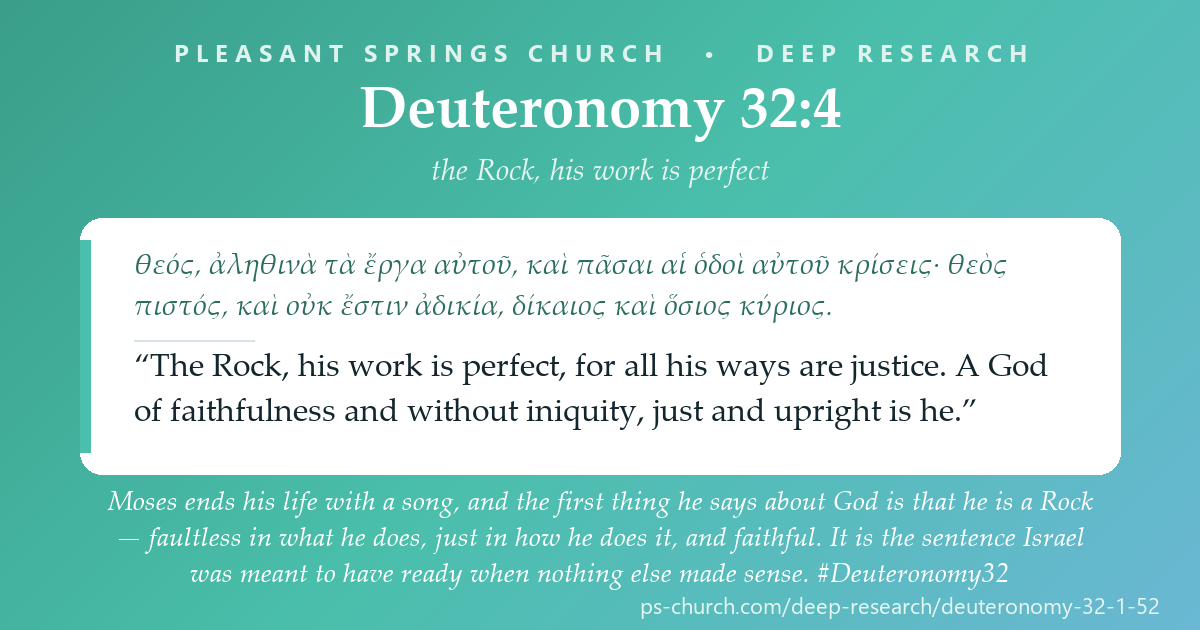
Deuteronomy 32:4 · to share
LXX + ESVEvery Deep Research page traces its passage across the whole sweep — the Old Testament, the Second-Temple world between the testaments (historical witnesses, not Scripture), and the New Testament. Follow the thread:
Pleasant Springs Church — Deep Research
Research method after Michael S. Heiser’s Bible Research Method (examine dictionaries → ancient literature → important words → textual connections → academic publications → share), with the Pleasant Springs “Author & Audience” foundation. Scripture set in the Hebrew, the Greek editions named on each page and the ESV (Old Testament), and the Greek New Testament and the ESV (New Testament), per the practice of Pleasant Springs Church. Deuteronomy 32 research grounded in Craigie, Block, McConville, Tigay, Christensen, Nelson, Driver, Miller and Merrill, with Paul Sanders’ The Provenance of Deuteronomy 32 for the chapter’s text and language, G. E. Wright and H. B. Huffmon for the covenant-lawsuit (rîḇ) description of its shape (reported as a description, not a settled genre — Sanders demurs), Emanuel Tov and John W. Wevers (with the Göttingen Septuaginta) for the textual apparatus, Patrick Skehan for the first publication of the longer Hebrew at 32:43, and Beale & Carson for the New Testament use (Romans; 1 Corinthians; Hebrews). ANE comparanda from the Hittite treaty witness-lists (ANET 199–206, at 205–206) and the Ugaritic myths, where Baal “summons Asherah’s seventy children” (ANET 134); the Esarhaddon vassal-treaties (ANET 534–541) are cited for form only. Second-Temple and rabbinic witnesses (4QDeut-j, 4QDeut-q, the second Ode of the Greek Psalter, Josephus Ant. 4.302–303, Philo, and the Targums) are read as witnesses, never leveled with Scripture. Numbering: Deuteronomy 32 has no MT/LXX versification offset — Hebrew, Rahlfs LXX and English all run 32:1–52 verse for verse; the book’s one offset is earlier (English 29:1 = MT/LXX 28:69, so English 29:2–29 = MT/LXX 29:1–28), and chapters 30–34 realign. Where a Psalm is cited the Greek numbering is given alongside (LXX 96:7 = MT/English 97:7). Greek from Rahlfs; where the Greek Psalter’s Odes 2 differs from Rahlfs’ Deuteronomy at 32:43 that is stated rather than blurred. The two great variants (32:8, 32:43) are presented as manuscript evidence with the ESV’s own footnotes quoted, and the divine-council reading is attributed to Michael Heiser as one reading among others rather than asserted as the plain sense, with David Stevens’ defence of the MT named alongside. The covenant sanctions are read as sanctions on a covenant nation sworn to by that nation itself, never aimed at any modern person, nation or group, and “Vengeance is mine” is handled as the New Testament handles it — as a restraint that takes retaliation out of the believer’s hands.
Scripture quotations marked ESV are from the ESV® Bible (The Holy Bible, English Standard Version®), © 2001 by Crossway, a publishing ministry of Good News Publishers. ESV Text Edition: 2016. Used by permission. All rights reserved. The ESV text may not be quoted in any publication made available to the public by a Creative Commons license, and the ESV may not be translated in whole or in part into any other language. www.esv.org
|
Did this study bless you today? 💚 Give to Support PS Church100% of gifts go to the General Fund — thank you. |