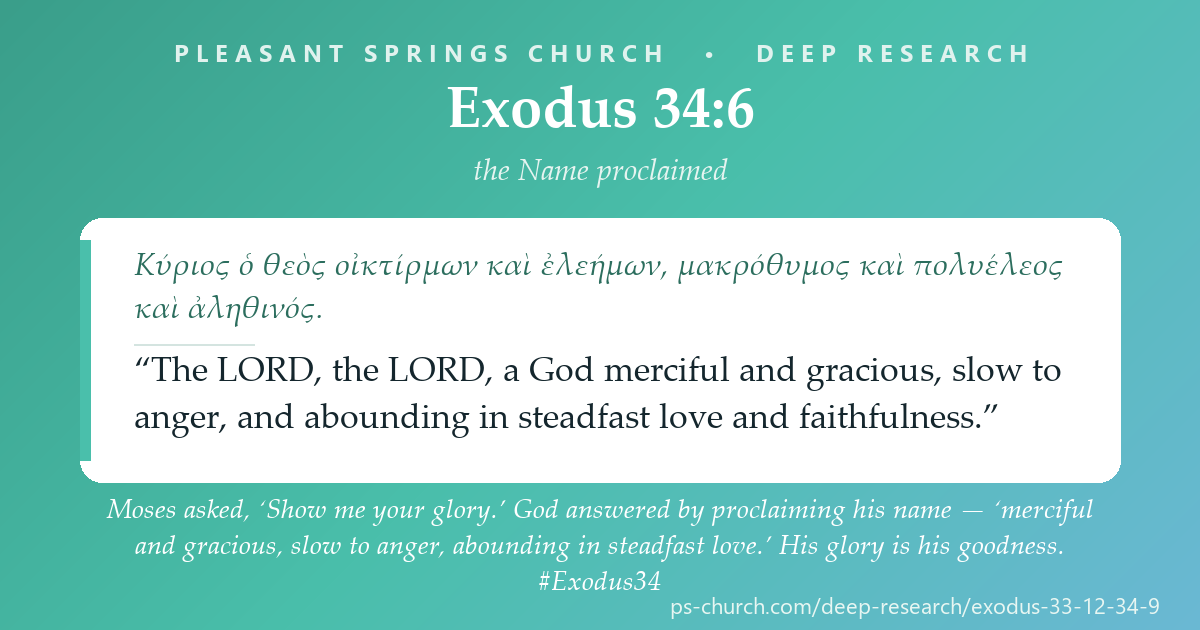
Moses prays the boldest prayer in Scripture: “Please show me your glory.” And God answers — not with a spectacle, but by proclaiming his name: “The Lord, the Lord, a God merciful and gracious, slow to anger, and abounding in steadfast love and faithfulness.” It is the most-quoted description of God in the Old Testament — declared, astonishingly, right after the golden calf. This study works Exodus 33–34 from the cleft of the rock to its final answer: the glory of God in the face of Christ. See the method →
Exodus 33:18–34:7 (selections)
Hebrew · LXX · ESVThe Shape of the Passage
InclusioThe same Author and audience as Exodus 32 — and in the wake of the golden calf, the question is whether God will still go with this people. His answer is a revelation of his very name.
Author
The Torah of Moses brings the golden-calf crisis to its resolution. After Israel’s apostasy (ch. 32), everything hangs on one question: will the Lord still dwell among a sinful people? Moses intercedes (“if your presence will not go with me, do not bring us up,” 33:15), and then asks to see God’s glory. God grants a veiled vision — his “goodness” and his back, but not his face — and, crucially, proclaims his name. The narrative makes the character of God, not a visual spectacle, the true content of his glory.
Grace in the ruins. That the fullest revelation of God’s name comes after the calf is the point: mercy and forgiveness are declared to a people who have just broken the covenant. Yet the same breath adds that God “will by no means clear the guilty” — grace that costs, not grace that winks. The whole Bible will lean on this tension until it is resolved at the cross.
Audience
Israel — a forgiven but fragile people, learning who their God is at his deepest. Through Moses they hear the name proclaimed: not a list of powers but a heart — compassionate, gracious, patient, overflowing in covenant love and truth. This is the God who has just spared them.
How they heard it. Israel would carry this confession through its whole life: when the nation sinned again, the prophets and psalmists prayed it back to God (Num 14:18; Ps 86:15; 103:8; Joel 2:13; Jonah 4:2). It became Israel’s go-to description of God’s character — the ground of every plea for mercy. And it set the longing that only Christ would satisfy: to see the glory of God with unveiled face.
Orient on the glory, the Name, and the mercy of God.
Search by topic: glory of God, name of God, mercy, steadfast love (hesed), theophany.
Which articles are relevant?
- Anchor Bible Dictionary — “Glory (of God),” “Name of God,” “Mercy,” “Theophany.”
- Dictionary of the OT: Pentateuch — “Glory,” “Name,” “Attributes of God,” “Presence of God.”
- NIDOTTE / TDOT — כָּבוֹד (kāḇôḏ, glory), חֶסֶד (ḥeseḏ, steadfast love), רַחוּם (raḥûm, merciful), שֵׁם (šēm, name).
Bibliography surfaced:
- Childs (OTL), Durham (WBC), Stuart (NAC); R. W. L. Moberly, At the Mountain of God (Exod 32–34).
- Nathan MacDonald and others on the “grace formula” (Exod 34:6–7); Michael Widmer on Mosaic intercession; Carey Walsh on the theophanic shift in Exodus.
- Brevard Childs, Biblical Theology; the “character of God” tradition in OT theology.
Seeing a god, naming a god, and the mercy that stunned the ancient world.
Read the request to “see God” against ANE notions of the divine, then hear how the proclaimed name reshapes them.
Which parallels shed light on religion and worldview?
To see a god was to die. Across the ancient world, an unmediated encounter with deity was thought to be lethal, and the gods’ favor was fickle, purchased by ritual. Exodus shares the danger — “you cannot see my face, for man shall not see me and live” (33:20) — but overturns the bargain: God’s glory is his freely-given goodness, and his mercy is sovereign, not bought (“I will be gracious to whom I will be gracious,” 33:19).
A name that is a character. In the ancient Near East a divine name carried a god’s nature and power. When the Lord “proclaims his name,” he does not display might but declares mercy, grace, patience, steadfast love, and faithfulness — and justice that will not treat sin as nothing. In a world of stormy, self-interested gods, a deity whose glory is chesed was, and is, startling.
- ANE theophany accounts — the deadly danger of seeing a god, and the mountain/cloud/fire idiom: the frame Exodus uses and transforms.
- Later Jewish reading (rabbinic-era) — Exodus 34:6–7 counted as the “Thirteen Attributes of Mercy” and woven into prayer: a witness to how central this text became (post-biblical, not Scripture).
- Sirach 2:11; Wisdom 15:1 (Apocrypha — a witness, not Scripture) — the grace formula echoed: “the Lord is compassionate and merciful.”
- Philo, On the Change of Names; Posterity of Cain 168–169 — first-century reflection on seeing God’s “back” and the unknowable divine essence.
Moses asked to see God’s glory and was shown his goodness and his back — but “man shall not see me and live” (33:20). John opens his Gospel on exactly this note: “the Word became flesh and dwelt among us, and we have seen his glory… full of grace and truth” (John 1:14) — grace and truth, widely read as an echo of Exodus 34:6’s hesed we’emet, steadfast love and faithfulness. And then: “No one has ever seen God; the only God… has made him known” (John 1:18). What Moses could not see, we behold in Jesus: “the glory of God in the face of Jesus Christ” (2 Cor 4:6). The name proclaimed at Sinai walks out of the tent and becomes a person — and at the cross, mercy that forgives and justice that “will by no means clear the guilty” are reconciled, for God is “just and the justifier” (Rom 3:26).
The vocabulary of glory, name, and mercy.
Watch the “glory” that is goodness, the “name” that is character, and the chesed that runs to the cross.
“Glory” — the weighty, radiant presence of God. Moses asks to see it; he is shown God’s goodness and his back — glory revealed as character, not spectacle.
“Steadfast love” — God’s loyal, covenant-keeping love, “for thousands.” Paired with ’emet (faithfulness/truth), it becomes John’s “grace and truth” (John 1:14).
“Slow to anger” — lit. “long of nostrils,” long-tempered; God’s patience with a sinful people (LXX μακρόθυμος).
“Merciful and gracious” — compassion (from reḥem, womb) and unearned favor: the heart of the Name.
“Forgiving iniquity” — lit. “bearing/lifting” iniquity; the God who carries sin away — ultimately by bearing it himself in Christ (Isa 53:11–12; John 1:29).
How the New Testament reuses the glory and the Name:
- John 1:14–18 — “the Word… dwelt among us, and we have seen his glory… full of grace and truth”; “the only God… has made him known”: Exodus 33–34 fulfilled.
- 2 Corinthians 3:7–4:6 — the fading glory on Moses’ face (Exod 34:29–35) and the greater, unveiled glory “in the face of Jesus Christ.”
- Romans 9:15 — “I will have mercy on whom I have mercy”: Paul quotes Exodus 33:19 on God’s sovereign mercy.
- Romans 3:25–26 — God “just and the justifier”: how mercy and “by no means clear the guilty” meet at the cross.
The grace formula echoing across Scripture — to the face of Christ.
Trace the Exodus 34:6–7 confession through the OT and into the New, then note the Beale & Carson trajectory.
Which cross-references matter?
- Numbers 14:18; Psalm 86:15; 103:8; 145:8; Joel 2:13; Jonah 4:2; Nehemiah 9:17 — the grace formula prayed back to God again and again: Israel’s most-repeated confession.
- Exodus 3:13–15 — the Name “I AM” first revealed (see Exodus 3), now filled with content: this is who I AM is.
- Exodus 34:29–35 — Moses’ face shining, the veil: taken up in 2 Corinthians 3.
- John 1:14–18; 2 Corinthians 4:6; Hebrews 1:3 — the glory and the name embodied in the Son, “the radiance of the glory of God.”
- Romans 3:21–26; 9:14–18 — sovereign mercy and just forgiveness resolved in Christ’s atonement.
The New Testament reads Exodus 34:6–7 as reaching its goal in Jesus. John’s “grace and truth” is widely read as drawing on the Hebrew pair hesed we’emet, and he says this glory was seen in the incarnate Word (John 1:14–17) — the vision denied to Moses now given to those who behold Christ. Paul makes the fading glory on Moses’ veiled face the foil for the surpassing, transforming glory Christians see “with unveiled face” (2 Cor 3:18). And the hardest words of the formula — God “will by no means clear the guilty” alongside “forgiving iniquity” — find their resolution where mercy and justice meet: at the cross, where God is shown to be “just and the justifier of the one who has faith in Jesus” (Rom 3:26). The name proclaimed in the cleft of the rock is spelled out, at last, in a crucified and risen Lord.
The scholarship on the glory and the grace formula.
Moberly on Exodus 32–34; the commentators on the theophany; the OT-theology tradition on the character of God.
Commentaries & studies:
- Brevard Childs (OTL), John Durham (WBC), Douglas Stuart (NAC) on Exodus.
- R. W. L. Moberly, At the Mountain of God: Story and Theology in Exodus 32–34.
- Studies of the “grace formula” (Exod 34:6–7) and its reuse across the canon; Beale & Carson, Commentary on the NT Use of the OT.
Interpretation notes worth keeping:
- Glory as character. God answers “show me your glory” by proclaiming his name — the biblical conviction that God’s deepest glory is his moral character, supremely his mercy.
- Mercy and justice together. The formula holds “abounding in steadfast love… forgiving iniquity” with “will by no means clear the guilty”: God’s grace never cancels his justice — a tension the New Testament resolves at the cross, not by relaxing either side.
- “Visiting the iniquity of the fathers on the children… to the third and the fourth generation” (34:7) is covenantal, not fatalistic; Ezekiel 18 and the gospel both affirm that each is answerable, and mercy runs “to thousands” — far outweighing judgment.
From the cleft of the rock to your own knowledge of God.
Name what you learned, why it matters, and one concrete response.
What should we carry away — and do?
- God’s glory is his goodness. When you long to know God, listen to how he names himself: merciful, gracious, patient, overflowing in steadfast love and truth. That is the heart at the center of the universe.
- Mercy after failure is the point. The fullest revelation of God’s name comes right after the golden calf. Your worst moment is not beyond the reach of the God who “forgives iniquity.”
- The Name has a face. What Moses could not see, we behold in Jesus — “the glory of God in the face of Jesus Christ.” To know Christ is to see the glory Moses asked for.
Step in response: pray Exodus 34:6–7 back to God this week, slowly, as Israel always did — naming him “merciful and gracious, slow to anger, abounding in steadfast love.” Then look for his glory where he has finally shown it: in the face of Christ, and let that mercy meet the failure you most want to hide.
Exodus 34:6 · to share
LXX + ESVEvery Deep Research page traces its passage across the whole sweep — the Old Testament, the Second-Temple world between the testaments (historical witnesses, not Scripture), and the New Testament. Follow the thread:
Pleasant Springs Church — Deep Research
Research method after Michael S. Heiser’s Bible Research Method (examine dictionaries → ancient literature → important words → textual connections → academic publications → share), with the Pleasant Springs “Author & Audience” foundation. Scripture set in the Hebrew, the Greek editions named on each page and the ESV (Old Testament), and the Greek New Testament and the ESV (New Testament), per the practice of Pleasant Springs Church. Exodus 33:12–34:9 research grounded in Childs, Durham, Stuart, and Moberly, with Beale & Carson on the New Testament use; ANE theophany background; Second-Temple material per Sirach and Philo (read as witnesses, not Scripture).
Scripture quotations marked ESV are from the ESV® Bible (The Holy Bible, English Standard Version®), © 2001 by Crossway, a publishing ministry of Good News Publishers. ESV Text Edition: 2016. Used by permission. All rights reserved. The ESV text may not be quoted in any publication made available to the public by a Creative Commons license, and the ESV may not be translated in whole or in part into any other language. www.esv.org
|
Did this study bless you today? 💚 Give to Support PS Church100% of gifts go to the General Fund — thank you. |