After the golden calf and the renewed covenant, the tabernacle is at last built — and Exodus tells it again, item for item, under one drumbeat refrain: “as the Lord had commanded Moses.” The people give so freely that Moses must tell them to stop (“the people bring much more than enough”); Spirit-gifted hands make it all exactly as told; Moses inspects the work, sees it was done as commanded, and blesses them; the tent is raised — and the glory of the Lord fills it. Obedience, glad generosity, and God come to dwell: the goal of the whole exodus, reached. This study completes the book of Exodus (35:1–40:38). See the method →
Exodus 35:21; 36:5; 39:43; 40:33–34
Hebrew · LXX · ESVThe Shape of the Passage
Parallel panelsSame Author and audience as Exodus 25 — but where chs. 25–31 were God’s commands, chs. 35–40 are Israel’s obedience: the same words, now done. The book that began in slavery ends with God at home in the camp.
Author
The Torah of Moses closes Exodus by telling the tabernacle story twice. First God gave the blueprint on the mountain (chs. 25–31); now, after the rupture of the golden calf (ch. 32) and the costly renewal of the covenant (chs. 33–34), the people build it (chs. 35–40) — and the narrator repeats the instructions almost item for item, in the past tense, as if reading a receipt against an order. The repetition is the point: obedience is not creativity but correspondence. Six chapters of “he made… he made… as the Lord had commanded Moses” answer the terrible improvisation of ch. 32, where the people made a god of their own devising. Worship, Exodus insists, is God-initiated and God-patterned, never self-invented.
The willing offering, restrained. It begins where ch. 25 began — with a gift. But now we watch the gift arrive: “everyone whose heart stirred him” and “all the women whose hearts stirred them to use their skill” (35:21–26) bring gold, silver, bronze, yarn, skins, oil, and gems, morning after morning, until the craftsmen come to Moses with an unheard-of complaint: “the people bring much more than enough” (36:5). So Moses issues the only command of its kind in Scripture — a proclamation to stop giving (36:6–7). A people freed from Egypt with its plunder (12:35–36) return it, overflowing, as worship.
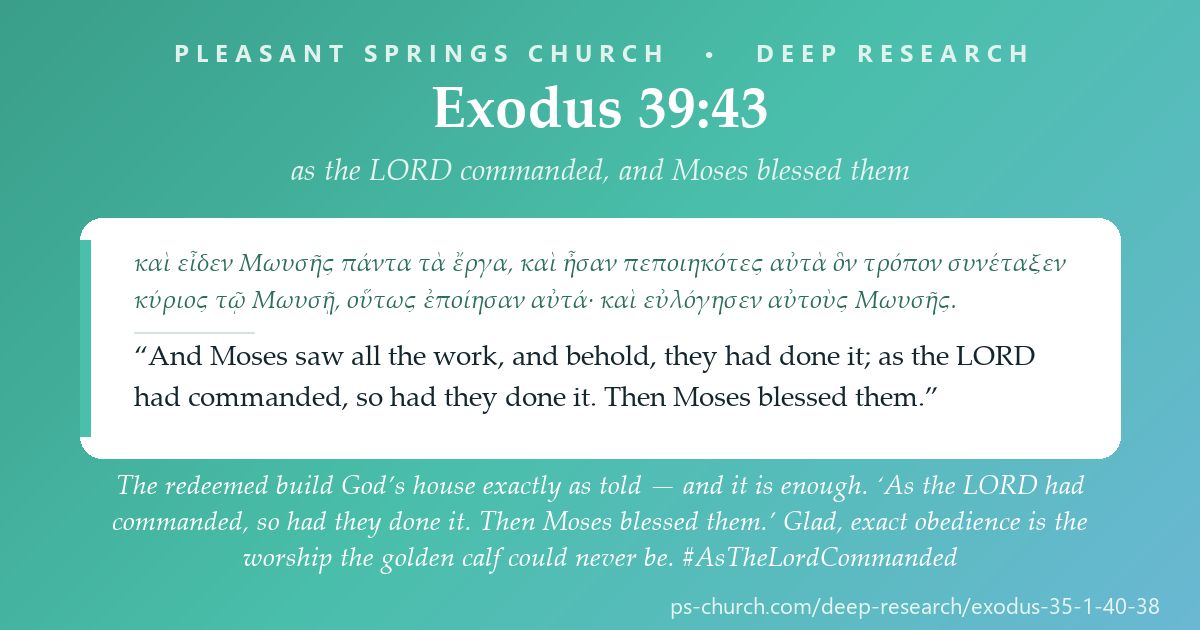
Spirit-gifted hands. Bezalel and Oholiab lead the work, “filled… with the Spirit of God, with skill, with intelligence, with knowledge, and with all craftsmanship” (35:31) — not a regenerating fullness but a Spirit-endowment for skill, the dignity of art and craft bent to worship. And they teach: “he has inspired him to teach” (35:34). Many hands — weavers, engravers, embroiderers, metalworkers — make one dwelling. Then Moses inspects all of it: “they had done it; as the Lord had commanded, so had they done it. Then Moses blessed them” (39:43). On the first day of the first month of the second year the tent is raised, Moses doing each thing “as the Lord commanded him” (40:16–33) — and the book ends in glory when the cloud covers the tent and the Lord’s glory fills it (40:34–38 — treated in its own study).
Audience
Israel — the very generation that had built the calf. To them, chs. 35–40 are grace made visible: the covenant broken and forgiven, the people set back to work, and the same God who could have consumed them (32:10) coming instead to dwell in their midst. Every “as the Lord commanded” is a small liturgy of restored trust; every basin and board and hook a token that the rupture is healed. The sabbath frames it all (35:1–3): even the holy work of the sanctuary stops for the rest of God — worship on God’s terms, God’s pattern, God’s time.
The goal reached. For the church, Exodus 35–40 is the destination of the whole book — indeed of the story that runs from Eden onward. Read as the devotional-typological arc Scripture itself traces, Moses’ finishing-and-blessing (“Moses finished the work… and blessed them,” 40:33; 39:43) echoes the Creator’s own: God “finished his work… and God blessed” (Gen 2:2–3) — the tabernacle a new creation in miniature, order and glory where there was chaos and sin. And the closing scene — “the glory of the Lord filled the tabernacle” — is the thread’s next knot: from this tent to the temple (1 Kgs 8:10–11), to the Word who “became flesh and tabernacled among us” (John 1:14), to the church his temple (1 Cor 3:16), to the New Jerusalem where “the dwelling place of God is with man” (Rev 21:3). Exodus began with a people in bondage and no God among them; it ends with God at home in their camp. That is the gospel’s whole ambition, in a tent.
Orient on the construction account, the willing offering, the Spirit-gifted craftsmen, and the glory.
Search by topic: tabernacle (construction), Bezalel and Oholiab, freewill offering, Spirit of God / endowment for skill, glory / Shekinah, sabbath, obedience.
Which articles are relevant?
- Anchor Bible Dictionary — “Tabernacle,” “Bezalel,” “Oholiab,” “Glory of God,” “Sabbath.”
- Dictionary of the OT: Pentateuch — “Tabernacle,” “Craftsmen / Artisans,” “Holy Spirit,” “Presence of God,” “Creation and the Tabernacle.”
- NIDOTTE / TDOT — נָדַב (nāḏaḇ, offer willingly), תְּרוּמָה (tərûmâ, contribution), חָכְמָה (ḥoḵmâ, skill/wisdom), כָּלָה (kālâ, finish/complete), כָּבוֹד (kāḇôḏ, glory).
Bibliography surfaced:
- Childs (OTL), Durham (WBC), Stuart (NAC), Sarna (JPS) on Exodus.
- G. K. Beale, The Temple and the Church’s Mission; T. D. Alexander, From Eden to the New Jerusalem.
- Peter Enns and others on the Exodus 25–40 / Genesis 1–2 creation–tabernacle parallels; Moshe Weinfeld, “Sabbath, Temple and the Enthronement of the Lord.”
Building to a pattern, giving beyond need, and a temple that echoes creation.
Read the construction account against ancient temple-building custom, and note how Second-Temple writers and the New Testament expound the finished tent and its glory.
Which parallels shed light on religion and worldview?
Building to the god’s command. Across the ancient Near East, temple-building was the crown of a reign, and the pious king insisted he had built “exactly as the god commanded,” to the precise plan revealed to him. Exodus shares the idiom and radicalizes it: the tabernacle is built not by a king’s ambition but by a freed people’s glad obedience, “as the Lord commanded Moses” — a refrain that tolls again and again through chs. 39–40. The contrast with ch. 32 is deliberate and total: there, worship invented (a calf of the people’s own gold and design); here, worship received (a tent of the people’s gold and God’s design). The whole difference between true and false worship is drawn in those two scenes.
The temple as a new creation. Ancient temple accounts often mirror cosmogony — the sanctuary a model cosmos, its raising a re-founding of order. Israel’s narrator uses the motif with sober precision. The instructions come in seven divine speeches (each “the Lord said to Moses,” chs. 25–31), the seventh about the sabbath (31:12–17) — as the world was made in seven days, crowned by rest. And the construction closes in the language of Genesis: Moses “finished (וַיְכַל) the work” (40:33) exactly as God “finished his work” (Gen 2:2); Moses “saw… and behold” and “blessed” (39:43) as God “saw… and behold, it was very good” and “blessed” (Gen 1:31–2:3). The tent is a portable Eden, order and glory reborn in the middle of the camp.
How the finished tent was read. Josephus (Antiquities 3.100–150, 179–187) narrates the construction and the craftsmen at length and reads the tent, the vestments, and the glory as a symbolic cosmos; Philo (Life of Moses 2.71–160) does the same, dwelling on Bezalel’s Spirit-given wisdom. The cosmic allegory can be overpressed, but it preserves an old and right instinct the New Testament shares: this sanctuary is where heaven and earth meet. The church reads its climax not as astronomy but as Immanuel — the glory-cloud settling on the tent is the promise “I will dwell among the people of Israel” (29:45) made visible, and the first installment of “God with us” (Matt 1:23; John 1:14).
- Genesis 1:31–2:3 — the Creator sees, finishes, and blesses his work and rests: the template behind Moses’ finishing, blessing (39:43; 40:33) and the sabbath frame (35:1–3).
- Exodus 32:1–6 — the golden calf: worship self-invented, the dark foil to the God-patterned building of chs. 35–40 (see the golden calf).
- Josephus, Antiquities 3.100–187; Philo, Life of Moses 2.71–160 — first-century Jewish narrations of the construction and the glory (witnesses to interpretation, not Scripture).
It is worth pausing on the sheer strangeness of Exodus 36:5–7. Every pastor and every treasurer knows the ordinary problem: the appeal falls short, the roof still leaks, the people must be coaxed. Here the opposite happens. The freewill offering for the sanctuary comes in so relentlessly — ‘morning after morning,’ the text says — that the skilled workers down tools and go to Moses with a crisis no one has ever had before or since: ‘the people bring much more than enough.’ And Moses does the unthinkable: he has it proclaimed through the camp that no man or woman should bring anything more, ‘so the people were restrained from bringing’ (36:6). This is the same crowd that, weeks earlier, had stripped off their gold to make a calf. The gold is the same; the heart is transformed. What changed is not the people’s wealth but their worship — grace had reached them, and grace makes givers. Paul saw exactly this pattern and named it: churches giving ‘beyond their means, of their own accord’ (2 Cor 8:3), because ‘God loves a cheerful giver’ (2 Cor 9:7). The tabernacle was funded not by assessment but by stirred hearts — and it was funded to overflowing. Generosity is not the tax a grudging people pay; it is the reflex of a rescued one. When the heart is stirred, the only problem left is where to put the surplus.
The vocabulary of the building: the willing gift, the skilled hand, exact obedience, and glory.
Watch the stirred heart that gives, the over-supply that must be restrained, the Spirit-gifted skill, the sevenfold “as the Lord commanded,” the “finished” that echoes creation, and the glory that fills.
“To offer willingly” / “freewill gift” — the verb of a heart that volunteers. The people give “whose heart stirred” and “whose spirit moved” them (35:21); the same root names the freewill offering. Worship that is given, not extracted (cf. 2 Cor 9:7).
“Bring much more than enough” — literally “the people are increasing to bring more than the sufficiency of the work.” The one place in Scripture where a leader must proclaim a halt to the people’s giving (36:6–7). LXX πλῆθος…παρὰ τὰ ἔργα.
“Skill” / “wise of heart” — the Spirit-given craftsmanship of Bezalel, Oholiab, and the artisans, “filled with the Spirit of God” (35:31). Not regeneration but endowment for skill: the dignity of art and craft offered to God (cf. 31:1–11).
“As the Lord commanded” — the drumbeat refrain, seven times in ch. 39, again through ch. 40. Exact, glad obedience is the whole theology of the building — the antidote to the calf’s self-willed worship.
“And he finished” — Moses “finished the work,” the exact verb of Gen 2:2, where God “finished his work.” With 39:43 (“saw… behold… blessed”) it frames the tabernacle as a new-creation echo. LXX συνετέλεσεν (as Gen 2:2).
“The glory of the Lord” — the weighty, blazing Presence that fills the finished tent, so that even Moses cannot enter (40:35). The goal of the whole exodus reached: God come to dwell (see the glory fills the tabernacle).
How the New Testament takes up the finished tabernacle:
- 2 Corinthians 8:1–9:15 — Spirit-moved, overflowing generosity “beyond their means, of their own accord”; “God loves a cheerful giver”: Exodus 35–36 in the church.
- John 1:14; Matthew 1:23 — the glory that filled the tent now “tabernacled” in flesh: “God with us,” the Presence in a body.
- 1 Corinthians 3:16; Ephesians 2:19–22; 1 Peter 2:5 — the church built of many gifted members into one dwelling for God’s Spirit — each contributing, like the many hands of Exodus 35.
- Hebrews 3:1–6; 8:5 — Moses “faithful… in all God’s house,” building the copy exactly as shown; Christ faithful as a son over the house (see our great high priest).
From a finished tent to the glory that fills, and the God who dwells.
Trace exact obedience, willing generosity, and the indwelling glory from the instructions through the construction to the temple, the incarnation, and the New Jerusalem.
Which cross-references matter?
- Exodus 25:1–31:18 — the blueprint that chs. 35–40 obey point for point: command answered by completion (see the tabernacle blueprint).
- Exodus 32:1–6; 33:12–34:9 — the calf’s self-willed worship and the renewed covenant: the rupture that makes the glad, exact obedience of chs. 35–40 so pointed (see the renewed covenant).
- Genesis 1:31–2:3 — the Creator sees, finishes, blesses, and rests: the new-creation template behind 39:43; 40:33 (see in the beginning).
- Exodus 40:34–38; 1 Kings 8:10–11; Ezekiel 43:1–5 — the glory filling tent and temple; the Presence that is the goal of the house (see the glory fills the tabernacle).
- John 1:14; 2 Corinthians 8–9; Revelation 21:1–3, 22 — the Word tabernacled among us; cheerful, overflowing giving; the dwelling of God with man, the house at last complete.
Read the last chapters of Exodus with Genesis 1–2 open beside them, and a pattern rises off the page that no attentive reader has invented. God’s instructions for the tent come in seven speeches, the seventh commanding the sabbath (31:12–17) — seven days, the seventh hallowed. When the work is done, Moses does what the Creator did: he ‘saw all the work, and behold, they had done it’ (39:43) — the cadence of ‘God saw everything… and behold, it was very good’ (Gen 1:31); he ‘blessed them’ as God ‘blessed’ the seventh day (Gen 2:3); and he ‘finished the work’ (40:33) in the very verb, Hebrew and Greek alike, of God who ‘finished his work’ (Gen 2:2). The tabernacle is a cosmos in miniature, a new creation raised in the middle of a redeemed camp — order, beauty, and glory where the calf had left chaos and shame. And then the roof of it all: ‘the glory of the Lord filled the tabernacle’ (40:34), as the Spirit once hovered over the deep. Held as the canon’s own devotional-typological arc — not allegory pressed into every clasp — the trajectory is luminous: Eden, tabernacle, temple, and then the Word who ‘tabernacled among us, and we have seen his glory’ (John 1:14), and finally the city with no temple, for God himself dwells with man (Rev 21:3, 22). Exodus ends not with a law kept but with a God at home. The building was always for the dwelling.
The scholarship on the construction account.
The commentators on Exodus 35–40; the studies of the creation–tabernacle parallel, the willing offering, and the theology of exact obedience.
Commentaries & studies:
- Brevard Childs (OTL), John Durham (WBC), Douglas Stuart (NAC), Nahum Sarna (JPS) on Exodus.
- G. K. Beale, The Temple and the Church’s Mission; T. Desmond Alexander, From Eden to the New Jerusalem; Moshe Weinfeld and Peter Enns on the Genesis–Exodus creation/tabernacle correspondences.
- Studies of the LXX of Exodus 35–40 (the reordered, shorter Greek construction account) — Wevers, Notes on the Greek Text of Exodus; the Septuagint’s divergent sequence in these chapters.
Interpretation notes worth keeping:
- The doubled account. Chapters 35–40 re-narrate chs. 25–31 almost verbatim — a deliberate, not clumsy, repetition. Command and completion are set side by side so that obedience is the theme: the redeemed build precisely as told.
- The LXX reordering (chs. 35–40). The Greek construction account follows a different, shorter sequence than the MT (e.g., the priestly-garment section stands earlier), and some verses diverge or are absent. The MT drives the ESV here; the LXX is quoted only where its wording is secure.
- ‘Filled with the Spirit’ (35:31). Bezalel’s Spirit-fullness is an endowment for skill (wisdom, craftsmanship, teaching), not a statement about regeneration — the Old Testament’s witness to the Spirit’s gifting of artisans and leaders for a task.
- Devotional typology, disciplined. The creation→tabernacle parallel and the tabernacle→incarnation→church→New Jerusalem arc are well-grounded (Beale, Alexander, Weinfeld), but held as the canon’s trajectory and analogy, not as allegory read into every board and loop — the house discipline for typology throughout this library.
From a finished tent to a God who came to stay.
Name what you learned, why it matters, and one concrete response.
What should we carry away — and do?
- Worship God’s way, not our own. The sevenfold “as the Lord commanded” makes exact, glad obedience the whole point — the opposite of the calf we design ourselves. Worship is God-initiated and God-patterned.
- Give from a stirred heart. The house was funded to overflowing by willing hearts, until giving had to be restrained. Grace makes cheerful givers (2 Cor 8–9); generosity is the reflex of the rescued.
- Bring your skill. Many gifted hands built one dwelling. Your craft, your work, your art — offered to God — has a place in his house (1 Cor 12; Eph 2:22). The Spirit gifts for the task.
- The goal is his presence. When the work was finished, the glory came. God’s aim was never the tent but the dwelling — and in Christ he has tabernacled among us, and by his Spirit dwells in us (John 1:14; 1 Cor 3:16).
Step in response: take one act of worship this week and do it God’s way, gladly and exactly — not what suits you, but what he asks. Then give one gift from a stirred heart, beyond the minimum, of substance or skill or time; and pause in wonder at the ending of Exodus — the God who could have consumed a calf-making people came instead to fill their tent with glory and live at the center of the camp. He still comes to dwell. Make room; do the work; and let the glory fall.
Exodus 39:43 · to share
LXX + ESVEvery Deep Research page traces its passage across the whole sweep — the Old Testament, the Second-Temple world between the testaments (historical witnesses, not Scripture), and the New Testament. Follow the thread:
Pleasant Springs Church — Deep Research
Research method after Michael S. Heiser’s Bible Research Method (examine dictionaries → ancient literature → important words → textual connections → academic publications → share), with the Pleasant Springs “Author & Audience” foundation. Scripture set in the Hebrew, the Greek editions named on each page and the ESV (Old Testament), and the Greek New Testament and the ESV (New Testament), per the practice of Pleasant Springs Church. Exodus 35:1–40:38 research grounded in Childs, Durham, Stuart, and Sarna, with Beale (The Temple and the Church’s Mission), Alexander (From Eden to the New Jerusalem), and Weinfeld/Enns on the Genesis 1–2 creation–tabernacle parallel (Moses “saw… finished… blessed,” 39:43; 40:33; cf. Gen 1:31–2:3); the doubled construction account read as the theology of exact, glad obedience (the sevenfold “as the Lord commanded Moses”) against the golden calf’s self-willed worship (ch. 32); the willing, restrained offering (36:5–7) as Spirit-moved generosity (2 Cor 8–9); Bezalel’s Spirit-fullness (35:31) as endowment for skill, not regeneration; the reordered, shorter LXX of these chapters noted (Wevers) and quoted only where secure; and the tabernacle→temple→incarnation→church→New Jerusalem arc held as the canon’s own devotional-typological trajectory (John 1:14; 1 Cor 3:16; Rev 21:3), per the house discipline for typology.
Scripture quotations marked ESV are from the ESV® Bible (The Holy Bible, English Standard Version®), © 2001 by Crossway, a publishing ministry of Good News Publishers. ESV Text Edition: 2016. Used by permission. All rights reserved. The ESV text may not be quoted in any publication made available to the public by a Creative Commons license, and the ESV may not be translated in whole or in part into any other language. www.esv.org
|
Did this study bless you today? 💚 Give to Support PS Church100% of gifts go to the General Fund — thank you. |