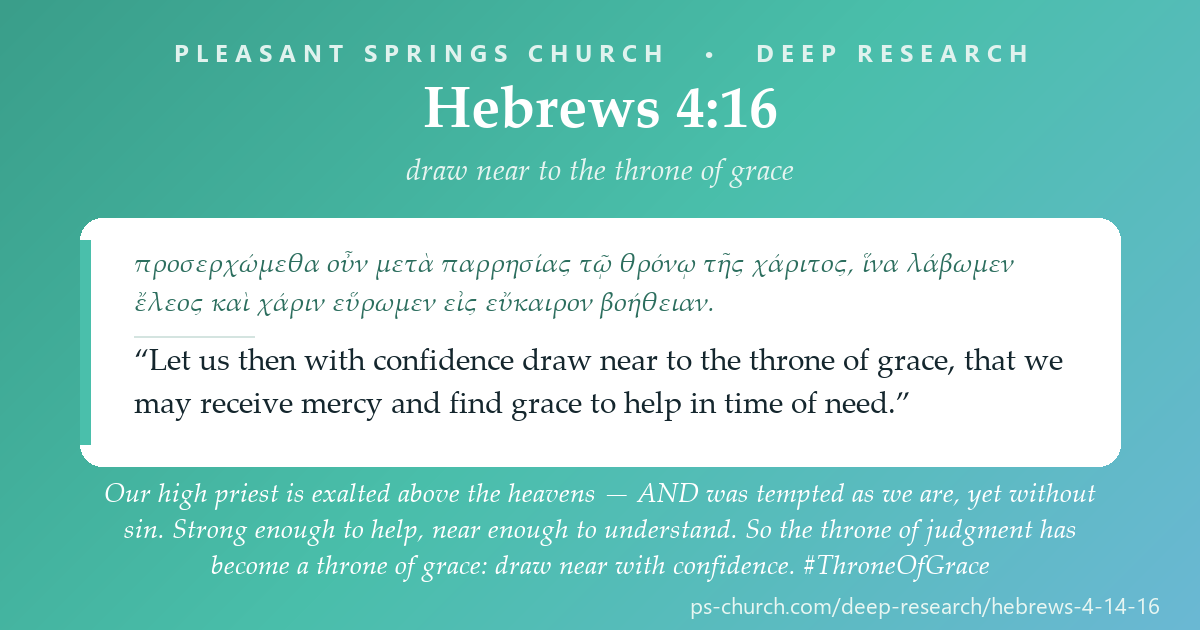
We have a great high priest who has passed through the heavens — Jesus, the Son of God, exalted beyond all others. Yet he is not remote: he was “tempted as we are… yet without sin,” and can sympathize with our weakness from the inside. Because both are true — exalted and sympathetic — the old fear of approaching God is gone. The throne of judgment has become a throne of grace: “let us then with confidence draw near… that we may receive mercy and find grace to help in time of need.” This study works Hebrews 4:14–16 — draw near. See the method →
Hebrews 4:14–16
Greek NT · ESVThe Shape of the Passage
ConcentricHaving warned against unbelief and drifting (3:7–4:13), the writer turns to the remedy: a high priest who is both exalted above the heavens and able to feel our weakness from within. On that double truth he builds the great invitation of the letter — draw near.
Author
The writer of Hebrews gathers a theme he has been touching since 2:17 and states it in full: we have “a great high priest.” The adjective (megas) is emphatic — not merely a high priest but a great one, greater than Aaron and all his line. And two things are said of him that seem to pull in opposite directions, yet together are the heart of the gospel. First, he has “passed through the heavens” (dielēlythota tous ouranous) — where Israel’s high priest passed once a year through the veil into the earthly Most Holy Place, Jesus passed through the heavens themselves into the true sanctuary, the presence of God (6:19–20; 9:24). He is exalted, enthroned, beyond all reach of our frailty.
Yet able to sympathize. Second — and this is the wonder — this exalted priest is not remote. “We do not have a high priest who is unable to sympathize with our weaknesses” (4:15). The double negative is emphatic: he most certainly can feel with us. The word is sympathēsai — to suffer with, fellow-feeling born of shared experience — because he “in every respect has been tempted as we are.” The Son who reigns above the heavens knew hunger, exhaustion, grief, the dread of the cup in Gethsemane, the full force of testing. He is not a priest who read about our weakness in a book; he lived it.
‘Yet without sin.’ The last two words guard everything: chōris hamartias, “without sin.” His testing was real and complete — “in every respect” — but at the one point where our testing so often ends in surrender, his never did. He shares our weakness (astheneia), not our sin. And that is exactly what qualifies him: a priest who had sinned would need a sacrifice for himself (as Aaron did, 5:3); a sinless priest can offer himself, spotless, for us (7:26–27). His sinlessness does not make him distant; it makes him able — the only one who both understands our struggle and stands unstained to help.
Audience
Weary, tempted believers — then and now — who fear that a holy, heavenly Christ must be far from their mess, and who are tempted to drift away rather than draw near. The writer’s answer is the throne. Under the old covenant only the high priest entered the Most Holy Place, once a year, with blood, in fear of death. Now the invitation is turned inside out: “let us… draw near” — all of us, continually, “with confidence” (meta parrēsias, the bold freedom of a citizen with the right to speak). And the throne we approach — God’s throne, the seat of judgment — has become “the throne of grace,” the place where the guilty receive mercy and find help exactly when they need it.
Hold fast, and draw near. The passage frames two commands. “Let us hold fast our confession” (4:14) — the confidence is not presumption; the same letter warns solemnly against falling away (2:1–3; 10:26–31). And “let us draw near” (4:16) — the confidence is not fear. These are not in tension: it is precisely because we have such a priest that we can both hold fast and come boldly. Assurance and perseverance are the two hands of the same faith. The believer kept by this great priest is the believer who keeps drawing near to him.
Orient on the high priest, temptation, sanctuary access, and the throne of grace.
Search by topic: high priest, Day of Atonement, Melchizedek, temptation, mercy seat, boldness / access.
Which articles are relevant?
- Anchor Bible Dictionary — “High Priest,” “Atonement, Day of,” “Melchizedek,” “Mercy Seat.”
- Dictionary of the Later NT — “Priest, High Priest,” “Temptation,” “Sinlessness of Christ,” “Boldness.”
- NIDNTT / TDNT — ἀρχιερεύς (archiereus, high priest), συμπαθέω (sympatheō, sympathize), παρρησία (parrēsia, boldness), προσέρχομαι (proserchomai, draw near).
Bibliography surfaced:
- William Lane (WBC), Harold Attridge (Hermeneia), Paul Ellingworth (NIGTC), F. F. Bruce (NICNT), Gareth Lee Cockerill (NICNT) on Hebrews.
- Eric Mason, ‘You Are a Priest Forever’ (Second Temple priestly messianism); David deSilva, Perseverance in Gratitude.
- Beale & Carson, Commentary on the NT Use of the OT (Hebrews).
The Day of Atonement, the mercy seat, and a priest who was tested.
Read the high priest “passing through,” the “throne of grace,” and the tested-yet-sinless priest against their Old Testament and Second Temple backdrop.
Which parallels shed light on religion and worldview?
‘Passed through the heavens’ — the true Day of Atonement. The picture behind verse 14 is the great annual drama of Leviticus 16. Once a year, on the Day of Atonement, Israel’s high priest passed through the veil into the Most Holy Place, carrying blood, to stand before the presence of God at the mercy seat — and the nation held its breath (see the Day of Atonement). Hebrews says Jesus has done the true and final version: he “passed through the heavens” — not a curtained room but the created heavens themselves — into the real sanctuary, the throne room of God, by his own blood (9:11–12, 24). The earthly ritual was a shadow; the ascended Christ is the substance. And unlike the high priest who entered trembling and came back out, our priest has entered and remains, seated, our forerunner (6:20).
The throne of grace and the mercy seat. The phrase “throne of grace” (thronos tēs charitos) fuses two ideas that ought to terrify: a throne — the seat of a sovereign judge — approached by sinners. What makes it a throne of grace is the priest and his blood. The image likely evokes the hilastērion, the “mercy seat” (Hebrew kapporet) — the gold cover over the ark where atoning blood was sprinkled and where the Lord promised to meet his people (Exod 25:17–22; Lev 16:2; cf. Heb 9:5; Rom 3:25). The place of judgment, sprinkled with blood, becomes the place of mercy. Because of Christ’s finished atonement, the throne from which the Judge rules is the very throne at which the guilty find grace.
A priest tested — and the hope of a better one. Second Temple Judaism longed for a superior priest. The Testament of Levi looked for a new priest who would “open the gates of paradise” and grant access to God; at Qumran, 11QMelchizedek pictured Melchizedek as an exalted heavenly figure executing atonement and release “in the last days” (see Psalm 110 on the Melchizedek priest-king). These are historical witnesses to a hope, not Scripture — and Hebrews answers the hope with something none of them imagined: a priest who is God’s own Son, yet who was “tempted in every respect as we are.” Where Ben Sira glorified the high priest Simon in his robes of splendor (Sirach 50), Hebrews insists the true high priest was “made like his brothers in every respect” (2:17) and learned obedience through what he suffered (5:8). His greatness is not distance from us; it is that he came all the way down to us, and never sinned.
- Leviticus 16; Exodus 25:17–22; Leviticus 16:2 — the Day of Atonement; the high priest passing the veil; the mercy seat where God meets his people: the type behind “passed through the heavens” and “the throne of grace” (see the Day of Atonement).
- Psalm 110:1, 4 (LXX 109:1, 4) — the priest-king enthroned at God’s right hand, “a priest forever after the order of Melchizedek”: the ground of the “great high priest” (developed at Heb 5–7; see Psalm 110).
- Isaiah 53:9; Genesis 14:18–20 — the sinless Servant with “no deceit in his mouth”; Melchizedek the priest-king of Salem: the sinlessness and the priestly order (see the Servant).
There is a particular kind of loneliness that comes in temptation and suffering — the sense that no one who is strong enough to help could possibly understand, and no one who understands is strong enough to help. The comfort of Hebrews 4 is that in Jesus those two things meet. He is strong enough: he has passed through the heavens, he is the Son of God, he sits on the throne. And he understands: he was tempted in every respect as we are. The writer will not let us imagine a Savior who floated above human experience untouched — a Christ who only seemed to hunger, only seemed to grieve, only seemed to face the pull of the easier path. The testing was real. In Gethsemane he sweat and cried out and asked whether the cup might pass; on the cross he entered the God-forsakenness of our condition. He knows temptation not as a theory but as an ordeal he endured to the end. And yet — here is the second half, and it is not a qualification but the very thing that saves — he came through it ‘without sin.’ His sinlessness is not evidence that his temptation was easy or unreal; a soldier who never surrenders has felt the full weight of the battle, not less of it, for he fought to the last. Precisely because he never yielded, he is able both to sympathize with us and to save us. A fellow-sufferer who had also fallen could weep with us but not rescue us; a sinless stranger who had never been tempted could rescue us but not feel with us. Only this priest can do both. So the writer does not conclude ‘therefore admire him from afar,’ but ‘therefore draw near.’ The most exalted being in the universe is the most approachable, and the throne where he sits is a throne of grace.
The vocabulary of priesthood, sympathy, sinlessness, and bold access.
Watch the “great” priest, the “passed through,” the double-negative “sympathize,” the “without sin,” and the “throne of grace.”
“Great high priest” — the emphatic megas lifts Jesus above the whole Aaronic order. The title anchors Hebrews’ central argument and points ahead to the Melchizedek priesthood of Ps 110:4 (LXX 109:4; developed in chs. 5–7).
“Having passed through the heavens” — where the high priest passed through the veil into the earthly Most Holy Place (Lev 16), Jesus passed through the heavens into the true sanctuary, the presence of God (9:24). The ascension as priestly entry, once for all.
“To sympathize” — from syn (with) + paschō (suffer): fellow-feeling born of shared experience, not distant pity. Stated with a double negative (“not… unable”) for emphasis: he most certainly can feel with us, because he was tested as we are.
“Tempted… yet without sin” — pepeirasmenon (perfect: a completed testing whose result abides) “in every respect”; chōris hamartias is the decisive exception — the testing was real and full, but it never issued in sin. He shares our weakness (astheneia), not our sin (cf. 7:26).
“Confidence / boldness” — originally a citizen’s right of free public speech; here the believer’s bold, unhindered access to God. Under the old covenant the priest entered once a year in fear; now every believer approaches “with boldness” (cf. 10:19).
“Let us draw near… to the throne of grace” — proserchomai is the cultic verb for approaching God in worship (present tense: keep drawing near). The throne (seat of judgment) is called a throne of grace because of the priest and his blood — the mercy seat where the guilty find help.
How Hebrews fills out the great high priest:
- Hebrews 2:17–18 — “made like his brothers in every respect… because he himself has suffered when tempted, he is able to help those who are being tempted”: the same real-testing-then-real-help logic.
- Hebrews 5:1–10; 7:23–28 — the priest appointed by God after the order of Melchizedek, who “learned obedience,” is “holy, innocent, unstained,” and “always lives to make intercession” (see Psalm 110).
- Hebrews 9:11–12, 24; 10:19–22 — Christ entered the heavenly Most Holy Place by his own blood, so we have “confidence to enter… let us draw near”: a near-verbatim echo of 4:16.
- 2 Corinthians 5:21; 1 Peter 2:22; 1 John 3:5 — “who knew no sin”; “committed no sin, neither was deceit found in his mouth”; “in him there is no sin”: the New Testament witness to the sinlessness of 4:15.
From the Day of Atonement to the throne of grace we approach.
Trace the priesthood from Melchizedek and the mercy seat to the ascended Christ who bids us draw near.
Which cross-references matter?
- Leviticus 16; Psalm 110:1, 4; Genesis 14:18–20 — the Day of Atonement; the priest-king “forever after the order of Melchizedek” enthroned at God’s right hand: the OT roots of the great high priest (see the Day of Atonement, Psalm 110).
- Matthew 4:1–11; Luke 22:39–46; Hebrews 5:7–8 — the wilderness temptation and Gethsemane: “tempted in every respect… yet without sin” in the flesh (see the temptation).
- Hebrews 1:1–4; 2:17–18 — the Son who made purification and sat down; the merciful and faithful high priest made like his brothers: the prologue and its priestly payoff (see He has spoken by his Son).
- Romans 3:25; Hebrews 9:5 — the hilastērion / mercy seat: the place of atonement that becomes the throne of grace (see just and the justifier).
- Ephesians 3:12; Romans 5:1–2; Hebrews 10:19–22 — “access with confidence”; “we have obtained access… into this grace”: the movement from justification to bold approach (see but God, peace with God).
It is worth noticing that the whole weight of this great Christology falls, in the end, on a single practical imperative: draw near. The writer does not pile up the glories of Christ’s priesthood so that we will have an impressive doctrine to admire; he does it so that we will come. And the two exhortations he gives — ‘hold fast’ (v.14) and ‘draw near’ (v.16) — belong together in a way we easily miss. Some Christians hear ‘hold fast’ and turn it into a white-knuckled, anxious religion of hanging on by their fingernails, forgetting that the one who holds them is a sympathetic priest at a throne of grace. Others hear ‘draw near with confidence’ and turn it into a casual presumption that never trembles at the warnings, forgetting that the same letter says the God we approach is a consuming fire. But the passage will not let us have either error. We hold fast because we may draw near — the confidence is what keeps us from drifting. And we draw near as those who must hold fast — the coming is not careless but constant, the approach of people who know they need mercy and know exactly where to find it. The throne of grace is not a place we visit once, at conversion, and then leave behind; it is the place we return to every time we sin, every time we are weak, every time the testing comes — and we return not cringing but bold, because the one seated there was tempted as we are, yet without sin, and he bids us come.
The scholarship on Hebrews 4:14-16.
The commentators on the great high priest; the studies of the temptation-and-sinlessness, the Melchizedek priesthood, and priestly access.
Commentaries & studies:
- William L. Lane (WBC), Harold W. Attridge (Hermeneia), Paul Ellingworth (NIGTC), F. F. Bruce (NICNT), Gareth Lee Cockerill (NICNT), Peter T. O’Brien (Pillar), Craig Koester (Anchor) on Hebrews.
- Eric F. Mason, ‘You Are a Priest Forever’; David A. deSilva, Perseverance in Gratitude; Bruce Metzger, A Textual Commentary.
- G. K. Beale & D. A. Carson, eds., Commentary on the NT Use of the OT.
Interpretation notes worth keeping:
- Real temptation, sure sinlessness. “In every respect… yet without sin” means the testing was fully real and felt (2:18; 5:7), yet the sinless Son did not and would not sin. Avoid both making his temptation play-acting and threatening the union of natures; chōris hamartias marks that he emerged sinless and that his testing differs from ours at the point of sin.
- Weakness, not guilt. He shares our astheneia (frailty), not our sin or Adamic guilt (ancestral sin, not inherited guilt) — he assumed real, mortal, tempted humanity while remaining “holy, innocent, unstained” (7:26).
- Passed through the heavens. Not a Gnostic ascent through spheres but the bodily-exalted Son entering the real heavenly sanctuary as our forerunner (6:20; 9:24) — the Day-of-Atonement type fulfilled.
- Throne of grace, not presumption. Bold access rests on Christ’s finished work, not human merit (congruent with the preservation of the saints, 7:25) — yet “hold fast” guards against antinomian drift (2:1–3; 10:26–31).
- Melchizedek, a type. Christ’s priesthood is superior to Aaron’s via Ps 110:4 / Gen 14; Melchizedek “resembles the Son” (7:3), a pattern — not a pre-incarnate Christophany, and not the Qumran speculation.
From a fearsome throne to a throne of grace — so draw near.
Name what you learned, why it matters, and one concrete response.
What should we carry away — and do?
- He is both exalted and near. Strong enough to help (he passed through the heavens, the Son of God), and able to understand (tempted as we are). In Jesus those two things meet.
- His sinlessness makes him able, not distant. He came all the way down into real testing and never yielded — so he can both sympathize with you and save you. A fellow-sufferer who fell could weep; a stranger who never struggled could not feel. Only this priest does both.
- The throne of judgment is a throne of grace. Because of his blood, the seat of the Judge is the place the guilty find mercy and timely help. You are invited to come boldly.
Step in response: stop staying away when you most need to come. The next time weakness or failure makes you want to hide from God, do the opposite of what shame demands — draw near. Bring the very thing you are ashamed of to the throne of grace, “that we may receive mercy and find grace to help in time of need.” The priest seated there was tempted as you are, yet without sin — and he is not waiting to turn you away, but to help.
Hebrews 4:16 · to share
Greek NT + ESVEvery Deep Research page traces its passage across the whole sweep — the Old Testament, the Second-Temple world between the testaments (historical witnesses, not Scripture), and the New Testament. Follow the thread:
Pleasant Springs Church — Deep Research
Research method after Michael S. Heiser’s Bible Research Method (examine dictionaries → ancient literature → important words → textual connections → academic publications → share), with the Pleasant Springs “Author & Audience” foundation. Scripture set in the Hebrew, the Greek editions named on each page and the ESV (Old Testament), and the Greek New Testament and the ESV (New Testament), per the practice of Pleasant Springs Church. Hebrews 4:14–16 research grounded in Lane, Attridge, Ellingworth, Bruce, Cockerill, and O’Brien, with Mason on Second Temple priestly messianism and deSilva on perseverance; “in every respect… yet without sin” read as fully real temptation (2:18; 5:7) that never issued in sin — Christ sharing our weakness (astheneia), not our sin or Adamic guilt (ancestral sin, not inherited guilt), against both a play-acting temptation and any threat to the union of natures; “passed through the heavens” as the bodily-exalted Son entering the real heavenly sanctuary (the Day-of-Atonement type, Lev 16), not a Gnostic ascent; the “throne of grace” as the mercy seat (hilastērion) where judgment becomes mercy; bold access grounded in Christ’s finished work (the preservation of the saints, 7:25) held together with “hold fast” against antinomian drift; Melchizedek (Ps 110:4 / Gen 14) as a type that “resembles the Son” (7:3), not a Christophany, and not the Qumran speculation.
Scripture quotations marked ESV are from the ESV® Bible (The Holy Bible, English Standard Version®), © 2001 by Crossway, a publishing ministry of Good News Publishers. ESV Text Edition: 2016. Used by permission. All rights reserved. The ESV text may not be quoted in any publication made available to the public by a Creative Commons license, and the ESV may not be translated in whole or in part into any other language. www.esv.org
|
Did this study bless you today? 💚 Give to Support PS Church100% of gifts go to the General Fund — thank you. |