Once a year the high priest passed behind the veil with blood, into the Most Holy Place, to make atonement for a sinful people. Two goats told one story: one was killed, its blood sprinkled on the mercy seat; over the other Israel’s sins were confessed, and it was sent away into the wilderness, carrying their guilt where it could never return. This study works Leviticus 16 — the Day of Atonement — from the mercy seat and the scapegoat to their fulfillment in Christ, our great High Priest, who entered “once for all” with his own blood. See the method →
Leviticus 16:15–30 (selections)
Hebrew · LXX · ESVThe Shape of the Passage
ConcentricLeviticus continues the Torah of Moses begun in Exodus: the glory has filled the tabernacle (Exod 40), and now God shows a sinful people how to live in his presence — supremely, how they are cleansed.
Author
The Torah of Moses places Leviticus 16 at the literary center of the book, and at the heart of Israel’s worship. The tabernacle has been built and filled with glory (Exod 40); Leviticus then answers the pressing question: how can an unclean people dwell near a holy God without being consumed? The Day of Atonement is the answer — one day a year when the high priest enters the innermost place with blood, cleansing the sanctuary and the people. The chapter opens by recalling the death of Aaron’s sons (16:1) — a reminder that approaching God is deadly serious.
A designed shadow. The ritual is deliberately layered: a bull for the priest, two goats for the people, blood carried behind the veil, sins confessed and carried away, everything cleansed. The New Testament reads this not as an end in itself but as a God-given pattern, pointing beyond the repeated blood of animals to a single, sufficient sacrifice.
Audience
Israel — a redeemed people living around the tabernacle, needing regular cleansing from sin and impurity. On this one day they were to “afflict” themselves — to fast and humble themselves — and do no work (16:29–31): a solemn Sabbath of humbling and mercy. The result was assurance: “you shall be clean before the Lord from all your sins” (16:30).
How they heard it. The Day of Atonement was the high point of the year — the one moment the Most Holy Place was entered, the one day the accumulated guilt of the nation was dealt with. It taught Israel that sin is real and defiling, that God has provided a way of cleansing, and that the way runs through blood and bearing-away. Every year it was repeated — and every year’s repetition whispered that a final atonement was still to come.
Orient on atonement, the mercy seat, the goats, and Yom Kippur.
Search by topic: Day of Atonement, atonement, mercy seat, scapegoat, sin offering, purity.
Which articles are relevant?
- Anchor Bible Dictionary — “Atonement, Day of,” “Azazel,” “Mercy Seat,” “Sacrifice.”
- Dictionary of the OT: Pentateuch — “Day of Atonement,” “Atonement,” “Sacrifice and Offerings,” “Holiness.”
- NIDOTTE / TDOT — כָּפַר (kāp̄ar, atone/cover), כַּפֹּרֶת (kappōreṯ, mercy seat), חַטָּאת (ḥaṭṭāʾṯ, sin offering), עֲזָאזֵל (ʿăzāʾzēl).
Bibliography surfaced:
- Gordon Wenham (NICOT), Jacob Milgrom (AB), Mark Rooker (NAC) on Leviticus.
- Leviticus 16 studies: the kapporet as “place of atonement,” the two-goat rite, and the Azazel question.
- Beale & Carson, Commentary on the NT Use of the OT (Hebrews; Romans 3).
Purity, blood, and the goat that carries sin away.
Read the rite against ANE purification rituals, weigh the debated “Azazel,” then follow the blood and the bearing-away to Christ.
Which parallels shed light on religion and worldview?
Cleansing the sacred, carrying off the impure. Ancient cultures knew rites that purged a temple and elimination rituals that loaded evil onto an animal or object and drove it out (e.g. Hittite and Mesopotamian purification texts). Leviticus 16 has both movements — blood that purges the sanctuary and a live goat that removes guilt — but reframed: the Lord himself commands the rite, sin is moral before him, and the goat is not a bribe to a hostile power but a God-given picture of sin carried away.
The debated ‘Azazel.’ The word עֲזָאזֵל (16:8,10,26) is rare and its meaning contested. Three readings are held: (1) “removal / the goat that goes away” (the traditional “scapegoat,” followed by the LXX’s ἀποπομπαῖος, “the one sent off,” and the Latin caper emissarius); (2) a rugged place or cliff in the wilderness; (3) the name of a wilderness being or demon — a reading reflected in 1 Enoch. Even on the third reading, the goat is not a sacrifice offered to Azazel (Israel is forbidden to sacrifice to “goat demons,” Lev 17:7); it carries Israel’s sin away from them into uninhabited wilderness. Both goats belong to the Lord’s single atonement.
- Hittite and Mesopotamian purification / elimination rites — ritual removal of impurity onto an animal or object: shared cultural furniture, reframed morally in Leviticus.
- 1 Enoch 10:4–8 (Pseudepigrapha — a witness, not Scripture) — Azazel bound in the wilderness: a Second-Temple reading behind the “demon” interpretation, which the text of Leviticus does not itself require.
- Jubilees 34:18–19 (Pseudepigrapha — a witness, not Scripture) — links the Day of Atonement to Israel’s mourning; the Mishnah, Yoma (rabbinic-era) preserves the ritual detail.
- Epistle of Barnabas 7 (early Christian, not Scripture) — an early reading of the two goats as a type of Christ.
Hebrews reads the whole Day of Atonement as a shadow of Christ. The high priest entered the earthly Most Holy Place once a year with the blood of goats and calves; but Christ, our great High Priest, “entered once for all into the holy places… by means of his own blood, thus securing an eternal redemption” (Heb 9:11–12). Because “it is impossible for the blood of bulls and goats to take away sins” (Heb 10:4), the yearly repetition pointed beyond itself to a single sufficient sacrifice (Heb 10:10–14). Paul names Jesus the ἱλαστήριον — the same word the LXX uses for the mercy seat — “whom God put forward as a propitiation by his blood” (Rom 3:25). And the two goats meet in one Savior: the slain goat whose blood cleanses, and the live goat who bears sin away — “the Lamb of God, who takes away the sin of the world” (John 1:29; cf. Isa 53:6, 12).
The vocabulary of atonement, mercy seat, and the two goats.
Watch kaphar (atone), the kapporet that becomes ἱλαστήριον, and the goat that “bears” sin away.
“To atone” — to cover / wipe clean / atone (the verb yəḵappēr, 16:30; ləḵappēr, 16:34; LXX ἐξιλάσκομαι). From it comes Yom Kippur, the “Day of Atonement” (the noun kippurîm, Lev 23:27–28), when sin is covered and the people cleansed.
“Mercy seat” — the gold cover of the ark where blood was sprinkled; the LXX calls it ἱλαστήριον, the word Paul applies to Christ (Rom 3:25; cf. Heb 9:5).
“Azazel” — a debated term: “the goat that is sent away” (LXX ἀποπομπαῖος), a wilderness place, or the name of a wilderness being. Either way the goat carries sin away; it is not an offering to a demon (Lev 17:7).
“Bear iniquity” — the live goat “bears” Israel’s sins to a remote place; the same verb describes the Servant who “bore the sin of many” (Isa 53:12).
“Sin offering” (also “purification offering”) — its blood purges the sanctuary defiled by sin; the goat “for the Lord” whose blood goes behind the veil.
How the New Testament reuses the Day of Atonement:
- Hebrews 9:1–14, 24–28; 10:1–14 — Christ our High Priest enters the true holy place “once for all” by his own blood; the yearly rite could not “take away sins.”
- Romans 3:24–26 — Jesus “whom God put forward as a propitiation (ἱλαστήριον) by his blood”: the true mercy seat.
- Hebrews 13:11–12 — the sin-offering bodies burned “outside the camp”; so “Jesus also suffered outside the gate” (Lev 16:27).
- 1 John 2:2; 4:10; John 1:29 — Christ the propitiation (ἱλασμός) for our sins; “the Lamb of God, who takes away the sin of the world.”
From the mercy seat and the scapegoat to the cross.
Trace the blood and the bearing-away through Isaiah’s Servant to the New Testament’s great High Priest.
Which cross-references matter?
- Exodus 25:17–22 — the mercy seat; Exodus 30:10 — the yearly atonement on the horns of the altar of incense; the ark at the center of the covenant (see Exodus 24).
- Isaiah 53:4–6, 11–12 — the Servant who “bore the sin of many,” of whom Isaiah says, “the Lord has laid on him the iniquity of us all”: the scapegoat’s burden, personified.
- Leviticus 17:11 — “the life of the flesh is in the blood… it is the blood that makes atonement”: why blood is central.
- Hebrews 9–10; Romans 3:25; 1 John 2:2 — the Day of Atonement fulfilled in Christ, our High Priest, sacrifice, and mercy seat.
- Acts 27:9 — “the Fast” (the Day of Atonement) as a time-marker (see The Fast and the Day of Atonement).
The New Testament treats Leviticus 16 as the God-given template that Christ fulfills. Hebrews maps the pieces one by one: the earthly tent is a “copy and shadow” of the heavenly (8:5); the yearly entrance with animal blood is answered by Christ’s single entrance with his own blood into the true sanctuary (9:11–12, 24); and the very impossibility of animal blood taking away sins (10:4) is what makes the one offering of Christ so decisive (10:10–14). Paul, using the LXX’s own word for the mercy seat, presents Jesus as the place where God’s righteous mercy meets sinners (Rom 3:25–26). And the two goats — blood carried in, guilt carried out — converge in one Savior who both propitiates and removes: “as far as the east is from the west, so far does he remove our transgressions from us” (Ps 103:12).
The scholarship on the Day of Atonement.
Wenham and Milgrom for Leviticus; the atonement studies for the two goats and the mercy seat; Beale & Carson for the NT use.
Commentaries & studies:
- Gordon J. Wenham, The Book of Leviticus (NICOT); Jacob Milgrom, Leviticus (Anchor); Mark F. Rooker (NAC).
- Studies of the kapporet / ἱλαστήριον and the two-goat rite; the Azazel debate (removal / place / being).
- G. K. Beale & D. A. Carson, eds., Commentary on the New Testament Use of the Old Testament.
Interpretation notes worth keeping:
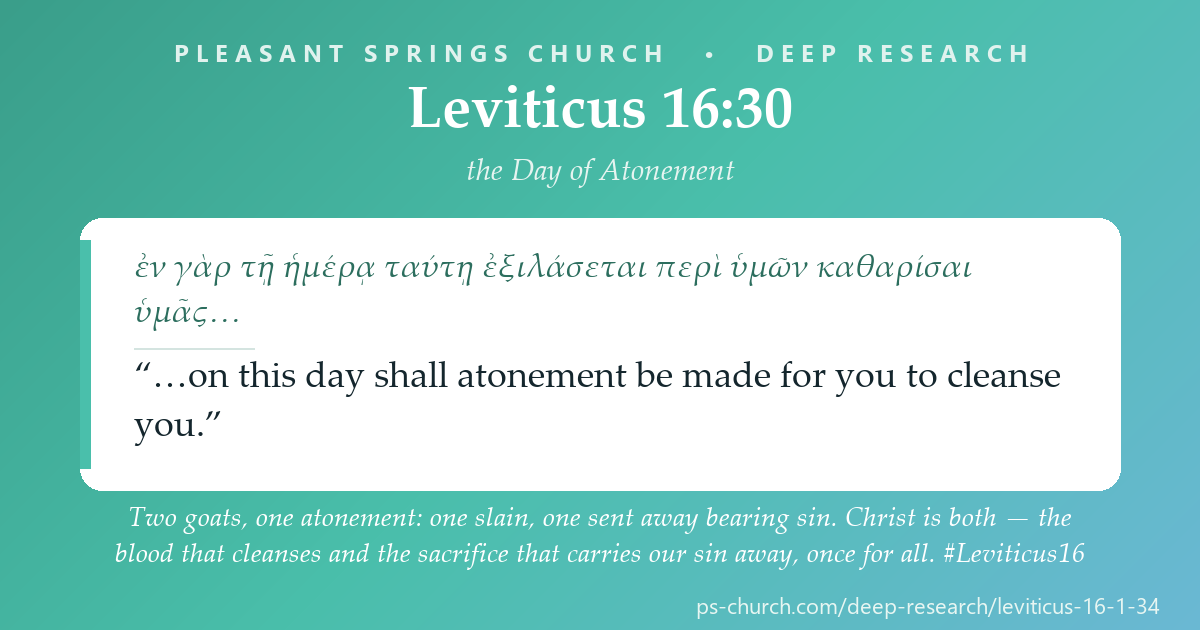
- Two goats, one atonement. The slain goat’s blood purges; the live goat removes. They are two facets of a single rite (both are taken “for a sin offering” for the congregation, 16:5), fulfilled together in Christ who both cleanses and carries sin away.
- ‘Azazel’ is genuinely uncertain — removal, place, or being. The demonic reading (from 1 Enoch) is a Second-Temple interpretation, not a claim of Leviticus itself; on any reading the goat is not an offering to a demon.
- Propitiation and cleansing. The rite both turns away wrath and wipes away defilement; the New Testament’s ἱλαστήριον / ἱλασμός language holds both together in Christ, without pitting them against each other.
From the mercy seat to the confidence of the cleansed.
Name what you learned, why it matters, and one concrete response.
What should we carry away — and do?
- Sin is real, and so is cleansing. The Day of Atonement takes guilt seriously — and provides a way to be made clean. God does not ignore sin; he covers it.
- Christ is both goats. He is the slain goat whose blood cleanses and the scapegoat who carries our sin away — “as far as the east is from the west.” What was repeated yearly, he finished once for all.
- Draw near with confidence. Because Jesus entered the true Most Holy Place with his own blood, we may “draw near with a true heart in full assurance of faith” (Heb 10:22). The veil is open.
Step in response: name a specific sin you keep carrying, and consciously hand it to the One who is your mercy seat and your scapegoat — not to be covered for a year, but taken away forever. Then live as one cleansed: draw near to God this week without hiding, in the confidence the blood of Christ has purchased.
Leviticus 16:30 · to share
LXX + ESVEvery Deep Research page traces its passage across the whole sweep — the Old Testament, the Second-Temple world between the testaments (historical witnesses, not Scripture), and the New Testament. Follow the thread:
Pleasant Springs Church — Deep Research
Research method after Michael S. Heiser’s Bible Research Method (examine dictionaries → ancient literature → important words → textual connections → academic publications → share), with the Pleasant Springs “Author & Audience” foundation. Scripture set in the Hebrew, the Greek editions named on each page and the ESV (Old Testament), and the Greek New Testament and the ESV (New Testament), per the practice of Pleasant Springs Church. Leviticus 16 research grounded in Wenham, Milgrom, and Rooker, with Beale & Carson on the New Testament use; ANE purification-rite background; Second-Temple material per 1 Enoch, Jubilees, the Mishnah, and Barnabas (read as witnesses, not Scripture).
Scripture quotations marked ESV are from the ESV® Bible (The Holy Bible, English Standard Version®), © 2001 by Crossway, a publishing ministry of Good News Publishers. ESV Text Edition: 2016. Used by permission. All rights reserved. The ESV text may not be quoted in any publication made available to the public by a Creative Commons license, and the ESV may not be translated in whole or in part into any other language. www.esv.org
|
Did this study bless you today? 💚 Give to Support PS Church100% of gifts go to the General Fund — thank you. |