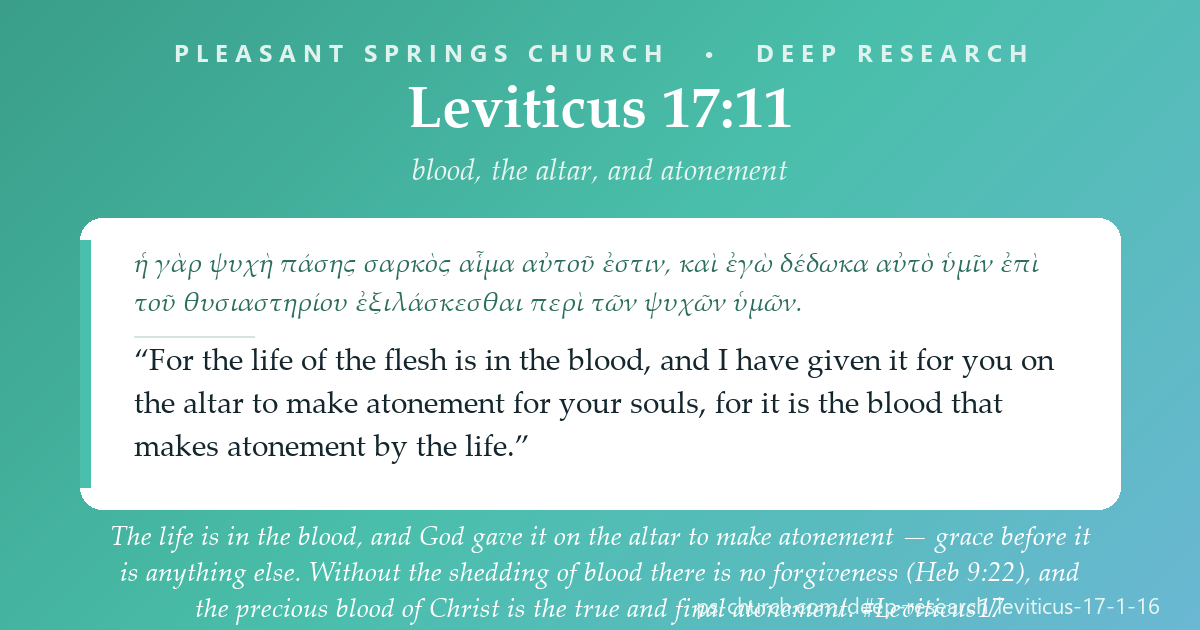
Blood belongs to God, because the life is in it. Leviticus 17 opens the Holiness Code by bringing every slaughter to one altar — ending the field-sacrifices that had drifted into feeding “goat demons” (17:7) — and then speaks the single most important sentence in the theology of sacrifice: “the life of the flesh is in the blood, and I have given it for you on the altar to make atonement” (17:11). This study works Leviticus 17:1–16, from the sacredness of blood to the day the true Lamb poured out his own — “without the shedding of blood there is no forgiveness” (Heb 9:22). See the method →
Leviticus 17:5–14 (selections)
Hebrew · LXX · ESVThe Shape of the Passage
Parallel panelsLeviticus 17 opens the Holiness Code (chs 17–26), the great block that follows the purity laws (ch 11) and the Day of Atonement (ch 16): now the whole people learns that its very life is bound up with blood, and blood belongs to God.
Author
The Torah of Moses sets chapter 17 as the hinge of the book. Chapters 1–16 have built the sacrificial system and cleansed the sanctuary on the Day of Atonement; chapters 17–26 — the “Holiness Code” — now press holiness out from the altar into every corner of Israel’s life: worship, blood, sexuality, justice, mercy, and the priesthood. The doorway into all of it is blood. Every slaughter is brought to one altar (17:1–9), every drop of blood is treated as sacred, because “the life of the flesh is in the blood” (17:11).
A polemic and a gift. The chapter has two edges. Negatively, it forbids the old open-field slaughter that slid into sacrificing to śəʿîrim, “goat demons” (17:7) — Israel is not to feed the powers of the wilderness. Positively, it gives the single most important sentence in the theology of sacrifice: blood is not a magical substance but a God-given means — “I have given it for you on the altar to make atonement” (17:11). Atonement is grace before it is anything else: the Lord himself provides the life that covers a life.
Audience
Israel — and, notably, “the strangers who sojourn among them” (17:8,10,13), for the blood law binds native and foreigner alike. A redeemed people is taught to hold life in awe: to eat flesh, but never its blood; to hunt game, but to pour the blood out and cover it (17:13). At every meal, life is honored and handed back to its Giver.
How they heard it. This was sober, weighty instruction. Blood meant life, and life belonged to God; to eat blood, or to spill sacrificial blood anywhere but the altar, was to seize what was his. Yet the same law that guarded blood also gave it: on the altar, the life of the victim stood in for the life of the worshipper. Israel learned that sin costs a life — and that God, in mercy, had appointed a life to be given in its place. The whole sacrificial system, and finally the cross, rests on this verse.
Orient on blood, atonement, sacrifice, and the goat demons.
Search by topic: blood, atonement, sacrifice, holiness, life / soul (nephesh), goat demons, Holiness Code.
Which articles are relevant?
- Anchor Bible Dictionary — “Blood,” “Atonement,” “Sacrifice,” “Holiness Code,” “Demons.”
- Dictionary of the OT: Pentateuch — “Blood,” “Atonement,” “Sacrifice and Offerings,” “Holiness.”
- NIDOTTE / TDOT — דָּם (dām, blood), נֶפֶשׁ (nep̄eš, life/soul), כָּפַר (kāp̄ar, atone), שָׂעִיר (śāʿîr, goat / goat demon).
Bibliography surfaced:
- Gordon Wenham (NICOT), Jacob Milgrom (AB), Mark Rooker (NAC) on Leviticus.
- Studies of nephesh-in-the-blood, the “life for a life” principle, and the meaning of kaphar.
- Beale & Carson, Commentary on the NT Use of the OT (Hebrews 9; Acts 15).
Blood, the wilderness demons, and the one altar.
Read the blood law against the ANE world of blood-rites and demons, weigh the centralization command, then follow the blood to the cross.
Which parallels shed light on religion and worldview?
Blood in the ancient world. Across the ancient Near East, blood was potent — poured out to feed gods and ghosts, smeared to ward off harm. Israel’s law shares the sense that blood is charged with life, but reframes it entirely: blood is not food for the gods and not a magic charge to be manipulated. It is life, and life belongs to the Lord alone. So it may be brought to one altar for atonement, and otherwise must be poured out and covered (17:13) — returned to God, never consumed.
The goat demons (śəʿîrim). Verse 7 exposes what the old open-field slaughter had become: sacrifice “to goat demons, after whom they whore.” The שְׂעִירִם were wilderness spirits (cf. Isa 13:21; 34:14), and later Israel is warned that its fathers “sacrificed to demons that were no gods” (Deut 32:17; cf. 2 Chron 11:15). Centralizing sacrifice at the tent of meeting was therefore not mere bureaucracy but worship-purity: it cut off a whole underworld of illicit devotion. The LXX makes the point in its own idiom, rendering “goat demons” as τοῖς ματαίοις, “the vain / worthless things” — idols that are nothing (see Paul and the Deuteronomy 32 Worldview).
- Deuteronomy 32:17; 2 Chronicles 11:15; Isaiah 13:21; 34:14 (Scripture) — the śəʿîrim / wilderness demons and Israel’s temptation to feed them.
- Jubilees 6:7–14; 7:28–33 (Pseudepigrapha — a witness, not Scripture) — an intense Second-Temple guarding of the blood prohibition, back to Noah.
- Temple Scroll (11Q19) 52–53; Damascus Document (Dead Sea Scrolls — witnesses, not Scripture) — Qumran’s strict rules on slaughter, blood, and covering it with dust.
- Josephus, Antiquities 3.260–262; Philo, Special Laws 1.205–211 (Second-Temple witnesses, not Scripture) — the blood ban explained: the soul is in the blood, so it is offered to God, not eaten.
The New Testament builds directly on Leviticus 17:11. If “the life of the flesh is in the blood” and God has given blood on the altar to atone, then Hebrews can state the principle it assumes: “without the shedding of blood there is no forgiveness of sins” (Heb 9:22). But the blood of bulls and goats was never the goal; it pointed forward. Christ, our great High Priest, “entered once for all into the holy places… by means of his own blood, thus securing an eternal redemption” (Heb 9:11–12), and the blood of Christ will “purify our conscience from dead works” where animal blood could not (Heb 9:14). Peter names it “the precious blood of Christ, like that of a lamb without blemish or spot” (1 Pet 1:18–19). At the table Jesus lifts the cup: “this is my blood of the covenant, which is poured out for many for the forgiveness of sins” (Matt 26:28). The life is in the blood — and the Life laid his own down, that a life given might cover our own.
The vocabulary of blood, life, and atonement.
Watch dam (blood) bound to nephesh (life), the atoning verb kaphar, and the śəʿîrim the law shuts out.
“Blood” — the key word of the chapter (LXX αἷμα). Not a magical fluid but the bearer of life; because life belongs to God, blood is never eaten and is given by God on the altar for atonement.
“Life / soul” — the living self (LXX ψυχή). “The nephesh of the flesh is in the blood”: blood and life are bound together, so a life is given on the altar for a life (17:11).
“To atone” — to cover / wipe clean / ransom (LXX ἐξιλάσκομαι). The blood makes atonement; the LXX’s ἀντὶ τῆς ψυχῆς (“in place of the life”) draws out the substitution the Hebrew implies.
“Goat demons” — wilderness spirits (cf. Isa 34:14); the old field-slaughter had drifted into sacrificing to them. The LXX reads τοῖς ματαίοις, “the vain idols” — powers that are nothing (Deut 32:17).
“To cut off” — the penalty for eating blood (yikkārēṯ; LXX ἐξολεθρεύω): removal from the covenant people. It measures how gravely Israel was to hold the sanctity of blood and life.
How the New Testament reuses Leviticus 17:
- Hebrews 9:11–14, 22 — “without the shedding of blood there is no forgiveness”; Christ entered the true holy place by his own blood.
- Matthew 26:28 — “this is my blood of the covenant, which is poured out for many for the forgiveness of sins” (Mark 14:24 records the same cup: “poured out for many”).
- 1 Peter 1:18–19; 1 John 1:7; Revelation 5:9 — ransomed by “the precious blood of Christ”; his blood “cleanses us from all sin.”
- Acts 15:19–29 — the Jerusalem Council asks Gentile believers to “abstain… from blood” — honoring Leviticus 17’s reverence for blood in the mixed church.
From the life in the blood to the blood of the new covenant.
Trace the blood-and-life principle from Noah, through the altar, to the cup of the new covenant.
Which cross-references matter?
- Genesis 9:4–6 — “you shall not eat flesh with its life, that is, its blood”: the blood law given to Noah, long before Sinai (see Genesis).
- Leviticus 1:5; 3:17; 16:14–19 — blood dashed on the altar in the burnt offering and peace offering, and carried within on the Day of Atonement.
- Deuteronomy 12:5–27; 32:17 — the one place of sacrifice, and the warning against “demons that were no gods.”
- Isaiah 53:10–12 — the Servant who makes “an offering for guilt” and “poured out his soul to death” (see Isaiah 52–53).
- Hebrews 9:22; Romans 3:25; Matthew 26:28; Acts 15:29 — blood, forgiveness, and the new covenant, fulfilled in Christ the true propitiation.
The New Testament treats Leviticus 17:11 as foundational, not incidental. Hebrews assumes it when it lays down the axiom “without the shedding of blood there is no forgiveness of sins” (9:22) — the very logic of 17:11, that a life must be given for a life. But the writer immediately turns from the shadow to the substance: the repeated animal blood “can never take away sins” (10:11), while Christ’s single self-offering “perfected for all time those who are being sanctified” (10:14). Paul, using the mercy-seat word, presents Jesus as the propitiation “by his blood” (Rom 3:25). And the Jerusalem Council’s request that Gentile Christians “abstain from blood” (Acts 15:29) shows the early church still honoring the reverence Leviticus 17 taught — not as a way of salvation, but as respect for the God who says the life is in the blood. What Israel poured out and covered, God himself gave: the life of his Son, poured out for many.
The scholarship on blood, atonement, and the Holiness Code.
Wenham and Milgrom for Leviticus; the atonement studies for “life for a life”; Beale & Carson for the NT use.
Commentaries & studies:
- Gordon J. Wenham, The Book of Leviticus (NICOT); Jacob Milgrom, Leviticus (Anchor); Mark F. Rooker (NAC).
- Studies of nephesh-in-the-blood and the meaning of kaphar (ransom / purge / cover); the “life for a life” principle.
- G. K. Beale & D. A. Carson, eds., Commentary on the New Testament Use of the Old Testament (Hebrews; Acts).
Interpretation notes worth keeping:
- Blood is life, not magic. The chapter’s reason for the blood ban is stated plainly: “the life of the flesh is in the blood” (17:11,14). Atonement works because God appointed it to, not because blood carries an automatic power; it is grace given, not force manipulated.
- ‘For a life’ — substitution. The Hebrew “makes atonement by / for the life” and the LXX’s ἀντὶ τῆς ψυχῆς (“in place of the life”) both carry the note of a life given for a life — the seed of substitutionary atonement the New Testament brings to flower.
- Centralization is worship-purity. Bringing all slaughter to one altar (17:1–9) is aimed at the goat demons of verse 7: exclusive, God-appointed worship, with no side-altars to the powers of the wilderness.
- Handle blood soberly. Leviticus 17 is weighty ground. It is not a curiosity of ancient ritual but the biblical root of how sin is covered — and it should be read with the reverence the subject asks, all the way to the cross.
From the life in the blood to the blood of Christ.
Name what you learned, why it matters, and one concrete response.
What should we carry away — and do?
- Life is sacred, and it belongs to God. The blood law teaches awe: life is not ours to seize. Even at the table, Israel honored the Giver of life. Reverence for life begins with reverence for the One who gives it.
- Atonement is a gift. “I have given it for you on the altar” (17:11). God is not extracting payment from a distance; he provides the very life that covers ours. Atonement is grace before it is anything else.
- The blood points to Christ. Every altar-death whispered that sin costs a life — and that God would one day give the Life. “The precious blood of Christ” (1 Pet 1:19) is where the whole system was always heading.
Step in response: read Leviticus 17:11 slowly, then Matthew 26:28 — and let the weight settle: the life is in the blood, and Christ poured out his own for you. Come to the Lord’s Table this week not casually but in wonder, receiving the atonement God gave, and living as one whose life was bought at that price.
Leviticus 17:11 · to share
LXX + ESVEvery Deep Research page traces its passage across the whole sweep — the Old Testament, the Second-Temple world between the testaments (historical witnesses, not Scripture), and the New Testament. Follow the thread:
Pleasant Springs Church — Deep Research
Research method after Michael S. Heiser’s Bible Research Method (examine dictionaries → ancient literature → important words → textual connections → academic publications → share), with the Pleasant Springs “Author & Audience” foundation. Scripture set in the Hebrew, the Greek editions named on each page and the ESV (Old Testament), and the Greek New Testament and the ESV (New Testament), per the practice of Pleasant Springs Church. Leviticus 17 research grounded in Wenham, Milgrom, and Rooker, with Beale & Carson on the New Testament use (Hebrews 9; Acts 15); the nephesh-in-the-blood and “life for a life” studies; the śəʿîrim read against Deuteronomy 32:17 and Isaiah 34:14. Second-Temple material per Jubilees, the Temple Scroll and Damascus Document, Josephus (Antiquities 3), and Philo (Special Laws 1), read as witnesses, not Scripture. Blood and atonement handled soberly; substitution drawn from the Hebrew “by the life” and the LXX’s ἀντὶ τῆς ψυχῆς, and grounded in the New Testament’s own readings (Heb 9:22; Matt 26:28; 1 Pet 1:19).
Scripture quotations marked ESV are from the ESV® Bible (The Holy Bible, English Standard Version®), © 2001 by Crossway, a publishing ministry of Good News Publishers. ESV Text Edition: 2016. Used by permission. All rights reserved. The ESV text may not be quoted in any publication made available to the public by a Creative Commons license, and the ESV may not be translated in whole or in part into any other language. www.esv.org
|
Did this study bless you today? 💚 Give to Support PS Church100% of gifts go to the General Fund — thank you. |