Of all the offerings, only one is eaten by the worshipper. The peace offering — zevach shelamim, from shalom — gives God the fat and the blood, the priests their portion, and the offerer and his family the rest, to be eaten in a joyful meal “before the Lord.” The altar becomes a table; reconciliation becomes a feast. This study works Leviticus 3:1–17 — the fat that is God’s, the blood that is life, and the fellowship that is the goal of atonement — toward its fulfillment: “we have peace with God through our Lord Jesus Christ” (Rom 5:1). See the method →
Leviticus 3:1, 5, 11, 16–17
Hebrew · LXX · ESVThe Shape of the Passage
Parallel panelsLeviticus opens the manual of worship begun when the glory filled the tabernacle (Exod 40). The five offerings of chapters 1–7 teach a sinful people how to draw near a holy God — and the third of them ends not in fear but at a table.
Author
The Torah of Moses sets the peace offering third in the sequence of chapters 1–7, after the burnt offering (total consecration, Lev 1) and the grain offering (dedicated work, Lev 2), and before the sin and guilt offerings (purification and reparation, Lev 4). Its placement is deliberate: consecration and dedication lead to communion. The Hebrew name is zevach shelamim — a “sacrifice of peace / well-being,” built on the root shalom. The older English “peace offering” and the newer “fellowship offering” both reach for the same thing: a sacrifice that expresses and enjoys being at peace with God.
A meal, not just a rite. Every other offering is wholly burned or eaten only by the priests. The peace offering alone is shared: God receives the fat and blood on the altar; the priests receive the breast and thigh (7:31–34); and the worshipper and his household receive the rest, to be eaten “before the Lord” in gladness (7:15–18; Deut 12:7). The chapter’s repeated refrain — the fat burned as “a food offering with a pleasing aroma” — and its closing statute (“you shall eat neither fat nor blood,” 3:17) frame a table where God and his people feast together, each portion honoring who he is.
Audience
Israel — a redeemed people learning that the goal of sacrifice is not merely pardon but peace. The peace offering was brought for thanksgiving, in fulfillment of a vow, or as a freewill gift of joy (7:11–16); it accompanied covenant ratifications, festivals, and homecomings. To eat it was to sit at God’s table as a reconciled friend, not a trembling stranger. The provision that it could come from herd or flock, male or female, opened the feast wide — grace makes room.
How they heard it. After the blood of the burnt and sin offerings had done its cleansing work, the peace offering was the celebration — the family meal of the covenant. Israel learned that reconciliation issues in fellowship: sin dealt with, wrath turned away, the worshipper is not merely dismissed but invited to dinner. And the two permanent restrictions taught reverence even in joy: the richest part (the fat) is God’s alone, and the blood is never common food, for “the life of the flesh is in the blood” and by it atonement is made (17:11). Peace with God is a feast — but it is a holy feast.
Orient on the peace / fellowship offering, shalom, fat and blood, and the sacrificial meal.
Search by topic: peace offering, fellowship offering, sacrifice, shalom / peace, fat (chelev), blood, thanksgiving and vow offerings, communion meal.
Which articles are relevant?
- Anchor Bible Dictionary — “Sacrifice and Sacrificial Offerings,” “Peace Offering,” “Meals,” “Blood.”
- Dictionary of the OT: Pentateuch — “Sacrifices and Offerings,” “Peace Offering / Fellowship Offering,” “Priests and Levites,” “Holiness.”
- NIDOTTE / TDOT — שֶׁלֶם / שְׁלָמִים (shelem / shelamim, peace offering), שָׁלוֹם (shalom, peace), חֵלֶב (chelev, fat), דָּם (dam, blood).
Bibliography surfaced:
- Gordon Wenham (NICOT), Jacob Milgrom (AB), Mark Rooker (NAC), Baruch Levine (JPS) on Leviticus.
- Studies of the shelamim as the shared “communion” sacrifice; the thanksgiving, vow, and freewill sub-types (Lev 7:11–16).
- Beale & Carson, Commentary on the NT Use of the OT (Hebrews; 1 Corinthians 10).
The shared sacrificial meal, the fat for the deity, and the blood held sacred.
Read the shelamim against the ancient world’s communion sacrifices, then follow the meal, the fat, and the blood to the New Testament’s table.
Which parallels shed light on religion and worldview?
The communion sacrifice. Across the ancient Near East, a class of sacrifice was not wholly burned but shared — the deity received a portion (often the fat and the aromatic smoke), and the worshippers ate the rest in a sacred meal. The Ugaritic ritual texts even name a shlmm offering, cognate to Hebrew shelamim. Leviticus works within this cultural furniture but reframes it: the meal is before the Lord, not a feeding of a hungry god (Ps 50:12–13); the portions are assigned by holy statute, not appetite; and the whole act flows from covenant peace already established, not a bribe to secure it.
The fat and the blood. Two portions are permanently withheld from the human diet, and the chapter says so twice (3:16–17). The fat (chelev) — the rich suet around the organs — was reckoned the choicest part; to burn it was to give God the best, not the leftovers (cf. Mal 1:8). The blood was never eaten because “the life of the flesh is in the blood,” and God had reserved it “to make atonement” (Lev 17:11, 14). So even the celebration meal is bounded by reverence: the best belongs to God, and life itself is sacred and not to be treated as common food.
A meal that says ‘reconciled.’ In Scripture, to eat together is to be at peace — covenants were sealed over food (Gen 31:54; Exod 24:11, where the elders “beheld God, and ate and drank”). The peace offering makes the sacrificial altar a table: sin has been dealt with by the other offerings, and now the forgiven sit down to eat in God’s presence. The goal of atonement was never mere acquittal; it was shalom — wholeness, welcome, and fellowship restored.
- Ugaritic ritual texts (shlmm offerings) — a cognate communion sacrifice: shared cultural furniture, reframed under covenant in Leviticus.
- Exodus 24:9–11; Genesis 31:54; Deuteronomy 12:7, 17–18 — covenant sealed and enjoyed at a meal in God’s presence (see the blood of the covenant).
- Mishnah, Zevachim (rabbinic-era) — the detailed procedure of the shelamim: what is burned, what the priests receive, what the owner eats, and by when.
- Josephus, Antiquities 3.9; Philo, Special Laws 1 — the “thank / preservation” offering (Philo’s σωτήριον) described for a Greek-reading audience: the shared, joyful sacrifice.
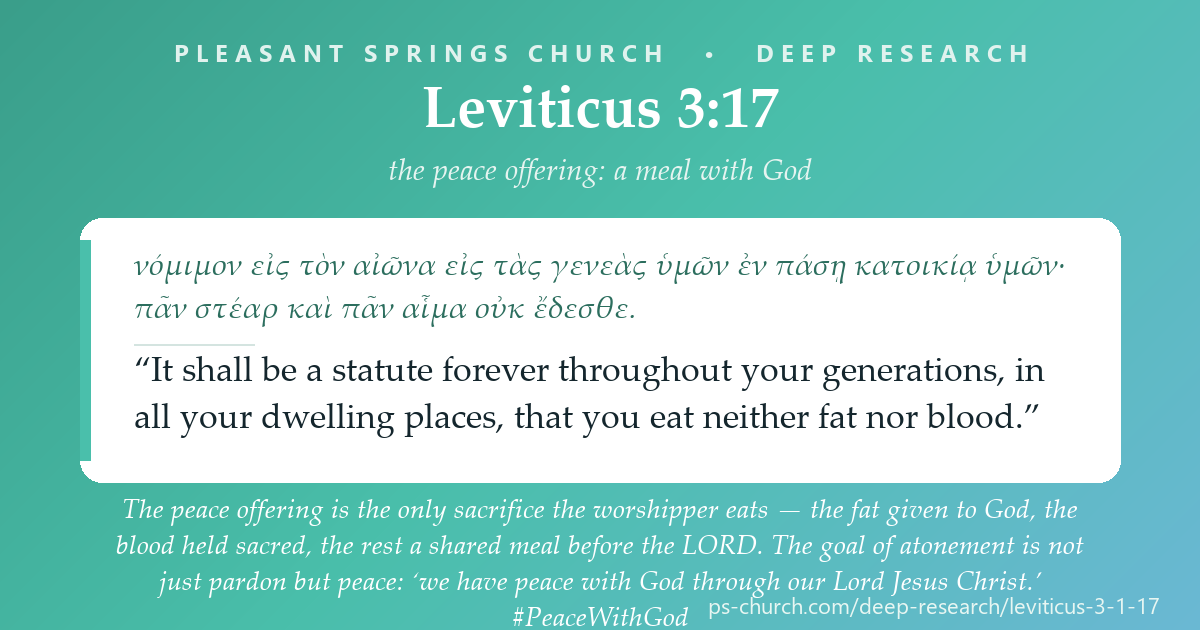
The peace offering is the only sacrifice the worshipper eats — and that is its whole theology. The burnt offering ascends entirely to God; the sin offering purges; but the shelamim ends in a meal, the reconciled family of the covenant seated before the Lord. The New Testament gathers up exactly this note. Paul says of Israel’s worship, “Consider the people of Israel: are not those who eat the sacrifices participants in the altar?” (1 Cor 10:18) — and sets the Lord’s Supper in the same key: “The cup of blessing that we bless, is it not a participation in the blood of Christ?” (1 Cor 10:16). Because “we have peace with God through our Lord Jesus Christ” (Rom 5:1), his people are not merely pardoned but welcomed to eat — and the whole story runs toward a final feast, “the marriage supper of the Lamb” (Rev 19:9). Held as devotional analogy, not strict exegesis: the peace offering’s shape is unmistakable — atonement ends in table-fellowship, and the goal of the cross is not only forgiveness but shalom.
The vocabulary of peace, the shared meal, the fat, and the blood.
Watch shelamim (peace offering) rooted in shalom, the chelev (fat) that is God’s alone, the dam (blood) that is never eaten, and the “pleasing aroma” that ascends.
“Peace / fellowship offering” — from the root shalom. The shared sacrifice of well-being; the LXX renders it θυσία σωτηρίου, a “sacrifice of deliverance / salvation.” The only offering the worshipper eats.
“Peace” — not mere absence of conflict but wholeness, welfare, and restored relationship. The peace offering both declares and enjoys peace with God: the goal of atonement is shalom (cf. Rom 5:1; Eph 2:14).
“Fat” — the rich suet around the organs, reckoned the choicest portion. Burned to God, never eaten: “all fat is the Lord’s” (3:16). The best belongs to him (cf. Mal 1:8).
“Blood” — never eaten, for “the life of the flesh is in the blood” and God reserved it “to make atonement” (Lev 17:11, 14). Even at the feast, life is held sacred.
“Food offering / offering by fire” — the fat given up in smoke. The Hebrew calls it לֶחֶם (lechem, “food / bread”), God’s portion on the altar; the LXX renders it κάρπωμα.
“A pleasing aroma” — the smoke that ascends and is received with favor (Gen 8:21; Lev 1:9); the LXX’s ὀσμὴ εὐωδίας, echoed of Christ’s self-offering (Eph 5:2).
How the New Testament takes up the peace-offering meal:
- Romans 5:1 — “we have peace with God through our Lord Jesus Christ”: the reality the shelamim pictured (see Romans 5:1–11).
- 1 Corinthians 10:16–18 — those who eat the sacrifices are “participants in the altar”; the cup is “a participation in the blood of Christ”: the covenant meal renewed.
- Ephesians 2:14–17 — Christ “himself is our peace,” who came and “preached peace”: the peace offering personified (see Ephesians 2).
- Ephesians 5:2; Hebrews 13:15–16; 1 Peter 2:5 — Christ’s self-offering “a fragrant offering”; the church’s answering “spiritual sacrifices” of praise and mercy.
From the altar-table of Israel to the Lord's Supper and the marriage feast.
Trace the shared meal, the peace, and the reserved blood from Leviticus through the Gospels to the wedding supper of the Lamb.
Which cross-references matter?
- Leviticus 7:11–18, 28–34 — the peace offering’s three occasions (thanksgiving, vow, freewill) and its portions: what is burned, given to the priests, and eaten by the worshipper (the sibling manual, Lev 6:8–7:38).
- Leviticus 17:11 — “the life of the flesh is in the blood… it is the blood that makes atonement”: why the blood is never eaten.
- Exodus 24:9–11 — the covenant sealed with peace offerings, the elders eating and drinking in God’s presence (see Exodus 24).
- Deuteronomy 12:7, 17–18; 27:7 — “there you shall eat before the Lord your God and rejoice”: the feast as covenant joy.
- 1 Corinthians 10:16–18; Luke 22:19–20; Revelation 19:9 — the Lord’s Supper as the covenant meal; the marriage supper of the Lamb: the feast’s furthest horizon.
Where the Day of Atonement (Lev 16) shows how guilt is purged and carried away, the peace offering shows what atonement is for: fellowship. The New Testament reads both together. Hebrews declares the animal sacrifices fulfilled and rendered obsolete for atonement — “it is impossible for the blood of bulls and goats to take away sins” (Heb 10:4), while Christ “offered for all time a single sacrifice for sins” (Heb 10:12). The church therefore no longer repeats the offerings; it brings “a sacrifice of praise” and the spiritual sacrifices of doing good and sharing (Heb 13:15–16; 1 Pet 2:5; Rom 12:1). Yet the peace offering’s distinctive note — the reconciled eating in God’s presence — is not abolished but transfigured: Paul sets the Lord’s Supper in its very frame (1 Cor 10:16–18), and John hears its final echo in “the marriage supper of the Lamb” (Rev 19:9). Peace with God (Rom 5:1) does not end at the courtroom door; it seats the forgiven at the table.
The scholarship on the peace / fellowship offering.
Wenham, Milgrom, Rooker, and Levine for Leviticus; the studies of the shelamim and the communion meal; Beale & Carson for the NT use.
Commentaries & studies:
- Gordon J. Wenham, The Book of Leviticus (NICOT); Jacob Milgrom, Leviticus (Anchor); Mark F. Rooker (NAC); Baruch A. Levine (JPS).
- Studies of the shelamim / communion sacrifice, its Ugaritic cognate, and its sub-types (thanksgiving, vow, freewill; Lev 7:11–16).
- G. K. Beale & D. A. Carson, eds., Commentary on the New Testament Use of the Old Testament (1 Corinthians 10; Hebrews).
Interpretation notes worth keeping:
- ‘Peace’ or ‘fellowship’? The name (shelamim, from shalom) has been rendered “peace,” “well-being,” and “fellowship” offering — each catching a facet of a sacrifice that both declares peace with God and is enjoyed in shared communion.
- Male or female, herd or flock. Unlike the burnt offering’s male animal, the peace offering admits either sex (3:1, 6) — the freewill gift of a thankful heart, its scope kept generously open.
- The fat as God’s portion. Burning the chelev is not disposal but honor: the richest part ascends to God. The standing statute (3:17) guards the principle — the best is his.
- Devotional analogy, disciplined. Lord’s-Supper and marriage-feast readings of the peace offering are rich and rest on the New Testament’s own moves (1 Cor 10:16–18; Rev 19:9); hold them as resonance built on real textual patterns, not the chapter’s literal sense — the house discipline for typology throughout this library.
From the altar-table to peace with God enjoyed as a feast.
Name what you learned, why it matters, and one concrete response.
What should we carry away — and do?
- Atonement ends at a table. The goal of sacrifice is not merely pardon but peace — the reconciled sit down to eat before the Lord. Forgiveness is the door; fellowship is the room.
- Give God the best. The fat is the Lord’s — the richest portion, not the leftovers. Peace with God is celebrated by honoring him with our finest, in gladness and thanks.
- We have peace with God. What the shelamim pictured, Christ secured: “we have peace with God through our Lord Jesus Christ” (Rom 5:1). The feast has a final table — the marriage supper of the Lamb.
Step in response: receive your peace with God as an invitation to the table, not just a verdict of acquittal — come to the Lord’s Supper this week as a reconciled member of the family, and turn your thanksgiving into an act of shared joy: a meal opened to someone lonely, a gift given in gladness, the “spiritual sacrifice” of praise and generosity (Heb 13:15–16). Peace with God issues in a feast — live as one already seated.
Leviticus 3:17 · to share
LXX + ESVEvery Deep Research page traces its passage across the whole sweep — the Old Testament, the Second-Temple world between the testaments (historical witnesses, not Scripture), and the New Testament. Follow the thread:
Pleasant Springs Church — Deep Research
Research method after Michael S. Heiser’s Bible Research Method (examine dictionaries → ancient literature → important words → textual connections → academic publications → share), with the Pleasant Springs “Author & Audience” foundation. Scripture set in the Hebrew, the Greek editions named on each page and the ESV (Old Testament), and the Greek New Testament and the ESV (New Testament), per the practice of Pleasant Springs Church. Leviticus 3 research grounded in Wenham, Milgrom, Rooker, and Levine, with Beale & Carson on the New Testament use; the shelamim read against ANE communion sacrifices (incl. the Ugaritic shlmm) and the covenant meal (Exod 24:11; Deut 12:7); the fat as God’s honored portion and the blood reserved for atonement (Lev 17:11); the offerings understood as God-given types and shadows fulfilled and rendered obsolete for atonement by the once-for-all sacrifice of Christ (Heb 10:1–14), the church now offering spiritual sacrifices of praise and mercy (Heb 13:15–16; 1 Pet 2:5; Rom 12:1); and the Lord’s-Supper and marriage-feast readings held as devotional analogy on real textual patterns (1 Cor 10:16–18; Rev 19:9), not the literal sense — per the house discipline for typology.
Scripture quotations marked ESV are from the ESV® Bible (The Holy Bible, English Standard Version®), © 2001 by Crossway, a publishing ministry of Good News Publishers. ESV Text Edition: 2016. Used by permission. All rights reserved. The ESV text may not be quoted in any publication made available to the public by a Creative Commons license, and the ESV may not be translated in whole or in part into any other language. www.esv.org
|
Did this study bless you today? 💚 Give to Support PS Church100% of gifts go to the General Fund — thank you. |