After the burnt offering of a whole animal comes the one bloodless sacrifice in the list: the grain offering (minchah, “gift, tribute”) — fine flour with oil and frankincense, or baked cakes, or roasted firstfruits. A single handful, the “memorial portion,” is burned; the rest feeds the priests. No leaven and no honey may go up in smoke, but salt — “the salt of the covenant of your God” — belongs on every offering. Grain is the fruit of human labor, so this offering lays a life’s ordinary work and daily bread on the altar. This study works Leviticus 2:1–16 — the gift of a life’s work — toward the New Testament’s “living sacrifice” and the true Bread. See the method →
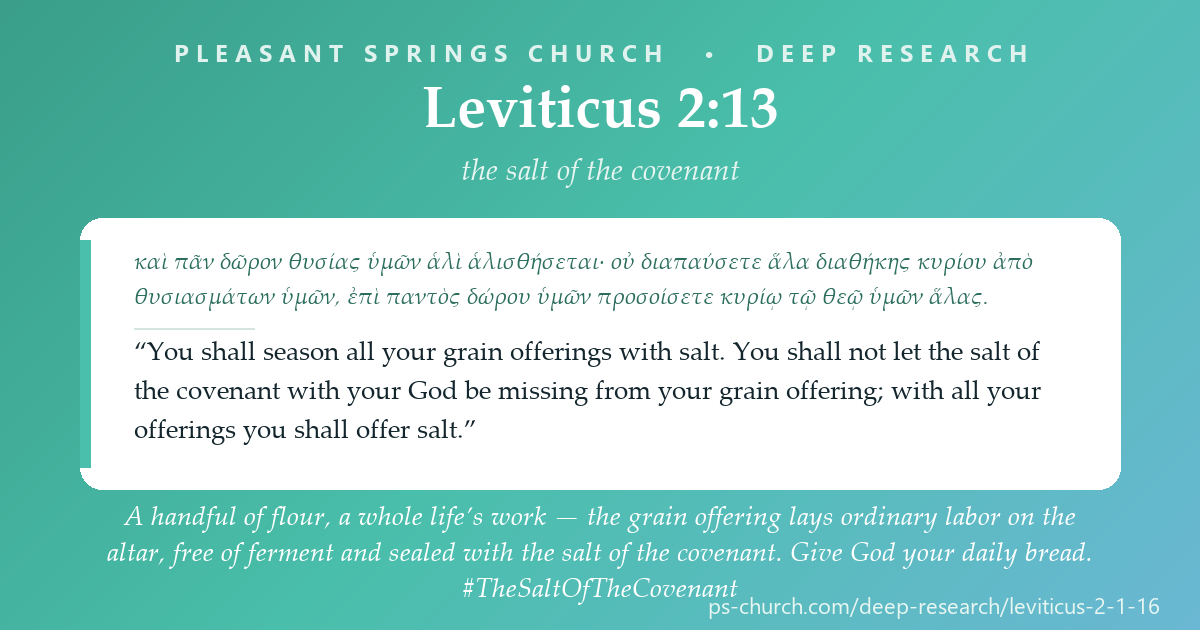
Leviticus 2:1, 2, 11, 13
Hebrew · LXX · ESVThe Shape of the Passage
Parallel panelsLeviticus opens the manual of offerings in order: the burnt offering of total consecration (ch. 1), then the grain offering of dedicated labor (ch. 2). Worship is not only blood; it is also the giving of our work.
Author
The Torah of Moses sets Leviticus 2 as the second of five offerings (chs 1–7), spoken from the tent that the glory has just filled (Exod 40:34–38). After the burnt offering’s whole animal (ch. 1) comes the grain offering — the only bloodless sacrifice in the list. It is not an atonement for sin (that is chs 4–5) but a gift: מִנְחָה (minḥâ) is the ordinary Hebrew word for the tribute a subject brings a king or a lesser brings a greater (Gen 32:13; Judg 3:15). Israel brings the Lord the produce of the promised land — flour, oil, frankincense, firstfruit grain — and he receives it.
A designed grammar of worship. The chapter is carefully patterned: three forms of the offering (uncooked flour, baked cakes, roasted firstfruits), one rule for all of them (a handful burned as the memorial portion, the rest to the priests), and two prohibitions with one requirement — no leaven, no honey; always salt. Each detail teaches. The token handful stands for the whole gift; the ban on ferment guards the offering from corruption and haste; the salt binds every sacrifice to the covenant. Leviticus is teaching a redeemed people how to draw near — and how to give.
Audience
Israel — a farming people whose daily bread came the hard way: plowing, sowing, reaping, threshing, grinding, kneading, baking. The grain offering took exactly that labor and laid it on the altar. It said that worship is not confined to the dramatic and the bloody; the Lord receives the fruit of ordinary work, the sweat of the field and the flour of the kitchen, as “a pleasing aroma” (2:2). And because the priests lived on what was offered (2:3, 10), the gift of the worshiper became the bread of those who served the altar (cf. Num 18:8–9).
How they heard it. The grain offering came within reach of everyone. A household that could not afford a bull or a lamb could still bring a handful of flour, a few cakes, some parched grain — and be fully received. Provision scaled to the poor is provision that excludes no one; the same grace runs through the whole book (5:11; 12:8). Israel learned that God is honored not only by the costly animal but by the consecrated ordinary — and that the covenant, salted into every gift, endures.
Orient on the grain offering, the memorial portion, leaven/honey, and the covenant of salt.
Search by topic: grain / cereal / meal offering, minchah, sacrifice and offerings, memorial portion, leaven, salt, firstfruits, priests’ portions.
Which articles are relevant?
- Anchor Bible Dictionary — “Sacrifice and Offerings,” “Cereal Offering,” “Leaven,” “Salt,” “Firstfruits.”
- Dictionary of the OT: Pentateuch — “Sacrifices and Offerings,” “Grain Offering,” “Priests and Levites,” “Holiness.”
- NIDOTTE / TDOT — מִנְחָה (minḥâ, gift/tribute/grain offering), אַזְכָּרָה (ʾazkārâ, memorial portion), סֹלֶת (sōleṯ, fine flour), מֶלַח (melaḥ, salt).
Bibliography surfaced:
- Gordon Wenham (NICOT), Jacob Milgrom (AB), Mark Rooker (NAC) on Leviticus.
- Studies of the minḥâ as tribute-gift; the ʾazkārâ (“memorial / token”) portion; the “covenant of salt” (Num 18:19; 2 Chr 13:5).
- Beale & Carson, Commentary on the NT Use of the OT (Hebrews; the spiritual-sacrifice texts).
Tribute-gifts, the token portion, ferment, and the covenant of salt.
Read the grain offering against ancient gift and tribute custom, the meaning of the “memorial” handful, and the covenant symbolism of salt; then follow the theme to the New Testament’s spiritual sacrifices.
Which parallels shed light on religion and worldview?
Tribute laid before the King. Across the ancient Near East, subjects brought their sovereign a minḥâ — a gift of homage, often grain, oil, and produce — acknowledging his lordship and their dependence. Israel’s grain offering takes that everyday grammar and turns it toward the Lord: the produce of the land he gave is brought back to him as tribute. But it is more than a tax. It is the consecration of labor — the plowing and reaping and grinding of a whole agricultural life — laid on the altar as worship. Where the burnt offering gives a life, the grain offering gives a life’s work.
The token that stands for the whole. Only a handful is burned — the אַזְכָּרָה (ʾazkārâ), the “memorial” or “token” portion (LXX μνημόσυνον) — while the rest feeds the priests. The part represents the whole: in giving God the handful, the worshiper gives him everything the offering represents. It is the logic of the tithe and the firstfruit — a consecrated token that hallows the entire harvest and the whole of life behind it (Prov 3:9; Rom 11:16).
No ferment; always salt. Leaven (שְׂאֹר) and honey (דְּבַשׁ) both ferment and sour; neither may go up in smoke on the altar (2:11) — the fire-gift is to be free of corruption and of the quick swelling that stands, in Scripture’s later imagery, for the puffing of sin (cf. 1 Cor 5:6–8). Salt is the opposite: it preserves. “The salt of the covenant of your God” (2:13) invokes a known idiom — a “covenant of salt” is an enduring, unbreakable bond (Num 18:19; 2 Chr 13:5). Salt on every offering seals each gift into the permanence of God’s covenant loyalty.
- Josephus, Antiquities 3.9 — describes the grain (fine-flour) offerings and the priests’ portions of the Second-Temple sacrificial system.
- Philo, Special Laws 1.271–272 — reads the fine flour and the ban on leaven and honey morally: the offerer’s life is to be free of the “swelling” of pride and the mere sweetness of pleasure.
- Mishnah, Menachot (rabbinic-era) — the tractate that preserves the detailed law of the grain offerings; on salt, cf. Menachot 21.
- Jubilees 21:10–11 (Pseudepigrapha — a witness, not Scripture) — Abraham charges Isaac, “on all thy oblations thou shalt strew salt… let not the salt of the covenant be lacking”: a Second-Temple echo of Leviticus 2:13.
The New Testament does not repeat the grain offering; it fulfills and transposes it. Because Christ “offered for all time a single sacrifice for sins” (Heb 10:12), the church no longer brings flour to an altar for atonement — but it does bring the very thing the grain offering pictured: the consecration of ordinary life and labor. Paul makes the whole redeemed person the offering — “present your bodies as a living sacrifice, holy and acceptable to God, which is your spiritual worship” (Rom 12:1) — and Hebrews names the church’s continuing sacrifices as “a sacrifice of praise… the fruit of lips” and “to do good and to share what you have” (Heb 13:15–16; cf. 1 Pet 2:5, “spiritual sacrifices acceptable to God through Jesus Christ”). The daily bread of a working life, given to God, is worship still. And the church has long heard, as devotional analogy, a deeper resonance: Jesus is “the bread of life” (John 6:35), the true grain that “falls into the earth and dies” and so “bears much fruit” (John 12:24) — the offered life that feeds the world.
The vocabulary of the gift: tribute, fine flour, the token portion, and the salt of the covenant.
Watch minḥâ (gift/tribute), the ʾazkārâ that becomes μνημόσυνον, the ban on ferment, and the covenant sealed in salt.
“Grain offering” — literally a gift or tribute (the same word for the present Jacob sent Esau, Gen 32:13). The bloodless offering of produce and labor, homage brought to the King; LXX θυσία / δῶρον.
“Fine flour” — the best, most finely sifted flour (LXX σεμίδαλις). Not raw grain but grain worked — the fruit of harvesting and grinding, given at its finest.
“Memorial portion” — the token handful burned on the altar (from zākar, “remember”; LXX μνημόσυνον). The part God receives stands for the whole gift: in the handful, everything is given.
“Frankincense” — costly aromatic resin laid on the offering and burned with the memorial portion; its rising fragrance a picture of prayer and acceptance (cf. Ps 141:2; Rev 8:3–4).
“Leaven / honey” — both ferment; neither may be burned on the altar. The fire-gift is kept from corruption and from mere sweetness — later a figure of unpurged sin (1 Cor 5:6–8).
“Salt of the covenant” — required on every offering. Salt preserves; a “covenant of salt” is an enduring, unbreakable bond (Num 18:19; 2 Chr 13:5). Every gift is sealed into God’s abiding covenant.
How the rest of Scripture fills out the grain offering:
- Numbers 18:8–19; Deuteronomy 18:1–5 — those who serve the altar live from the offerings; “a covenant of salt forever” (Num 18:19). Fulfilled in principle at 1 Corinthians 9:13–14 — “those who proclaim the gospel should get their living by the gospel.”
- Leviticus 5:11–13; 12:8 — the offering scaled to the poor: a handful of flour, or two birds, fully accepted (see the sin offering). Grace excludes no one.
- Romans 12:1; Hebrews 13:15–16; 1 Peter 2:5; Philippians 4:18 — the church’s “spiritual sacrifices”: bodies presented, praise offered, good done and shared, gifts “a fragrant offering” (see the self-emptying of Christ).
- Mark 9:49–50; Matthew 5:13; Colossians 4:6 — “have salt in yourselves”; “you are the salt of the earth”: the covenant of salt drawn into discipleship (devotional).
From the handful on the altar to the living sacrifice and the true bread.
Trace the consecrated gift, the covenant of salt, and the priests’ portion toward their New Testament fulfillment.
Which cross-references matter?
- Leviticus 1; 3; 4–5 — the grain offering in the order of the five: after the burnt offering of total consecration, before the peace offering of fellowship and the sin and guilt offerings of purification and reparation.
- Exodus 29:38–41 — grain and oil accompany the daily burnt offering at the altar of ordination (see the ordination of the priests): the grain offering woven into Israel’s daily worship.
- Numbers 18:19; 2 Chronicles 13:5 — the “covenant of salt”: an enduring, unbreakable bond, sealed into every gift (2:13).
- Leviticus 16 — the whole system of offerings finds its yearly climax in the Day of Atonement, and its once-for-all fulfillment in Christ.
- Romans 12:1; Hebrews 13:15–16; John 6:35; 12:24 — the living sacrifice, the sacrifice of praise, and the true bread that falls into the earth and dies.
The grain offering guards a truth the church is always in danger of forgetting: that God receives the ordinary. Israel’s worship was not only the dramatic shedding of blood; it was also a handful of flour — the end of a long, unglamorous chain of labor: someone plowed, someone sowed, someone waited on the rain, someone reaped and threshed and winnowed and ground and kneaded and baked. All of that field-work and kitchen-work went up as “a pleasing aroma to the Lord.” The New Testament universalizes it: the believer’s body, work, words, and generosity become the continuing offering (Rom 12:1; Heb 13:15–16), because the one sacrifice that atones has already been made. So the Christian mason and mother and clerk and farmer do not leave worship at the church door; they carry the altar into Monday. The salt of the covenant is on it — the work is bound to a bond that endures — and the leaven is kept out: no corruption, no shortcut, no swelling self-display. What the grain offering asked of Israel, the gospel asks of the church: give God your daily bread, the fruit of your labor, consecrated and whole, in the name of the One who is himself the Bread of life.
The scholarship on the grain offering.
Wenham and Milgrom for Leviticus and the sacrificial system; the studies of the minchah, the memorial portion, and the covenant of salt; Beale & Carson for the New Testament use.
Commentaries & studies:
- Gordon J. Wenham, The Book of Leviticus (NICOT); Jacob Milgrom, Leviticus 1–16 (Anchor); Mark F. Rooker (NAC).
- Studies of the minḥâ as tribute-gift, the ʾazkārâ (“memorial / token”) portion, and the “covenant of salt” idiom.
- G. K. Beale & D. A. Carson, eds., Commentary on the New Testament Use of the Old Testament.
Interpretation notes worth keeping:
- ‘Memorial portion’ (ʾazkārâ). Best taken as the token handful that represents the whole offering (and, some argue, that brings the worshiper to God’s “remembrance” in a good sense). The part given hallows the whole.
- The leaven / honey ban. Both are agents of fermentation; the point is not that they are evil (leavened bread and honey are elsewhere gifts, 2:12; 7:13) but that what is burned on the altar must be free of ferment — a purity requirement, later read morally (1 Cor 5:6–8).
- The covenant of salt. Salt’s preserving permanence made it a natural seal of covenants (Num 18:19; 2 Chr 13:5). On every offering it declared each gift bound to God’s abiding faithfulness.
- Provision for the priests. The grain offering is “most holy” and largely eaten by the priests (2:3, 10); the worshiper’s gift becomes the servants’ bread — a principle Paul applies to gospel ministry (1 Cor 9:13–14).
- Typology, labeled. The bread / grain-and-Christ readings (John 6; 12:24) are homiletically rich devotional analogy grounded in Jesus’ own words — held as resonance, not as the chapter’s literal sense, per the house discipline for typology.
From a handful of flour to a life laid on the altar.
Name what you learned, why it matters, and one concrete response.
What should we carry away — and do?
- Worship includes your work. The grain offering took the fruit of ordinary labor — plowing, grinding, baking — and laid it on the altar. God receives the consecrated ordinary, not only the dramatic.
- The token gives the whole. A single handful, the memorial portion, stood for the entire gift. Give God the “handful” — the firstfruit, the tithe, the first hour — and the whole is hallowed.
- Salt, not ferment. Keep the offering free of the leaven of shortcut and self-display; salt it with covenant loyalty that endures. And remember: the offering came within reach of the poor — grace excludes no one.
Step in response: take one piece of your ordinary work this week — a task, a shift, a chore, a paycheck — and consciously offer it to God before you begin, as a grain offering: the fruit of your labor, given whole, salted with faithfulness, in the name of the One who is the true Bread. Then let a “handful” of it — time, money, or strength — go to feed those who serve at the altar and those in need (Heb 13:16).
Leviticus 2:13 · to share
LXX + ESVEvery Deep Research page traces its passage across the whole sweep — the Old Testament, the Second-Temple world between the testaments (historical witnesses, not Scripture), and the New Testament. Follow the thread:
Pleasant Springs Church — Deep Research
Research method after Michael S. Heiser’s Bible Research Method (examine dictionaries → ancient literature → important words → textual connections → academic publications → share), with the Pleasant Springs “Author & Audience” foundation. Scripture set in the Hebrew, the Greek editions named on each page and the ESV (Old Testament), and the Greek New Testament and the ESV (New Testament), per the practice of Pleasant Springs Church. Leviticus 2:1–16 research grounded in Wenham, Milgrom, and Rooker, with Beale & Carson on the New Testament use; the minḥâ read as a tribute-gift consecrating ordinary labor, the ʾazkārâ (2:2; LXX μνημόσυνον) as the token portion standing for the whole, the ban on ferment and the “covenant of salt” (2:11, 13; Num 18:19; 2 Chr 13:5) as purity and enduring loyalty; Second-Temple material per Josephus (Ant. 3.9), Philo (Spec. Laws 1.271–272), the Mishnah (Menachot), and Jubilees 21 (read as witnesses, not Scripture); and the fulfillment in Christ’s once-for-all sacrifice and the church’s “spiritual sacrifices” (Rom 12:1; Heb 13:15–16; 1 Pet 2:5) held with the bread-of-life reading (John 6; 12:24) as devotional analogy, per the house discipline for typology.
Scripture quotations marked ESV are from the ESV® Bible (The Holy Bible, English Standard Version®), © 2001 by Crossway, a publishing ministry of Good News Publishers. ESV Text Edition: 2016. Used by permission. All rights reserved. The ESV text may not be quoted in any publication made available to the public by a Creative Commons license, and the ESV may not be translated in whole or in part into any other language. www.esv.org
|
Did this study bless you today? 💚 Give to Support PS Church100% of gifts go to the General Fund — thank you. |