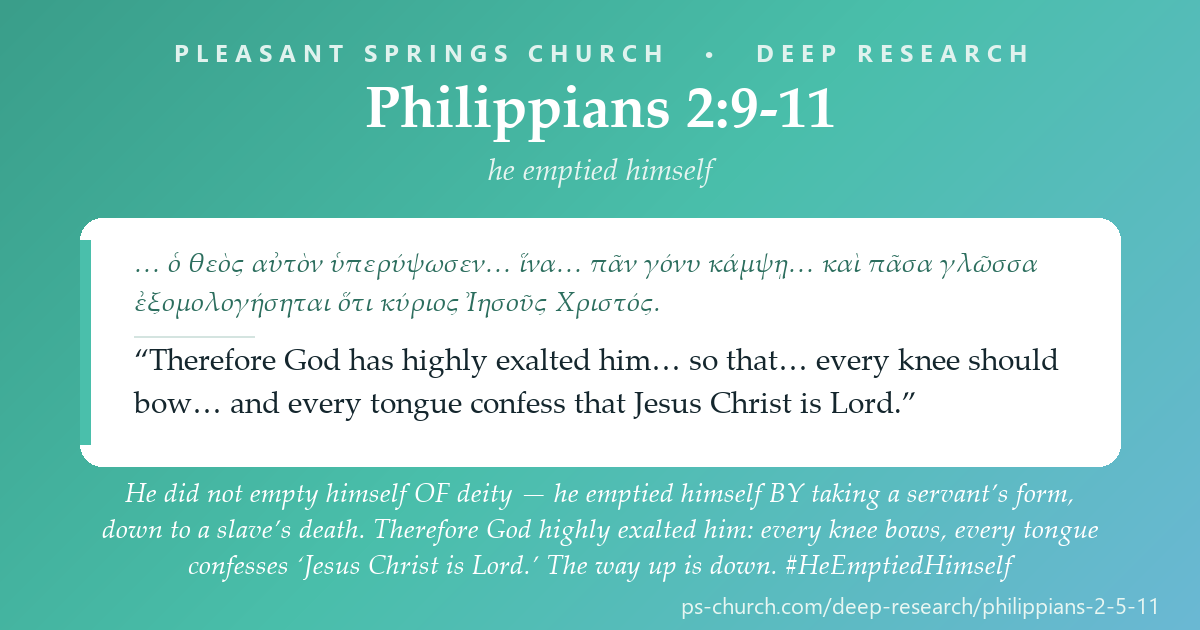
Have this mind among yourselves.” To cure a bickering church, Paul quotes what may be the oldest hymn of the faith — the arc of the Son from highest to lowest to highest. He was in the form of God, yet did not grasp at his equality; he emptied himself — not of his deity, but by taking a servant’s form — and humbled himself to death on a cross. Therefore God highly exalted him and gave him the name above every name: every knee bows, every tongue confesses “Jesus Christ is Lord.” This study works Philippians 2:5–11 — the way down that is the way up. See the method →
Philippians 2:6–11
Greek NT · ESVThe Shape of the Passage
Parallel panelsPaul quotes what may be the earliest Christian hymn to press a very practical point: be humble like this. But to make humility possible he unfolds the whole story of Christ — the eternal Son who went down to a slave’s death and was raised to the name above every name.
Author
Paul introduces the hymn with an ethical aim: “Have this mind among yourselves, which is yours in Christ Jesus” (2:5) — the cure for the rivalry and conceit of 2:3–4 is the mind of Christ. Then he traces that mind in three movements. First, the pre-existent Son, “in the form of God” (morphē theou — not mere appearance but true, essential deity), “did not count equality with God a thing to be grasped” (harpagmos). Equality with God was his by right; he simply refused to exploit it for his own advantage. Second, he “emptied himself” (ekenōsen) — and here everything depends on reading Paul carefully. He does not say Christ emptied himself of anything; the verb has no object of content. What follows tells us how: he emptied himself by taking the form of a servant, being born in human likeness. The kenosis is not subtraction of deity but addition of humanity — a self-veiling, a taking of the servant’s form, a stooping. Third, he “humbled himself… obedient to the point of death, even death on a cross” — the lowest point a person could reach, the death of a slave and the accursed (Deut 21:23).
The great ‘therefore.’ At 2:9 the movement reverses: “Therefore God has highly exalted him.” The exaltation is not the Son becoming divine — he already was in the form of God — but the public vindication and enthronement, in his risen humanity, of the One who humbled himself. God gives him “the name above every name,” and then Paul reaches for Isaiah: “every knee shall bow… every tongue confess.” In Isaiah those words are spoken by the Lord himself — “to me every knee shall bow” (Isa 45:23) — and Paul applies them to Jesus. The “name above every name” is Lord, the Greek for the divine Name. To confess “Jesus Christ is Lord” is to give him the worship due to God alone.
Audience
The Philippians — a beloved but bickering church (2:2–4; 4:2) — and every Christian tempted to grasp at status. Paul’s argument is startling: the way up is down. The One who was highest went lowest, and was therefore raised highest; and that same mind is to shape the church. Christology here is never abstract — it is the pattern of a humble life.
To the glory of the Father. The hymn ends carefully: every tongue confesses Jesus as Lord “to the glory of God the Father” (2:11). The Son’s exaltation does not rival the Father but glorifies him — the two are one God, and the worship of the Son is the glory of the Father. And the confession is universal: “in heaven and on earth and under the earth.” That does not mean all are saved; it means all — the redeemed in glad worship, and every hostile power in forced submission — will finally acknowledge that Jesus is Lord. The knee that will not bow in love will bow in the end regardless; better to bow now.
Orient on the incarnation, the kenosis, humility, and the exaltation of Christ.
Search by topic: incarnation, kenosis / self-emptying, form of God, exaltation, Lord (kyrios) / deity of Christ.
Which articles are relevant?
- Anchor Bible Dictionary — “Christ Hymn,” “Incarnation,” “Kenosis,” “Lord.”
- Dictionary of Paul and His Letters — “Christology,” “Hymns,” “Exaltation,” “Humility.”
- NIDNTT / TDNT — μορφή (morphē, form), ἁρπαγμός (harpagmos, thing grasped), κενόω (kenoō, empty), κύριος (kyrios, Lord).
Bibliography surfaced:
- Gordon Fee (NICNT), Peter O’Brien (NIGTC), Moisés Silva (BECNT), G. Walter Hansen (Pillar), Markus Bockmuehl on Philippians.
- Studies of the carmen Christi (Martin, Hoover on harpagmos); Bauckham on Christ and the divine identity.
- Beale & Carson, Commentary on the NT Use of the OT (Philippians).
What the kenosis means, and the divine Name confessed of Jesus.
Read the two “forms,” the “grasping,” and the “emptying” with care, then hear Isaiah 45 confessed of Jesus.
Which parallels shed light on religion and worldview?
‘Emptied himself’ — of what? The most misread words in the hymn are “he emptied himself” (heauton ekenōsen). Some have taken them to mean that in becoming man the Son gave up his divine attributes — his omniscience, his omnipotence — and so was, for a time, less than God (the theory called kenoticism). But that reads into the Greek what is not there. The verb is reflexive and has no genitive of content: Paul does not say “emptied himself of” anything. And the very next words tell us how the emptying happened: “by taking the form of a servant, being born in the likeness of men.” The self-emptying is a self-adding — the eternal Son, without ceasing to be God, took to himself a true human nature and the form of a slave, veiling his glory beneath our flesh. He did not become less than God; he became, in addition, one of us. As the old paradox has it, he remained what he was and became what he was not.
‘A thing to be grasped.’ The word harpagmos (2:6) is rare and much debated, but its force in context is clear. Since the Son was already “in the form of God,” equality with God was his by right, not something he lacked; so he did not “grasp” at it as though reaching for what was not his. The best reading (the idiom studied by R. W. Hoover) is that he “did not regard equality with God as something to be exploited for his own advantage.” Here is the deepest reversal of Eden. The first Adam, being man, grasped at being like God (Gen 3:5); the last Adam, being God, refused to exploit his equality and became a servant. Grasping is the way of Adam and of the proud church; releasing is the mind of Christ.
The name above every name. The climax quotes Isaiah. In Isaiah 45 the Lord — the one God, “and there is no other” (45:22) — swears, “To me every knee shall bow, every tongue shall swear allegiance” (45:23). Paul takes that exclusive, monotheistic oath and applies it to Jesus: at his name every knee bows and every tongue confesses that “Jesus Christ is Lord” (2:10–11). The “name above every name” that God bestows is kyrios — the Greek Old Testament’s standard rendering of the sacred Name, YHWH. To hail Jesus as Lord is not to give him a courtesy title but to identify him with the God of Israel — and this, Paul says, is “to the glory of God the Father.” The exaltation of the Son is the glory of the Father; the confession of Jesus as Lord is Trinitarian worship, not the crowning of a rival god.
- Isaiah 45:22–23; 52:13 — “I am God, and there is no other… to me every knee shall bow”; the Servant “shall be high and lifted up”: the oath and the exaltation applied to Jesus (see the Servant).
- Genesis 3:5; Isaiah 53:12 — “you will be like God” (Adam’s grasping); “he poured out his soul to death” (the Servant’s self-outpouring): the contrast and the pattern (see the fall).
- John 1:1–14; 2 Corinthians 8:9; Daniel 7:13–14 — the Word made flesh; “though he was rich… he became poor”; the Son of Man given dominion: the incarnation and the exaltation (see In the beginning was the Word).
The Christ-hymn has been quarried for two thousand years, and the church has learned to read it carefully, because everything hangs on the little verb “emptied.” The temptation is to make it mean more than it says — to imagine that at Bethlehem the Son laid his deity aside like a coat, becoming for a while a merely human Jesus who then had it returned at the resurrection. But the grammar will not bear it, and neither will the gospel. Paul does not say the Son emptied himself of the form of God; he says he emptied himself by taking the form of a servant. The emptying is not a losing but a taking, not a subtraction but a stoop. The One who was in the form of God remained in the form of God while adding to himself the form of a slave; the glory was veiled, not surrendered. This is the mystery the church confessed at Chalcedon: one person, two natures, truly God and truly man, without confusion and without loss. And it matters pastorally as much as doctrinally. If Christ ceased to be God in order to save us, then it was not God who saved us, and the cross is the death of a mere man. But if the eternal Son, without ceasing for a moment to be God, humbled himself to a servant’s death, then the cross is God’s own self-giving, and the love it reveals is the love of God himself. The kenosis is not the emptying of deity but the fullest expression of it: this is what God is like — not grasping, but giving; not clutching his rights, but pouring himself out. And the way down was the way up: “therefore God has highly exalted him.”
The vocabulary of form, grasping, emptying, and the Name.
Watch the two “forms,” the reflexive “emptied” without an object, the descent to the cross, and the divine Name confessed.
“The form of God” — not mere outward shape (that is schēma) but the form that expresses the essence: truly, essentially God. Balanced by “form of a servant” (2:7). Hyparchōn (“being”) points to prior, continuing existence — the pre-existent eternal Son.
“A thing to be grasped” — a rare word. Since equality with God is his by right (morphē theou), the sense is not grasping at what he lacked but “did not regard equality with God as something to exploit for his own advantage.” The reverse of Adam’s grasping (Gen 3:5).
“He emptied himself” — reflexive, with no genitive of content: Paul does not say “emptied himself of” deity. The following participles are the means: he emptied himself by taking the servant’s form and being born a man. Kenosis = self-addition of humanity and self-humbling, not subtraction of deity.
“He humbled himself… even death on a cross” — voluntary self-abasement to its extreme. Crucifixion was the death of slaves and of the accursed (Deut 21:23; Gal 3:13); the “even the cross” is the scandalous bottom of the descent.
“Highly exalted / super-exalted” — the divine response to the self-humbling (“therefore”), echoing the Servant “exalted and lifted up” (Isa 52:13 LXX). Not the Son becoming divine (adoptionism) but the vindication and public enthronement of the eternal Son in his risen humanity.
“Jesus Christ is Lord” — the earliest Christian confession. Set against Isaiah 45:23 (where the Lord says every knee bows to me), calling Jesus kyrios (the Greek for YHWH) ascribes to him the divine Name and identity — “to the glory of God the Father.”
How the New Testament fills out the humiliation and exaltation:
- John 1:1–14; 17:5 — the Word who was God became flesh; “the glory that I had with you before the world existed”: the pre-existent Son who veiled his glory (see the Word made flesh).
- 2 Corinthians 8:9; Hebrews 2:9–18 — “though he was rich… he became poor”; “made lower than the angels… crowned with glory”: the same descent-and-ascent pattern.
- Isaiah 45:22–23; Romans 14:11; Revelation 5:11–14 — “to me every knee shall bow”; the same oath applied to Jesus; the Lamb worshiped by all creation: the divine Name confessed.
- Matthew 28:18; Ephesians 1:20–22; Acts 2:36 — “all authority… given to me”; seated far above all rule; “both Lord and Christ”: the exaltation (see the Great Commission).
From the grasping of Adam to the every knee that bows to Jesus.
Trace the descent and ascent of the Son through the Scriptures, and the divine Name confessed of Jesus.
Which cross-references matter?
- Isaiah 45:22–23; 52:13–53:12 — the every-knee oath of the one God; the Servant exalted after his humiliation: the OT behind the hymn (see the Servant).
- Genesis 3:5; Romans 5:12–19 — Adam grasping at being like God; the one man’s obedience against the one man’s disobedience: the last-Adam pattern (see the fall).
- John 1:1–14; 13:3–17 — the Word made flesh; the Lord who took a towel and washed feet: deity expressed in humble service (see the Word).
- Matthew 28:16–20; Romans 14:11; Revelation 5 — all authority given; every knee bowing; the Lamb worshiped: the exaltation and its worship (see the Great Commission).
- Colossians 1:15–20; Hebrews 1:1–4 — the image of God and the exact imprint, who upholds all things: the same high Christology (see the supremacy of Christ).
The genius of the Christ-hymn is the way it says the highest possible thing about Jesus without ever ceasing to be Jewish monotheism. Paul does not say there are now two gods, or that Jesus has been promoted into a divine committee. He does something far more radical and far more careful: he takes the one text in Isaiah where the God of Israel most emphatically insists that he alone is God — “I am God, and there is no other… to me every knee shall bow” — and he says that this very homage is now rendered to Jesus. The name God bestows on the exalted Christ is not a new name alongside God’s; it is the Name, the Lord, YHWH’s own Name, which no creature could ever be given. And the hymn guards the point at both ends: the Son was “in the form of God” before he was ever exalted, and the confession of him as Lord is “to the glory of God the Father.” So Jesus is included within the identity of the one God — not a second deity worshiped beside the Father, but the Son who shares the Father’s throne and Name, whose worship is the Father’s glory. This is the seed of everything the church would later confess at Nicaea. And it grows, astonishingly, in the soil of a hymn about humility. The One who is worshiped as the God of Israel is the One who washed feet and died a slave’s death — and that, Paul says, is the mind we are to have.
The scholarship on Philippians 2:5-11.
The commentators on the Christ-hymn; the studies of harpagmos, the kenosis, and the Isaiah-45 background.
Commentaries & studies:
- Gordon D. Fee (NICNT), Peter T. O’Brien (NIGTC), Moisés Silva (BECNT), G. Walter Hansen (Pillar), Markus Bockmuehl on Philippians.
- Ralph Martin, A Hymn of Christ; R. W. Hoover on harpagmos; Richard Bauckham, Jesus and the God of Israel.
- Bruce Metzger on the Phil 2:11 exomologēsētai reading.
Interpretation notes worth keeping:
- Kenosis = addition, not subtraction. “Emptied himself” is reflexive with no genitive of content; he emptied himself by taking servant-form (2:7) — adding humanity and veiling glory, not divesting deity (against kenoticism). Chalcedon: two natures, one person.
- Harpagmos: he already had equality. Being “in the form of God,” equality with God is his by right; he “did not regard it as something to exploit” — the reverse of Adam’s grasping (Gen 3:5).
- Exaltation is vindication, not adoptionism. “Therefore” (2:9) marks the enthronement of the eternal Son in his risen humanity — not the acquiring of a deity he lacked.
- ‘Lord’ = the divine Name. The Isa 45:23 transfer and “the name above every name” make kyrios the LXX rendering of YHWH: confessing Jesus as Lord is full-deity worship, “to the glory of God the Father.”
- Universal confession, not universalism. “Every knee… every tongue” is universal acknowledgment of Christ’s lordship (willing worship and compelled submission) — not the salvation of all persons.
From grasping to giving, and the way down that is the way up.
Name what you learned, why it matters, and one concrete response.
What should we carry away — and do?
- He did not empty himself of God. The Son added our humanity and veiled his glory; he did not stop being God. So the cross is God’s own self-giving — and the love it shows is the love of God himself.
- The way up is down. The One who was highest went lowest, and was therefore raised highest. Grasping is the way of Adam; releasing is the mind of Christ — and it is to be ours.
- Every knee will bow. Jesus already bears the name above every name. Better to confess him Lord now, in glad worship, than to bow at last in forced submission.
Step in response: take Paul’s aim to heart — “have this mind” — and this week choose the downward path in one concrete place: release a right you could grasp, take the servant’s role no one else wants, count someone else more significant than yourself. And whenever you are tempted to clutch at status, look at the One who was in the form of God and took a towel — and worship him as Lord, to the glory of the Father.
Philippians 2:9–11 · to share
Greek NT + ESVEvery Deep Research page traces its passage across the whole sweep — the Old Testament, the Second-Temple world between the testaments (historical witnesses, not Scripture), and the New Testament. Follow the thread:
Pleasant Springs Church — Deep Research
Research method after Michael S. Heiser’s Bible Research Method (examine dictionaries → ancient literature → important words → textual connections → academic publications → share), with the Pleasant Springs “Author & Audience” foundation. Scripture set in the Hebrew, the Greek editions named on each page and the ESV (Old Testament), and the Greek New Testament and the ESV (New Testament), per the practice of Pleasant Springs Church. Philippians 2:5–11 research grounded in Fee, O’Brien, Silva, Hansen, and Bockmuehl, with Hoover on harpagmos and Bauckham on the divine identity; the kenosis read as self-addition of humanity / veiling of glory (NOT divesting of deity — against kenoticism; Chalcedonian two natures); harpagmos as “not exploiting” equality already his by right (the reverse of Adam); the exaltation as vindication of the eternal Son (not adoptionism); kyrios = the divine Name via Isa 45:23 (full-deity worship, to the glory of the Father); “every knee” as universal acknowledgment, not universalism.
Scripture quotations marked ESV are from the ESV® Bible (The Holy Bible, English Standard Version®), © 2001 by Crossway, a publishing ministry of Good News Publishers. ESV Text Edition: 2016. Used by permission. All rights reserved. The ESV text may not be quoted in any publication made available to the public by a Creative Commons license, and the ESV may not be translated in whole or in part into any other language. www.esv.org
|
Did this study bless you today? 💚 Give to Support PS Church100% of gifts go to the General Fund — thank you. |