A church was being told that Jesus was necessary but not enough — one power among many on the way to God. Paul answers with the highest Christology in his letters. Christ is the image of the invisible God and the firstborn of all creation — which does not mean first-created, for “by him all things were created.” The Maker of everything cannot be one of the made. He is before all things, holds all things together, is head of the church, and in him all the fullness of God dwells — reconciling all things by the blood of his cross. This study works Colossians 1:15–20 — the supremacy of Christ. See the method →
Colossians 1:15–20
Greek NT · ESVThe Shape of the Passage
Parallel panelsA young church at Colossae was being told that Christ was one power among many — that to reach the fullness of God you needed angels, visions, and rules besides. Paul answers with the highest Christology in his letters: Christ is supreme over creation and the church, because in him all the fullness of God dwells.
Author
Paul (with Timothy) writes to a congregation he had not founded, threatened by a “philosophy” that mixed Jewish observance, angel-worship, and ascetic rules (2:8–23). His reply is not a list of counter-arguments but a portrait of Christ so exalted that every rival power shrinks to nothing beside him. Christ is the eikōn, the “image of the invisible God” — not a lesser copy but the visible revelation of the God no one can see (“whoever has seen me has seen the Father,” John 14:9). And he is “the firstborn of all creation” (prōtotokos).
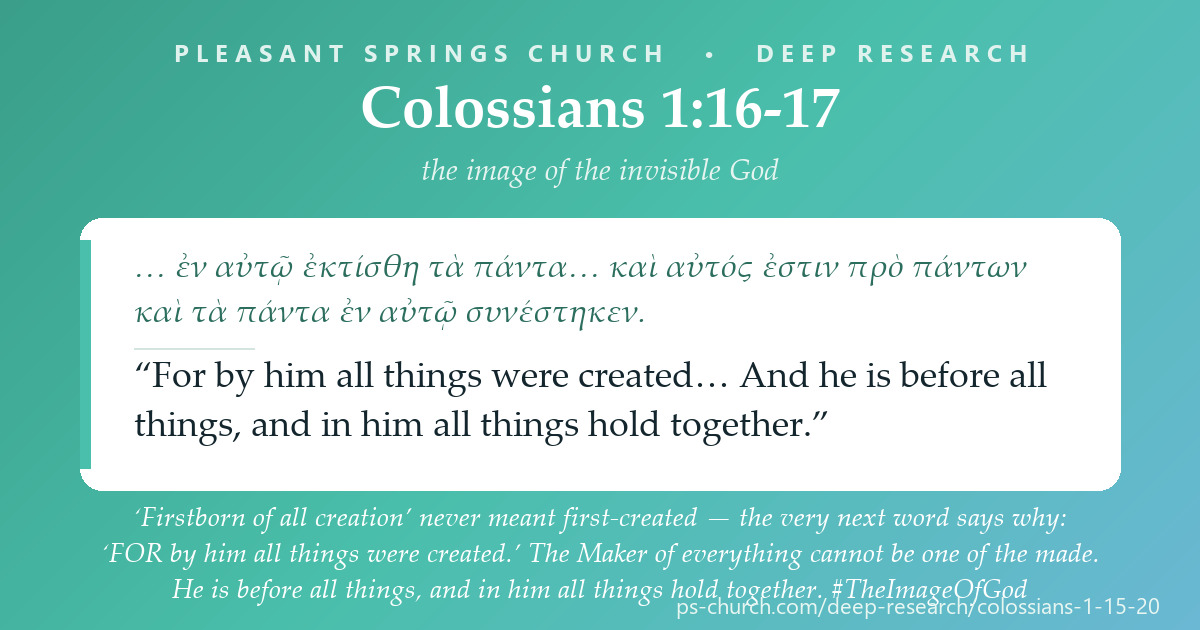
‘Firstborn’ does not mean first-created. This is the hinge of the passage, and Paul guards it in the very next breath. The word “firstborn” in Scripture means not the eldest born but the heir, the one with the rights and rank of preeminence — God calls David, the youngest son, “the firstborn, the highest of the kings of the earth” (Ps 89:27). And Paul makes the meaning unmistakable with a “for”: Christ is firstborn of all creation because “by him all things were created” (1:16). The One who created all things — things in heaven and on earth, thrones, dominions, rulers, authorities, the very powers the false teachers revered — cannot himself be one of the created things. He is their Maker, not their eldest brother. This is the verse the church would set against Arius: begotten, not made; through him all things came to be.
He holds it all together. Christ is “before all things” (in time and in rank), “and in him all things hold together” (synestēken, 1:17) — the cosmos does not merely owe him its origin but its continued existence, moment by moment (Heb 1:3). Then Paul turns from creation to redemption: Christ is “the head of the body, the church” and “the firstborn from the dead” — the same title now over the new creation, that “in everything he might be preeminent” (1:18). In him “all the fullness of God was pleased to dwell” (1:19; “the whole fullness of deity bodily,” 2:9): not a portion of divine power distributed among angels, but the full deity dwelling in Christ. And through him God reconciles “all things” to himself, “making peace by the blood of his cross.”
Audience
The Colossians — and everyone tempted to think Jesus is necessary but not sufficient, one authority to be supplemented by others. Paul’s whole point is sufficiency: if all the fullness of God dwells in Christ, and if in him you have been filled (2:9–10), then you need no angel, no vision, no rule to complete what he has done. To add to Christ is to subtract from him.
‘Reconcile all things’ — not universal salvation. Paul says God will “reconcile to himself all things… making peace by the blood of his cross” (1:20) — the same “all things” Christ created in 1:16, including the hostile powers. This is cosmic reconciliation: the whole created order brought back under its rightful Head, every rebel power pacified and subjected (2:15). It is not the promise that every person will be saved. Paul is explicit a few verses later: this reconciliation is received “if indeed you continue in the faith” (1:21–23); those who remain in rebellion are subdued, not embraced. The cross either reconciles you as a willing subject or conquers you as a defeated enemy — but in the end, all things bow to the preeminent Christ. And notice the ground of it all: “the blood of his cross.” The One in whom the fullness of deity dwells is the same One who bled — truly God and truly man, reconciling the cosmos not by decree but by dying.
Orient on image, firstborn, fullness, and cosmic reconciliation.
Search by topic: image of God, firstborn (prōtotokos), Wisdom, fullness (plērōma), reconciliation, principalities and powers.
Which articles are relevant?
- Anchor Bible Dictionary — “Colossian Hymn,” “Image,” “Firstborn,” “Reconciliation.”
- Dictionary of Paul and His Letters — “Christology,” “Creation,” “Wisdom,” “Principalities and Powers,” “Fullness.”
- NIDNTT / TDNT — εἰκών (eikōn, image), πρωτότοκος (prōtotokos, firstborn), πλήρωμα (plērōma, fullness), ἀποκαταλλάσσω (apokatallassō, reconcile).
Bibliography surfaced:
- F. F. Bruce (NICNT), Douglas Moo (Pillar), James Dunn (NIGTC), G. K. Beale (BECNT), Peter O’Brien (WBC) on Colossians.
- Studies of the Colossian hymn and the Wisdom background (Prov 8; Wisdom of Solomon 7); the anti-Arian reading of prōtotokos.
- Beale & Carson, Commentary on the NT Use of the OT (Colossians).
Firstborn, the Wisdom background, and the fullness of deity.
Read “firstborn” in its biblical sense, hear the Wisdom echoes without collapsing Christ into a creature, and weigh “the fullness” against the Colossian error.
Which parallels shed light on religion and worldview?
‘Firstborn’ — the great misreading. Because the English word “firstborn” sounds like “first one born,” Arius in the fourth century — and groups like the Jehovah’s Witnesses since — have read Colossians 1:15 to mean that Christ was the first and highest creature, made before the rest. But the Greek prōtotokos and its Hebrew background carry the sense of rank and inheritance, not sequence of birth. The firstborn son held the birthright, the double portion, the headship of the family — and Scripture happily calls the youngest “firstborn” when he holds that rank: God says of David, the youngest son of Jesse, “I will make him the firstborn, the highest of the kings of the earth” (Ps 89:27; LXX 88:28). “Firstborn of all creation” means heir and lord over all creation, not first item within it. And Paul slams the door on any other reading with the word “for”: Christ is firstborn because “by him all things were created” (1:16). The Maker of everything is not part of the everything he made.
The Wisdom background — answered, not adopted. The hymn’s language — image of God, agent of creation, the one in whom all things hold together — deliberately echoes the way Jewish writers spoke of God’s Wisdom (Prov 8:22–31; Wisdom of Solomon 7:25–26, where Wisdom is “a reflection of eternal light… the image of his goodness”). But Paul does something the Wisdom writers never did: he identifies this Wisdom not with a divine attribute or a poetic personification, but with a person, the crucified and risen Jesus — who is himself the Creator, not a created instrument. Even the famous Wisdom text was contested: the Septuagint of Proverbs 8:22 reads “the Lord created me” (ektisen), which the Arians seized upon; but the later Jewish translator Aquila rendered the same Hebrew “the Lord possessed me” (ektēsato) — Wisdom as God’s eternal own, not his first product. Colossians transposes all of it up a key: the Wisdom by which God made the world is not a thing God made, but the Son in whom the fullness of God dwells.
‘All the fullness.’ The word plērōma (“fullness,” 1:19) may have been a slogan of the Colossian teachers — the idea that the divine fullness was spread across a hierarchy of spiritual powers, so that Christ was one rung on a ladder to God. Paul seizes the word and empties the ladder: “in him all the fullness of God was pleased to dwell,” and to leave no doubt, “in him the whole fullness of deity dwells bodily” (2:9). Not an emanation, not a portion, not the highest of the intermediaries — the total, undivided deity, dwelling permanently (katoikeō) in the incarnate Christ. There is no fullness of God to be found anywhere else, and none lacking in him.
- Psalm 89:27; Exodus 4:22; Proverbs 8:22–31 — “firstborn” as heir and rank (David, Israel); Wisdom present at creation: the background to prōtotokos and the creation language.
- Genesis 1:1, 26–27; John 1:1–3 — God creates in the beginning and makes man in his image; “all things were made through him”: the creation Christ effects (see Genesis 1:1, the Word).
- Hebrews 1:1–3; 2 Corinthians 4:4; Philippians 2:6 — the Son as “the exact imprint” who “upholds all things”; “the image of God”; “the form of God”: the same high Christology (see He emptied himself).
Everything in the fight over this text turns on one little word in verse 16: “for” (Greek hoti, “because”). Read verse 15 alone and you can, if you are determined, hear “firstborn of all creation” as “the first thing God created.” That is exactly what Arius did, and what his heirs still do. But Paul does not let verse 15 stand alone. He immediately tells us why Christ is the firstborn of creation: “because by him all things were created.” The logic is airtight and it runs the opposite direction from the Arian reading. Christ is not the firstborn because he was the first to be created; he is the firstborn — the heir, the Lord — over all creation because he is the one through whom and for whom creation exists. You cannot be the agent of the creation of all things and also be one of the things created; the Maker stands outside the made. And Paul piles up the “all” to make sure no exception is smuggled in: things visible and invisible, thrones and dominions and rulers and authorities — the whole invisible hierarchy the Colossian teachers were so anxious about — every last one of them was created by him, through him, and for him. So the very powers people were tempted to venerate turn out to be his creatures and his servants. This is why the church, at Nicaea, could rest so much weight on Colossians 1. Against every attempt to make the Son a creature, however exalted, stands Paul’s flat “because”: he made it all. Begotten, not made; through him all things were made. And the pastoral payoff is immediate: if the One in whom the fullness of God dwells is the Maker and Sustainer and Reconciler of all things, then he is not a resource to be supplemented but a Lord to be trusted — wholly sufficient, preeminent in everything.
The vocabulary of image, firstborn, fullness, and reconciliation.
Watch the “image,” the “firstborn” anchored by “for,” the sustaining “hold together,” the whole “fullness,” and the cosmic “reconcile.”
“The image of the invisible God” — not a lesser copy but the visible revelation of the God no one can see (John 1:18; 14:9). As the true image, Christ is what Adam was made to be and what fallen humanity lost (Gen 1:27; 2 Cor 4:4).
“Firstborn of all creation” — rank and inheritance, not birth-order: the heir and lord over all creation (as David the youngest is called “firstborn,” Ps 89:27, LXX 88:28), NOT the first thing created. Proved by the “for” of 1:16. The anti-Arian crux: begotten, not made.
“By him all things were created” — the ground (hoti, “for”) of his firstborn rank. “All things” includes every invisible power the false teachers revered; the Creator of all cannot be part of the all. Created “through him and for him” — he is both agent and goal.
“Hold together” — perfect tense: the cosmos was and remains held together in him. Not a distant first cause but the present Sustainer, upholding all things moment by moment (Heb 1:3). Remove him and creation unravels.
“All the fullness” — likely a Colossian slogan for divine fullness spread across many powers. Paul locates the whole of it in Christ: “the whole fullness of deity dwells bodily” (2:9). Not a portion or emanation — the total, undivided God, dwelling permanently in him.
“To reconcile all things” — cosmic pacification: the whole created order (the same “all things” of 1:16, incl. hostile powers) brought back under its rightful Head, “making peace by the blood of his cross.” Not universal salvation of persons — received by faith (1:21–23); rebels are subdued, not embraced.
How the New Testament fills out the supremacy of Christ:
- John 1:1–18; 1:3; 14:9 — the Word who was God, through whom all things were made; “whoever has seen me has seen the Father”: the image and the agent of creation (see the Word).
- Hebrews 1:1–4; 2:14–17 — the Son who upholds the universe by his word, the exact imprint of God’s nature, who made purification for sins: the same fullness and cross.
- Philippians 2:6–11; 2 Corinthians 4:4–6 — “the form of God”; “the image of God”; “the light of the knowledge of the glory of God in the face of Christ”: the image and the exaltation (see He emptied himself).
- Colossians 2:9–15; Ephesians 1:20–23 — “the whole fullness of deity bodily”; “head over all things to the church”; the powers disarmed: the sufficiency and the triumph.
From the image of God and Wisdom at creation to the head of the new creation.
Trace the supremacy of Christ across creation and redemption — and guard the firstborn from the Arian reading.
Which cross-references matter?
- Genesis 1:1, 26–27; Proverbs 8:22–31 — creation in the beginning; man in God’s image; Wisdom present at creation: the OT behind the hymn (see Genesis 1:1, the image of God).
- Psalm 89:27; Exodus 4:22 — “firstborn” as rank and heir (David; Israel): the sense of prōtotokos against “first-created.”
- John 1:1–18; Hebrews 1:1–4 — the Word/Son as agent and sustainer of all things, the image and imprint of God: the same Christology (see the Word).
- Philippians 2:6–11; 1 Corinthians 8:6 — the form of God exalted as Lord; “one Lord, Jesus Christ, through whom are all things”: supremacy and creation (see the kenosis hymn).
- Colossians 1:21–23; 2:8–23; Romans 5:1–11 — reconciliation received by faith, “if you continue”; the sufficiency of Christ against the “philosophy”; peace with God through the cross (see peace with God).
The heresy at Colossae was not a frontal denial of Christ; it was a quiet demotion of him. No one there was saying Jesus did not matter. They were saying he was not enough — that to reach the true fullness of God you needed him and the angels, him and the visions, him and the rules about food and festivals and the calendar. It is the most persistent of all religious errors, because it flatters both our piety and our pride: it keeps Jesus and adds a role for us. Paul’s answer is not to argue the supplements down one by one but to lift Christ so high that the supplements become absurd. If in him all the fullness of God was pleased to dwell — the whole fullness, bodily — then what could you possibly add? To seek the fullness of God anywhere but in Christ is to look for the ocean in a teaspoon while standing on the shore. And what is true of the Colossians is true of every age’s attempt to have Christ-plus: Christ plus experiences, Christ plus techniques, Christ plus my performance. The gospel of Colossians is that you are already “filled in him, who is the head of all rule and authority” (2:10). He is not a component of your spiritual life to be balanced against others; he is the head, the fullness, the all. To add to him is to insult him; to rest in him is to have everything.
The scholarship on Colossians 1:15-20.
The commentators on the Colossian hymn; the studies of the Wisdom background, prōtotokos, and cosmic reconciliation.
Commentaries & studies:
- F. F. Bruce (NICNT), Douglas J. Moo (Pillar), James D. G. Dunn (NIGTC), G. K. Beale (BECNT), Peter T. O’Brien (WBC) on Colossians.
- Studies of the Colossian hymn and its Wisdom background (Prov 8; Wis 7); the Nicene reading of prōtotokos against Arius.
- G. K. Beale & D. A. Carson, eds., Commentary on the NT Use of the OT.
Interpretation notes worth keeping:
- ‘Firstborn’ = heir, not first-created. Prōtotokos is rank/inheritance (Ps 89:27), proved by the “for” of 1:16 (“by him all things were created”). The central anti-Arian crux: begotten, not made (Nicaea, homoousios).
- ‘Image’ = full deity revealed. Eikōn is the visible revelation of the invisible God (John 14:9), not a lesser copy — the true image Adam was to be.
- ‘Fullness’ = the whole deity. Plērōma (1:19; 2:9 “bodily”) locates the total, undivided deity in Christ — against diluting God among intermediaries.
- ‘Reconcile all things’ = cosmic pacification, not universalism. The whole created order subjected under its Head (2:15); saving reconciliation received by faith (1:21–23), not the salvation of all persons.
- Wisdom answered, not adopted. The hymn transposes Wisdom-language (Prov 8:22 LXX ektisen; Aquila ektēsato) onto the Son who is himself Creator — not a created Wisdom. The “blood of his cross” guards his true humanity (against docetism).
From a demoted Christ to the preeminent Lord who is enough.
Name what you learned, why it matters, and one concrete response.
What should we carry away — and do?
- Firstborn means heir, not first-made. Christ made all things; the Maker cannot be one of the made. He is not the highest creature but the Creator — begotten, not made.
- He holds everything together. The universe does not merely owe him its origin but its every next moment. He is the present Sustainer, not a distant first cause.
- He is enough. All the fullness of God dwells in Christ, and in him you are filled. To seek fullness anywhere else — Christ-plus-anything — is to demote the One who is all.
Step in response: name the “and” you have been adding to Christ — the experience, the technique, the performance you secretly trust to complete you — and let it go. Rest where Colossians puts you: “filled in him, who is the head of all rule and authority” (2:10). Give the preeminent Christ the preeminence in everything — your worship, your worry, your work — because in him all the fullness of God was pleased to dwell.
Colossians 1:16–17 · to share
Greek NT + ESVEvery Deep Research page traces its passage across the whole sweep — the Old Testament, the Second-Temple world between the testaments (historical witnesses, not Scripture), and the New Testament. Follow the thread:
Pleasant Springs Church — Deep Research
Research method after Michael S. Heiser’s Bible Research Method (examine dictionaries → ancient literature → important words → textual connections → academic publications → share), with the Pleasant Springs “Author & Audience” foundation. Scripture set in the Hebrew, the Greek editions named on each page and the ESV (Old Testament), and the Greek New Testament and the ESV (New Testament), per the practice of Pleasant Springs Church. Colossians 1:15–20 research grounded in Bruce, Moo, Dunn, Beale, and O’Brien; prōtotokos read as heir/rank (Ps 89:27) not first-created, proved by the hoti (“for”) of 1:16 — the anti-Arian crux (Nicaea, begotten-not-made); eikōn as the visible revelation of full deity (John 14:9), not a lesser copy; plērōma as the whole undivided deity (2:9 “bodily”), against dilution among intermediaries; “reconcile all things” as cosmic pacification (2:15), not universal salvation of persons — received by faith (1:21–23); the Wisdom background (Prov 8:22 LXX ektisen / Aquila ektēsato) transposed onto the Son who is himself Creator; the “blood of his cross” guarding true humanity.
Scripture quotations marked ESV are from the ESV® Bible (The Holy Bible, English Standard Version®), © 2001 by Crossway, a publishing ministry of Good News Publishers. ESV Text Edition: 2016. Used by permission. All rights reserved. The ESV text may not be quoted in any publication made available to the public by a Creative Commons license, and the ESV may not be translated in whole or in part into any other language. www.esv.org
|
Did this study bless you today? 💚 Give to Support PS Church100% of gifts go to the General Fund — thank you. |