Colossians 2 is where the church has done its arguing: the record of debt nailed to the cross, the festival and the new moon and the Sabbath, the worship of angels, the self-made religion. So the screen was run over the whole body of the letter — every verse of chapters 2, 3 and 4 against all 7,927 verses of the Greek New Testament and all 30,637 Greek Old Testament verse units held here. The famous verses came back almost empty. Colossians 2:14 reaches a run of two with a tie band of 226; 2:16 reaches two with a band of 28; 2:23 reaches two with a band of 42. And the deepest result on the page is a travel note. Colossians 4:8 and Ephesians 6:22 are the same seventeen Greek words — both verses entire, nothing added and nothing left out — and outside the Gospels and Acts, where repeated material runs to thirty-four, no two verses in different New Testament books share more. The next deepest is twelve, and it is the greeting formula, with a tie band of five. Seventeen words, and they are about who is carrying the mail. See the method →
Colossians 2:1–4:18 (selections)
Greek New Testament (SBLGNT via MorphGNT) · ESV⚠️ What a reader with an English Bible will and will not find. Two rows above depend on an editorial decision in the Greek. At 3:6 the ESV ends the verse at the wrath of God is coming and puts upon the sons of disobedience in a footnote — those are five of the ten words this page measures. At 4:8 the run of seventeen depends on the SBLGNT reading γνῶτε … ἡμῶν; on the alternative γνῷ … ὑμῶν it is eight. Both are flagged where they are used, and neither is smoothed over.
⚠️ Where this page does NOT go. Colossians 1:15–20, the Christ hymn, has its own study on this shelf and is not re-quoted here. This page begins at 2:1, where the body of the letter begins.
The Shape of the Passage
Sequence — four warnings, a put-off / put-on pair, and an errand at the endColossians is a disputed letter, and the dispute is mostly about its relation to Ephesians. That relation is measurable, and this page measures it — then says clearly what the measurement cannot settle.
Author
The letter names Paul and Timothy at 1:1 and claims a hand at 4:18. The autograph formula ὁ ἀσπασμὸς τῇ ἐμῇ χειρὶ Παύλου stands three times in the Greek New Testament: here, 1 Corinthians 16:21 and 2 Thessalonians 3:17. It is a habit, not a fingerprint, and the page treats it as one.
The measurable fact about authorship is the Ephesians overlap, and it is very lopsided. Screened book by book across the whole Greek New Testament, Colossians 2–4 reaches 17 words into Ephesians and 6 into the next book on the list. Three rows reach eight or more, and all three are Ephesians. No other New Testament book gets a single row above six.
And the measurement cannot say which way the debt runs. A contiguous-run screen counts shared sequence. It cannot tell a writer repeating himself from a second writer working with the first letter in front of him, and it cannot tell either of those from two letters carried by the same courier on the same journey. Direction of influence is not asserted anywhere on this page.
Audience
A church in the Lycus valley the writer has never met. 2:1 says it outright: for you and for those at Laodicea, and for all who have not seen my face. Three place names carry the letter, and two of them occur once each in the entire Greek New Testament: Colossae itself at 1:2, and Hierapolis at 4:13. Laodicea occurs seven times, five of them here.
They are being pressed by something the letter argues with but never names. Chapter 2 gives its shape in four warnings: plausible speech (2:4), philosophy and the elemental things (2:8), judgement over food and drink and the calendar (2:16), and disqualification by way of humility, angels and something seen (2:18). ⚠️ The page does not give it a label. The word heresy appears in no verse of this letter, and reconstructions of "the Colossian philosophy" are inferences from the rebuttal, not descriptions from a source.
And a second congregation is expected to read it. 4:16 instructs an exchange of letters with Laodicea, which makes this one of the very few New Testament documents that says what it expects to happen to itself.
Orient on Colossae, on the thing chapter 2 argues with, and on a numbering with no surprises in it.
Search by topic: Colossians, Letter to the; Colossae; Laodicea; Hierapolis; Lycus valley; the Colossian philosophy; stoicheia / elemental spirits; angels, worship of; Tychicus; Onesimus; Epaphras; household codes (Haustafeln); asceticism; the letter from Laodicea.
Which articles are relevant?
- Anchor Bible Dictionary — “Colossians, Epistle to the,” “Colossae,” “Laodicea,” “Hierapolis,” “Elements, Elemental Spirits,” “Household Codes,” “Tychicus,” “Onesimus.”
- Dictionary of Paul and His Letters (IVP) — “Colossians, Letter to the,” “Elements / Elemental Spirits of the World,” “Households and Household Codes,” “Principalities and Powers,” “Fullness.”
- NIDNTTE — στοιχεῖον, πλήρωμα, θρησκεία, ταπεινοφροσύνη, χειρόγραφον, ἐμβατεύω.
- Dictionary of NT Use of the OT (Beale & Carson) — on Colossians, which is a short entry for a measurable reason: the letter contains no formal Old Testament citation at all.
Settle the numbering first — and here there is nothing to settle
Colossians is chapter-for-chapter and verse-for-verse identical across the editions checked here.
| ch 1 | ch 2 | ch 3 | ch 4 | total | |
|---|---|---|---|---|---|
| SBLGNT (MorphGNT) | 29 | 23 | 25 | 18 | 95 |
| English (ESV) | 29 | 23 | 25 | 18 | 95 |
Derived by counting verse units in the MorphGNT file for Colossians against the chapter shape of the English verse-count files held on this shelf. There is no offset, and no verse on this page carries a second number.
Why a New Testament page still says this. The rule was written for the Psalms and the Twelve, where the Greek runs a chapter behind or a verse ahead and a silent page misleads. On a Greek letter it costs one paragraph and buys the reader the knowledge that somebody checked. The two places where a number on this page turns on a manuscript decision rather than on the count are 3:6 and 4:8, and both are text-critical rather than numerical — flagged in the codex and again in stage 5.
What the dictionaries will call “the Colossian heresy” — and why this page will not
There is no source for it outside the letter’s own rebuttal. Every reconstruction — Jewish mysticism, a mystery cult, Middle Platonism, Phrygian folk religion, an early gnosis — is built by reading chapter 2 backwards. That is a legitimate scholarly move and it is not a measurement. This page prints the four warnings and the words in them, and leaves the label to the reader.
The one thing that can be said without inference is negative: the letter never uses αἵρεσις, never says false teacher, and never names an opponent. What it names are practices.
A valley, a calendar, a household code, and two men walking to Colossae with letters.
The three cities, and what the letter says about them
Colossae is named once in the Greek New Testament (1:2). Hierapolis is named once (4:13). Laodicea is named seven times, and five of the seven are in this letter.
| verse | what it says |
|---|---|
| 2:1 | a struggle for you and for those at Laodicea and for all who have not seen my face in the flesh |
| 4:13 | Epaphras works hard for you and for those at Laodicea and those at Hierapolis |
| 4:15 | greet the brothers at Laodicea, and Nympha and the church in her house |
| 4:16 | have this letter read at Laodicea, and read the letter from Laodicea |
Five mentions of Laodicea across four verses of a 95-verse letter, against a single mention of Colossae itself. This is written to a valley, not to a city, and it expects to travel.
What was not consulted. The excavation reports for Laodicea and Hierapolis, the inscriptional evidence for Jewish settlement in Phrygia, Cicero’s Asian correspondence, and Strabo on the Lycus earthquakes are all standard background here. No inscription, no papyrus, no excavation report and no classical author was consulted for this page. The four verses above are the evidence actually in hand.
The calendar in 2:16 — and the gap that closed
Festival, new moon, Sabbath is a formula, and it is an Old Testament formula. Nine verses in the 64 Greek Old Testament files held here carry all three terms together:
| verse | verse |
|---|---|
| 1 Chronicles 23:31 | 2 Esdras 20:34 (English Nehemiah 10:33) |
| 2 Chronicles 2:3 (English 2:4) | 1 Esdras 5:51 |
| 2 Chronicles 31:3 | 1 Maccabees 10:34 |
| Ezekiel 45:17 | Hosea 2:13 (English 2:11) |
| Judith 8:6 — a witness, not Scripture, and new to this shelf on 30 August 2026. It is the fullest calendar list of the nine: Judith fasted every day of her widowhood except the eves of sabbaths and the sabbaths, the eves of new moons and the new moons, and the feasts and glad days of the house of Israel. | |
Against every one of the nine, Colossians 2:16 measures a run of 1 — on this page’s Greek-side convention that means it shares single words and no two consecutive ones. The Greek Old Testament writes the three as a list of nouns in agreement; Colossians strings them with ἤ … ἤ … ἤ after ἐν μέρει. The idea is the calendar; the wording is not any of these verses.
⚠️ The gap that stood here, and what filled it. Until 30 August 2026 this paragraph read: Exodus, Leviticus, Numbers and Joshua are not held on this shelf, so Leviticus 23 and Numbers 28–29, the two calendar chapters a reader would reach for first, could not be screened at all. All four were fetched that day, with sixteen more CATSS files, and the shelf went from 44 files and 23,061 verse units to 64 files and 30,637. The two calendar chapters have now been screened, and here is what they give:
| Colossians 2:16 against | run | band |
|---|---|---|
| the whole of Greek Leviticus | 2 | 20 |
| the whole of Greek Numbers | 2 | 6 |
| the whole of Greek Exodus | 2 | 2 |
| Greek Joshua, B text | 2 | 1 |
Every one of those twos is a conjunction and a preposition. The calendar chapters were the whole reason for the caveat, and they change nothing. Leviticus 23 — the chapter every reader reaches for — turns out not to contain the Greek word for new moon anywhere in it: it has festivals and it has sabbaths and no third member. The word arrives in the Pentateuch at Exodus 40:2 and 40:17 and at Numbers 10:10, 28:11 and 29:6. Not one of those five comes within two consecutive words of Colossians 2:16. The finding the caveat was hedging is confirmed, not overturned. Run python -m dr_tools coverage for the current list.
The household code, and the thing that is easy to miss in it
3:18–4:1 is the shortest of the New Testament household codes, and its proportions are lopsided.
| addressed | verses | Greek words (normalised) |
|---|---|---|
| wives | 3:18 | 9 |
| husbands | 3:19 | 10 |
| children | 3:20 | 13 |
| fathers | 3:21 | 10 |
| slaves | 3:22–25 | 56 |
| masters | 4:1 | 18 |
| whole unit | 3:18–4:1, nine verses | 116 |
Four verses out of nine, and 56 of the unit’s 116 words — just under half — go to one group. And 4:9 says one of the two men carrying this letter is Onesimus, who is one of you — the same name as the runaway in Philemon. The page reports the name and the count; it does not assert that the letter was shaped around him. The counts above are counts of normalised word tokens in the MorphGNT file — the same tokens the run screen counts — with apparatus sigla and punctuation excluded.
Ancient letters travelled with people, and this one names them
4:7–9 is a courier note, which in the ancient world was not an afterthought. A letter had no envelope, no postmark and no independent authentication; the person who handed it over was the authentication, and was expected to supply the news the letter did not contain. That is exactly what 4:7 says Tychicus is for: he will tell you all about my activities.
The same two verses are the deepest verbal contact this letter has with anything. Whatever else that means, it means the courier paragraph is the part two letters would most naturally share if they travelled together. The page states that as the obvious reading and does not claim to have established it.
What was not consulted. No papyrus letter, no study of ancient letter-carrying, no work on the amanuensis. The observation above is a commonplace of the handbooks and is offered as one.
A letter whose argument is carried almost entirely by words nobody else in the New Testament uses.
2:8 and 2:20. The noun occurs seven times in the Greek New Testament — Galatians 4:3 and 4:9, Colossians 2:8 and 2:20, Hebrews 5:12, 2 Peter 3:10 and 3:12. The four-word phrase τὰ στοιχεῖα τοῦ κόσμου occurs twice: Galatians 4:3 and Colossians 2:8. Hebrews uses it of the ABCs of a subject; 2 Peter of the physical elements that burn. The page does not choose between ‘elemental spirits’ and ‘elementary principles’ — the word carries both ranges and the letter does not disambiguate it.
2:14. Once in the Greek New Testament — and this entry’s Old Testament negative has been overturned. It used to read nowhere in the 44 Greek Old Testament files held here. Twenty more CATSS files reached the shelf on 30 August 2026, and the word is in them: it now stands six times in five verses, every one of them in Tobit — 5:3 and 9:5 in the B/A text, 5:3, 9:2 and 9:5 in the Sinaiticus text. Tobit is a witness, not Scripture. And Tobit uses it for precisely what Colossians uses it for: a handwritten bond for money, torn in two so that each party keeps a half, carried across the country, handed over and discharged. Nothing here says Paul read Tobit, and this page does not say it — it says that the only Greek book on this shelf that has the word has it for a debt-note produced and cancelled, which is the picture in 2:14. Its ordinary use in the papyri is the same: a bond in the debtor’s own hand. The verb beside it, ἐξαλείψας, is what you do to writing — wipe it off.
2:9. Once in the Greek New Testament. Not to be confused with θειότης, divine nature, which also occurs once, at Romans 1:20. Two different nouns, one occurrence each, and the shelf reports them as two words rather than one.
2:18. Once in the Greek New Testament. The ESV renders it going on in detail about visions and footnotes the uncertainty. Nothing on this shelf can settle it, and the page says so rather than picking the reading that suits the paragraph. What the 30 August 2026 fetch did add is the Greek Old Testament’s own usage. The verb stood in four verses of the 44 files, all four in 1 Maccabees; it stands in seven of the 64. The three new ones are 2 Maccabees 2:30 and Joshua 19:49 and 19:51 (B text), where the sons of Israel went to take possession of the land according to their border. Joshua is Scripture; Maccabees is a witness. Every one of the seven is territorial — entering ground and holding it, and none of them is about a vision. That does not settle Colossians 2:18, because the mystery-cult inscriptions the commentaries cite are not on this shelf and were not consulted; it does mean the sense the shelf can actually see is the local one.
2:15 ἀπεκδυσάμενος and 3:9 ἀπεκδυσάμενοι, with the noun ἀπεκδύσει at 2:11. Those three are every occurrence of the family in the whole Greek New Testament, and all three are in Colossians. The same verb does the disarming of the powers and the taking off of the old self.
2:16. Once in the Greek New Testament. Common in the Greek Old Testament, where it belongs to the sacrificial calendar. This entry used to end with a caveat — Leviticus and Numbers are not held on this shelf, so the calendar chapters themselves were not searched. They are held now, and the count moved with them: the noun stood in 31 verses of the 44 files and stands in 37 of the 64, the six new ones being Exodus 40:2 and 40:17, Numbers 10:10, 28:11 and 29:6, and Judith 8:6. Greek Leviticus does not carry the word once — not in chapter 23 and not anywhere else.
3:11. Once in the Greek New Testament. In Greek writing generally the Scythian is the standing example of the outer barbarian, the person beyond the edge of the civilised world — which is why the list runs barbarian, Scythian rather than pairing opposites as it does on either side.
4:6, ἅλατι ἠρτυμένος, seasoned with salt. Three occurrences in the Greek New Testament: this one, Mark 9:50 and Luke 14:34 — and both of the others are about salt that has lost its taste. The dative ἅλατι stands here alone.
Eight words that occur once in the New Testament, all in these three chapters
| word | where | sense |
|---|---|---|
| πιθανολογίᾳ | 2:4 | persuasive speech, plausible argument |
| συλαγωγῶν | 2:8 | carrying off as plunder |
| φιλοσοφίας | 2:8 | philosophy |
| σωματικῶς | 2:9 | bodily |
| προσηλώσας | 2:14 | having nailed |
| ἐθελοθρησκίᾳ | 2:23 | self-chosen worship |
| ἀφειδίᾳ | 2:23 | unsparingness, severity |
| πλησμονήν | 2:23 | filling up, gratification |
Three of the eight are in one verse, 2:23 — which is also one of the two or three hardest sentences in the Pauline corpus to construe. Four more of the same kind sit further on: αἰσχρολογίαν (3:8), μομφήν (3:13), ἀθυμῶσιν (3:21) and παρηγορία (4:11). Four, not five: ἐρεθίζετε (3:21) looks like one of them and is not — the same verb stands at 2 Corinthians 9:2 as ἠρέθισεν, which a search on the printed stem does not reach. A letter whose central chapter argues in vocabulary the rest of the New Testament never uses is a letter a run screen will find almost nothing in — and that is exactly what happened.
Counted over 7,927 verses of the Greek New Testament as digitized by MorphGNT, on normalised word forms and stems. A form search is not a lemma search: a rarer form of a commoner verb would not be caught by it. Each of the eight above was checked on its stem, not only on the form printed.
The word the letter uses for the good thing and the bad thing
The tradition vocabulary is on both sides of the argument, two verses apart.
| verse | Greek | sense on the page |
|---|---|---|
| 2:6 | ὡς οὖν παρελάβετε τὸν Χριστὸν Ἰησοῦν | as you received — approved |
| 2:8 | κατὰ τὴν παράδοσιν τῶν ἀνθρώπων | the tradition of men — refused |
The noun παράδοσις occurs thirteen times in the Greek New Testament. Eight of the thirteen are the Gospels’ tradition of the elders, which Jesus opposes; the rest are Pauline, and there the same word is used positively of what was handed on (1 Corinthians 11:2, 2 Thessalonians 2:15 and 3:6) and negatively here and at Galatians 1:14. The letter is not against handing things on. It is against handing on the wrong things.
Sixty-six rows against 7,927 verses and 30,637 verse units — and the answer is in chapter 4.
Colossians 2–4 against every other book of the Greek New Testament
Sixty-six rows, screened book by book. One book answers and the rest do not.
| book screened against | verses (MorphGNT) | deepest run | rows reaching 8+ | rows reaching 5+ |
|---|---|---|---|---|
| Ephesians | 155 | 17 | 3 | 7 |
| 1 Corinthians | 437 | 6 | 0 | 1 |
| 2 Thessalonians | 47 | 6 | 0 | 1 |
| Luke | 1,149 | 5 | 0 | 2 |
| Matthew · Mark · John · Acts · Romans · Galatians | — | 5 | 0 | 1 each |
| Philippians · 1 Timothy · 2 Timothy · Hebrews · 1 Peter · 2 Peter | — | 4 | 0 | 0 |
| 2 Corinthians · 1 Thessalonians · Titus · Philemon · James · 1 John · Revelation | — | 3 | 0 | 0 |
| 2 John · 3 John · Jude | — | 2 | 0 | 0 |
Seventeen against six. That is not a difference of degree. Three rows of Colossians 2–4 reach eight words or more into another book, and all three are Ephesians: 4:8 at seventeen, 3:6 and 4:7 at ten. No other book in the New Testament yields a single row above six.
The seventeen, in full
Colossians 4:8 is seventeen words long. Ephesians 6:22 is seventeen words long. After normalisation they are the same seventeen words in the same order.
| row | partner | run | tie band | the shared words |
|---|---|---|---|---|
| Col 4:8 | Eph 6:22 | 17 | 1 | ὃν ἔπεμψα πρὸς ὑμᾶς εἰς αὐτὸ τοῦτο ἵνα γνῶτε τὰ περὶ ἡμῶν καὶ παρακαλέσῃ τὰς καρδίας ὑμῶν |
| Col 3:6 | Eph 5:6 | 10 | 1 | ἔρχεται ἡ ὀργὴ τοῦ θεοῦ ἐπὶ τοὺς υἱοὺς τῆς ἀπειθείας |
| Col 4:7 | Eph 6:21 | 10 | 1 | πάντα γνωρίσει ὑμῖν Τυχικὸς ὁ ἀγαπητὸς ἀδελφὸς καὶ πιστὸς διάκονος |
Taken as a single block, Colossians 4:7–8 and Ephesians 6:21–22 share nineteen consecutive words: the run crosses the verse division (… ἐν κυρίῳ, ὃν ἔπεμψα …) because Colossians ends 4:7 with the same two words Ephesians ends 6:21 with.
⚠️ All three numbers depend on editorial decisions, and here they are.
| row | the variant | run if the other reading is taken |
|---|---|---|
| Col 4:8 | SBLGNT γνῶτε … ἡμῶν against γνῷ … ὑμῶν | 17 → 8 |
| Col 3:6 | SBLGNT brackets ἐπὶ τοὺς υἱοὺς τῆς ἀπειθείας; the ESV omits it from the text | 10 → 5 |
| Col 4:7 | SBLGNT marks the order γνωρίσει ὑμῖν in Eph 6:21 against ὑμῖν γνωρίσει | 10 → 7 |
None of the three collapses to nothing, and the seventeen stays the deepest row on any reading. But a page that printed 17 / 10 / 10 without this table would be reporting the SBLGNT’s editorial judgement as if it were the manuscript tradition.
Is seventeen unusual? The control across the whole New Testament
Every verse of the Greek New Testament was screened against every verse in a different book. Here is what stands above twelve.
| run | pair | what it is |
|---|---|---|
| 34 | Matthew 13:15 · Acts 28:27 | both quoting Isaiah 6:9–10 |
| 26 | Matthew 6:24 · Luke 16:13 | synoptic |
| 24 | Matthew 8:20 · Luke 9:58 | synoptic |
| 24 | Matthew 12:41 · Luke 11:32 | synoptic |
| 23 | Matthew 8:9 · Luke 7:8 | synoptic |
| 23 | Matthew 26:24 · Mark 14:21 | synoptic |
| 22 | Matthew 3:9 · Luke 3:8 | synoptic |
| 20 | Matthew 3:10 · Luke 3:9 | synoptic |
| 19 | Matthew 22:44 · Mark 12:36 | synoptic, both quoting Psalm 109:1 |
| 18 | Mark 10:15 · Luke 18:17 | synoptic |
| 17 | Matthew 20:28 · Mark 10:45 | synoptic |
| 17 | Matthew 24:50 · Luke 12:46 | synoptic |
| 17 | Mark 1:24 · Luke 4:34 | synoptic |
| 17 | Colossians 4:8 · Ephesians 6:22 | two letters — the only non-Gospel pair in this table |
Now drop the Gospels and Acts and run the same list again.
| run | row | tie band | what it is |
|---|---|---|---|
| 17 | Colossians 4:8 · Ephesians 6:22 | 1 | the courier |
| 12 | Romans 1:7, 1 Corinthians 1:3, 2 Corinthians 1:2, Ephesians 1:2, Philippians 1:2, Philemon 3 | 5 | grace to you and peace from God our Father and the Lord Jesus Christ |
| 12 | 1 Timothy 1:2, 2 Timothy 1:2 | 1 | the same greeting with mercy added |
| 11 | 2 Corinthians 1:1, Colossians 1:1, 1 Thessalonians 1:1, 2 Thessalonians 1:1, 2 Corinthians 1:3, Ephesians 1:3, 1 Peter 1:3, 1 Peter 4:11, Revelation 1:6 | 1–2 | addresses and doxologies |
A five-word gap, and everything on the far side of it is the envelope. The deepest thing two New Testament letters share, once the openings and closings are set aside, is a sentence about a man being sent to tell them how the writer is. Nothing in either letter’s theology comes anywhere near it.
⚠️ The counter-examples this page prints against itself
Four places where a reader expects a match and the measurement gives one or two.
| pairing everyone prints together | run | the shared words |
|---|---|---|
| Col 3:16 (psalms, hymns, spiritual songs) vs Eph 5:19 | 2 | ᾠδαῖς πνευματικαῖς |
| Col 3:11 (neither Greek nor Jew) vs Galatians 3:28 | 2 | οὐκ ἔνι |
| Col 3:11 vs 1 Corinthians 12:13 | 1 | ἔνι |
| Col 3:1 (seated at the right hand of God) vs Greek Psalm 109:1 (English 110:1) | 1 | — |
| Col 2:22 (commands and teachings of men) vs Greek Isaiah 29:13 | 2 | καὶ διδασκαλίας |
The Isaiah row is the instructive one, because the relationship is obviously real. Greek Isaiah 29:13 ends διδάσκοντες ἐντάλματα ἀνθρώπων καὶ διδασκαλίας. Colossians 2:22 has τὰ ἐντάλματα καὶ διδασκαλίας τῶν ἀνθρώπων — the same three content words, reordered, with an article and a καί moved. A contiguous-run screen cannot see through a reordering, and here it does not. Matthew 15:9 and Mark 7:7 quote the same Isaiah clause and this row reaches one word against each of them. The connection is there; the instrument is blind to it; both facts are printed.
Why these are on the page. The seventeen-word result is only worth anything if the reader can see what the same instrument does with the passages that feel parallel. It gives them two. That is the calibration, and a page that reported only its best number would be hiding it.
The household code, measured verse against verse
The unit everyone sets beside Ephesians 5:22–6:9 — and its deepest row is six.
| Colossians | Ephesians | run | the shared words |
|---|---|---|---|
| 3:18 wives | 5:22 | 2 | αἱ γυναῖκες |
| 3:19 husbands | 5:25 | 5 | οἱ ἄνδρες ἀγαπᾶτε τὰς γυναῖκας |
| 3:20 children | 6:1 | 5 | τὰ τέκνα ὑπακούετε τοῖς γονεῦσιν |
| 3:21 fathers | 6:4 | 3 | οἱ πατέρες μή |
| 3:22 slaves | 6:5 | 4 | τοῖς κατὰ σάρκα κυρίοις |
| 3:23 | 6:7 | 6 | ὡς τῷ κυρίῳ καὶ οὐκ ἀνθρώποις |
| 3:24 | 6:8 | 2 | εἰδότες ὅτι |
| 4:1 masters | 6:9 | 3 | εἰδότες ὅτι καί |
Eight rows, and the total of the deepest runs across all eight is thirty. The deepest single row in the whole household code is six; one verse in chapter 4 reaches seventeen. The two codes address the same six groups in the same order and say much the same thing — and they do it in different words. Whatever relation these letters stand in, it is not that one was copied out of the other paragraph by paragraph.
Colossians 2–4 against 30,637 Greek Old Testament verse units
The result is the flattest on this shelf, and a third more corpus did not change it. Nothing reaches five.
| run | rows reaching it (44 files · 23,061 units) | rows reaching it (64 files · 30,637 units) |
|---|---|---|
| 2 or more | 64 of 66 | 64 of 66 |
| 3 or more | 40 | 43 |
| 4 | 10 | 10 |
| 5 or more | none | none |
⚠️ Two corrections in that table, and both are printed rather than swapped in silence. The first column used to read 39 at three-or-more and 9 at four. Recounted on the same 44 files it is 40 and 10: the row that was missing from the four-count is Colossians 3:23, which the page had already discussed under the household code and had left out of this census. The second is the corpus itself — 44 files to 64 on 30 August 2026. Three rows moved up from two to three (2:19, 3:7 and 4:6), and every one of the three found its new partner in a book that was not on the shelf before: Leviticus and Judith at 2:19, 3 Maccabees at 3:7, Judith again at 4:6. Judith and Maccabees are witnesses, not Scripture. Nothing reached five in either column.
And all ten of the fours are stock phrases, not quotations.
| row | partner | band | the four words |
|---|---|---|---|
| Col 3:23 (missing from this census until 30 Aug 2026) | 2 Chronicles 19:10, Jeremiah 51:23, Judges 10:16 A and B — and, new with the fetch, Exodus 30:12 and Leviticus 27:26 | 4 → 6 | τῷ κυρίῳ καὶ οὐκ |
| Col 2:1 | Hosea 5:15 | 1 | τὸ πρόσωπόν μου ἐν |
| Col 2:5 | 1 Maccabees 9:14 | 1 | καὶ τὸ στερέωμα τῆς |
| Col 2:8 | Sirach 35:22 — and, new with the fetch, Wisdom 1:14 (a witness, not Scripture) on four different words, τοῦ κόσμου καὶ οὐ | 1 → 2 | τῶν ἀνθρώπων κατὰ τά |
| Col 3:2 · Col 3:5 | 1 Esdras 5:49 | 1 | τὰ ἐπὶ τῆς γῆς |
| Col 3:8 | 1 Kingdoms 2:3 (English 1 Samuel 2:3) — and, new with the fetch, Exodus 23:13 and Numbers 32:24 | 1 → 3 | ἐκ τοῦ στόματος ὑμῶν |
| Col 3:15 · Col 3:16 | Psalm 4:5 (English 4:4), Haggai 2:18, Zechariah 7:10, Zechariah 8:17 | 4 | ἐν ταῖς καρδίαις ὑμῶν |
| Col 4:11 | 1 Esdras 8:21, Daniel 11:9 (Theodotion) | 2 | εἰς τὴν βασιλείαν τοῦ |
| Col 3:23 (restored to this census 30 Aug 2026) | 2 Chronicles 19:10, Jeremiah 51:23, Judges 10:16 (A and B), and — new with the fetch — Exodus 30:12 and Leviticus 27:26 | 4 → 6 | τῷ κυρίῳ καὶ οὐκ |
⚠️ Two tie bands in that table were corrected on 2026-09-24. Until then the table gave Colossians 2:8 a band of 1 (Sirach 35:22 alone) and Colossians 3:8 a band of 1 (1 Kingdoms 2:3 alone). Re-run on the 63 files screened, 2:8 also reaches four against Wisdom 1:14, on different words, and 3:8’s phrase also stands in Exodus 23:13 and Numbers 32:24 — all three partners arrived with the 30 August 2026 fetch. No row moved above four, and every one of the ten is still a stock phrase.
This is what a letter with no formal Old Testament citation looks like when you measure it. Colossians never writes as it is written, never names a prophet, and never introduces a quotation. The screen agrees with the commentaries — which is worth reporting precisely because it is the boring answer.
⚠️ And the scope of that negative — which is now wider than it was. This paragraph used to read: Twenty CATSS files are not on this shelf, among them Exodus, Leviticus, Numbers, Joshua, Wisdom and Baruch. Leviticus 23 and Numbers 28–29 are the calendar chapters behind 2:16 and they were not searched. Wisdom is regularly brought into the discussion of 1:15–20 and 2:3, and it was not searched either. The sentence ‘nothing reaches five’ is true of the 44 files held, and this page will not state it more broadly than that. All twenty were fetched on 30 August 2026. Every book that paragraph named has now been screened, and “nothing reaches five” is true of the 64 files and the 30,637 verse units — a claim a third larger than the one it replaces. Wisdom in particular was searched: Colossians 2:8 now ties with it (Wisdom 1:14, four words) and 2:23 finds its band there, and nothing in the letter reaches five against it. Wisdom, Judith, Tobit and the books of Maccabees are witnesses, not Scripture, and this page labels them so every time it names one. ⚠️ What is still out of scope: no Greek book beyond the CATSS set, no papyri, no inscriptions, and no versions.
Nine names, and no words
Colossians and Philemon share almost their whole cast and almost none of their wording.
| name | in Philemon | in Colossians |
|---|---|---|
| Paul | 1, 9, 19 | 1:1, 1:23, 4:18 |
| Timothy | 1 | 1:1 |
| Archippus | 2 | 4:17 |
| Onesimus | 10 | 4:9 |
| Epaphras | 23 | 1:7, 4:12 |
| Mark | 24 | 4:10 |
| Aristarchus | 24 | 4:10 |
| Demas | 24 | 4:14 |
| Luke | 24 | 4:14 |
| Philemon | 1 | — |
| Apphia | 2 | — |
Nine of the eleven personal names in Philemon stand in Colossians — and the deepest verbal run between Colossians 2–4 and any verse of Philemon is three words. That pairing is the cleanest demonstration on this page of what the instrument does and does not see. Two documents can share a household, a courier and a prison and share no sentences at all. Which is also the warning to read back across the Ephesians result: seventeen shared words prove seventeen shared words, and the step from there to a claim about who wrote what is a step the measurement does not take.
What this page did not check, what it could not check, and where it is weakest.
The biggest limit: a run screen cannot settle the Colossians question
Colossians is disputed, and this page has measured the easiest thing to measure rather than the thing actually at issue.
The scholarly case against Pauline authorship rests mainly on style — long compound sentences, a high rate of genitive chains, the piling of synonyms, an unusually large hapax count for the letter’s length — and on theology, chiefly a realised eschatology in 2:12 and 3:1 where the undisputed letters keep the resurrection future. None of that was computed here. No sentence-length distribution, no particle frequency, no genitive-chain count, no hapax-per-thousand-words figure. Those are the numbers the debate runs on and this page does not have them.
What it has is the Ephesians overlap, and that cuts both ways. A seventeen-word identity in a courier note is compatible with one writer sending two letters by one man, and equally compatible with a later writer copying a paragraph he had in front of him. Both hypotheses predict exactly this number. The measurement narrows nothing about authorship; it only says where the two letters touch.
And note the shape of where they touch. If a second writer were working from Ephesians, one would expect the theology to be closest and the incidentals to drift. The opposite is measured here: the doctrinal paragraphs of Colossians 2 reach two words against the whole New Testament, and the errand reaches seventeen. ⚠️ That is an observation, not an argument — the same pattern is what you would get if two genuine letters were dictated on the same day and handed to the same man.
What could not be checked at all
No Greek critical apparatus. The SBLGNT is one edited text among several; its apparatus sigla were stripped before measuring, so every figure on this page is a figure about the SBLGNT reading and not about the manuscript tradition. The three variants that move numbers here are named in stage 4 with their consequences (4:8, 3:6, 4:7). Others were not weighed at all — among them 2:2 (the mystery of God, Christ, which has one of the longest variant lists in the New Testament), 2:7 (ἐν αὐτῇ / ἐν εὐχαριστίᾳ), 2:18 (ἃ ἑόρακεν against ἃ μὴ ἑόρακεν — a negative that reverses the sense of the clause), and 3:16 (τῷ θεῷ against τῷ κυρίῳ). The 2:18 variant in particular would change how that codex row reads, and this page prints only one side of it.
Twenty CATSS files were not on the shelf when this page was first published, and they are now. This paragraph used to name Exodus, Leviticus, Numbers, Joshua, Wisdom and Baruch as absent, and to say that two of those absences sat directly under this passage — Leviticus 23 and Numbers 28–29 for the calendar of 2:16, and Wisdom for the language of 2:3. All twenty were fetched on 30 August 2026, and every Old Testament negative on this page is now a negative on 64 files and 30,637 verse units. Three of this page’s statements moved as a result and each is printed with its history where it stands: the festival triad went from eight verses to nine (Judith 8:6), the four-count census was corrected from nine rows to ten, and the flat negative on χειρόγραφον was overturned outright — the word stands six times in Tobit, and Tobit uses it for a cancelled debt-note. Tobit and Judith are witnesses, not Scripture.
No papyri, no inscriptions, no patristic citations, no versions. Nothing from the Latin, Syriac or Coptic. Nothing from Qumran, and that is a real gap for 2:18, where the Qumran angelic-liturgy material is regularly brought into the discussion of worship of angels. Nothing from the mystery-cult inscriptions that carry ἐμβατεύω, which is the single piece of external evidence most often cited on that word.
No commentary was consulted for any measurement. Where this page says “every commentary prints these together” it is reporting a commonplace, not a survey, and should be read as one.
Where the page is weakest
The chapter people come for is the chapter with nothing in it. Colossians 2:14 measures two with a tie band of 226. 2:16 measures two with a band of 28. 2:23 measures two with a band of 42. A reader arriving for the record of debt nailed to the cross will find that this page has almost nothing to add to it, and that is reported plainly rather than padded. The measurement was run; it came back empty; the empty result is the honest one.
The seventeen is the page’s strongest number and its easiest to over-read. It is a fact about two edited verses. It does not establish dependence in either direction, it does not establish common authorship, it does not establish separate authorship, and it does not establish that the two letters travelled together — that last is the natural reading and it is an inference, not a measurement. Direction of influence is not asserted anywhere on this page.
Three words in this passage are left open, and readers who want them closed will be disappointed. στοιχεῖα — elemental spirits or elementary principles; the word carries both and the letter does not disambiguate. θρησκείᾳ τῶν ἀγγέλων — worship offered to angels or worship performed by them; the genitive does not decide it. ἐμβατεύων — entering, or being initiated, or investigating; the ESV itself footnotes the uncertainty. On all three this page reports occurrence counts and stops.
And one whole verse of this passage cannot be studied at all. 4:16 names a letter from Laodicea that no one has. Whether it is Ephesians, Philemon, a lost letter or something else is not measurable from any corpus on this shelf, and the page declines to guess — even though the Ephesians result above is exactly the sort of number a guess would like to lean on.
Reading list
- James D. G. Dunn, The Epistles to the Colossians and to Philemon (NIGTC).
- Douglas J. Moo, The Letters to the Colossians and to Philemon (PNTC).
- Peter T. O’Brien, Colossians, Philemon (WBC 44).
- Eduard Lohse, Colossians and Philemon (Hermeneia) — the standard statement of the case against authenticity.
- Clinton E. Arnold, The Colossian Syncretism (WUNT 2/77) — on 2:18 and the inscriptional evidence for ἐμβατεύω.
- Morna D. Hooker, “Were There False Teachers in Colossae?” — the classic argument that the reconstruction outruns the evidence.
- None of these were consulted for the measurements on this page, which were run on the text files named in the footer.
Seventeen words, and what they are about.
The deepest thing two letters share
Set the Gospels aside, where whole paragraphs repeat. Set the addresses and the closing graces aside, which every letter carries. Then ask what is the longest stretch of Greek that two different New Testament letters have word for word in common. The answer is seventeen words, it has a tie band of one, and this is it:
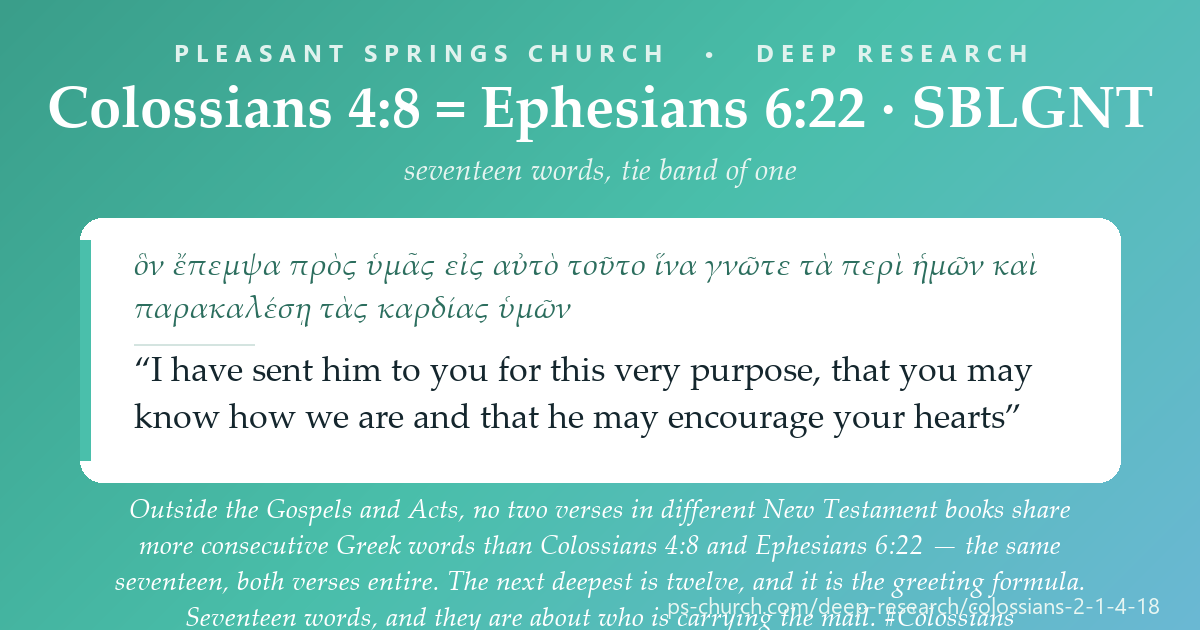
“I have sent him to you for this very purpose, that you may know how we are and that he may encourage your hearts”Colossians 4:8 = Ephesians 6:22 · seventeen consecutive Greek words, tie band 1
Not the fullness of deity. Not the record of debt. A note about a man carrying the mail. The next deepest thing two letters share is twelve words, and it is grace to you and peace from God our Father — with a tie band of five, because six letters open that way.
There is a reading of that which is worth sitting with. The parts of these letters that are most exactly repeated are the parts about people: who is coming, who sends greetings, who is in prison, who needs to be told how the writer is. The doctrine is written fresh each time. The care is written the same way twice. ⚠️ That is a reflection and not a finding, and the page marks it as one.
Three things a reader can check without any tools
1. Read Colossians 2 counting the warnings. 2:4, 2:8, 2:16, 2:18 — four times, let no one … you. Then notice that the letter never says what the thing is called. Ask why a writer would argue that hard against something he never names.
2. Read Colossians 4:7–9 and Ephesians 6:21–22 side by side in English. You will see the overlap without knowing any Greek — and you will also see the one thing Colossians adds: and fellow servant, plus a second man, Onesimus, who is one of you.
3. Look up Colossians 3:6 in your own Bible. If it is short, your translation has followed the manuscripts that omit upon the sons of disobedience. If it is long, it has followed the ones that keep it. Five of the ten words this page measures there are inside that decision, and your footnote is telling you so.
Whole-passage study, 66 verses screened, chapters 2, 3 and 4 all represented in the codex above. Greek New Testament and ESV. Colossians 1:15–20 has its own study on this shelf.
Every Deep Research page traces its passage across the whole sweep — the Old Testament, the Second-Temple world between the testaments (historical witnesses, not Scripture), and the New Testament. Follow the thread:
Pleasant Springs Church — Deep Research
Research method after Michael S. Heiser’s Bible Research Method (examine dictionaries → ancient literature → important words → textual connections → academic publications → share), with the Pleasant Springs “Author & Audience” foundation. Scripture set in the Hebrew, the Greek editions named on each page and the ESV (Old Testament), and the Greek New Testament and the ESV (New Testament), per the practice of Pleasant Springs Church. Colossians research grounded in Dunn (NIGTC), Moo (PNTC), O’Brien (WBC), Lohse (Hermeneia), Arnold (WUNT) and Hooker. Text: Greek New Testament from the SBL Greek New Testament as digitized by MorphGNT; Greek Old Testament from Rahlfs’ Septuaginta as digitized by CATSS; English from the ESV. ⚠️ VERSE NUMBERING — there is no offset in this book, and the page says so rather than leaving it unsaid. Colossians runs 29 / 23 / 25 / 18 = 95 verses in the SBLGNT as digitized by MorphGNT and 29 / 23 / 25 / 18 = 95 in the English editions checked here. Every reference on this page means the same verse in both. ⚠️ THREE NUMBERS ON THIS PAGE DEPEND ON EDITORIAL DECISIONS, AND ALL THREE ARE PRINTED WITH THEIR ALTERNATIVES. Colossians 4:8 measures 17 against Ephesians 6:22 on the SBLGNT reading γνῶτε … ἡμῶν and 8 on the alternative; Colossians 3:6 measures 10 against Ephesians 5:6 with the bracketed clause and 5 without it, and the ESV does not print that clause in its text; Colossians 4:7 measures 10 against Ephesians 6:21 on one word order and 7 on the other. Every one of the three is flagged in the codex and tabulated in stage 4. ⚠️ The measurement, in full. Greek against Greek. MorphGNT field 6, the normalised word — the column that already resolves elision and the movable nu — on both sides for New Testament comparisons; CATSS FORM column (cols 0–24), beta-code transliterated first, for the Greek Old Testament. Both sides lowercased, accents and breathings dropped, final sigma folded, then filtered to Greek letters — the same filter applied to every corpus. Word forms, never lemmas. The SBLGNT apparatus sigla were stripped from the printed Greek before measuring. Corpora: the 66 verses of Colossians 2–4 against 7,927 verses across 27 MorphGNT files, and against 30,637 verse units across 64 CATSS files (44 and 23,061 until 30 August 2026 — every figure on this page has been re-run on the larger corpus and the ones that moved are printed with what they replaced); plus a full New-Testament-against-itself control in which every verse was screened against every verse in a different book. Exhaustive and deterministic; nothing sampled, so no seed applies. ⚠️ What a reported 1 means here. This page uses the shelf’s Greek-side convention, with unigram fallback ON: a row reported as 1 shares single words but no two consecutive words. It does not mean the row shares nothing. The Hebrew-side pages on this shelf use the opposite convention, where 0 carries that meaning, and the two must not be read across. ⚠️ Tie bands are printed beside every run, because a run without its band is misleading: Colossians 4:18 reaches six into 1 Corinthians 16:21 and into 2 Thessalonians 3:17, and that tie is the whole reason the page discounts it. ⚠️ Every Old Testament negative here is a negative on the 63 CATSS files screened — 30,348 verse units, of 64 files and 30,637 units held. The sixty-fourth file is the Odes appendix, left out of every screen by house convention: two of its canticles are Luke 1–2 and ten are second copies of passages already screened. Leviticus 23 and Numbers 28–29, which sit directly under Colossians 2:16, are held and were screened. Pair by pair against their 44 and 70 verses, 2:16 reaches 1 — single words, never two consecutive; no verse in the three chapters carries all three of festival, new moon and sabbath; and Leviticus 23 has no new moon at all. The page’s Old Testament negatives — nothing reaching five, a run of 1 against each of the nine calendar verses, the absence of new moon from Greek Leviticus — were re-run on 2026-09-24 on the screened corpus and held. Until 2026-09-24 this note read: Every Old Testament negative here is a negative on the 44 CATSS files held. Exodus, Leviticus, Numbers, Joshua, Wisdom and Baruch are among the twenty not held, and Leviticus 23 and Numbers 28–29 sit directly under Colossians 2:16. The page says so at the point of use. ⚠️ Direction of influence is never asserted. Nothing here says that Colossians copies Ephesians or that Ephesians copies Colossians; nothing here settles the authorship of either letter, which a contiguous-run screen is the wrong instrument to settle; nothing here identifies the letter from Laodicea; and nothing here decides what στοιχεῖα or ἐμβατεύων means. Typology is handled per the house position: what the text says, what the New Testament itself draws, and what we see from this side of the cross — with the seeing left to the reader.
Scripture quotations marked ESV are from the ESV® Bible (The Holy Bible, English Standard Version®), © 2001 by Crossway, a publishing ministry of Good News Publishers. ESV Text Edition: 2016. Used by permission. All rights reserved. The ESV text may not be quoted in any publication made available to the public by a Creative Commons license, and the ESV may not be translated in whole or in part into any other language. www.esv.org
|
Did this study bless you today? 💚 Give to Support PS Church100% of gifts go to the General Fund — thank you. |