In the empires around Israel, one man was the “image of the god” — the king — and everyone else was made to be the gods’ unpaid labor. Then the creation week reaches its summit, the rhythm breaks, and God says: let us make man in our image — and means all of them, male and female, a nation of freed slaves included. This study works the imago Dei from that royal revolution to the face of Christ, the true Image. See the method →
Genesis 1:26–31
Hebrew · LXX · ESVThe Shape of the Passage
SequenceSame Author and audience as Genesis 1:1 — but here the whole week has been climbing toward one creature, and the style changes to mark the summit.
Author
The Torah of Moses signals the climax with three deliberate breaks in the rhythm. The refrain “let the earth bring forth” gives way to a divine self-summons, “let us make”; the God-only verb בָּרָא is spent three times in verse 27 (its densest use in all Scripture); and the nightly “good” becomes “very good.” Everything before was the house; the image-bearer is the one who moves in.
The “us.” The plural “let us make… in our image” has been read three main ways: a plural of majesty or deliberation (God taking counsel with himself); an address to the heavenly court, the angels/divine council God speaks among (cf. 1 Kgs 22:19–22; Job 38:7; Isa 6:8); and, held in historic Christian confession from the Fathers on, an early glimpse of the triune God. Note carefully: even on the divine-council view, the image is stamped in God’s likeness alone — verse 27 immediately narrows “our” to “his own image, in the image of God.” The making is God’s.
Audience
Israel — living among empires where only the king was “the image of the god,” his living representative on earth, and where humanity at large was made (in Atrahasis and Enuma Elish) as slave labor to feed the gods and spare them work.
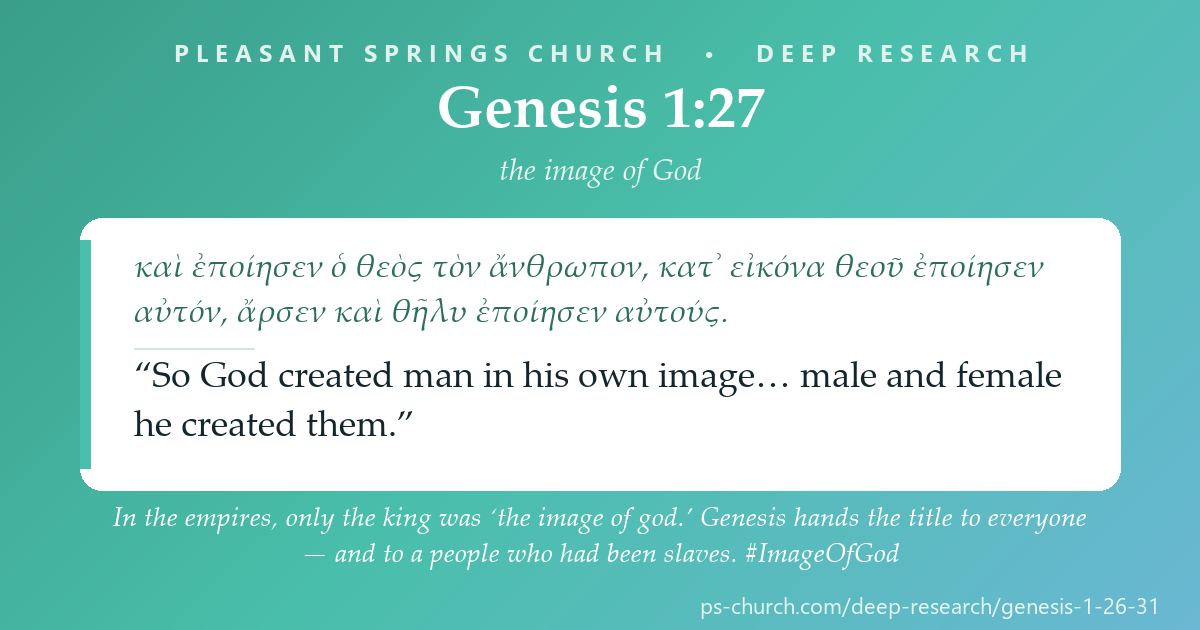
How they heard it. Genesis performs a quiet revolution: every human — male and female, king and slave — is the image of God, given the royal task of dominion. Humanity is not the gods’ unpaid workforce but God’s royal-priestly representative in a temple-cosmos. For an audience that had been Pharaoh’s slaves, “you are the image of God” was not philosophy; it was emancipation.
Orient on the image, dominion, and the divine council.
Search by topic: image of God (imago Dei), likeness, dominion, humanity, divine council.
Which articles are relevant?
- Anchor Bible Dictionary — “Image of God,” “Man (Anthropology of the OT),” “Divine Assembly,” “Dominion.”
- Dictionary of the OT: Pentateuch — “Image of God,” “Creation,” “Humanity.”
- NIDOTTE / TDOT — צֶלֶם (ṣelem), דְּמוּת (dəmûṯ), רָדָה (rāḏâ), כָּבַשׁ (kāḇaš).
Bibliography surfaced:
- J. Richard Middleton, The Liberating Image: The Imago Dei in Genesis 1 — the royal-functional reading in full.
- D. J. A. Clines, “The Image of God in Man,” Tyndale Bulletin 19 (1968) — the classic study.
- Gerhard von Rad, Genesis; Claus Westermann, Genesis 1–11; Gordon Wenham, Genesis 1–15.
The royal image, the slave-humanity myths, and the Second-Temple imago.
Set Genesis’ image against the ANE royal-image ideology and the creation-of-humanity myths, then follow the imago into Second-Temple Judaism.
Which parallels shed light on religion and worldview?
The royal image. Across Egypt and Mesopotamia, the king — and only the king — was the “image” (Akkadian ṣalmu, the very cognate of Hebrew צֶלֶם) of the god: his appointed representative, through whom the god ruled. Kings also set up statues (the same word) of themselves in distant provinces to mark their sovereignty. Genesis takes this loaded royal term and democratizes it to all humanity: every person is God’s living statue, placed in the world-temple to represent his rule.
The slave-humanity myths. In Atrahasis and Enuma Elish, humans are fashioned from clay mixed with a slain god’s blood, expressly to carry the gods’ workload so the gods can rest. Genesis inverts the motive: humanity is not made to give God rest from labor, but is blessed, commissioned, fed (vv.28–30), and then joined by God in his own rest (2:2–3).
- Egyptian royal ideology (e.g. the Instruction of Merikare) — humanity as the god’s “images who came from his body”; the king as the living image of Re.
- Atrahasis; Enuma Elish VI — humanity created from clay and a god’s blood to bear the gods’ toil.
- Sirach 17:1–4 (Apocrypha/Deuterocanon — a valued witness, not Scripture) — God “made them in his own image” and gave them “dominion over beasts and birds”: an early reading of Genesis 1:26–28.
- Wisdom of Solomon 2:23 (Apocrypha — likewise not Scripture) — “God created man for incorruption, and made him the image of his own eternity.”
- Jubilees 2:14 (Pseudepigrapha — a witness, not Scripture) — retells day six with humanity made male and female and given rule over all, but pointedly drops Genesis’ “image” language — a telling contrast with Sirach and Wisdom, which keep it.
צֶלֶם was a king’s word and a statue’s word. Genesis hands it to a slave-people and says: this is you. Human dignity in the Bible is not earned or ranked — it is a status conferred at creation on every image-bearer, the theological ground beneath every later claim that the poor, the enslaved, and the unborn bear the weight of God’s own likeness (cf. Gen 9:6; James 3:9).
Six words at the summit of the week.
Watch the royal weight of צֶלֶם, the plural נַעֲשֶׂה, and the leap to “very good.”
“Image, statue” — the ANE royal/representative word (Akkadian ṣalmu); LXX εἰκών, behind Colossians 1:15. Humanity as God’s living statue in the world.
“Likeness, resemblance” — pairs with צֶלֶם to soften and specify it: a true likeness, yet not identity. LXX ὁμοίωσις.
“Let us make” — the plural cohortative: majesty/deliberation, the divine council, or (in Christian reading) the triune God. V.27 at once narrows it to God’s image alone.
“Have dominion, rule” — royal governance, delegated. Bounded by the image it serves: rule as God rules — tending, not tyranny (cf. 2:15).
“Subdue” — strong cultivation language; the mandate to develop the earth’s potential, later re-aimed after the fall toward a groaning creation (Rom 8).
“Very good” — the only intensified verdict of the week, spoken once the image-bearer completes the whole: creation is not merely functional but delightful to its Maker.
How the New Testament reuses the image:
- Colossians 1:15; 2 Corinthians 4:4 — Christ is “the εἰκών of the invisible God”: the true and perfect Image, the one צֶלֶם to whom all others point (and Hebrews 1:3 says the same with a different word — χαρακτήρ, the “exact imprint”).
- Romans 8:29; 2 Corinthians 3:18; 1 Corinthians 15:49 — salvation as being “conformed to the image of his Son”: the imago defaced in the fall, restored in Christ.
- Colossians 3:10; Ephesians 4:24 — the new self “renewed… after the image of its creator”: Genesis 1:27 becoming the shape of sanctification.
- James 3:9; Genesis 9:6 — the abiding image grounds human dignity: you cannot curse or shed the blood of one made “in the likeness of God.”
From the image made to the image restored.
Trace the image through the canon — conferred, defaced, and renewed in Christ — then note where Beale & Carson picks up the imago in the New Testament.
Which cross-references matter?
- Genesis 5:1–3; 9:6 — the image passed on through the generations and protecting human life after the fall.
- Psalm 8:4–8 — humanity “crowned with glory and honor,” given dominion: the imago set to poetry (and applied to Christ in Heb 2:6–9).
- 1 Corinthians 11:7; 15:45–49 — the first Adam’s image and the last Adam’s: we bear the image of the man of dust, and shall bear the image of the man of heaven.
- Colossians 1:15–20; 3:9–10; 2 Corinthians 3:18–4:6 — Christ the Image, and the Spirit re-forming us into it “from one degree of glory to another.”
- Revelation 22:4 — “they will see his face, and his name will be on their foreheads”: the image-bearers fully restored, bearing the likeness openly at last.
The commentary’s handling of Colossians and 2 Corinthians traces the New Testament’s εἰκών language straight back to Genesis 1:26–27: Christ is the true Image, and the church is being re-made into that image by the Spirit. The trajectory this library has followed — creation climbing to the image-bearer — turns out to be the same trajectory the gospel runs in reverse: the defaced image remade in the One who is the image, until we see his face (Rev 22:4).
The scholarship on the imago Dei.
Middleton for the royal-functional reading; Clines for the classic survey; the standard commentaries for the “us” debate.
Commentaries & studies:
- J. Richard Middleton, The Liberating Image: The Imago Dei in Genesis 1 — image as royal function and vocation.
- D. J. A. Clines, “The Image of God in Man,” TynBul 19 (1968); Wenham (WBC), von Rad, Westermann, Hamilton (NICOT).
- Catherine McDowell, The Image of God in the Garden of Eden — image against Mesopotamian and Egyptian ritual backgrounds.
The “let us” and the image — notes worth keeping:
- Three readings of “us” — (1) plural of majesty/self-deliberation; (2) address to the divine council/heavenly court (cf. 1 Kgs 22:19–22; Isa 6:8); (3) the intra-triune reading held in historic Christian confession from the Fathers onward. Verse 27’s singular (“in his image”) keeps the making God’s alone on any view — a useful guardrail.
- What the image is — the older debate (a faculty: reason, soul, will) has largely yielded to the functional/royal view (representative rule) and the relational view (made for communion, “male and female”); these are complementary, not exclusive.
- “Male and female” (v.27) roots the equal image-bearing of both sexes in creation itself — a claim with no real parallel in the surrounding cultures.
From the image made to the image lived.
Name what you learned, why it matters, and one concrete response.
What should we carry away — and do?
- Your dignity is conferred, not earned. The image is a status God stamped on you at creation — before you achieved, produced, or proved anything. It cannot be out-performed or lost.
- Everyone you meet is a royal image. The cashier, the opponent, the unborn, the enemy — each is God’s living statue (James 3:9). How we treat image-bearers is how we treat their King.
- The image is being restored. Defaced in the fall, it is remade in Christ, the true Image (Col 1:15), “from one degree of glory to another” (2 Cor 3:18) — until we see his face.
Step in response: pick one person you find it hardest to honor, and this week treat them deliberately as צֶלֶם אֱלֹהִים — the image of God — in one concrete act. And thank God that the image you cannot perfect, Christ is perfecting in you.
Genesis 1:27 · to share
LXX + ESVEvery Deep Research page traces its passage across the whole sweep — the Old Testament, the Second-Temple world between the testaments (historical witnesses, not Scripture), and the New Testament. Follow the thread:
Pleasant Springs Church — Deep Research
Research method after Michael S. Heiser’s Bible Research Method (examine dictionaries → ancient literature → important words → textual connections → academic publications → share), with the Pleasant Springs “Author & Audience” foundation. Scripture set in the Hebrew, the Greek editions named on each page and the ESV (Old Testament), and the Greek New Testament and the ESV (New Testament), per the practice of Pleasant Springs Church. Genesis 1:26–31 research grounded in Middleton, Clines, McDowell, von Rad, and Wenham; ancient parallels from Egyptian royal ideology, Atrahasis, and Enuma Elish; Second-Temple readings per Sirach 17, Wisdom 2, and Jubilees 2 (all read as witnesses, not Scripture).
Scripture quotations marked ESV are from the ESV® Bible (The Holy Bible, English Standard Version®), © 2001 by Crossway, a publishing ministry of Good News Publishers. ESV Text Edition: 2016. Used by permission. All rights reserved. The ESV text may not be quoted in any publication made available to the public by a Creative Commons license, and the ESV may not be translated in whole or in part into any other language. www.esv.org
|
Did this study bless you today? 💚 Give to Support PS Church100% of gifts go to the General Fund — thank you. |