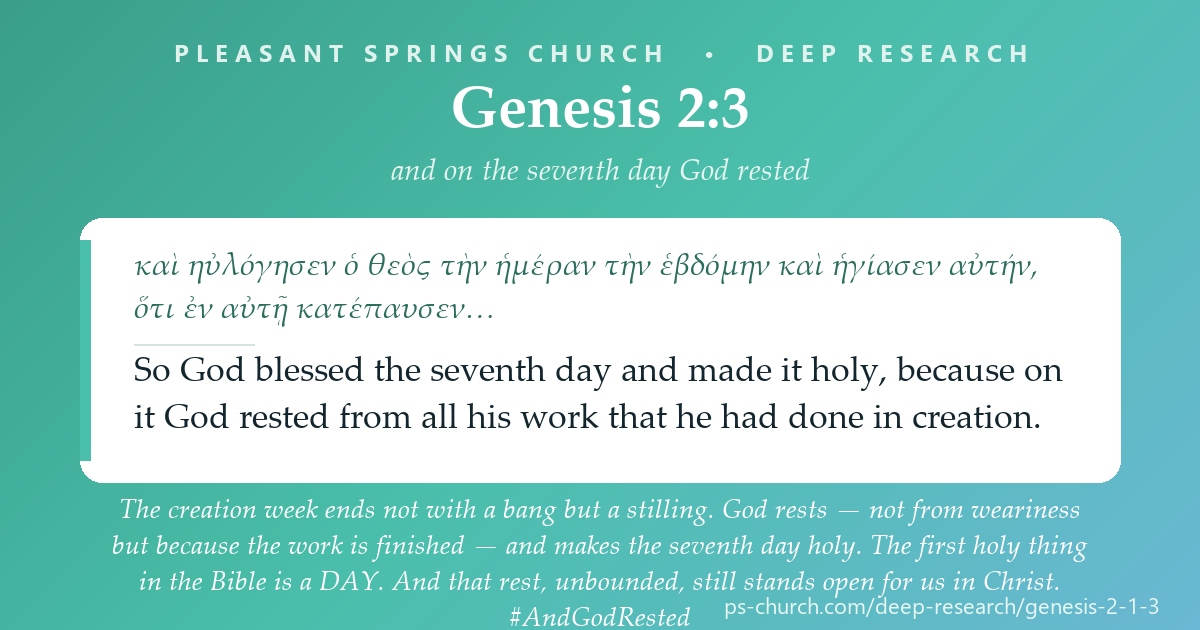
The creation week ends not with a bang but with a stilling. “The heavens and the earth were finished” — and God does three things to a day: he rests (not from weariness but because the work is done), he blesses it, and he makes it holy — the first holy thing in the Bible. Holiness attaches first not to a place or a people but to time. God’s rest is the settled repose of the Maker enthroned over a finished world he called “very good” — the ground of the Sabbath, and a rest that still stands open for the people of God. This study works Genesis 2:1–3 — the seventh day. See the method →
Genesis 2:1–3
Hebrew · LXX · ESVThe Shape of the Passage
Sevenfold refrainGenesis 2:1–3 is the hinge between the cosmic creation account (1:1–2:3) and the human story that follows. It is the climax of the seven days — and, strikingly, the only day God blesses and sanctifies. The rest of God is not an afterthought to creation; it is its crown.
Author
Moses closes the creation week with a deliberate, measured cadence. Verse 1 declares the work “finished” (waykhullu, from kalah, “to complete”) — the same verb later used for the finishing of the tabernacle (Exod 39:32; 40:33), a clue that creation is a cosmic sanctuary and the tabernacle a miniature cosmos. “All their host” (tsava’) pictures the sun, moon, stars, and creatures as an ordered, arrayed army under their Commander. Then the sevenfold rhythm of “and God said… and it was so… and it was good” gives way to something new: God rests.
Rest, not fatigue. The verb is shabat — to cease, to desist, to stop — not to grow weary. God does not rest because he is tired (Isa 40:28, “he does not faint or grow weary”); he ceases because the work is complete. In the ancient world, a god’s “rest” was his settled, enthroned repose in his temple, taking up his rule over a finished order — not inactivity but the calm of sovereignty. So God’s seventh-day rest is his kingly enthronement over the world he has made and pronounced “very good.” And notice the sharp contrast with the surrounding cultures: in the Babylonian myths, humanity is made so the gods can rest from their labor; in Genesis, God’s rest is a gift given to humanity, a day blessed and hallowed for us.
The first holy thing is a day. Verse 3 contains the Bible’s first use of the word “holy” (qadash, “to sanctify, set apart”). And what God first makes holy is not a mountain, a temple, or a nation — it is time, the seventh day. Sacred time precedes sacred space (the tabernacle) and sacred people (Israel). The Sabbath is therefore not merely a law given at Sinai; it is stitched into the structure of the world at the very beginning. (A textual note: the Hebrew reads that God “finished” his work “on the seventh day” — best understood as “had finished,” since the resting is the point; the Septuagint and Samaritan Pentateuch read “sixth day,” smoothing the apparent tension. The ESV, following the Hebrew, keeps “seventh.”)
Audience
Israel — a people who would be commanded to keep the seventh day precisely because God did: “For in six days the Lord made heaven and earth… and rested on the seventh day. Therefore the Lord blessed the Sabbath day and made it holy” (Exod 20:11). Human Sabbath-keeping is an imitation of God: as he worked and then rested, so his image-bearers work and rest, confessing that the world is his and complete, not ours to anxiously sustain. To a nation freshly out of slavery — where rest was impossible — a hallowed day of rest was itself a declaration of freedom (Deut 5:15).
The rest that remains. Genesis 2:1–3 has an open ending. Unlike the first six days, the seventh has no “evening and morning” — the refrain simply stops. The New Testament sees this as no accident: God’s rest is a rest not yet fully entered, and it stands open still. “There remains a Sabbath rest for the people of God, for whoever has entered God’s rest has also rested from his works as God did from his” (Heb 4:9–10). The seventh day points beyond itself — to the finished work of Christ, in whom the weary find rest (Matt 11:28), and to the new creation where God dwells with his people and every labor and tear is done (Rev 21:3–4). Whether Christians are bound to a particular day is debated (Rom 14:5; Col 2:16–17); that the deepest Sabbath is found in Christ is not.
Orient on Sabbath, rest, holiness, and completion.
Search by topic: Sabbath, rest (menuchah), holiness (qadash), creation, cosmic temple.
Which articles are relevant?
- Anchor Bible Dictionary — “Sabbath,” “Rest,” “Holiness,” “Creation.”
- Dictionary of the OT: Pentateuch — “Sabbath,” “Creation,” “Rest,” “Holiness.”
- NIDOTTE / TDOT — shabat (cease/rest), qadash (make holy), kalah (complete), barakh (bless).
Bibliography surfaced:
- Gordon Wenham (WBC), Victor Hamilton (NICOT), Kenneth Mathews (NAC), Bruce Waltke, Nahum Sarna (JPS) on Genesis.
- John Walton, The Lost World of Genesis One (cosmic-temple rest); Abraham Heschel, The Sabbath.
- Beale & Carson, Commentary on the NT Use of the OT (Hebrews 3–4).
Divine rest, the cosmic temple, and holy time.
Read God’s “rest,” the “finishing” language, and the hallowing of a day against their Ancient Near Eastern backdrop.
Which parallels shed light on religion and worldview?
Rest as enthronement, not exhaustion. In the Ancient Near East, when a deity “rested,” it meant he took up settled residence and rule in his temple. Creation accounts often climaxed with the god entering his house to reign. Genesis speaks the same idiom but transfigures it: the true God rests not because his labor wore him out but because his work is finished and good, and his rest is the calm sovereignty of the Maker over his ordered world. The Bible elsewhere calls the temple God’s “resting place” (Ps 132:8, 14; Isa 66:1) — the same theology. And the literary link between the “finishing” of creation (Gen 2:1–2) and the “finishing” of the tabernacle (Exod 39–40) says quietly but unmistakably: the cosmos itself is God’s temple, and the seventh day is the day he takes his throne within it.
Humanity made for rest, not to give the gods rest. The contrast with Mesopotamia is pointed. In Atrahasis and Enuma Elish, humanity is created precisely so the lesser gods can be relieved of their toil — people exist to do the gods’ labor. Genesis inverts this entirely. God does not make humans to secure his own rest; he gives his rest to them as blessing. The seventh day is hallowed for humanity (cf. Mark 2:27, “the Sabbath was made for man”). Where the pagan gods extract labor, the God of Israel bestows rest.
Holy time before holy space. Perhaps the most quietly radical feature of these verses is that the first thing God sanctifies is a day. Every other religion of the ancient world located holiness in a place — a shrine, a mountain, a sacred grove — or in objects and images. Genesis locates the first holiness in time. As Abraham Heschel put it, the Sabbath is a “cathedral in time,” a sanctuary no army can raze and no exile can take away. A people could lose their land and their temple — and Israel did — and still carry their holiest thing with them, because it was a day, not a place. Holiness that lives in time cannot be captured; it can only be kept.
- Exodus 20:8–11; 31:12–17; Deuteronomy 5:12–15 — the Sabbath command grounded in creation (Exod) and in the exodus from slavery (Deut): the two roots of Israel’s rest.
- Psalm 132:8, 14; Isaiah 66:1–2 — the temple as God’s “resting place”; heaven his throne and earth his footstool: divine rest as enthronement.
- Exodus 39:32; 40:33–34 — the tabernacle “finished” (same verb as Gen 2:1–2) and filled with glory: creation as cosmic temple.
We tend to read the seventh day as a kind of appendix — the work of creation is over in six days, and the seventh is just God taking a well-earned break before the real story begins with Adam. But in the world Genesis was written for, the seventh day was not the anticlimax; it was the climax. In ancient thinking, a temple was not finished when the last stone was laid; it was finished when the deity entered it and took up residence and rule. The building of the house was preparation; the god’s coming to rest in it was the point. Read that way, the six days are the construction of the cosmic temple — light and land and sea and sky and their inhabitants, all put in order — and the seventh day is God moving in. His ‘rest’ is not disengagement from the world but engagement with it; it is the Creator settling onto his throne in the temple of the cosmos to run it, to be present in it, to bless it. That is why the day is blessed and made holy: it is the day the world becomes God’s dwelling. And it is why the theme cannot rest, so to speak, until the very end of Scripture, where the promise is finally kept: ‘Behold, the dwelling place of God is with man. He will dwell with them.’ The seventh day of Genesis and the new creation of Revelation are the same hope — God at rest, at home, among his people, in a finished and very good world.
The vocabulary of ceasing, hallowing, and completion.
Watch the “cease” (not tire), the first “make holy,” the “finish” that ties creation to the tabernacle, and the blessing of a day.
“To cease, desist, rest.” The verb behind the noun shabbat (Sabbath). It means to stop, not to be weary — God ceases because the work is complete, not because he is tired. Gen 2:2–3 gives the theological root of Israel’s seventh day, though the noun “Sabbath” is not yet used.
“To make holy, consecrate, set apart.” The Bible’s FIRST occurrence of holiness language — and the first thing sanctified is time, the seventh day, not a place or a people. Sacred time precedes sacred space and sacred persons.
“To complete, finish, bring to an end.” Frames creation as a finished, ordered whole. The same root marks the finishing of the tabernacle (Exod 39:32; 40:33) — a deliberate link: creation is a cosmic sanctuary.
“Work, craftsmanship.” Not laborious toil (the post-fall words are ’itstsavon/’avodah, 3:17–19) but skilled, purposeful making. The very word later defining the “work” forbidden on the Sabbath (Exod 20:10) — human rest imitates God the Craftsman.
“To bless.” In Genesis 1 God blessed living creatures (1:22) and humanity (1:28); here uniquely he blesses a day. The seventh day is endowed with life-giving, generative power — rest is fruitful, not merely a pause.
“He caused to cease / rested,” the LXX rendering of shabat. Its noun katapausis (“rest”) becomes the keyword of Hebrews 3–4, where God’s creation rest is the pattern for the “rest that remains for the people of God” — entered by faith in Christ.
How the rest of Scripture fills out the seventh day:
- Exodus 20:8–11; 31:12–17 — the Sabbath command and sign, grounded in God’s own resting: human rest as imitation of God (see the Ten Commandments).
- Hebrews 3:7–4:11 — God’s creation rest still stands open; “there remains a Sabbath rest for the people of God”; entered by faith, not works (see the great high priest).
- Matthew 11:28–30; Mark 2:27–28 — “Come to me… and I will give you rest”; “the Sabbath was made for man”; the Son of Man is Lord of the Sabbath.
- Revelation 21:1–4; Colossians 2:16–17 — the new creation where God dwells with his people and all sorrow ends; the Sabbath a “shadow” whose substance is Christ (see the new creation).
From the first rest to the rest that remains.
Trace the seventh day from creation through Sinai to the rest fulfilled in Christ and consummated in the new creation.
Which cross-references matter?
- Genesis 1:26–31; 2:4–17 — the sixth-day crown (humanity in God’s image) and the garden-temple: what the seventh day completes (see the image of God, the garden).
- Exodus 20:8–11; 31:12–17; Deuteronomy 5:12–15 — the Sabbath rooted in creation and in redemption from slavery (see the Decalogue).
- Hebrews 4:1–11; Matthew 11:28–30 — the rest that remains; the rest Christ gives to the weary: the seventh day’s open ending answered (see Hebrews 4).
- Revelation 21:1–4; 22:1–5 — God dwelling with man, death and tears no more: the consummation of the seventh-day rest (see the new creation).
- Colossians 2:16–17; Romans 14:5–6 — the Sabbath as a shadow whose body is Christ; freedom of conscience on days: the New Testament’s careful balance.
It is easy to miss how carefully the seventh day is set apart from the other six, because nothing dramatic happens on it. But the very quietness is the signal. Each of the first six days follows a formula — God speaks, it is so, God sees that it is good, evening and morning, the next day. The seventh day breaks every part of the pattern. There is no divine command, because there is nothing left to make. There is no ‘it was good,’ because now the whole is pronounced ‘very good.’ And, most tellingly, there is no ‘and there was evening and there was morning.’ The other days are bounded; the seventh is not. The writer leaves it open. In the flow of the narrative this is simply an elegant way to end a poem, but the later Scriptures treat it as pregnant: the seventh day’s rest has never been closed off, and the invitation to enter it stands open still. So the creation account ends not with a period but with a door left ajar. Six days of work reach their goal in a day of rest and holiness and blessing — and that day, uniquely unbounded, reaches out past the end of the week and past the end of the Old Testament, toward the rest that Christ gives and the new creation where God is at home with his people. The crown of creation is not the making of humanity on the sixth day, glorious as that is; it is the rest of God on the seventh, into which he means to bring us.
The scholarship on Genesis 2:1-3.
The commentators on the seventh day; the studies of divine rest, the cosmic temple, and the Sabbath in biblical theology.
Commentaries & studies:
- Gordon J. Wenham (WBC), Victor P. Hamilton (NICOT), Kenneth A. Mathews (NAC), Bruce K. Waltke, Nahum M. Sarna (JPS) on Genesis.
- John H. Walton, The Lost World of Genesis One and Genesis 1 as Ancient Cosmology; Abraham J. Heschel, The Sabbath.
- G. K. Beale, The Temple and the Church’s Mission; G. K. Beale & D. A. Carson, eds., Commentary on the NT Use of the OT.
Interpretation notes worth keeping:
- Rest, not fatigue. Shabat = “cease,” not “grow weary” (Isa 40:28) — God ceases because the work is complete; his rest is enthroned sovereignty, not recovery.
- Cosmic temple. The “finished” language (Gen 2:1–2 / Exod 39–40) and the ANE “rest” motif read creation as God’s temple, the seventh day his enthronement — without over-literalizing (God did not physically nap) or reducing the day to mere metaphor.
- Holy time first. The first sanctified thing is a day (2:3) — sacred time before sacred space or people; a holiness that exile cannot capture.
- Text note. MT “on the seventh day God finished” is best read “had finished”; the LXX/Samaritan “sixth day” is a harmonizing variant. The ESV follows the Hebrew.
- Sabbath and Christians. The creation ordinance is real and abiding; whether believers are bound to a specific day is debated (Rom 14:5; Col 2:16–17). The deepest rest is Christ himself (Matt 11:28; Heb 4).
From a finished world to a rest still offered.
Name what you learned, why it matters, and one concrete response.
What should we carry away — and do?
- God rested because the work was finished. His Sabbath is not exhaustion but the calm of a Maker enthroned over a world he called “very good.” The world is his, and complete — not ours to anxiously hold together.
- Holiness begins in time. The first holy thing is a day, not a place. A rhythm of rest is woven into creation itself — a gift, not a burden; freedom, not idleness.
- The rest still stands open. The seventh day has no evening. Its rest is fulfilled in Christ, who says to the weary, “Come to me,” and consummated where God dwells with his people and every tear is wiped away.
Step in response: keep a real Sabbath this week — a set-apart span of ceasing — and let it preach to you. Stopping your work is a confession that the world runs on God’s power, not yours. And carry the deeper rest with you: come to Christ, the finished work, in whom the soul finds the rest that no day off can give.
Genesis 2:3 · to share
LXX + ESVEvery Deep Research page traces its passage across the whole sweep — the Old Testament, the Second-Temple world between the testaments (historical witnesses, not Scripture), and the New Testament. Follow the thread:
Pleasant Springs Church — Deep Research
Research method after Michael S. Heiser’s Bible Research Method (examine dictionaries → ancient literature → important words → textual connections → academic publications → share), with the Pleasant Springs “Author & Audience” foundation. Scripture set in the Hebrew, the Greek editions named on each page and the ESV (Old Testament), and the Greek New Testament and the ESV (New Testament), per the practice of Pleasant Springs Church. Genesis 2:1–3 research grounded in Wenham, Hamilton, Mathews, Waltke, and Sarna, with Walton on the cosmic-temple rest and Heschel on holy time; shabat read as “cease” (the work complete), not fatigue (Isa 40:28); God’s rest as enthroned sovereignty in the cosmos-temple (the “finished” link to the tabernacle, Exod 39–40) — without over-literalizing or reducing the day to metaphor; the first sanctified thing being time (holy time before holy space); the MT “seventh day” kept in the ESV (“had finished”), the LXX/Samaritan “sixth day” noted as a harmonizing variant; the creation ordinance affirmed while the binding of Christians to a specific day is held as debated (Rom 14:5; Col 2:16–17), the deepest rest being Christ (Matt 11:28; Heb 4).
Scripture quotations marked ESV are from the ESV® Bible (The Holy Bible, English Standard Version®), © 2001 by Crossway, a publishing ministry of Good News Publishers. ESV Text Edition: 2016. Used by permission. All rights reserved. The ESV text may not be quoted in any publication made available to the public by a Creative Commons license, and the ESV may not be translated in whole or in part into any other language. www.esv.org
|
Did this study bless you today? 💚 Give to Support PS Church100% of gifts go to the General Fund — thank you. |