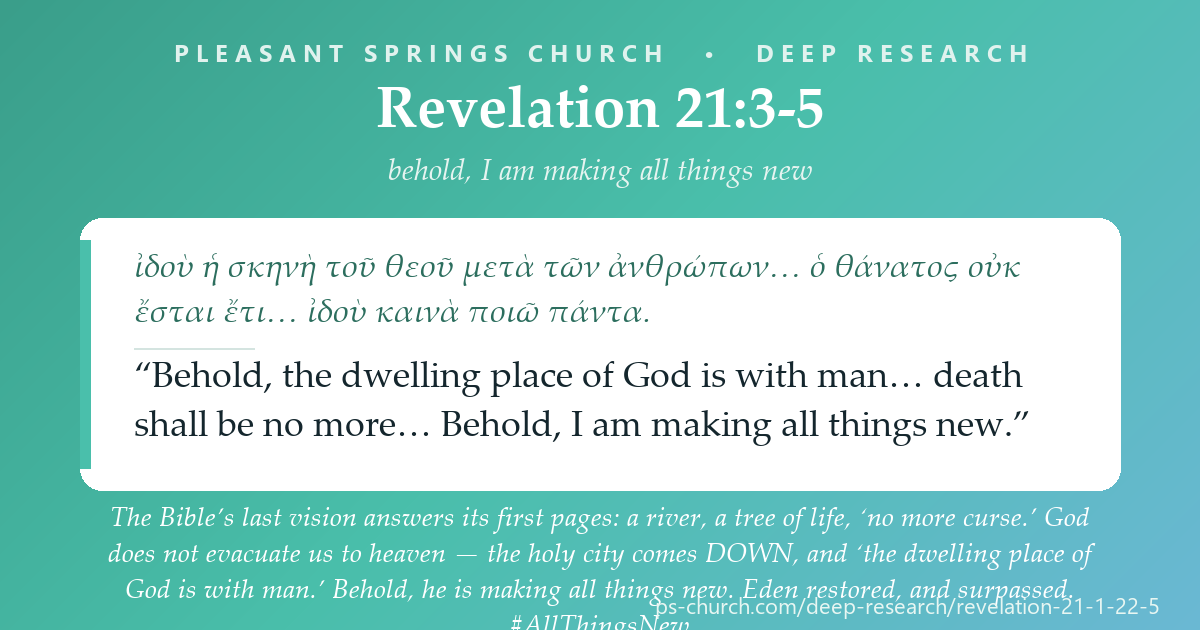
The Bible’s last vision answers its first pages. John sees a new heaven and a new earth, and the holy city coming down — God does not evacuate his people to heaven; he brings heaven to earth. “The dwelling place of God is with man… he will wipe away every tear… death shall be no more.” “Behold, I am making all things new.” The river and the tree of life return — the tree barred in Eden — and the word that undoes Genesis 3: “No longer will there be anything accursed.” This study — the capstone of the whole library — works Revelation 21:1–8 and 22:1–5: Eden restored, and surpassed. See the method →
Revelation 21:1, 3–5; 22:2–3
Greek NT · ESVThe Shape of the Passage
Sevenfold refrainThis is where the whole Bible has been going, and where this whole library of studies has been going — back to a garden, a river, and a tree of life, but now a garden-city that can never be lost. What was ruined in Genesis 3 is not merely repaired but surpassed: God dwelling with his people, the curse gone, death dead, the nations healed.
Author
John sees “a new heaven and a new earth” (21:1) — the fulfillment of Isaiah’s promise, “Behold, I create new heavens and a new earth” (Isa 65:17; 66:22). The crucial word is kainos, “new” — new in quality, renewed, not neos, brand-new-in-time. This is not the scrapping of creation and the manufacture of a replacement; it is the transfiguration of this world. That is confirmed by the direction of travel: the holy city comes down “out of heaven from God” (21:2). The hope of the gospel is not that we escape the material world to float in a disembodied heaven — that is the old Gnostic error — but that heaven comes to earth, and God makes his home with us. “The sea was no more” (21:1) is not a statement that the new earth lacks water; in Revelation’s symbolic world the sea is the source of chaos and of the beast (13:1) — its absence means the end of all threat.
‘Behold, the dwelling place of God is with man.’ A loud voice from the throne names the goal of the entire biblical story: “the skēnē [tabernacle] of God is with man. He will tabernacle (skēnōsei) with them… and God himself will be with them as their God” (21:3) — the same word John used of the incarnation, “the Word became flesh and tabernacled among us” (John 1:14). Every earlier dwelling — Eden, the tabernacle, the temple, the incarnate Christ — was pointing here. And with the Presence comes the end of all sorrow: “he will wipe away every tear… and death shall be no more, neither mourning, nor crying, nor pain” (21:4; Isa 25:8). Then the One on the throne — who has spoken only rarely in the whole book — declares: “Behold, I am making all things new” and “It is done” (21:5–6), the divine counterpart to the cross’s “It is finished.” He seals it with his Name: “I am the Alpha and the Omega” — the same title the risen Christ claims (22:13), Father and Son bound in one divine identity.
Eden restored — and surpassed. The final scene (22:1–5) walks us back into Genesis, and every detail is Eden fulfilled. A river of the water of life flows “from the throne of God and of the Lamb” (Gen 2:10; Ezek 47). The tree of life stands there — the very tree from which Adam was barred by cherubim and a flaming sword (Gen 3:22–24) — now freely accessible, bearing twelve fruits, its leaves “for the healing of the nations” (Ezek 47:12). And then the sentence that reverses the fall: “No longer will there be anything accursed” (pan katathema ouk estai eti, 22:3) — the undoing of “cursed is the ground because of you” (Gen 3:17). The exile that began east of Eden ends in the city where God dwells; the redeemed “will see his face” (22:4) — the vision denied to Moses (Exod 33:20) — and “will reign forever and ever.”
Audience
Suffering churches who needed to know that their tears, their martyrs, and their groaning world were not the last word. To them — and to us — the vision gives not an escape but a promise: this creation, and these very bodies, are destined for glory (Rom 8:19–23). The dead will rise, the earth will be healed, the nations will flourish, and God will live among his people. The words are certified twice: “these words are trustworthy and true” (21:5). It is not wishful thinking; it is the promise of the One who sits on the throne.
Two destinies, honestly named. The vision is radiant, but it is not sentimental. Right in the middle of it stands a solemn warning: “as for the cowardly, the faithless… and all liars, their portion will be in the lake that burns with fire… the second death” (21:8). The open gates and the “healing of the nations” are not a promise that all will be saved regardless; the same vision keeps the impenitent outside (22:15) and admits only “those who are written in the Lamb’s book of life” (21:27). The new creation is for a real, redeemed, secured people — and the invitation stands wide open now: “let the one who is thirsty come; let the one who desires take the water of life without price” (22:17). The end of the story is a free gift, offered to all and received by faith.
Orient on the new creation, the New Jerusalem, and the tree of life.
Search by topic: new creation / new heavens and earth, New Jerusalem, tree of life, the curse, beatific vision.
Which articles are relevant?
- Anchor Bible Dictionary — “New Jerusalem,” “Heaven, New,” “Tree of Life,” “Paradise.”
- Dictionary of the Later NT — “Heaven, New Heavens,” “Creation, New Creation,” “Eschatology.”
- NIDNTT / TDNT — καινός (kainos, new), σκηνόω (skēnoō, tabernacle), κατάθεμα (katathema, accursed), θεραπεία (therapeia, healing).
Bibliography surfaced:
- G. K. Beale (NIGTC), Grant Osborne (BECNT), Robert Mounce (NICNT), David Aune (WBC), Craig Koester (Anchor) on Revelation.
- Richard Bauckham, The Theology of the Book of Revelation; G. K. Beale, The Temple and the Church’s Mission (the Eden-temple inclusio).
- Beale & McDonough, “Revelation,” in Commentary on the NT Use of the OT.
The renewed creation, the tabernacling God, and the curse reversed.
Read “new,” the descending city, and the “no more curse” against Isaiah, Ezekiel, and Genesis — the Bible’s grand inclusio.
Which parallels shed light on religion and worldview?
‘New’ means renewed, not replaced. Everything in the reading of this passage turns on one word. When the One on the throne says, “Behold, I am making all things new” (21:5), the Greek is kaina, not nea — new in quality and freshness, not brand-new-in-time. He does not say “I am making all new things” (which would mean replacement); he says “I am making all things new” — renewal. The whole biblical hope is not that God will trash the physical creation he called “very good” (Gen 1) and start over with disembodied souls in an ethereal heaven, but that he will liberate and transfigure this creation from its bondage to decay (Rom 8:21; 2 Pet 3:13). That is why the city comes down to earth (21:2, 10), why there is a river and trees and fruit and healing and nations, and why the redeemed “reign on the earth” (5:10). Salvation is not evacuation; it is resurrection and a renewed world.
The tabernacling God — the goal of the whole story. The voice from the throne says, “the tabernacle of God is with man, and he will tabernacle with them” (21:3). The Greek skēnē/skēnoō reaches back across the whole Bible: to Eden, where God walked with Adam; to the tabernacle and temple, where his glory dwelt behind a veil; to the incarnation, where “the Word became flesh and tabernacled among us” (John 1:14, same verb). Every dwelling was partial and provisional; here it is total and permanent. The refrain of the covenant — “I will be their God, and they shall be my people” (Lev 26:11–12; Ezek 37:27) — reaches its consummation, now widened to “peoples” (the plural in the best manuscripts): all the nations, not Israel alone, are God’s dwelling.
The curse reversed — the Bible’s inclusio. The final scene is Genesis run backward. In Eden a river watered the garden (Gen 2:10); here a river of the water of life flows from the throne. In Eden stood the tree of life (Gen 2:9); here it stands again, but now Adam is not barred from it by cherubim and a flaming sword (Gen 3:24) — access is total, the fruit is monthly, the leaves heal the nations (drawn from Ezekiel’s temple-river, Ezek 47:12). And the curse God pronounced — “cursed is the ground because of you” (Gen 3:17) — is lifted with a word that echoes Zechariah’s promise: “no longer will there be anything accursed” (Rev 22:3; cf. Zech 14:11, “there shall be no more curse”). The whole canon, from the first garden to the last city, is a single arc — and its hinge is the blood of the Lamb, whose throne now stands where the curse once fell.
- Isaiah 65:17–25; 66:22; 25:8; 55:1 — “I create new heavens and a new earth”; God swallows death and wipes away tears; the free water: the OT behind 21:1–6.
- Genesis 2:9–10; 3:17–24; Ezekiel 47:1–12 — the river, the tree of life, the curse and the barring cherubim; Ezekiel’s temple-river with healing trees: the Eden inclusio of 22:1–3 (see the garden, the curse & exile).
- Leviticus 26:11–12; Ezekiel 37:27; Zechariah 14:11; Exodus 33:20 — “I will be their God”; “no more curse”; the face of God denied to Moses, now seen: the dwelling, the decursing, the vision (see Ezekiel 37).
The Bible is a story with a garden at the beginning and a garden-city at the end, and the two are meant to be read together — the last chapters of Revelation are deliberately written to answer the first chapters of Genesis. In Eden there was a river; in the New Jerusalem there is a river. In Eden there was the tree of life; in the New Jerusalem there is the tree of life. In Eden God walked with humanity in the cool of the day; in the New Jerusalem the dwelling of God is with man, and they see his face. But the answer is not merely a return to the beginning, as though the whole drama of redemption were a long detour that finally deposits us back where Adam started. It is a return that has become a consummation. Eden was a garden with the possibility of a serpent, a forbidden tree, a fall, an exile; the New Jerusalem is a garden-city where ‘there shall be no more curse,’ no more sea of chaos, no more night, no more death, no more tempter — nothing that could ever again unmake the joy. What was vulnerable is now secure; what was a garden is now also a city, filled with the redeemed of every nation; what Adam could lose, the last Adam has made unlosable by his blood. And the barrier that kept humanity from the tree of life — the flaming sword of the cherubim — has been taken away, not by our forcing our way back in, but by the Lamb who was slain, whose throne now stands at the center of the city where the curse used to be. This is why the whole long study of Scripture, from Genesis 1:1 onward, comes to rest here: the God who said ‘Let there be light’ says at the last, ‘Behold, I am making all things new,’ and the light that fills the city is the glory of God and the Lamb.
The vocabulary of renewal, indwelling, and the reversed curse.
Watch the qualitative “new,” the tabernacling God, the “It is done,” the divine self-title, the reversed curse, and the restored tree of life.
“New” — new in quality/kind (renewed, fresh), not neos (brand-new in time). “I make all things new” (kaina poiō panta) = renewal of this creation, not replacement by a different one — the lexical anchor against Gnostic escapism.
“Dwelling / to tabernacle” — the same root as John 1:14 (“the Word… tabernacled among us”). The Bible’s whole goal — God dwelling with his people (Eden, tabernacle, temple, incarnation) — reaches consummation: God himself with them, forever.
“It is done” — a perfect (completed, abiding action), the divine counterpart to the cross’s tetelestai (“It is finished,” John 19:30). The whole redemptive program stands accomplished. (A plural form, one of Revelation’s grammatical roughnesses; not to be confused with gegonen of 16:17.)
“The Alpha and the Omega” — first and last letters of the alphabet: totality, “the beginning and the end.” Spoken by God on the throne here (cf. 1:8) and by the risen Christ at 22:13 — a shared divine self-title binding Father and Son in one identity (echoing Isa 44:6).
“Accursed thing” — a rare, intensified word (related to anathema). “No longer will there be anything accursed” directly reverses “cursed is the ground” (Gen 3:17) and echoes Zech 14:11 (“no more curse”) — the single clearest verbal marker of the Eden-restored inclusio.
“The tree of life” — the LXX phrase for the tree of Genesis 2:9 (LXX to xylon tēs zōēs; anarthrous here as in Prov 3:18), the tree from which Adam was barred (Gen 3:22–24). Now access is total, the tree bears twelve fruits, and its leaves heal the nations (Ezek 47:12). Paradise lost becomes paradise consummated.
How the whole canon fills out the new creation:
- Genesis 1–3; Ezekiel 47:1–12 — the first creation, the garden, the river, the tree of life, the curse and exile; the temple-river with healing trees: the inclusio Revelation closes (see Genesis 1:1, the curse & exile).
- Isaiah 25:8; 65:17–25; 66:22; 60:19–20 — death swallowed up, tears wiped away; new heavens and new earth; God the everlasting light: the OT promises fulfilled.
- Romans 8:18–23; 2 Peter 3:13; 2 Corinthians 5:17 — creation set free from bondage to decay; new heavens and new earth where righteousness dwells; the new creation begun in Christ: renewal, not escape.
- John 1:14; Revelation 21:22–27; 22:13, 17 — the Word tabernacled; God and the Lamb are the city’s temple and light; “the Alpha and the Omega”; the free invitation: the Presence and the open door (see the Word made flesh).
From the first garden to the last city — the canon's single arc.
Trace the Bible’s grand inclusio: Eden lost in Genesis, Eden restored and surpassed in Revelation.
Which cross-references matter?
- Genesis 1:1–3; 2:8–10; 3:17–24 — “let there be light”; the garden, river, and tree of life; the curse and the barring cherubim: the beginning this vision answers (see Genesis 1:1, the garden, the curse).
- Isaiah 65:17–25; 25:8; Ezekiel 47:1–12 — new heavens and new earth; death swallowed; the temple-river and healing trees: the prophetic template.
- Romans 8:18–23; 2 Peter 3:10–13 — the redemption of creation and of the body; the new heavens and new earth: renewal not escape.
- Revelation 1:8; 5:6–14; 22:13 — the Alpha and Omega; the slain Lamb who shares the throne, the river, and the worship: the Lamb at the center of the new creation (see the Lamb, the glorified Son).
- 2 Samuel 7:14; Matthew 5:8; 1 John 3:2 — “I will be to him a father, and he shall be to me a son” (the Davidic sonship, now every overcomer’s: “I will be his God and he will be my son,” 21:7); “the pure in heart… shall see God”: the sonship and the beatific vision consummated (see the Davidic covenant, the Beatitudes).
It is worth pausing at the end of the whole Bible to notice what the goal of everything turns out to be. It is not, as popular imagination often has it, souls escaping earth to live as disembodied spirits in a faraway heaven. The movement of Revelation’s climax runs the other way entirely: the holy city comes down, out of heaven, to a renewed earth, and the voice from the throne announces the consummation not as ‘now you may come up to where God is’ but as ‘the dwelling of God is with man — God himself will be with them.’ The whole story has been driving toward this one thing: God dwelling with his people in a healed creation. That is what Eden was, in seed; that is what the tabernacle and temple pointed to, in shadow; that is what the incarnation accomplished, in the flesh of one man; and that is what the new creation will be, in full and forever. And it means the material world matters to God. He does not rescue us from creation; he redeems creation itself, wiping the tears from human eyes, ending death, healing the nations, decursing the ground. The Christian hope is not less physical than the present world but more — more solid, more alive, more permanent, because nothing in it can ever again be lost to sin or death. The story that began ‘In the beginning God created the heavens and the earth’ ends with a new heaven and a new earth, and the God who walked in the first garden dwelling forever with his people in the last city. This is where every page has been going.
The scholarship on Revelation 21-22.
The commentators on the new creation; the studies of the Eden-temple inclusio, the “new” creation, and the text of 21–22.
Commentaries & studies:
- G. K. Beale (NIGTC), Grant R. Osborne (BECNT), Robert H. Mounce (NICNT), David E. Aune (WBC), Craig R. Koester (Anchor) on Revelation.
- Richard Bauckham, The Theology of the Book of Revelation; G. K. Beale, The Temple and the Church’s Mission; Bruce Metzger, A Textual Commentary.
- G. K. Beale & Sean McDonough, “Revelation,” in Commentary on the NT Use of the OT.
Interpretation notes worth keeping:
- Renewal, not escape. Kainos (“new in kind,” 21:1, 5) and the descending city (21:2, 10) argue for the renewal/glorification of this creation (Isa 65; Rom 8:21; 2 Pet 3:13) — against Gnostic/Platonic flight from matter. The hope is bodily resurrection on a healed earth. “The sea was no more” = the end of chaos, not the abolition of water.
- Deity of Christ. The one throne “of God and of the Lamb” (22:1, 3), the singular pronouns (“his servants worship him… see his face”), and the shared Alpha-Omega title (21:6; 22:13) confess the Lamb’s full deity — two distinct persons, one God, one throne, one worship.
- The Eden inclusio. The river, the tree of life, and “no more curse” (katathema, reversing Gen 3:17) deliberately close the canon’s arc — Eden restored and surpassed, the Lamb’s blood the hinge.
- Not universalism. “The healing of the nations” (22:2) is the flourishing of the redeemed, not the salvation of all: 21:8, 27 and 22:15 keep the impenitent outside; entry is by the Lamb’s book of life.
- Symbol, not survey-map. The imagery is symbol-with-a-real-referent — neither a literal gemstone inventory nor empty poetry; and no date-setting (this is the consummation after the judgment of ch. 20).
From the first garden to the last city — and the free water offered now.
Name what you learned, why it matters, and one concrete response.
What should we carry away — and do?
- God is coming down to dwell with us. The hope is not escape from earth but heaven brought to a renewed earth — “the dwelling place of God is with man.” Your body and this world are destined for glory, not the trash heap.
- The curse is reversed. The tree Adam lost stands open again; “no longer will there be anything accursed.” Every tear wiped, death dead, the nations healed — Eden not merely regained but consummated, and unlosable.
- The water is free — now. “Let the one who is thirsty come… take the water of life without price” (22:17). The end of the story is a gift, offered to all and received by faith.
Step in response: live now in the light of that ending. Let “he will wipe away every tear” steady you in grief; let “I am making all things new” give you hope for a world in decay; let “the dwelling of God is with man” make you long for his presence more than his gifts. And do the one thing the vision itself asks: if you are thirsty, come — take the water of life without price — and then hold out the same free cup to a thirsty world.
Revelation 21:3–5 · to share
Greek NT + ESVEvery Deep Research page traces its passage across the whole sweep — the Old Testament, the Second-Temple world between the testaments (historical witnesses, not Scripture), and the New Testament. Follow the thread:
Pleasant Springs Church — Deep Research
Research method after Michael S. Heiser’s Bible Research Method (examine dictionaries → ancient literature → important words → textual connections → academic publications → share), with the Pleasant Springs “Author & Audience” foundation. Scripture set in the Hebrew, the Greek editions named on each page and the ESV (Old Testament), and the Greek New Testament and the ESV (New Testament), per the practice of Pleasant Springs Church. Revelation 21:1–8 and 22:1–5 research grounded in Beale, Osborne, Mounce, Aune, and Koester, with Bauckham on the new-creation theology and Beale on the Eden-temple inclusio; the new creation read as the renewal/glorification of this cosmos (kainos = new in kind, the descending city, Isa 65; Rom 8:21; 2 Pet 3:13) — against Gnostic/Platonic escapism; “the sea was no more” as the end of chaos, not the abolition of water; the one throne “of God and of the Lamb” with singular pronouns and the shared Alpha-Omega title as the deity of Christ within monotheism; the river, tree of life, and “no more curse” (katathema, reversing Gen 3:17; echoing Zech 14:11) as the deliberate closing of the Genesis–Revelation inclusio; “the healing of the nations” as the flourishing of the redeemed, not universal salvation (21:8, 27; 22:15); the imagery as symbol-with-a-real-referent, with no date-setting (the consummation after the judgment of ch. 20). The NA28/ESV text followed throughout (plural “peoples” 21:3; gegonan 21:6; no “pure” at 22:1).
Scripture quotations marked ESV are from the ESV® Bible (The Holy Bible, English Standard Version®), © 2001 by Crossway, a publishing ministry of Good News Publishers. ESV Text Edition: 2016. Used by permission. All rights reserved. The ESV text may not be quoted in any publication made available to the public by a Creative Commons license, and the ESV may not be translated in whole or in part into any other language. www.esv.org
|
Did this study bless you today? 💚 Give to Support PS Church100% of gifts go to the General Fund — thank you. |