A sealed scroll, and no one worthy to open it — until an elder cries, “the Lion of the tribe of Judah has conquered.” John turns to see the Lion… and sees “a Lamb standing, as though it had been slain.” The whole book turns on that reversal: the Lion is the Lamb, and he conquered by being slain. Heaven erupts in a new song — “Worthy are you… for you were slain, and by your blood you ransomed people for God” — until every creature sings one doxology to the One on the throne and to the Lamb. This study works Revelation 5:1–14 — worthy is the Lamb. See the method →
Revelation 5:5–6, 9, 12–13
Greek NT · ESVThe Shape of the Passage
ConcentricChapter 4 showed heaven worshiping God the Creator: “Worthy are you… for you created all things” (4:11). Chapter 5 adds an identical worship of the Lamb the Redeemer: “Worthy is the Lamb… for you were slain” (5:9, 12). The two chapters are one throne-room scene, and their climax is a single song sung to God and the Lamb together.
Author
John sets the scene as a crisis. In the right hand of the One on the throne is a sealed scroll — God’s redemptive-judicial decree, the unfolding of his purpose for history — and “no one in heaven or on earth or under the earth” is worthy to open it. John “began to weep loudly” (5:4): if the scroll stays sealed, God’s purpose stalls. Then an elder speaks the language of triumph: “the Lion of the tribe of Judah, the Root of David, has conquered” (5:5) — titles of the militant, royal Messiah of Jewish hope (Gen 49:9; Isa 11:1, 10). Everything in John, and in us, expects a Lion.
He heard ‘Lion’ — he saw ‘Lamb.’ And here is the hinge of the whole book: John hears “Lion,” but when he looks he sees “a Lamb standing, as though it had been slain” (5:6). The word is arnion, a little lamb — and it bears the marks of slaughter (esphagmenon, a perfect participle: slain and remaining so, even in glory), yet it stands, alive. Revelation redefines conquest before our eyes. The Lion is the Lamb; the way he “conquered” was by being slain. This is no gentle, powerless Lamb, though: it has “seven horns” (fullness of power) and “seven eyes” — which John himself decodes as “the seven spirits of God sent out into all the earth” (the fullness of the Spirit, Zech 4:10). Power expressed through sacrificial love; the throne won at the cross.
The new song. When the Lamb takes the scroll, heaven breaks into “a new song” — the Psalter’s song to the Creator-Redeemer, now sung to the Lamb: “Worthy are you to take the scroll… for you were slain, and by your blood you ransomed people for God from every tribe and language and people and nation, and you have made them a kingdom and priests” (5:9–10). The ground of the Lamb’s worthiness is not raw power but redemptive death; the price is his own blood; the beneficiary is God; the ransomed are drawn from every people on earth — and given the ancient vocation of Israel, “a kingdom and priests” (Exod 19:6).
Audience
Seven churches under an empire that acclaimed Caesar as “worthy” (dignus est) of divine honors. Against that, Revelation sings its counter-acclamation: the slain Lamb, not Caesar, is “worthy.” And to a church that felt weak and defeated, the vision preaches the deepest comfort of all: the pattern of the whole universe is cross-shaped. Victory comes not by killing but by dying faithfully — “they have conquered him by the blood of the Lamb and by the word of their testimony” (12:11). The Lamb’s way is the way of his people.
Worship given to the Lamb — the deity of Christ. The scene builds in widening circles — the four living creatures and elders, then “myriads of myriads” of angels, then every creature in heaven, on earth, under the earth, and in the sea — until all of them sing one doxology: “To him who sits on the throne and to the Lamb be blessing and honor and glory and might” (5:13). One song, two co-recipients, one throne. And the elders “fell down and worshiped” (5:14). This is the theological climax of the chapter, and one of the strongest statements of Christ’s deity in the Bible. For elsewhere in Revelation, when John falls to worship an angel, he is sharply forbidden: “You must not do that… Worship God” (19:10; 22:8–9). Worship refused to the highest creature is freely given to the Lamb — because the Lamb is not a creature. He belongs on the throne, on the God side of the line, receiving the worship due to God alone — two distinct persons, one God.
Orient on the Lamb, the scroll, worship, and redemption.
Search by topic: Lamb of God, worship, redemption / ransom, kingdom of priests, the seven spirits.
Which articles are relevant?
- Anchor Bible Dictionary — “Lamb of God,” “Worship (NT),” “Redemption,” “Revelation, Book of.”
- Dictionary of the Later NT — “Christology,” “Lamb,” “Worship,” “Priest, Priesthood.”
- NIDNTT / TDNT — ἀρνίον (arnion, lamb), σφάζω (sphazō, slay), ἀγοράζω (agorazō, ransom), ἄξιος (axios, worthy).
Bibliography surfaced:
- G. K. Beale (NIGTC), Grant Osborne (BECNT), Robert Mounce (NICNT), David Aune (WBC), Craig Koester (Anchor) on Revelation.
- Richard Bauckham, The Theology of the Book of Revelation and The Climax of Prophecy (the worship of the Lamb).
- Beale & McDonough, “Revelation,” in Commentary on the NT Use of the OT.
The Lion who is the Lamb, and the worship of the slain One.
Read the Lion-to-Lamb reversal, the ransom “for God,” and the joint worship against their Old Testament and Second Temple backdrop.
Which parallels shed light on religion and worldview?
Lion and Lamb — two images, one Christ. The elder announces a Lion and a Root of David — the messianic conqueror the age was waiting for. Second Temple Judaism ran hot with that hope: at Qumran the “Branch of David” would crush the nations (4Q285), and in the near-contemporary 4 Ezra a lion rebukes the Roman eagle and a man from the sea judges the nations. Revelation invokes exactly that expectation — and then subverts it. John looks for the Lion and sees “a Lamb standing, as though slain.” The two images are not two beings but one, correcting one another: the Messiah really has “conquered” (the militant word stands), but the mode of his conquest is a slaughtered lamb. The cross is not the opposite of victory; it is the victory. This is the single most important interpretive key in the book: wherever Revelation later speaks of conquering, it means conquering the Lamb’s way — faithful witness unto death (12:11), not the sword.
‘By your blood you ransomed… for God.’ The new song grounds the Lamb’s worthiness in redemption: “you were slain, and by your blood you ransomed people for God” (5:9). The verb agorazō is a marketplace word — to buy, to purchase a slave out of bondage; the price named is “your blood,” and the one for whom the purchase is made is God. (In the earliest Greek there is no object “us” here — the ransom is stated absolutely, “for God,” and the ESV rightly supplies “people” from the following line.) The ransomed are drawn “from every tribe and language and people and nation” — a redemption universal in its scope, reaching every ethnicity on earth, and particular in its effect, actually purchasing a people and making them “a kingdom and priests” who “will reign on the earth” (5:10). This is the vocation once given to Israel at Sinai — “you shall be to me a kingdom of priests” (Exod 19:6) — now fulfilled in a multiethnic redeemed people, destined not to float off to a disembodied heaven but to reign on a renewed earth.
The seven eyes and the eyes of the Lord. The Lamb has “seven eyes, which are the seven spirits of God sent out into all the earth” (5:6). John is quoting Zechariah, where the seven lamps of the golden lampstand are “the eyes of the Lord, which range through the whole earth” (Zech 4:10). The all-seeing, omnipresent gaze that in Zechariah belongs to the Lord belongs, in Revelation, to the Lamb — who possesses the fullness of the Spirit. The slain little Lamb is not weak: he holds complete power (seven horns) and complete, omniscient presence (seven eyes) throughout the earth. Sacrificed, yet sovereign.
- Genesis 49:9–10; Isaiah 11:1, 10 — the Lion of Judah; the Root/shoot of Jesse on whom the sevenfold Spirit rests: the messianic titles of 5:5 (reprised in Rev 22:16).
- Isaiah 53:7; Exodus 12 — “like a lamb led to the slaughter”; the Passover lamb slain, its blood the ransoming price: the slain-Lamb image of 5:6, 9 (see the Servant, Passover).
- Exodus 19:6; Zechariah 4:2, 10; Daniel 7:10 — “a kingdom of priests”; the seven eyes of the Lord ranging the earth; the myriads before the throne: the worship, the Spirit, and the redeemed people (see Sinai).
The most extraordinary thing about the book of Revelation is not its beasts or its bowls or its thousand years; it is that a first-century Jewish Christian, who would rather die than bow to Caesar because there is only one God, portrays the whole of creation falling down to worship a slaughtered Lamb alongside the One on the throne — and sees no contradiction. To grasp how staggering this is, watch what Revelation does with worship everywhere else. Twice John is so overwhelmed that he falls at the feet of the angel who has been showing him these things, and twice the angel recoils in horror: ‘You must not do that! I am a fellow servant… Worship God!’ The line between Creator and creature is absolute, and no creature, however exalted, may receive worship. And yet in chapter 5 that same worship — the identical prostration, the identical doxology of blessing and honor and glory and might — is offered to the Lamb, and no one recoils; the elders simply fall down and worship. The only possible conclusion, for a writer this careful about monotheism, is that the Lamb is not on the creature side of the line. He belongs with God, sharing God’s throne, receiving God’s worship — and yet he is distinct from ‘the One who sits on the throne,’ so that the doxology can name them both. This is not two gods; it is the one God, now known to include the Lamb within his own identity. And the hinge of it all is the cross. What makes the Lamb worthy of the worship due to God is that he was slain and by his blood ransomed a people for God. The deepest revelation of who God is turns out to be a wounded Lamb on the throne.
The vocabulary of the slain Lamb, the ransom, and the worship.
Watch the “little Lamb,” the perfect “slain,” the redefined “conquered,” the counter-imperial “worthy,” the “ransomed for God,” and the joint doxology.
“Lamb” — a diminutive (“little lamb”), John’s signature title for Christ (28× in Revelation). The tender word bears the highest Christology: the slain little Lamb shares the throne and receives worship. It fuses the Passover lamb (Exod 12), the Servant led to slaughter (Isa 53), and the ram of the Aqedah (Gen 22).
“Slain” — perfect passive of sphazō (to slaughter, the sacrificial word; the aorist esphagēs, “you were slain,” stands at 5:9). The perfect tense is loaded: the Lamb stands (also perfect, alive) “as though slain” — the marks of slaughter permanent even in glory. Death and resurrection held together in one frozen image.
“He has conquered” — the militant word (of the Lion) whose mode is disclosed in v.6 as being slain. Revelation redefines conquest throughout (2–3; 12:11 “conquered… by the blood of the Lamb”) as faithful witness unto death, not military triumph.
“Worthy” — the chapter’s refrain. The acclamation echoes the “dignus est” offered to the Roman emperor — a pointed counter-imperial confession: the slain Lamb, not Caesar, is worthy. The ground of his worthiness is redemptive death (“for you were slain,” v.9), not power.
“You ransomed… for God” — agorazō is a marketplace/slave-redemption term: to buy out of bondage. The price is “your blood,” the beneficiary is God. (The earliest text has no “us”; the ransom is stated absolutely “for God” — ESV supplies “people.”) Universal in scope, particular in effect.
“To him who sits on the throne and to the Lamb” — a single doxology with two co-recipients, sung by every creature. The Lamb receives, alongside God, the worship Revelation forbids to any creature (19:10; 22:8–9): the deity of Christ within monotheism, two distinct persons sharing one throne.
How the NT fills out the Lamb and his worship:
- John 1:29, 36; 1 Peter 1:18–19 — “Behold, the Lamb of God”; ransomed “with the precious blood of Christ, like that of a lamb without blemish”: the lamb-ransom soteriology (see the Word made flesh).
- Philippians 2:6–11; Colossians 1:15–20 — humbled unto death, therefore exalted, every knee bowing; the firstborn who reconciles by the blood of his cross: death as the ground of exaltation and worship (see Philippians 2, Colossians 1).
- Revelation 4:11; 5:13–14; 19:10; 22:8–9 — worship of the Creator, then of the Lamb; the angel who refuses worship: the Lamb’s deity within monotheism.
- Revelation 1:5–6; 5:10; 20:6; 22:5 — “a kingdom, priests” who “will reign on the earth” and reign forever: the redeemed people’s royal-priestly vocation and destiny (see the glorified Son).
From the Passover lamb to the Lamb on the throne.
Trace the Lamb from the Old Testament sacrifices through the Gospels to the throne-room worship.
Which cross-references matter?
- Exodus 12; Isaiah 53:7; Genesis 22 — the Passover lamb slain; the Servant led to slaughter; the God-provided ram: the slain-Lamb substructure (see Passover, the Servant, the Akedah).
- Genesis 49:9–10; Isaiah 11:1–10; Zechariah 4 — the Lion of Judah, the Root of David, the sevenfold Spirit, the seven eyes of the Lord: the messianic and Spirit imagery of 5:5–6.
- Exodus 19:6; 1 Peter 2:9; Revelation 1:6 — “a kingdom of priests”: the Sinai vocation fulfilled in the ransomed multiethnic people (see Sinai).
- Daniel 7:9–14; Philippians 2:6–11 — the myriads before the throne and the dominion given to the Son of Man; the exalted Lord worshiped by all: the throne-room and its worship (see Philippians 2).
- Revelation 21:22–22:5 — the throne of God and of the Lamb, the river and tree of life, the redeemed who reign forever: where the Lamb’s victory is going (see the new creation).
Everything hangs on the two verbs in verses 5 and 6: John heard, and John saw. He heard one of the elders announce the Lion of the tribe of Judah, the Root of David — the most muscular messianic titles in the Jewish arsenal, promising a conqueror who would break the nations like pottery. That is what the ear was told to expect. But when the eye turned to look, it found not a lion but a lamb, and not a lamb in its prime but one bearing the wounds of slaughter. This is not a correction of the elder’s words — the Lamb really has conquered, the militant verb stands — but a radical reinterpretation of what conquering means. The Messiah triumphs, but he triumphs by dying; the throne is won at the cross. And this hearing-then-seeing pattern becomes the lens for the entire book. Again and again Revelation will announce something in the traditional language of holy war — armies, blood, treading the winepress — and then show us that the weapon is a cross, the blood is the Lamb’s own, and the victory of the saints is that ‘they loved not their lives even unto death’ (12:11). Readers who keep only the elder’s words in their ears — who want a Lion who conquers the way empires conquer — will misread the whole book, and worse, will be tempted to fight the world’s way. Readers who keep the vision of the slain Lamb before their eyes will understand that the people of the Lamb overcome as he did: by faithful witness, by suffering love, by the blood of the Lamb. The Lion of Judah conquered as a slaughtered Lamb, and so must his church.
The scholarship on Revelation 5:1-14.
The commentators on the throne-room; the studies of the Lamb Christology, the worship of the Lamb, and the 5:9–10 text.
Commentaries & studies:
- G. K. Beale (NIGTC), Grant R. Osborne (BECNT), Robert H. Mounce (NICNT), David E. Aune (WBC), Craig R. Koester (Anchor), Ian Paul (TNTC) on Revelation.
- Richard Bauckham, The Theology of the Book of Revelation and The Climax of Prophecy; Bruce Metzger, A Textual Commentary.
- G. K. Beale & Sean McDonough, “Revelation,” in Commentary on the NT Use of the OT.
Interpretation notes worth keeping:
- Worship of the Lamb = deity of Christ. The single doxology to “the One on the throne and the Lamb” (5:13), with worship (proskyneō) refused to angels (19:10; 22:8–9), includes the Lamb in the divine identity (Bauckham) — not ditheism, not an exalted creature (Arianism), and without collapsing the persons.
- Lion = Lamb. John hears “Lion” and sees “Lamb”: one referent, two images correcting each other. The Messiah conquered by being slain — the interpretive key to the whole book’s “conquering.”
- Symbol with a real referent. The seven horns and seven eyes are not a literal animal; John decodes the eyes as “the seven spirits of God” (5:6) — a built-in model of reading apocalyptic symbols as pointing to real realities (complete power; the omniscient Spirit), neither wooden literalism nor empty metaphor.
- Text of 5:9–10. NA28/ESV read “ransomed people for God” (no “us”) and “made them… they shall reign”; the KJV/TR “redeemed us… we shall reign” is a later reading. The theology is unchanged: the redeemed are a kingdom of priests.
- Scope and effect. “From every tribe and language and people and nation” is universal in scope (every ethnicity), particular in effect (an actual people purchased) — not universalism (cf. 21:8, 27).
From the search for a worthy one to the worship of the Lamb.
Name what you learned, why it matters, and one concrete response.
What should we carry away — and do?
- The Lion conquered as a Lamb. The victory of God is cross-shaped. The throne was won not by killing but by dying — and the people of the Lamb overcome the same way, by faithful witness and suffering love.
- You were ransomed by blood, for God. Not with silver but with the Lamb’s own blood, and not as a crowd but “from every tribe and language and people and nation” — a definite, costly, personal purchase.
- The slain Lamb receives the worship of God. All creation sings to the One on the throne and to the Lamb. To worship Jesus is not idolatry but the truest sight in the universe.
Step in response: join the song. When the world’s powers seem “worthy” of your fear or your allegiance, answer with heaven’s counter-acclamation: “Worthy is the Lamb who was slain.” Let the sight of the wounded Lamb on the throne reshape how you pursue victory this week — not by grasping and dominating, but by the Lamb’s way of faithful, sacrificial love. And worship him without reserve; he is worthy.
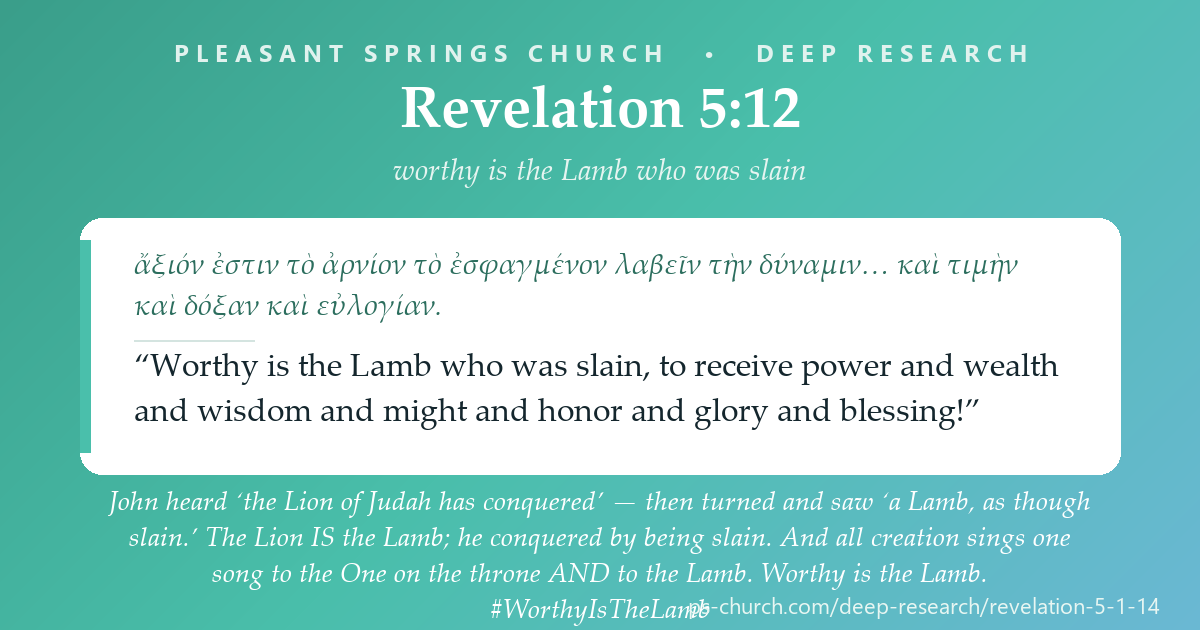
Revelation 5:12 · to share
Greek NT + ESVEvery Deep Research page traces its passage across the whole sweep — the Old Testament, the Second-Temple world between the testaments (historical witnesses, not Scripture), and the New Testament. Follow the thread:
Pleasant Springs Church — Deep Research
Research method after Michael S. Heiser’s Bible Research Method (examine dictionaries → ancient literature → important words → textual connections → academic publications → share), with the Pleasant Springs “Author & Audience” foundation. Scripture set in the Hebrew, the Greek editions named on each page and the ESV (Old Testament), and the Greek New Testament and the ESV (New Testament), per the practice of Pleasant Springs Church. Revelation 5:1–14 research grounded in Beale, Osborne, Mounce, Aune, and Koester, with Bauckham on the worship of the Lamb and the divine identity; the joint doxology to “the One on the throne and the Lamb” (5:13), with proskyneō refused to angels (19:10; 22:8–9), read as the deity of Christ within monotheism (against ditheism and an exalted-creature Arianism, without collapsing the persons); the Lion-to-Lamb reversal as the book’s key (conquest by being slain); the seven horns/eyes as symbol-with-a-real-referent (John decodes the eyes as the seven spirits of God, 5:6); the NA28/ESV text of 5:9–10 (“ransomed people for God… they shall reign,” not the KJV/TR “us… we”); the ransom “from every tribe” as universal in scope and particular in effect (not universalism, cf. 21:8, 27); the redeemed as a kingdom of priests destined to reign on a renewed earth.
Scripture quotations marked ESV are from the ESV® Bible (The Holy Bible, English Standard Version®), © 2001 by Crossway, a publishing ministry of Good News Publishers. ESV Text Edition: 2016. Used by permission. All rights reserved. The ESV text may not be quoted in any publication made available to the public by a Creative Commons license, and the ESV may not be translated in whole or in part into any other language. www.esv.org
|
Did this study bless you today? 💚 Give to Support PS Church100% of gifts go to the General Fund — thank you. |