An eagle comes up out of the sea, and an angel tells Ezra that it is the kingdom which was seen in the vision of thy brother Daniel. The fifth vision says outright, at 12:11–12, that it is re-reading Daniel — and then, measured in Latin, chapters 11–13 share no run longer than three words with Daniel 2 or 7. And three words that would make the link explicit are absent from the 1598 Latin, the one Latin text of these chapters held in full on this disk: the 1598 Latin has no ‘fourth’ at 12:11, no ‘anointed’ at 12:32 — it says ‘wind’ — and no ‘clouds of heaven’ at 13:3. The deepest run in all six chapters is unannounced: eight Latin words at 16:12 that stand in one other verse of the 35,809 in the Vulgate, 2 Thessalonians 1:9. And when Ezra’s scribes finish their forty days, the witnesses cannot agree how many books they wrote: 204, 94 or 904. This is the third of three studies of 4 Ezra. It is not Scripture for us; it is a Second-Temple witness, read closely, with no Greek, no Hebrew and no ESV to lean on — and the page says what that costs. See the method →
4 Ezra (2 Esdras), in three studies: 1:1–6:59 · 7:1–10:59 · 11:1–16:78 (this page, and the series’ close)
4 Ezra is a Jewish apocalypse, commonly dated to the generation after Rome destroyed the Temple, written in Ezra’s name, which survives complete only in translations — Latin, Syriac, Ethiopic and others — and which the Latin Bible carried, framed by two shorter works commonly regarded as Christian, as 4 Esdras. The Council of Trent’s list of the canonical books (1546) does not name it, and the Clementine Vulgate of 1598 printed it in an appendix after the New Testament. It is not Scripture for us. We read it as a window into how Jews and early Christians wrestled with catastrophe, empire and the end — gratefully, critically, and with the canon as the test.
⚠️ What this page can and cannot measure — read this first.
HELD: the Latin of the whole book in the 1598 Clementine appendix (872 verses, Clementine numbering, without the seventy verses of 7:36–105); Bensly–James’s 1895 Latin for 7:36–105 only (70 verses) and the OCR of the rest of that edition; the King James Apocrypha (874 verses); the Revised Version Apocrypha of 1895 (944 verses, modern numbering) with the OCR of a separate scan of its 1895 print; and the Clementine Vulgate of the 73 canonical books, 35,809 verses, against which every Latin verse here is measured.
NOT HELD: any Greek 4 Ezra — commonly described as lost, and LXX “2 Esdras” is a different book (Ezra–Nehemiah); any Hebrew; the Syriac, Ethiopic, Arabic, Armenian and Georgian versions (the 1895 Latin apparatus cites all of these but the Georgian), which this page cannot check; and any ESV of this book, which does not exist.
CONSEQUENCE: every Greek and Hebrew screen this shelf owns is impossible here. The measurement is Latin against Latin — and the two Latins are different translations: 4 Ezra’s Latin is commonly described as an Old Latin rendering of a lost Greek, the Vulgate is Jerome’s work and the older Latin he revised. A shared run measures shared Latin wording. It never identifies a source.
4 Ezra (2 Esdras) 11–16 — nine verses, two columns
Latin: Clementine appendix, Vatican 1598 (Wikisource) · English: KJV Apocrypha (1769 standard text, public domain)An eagle from the sea — as Daniel’s four beasts come up from the sea (Daniel 7:3). Measured in Latin: this verse and Vulgate Daniel 7:3 share two consecutive words, de mari. Its deepest partners anywhere in the Vulgate reach three, with three verses (band 3). The other way, Daniel 7:3 screened against all 942 Latin rows of 4 Ezra reaches two with four of them (band 4) — 11:1, 12:11, 13:2 and 13:5, every one on de mari.
The four beasts are named in every column held here, and the next verse brings on Et quartus — the fourth. Against Vulgate Daniel 7:7 and 7:23 each of the two verses shares one word. Their own deepest runs anywhere in the Vulgate: 11:39, three (band 10, on Nonne tu es or tu es, qui); 11:40, two (band 113). The four beasts are a Danielic image; the shared Latin wording is one word.
The verse that names Daniel — and neither column printed here says ‘fourth’. The 1598 Latin reads regnum quod; the KJV, the kingdom which was seen. The 1895 Revised Version reads the fourth kingdom which appeared in vision, and Bensly–James’s 1895 Latin regnum quartum quod uisum est in uisu Danielo fratri tuo. Against Vulgate Daniel 7:23 — regnum quartum erit in terra — this verse shares one word; Daniel 7:23 screened back against the 942 Latin rows of 4 Ezra reaches two, band 25. See Stage 4.
‘This is the anointed’ — but the 1598 Latin says ventus, ‘wind’. Checked on the 1598 page image: it prints vẽtus, the tilde standing for the n. Bensly–James read Hic est unctus, quem reseruauit altissimus in finem ... ad eos, and their apparatus records no variant at that word among the four manuscripts they collate. The RV reads this is the anointed one.
Thousands, not clouds. Both columns printed here have the man grow strong with the thousands of heaven (KJV waxed strong with the thousands of heaven). In the RV, that man flew with the clouds of heaven; Bensly–James print Et uidi et ecce .... conuolabat ille homo cum nubibus caeli — and their apparatus records conualescebat in all four of their manuscripts, citing the Syriac and Ethiopic beside the conuolabat (‘flew’) they print. Vulgate Daniel 7:13 has et ecce cum nubibus cæli; the 1598 Latin of 13:3 shares two words with it, et ecce. 13:3’s own deepest Vulgate run is four, band 19 — the seer’s formula Et vidi, et ecce; Daniel 7:13 screened back against the 942 Latin rows of 4 Ezra reaches two, band 77.
Two words — and they lead to one place. sine manibus occurs in two verses of the 35,809 in the Vulgate, Daniel 2:34 and 2:45, the stone cut from the mountain without hands. As a run it is nothing special: 13:36’s deepest Vulgate run is two, band 20 — seventeen of the twenty on veniet, et. As a phrase it stands in those two verses and no other. And Daniel 2:34, screened back against all 942 Latin rows of 4 Ezra, reaches two with exactly two (band 2): 13:12 (de monte) and 13:36 — both in this vision. Depth and rarity are different measurements.
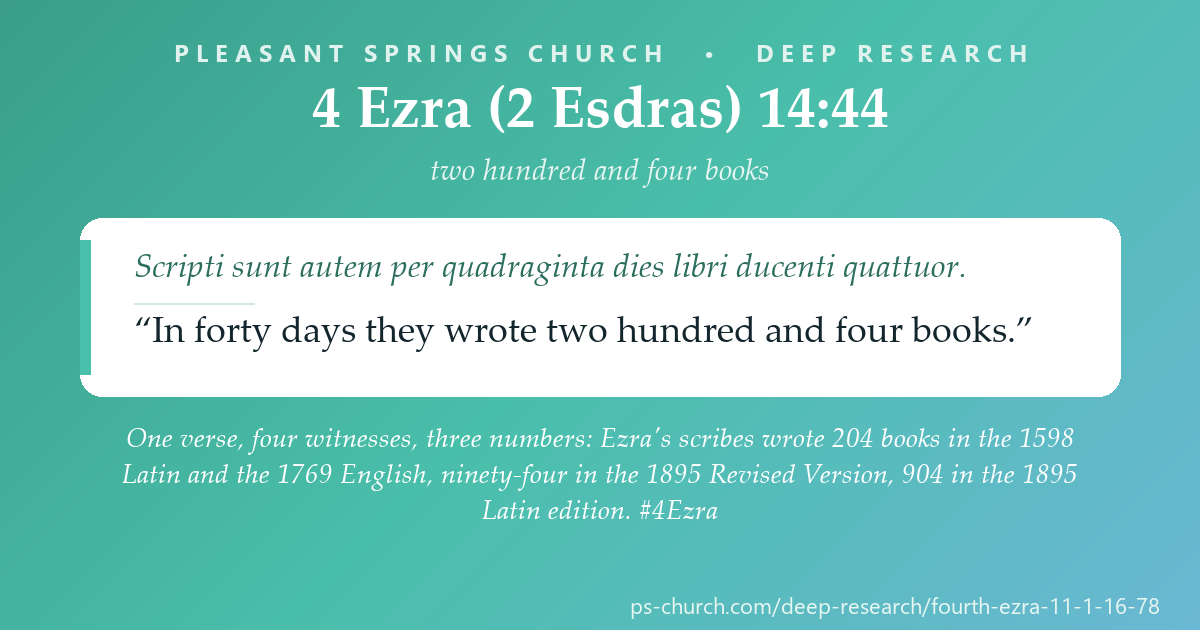
The 1598 Latin and the 1769 English agree: two hundred and four. The 1895 RV reads “So in forty days were written fourscore and fourteen books.” — ninety-four, checked against the 1895 print. Bensly–James’s 1895 Latin reads Scripti sunt autem in XL diebus libri DCCCCIIII — nine hundred and four. One verse, three numbers. See the table in Stage 3.
Here every witness agrees: seventy. Clementine septuaginta, KJV and RV seventy, Bensly–James LXX. The total moves; the hidden seventy do not. The RV: “but keep the seventy last, that thou mayest deliver them to such as be wise among thy people:”
The deepest Latin run in all six chapters — eight words — and it is with 2 Thessalonians 1:9, and with nothing else in the Vulgate. Band 1 both ways. Its last three words, gloria virtutis ejus, already stand in no other verse of either corpus. And in Greek, 2 Thessalonians 1:9 shares eight words with Isaiah 2 — three times. See Stage 4.
⚠️ Every line of the 1598 Latin printed on this page was checked against the page images of the 1598 print itself (archive.org item bub_gb_bPXlOFEn6NYC, leaves n1210–n1218), because two of this page’s findings rest on a single word of it.
Two other witnesses are quoted, not printed as columns. The Revised Version Apocrypha of 1895 (public domain; eBible’s text, every word quoted here checked against the OCR of a separate scan of the 1895 print) and R. L. Bensly and M. R. James’s critical Latin edition of 1895 (public domain; four short readings transcribed from its page images for this page). Each is labelled every time it appears.
Versification — a third state: no Masoretic text, no Septuagint, no ESV. There is no Hebrew or Greek numbering to offset against, and the page manufactures none. The offsets that exist are between the witnesses, and they are counted:
| Chapter | 11 | 12 | 13 | 14 | 15 | 16 | Total |
|---|---|---|---|---|---|---|---|
| KJV 1769 | 46 | 51 | 58 | 48 | 63 | 78 | 344 |
| RV 1895 | 46 | 51 | 58 | 48 | 63 | 78 | 344 |
| Clementine 1598 | 46 | 51 | 58 | 47 | 63 | 78 | 343 |
• The seventy verses the KJV and the 1598 Latin both lack are the passage R. L. Bensly published in 1875 as The Missing Fragment of the Latin Translation of the Fourth Book of Ezra, recovered from Latin manuscripts that carry it. In the RV’s text they describe the pit of torment and the paradise of delight (7:36), what befalls the spirit after death — for the scorners, “be in torments forthwith … in seven ways” (7:80), and an order of rest for those who kept the ways of the Most High (7:88) — and end on Ezra’s question whether the just may intercede for the ungodly in the day of judgment, which 7:105 answers: “so never shall any one pray for another in that day” (RV 1895, checked against the 1895 print). The second study prints them.
• Clementine against KJV, aligned by content — chapters 11, 12, 13 and 15 keep the same labels for the same verses, though a clause often sits on the other side of a verse break: at 12:9/10, 12:17/18, 12:19/20, 12:20/21, 12:22/23 and 12:39/40; at 13:9/10, 13:10/11, 13:37/38 and 13:51/52; at 15:36/37, 15:37/38 and 15:49/50. Most are the formula ‘and he said to me’ or ‘this is the interpretation’ ending one verse in one edition and opening the next in the other.
• Chapter 14 (Clementine 47, KJV 48): Clementine 14:1 is the first clause of KJV 14:1 and Clementine 14:2 runs on to the first words of KJV 14:3; Clementine 14:14 = KJV 14:14–15; Clementine 14:15–18 = KJV 14:16–19; Clementine 14:19–20 = KJV 14:20; the labels agree again from 14:21; Clementine 14:43 opens with words the KJV ends 14:42 with; and Clementine 14:47 = KJV 14:47–48. Every verse printed above from this chapter — 14:44 and 14:46 — has the same label in both.
• Chapter 16 (78 in both, divided differently): Clementine 16:18–19 = KJV 16:18; Clementine 16:20–77 = KJV 16:19–76, one number higher all the way; Clementine 16:78 = KJV 16:77–78. 16:12, printed above, is unaffected.
• Every boundary above was confirmed on the 1598 page images, where the print marks each verse with an asterisk and a marginal number — they are the Clementine’s own divisions, not transcription slips. Bensly–James number the verses quoted on this page as the RV does (checked on the four page images read).
• Throughout this page a bare reference is the Clementine’s, because the Latin is what is measured; where the KJV’s number differs the page says so.
The Shape of the Passage
Parallel panels, then a sequence — marked by counted formulasAnd the seam at 15:1 is lexical. In the 1598 Latin, the title Altissimus in any case-form occurs — counting word tokens — 51 times in chapters 3–14 and not once in chapters 1–2 or 15–16; dicit Dominus occurs 18 times in chapters 1–2, 12 times in chapters 15–16, and not once in chapters 3–14. That is consistent with the scholarly division of the book into a Jewish apocalypse (3–14) inside two later frames (1–2, 15–16), which Stage 1 attributes. Two counts do not prove an authorship; they show where the vocabulary changes.
⚠️ Where this page sits. 4 Ezra is printed as 2 Esdras among the Apocrypha of the older English Bibles and in an appendix to the Clementine Vulgate, and is absent from the Hebrew Bible and from both the Protestant and the Roman Catholic canons. This library reads it as a Second-Temple witness, not as Scripture, and files it under Apocrypha / Deuterocanon. Nothing taught at Pleasant Springs rests on it.
Author
Anonymous, writing as Ezra the scribe — and, by the usual account, more than one author. Chapters 3–14 are commonly read as a Jewish apocalypse of the generation after the Temple fell to Rome; chapters 1–2 (“5 Ezra”) and 15–16 (“6 Ezra”) as later Christian frames around it. That division is the scholars’, attributed in Stage 1; what this page measures is that the Latin vocabulary changes exactly at the seams.
The apocalypse sets itself in Babylon thirty years after a fall of Jerusalem — “In the thirtieth year after the ruin of the city I was in Babylon, and lay troubled upon my bed, and my thoughts came up over my heart:” (KJV 3:1). Commonly read as a cipher: Babylon for Rome, the first ruin for the second. In chapters 11–12 the text supplies a key of its own — an eagle that is the kingdom which was seen in the vision of thy brother Daniel (KJV 12:11) — and never names Rome.
And he ends by giving the books back. Chapter 14 sets Ezra beside Moses: a voice from a bush, forty days, scribes writing what they do not understand, books for everyone and books for the wise.
Audience
People living after a catastrophe. The dream visions of chapters 11–13 set out in images a question a reader can put in plain words: if Zion is fallen, who rules now, and for how long? An eagle whose heads devour one another; a lion that rebukes it; a man from the sea whom no army can touch.
Readers who no longer have their scriptures in hand. 14:21 — “For thy law is burnt, therefore no man knoweth the things that are done of thee, or the work that shall begin.” — is the premise of the last vision. Its answer is writing.
And, in 6 Ezra, readers warned of persecution. The oracles end with the chosen tried as the gold in the fire (KJV 16:73) and a promise of deliverance. Read soberly: the violence in chapters 15–16 is oracle against cities and nations, and the page reports it rather than applying it.
Orient on the book, on its three names, and on why it has three parts.
Search by topic: 4 Ezra; 2 Esdras; 4 Esdras; 5 Ezra; 6 Ezra; eagle vision; man from the sea; Bensly missing fragment; Vulgate appendix; Old Latin.
One book, four names — said once, here:
The Latin Bible calls it Liber Quartus Esdrae, 4 Esdras; the English Apocrypha calls it 2 Esdras; scholarship calls chapters 3–14 4 Ezra and, commonly, chapters 1–2 “5 Ezra” and 15–16 “6 Ezra”. This shelf names it “4 Ezra (2 Esdras)”. Two other books share the name and are not this one: the Septuagint’s 1 Esdras (the Vulgate’s 3 Esdras, the English Apocrypha’s 1 Esdras — a separate book on this shelf), and the Septuagint’s 2 Esdras, which is Ezra–Nehemiah. That last collision is why the shelf’s Greek file called 2Esdras is never used on this page.
Which articles are relevant?
- Anchor Bible Dictionary — the entries on 2 Esdras / 4 Ezra and on the Apocrypha.
- Eerdmans Dictionary of Early Judaism — Fourth Ezra; apocalypses; messianism.
- Dictionary of New Testament Background (IVP) — Fourth Ezra; apocalypticism.
- On the text — any article that distinguishes the Latin manuscripts from the Oriental versions (Syriac, Ethiopic, Arabic, Armenian, Georgian). An article that quotes ‘the text of 4 Ezra’ without saying which witness it follows may be quoting a reconstruction — as Stage 3 shows, at 12:11, 12:32, 13:3 and 14:44 the witnesses do not agree.
Bibliography surfaced (named so a reader can go further; see Stage 5 for what was consulted):
- Michael E. Stone, Fourth Ezra (Hermeneia; Fortress, 1990).
- Bruce M. Metzger, “The Fourth Book of Ezra,” in James H. Charlesworth (ed.), The Old Testament Pseudepigrapha, vol. 1 (1983).
- Jacob M. Myers, I and II Esdras (Anchor Bible 42; 1974).
- Robert L. Bensly and M. R. James, The Fourth Book of Ezra: the Latin version edited from the MSS (Texts and Studies III.2; Cambridge, 1895).
- Theodore A. Bergren, Fifth Ezra: The Text, Origin and Early History (1990), and Sixth Ezra: The Text and Origin (1998).
- Hindy Najman, Losing the Temple and Recovering the Future: An Analysis of 4 Ezra (2014).
An apocalypse that names its source, and a prophet re-cast as Moses.
Three bodies of material stand behind these chapters. The page names them and then, in Stage 4, measures what can be measured.
Which parallels shed light on the world of the text?
- Daniel 2 and 7 → 4 Ezra 11–13. Named by the text itself: the eagle is the kingdom which was seen in the vision of thy brother Daniel (KJV 12:11), and 12:12 says it was not interpreted to Daniel as it is now to Ezra. Four beasts (11:39), a creature from the sea (11:1; 13:5), a mountain carved (13:6–7) that the interpretation sets beside Sion (13:35–36) — sicut vidisti montem sculpi sine manibus, as you saw the mountain carved without hands. The eagle is commonly identified with Rome, and its three heads with three emperors of one dynasty; the text names neither, and the page does not adopt an identification.
- Exodus 3, 19, 24 and 34 → 4 Ezra 14. A voice from a bush; Moses kept on Sinai; forty days; words to publish and words to hide (14:3–6). The book makes the parallel itself. In the 1598 Latin the mountain is Sinai — super montem Sina — and in the RV the mount of Sinai. The 1769 KJV file on this disk reads the mount of where I held him: no Sinai at all. See Stage 5.
- 6 Ezra beside the prophets’ oracles against the nations. Babylon, Asia, Egypt and Syria (16:1); the sword, famine, death, and destruction (KJV 15:5). Babylon is commonly read here, as in Revelation 17–18, as Rome — and Stage 4 measures how little Latin wording these oracles share with Revelation.
- The count of the scriptures. The number at 14:44 is the total of all the books, and 14:45–46 divide it into the first, to be published, and the seventy last, to be kept. If the seventy are counted inside the total, the RV’s ninety-four leaves twenty-four books to publish, which is commonly read as a count of the Hebrew scriptures in one Jewish reckoning. That identification is the commentators’; the text gives no list, and the arithmetic changes with the witness — 134 in the 1598 Latin and the KJV, 834 in Bensly–James, by the same subtraction.
The Daniel 7:9–14 page on this shelf describes 4 Ezra 13 as a man who flies with the clouds. That is the reading of the 1895 critical Latin text and of the RV, and not of either column printed here. The 1598 Latin and the 1769 KJV have the man grow strong with the thousands of heaven; Bensly–James print conuolabat, ‘flew’, where all four of their Latin manuscripts read conualescebat, citing the Syriac and Ethiopic; and the words this wind caused to come up from the midst of the sea as it were the likeness of a man are printed by the RV between square brackets, and the 1895 Latin apparatus gives them as an addition of the Syriac. Not wrong — unscoped. Which text you open decides what the man does.
Two divine titles that never meet, and four words the witnesses cannot agree on.
Counts of Latin words are over the 1598 Latin of 4 Ezra (872 verses) and, where stated, Bensly’s fragment (70) and the Clementine Vulgate (35,809 verses), after the declared normalisation (Stage 4). Each count says which text and which unit — verses, not words — unless it says otherwise.
51 word tokens, in 50 of the 643 verses of chapters 3–14 of the 1598 Latin, and 15 more tokens, in 14 of the 70 verses of Bensly’s fragment. Not once in chapters 1–2 or 15–16. In this page’s range: 3, 8, 6 and 3 verses in chapters 11–14, once in each, then nothing. Every case-form counted; the last is at 14:45.
18 verses in chapters 1–2 and 12 verses in chapters 15–16 (8 and 4), once in each. Not once in chapters 3–14, nor in the fragment. The first in this page’s range is 15:1. The two divine titles do not overlap anywhere in the book.
Ten verses in the whole book — seven in chapter 12 and three in chapter 13. The formula of the two interpreted dreams, and of nothing else in this book. It is not the book’s alone: in the Vulgate the same three words stand in four verses — Genesis 40:12 and 40:18 (Joseph) and Daniel 4:21 and 5:26 (see Stage 4). Its partner formula, et vidi, et ecce, stands in 16 verses, 12 of them in chapter 11.
12:32. The 1598 Latin: hic est ventus. Bensly–James: Hic est unctus. The KJV: This is the anointed. One word, and the difference between a wind and an anointed one. Hic est ventus occurs in no verse of the Vulgate, and unctus occurs in 8 — none of them in Daniel 7.
Two Vulgate verses of 35,809: Daniel 2:34 and 2:45. One verse of 4 Ezra: 13:36. A two-word phrase that leads to exactly one chapter. The page’s best example of rarity without depth.
Two verses of the whole Latin book, once in each: 6:20, and the count at 14:44. What the count is depends on the witness — see the table below.
⚠️ Four witnesses, four verses — read exactly as each one prints them:
| Witness | 12:11 | 12:32 | 13:3 | 14:44 |
|---|---|---|---|---|
| Latin, Clementine 1598 checked on the page images | hoc est regnum quod visum est | hic est ventus quem servavit Altissimus | convalescebat ille homo cum millibus cæli | libri ducenti quattuor (204) |
| KJV 1769 | is the kingdom which was seen in the vision of thy brother Daniel | This is the anointed | that man waxed strong with the thousands of heaven | two hundred and four books (204) |
| Latin, Bensly–James 1895 transcribed from the page images | regnum quartum quod uisum est in uisu Danielo fratri tuo quartum ACM, om. S | Hic est unctus, quem reseruauit altissimus in finem ... ad eos no variant recorded at unctus | Et uidi et ecce .... conuolabat ille homo cum nubibus caeli conualescebat SACM; for the printed conuolabat the editors cite the Syriac and Ethiopic | Scripti sunt autem in XL diebus libri DCCCCIIII (904) |
| RV 1895 checked against the 1895 print | is the fourth kingdom which appeared in vision to thy brother Daniel | this is the anointed one, whom the Most High hath kept unto the end | that man flew with the clouds of heaven | fourscore and fourteen books (94) |
Read across the rows. The 1598 Latin has none of the three words that would link these verses in wording to Daniel and to an anointed figure: no fourth at 12:11, no anointed at 12:32, no clouds at 13:3. The 1769 KJV has one of the three — the anointed at 12:32. The two 1895 editions have all three. And the four witnesses give three different totals for the books of 14:44.
What the 1895 apparatus says about 14:44 (read from the page image, p. 72): the editors print DCCCCIIII, the reading of their manuscript S; M has nongenti quatuor, ‘nine hundred and four’; A has DCCCCLXXIIII with nongenti septuaginta quatuor written above (the print abbreviates nongenti with an overbar on the n); C has DCCCCLXX, the LXX on an erasure; and for the Syriac, Ethiopic, first Arabic and Armenian versions it gives nonaginta quatuor, ‘ninety-four’ — the RV’s number. The 1598 Latin’s 204 is not among the readings that apparatus lists. Where it came from, this page cannot say.
And at 12:11 the apparatus says quartum is in three of Bensly’s four manuscripts and missing from S — the manuscript whose number his text prints at 14:44. So the 1598 Latin and the 1769 English are not alone in lacking the word; the page reports the readings and does not decide between them.
A vision that names Daniel and barely shares his words; an oracle that names no source and shares eight.
What is screened. Every one of the 343 verses of chapters 11–16 in the 1598 Latin against all 35,809 verses of the Clementine Vulgate (73 books: 46 of the Old Testament with the deuterocanon, 27,858 verses; 27 of the New, 7,951 verses). The Vulgate contains no appendix, so 4 Ezra cannot match itself. Contiguous runs of whole word forms; the tie band — how many Vulgate verses reach the same depth — beside every run; and the band the other way: the partner verse screened back against all 942 Latin rows of 4 Ezra held here (the 872 of 1598 and Bensly’s 70).
Normalisation, declared: diacritics stripped (quòd → quod, Israël → israel), lower case, æ → ae, œ → oe, j → i, v → u, non-letters dropped. Nothing else is folded — not spelling, not inflection, not -que. Shared words are shown in that normalised form (so virtutis appears as uirtutis). A verse sharing only single words scores 1; 0 would mean no word shared at all, and no verse scores 0.
⚠️ What a run here means. Two Latin translations, made separately. A run measures shared Latin wording — never a source, and never who read whom. And there is no Greek 4 Ezra to run against the Greek New Testament at all.
The distribution — all 343 verses:
Against the whole Vulgate (35,809 verses): all 343 share a word; 340 reach two, 241 reach three, 80 reach four, 14 reach five, 4 reach six, and one verse reaches eight — nothing else reaches seven. Three verses share no two consecutive words with any Vulgate verse: 13:43, 14:16 and 16:7.
Against the Old Testament side alone (27,858): 339 reach two, 235 three, 72 four, 12 five, 2 six, and nothing reaches seven — the two are 12:40 and 15:11.
Against the New Testament side alone (7,951): 333 reach two, 143 three, 44 four, 6 five, 2 six — and one of the two reaches eight: 16:12.
By chapter, the deepest run: 11 → 5; 12 → 6; 13 → 6; 14 → 5; 15 → 6; 16 → 8.
Every verse that reaches five, with its bands both ways:
| 4 Ezra (Clementine) | Run | Band | Vulgate partner(s) — and the partner’s own deepest against all 942 Latin 4 Ezra rows (↩ run, band) | Shared words (normalised) |
|---|---|---|---|---|
| 16:12 | 8 | 1 | 2 Thessalonians 1:9 (↩ 8, band 1) | a facie domini et a gloria uirtutis eius |
| 12:40 | 6 | 1 | 1 Maccabees 5:45 (↩ 6, band 1) | a minimo usque ad maximum et |
| 13:8 | 6 | 1 | Revelation 15:5 (↩ 6, band 1) | et post haec uidi et ecce |
| 15:11 | 6 | 1 | Psalms 135:12 (↩ 6, band 1) | in manu potenti et brachio excelso |
| 11:20 | 5 | 2 | Ezekiel 10:1 (↩ 5, band 1) Revelation 5:6 (↩ 5, band 1) | et uidi et ecce in |
| 11:28 | 5 | 1 | Zechariah 5:9 (↩ 5, band 1) | et uidi et ecce duae |
| 11:31 | 5 | 6 | 2 Samuel 15:22 (↩ 5, band 1) Jeremiah 41:2 (↩ 5, band 1) 1 Maccabees 7:25 (↩ 5, band 1) 1 Maccabees 9:33 (↩ 5, band 1) 2 Maccabees 1:16 (↩ 5, band 1) Matthew 12:4 (↩ 5, band 1) | qui cum eo erant et |
| 12:7 | 5 | 1 | Ruth 2:10 (↩ 5, band 2) | gratiam ante oculos tuos et |
| 12:24 | 5 | 3 | 1 Kings 14:9 (↩ 5, band 1) 1 Kings 16:25 (↩ 5, band 1) 1 Kings 16:30 (↩ 5, band 1) | super omnes qui fuerunt ante |
| 13:1 | 5 | 1 | Jeremiah 13:6 (↩ 5, band 3) | et factum est post dies |
| 13:31 | 5 | 1 | Luke 21:10 (↩ 5, band 1) | gentem et regnum aduersus regnum |
| 14:23 | 5 | 1 | Numbers 15:38 (↩ 5, band 1) | et dices ad eos ut |
| 14:39 | 5 | 1 | Ezekiel 3:2 (↩ 5, band 1) | et aperui os meum et |
| 15:14 | 5 | 1 | Psalms 97:7 (↩ 5, band 1) | et qui habitant in eo |
Vulgate references are the Vulgate’s own: its Psalms are numbered as in the Greek and Latin Bibles, so Psalm 135:12 here is Psalm 136:12 in the ESV, and Psalm 97:7 is Psalm 98:7.
Read the band columns before the run column. A run with band 1 both ways is a phrase that these two Latin texts share with each other and with nothing else; a run whose first words stand in dozens of verses is a formula however deep it goes. The table is computed when the page is built, and so is the full per-verse table below.
Open the full table — all 343 verses of chapters 11–16, one row each
| Clem. | Run | Band | First partner (canonical order) | ↩ run / band | Shared (normalised) |
|---|---|---|---|---|---|
| 11:1 | 3 | 3 | Judges 7:13 +2 more | 3 / 1 | uidi somnium et |
| 11:2 | 4 | 19 | Ezekiel 1:4 +18 more | 4 / 16 | et uidi et ecce |
| 11:3 | 3 | 24 | Isaiah 41:28 +23 more | 3 / 19 | et uidi et |
| 11:4 | 2 | 137 | Genesis 7:13 +136 more | 2 / 4 | cum eis |
| 11:5 | 4 | 24 | Psalms 74:4 +23 more | 4 / 3 | qui habitant in ea |
| 11:6 | 4 | 1 | Genesis 9:16 | 4 / 1 | quae est super terram |
| 11:7 | 4 | 19 | Ezekiel 1:4 +18 more | 4 / 16 | et uidi et ecce |
| 11:8 | 4 | 3 | 1 Samuel 3:2 +2 more | 4 / 1 | in loco suo et |
| 11:9 | 2 | 183 | Genesis 14:1 +182 more | 3 / 2 | autem in |
| 11:10 | 4 | 19 | Ezekiel 1:4 +18 more | 4 / 16 | et uidi et ecce |
| 11:11 | 3 | 1 | Daniel 7:8 | 3 / 1 | eius et ecce |
| 11:12 | 4 | 19 | Ezekiel 1:4 +18 more | 4 / 16 | et uidi et ecce |
| 11:13 | 4 | 22 | 1 Samuel 11:11 +21 more | 4 / 16 | et factum est cum |
| 11:14 | 4 | 22 | 1 Samuel 11:11 +21 more | 4 / 16 | et factum est cum |
| 11:15 | 3 | 3 | 1 Kings 19:13 +2 more | 3 / 5 | et ecce uox |
| 11:16 | 2 | 5 | Judges 11:26 +4 more | 3 / 1 | tanto tempore |
| 11:17 | 2 | 45 | Genesis 17:7 +44 more | 2 / 52 | post te |
| 11:18 | 3 | 1 | Genesis 5:24 | 3 / 2 | et non apparuit |
| 11:19 | 2 | 114 | Genesis 6:15 +113 more | 2 / 1 | et sic |
| 11:20 | 5 | 2 | Ezekiel 10:1 +1 more | 5 / 1 | et uidi et ecce in |
| 11:21 | 2 | 221 | Genesis 27:9 +220 more | 2 / 4 | ex eis |
| 11:22 | 3 | 3 | Psalms 36:36 +2 more | 3 / 2 | et ecce non |
| 11:23 | 2 | 74 | Genesis 16:16 +73 more | 2 / 2 | et sex |
| 11:24 | 4 | 19 | Ezekiel 1:4 +18 more | 4 / 16 | et uidi et ecce |
| 11:25 | 4 | 19 | Ezekiel 1:4 +18 more | 4 / 16 | et uidi et ecce |
| 11:26 | 4 | 19 | Ezekiel 1:4 +18 more | 4 / 16 | et uidi et ecce |
| 11:27 | 2 | 1 | 2 Maccabees 3:34 | 2 / 16 | non comparuerunt |
| 11:28 | 5 | 1 | Zechariah 5:9 | 5 / 1 | et uidi et ecce duae |
| 11:29 | 3 | 5 | Psalms 7:14 +4 more | 3 / 2 | et in eo |
| 11:30 | 3 | 1 | Daniel 7:11 | 3 / 3 | et uidi quoniam |
| 11:31 | 5 | 6 | 2 Samuel 15:22 +5 more | 5 / 1 | qui cum eo erant et |
| 11:32 | 3 | 8 | Joshua 9:24 +7 more | 3 / 4 | omnem terram et |
| 11:33 | 4 | 1 | 1 Kings 20:40 | 4 / 1 | subito non comparuit et |
| 11:34 | 4 | 5 | Psalms 74:4 +4 more | 4 / 3 | qui habitant in ea |
| 11:35 | 4 | 19 | Ezekiel 1:4 +18 more | 4 / 16 | et uidi et ecce |
| 11:36 | 4 | 1 | Acts 22:7 | 4 / 1 | audiui uocem dicentem mihi |
| 11:37 | 4 | 19 | Ezekiel 1:4 +18 more | 4 / 16 | et uidi et ecce |
| 11:38 | 4 | 1 | Exodus 25:22 | 4 / 1 | et loquar ad te |
| 11:39 | 3 | 10 | Judges 13:11 +9 more | 3 / 1 | tu es qui |
| 11:40 | 2 | 113 | Genesis 1:21 +112 more | 2 / 11 | et omnem |
| 11:41 | 2 | 17 | Deuteronomy 5:3 +16 more | 2 / 11 | non cum |
| 11:42 | 3 | 3 | 2 Chronicles 1:11 +2 more | 3 / 1 | eorum qui te |
| 11:43 | 3 | 2 | 2 Kings 19:28 +1 more | 3 / 3 | et superbia tua |
| 11:44 | 2 | 536 | Genesis 1:14 +535 more | 3 / 1 | tempora et |
| 11:45 | 3 | 2 | Ezekiel 10:12 +1 more | 3 / 2 | et omne corpus |
| 11:46 | 3 | 5 | Sirach 38:15 +4 more | 3 / 2 | eius qui fecit |
| 12:1 | 4 | 6 | Luke 17:11 +5 more | 4 / 1 | et factum est dum |
| 12:2 | 3 | 2 | Deuteronomy 28:13 +1 more | 3 / 1 | caput et non |
| 12:3 | 4 | 19 | Ezekiel 1:4 +18 more | 4 / 16 | et uidi et ecce |
| 12:4 | 3 | 12 | Nehemiah 13:1 +11 more | 3 / 3 | in eo quod |
| 12:5 | 4 | 1 | Isaiah 50:2 | 4 / 1 | est in me uirtus |
| 12:6 | 3 | 13 | Psalms 15:10 +12 more | 3 / 1 | usque in finem |
| 12:7 | 5 | 1 | Ruth 2:10 | 5 / 2 | gratiam ante oculos tuos et |
| 12:8 | 2 | 503 | Genesis 3:13 +502 more | 2 / 79 | me et |
| 12:9 | 4 | 44 | Ezekiel 2:1 +43 more | 4 / 27 | et dixit ad me |
| 12:10 | 3 | 4 | Genesis 40:12 +3 more | 4 / 1 | haec est interpretatio |
| 12:11 | 3 | 2 | 2 Samuel 7:19 +1 more | 3 / 3 | uisum est in |
| 12:12 | 3 | 4 | 2 Samuel 15:3 +3 more | 3 / 1 | sed non est |
| 12:13 | 4 | 2 | 1 Samuel 2:31 +1 more | 4 / 2 | ecce dies ueniunt et |
| 12:14 | 3 | 1 | John 8:9 | 3 / 1 | unus post unum |
| 12:15 | 2 | 211 | Genesis 3:16 +210 more | 2 / 6 | et ipse |
| 12:16 | 3 | 4 | Genesis 40:12 +3 more | 4 / 1 | haec est interpretatio |
| 12:17 | 2 | 202 | Genesis 3:17 +201 more | 2 / 5 | audisti uocem |
| 12:18 | 3 | 5 | Genesis 40:12 +4 more | 4 / 1 | haec est interpretatio |
| 12:19 | 2 | 11 | 2 Samuel 5:12 +10 more | 2 / 22 | et quoniam |
| 12:20 | 3 | 4 | Genesis 40:12 +3 more | 4 / 1 | haec est interpretatio |
| 12:21 | 2 | 350 | Genesis 13:7 +349 more | 3 / 3 | autem tempore |
| 12:22 | 2 | 11 | 2 Samuel 5:12 +10 more | 2 / 22 | et quoniam |
| 12:23 | 3 | 4 | Genesis 40:12 +3 more | 4 / 1 | haec est interpretatio |
| 12:24 | 5 | 3 | 1 Kings 14:9 +2 more | 5 / 1 | super omnes qui fuerunt ante |
| 12:25 | 3 | 9 | Exodus 29:30 +8 more | 3 / 1 | eius et qui |
| 12:26 | 3 | 16 | Genesis 40:12 +15 more | 4 / 1 | haec est interpretatio |
| 12:27 | 2 | 1 | 1 Maccabees 6:37 | 2 / 18 | duo qui |
| 12:28 | 3 | 48 | Genesis 7:23 +47 more | 4 / 1 | qui cum eo |
| 12:29 | 3 | 23 | Genesis 3:3 +22 more | 3 / 1 | quod est in |
| 12:30 | 3 | 6 | Genesis 40:12 +5 more | 4 / 1 | haec est interpretatio |
| 12:31 | 2 | 230 | Genesis 1:28 +229 more | 2 / 46 | eam et |
| 12:32 | 3 | 22 | Leviticus 22:3 +21 more | 3 / 3 | ad eos et |
| 12:33 | 3 | 4 | Judith 14:2 +3 more | 3 / 3 | et erit cum |
| 12:34 | 4 | 2 | Exodus 32:34 +1 more | 4 / 1 | quo locutus sum tibi |
| 12:35 | 4 | 1 | Genesis 37:10 | 4 / 1 | hoc somnium quod uidisti |
| 12:36 | 2 | 23 | Genesis 17:9 +22 more | 2 / 17 | tu ergo |
| 12:37 | 4 | 1 | Ezra 5:15 | 4 / 1 | et pone ea in |
| 12:38 | 3 | 5 | 1 Kings 8:38 +4 more | 3 / 3 | de populo tuo |
| 12:39 | 3 | 1 | 2 Chronicles 30:23 | 3 / 1 | alios dies septem |
| 12:40 | 6 | 1 | 1 Maccabees 5:45 | 6 / 1 | a minimo usque ad maximum et |
| 12:41 | 3 | 5 | 1 Samuel 12:8 +4 more | 3 / 4 | in loco hoc |
| 12:42 | 3 | 4 | Isaiah 1:8 +3 more | 3 / 1 | uinea et sicut |
| 12:43 | 2 | 17 | Deuteronomy 31:18 +16 more | 3 / 1 | mala quae |
| 12:44 | 3 | 2 | 2 Corinthians 4:14 +1 more | 3 / 1 | et nos cum |
| 12:45 | 3 | 34 | Leviticus 22:3 +33 more | 3 / 3 | ad eos et |
| 12:46 | 2 | 418 | Genesis 34:7 +417 more | 2 / 7 | israel et |
| 12:47 | 3 | 3 | Psalms 9:13 +2 more | 3 / 1 | non est oblitus |
| 12:48 | 3 | 3 | Luke 16:28 +2 more | 3 / 1 | in hunc locum |
| 12:49 | 4 | 11 | Judges 19:21 +10 more | 4 / 1 | in domum suam et |
| 12:50 | 3 | 8 | Judges 18:20 +7 more | 3 / 2 | et profectus est |
| 12:51 | 3 | 55 | Genesis 6:4 +54 more | 3 / 4 | in diebus illis |
| 13:1 | 5 | 1 | Jeremiah 13:6 | 5 / 3 | et factum est post dies |
| 13:2 | 2 | 272 | Genesis 14:13 +271 more | 2 / 42 | et ecce |
| 13:3 | 4 | 19 | Ezekiel 1:4 +18 more | 4 / 16 | et uidi et ecce |
| 13:4 | 3 | 13 | Numbers 30:7 +12 more | 3 / 2 | de ore eius |
| 13:5 | 4 | 1 | Judith 2:8 | 4 / 1 | quorum non erat numerus |
| 13:6 | 4 | 19 | Ezekiel 1:4 +18 more | 4 / 16 | et uidi et ecce |
| 13:7 | 3 | 1 | Psalms 39:13 | 3 / 6 | et non potui |
| 13:8 | 6 | 1 | Revelation 15:5 | 6 / 1 | et post haec uidi et ecce |
| 13:9 | 3 | 2 | 2 Samuel 20:21 +1 more | 3 / 1 | leuauit manum suam |
| 13:10 | 3 | 3 | Ezekiel 1:13 +2 more | 3 / 1 | ignis et de |
| 13:11 | 3 | 24 | Isaiah 41:28 +23 more | 3 / 19 | et uidi et |
| 13:12 | 4 | 2 | Revelation 15:5 +1 more | 6 / 1 | et post haec uidi |
| 13:13 | 3 | 10 | Isaiah 66:19 +9 more | 3 / 3 | ex eis qui |
| 13:14 | 2 | 159 | Genesis 24:14 +158 more | 2 / 17 | seruo tuo |
| 13:15 | 2 | 153 | Genesis 27:36 +152 more | 2 / 26 | et nunc |
| 13:16 | 4 | 10 | Deuteronomy 26:3 +9 more | 4 / 1 | in diebus illis et |
| 13:17 | 3 | 4 | 2 Kings 13:7 +3 more | 3 / 2 | non sunt derelicti |
| 13:18 | 3 | 30 | Deuteronomy 7:9 +29 more | 3 / 1 | et his qui |
| 13:19 | 2 | 187 | Genesis 24:62 +186 more | 2 / 7 | enim in |
| 13:20 | 3 | 55 | Genesis 27:26 +54 more | 3 / 27 | ad me et |
| 13:21 | 3 | 6 | Joshua 20:2 +5 more | 3 / 2 | de quibus locutus |
| 13:22 | 3 | 6 | Genesis 40:12 +5 more | 4 / 1 | haec est interpretatio |
| 13:23 | 3 | 11 | Exodus 6:27 +10 more | 3 / 3 | hi sunt qui |
| 13:24 | 3 | 8 | Exodus 24:11 +7 more | 3 / 4 | super eos qui |
| 13:25 | 2 | 25 | Deuteronomy 4:9 +24 more | 2 / 11 | de corde |
| 13:26 | 3 | 4 | Sirach 23:37 +3 more | 3 / 4 | qui derelicti sunt |
| 13:27 | 3 | 13 | Numbers 30:7 +12 more | 3 / 2 | de ore eius |
| 13:28 | 3 | 7 | Genesis 40:12 +6 more | 4 / 1 | haec est interpretatio |
| 13:29 | 3 | 19 | 1 Samuel 2:31 +18 more | 4 / 2 | ecce dies ueniunt |
| 13:30 | 3 | 14 | Exodus 24:11 +13 more | 3 / 4 | super eos qui |
| 13:31 | 5 | 1 | Luke 21:10 | 5 / 1 | gentem et regnum aduersus regnum |
| 13:32 | 3 | 5 | Judith 14:2 +4 more | 3 / 3 | et erit cum |
| 13:33 | 3 | 6 | Exodus 5:2 +5 more | 3 / 1 | uocem eius et |
| 13:34 | 2 | 36 | Exodus 28:7 +35 more | 2 / 6 | in unum |
| 13:35 | 2 | 39 | Genesis 24:21 +38 more | 2 / 2 | ipse autem |
| 13:36 | 2 | 20 | 1 Kings 1:35 +19 more | 2 / 22 | ueniet et |
| 13:37 | 2 | 388 | Genesis 4:4 +387 more | 2 / 19 | eorum et |
| 13:38 | 2 | 18 | Ecclesiastes 7:8 +17 more | 2 / 1 | et perdet |
| 13:39 | 2 | 75 | Genesis 19:10 +74 more | 2 / 44 | ad se |
| 13:40 | 4 | 5 | Deuteronomy 29:28 +4 more | 4 / 1 | de terra sua in |
| 13:41 | 2 | 55 | Genesis 14:9 +54 more | 2 / 1 | gentium et |
| 13:42 | 2 | 122 | Genesis 8:12 +121 more | 2 / 25 | quae non |
| 13:43 | 1 | 6478 | Genesis 1:2 +6477 more | 2 / 6 | autem |
| 13:44 | 2 | 47 | Genesis 1:14 +46 more | 3 / 1 | signa et |
| 13:45 | 3 | 1 | Ezekiel 40:42 | 3 / 1 | unius et dimidii |
| 13:46 | 3 | 6 | Joshua 4:9 +5 more | 3 / 1 | ibi usque in |
| 13:47 | 2 | 19 | Genesis 6:20 +18 more | 3 / 1 | ut possint |
| 13:48 | 4 | 1 | Jeremiah 21:7 | 4 / 1 | et qui derelicti sunt |
| 13:49 | 2 | 173 | Genesis 10:32 +172 more | 2 / 10 | sunt gentes |
| 13:50 | 2 | 47 | Genesis 37:20 +46 more | 2 / 11 | et tunc |
| 13:51 | 3 | 20 | Genesis 24:46 +19 more | 3 / 8 | et dixit mihi |
| 13:52 | 4 | 7 | 2 Samuel 17:8 +6 more | 4 / 2 | qui cum eo sunt |
| 13:53 | 4 | 2 | Genesis 40:12 +1 more | 4 / 1 | haec est interpretatio somnii |
| 13:54 | 2 | 185 | Genesis 16:9 +184 more | 2 / 7 | tuam et |
| 13:55 | 3 | 3 | Ecclesiastes 2:21 +2 more | 3 / 1 | in sapientia et |
| 13:56 | 3 | 4 | Exodus 16:29 +3 more | 3 / 4 | et propter hoc |
| 13:57 | 2 | 140 | Genesis 15:1 +139 more | 2 / 18 | sum et |
| 13:58 | 4 | 1 | Revelation 5:13 | 4 / 1 | et quae sunt in |
| 14:1 | 3 | 161 | Genesis 1:7 +160 more | 3 / 30 | et factum est |
| 14:2 | 4 | 45 | Isaiah 6:8 +44 more | 4 / 1 | et dixi ecce ego |
| 14:3 | 3 | 8 | Joshua 1:3 +7 more | 3 / 1 | locutus sum moysi |
| 14:4 | 4 | 2 | Exodus 3:12 +1 more | 4 / 1 | populum meum de aegypto |
| 14:5 | 2 | 53 | Genesis 2:16 +52 more | 2 / 3 | ei dicens |
| 14:6 | 2 | 125 | Genesis 20:8 +124 more | 2 / 8 | haec in |
| 14:7 | 2 | 154 | Genesis 27:36 +153 more | 2 / 26 | et nunc |
| 14:8 | 3 | 37 | Leviticus 19:17 +36 more | 3 / 3 | in corde tuo |
| 14:9 | 3 | 2 | Proverbs 1:30 +1 more | 3 / 1 | consilio meo et |
| 14:10 | 2 | 176 | Genesis 1:12 +175 more | 2 / 8 | suam et |
| 14:11 | 2 | 32 | Genesis 14:4 +31 more | 2 / 3 | duodecim enim |
| 14:12 | 2 | 46 | Genesis 17:19 +45 more | 2 / 6 | eius post |
| 14:13 | 3 | 20 | Exodus 5:23 +19 more | 3 / 2 | populum tuum et |
| 14:14 | 4 | 4 | Matthew 5:29 +3 more | 4 / 1 | et proiice abs te |
| 14:15 | 2 | 8 | Wisdom 11:5 +7 more | 2 / 32 | quae enim |
| 14:16 | 1 | 7377 | Genesis 1:2 +7376 more | 2 / 6 | super |
| 14:17 | 2 | 32 | Genesis 32:26 +31 more | 2 / 9 | iam enim |
| 14:18 | 4 | 3 | Jeremiah 11:5 +2 more | 4 / 19 | et respondi et dixi |
| 14:19 | 3 | 5 | Genesis 27:19 +4 more | 3 / 1 | sicut praecepisti mihi |
| 14:20 | 3 | 8 | Deuteronomy 28:29 +7 more | 3 / 1 | in tenebris et |
| 14:21 | 4 | 1 | Wisdom 9:2 | 4 / 1 | quae a te facta |
| 14:22 | 4 | 1 | Daniel 9:12 | 4 / 3 | quod factum est in |
| 14:23 | 5 | 1 | Numbers 15:38 | 5 / 1 | et dices ad eos ut |
| 14:24 | 3 | 1 | Job 3:8 | 3 / 1 | qui parati sunt |
| 14:25 | 3 | 34 | Leviticus 19:17 +33 more | 3 / 3 | in corde tuo |
| 14:26 | 2 | 65 | Genesis 37:20 +64 more | 2 / 11 | et tunc |
| 14:27 | 3 | 7 | Deuteronomy 10:5 +6 more | 3 / 1 | sicut mihi praecepit |
| 14:28 | 2 | 67 | Genesis 20:8 +66 more | 2 / 8 | uerba haec |
| 14:29 | 3 | 17 | Exodus 3:7 +16 more | 3 / 1 | in aegypto et |
| 14:30 | 2 | 187 | Genesis 9:12 +186 more | 2 / 48 | et uos |
| 14:31 | 4 | 1 | Jeremiah 16:13 | 4 / 1 | et patres uestri et |
| 14:32 | 3 | 2 | Deuteronomy 3:18 +1 more | 3 / 1 | uobis in tempore |
| 14:33 | 2 | 278 | Genesis 27:36 +277 more | 2 / 26 | et nunc |
| 14:34 | 3 | 2 | Judith 16:30 +1 more | 3 / 1 | et post mortem |
| 14:35 | 2 | 60 | Genesis 37:20 +59 more | 2 / 11 | et tunc |
| 14:36 | 2 | 379 | Genesis 4:10 +378 more | 3 / 1 | ad me |
| 14:37 | 3 | 8 | Deuteronomy 4:5 +7 more | 3 / 1 | sicut mandauit mihi |
| 14:38 | 4 | 1 | Ezekiel 2:8 | 4 / 1 | aperi os tuum et |
| 14:39 | 5 | 1 | Ezekiel 3:2 | 5 / 1 | et aperui os meum et |
| 14:40 | 3 | 5 | Psalms 7:14 +4 more | 3 / 2 | et in eo |
| 14:41 | 3 | 138 | Genesis 40:8 +137 more | 3 / 1 | et non est |
| 14:42 | 2 | 17 | Genesis 12:20 +16 more | 2 / 5 | uiris et |
| 14:43 | 3 | 2 | Exodus 13:21 +1 more | 3 / 1 | et per noctem |
| 14:44 | 3 | 1 | 1 Chronicles 7:9 | 3 / 1 | sunt autem per |
| 14:45 | 4 | 22 | 1 Samuel 11:11 +21 more | 4 / 16 | et factum est cum |
| 14:46 | 3 | 6 | 1 Kings 8:38 +5 more | 3 / 3 | de populo tuo |
| 14:47 | 2 | 134 | Genesis 30:37 +133 more | 3 / 1 | in his |
| 15:1 | 3 | 1 | Luke 7:1 | 3 / 1 | in aures plebis |
| 15:2 | 2 | 88 | Genesis 18:5 +87 more | 2 / 8 | fac ut |
| 15:3 | 3 | 2 | Isaiah 37:6 +1 more | 3 / 36 | ne timeas a |
| 15:4 | 2 | 11 | Judith 10:4 +10 more | 2 / 1 | quoniam omnis |
| 15:5 | 4 | 2 | Jeremiah 24:10 +1 more | 4 / 1 | gladium et famem et |
| 15:6 | 3 | 5 | Joshua 9:24 +4 more | 3 / 4 | omnem terram et |
| 15:7 | 2 | 685 | Genesis 22:16 +684 more | 2 / 63 | dicit dominus |
| 15:8 | 3 | 56 | Genesis 4:10 +55 more | 3 / 1 | clamat ad me |
| 15:9 | 3 | 41 | Isaiah 41:14 +40 more | 3 / 1 | dicit dominus et |
| 15:10 | 3 | 53 | Genesis 41:19 +52 more | 3 / 1 | in terra aegypti |
| 15:11 | 6 | 1 | Psalms 135:12 | 6 / 1 | in manu potenti et brachio excelso |
| 15:12 | 3 | 1 | Micah 1:6 | 3 / 2 | et fundamenta eius |
| 15:13 | 2 | 161 | Genesis 4:14 +160 more | 2 / 19 | et a |
| 15:14 | 5 | 1 | Psalms 97:7 | 5 / 1 | et qui habitant in eo |
| 15:15 | 3 | 21 | Numbers 32:6 +20 more | 3 / 1 | ad pugnam et |
| 15:16 | 3 | 3 | Numbers 23:17 +2 more | 3 / 1 | suum et principes |
| 15:17 | 3 | 3 | Deuteronomy 22:19 +2 more | 3 / 1 | et non poterit |
| 15:18 | 2 | 7 | Deuteronomy 12:23 +6 more | 2 / 16 | enim eorum |
| 15:19 | 2 | 184 | Genesis 11:3 +183 more | 2 / 1 | proximum suum |
| 15:20 | 4 | 2 | Joshua 17:10 +1 more | 4 / 1 | ab austro et ab |
| 15:21 | 4 | 175 | Exodus 5:1 +174 more | 4 / 1 | haec dicit dominus deus |
| 15:22 | 2 | 240 | Genesis 1:11 +239 more | 3 / 36 | super terram |
| 15:23 | 3 | 2 | Psalms 17:9 +1 more | 3 / 2 | ira eius et |
| 15:24 | 3 | 2 | Isaiah 66:23 +1 more | 3 / 2 | mea dicit dominus |
| 15:25 | 2 | 8 | Leviticus 11:43 +7 more | 2 / 1 | nolite contaminare |
| 15:26 | 3 | 19 | Judges 2:14 +18 more | 3 / 1 | tradidit eos in |
| 15:27 | 3 | 3 | Joshua 22:17 +2 more | 3 / 1 | quod peccastis in |
| 15:28 | 3 | 2 | Joshua 18:20 +1 more | 3 / 1 | illius ab oriente |
| 15:29 | 3 | 4 | Genesis 6:17 +3 more | 3 / 1 | super terram ut |
| 15:30 | 3 | 11 | Deuteronomy 29:23 +10 more | 3 / 3 | in ira et |
| 15:31 | 3 | 30 | Genesis 10:18 +29 more | 3 / 5 | et post haec |
| 15:32 | 2 | 103 | Genesis 39:7 +102 more | 2 / 1 | suos in |
| 15:33 | 4 | 1 | 1 Maccabees 7:18 | 4 / 1 | timor et tremor in |
| 15:34 | 3 | 7 | Joshua 11:3 +6 more | 3 / 3 | ab oriente et |
| 15:35 | 3 | 33 | Genesis 1:11 +32 more | 3 / 36 | super terram et |
| 15:36 | 3 | 4 | Exodus 13:15 +3 more | 3 / 2 | hominis usque ad |
| 15:37 | 3 | 28 | Genesis 10:18 +27 more | 3 / 5 | et post haec |
| 15:38 | 2 | 9 | Genesis 12:8 +8 more | 2 / 8 | ab occidente |
| 15:39 | 3 | 8 | Deuteronomy 29:23 +7 more | 3 / 3 | in ira et |
| 15:40 | 3 | 6 | Joshua 9:24 +5 more | 3 / 4 | omnem terram et |
| 15:41 | 2 | 300 | Genesis 2:20 +299 more | 2 / 15 | et omnes |
| 15:42 | 4 | 2 | Judith 3:3 +1 more | 4 / 1 | montes et colles et |
| 15:43 | 3 | 1 | Micah 4:10 | 3 / 1 | usque ad babylonem |
| 15:44 | 3 | 24 | Exodus 9:23 +23 more | 3 / 1 | in caelum et |
| 15:45 | 3 | 1 | 2 Chronicles 5:12 | 3 / 1 | et qui sub |
| 15:46 | 2 | 239 | Genesis 3:15 +238 more | 2 / 21 | et tu |
| 15:47 | 2 | 188 | Genesis 14:19 +187 more | 3 / 1 | ei et |
| 15:48 | 3 | 41 | Genesis 37:31 +40 more | 3 / 1 | eius et in |
| 15:49 | 3 | 5 | 1 Samuel 22:13 +4 more | 3 / 2 | et gladium et |
| 15:50 | 3 | 1 | Jeremiah 11:17 | 3 / 1 | est super te |
| 15:51 | 2 | 209 | Genesis 3:1 +208 more | 2 / 50 | ut non |
| 15:52 | 3 | 11 | 2 Chronicles 34:27 +10 more | 4 / 1 | te dicit dominus |
| 15:53 | 3 | 17 | Deuteronomy 5:29 +16 more | 3 / 2 | in omni tempore |
| 15:54 | 2 | 7 | Genesis 3:19 +6 more | 2 / 31 | uultus tui |
| 15:55 | 3 | 4 | Numbers 11:12 +3 more | 3 / 1 | in sinu tuo |
| 15:56 | 3 | 10 | Deuteronomy 26:17 +9 more | 3 / 1 | tibi deus et |
| 15:57 | 3 | 1 | Ezekiel 35:9 | 3 / 2 | et ciuitates tuae |
| 15:58 | 4 | 1 | Ezekiel 25:13 | 4 / 2 | et qui sunt in |
| 15:59 | 2 | 27 | Genesis 16:10 +26 more | 2 / 40 | et rursum |
| 15:60 | 4 | 1 | Numbers 27:20 | 4 / 1 | et partem gloriae tuae |
| 15:61 | 3 | 6 | Jeremiah 31:1 +5 more | 3 / 2 | et ipsi erunt |
| 15:62 | 3 | 3 | Genesis 32:9 +2 more | 3 / 1 | terram tuam et |
| 15:63 | 2 | 130 | Genesis 15:13 +129 more | 2 / 21 | tuum in |
| 16:1 | 2 | 13 | Genesis 10:10 +12 more | 2 / 5 | babylon et |
| 16:2 | 3 | 2 | Tobit 9:11 +1 more | 3 / 1 | filios uestros et |
| 16:3 | 4 | 4 | 2 Samuel 16:10 +3 more | 4 / 5 | et quis est qui |
| 16:4 | 4 | 4 | 2 Samuel 16:10 +3 more | 4 / 5 | et quis est qui |
| 16:5 | 4 | 4 | 2 Samuel 16:10 +3 more | 4 / 5 | et quis est qui |
| 16:6 | 2 | 28 | Exodus 35:3 +27 more | 2 / 5 | ignem in |
| 16:7 | 1 | 2764 | Genesis 1:4 +2763 more | 2 / 2 | a |
| 16:8 | 4 | 4 | 2 Samuel 16:10 +3 more | 4 / 5 | et quis est qui |
| 16:9 | 4 | 4 | 2 Samuel 16:10 +3 more | 4 / 5 | et quis est qui |
| 16:10 | 3 | 3 | Jeremiah 10:7 +2 more | 3 / 1 | quis non timebit |
| 16:11 | 3 | 1 | Psalms 88:24 | 3 / 1 | a facie ipsius |
| 16:12 | 8 | 1 | 2 Thessalonians 1:9 | 8 / 1 | a facie domini et a gloria uirtutis eius |
| 16:13 | 3 | 2 | Psalms 47:11 +1 more | 3 / 1 | in fines terrae |
| 16:14 | 3 | 3 | Sirach 7:1 +2 more | 3 / 2 | mala et non |
| 16:15 | 3 | 6 | 2 Kings 22:17 +5 more | 3 / 3 | et non extinguetur |
| 16:16 | 3 | 1 | 1 Kings 8:46 | 3 / 2 | fuerint in terram |
| 16:17 | 3 | 11 | Judges 11:4 +10 more | 3 / 1 | in illis diebus |
| 16:18 | 2 | 29 | 2 Samuel 1:4 +28 more | 3 / 30 | et multi |
| 16:19 | 2 | 71 | Genesis 27:37 +70 more | 2 / 30 | quid faciam |
| 16:20 | 3 | 4 | Job 15:24 +3 more | 3 / 1 | tribulatio et angustia |
| 16:21 | 4 | 4 | Ecclesiastes 11:8 +3 more | 4 / 1 | et in his omnibus |
| 16:22 | 3 | 2 | Isaiah 54:9 +1 more | 3 / 1 | super terram sic |
| 16:23 | 3 | 2 | Revelation 13:8 +1 more | 3 / 3 | qui inhabitant terram |
| 16:24 | 4 | 20 | Leviticus 26:6 +19 more | 4 / 1 | et non erit qui |
| 16:25 | 3 | 1 | Numbers 14:36 | 3 / 1 | terram et qui |
| 16:26 | 2 | 49 | 1 Samuel 10:12 +48 more | 2 / 22 | et quis |
| 16:27 | 2 | 62 | Judges 13:5 +61 more | 3 / 1 | erit enim |
| 16:28 | 3 | 1 | Deuteronomy 9:23 | 3 / 1 | uocem eius audire |
| 16:29 | 2 | 159 | Genesis 7:2 +158 more | 2 / 9 | et duo |
| 16:30 | 2 | 2 | Exodus 23:11 +1 more | 2 / 43 | in oliueto |
| 16:31 | 3 | 13 | Exodus 38:25 +12 more | 3 / 1 | ab his qui |
| 16:32 | 3 | 55 | Genesis 6:4 +54 more | 3 / 4 | in diebus illis |
| 16:33 | 3 | 56 | Leviticus 26:35 +55 more | 3 / 1 | eo quod non |
| 16:34 | 2 | 9 | 1 Kings 22:17 +8 more | 3 / 1 | non habentes |
| 16:35 | 3 | 1 | Jeremiah 18:21 | 3 / 1 | et uiri earum |
| 16:36 | 2 | 20 | Genesis 44:9 +19 more | 2 / 3 | serui domini |
| 16:37 | 3 | 1 | Jeremiah 6:10 | 3 / 1 | ecce uerbum domini |
| 16:38 | 3 | 3 | Sirach 7:1 +2 more | 3 / 2 | mala et non |
| 16:39 | 2 | 957 | Genesis 2:21 +956 more | 2 / 17 | eius et |
| 16:40 | 3 | 32 | Genesis 1:11 +31 more | 3 / 36 | super terram et |
| 16:41 | 3 | 2 | 1 Samuel 4:1 +1 more | 4 / 3 | in pugnam et |
| 16:42 | 2 | 426 | Genesis 7:23 +425 more | 4 / 1 | et qui |
| 16:43 | 2 | 444 | Genesis 7:23 +443 more | 4 / 1 | et qui |
| 16:44 | 3 | 5 | Sirach 22:23 +4 more | 4 / 1 | sic et qui |
| 16:45 | 3 | 23 | Numbers 16:40 +22 more | 3 / 1 | et qui non |
| 16:46 | 2 | 75 | 1 Chronicles 10:14 +74 more | 2 / 14 | propter quod |
| 16:47 | 3 | 3 | Tobit 1:15 +2 more | 3 / 1 | in captiuitate et |
| 16:48 | 4 | 1 | Numbers 1:2 | 4 / 1 | et domos suas et |
| 16:49 | 3 | 3 | Job 34:37 +2 more | 3 / 1 | super peccata sua |
| 16:50 | 2 | 3 | 2 Corinthians 5:8 +2 more | 2 / 3 | et bonam |
| 16:51 | 3 | 2 | Hosea 10:12 +1 more | 3 / 1 | cum uenerit qui |
| 16:52 | 2 | 8 | Numbers 23:25 +7 more | 2 / 1 | ei nec |
| 16:53 | 3 | 3 | Psalms 36:10 +2 more | 3 / 2 | adhuc pusillum et |
| 16:54 | 3 | 56 | Genesis 48:18 +55 more | 3 / 2 | super caput eius |
| 16:55 | 2 | 122 | Genesis 39:8 +121 more | 2 / 33 | ecce dominus |
| 16:56 | 4 | 1 | Genesis 1:8 | 4 / 1 | caelum et factum est |
| 16:57 | 2 | 1674 | Genesis 1:30 +1673 more | 3 / 30 | et in |
| 16:58 | 3 | 1 | Psalms 94:5 | 3 / 1 | est mare et |
| 16:59 | 4 | 1 | Genesis 1:6 | 4 / 1 | in medio aquarum et |
| 16:60 | 2 | 26 | Genesis 1:2 +25 more | 2 / 6 | super aquas |
| 16:61 | 3 | 9 | Exodus 15:27 +8 more | 3 / 1 | fontes aquarum et |
| 16:62 | 3 | 7 | Genesis 2:15 +6 more | 3 / 2 | hominem et posuit |
| 16:63 | 3 | 1 | Jeremiah 51:19 | 3 / 2 | qui fecit omnia |
| 16:64 | 4 | 2 | Mark 2:8 +1 more | 4 / 1 | cogitatis in cordibus uestris |
| 16:65 | 3 | 1 | Wisdom 6:4 | 3 / 1 | opera uestra et |
| 16:66 | 3 | 23 | Exodus 5:6 +22 more | 3 / 1 | in die illo |
| 16:67 | 3 | 7 | Genesis 6:11 +6 more | 3 / 1 | coram deo et |
| 16:68 | 2 | 310 | Genesis 1:17 +309 more | 2 / 25 | eas in |
| 16:69 | 2 | 219 | Genesis 17:10 +218 more | 2 / 55 | ex uobis |
| 16:70 | 4 | 6 | Wisdom 5:3 +5 more | 4 / 1 | in derisum et in |
| 16:71 | 2 | 1414 | Genesis 1:30 +1413 more | 3 / 30 | et in |
| 16:72 | 3 | 1 | Ezekiel 7:21 | 3 / 1 | ad diripiendum et |
| 16:73 | 2 | 371 | Genesis 4:4 +370 more | 2 / 19 | et de |
| 16:74 | 2 | 10 | Exodus 38:24 +9 more | 2 / 19 | aurum quod |
| 16:75 | 3 | 40 | 2 Samuel 12:11 +39 more | 3 / 9 | dicit dominus ecce |
| 16:76 | 2 | 29 | Deuteronomy 6:15 +28 more | 3 / 1 | quoniam deus |
| 16:77 | 4 | 1 | 1 John 3:24 | 4 / 1 | et qui seruat mandata |
| 16:78 | 3 | 7 | 1 Kings 8:35 +6 more | 3 / 1 | a peccatis suis |
⚠️ The lead the text announces: Daniel. Measured — and it measures almost nothing:
Chapters 11–13 (155 verses) against Vulgate Daniel 2 and 7 (77 verses): nothing exceeds three. Thirteen verses reach three, on nine different runs, and every one is a formula or a narrative joint — vidi somnium, et (‘I saw a dream, and’, with Daniel 2:3), post haec et, et vidi quoniam, et dixit ad, usque in finem — none of them one of Daniel’s images. Against the whole of Vulgate Daniel (531 verses, the Greek additions included) the ceiling is four — et vidi et ecce, et dixit ad me, in domum suam et — and the first of those is a seer’s formula that stands in 19 Vulgate verses.
- 12:11 → Daniel 7:23 — ONE word, regnum. The verse that names Daniel. Its deepest partners in the whole Vulgate reach three — uisum est in — with 2 Samuel 7:19 and 1 Chronicles 17:17 (band 2), neither of them apocalyptic. Daniel 7:23 screened back against the 942 Latin rows of 4 Ezra reaches two, band 25.
- 11:39 and 11:40 → Daniel 7:7 and 7:23 — ONE word each. The four beasts and the fourth, in every column, and no shared wording. Their own deepest Vulgate runs: three, band 10, and two, band 113.
- 11:1 → Daniel 7:3 — TWO, de mari, from the sea. 11:1’s deepest anywhere is three, band 3; Daniel 7:3 back against the 942 rows reaches two, band 4, all four on de mari.
- 13:1–13 against Daniel 7 alone (28 verses): nothing exceeds two — ten of the thirteen verses reach two, on words such as et ecce, et vidi and post haec.
- 13:3 → Daniel 7:13 — TWO, et ecce. 13:3’s deepest anywhere is four, band 19, the seer’s formula; Daniel 7:13 back against the 942 rows reaches two, band 77. The 1598 Latin reads cum millibus caeli, which occurs in no Vulgate verse; Bensly–James’s cum nubibus caeli occurs in two — Daniel 7:13 and Mark 14:62.
- 13:36 → Daniel 2:34 and 2:45 — TWO, sine manibus, band 20 — twenty Vulgate verses tie with 13:36 at two, seventeen of them on ueniet et. But the phrase sine manibus stands in those two Daniel verses and in no other verse of the Vulgate, and Daniel 2:34, screened back against the 942 rows, reaches two with exactly two — 13:12 and 13:36, both in the sixth vision. The shallowest run on this list, with a wide band, is the only one whose words point to a single chapter.
- The interpretation formula → Daniel 4:21 and 5:26 — and Genesis 40:12 and 40:18. Hæc est interpretatio, which opens the interpretations in ten verses of chapters 12–13, stands word for word in four Vulgate verses: Daniel 4:21 and 5:26, and Joseph’s two interpretations, Genesis 40:12 and 40:18. 12:10’s deepest Vulgate run is those three words, band 4; Daniel 4:21 and 5:26, each screened back against the 942 Latin rows of 4 Ezra, reach three, band 10 — the ten rows that carry the formula. The one row that goes further goes with Joseph, not Daniel: 13:53, Hæc est interpretatio somnii, reaches four with Genesis 40:12 and 40:18 (band 2), and each of those screened back reaches four with 13:53 alone (band 1). A formula of dream interpretation, in no verse of Daniel 2 or 7.
- If Bensly–James’s 1895 readings were measured instead (they are not a held text; only these two phrases are counted): regnum quartum at 12:11 occurs in two Vulgate verses, Daniel 2:40 and 7:23; cum nubibus caeli at 13:3 occurs in Daniel 7:13 and Mark 14:62. The Danielic wording is in the critical text and largely absent from the 1598 one.
It shows that the link to Daniel in these chapters is made by naming and by images — four beasts, a sea, a mountain cut without hands — and not, in the 1598 Latin, by shared wording beyond formulas. Even the formula that opens every interpretation, haec est interpretatio, which these chapters share with Daniel 4:21 and 5:26, they share with Joseph in Genesis 40 as well; it is not in Daniel 2 or 7. The text says outright that it is re-reading Daniel (12:11–12). The run engine was never going to see that; it can only see that the Latin of the two books, made by different translators, rarely runs together for more than three words. It does not show that the author knew Daniel only by hearsay, or anything else about him.
The deepest run in the six chapters — and the text does not announce it:
16:12 → 2 Thessalonians 1:9: eight consecutive words, band 1; and 2 Thessalonians 1:9 against all 942 Latin 4 Ezra rows reaches eight with exactly one, 16:12.
4 Ezra 16:12 and 2 Thessalonians 1:9, Latin
Clementine 1598 · Clementine VulgateWhere uniqueness completes. a facie Domini is common — 18 Vulgate verses. The last three words, gloria virtutis ejus, stand in one Vulgate verse and one verse of 4 Ezra, and they are these two. So the run’s rarity does not depend on its length: its last three words alone are found nowhere else in either corpus.
Now the Greek — which 6 Ezra does not have here, but 2 Thessalonians does. The Greek of 2 Thessalonians 1:9 against the 30,348 Greek Old Testament units screened on this shelf reaches eight, band 3: Isaiah 2:10, 2:19 and 2:21, a refrain [gloss: from the presence of the fear of the Lord and from the glory of his might]. The six words ἀπὸ τῆς δόξης τῆς ἰσχύος αὐτοῦ stand in those three Isaiah verses and in that one New Testament verse, and nowhere else in either Greek corpus. The other way, each of the three Isaiah verses screened against the 7,927 SBLGNT verses reaches eight with 2 Thessalonians 1:9 alone (band 1). (The 2 Thessalonians page on this shelf reports the same eight, band 3.)
Isaiah 2:10 — the same refrain, in two languages
LXX (CATSS) · Clementine VulgateAnd in Latin the refrain comes apart. Jerome’s Isaiah, made from the Hebrew, reads a gloria majestatis ejus at all three places; the Vulgate’s 2 Thessalonians reads a gloria virtutis ejus. 4 Ezra 16:12’s Latin goes with 2 Thessalonians’ word, not Isaiah’s — eight words with the one, four (domini et a gloria) with each of the three Isaiah verses, and five (a facie domini et a) with Jeremiah 4:26 and 23:9.
It does not show that 6 Ezra quotes 2 Thessalonians, nor that a Latin translator knew the Latin New Testament, nor the reverse. 6 Ezra 16:12 has no Greek on this disk; whether its lost Greek read like Isaiah’s refrain or like 2 Thessalonians cannot be measured here. What is measured is narrower and firm: of 35,809 Vulgate verses, one carries these eight Latin words, and of 942 Latin 4 Ezra rows, one does — and they are in the chapters scholarship counts as a later frame, not in the apocalypse that names Daniel.
⚠️ The page’s own counter-examples — band 1, and still not what they look like:
- 13:31 → Luke 21:10: five words, band 1 both ways — gentem, et regnum adversus regnum. The run begins at gentem: 13:31 reads gens adversus gentem and Luke gens contra gentem — nation against nation, then kingdom against kingdom. Matthew 24:7 and Mark 13:8 measure three. But in the Greek the three Gospels carry the same seven words, ἔθνος ἐπ’ ἔθνος καὶ βασιλεία ἐπὶ βασιλείαν, in all three (read through the shelf’s normalisation, which resolves the elided ἐπ’ of Mark and Luke to the full preposition) and in none of the 30,348 Greek Old Testament units screened. The Vulgate renders that one Greek phrase three ways — regnum in regnum, regnum super regnum, regnum adversus regnum. The band-1 run with Luke is a fact about Latin prepositions. It is printed so that the 16:12 run is not read as more than it is either.
- 13:8 → Revelation 15:5: six words, band 1 both ways — et post haec vidi, et ecce, ‘and after this I saw, and behold’. A seer’s formula: its first four words stand in Revelation 15:5 and 18:1 and in 4 Ezra 13:8 and 13:12; et vidi et ecce stands in 19 Vulgate verses and 16 rows of 4 Ezra.
- 12:40 → 1 Maccabees 5:45: six words, band 1 both ways — but a minimo usque ad maximum, ‘from the least to the greatest’, stands in 10 Vulgate verses. Uniqueness arrives only with the sixth word, which is et.
- 15:11 → Psalm 135:12 (Vulgate; Psalm 136:12 in the ESV): six words, band 1 both ways — in manu potenti et brachio excelso. The Exodus formula, in a verse about bringing a people out of Egypt. In manu potenti stands in that one psalm verse only; brachio excelso in four (Exodus 6:6, Psalm 135:12, Baruch 2:11, Acts 13:17). The ESV of the psalm: “with a strong hand and an outstretched arm, for his steadfast love endures forever;”
- 14:44 → 1 Chronicles 7:9: three words, band 1 both ways — sunt autem per, ‘are, moreover, through’. It is 14:44’s deepest run in the whole Vulgate, and 1 Chronicles 7:9 (Numerati sunt autem per, a genealogy) reaches three with no other 4 Ezra row. A unique run of three of the commonest words in Latin. Band 1 says that nothing else ties; it says nothing about meaning.
- Daniel 2:45, screened back against all 942 Latin 4 Ezra rows, does not find 13:36. Its deepest partner is the fragment’s 7:55 — three words, band 1, et argentum et, ‘and silver and’ (Bensly–James 1895), against Daniel’s et argentum, et. One of the two verses that share sine manibus with 13:36 answers with a list of metals.
The other leads, measured:
- Chapter 14 against Moses’ forty days. Chapter 14 (47 verses) against Vulgate Exodus 24 and 34 (53 verses), the two chapters of Moses’ forty days on the mountain: nothing exceeds two — 13 verses reach two, and the other 34 share single words only. Against all of Vulgate Exodus (1,211 verses) the ceiling is four, in two verses: 14:4 with Exodus 3:12, populum meum de Ægypto, and 14:23 with three verses on et dices ad eos. In the whole Vulgate 14:4 reaches four with Exodus 3:12 and 2 Chronicles 6:5 (band 2), and Exodus 3:12 back against the 942 rows reaches four with 14:4 alone. 14:44 and Exodus 34:28 share quadraginta dies — two words that stand in 6 Vulgate verses; Exodus 34:28 back against the 942 rows reaches two, band 5. 14:23’s diebus quadraginta stands in two (2 Maccabees 5:2, Luke 4:2). 14:4 and Exodus 19:20 share super montem. The bush and the mountain are the book’s own parallel; the Latin wording barely touches Exodus.
- 6 Ezra against Revelation. Chapters 15–16 (141 verses) against Revelation’s 405 Vulgate verses: 23 reach three and nothing reaches four. Against Isaiah (1,292 verses) the ceiling is four; against Jeremiah (1,363) it is five — 16:12 again, a facie domini et a. Against Revelation 18 alone (24 verses), the fall of Babylon, the ceiling is three, in three verses: 15:31 and 15:37 on et post haec, 16:56 on et facta est. The oracles against Babylon share Revelation’s subject, not its Latin.
The series’ close — the whole book, all 942 Latin rows:
All 942 share a word with the Vulgate; 938 reach two, 646 three, 224 four, 35 five, 8 six, 4 seven, and 3 eight. The 872 verses of 1598: 868, 605, 214, 35, 8, 4, 3. Bensly’s 70: all reach two, 41 three, 10 four, none five — and it keeps medieval spellings this normalisation does not fold, so its figures are not directly comparable.
The three verses that reach eight are 1:4, 1:7 and 16:12 — all in the frame chapters. 1:4 is a formula — the word of the Lord came unto me, saying (KJV) — band 22: thirteen verses of Ezekiel, seven of Jeremiah, two of Zechariah; 1:7 (Jeremiah 34:13) and 16:12 (2 Thessalonians 1:9) are band 1. No verse of chapters 3–14 reaches eight; the only one to reach seven is 10:30 (Ezekiel 3:24, band 1).
By section, verses reaching five: 9 of the 88 in chapters 1–2; 23 of the 643 in chapters 3–14; 3 of the 141 in chapters 15–16. So the frame chapters do not share more Latin with the Vulgate across the board — the share of verses reaching five is 10.2% in chapters 1–2, 3.6% in chapters 3–14 and 2.1% in chapters 15–16 — but both of the book’s band-1 runs of eight are in the frames. 1:7 is the first study’s finding; 10:30 is the second’s.
What this page could not check, what it found wrong on the way, and where it is weakest.
This is the section that makes the shelf trustworthy, and for a book with no original-language text it is long.
⚠️ Faults found in the witnesses while building this page — reported, not buried:
- The KJV file has no ‘Sinai’ at 14:4. It reads brought him up to the mount of where I held him. The 1598 Latin has Sina, the RV Sinai. Project Gutenberg’s KJV Apocrypha (#124) has the identical wording — and the identical ‘Then I head a voice’ at 11:36 — so it is the same digital text, not an independent check. No printed 1769 text was consulted; the page reports the gap and does not repair it.
- eBible’s RV drops a word at 12:32 that the 1895 print has: for their wickedness and their unrighteousness. It is not in the deviation list shipped with that text, which says of itself that it is not exhaustive. Every RV word quoted on this page was checked against the OCR of the 1895 print.
- The 1895 RV’s margin note at 14:44 — the print sets a reference mark before fourscore and fourteen — is not legible in the OCR held, and the page does not guess its wording.
- The 1598 Latin’s ventus at 12:32 is the print’s, not Wikisource’s — checked on the page image, because a page that says ‘the 1598 Latin has no anointed’ had better be right about one word.
⚠️ What this page could NOT check:
- Any Greek or Hebrew of this book. None is held; the Greek of 4 Ezra is commonly described as lost, and a small Greek fragment of 6 Ezra (15:57–59) reported among the Oxyrhynchus papyri is not on this disk. Every Greek-side screen this shelf owns is impossible here.
- The Oriental versions — Syriac, Ethiopic, Arabic, Armenian, Georgian. The 1895 Latin edition names the Syriac, two Arabic versions, the Ethiopic and the Armenian, and no Georgian; its apparatus attributes to those versions the readings that agree with the RV’s ninety-four and with its bracketed words at 12:32 and 13:3, and cites them beside the editors’ conuolabat; this page can only report that the apparatus says so, and cannot say what the RV’s revisers themselves consulted.
- Bensly–James as a whole. No clean text of their edition beyond 7:36–105 is on disk. Four readings were read from four page images for this page; the rest of their text was not used, and the Latin screened is the 1598 text throughout.
- Where the 1598 Latin’s ducenti quattuor and ventus came from. Neither is among the readings Bensly–James record from their four manuscripts. The Clementine editors’ sources are not on this disk.
- The 1598 print beyond the lines quoted. Its page images for 10:55–16:78 (leaves n1210–n1218) were read for every Latin line printed here and every verse boundary mapped, and all of them agree. But the transcription is not letter-perfect: at 15:37 the print reads mouebunt where Wikisource has movebuntur (15:37 reaches three, band 28, either way), and its provenance already flags bis for his at 7:28. The 343-verse screen uses the transcription as it stands; it was not collated word by word.
- Direction of influence, anywhere. Not measured and not asserted — including at 16:12.
⚠️ Where this page is weakest:
- Latin against Latin is a measurement of translators as much as of authors. 4 Ezra’s Latin and the Vulgate are different translations; the Luke 21:10 counter-example shows a band-1 run produced by one Latin preposition. Every run on this page has that ceiling.
- The scholarly frame is borrowed, not tested. The division into 5, 4 and 6 Ezra, the dating, the identification of the eagle with Rome and of twenty-four with the Hebrew scriptures are reported as commonly held. None of the works in the bibliography was consulted for this page except Bensly–James 1895, of which four page images and the OCR were read. The three dictionaries named in Stage 1 were not opened either; their entry titles are pointers, not citations.
- The divine-title seam is two word counts. It agrees with the usual division and proves nothing about who wrote what.
- The structure diagram claims panels, not a chiasm. The two dream-and-interpretation panels are marked by counted formulas; chapter 14 and 6 Ezra are described as a sequence.
- English-against-English runs (KJV against KJV) were not used. They would measure the 1611 translators, not the book.
Commentaries, editions & studies:
- R. L. Bensly and M. R. James, The Fourth Book of Ezra (Cambridge, 1895) — consulted: OCR, and page images pp. 59, 61, 63 and 72.
- R. L. Bensly, The Missing Fragment of the Latin Translation of the Fourth Book of Ezra (Cambridge, 1875) — held as OCR; not used on this page.
- Michael E. Stone, Fourth Ezra (Hermeneia, 1990) — not consulted.
- Bruce M. Metzger, “The Fourth Book of Ezra” (OTP 1, 1983) — not consulted.
- Jacob M. Myers, I and II Esdras (Anchor Bible 42, 1974) — not consulted.
- Theodore A. Bergren, Fifth Ezra (1990) and Sixth Ezra (1998) — not consulted.
- Bruno Violet, Die Esra-Apokalypse (GCS, 1910) — the edition that sets the versions side by side; not held.
An eagle, a man from the sea, and a count of books the witnesses do not agree on.
Name what you learned, why it matters, and one concrete response.
What should we carry away — and do?
- Ask which copy. At four verses in six chapters, the 1598 Latin, the 1769 English and the two 1895 editions say different things — about a fourth kingdom, an anointed one, the clouds of heaven, and the number of the books. The words that carry the meaning are the ones the copies disagree on.
- Naming a source is not sharing its words. The vision that says it is re-reading Daniel shares at most three consecutive Latin words with Daniel 2 or 7; an oracle that names no source shares eight with 2 Thessalonians. Measure before you assume.
- The seventy are fixed; the total is not. Every witness agrees that seventy books were kept for the wise. How many were published depends on which witness you open.
- One concrete response. Read Daniel 7 aloud, then 4 Ezra 12:10–34. Write down one thing the later text does with the earlier one that the earlier one does not do itself. Then test it against the canon — which is the point of reading a witness.
4 Ezra 14:44 · to share
Latin 1598 · KJV 1769Every Deep Research page traces its passage across the whole sweep — the Old Testament, the Second-Temple world between the testaments (historical witnesses, not Scripture), and the New Testament. Follow the thread:
Pleasant Springs Church — Deep Research
Research method after Michael S. Heiser’s Bible Research Method (examine dictionaries → ancient literature → important words → textual connections → academic publications → share), with the Pleasant Springs “Author & Audience” foundation. Scripture set in the Hebrew, the Greek editions named on each page and the ESV (Old Testament), and the Greek New Testament and the ESV (New Testament), per the practice of Pleasant Springs Church. ⚠️ Status: 4 Ezra (2 Esdras) is not part of the Protestant canon, nor of the Roman Catholic canon; it stands in the appendix of the Clementine Vulgate and among the Apocrypha of the older English Bibles. This study is filed under Apocrypha / Deuterocanon and nothing taught at Pleasant Springs rests on it. Latin: the Clementine appendix, Liber Quartus Esdrae, Vatican 1598, in the transcription published on Latin Wikisource (CC BY-SA transcription of a public-domain text; credit to Latin Wikisource), Clementine numbering; every line of it printed here checked against the 1598 page images. English: the King James Apocrypha, standardised text of 1769, public domain, quoted verbatim from the verse-per-line file on this disk. Quoted witnesses: the Revised Version Apocrypha of 1895 (public domain; eBible text, every quoted word checked against the 1895 print) and R. L. Bensly and M. R. James, The Fourth Book of Ezra (Cambridge, 1895; public domain; four readings transcribed from its page images). Measurement: Latin against the Clementine Vulgate (public domain; 73 books, 35,809 verses) with a declared normalisation; the Greek of 2 Thessalonians and Isaiah from the SBLGNT/MorphGNT and the CATSS Septuagint, quoted at verse level with attribution. No ESV of 4 Ezra exists; the one ESV verse quoted is Psalm 136:12. Direction of influence is nowhere asserted.
Scripture quotations marked ESV are from the ESV® Bible (The Holy Bible, English Standard Version®), © 2001 by Crossway, a publishing ministry of Good News Publishers. ESV Text Edition: 2016. Used by permission. All rights reserved. The ESV text may not be quoted in any publication made available to the public by a Creative Commons license, and the ESV may not be translated in whole or in part into any other language. www.esv.org
|
Did this study bless you today? 💚 Give to Support PS Church100% of gifts go to the General Fund — thank you. |