In the King James Apocrypha of 1769, chapter 7 of 2 Esdras has seventy verses. In the Revised Version of 1895 it has a hundred and forty. The difference is one leaf of one Latin manuscript, written in AD 822 and cut, as M. R. James put it in 1895, “no doubt purposely” — a manuscript from which, the nineteenth-century editors argued, almost every later Latin copy descends, gap and all. Those seventy verses are the book’s account of the judgement and of the soul after death: a pit of torment and a paradise of delight, seven ways of grief and seven orders of rest, and, last, a ruling: on the day of judgement “never shall any one pray for another” (RV 1895). And here is what the 1769 English and the 1598 Latin print where the leaf was: Ezra’s reply to that ruling, without the ruling. Around the gap stand my son, revealed with four hundred years of rejoicing and then dead, the resurrection, many created and few saved, and a mourning mother who turns into a city. It is not Scripture for us; there is no Greek and no Hebrew of these chapters to print, and none of the shelf’s licensed English, and the page says what that costs. Part 2 of 3: ← chapters 1–6 · chapters 11–16 → See the method →
4 Ezra is commonly read as a Jewish apocalypse from the generation after the Romans destroyed the Second Temple in AD 70. It speaks in the name of Ezra and dates itself “In the thirtieth year after the ruin of the city” (3:1, KJV); G. H. Box, whose 1912 edition is quoted on this page, read that date as a type — thirty years after Babylon’s destruction of Jerusalem standing for thirty years after Titus’s — and so dated the book’s core source to AD 100, its final editing “probably somewhat later”. Seven visions; in the first three Ezra argues with an angel about why God’s people suffer and why so few are saved. The Latin Bible wraps it in other chapters. Box noted that “Chapters 1 and 2 and 15 and 16 belong only to the Latin form of the Book; the Oriental Versions recognise only chapters 3-14.” Wikipedia’s article “2 Esdras” (read on the web for this page, 10 October 2026, and re-read when the page was checked; no copy is held on this disk, so the page’s self-check cannot re-verify it) reports that scholars call chapters 1–2 5 Ezra and chapters 15–16 6 Ezra; that most scholars consider chapters 1–2 Christian in origin and late additions, possibly of the third century; and, of chapters 15–16, that many date them much later and think they may be Christian, though the article also says they are likely Jewish in origin, since 15:57–59 have been found in Greek. That is a web encyclopedia’s summary of the scholarship, reported; the commentaries behind it were not consulted. What the text itself carries: chapter 2 ends with a figure crowning the faithful, of whom the angel says “It is the Son of God, whom they have confessed in the world” (KJV 2:47). This page sits wholly inside chapters 3–14.
It is not Scripture for us. We read it the way we read the other Second-Temple books — as a witness to how a Jewish writer, in the generation after the Temple fell, wrestled with judgement, mercy and the fewness of the saved. Nothing taught at Pleasant Springs rests on it. Its ruling at 7:102–105 is about intercession on the day of judgement; later readers carried it into a dispute about intercession after death — the Latin Box prints from Jerome speaks of a book which says that after death no one may dare to pray for others, which is a question about who may pray, not about prayers offered for the dead — and Box wrote of the writer: “Certainly no room seems to be left in his theology for prayers for the dead.” This page describes what the text says and what named readers made of it, and adopts none of it as doctrine.
The names, once. The Latin Bible calls this book the Fourth Book of Esdras (4 Esdras); the English Apocrypha calls it 2 Esdras; this shelf calls it 4 Ezra (2 Esdras). It is not Greek “2 Esdras”, which is Ezra–Nehemiah, and it is not Greek 1 Esdras (= Latin 3 Esdras), a different book filed separately on this shelf. The book itself adds a fourth name: its first verse reads Liber Esdræ prophetæ secundus in Latin and “The second book of the prophet Esdras” in English. And the manuscripts number it every way: Box records that in Codex S, the oldest, “IV Esdras = 4 Ezra, 3-14; and V Esdras = 4 Ezra, 15-16”, with chapters 1–2 as a separate II Esdras.
⚠️ What this page can and cannot measure — read this first.
HELD: the Clementine appendix Latin of 1598, whole book (872 verses, Latin Wikisource transcription, CC BY-SA, of a public-domain print, with the Internet Archive OCR of the 1598 print beside it); Bensly & James’s 1895 Latin of 7:36–105 (70 verses, transcribed from the page images and checked against the OCR by the acquiring agent), with the OCR of the whole 1895 edition; Bensly’s 1875 Missing Fragment (OCR of five copies); the King James Apocrypha of 1769 (874 verses); the Revised Version Apocrypha of 1895 (944 verses) with an independent scan of the 1895 print; the whole Clementine Vulgate (35,809 verses, 73 books); and Box’s 1912 commentary (OCR, attribution only).
NOT HELD: any Greek or Hebrew text of these chapters (both lost, so not obtainable at all); the Syriac, Ethiopic, Arabic, Armenian or Georgian versions (not acquired for this page). CONSEQUENCE: no Greek New Testament screen is possible, and none of the shelf’s Greek or Hebrew methods can run. The one measurement that can run is Latin against Latin — and Stage 4 says exactly what that does and does not measure.
4 Ezra (2 Esdras) 7:28–10:44 — twelve verses, four witnesses
Latin: Clementine appendix 1598 and, for 7:36–105 only, Bensly–James 1895 · English: KJV Apocrypha (1769 standard text, public domain) and, for 7:36–105 only, the Revised Version Apocrypha of 1895 · edition named on every lineEvery column held on this disk names him. The 1598 Latin reads filius meus Jesus; the 1769 English and the 1895 English both read “my son Jesus” (RV: “For my son Jesus shall be revealed”); and Bensly’s critical Latin of 1895, read from the scan, prints Reuelabitur enim filius meus … Iesus cum his qui cum eo. The other ancient versions are not held here. G. H. Box (1912) reported that the Syriac and one Arabic version read “my Son the Messiah” and the Ethiopic “my Messiah”, and judged the Latin reading “contains an obvious Christian correction”, adding: “This reading was already current in the time of Ambrose, who cites the passage”. That is Box’s judgement, reported; this page cannot check the Syriac. And note the transcription’s slip: the Wikisource line reads cum bis, where the OCR of the 1598 scan itself has cu !iis qui — iis or his, not bis. Printed as found.
“my son Christ die” — Latin morietur filius meus Christus. The son dies with everyone who has breath, before the seven days of silence and the resurrection. This is the only Jesus and the only Christus in the 872 verses of the 1598 Latin book. The eBible RV line here is one of its known faults (“Christ dieof them that”); the 1895 print reads “After these years shall my son Christ die,”.
The last words before the gap — and the two traditions do not agree on them. The 1598 Latin ends et iniustitiæ non dominabuntur. The 1769 English ends “and wicked deeds shall bear no rule.” Bensly’s 1895 Latin ends et iustitiae uigilabunt, et iniustitiae non dormibunt. The RV ends “good deeds shall awake, and wicked deeds shall not sleep.” — shall not sleep, not shall bear no rule. His apparatus: dormibunt SA* (ut vid.), dormient A**CMV.
The first verse of the seventy. Neither the 1769 English nor the 1598 Latin prints this verse. Bensly’s apparatus marks the whole stretch absent from his oldest manuscript: 36 Et apparebit...rogauit (v. 106) deficit S.
ad paucos … multis autem tormenta. Few and many is the subject of these four chapters (Stage 3 counts it), and five of the occurrences of few stand in the missing verses.
The last verse of the seventy: the ruling. On the day of judgement, “so never shall any one pray for another in that day”. (eBible prints anyone; the 1895 print, any one.) Ezra had asked at 7:102–103 whether the just could intercede for the ungodly, “whether fathers for children” (RV). G. H. Box (1912) tied the disappearance of the passage to exactly this. In his words, “Its citation as scriptural proof against the efficacy of intercessions for the dead evoked a severe reproof from Jerome” (Against Vigilantius 7), and “This objection doubtless accounts for the disappearance of the section from the Latin Cod. S, and nearly all later copies”. Attributed to Box; the page does not assert a motive. The Latin Box prints from Jerome is not the same as his summary: it speaks of a book which says that after death no one may dare to pray for others — who may pray, not prayers offered for the dead (Stage 2).
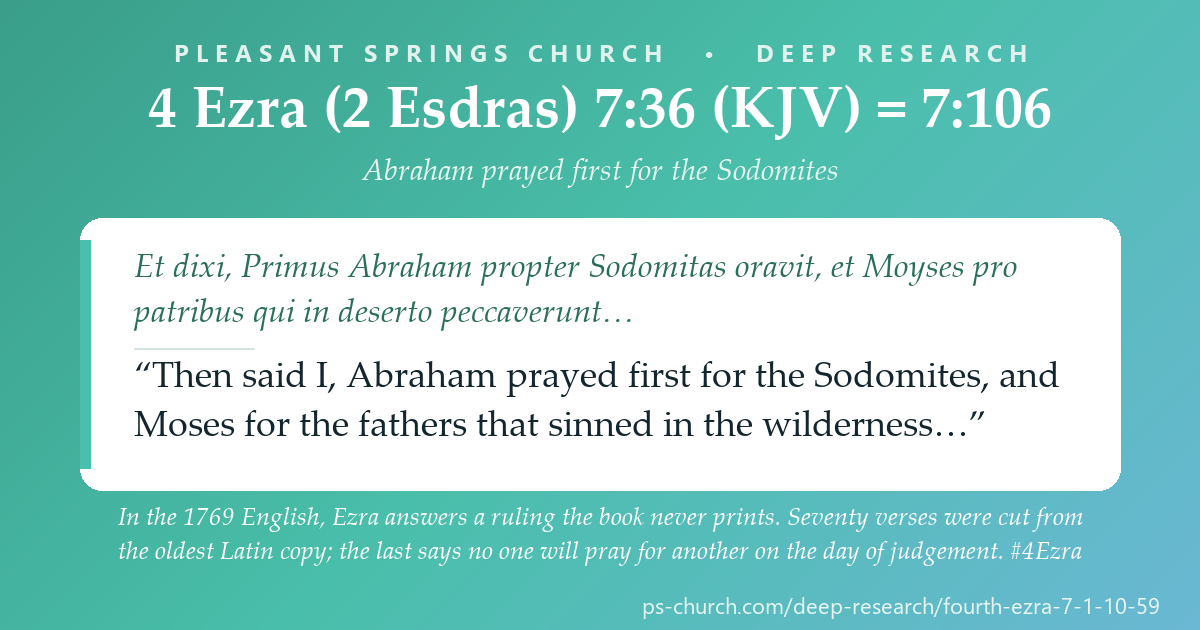
Here the 1769 English and the 1598 Latin resume — with a statement. In the 1895 texts the same verse is a question: “And I answered and said, How do we now find that first Abraham prayed for the people of Sodom, and Moses for the fathers that sinned in the wilderness:” (RV 7:106); Latin Et respondi et dixi: et quomodo inuenimus modo quoniam rogauit primus Abraham propter Sodomitas. The question answers 7:105. In the older Bibles, nothing in 7:1–35 speaks of prayer at all. Gildemeister, collating the Codex Sangermanensis in 1865, reported (as Bensly printed in 1875) that the leaf before the gap ends et iniustitiae non dormibunt and the leaf after it begins “primus (with a small p) Abraham propter Sodomitas et Moyses” — mid-sentence, with no verb. The 1598 Latin’s verse has Et dixi before it and oravit after.
One word, and what it points to. The 1598 Latin asks quare et nunc sic non erit, the 1769 English “wherefore shall it not be so now also?” — now. The 1895 Latin reads quare et tunc sic non and the RV “wherefore shall it not be so then also?” — then, the day of judgement of 7:105. And the manuscripts divide: Bensly’s apparatus reads et tunc A** cf. Syr. &c., et nunc SA*M, et nunc (on eras.) C — now is the reading of his oldest manuscript, S, of the first hand of A, of M, and of C on an erasure; then is a corrector’s in A, with the Syriac. So the older Bibles are not alone in reading now, and the page does not say which is original.
The parallel Box draws, measured. Box’s note on this verse compares Matthew 22:14, which he renders “many are called but few are chosen”; the Vulgate there reads Multi enim sunt vocati, pauci vero electi. [gloss: for many are called, but few chosen]. In Latin the two share three words in the same order — Multi … sunt, pauci — but never two side by side: a run of one. 8:1 — “The most High hath made this world for many, but the world to come for few” (KJV) — in Latin shares no identical word form with it (multos and paucos against Matthew’s multi and pauci; the declared normalisation folds no case endings). See Stage 4.
The woman becomes a city. “the woman appeared unto me no more” — and in the same verse, “there was a city builded”.
The deepest Latin contact in these four chapters — seven words, band one, both ways — and the only run of seven anywhere in chapters 3–14 of the 1598 Latin. et statuit me super pedes meos, et stands in exactly one verse of the Clementine Vulgate, Ezekiel 3:24: Et ingressus est in me spiritus, et statuit me super pedes meos, et locutus est mihi, et dixit ad me : Ingredere, et includere in medio domus tuæ. [gloss: and the spirit entered into me, and set me upon my feet, and spoke with me…]. The commentary looks elsewhere: Box’s notes on the seer lying as one dead and being strengthened here compare Daniel 8 and 10 and Revelation 1:17, and his note on set me on my feet is illegible in the scan held, so whether it names Ezekiel cannot be checked. Daniel 8:18 measures four (Stage 4). The Latin wording and the commentary’s legible parallels point to different books.
The interpretation. mulier quam vidisti … est Sion. The three Latin words stand in one Vulgate verse: Revelation 17:18, Et mulier, quam vidisti, est civitas magna, quæ habet regnum super reges terræ. [gloss: and the woman whom you saw is the great city, which has kingship over the kings of the earth]. A woman who is a city, in both — Zion here, the great city there. Three words, two different Latin translations; nothing about who read whom.
⚠️ Every verse after 7:35 in chapter 7 carries two numbers. KJV 7:36 is modern 7:106; KJV 7:70 is modern 7:140. The 1895 print itself carries both: at this point it prints “36 And I answered and said, How do” with the old number, and “[106] for the fathers that sinned in the wil-” with the new, bracketed. Every line above says which numbering it is using.
On the columns. There is no Greek and no Hebrew 4 Ezra to print: no Greek text of these chapters survives, and Box held that the Greek was itself translated from a Hebrew that does not survive either (Stage 5). The Latin is the book’s oldest complete witness held here. The English is the King James Apocrypha of 1769 wherever it has the verse, and the Revised Version of 1895 only for the seventy verses it lacks — one English column, two editions, each line labelled. Every RV line has been corrected to the 1895 print where the eBible transcription departs from it, and checked against an independent scan of that print. The shelf’s licensed English does not cover this book.
The page’s central measurement. Five witnesses, the same place in the book: the last words before the missing verses, and the first words after. Every cell is read from the witness file named in it.
| Witness | Last words before | What follows |
|---|---|---|
| KJV Apocrypha 1769 | 7:35 “…and wicked deeds shall bear no rule.” | 7:36 “Then said I, Abraham prayed first for the Sodomites, and Moses for the fathers that sinned in the wilderness:” |
| Latin, Clementine 1598 | 7:35 …et iniustitiæ non dominabuntur. | 7:36 Et dixi, Primus Abraham propter Sodomitas oravit, et Moyses pro patribus qui in deserto peccaverunt, |
| RV Apocrypha 1895 | 7:35 “…good deeds shall awake, and wicked deeds shall not sleep.” | [36] “And the pit of torment shall…” — seventy verses — ending [105] “so never shall any one pray for another in that day…”; then [106] “And I answered and said, How do we now find that first Abraham prayed for the people of Sodom, and Moses for the fathers that sinned in the wilderness:” |
| Latin, Bensly–James 1895 | 7:35 …et iniustitiae non dormibunt. | 7:36 Et apparebit lacus tormenti, et… — seventy verses — ending 7:105 Sic nunquam nemo pro aliquo rogabit…; then 7:106 Et respondi et dixi: et quomodo inuenimus modo quoniam rogauit primus Abraham propter Sodomitas… |
| Codex Sangermanensis, AD 822, as Gildemeister described it (Bensly 1875) | verso ends et iniustitiae non dormibunt | “But a leaf which originally came between (it was the sixth of the quire, if I am not mistaken) has been cut out, leaving about half an inch of its inner margin”; the recto then begins “primus (with a small p) Abraham propter Sodomitas et Moyses” |
In the 1769 English and the 1598 Latin, Ezra’s appeal to the intercessors of Israel follows straight on the judgement scene. In the 1895 texts it follows a ruling — “never shall any one pray for another in that day” — and is framed as an objection to it: “How do we now find that first Abraham prayed…” The older Bibles print the second half of an argument. This is not a new observation. Bensly opened his 1875 edition with it: “the transition from the thirty-fifth to the thirty-sixth verse of the seventh chapter must strike even a superficial reader as singularly abrupt”. What this page adds is the measurement: the table above, and the word counts in the codex note.
It does not show why the leaf was cut. M. R. James, introducing the 1895 edition, wrote that the leaf had been “(no doubt purposely) cut out in early times”. Bensly in 1875 addressed a narrower question, why later copyists who could consult another manuscript did not fill the gap from it: “The fact that the lacuna was not filled up from this source will be best accounted for by the supposition that the passage was suppressed for dogmatic reasons”. Box in 1912 connected the disappearance to 7:102–105 and Jerome (see 7:105 above). Those are three named scholars’ judgements, quoted. The page measures the gap and the seam; it does not know the motive.
Gildemeister’s inference, as Bensly printed it: since no manuscript then known lacked the gap anywhere else, “all known MSS., since none have been found without this lacuna, were derived from the Codex Sangermanensis”. James in 1895: “Codex S. is the oldest known manuscript of 4 Esdras, and is the parent of the vast majority of extant copies.” Bensly found the passage in a ninth-century manuscript at Amiens (“This is the book in which Professor Bensly discovered the Missing Fragment.”; James describes the hand as “a Carolingian minuscule” of the ninth century) and published it in 1875. He was not the first to copy it: James adds of a Spanish manuscript, “It was from this MS. that Professor Palmer had copied the Missing Fragment in 1826”, a transcript not printed until after Bensly’s discovery. The Revised Version’s preface of 1895 records that the revisers “were thus able to incorporate the missing fragment, vii. 36-105, which was edited by Professor Bensly with elaborate care, and published by the Cambridge University Press (1875)”.
Versification — a third state again: no Masoretic text, no Septuagint, and none of the shelf’s licensed English. This book is not in the Hebrew Bible, and its Greek is lost for these chapters; LXX “2 Esdras” is Ezra–Nehemiah, a different book, and is not used. The offsets that exist are between the four witnesses printed here, and they are measured, not copied from a table:
| Chapter | KJV Apocrypha 1769 | Latin, Clementine 1598 | RV Apocrypha 1895 | Latin, Bensly–James 1895 (held) |
|---|---|---|---|---|
| 7 | 70 | 69 | 140 | 70 (7:36–105 only) |
| 8 | 63 | 63 | 63 | — |
| 9 | 47 | 47 | 47 | — |
| 10 | 59 | 60 | 59 | — |
| 7–10 | 239 | 239 | 309 | 70 |
| whole book | 874 | 872 | 944 |
The 1769 English and the 1895 English agree verse for verse in all four chapters once chapter 7 is offset: KJV 7:36–70 = RV 7:106–140 — with one clause apart: the RV closes 8:43 with “so perisheth”, where the KJV opens 8:44 with “Even so perisheth” (and the 1598 Latin with sic periit). The 1598 Latin does not agree with either, even where the totals match. Its chapter 7 ends one verse early (Latin 7:69 = English 7:69–70) and its chapter 10 one verse late (Latin 10:59–60 = English 10:59); and inside the chapters it breaks the verse at a different place nineteen more times — fourteen of them by moving a speech or sight formula (and he said to me, and I saw) from the start of one verse to the end of the one before, five by moving a clause. Twenty-one places in four chapters. The acquisition note for this Latin file named five such places in the whole book and said a full map was not made; this is the map for chapters 7–10, and it is printed whole:
| Boundary | What differs | Latin · Clementine 1598 | English · KJV 1769 (RV 1895 agrees) |
|---|---|---|---|
| 7:37 | 7:38 | a clause moves | 7:37 et Samuelis, | 7:38 And Samuel |
| 7:45 | 7:46 | a speech or sight formula moves | 7:45 Et respondi, · 7:46 et dixi, | 7:46 I answered then and said, |
| 7:53 | 7:54 | a clause moves | 7:54 nos vero non ingrediemur. | 7:53 since we shall not enter into it? |
| 7:69 | 7:70 | verse count differs | 7:69 non fortassis derelinquerentur in innumerabili multitudine, nisi pauci valde. | 7:70 There should be very few left peradventure in an innumerable multitude. |
| 8:19 | 8:20 | a clause moves | 8:20 Initium verborum Esdræ priusquam assumeretur : et dixi, | 8:19 This is the beginning of the words of Esdras, before he was taken up: and I said, |
| 8:22 | 8:23 | a clause moves | 8:23 cujus jussio fortis, et dispositio terribilis : | 8:22 whose commandment is strong, and ordinance fearful; |
| 9:11 | 9:12 | a clause moves | 9:12 et cum adhuc esset eis apertus pænitentiæ locus, non intellexerunt, sed spreverunt : | 9:11 and, when as yet place of repentance was open unto them, understood not, but despised it; |
| 9:16 | 9:17 | a speech or sight formula moves | 9:16 Et respondit ad me, et dixit, | 9:17 And he answered me, saying, |
| 9:29 | 9:30 | a speech or sight formula moves | 9:29 et dicens dixisti, | 9:30 And thou spakest saying, |
| 9:39 | 9:40 | a speech or sight formula moves | 9:39 et dixi ei, | 9:40 And said unto her, |
| 9:40 | 9:41 | a speech or sight formula moves | 9:40 Et dixit ad me, | 9:41 And she said unto me, |
| 9:42 | 9:43 | a speech or sight formula moves | 9:42 Et dixit ad me, | 9:43 She said unto me, |
| 10:11 | 10:12 | a speech or sight formula moves | 10:11 Si autem dicis mihi, | 10:12 But if thou sayest unto me, |
| 10:13 | 10:14 | a speech or sight formula moves | 10:13 et ego tibi dico, | 10:14 Then say I unto thee, |
| 10:17 | 10:18 | a speech or sight formula moves | 10:17 Et dixit ad me, | 10:18 And she said unto me, |
| 10:26 | 10:27 | a speech or sight formula moves | 10:26 Et vidi : | 10:27 And I looked, |
| 10:31 | 10:32 | a speech or sight formula moves | 10:31 Et dixi, | 10:32 And I said, |
| 10:32 | 10:33 | a speech or sight formula moves | 10:32 Et dixit ad me, | 10:33 And he said unto me, |
| 10:33 | 10:34 | a speech or sight formula moves | 10:33 Et dixi, | 10:34 Then said I, |
| 10:37 | 10:38 | a speech or sight formula moves | 10:37 Et respondit ad me, et dixit, | 10:38 He answered me then, and said, |
| 10:59 | 10:60 | verse count differs | 10:60 Et dormivi illam noctem et aliam, sicut dixerat mihi. | 10:59 So I slept that night and another, like as he commanded me. |
How the map was made, and how far to trust it. Every boundary was read side by side. Three automatic screens were then run over all 239 verse pairs — a length alignment, a speech-formula scan, and a “see-saw” test for one verse running long where its neighbour runs short. Every boundary any screen flagged is either in the table above or was read and found to break the same way in both texts, and the page’s self-check enforces that. One shift (7:53 | 7:54) was found by reading and only one screen catches it. And one shift escaped the first reading and all three screens: at 7:37 | 7:38 the 1598 Latin ends its verse et Samuelis, where the English opens the next “And Samuel” — a name moving, with no formula and no great length. A second reading found it; a fourth screen, for proper names standing in different verses, was then added to the self-check, and it flags that boundary and 8:19 | 8:20 (already in the table) and nothing else. A clause that moves no formula, no name and no great length could still hide elsewhere. Bensly’s fragment and the RV agree on all seventy boundaries of 7:36–105 (recorded when the Latin file was made).
The Shape of the Passage
Sequence (measured), with one gap — not a chiasmThis is offered as a sequence, not a chiasm. The third vision is a dialogue with the angel closed by a command to wait seven days (9:23–25); the fourth breaks that pattern: Uriel is not present until the woman is gone (10:28–29). No mirror is claimed, because none was found.
⚠️ Where this page sits. 4 Ezra stands in the appendix of the Clementine Vulgate, outside its canonical books, and among the Apocrypha of the older English Bibles. This library reads it as a Second-Temple witness and files it under Apocrypha / Deuterocanon.
Author
Anonymous, writing as Ezra in Babylon. The setting is the Babylonian exile; on Box’s reading the grief is the Roman one, and in such a book “Babylon typically = Rome”. The book never names Rome in these chapters — it names Zion, and mourns her.
He argues with God, and the argument does not go his way. Chapters 7–10 are the hinge of the book: Ezra keeps pressing the case for the many who perish, the angel keeps answering that the world to come is for the few, and then — in the fourth vision — Ezra stops arguing and starts comforting a grieving mother, and the mother turns out to be the city.
He writes in sevens. Seven numbered ways of torment, seven numbered orders of rest, seven days of freedom for the departed soul, seven days of primeval silence before the resurrection.
Audience
Jews after the fall of the Temple, as the book is commonly read. Its questions are those of people who had kept the law and seen Zion laid waste: whether keeping it had been worth anything. The answer of these chapters is hard: few will be saved, the law does not perish even if those who received it do (9:37), and on the day of judgement no one will pray for another (7:105).
And then, later, Christian readers. Both Latin texts held here name the son of 7:28 Jesus; Ambrose quoted the book, and drew on the missing verses (Bensly, 1875); an opponent of Jerome cited it, and Jerome rebuked him (Box, 1912). The book’s Latin history is a history of being read by people it was not written for — and in its oldest Latin copy one leaf is missing: it “has been cut out with a knife”, Bensly reported in 1875. Why, the page reports and does not decide.
Orient on the book under both its names, and on the manuscript story.
Search under every name: 4 Ezra; 2 Esdras; Fourth Book of Esdras; Ezra Apocalypse; Esdras, Books of — and for this passage missing fragment; Codex Sangermanensis; Bensly; intermediate state; intercession; Uriel; messiah in 4 Ezra. An article filed under “2 Esdras” may be about Ezra–Nehemiah in Greek; check before reading.
Which articles are relevant?
- Anchor Bible Dictionary — the article on this book (look under both Ezra and Esdras), and “Apocalypses and Apocalypticism.”
- Eerdmans Dictionary of Early Judaism — 4 Ezra; Messiah; Resurrection; Afterlife.
- Dictionary of New Testament Background (IVP) — the articles on apocalyptic literature and on the Ezra literature.
- On the text — anything that explains why chapter 7 has two lengths. An article that quotes “2 Esdras 7:36” without saying which numbering it means is not usable for this passage: in one Bible it is the pit of torment, in the other Abraham praying for Sodom.
Bibliography surfaced:
- R. L. Bensly, The Missing Fragment of the Latin Translation of the Fourth Book of Ezra (Cambridge, 1875) — read for this page (OCR, five copies).
- R. L. Bensly, The Fourth Book of Ezra: the Latin version edited from the MSS., with an introduction by M. R. James (Texts and Studies III.2; Cambridge, 1895) — read for this page.
- G. H. Box, The Ezra-Apocalypse (London: Pitman, 1912) — read for this page (OCR) and quoted for attribution only.
- Michael E. Stone, Fourth Ezra (Hermeneia, 1990) — a full modern commentary. Not consulted.
- B. M. Metzger, “The Fourth Book of Ezra,” in J. H. Charlesworth (ed.), The Old Testament Pseudepigrapha, vol. 1 (1983). Not consulted.
Who read these chapters before us — and who read the missing ones.
Each statement below is attributed to the edition it was read in. None of the ancient works named here is held on this disk except as quoted in those editions.
Which ancient readers shed light on the passage?
- Ambrose of Milan (late 4th century). Bensly reported in 1875 that Ambrose’s treatise On the Good of Death “drew largely for illustration from this version, and especially from the missing portion” — which Bensly took as decisive evidence that the Latin once had the seventy verses. The 1895 introduction prints Ambrose quoting 7:28–30 in his commentary on Luke, with the name: Reuelabitur enim, inquit, filius meus …
- Jerome (Against Vigilantius 7, early 5th century), as Box quotes him: rebuking an opponent who cited an apocryphal book under Ezra’s name, which says that after death no one may dare to pray for others — a book Jerome says he never read. Box’s quotation; the Latin of Jerome is not held here.
- Codex Sangermanensis (Paris), dated by its own note — Bensly: “the eighth year of Louis le D^bonnaire (=A.D. 822)” [OCR as found; Débonnaire]. The oldest Latin manuscript, the one with the cut leaf.
- 2 Baruch (the Syriac Apocalypse of Baruch), which Box cites throughout his notes: he sets its chapter 85 (no intercession of the fathers, no prayer of the prophets at the end) beside 7:102–115. Not held.
- Ezekiel and Daniel. Box reports that Vaganay took the “thirtieth year” of 3:1 (KJV) as modelled on Ezekiel 1:1, and himself read the date as typical. At 10:29–30 Box’s notes compare Daniel 8 and 10 for the seer prostrate and strengthened (his note on being set on his feet is illegible in the scan); the Latin screen finds Ezekiel 3:24 instead (Stage 4). Neither link is a claim about who read whom.
The name. 1598 Latin filius meus Jesus; 1769 English “my son Jesus”, and the 1895 English the same; 1895 Latin Iesus cum his qui cum eo. No held column lacks it.
The years. All held columns read four hundred: in annis quadringentis. Box reported that the versions disagree — the Latin and one Arabic version 400, the Syriac 30, the other Arabic 1,000, the Ethiopic and Armenian apparently none. Reported, not checked.
The death. morietur filius meus Christus — and Box’s notes report that the Ethiopic reads “Ethiop., my servant” for my son, that the Arabic and Armenian lack the whole verse, and that one Latin manuscript reads shall be taken up for shall die. The page does not identify this figure with anyone; it reports what each witness reads.
The Most High, the few, my son, Zion — and an angel with a name.
Counts are over the Latin, normalised as declared in Stage 4: the 1598 Latin’s 239 verses of chapters 7–10 (3,969 words) plus the 70 verses of Bensly’s fragment (1,330 words), against the 35,809 verses of the Clementine Vulgate (612,048 words). Word-families are counted by prefix, so case forms are included and nothing else is.
37 times in these four chapters — 22 in the 1598 Latin’s 239 verses and 15 more in the seventy of the fragment, in 5,299 Latin words. The whole Clementine Vulgate, 73 books and 612,048 words, has the word-family 89 times — and some of those are the plain adjective highest (Luke 2:14, in altissimis). Sirach 38, Psalms 17, Daniel 7, Luke 6, Wisdom 6. The whole Vulgate’s stock is 89; these four chapters alone carry 37.
Six of the seven occurrences in the whole 1598 Latin book stand in chapters 7–10 (7:12, 7:69, 8:1, 8:3, 8:62, 10:57; the seventh is 2:13), and Bensly’s text of the missing verses carries five more (7:47, 48, 51, 52, 60). The Vulgate has the word-family 84 times in 612,048 words. The fewness of the saved is this passage’s word, and nearly half of it stands in the missing verses.
Four times in these chapters, from two speakers. God’s my son, revealed and then dying (7:28, 7:29); and the mourning woman’s my son, who died on entering his bridal chamber (10:1, and the angel repeating her at 10:48). The text draws no line between them, and neither does this page. The pair filius meus stands in 30 Vulgate verses; filius meus Jesus and filius meus Christus in none of the 35,809.
Five times in chapters 7–10, all five in chapter 10 (10:7, 20, 23, 39, 44). The first is Ezra’s, to the woman: Zion our mother. The last is the angel’s, about her: this is Zion. The reader has heard the name before Ezra is told what the woman means.
Three times in the whole 1598 Latin book — 4:1, 5:20 and here, 10:28, where Ezra calls for him by name. In the 73 books of the Clementine Vulgate the name occurs four times and every one is a man (1 Chronicles 6:24; 15:5; 15:11; 2 Chronicles 13:2). Among the Latin texts searched here (the 73 Vulgate books, the 942 Latin 4 Ezra rows and the Latin 3 Esdras), an angel named Uriel appears only in 4 Ezra.
Counted here, not assumed:
- The book’s own dialogue formula. Et respondi et dixi (and I answered and said) stands in 19 verses of the Latin 4 Ezra held here (1598 text plus fragment) and in 3 verses of the entire Clementine Vulgate (Jeremiah 11:5; Zechariah 4:11; 6:4). A dialogue book, measurably.
- “Jesus” in the 1769 English of 4 Ezra: two verses, 7:28 and 7:37 (KJV numbering; = modern 7:107). The second is “And Jesus after him for Israel” — Joshua, in the Greek form of his name (the RV prints Joshua; the 1598 Latin has no name there at all: et qui post eum). A word search would count it.
- Thirty years, three, or three thousand? The woman was barren thirty years (9:43). Interpreting it at 10:45–46, the 1769 English reads “after thirty years Solomon builded the city” with the 1598 Latin (post annos triginta); the 1895 English reads “after three thousand years that Solomon builded the city” (RV). The two English editions on this page disagree by a factor of a hundred. And Bensly’s 1895 Latin reads neither. Read from the OCR of his edition (no page image of chapter 10 is held), his text has tres aedificauit Salomon ciuitatem — three — and his apparatus ann- tres SACM, annorum tria milia Syr.: his four principal Latin manuscripts read three years, and the Syriac, with other Oriental versions, three thousand. Three witnesses on this page, three numbers. The RV’s figure matches what Bensly reports for the Syriac, not his Latin; the page does not say which reading is original.
Latin against Latin: what can be measured, and runs that are not what they look like.
What is screened. Every verse of the 1598 Latin’s chapters 7–10 (239) and every verse of Bensly’s fragment (70), against all 35,809 verses of the Clementine Vulgate (73 books, Old Testament with the deuterocanon, and New Testament; the appendix is not in it, so 4 Ezra cannot match itself). Contiguous runs of whole word forms; the tie band — how many Vulgate verses reach the same depth — beside every run, and the band the other way: how many of the 942 Latin 4 Ezra rows held here the partner verse reaches at its own deepest.
Normalisation, declared: diacritics stripped, lowercase, æ→ae, œ→oe, j→i, v→u, non-letters dropped. Nothing else is folded — so Bensly’s medieval spellings (iocunditas, habundat, inmortales) do not meet the Vulgate’s, and the fragment’s numbers run low for a reason that is orthography, not distance. A row sharing only single words scores 1; 0 means no word shared at all.
⚠️ What a run here means. 4 Ezra’s Latin is an Old Latin translation of a lost Greek; the Vulgate is Jerome’s and older Latin. Two different translations. A run measures shared Latin wording — never a source, and never who read whom.
Not run, on purpose: English against English. The 1769 English of 4 Ezra against the 1769 English of the canon would measure the habits of the King James translators, not the book, and is not evidence of anything here.
The distribution:
1598 Latin, chapters 7–10, 239 verses against 35,809: all 239 reach two, 159 reach three, 49 reach four, 6 reach five, 1 reaches six, 1 reaches seven, and nothing reaches eight.
Bensly’s fragment, 70 verses against the same 35,809: all 70 reach two, 41 reach three, 10 reach four, and nothing reaches five.
The wider screen, for scale: all 942 Latin rows of the book held here (872 + 70). Three reach eight, and all three are in the frame chapters 1–2 and 15–16 — 1:4 (band 22, a formula), 1:7 and 16:12. 10:30 is the only verse of chapters 3–14 to reach seven.
The deepest run — and it holds both ways:
10:30 → Ezekiel 3:24: seven words, band 1; and Ezekiel 3:24 against all 942 Latin 4 Ezra rows reaches seven with exactly one, 10:30. et statuit me super pedes meos, et — [gloss: and he set me upon my feet, and]. Ezra lies as one dead; the angel takes his right hand, strengthens him and stands him up. The five-word core statuit me super pedes meos stands in one Vulgate verse.
And it is fragile in an instructive way. Ezekiel 2:2 tells the same moment with supra for super, and measures 3; Daniel 8:18, an angel raising a fallen seer with statuit me in gradu meo, measures 4. A preposition decides which prophet this verse shares Latin with. Within 4 Ezra itself Ezra is set on his feet at 5:15 too — et statuit me super pedes, and there the phrase stops.
The five runs of five — and what they are:
- 10:1 → Acts 10:25, Et factum est, cum introisset, band 1 both ways. A narrative formula: its first four words stand in 22 Vulgate verses and 16 Latin 4 Ezra rows. Peter enters a house; the woman’s son enters his bridal chamber.
- 10:22 → James 2:7, nomen quod invocatum est super, band 1 both ways — the name called over a people. An idiom: its last three words stand in 6 Vulgate verses.
- 9:27 → Jeremiah 13:6, Et factum est post dies, band 1 — but Jeremiah 13:6 reaches that depth with three 4 Ezra verses (5:21, 9:27, 13:1). The book’s own way of opening a vision.
- 9:42 → Ezekiel 3:24, mihi. Et dixit ad me, band 1. Speech formula — and Ezekiel 3:24’s own deepest partner in 4 Ezra is 10:30, at seven.
- 9:8 → Isaiah 14:25, in terra mea, et in, band 1 both ways. Coincidence — five common words in a row.
Every one of those five has tie band 1, and every one is a formula, an idiom, the book’s own habit or an accident. Band 1 says the sequence is rare in the Vulgate. It does not say the sequence means anything. The seven-word run at 10:30 is printed as a shared image in shared Latin — a seer set upright by a heavenly hand — and not as evidence that either translator knew the other’s Latin: that is a question of dates and translation history, and this screen cannot test it.
⚠️ Four parallels Box’s notes draw, measured — and three this page checked or found:
- 8:3 → Matthew 22:14 (Box) — run of ONE. “many created, but few shall be saved” (KJV) and Matthew 22:14 [gloss: for many are called, but few chosen]: in Latin the two share three words in the same order (Multi … sunt, pauci) but no two side by side; 8:1 shares no identical word form (0) — multos and paucos are case forms of Matthew’s multi and pauci, which the declared normalisation does not fold; and Matthew 22:14 against all 942 Latin 4 Ezra rows reaches only 2, band 1 (the fragment’s 7:61, on enim sunt). Box’s note on 8:3 compares Matthew 22:14. The thought is close; the Latin shares its key words but not their sequence. 8:3’s own deepest Vulgate run is 2, band 4.
- 7:3–14 → Matthew 7:13–14 (Box) — run of ONE. Box’s notes on the passage cite Matthew 7:13–14. The angel’s narrow entrances (“Then were the entrances of this world made narrow”, KJV) and the narrow gate of Matthew 7:13–14 (Quam angusta porta…) share single words — angusta, pauci — and no two in sequence: across all twelve verses 7:3–14 the deepest run with either Matthean verse is 1. Against Luke 13:24 it is 2 (non poterunt, 7:14). The image is shared; the Latin is not.
- 7:28 → Matthew 3:17 (checked here) — run of TWO, filius meus, a pair found in 30 Vulgate verses. 7:28’s deepest run is 4, band 5: qui cum eo sunt (2 Samuel 17 three times, 1 Maccabees 9:58, Acts 19:38) — a formula. And the transcription slip matters: read cum his qui (as Bensly prints it) for the Wikisource cum bis and the depth is unchanged but the band becomes 7 (Matthew 12:4 and Mark 16:10 join). A one-letter error moves a published number.
- 7:132–140 (1598: 7:62–69) → Exodus 34:6–7 (Box) — run of TWO, et multæ. Box says the seer “obviously has in mind the passage of Scripture which has become classical in this connection”, Exodus 34:6. Two independent Latin translations of a list of divine names need not share word order or vocabulary. But the screen does find the formula where the Vulgate words it the same way. Exodus 34:6 has multæ miserationis; 7:66’s own deepest run is three, et multæ misericordiæ, band 6 — and four of the six are that formula elsewhere in the Vulgate: Numbers 14:18, Joel 2:13, Psalms 85:5 and 85:15 (Vulgate numbering). Those four are the only Vulgate verses with the three words, and each reaches three in 4 Ezra only at 7:66. The other two partners (Deuteronomy 33:3, Ecclesiastes 1:11) share sunt et qui and qui futuri sunt — incidental.
- 7:97 (fragment) → Matthew 13:43 (checked here) — run of TWO, sicut sol: the righteous shining like the sun. The pair stands in 7 Vulgate verses; 7:97’s deepest run, 2, is shared with 64; and Matthew 13:43 against all 942 Latin 4 Ezra rows reaches 2 with 15. A pair, not a passage.
- 7:103 (fragment) → Deuteronomy 24:16 (Box) — run of THREE, band 3. Box’s note on 7:103 cites Deuteronomy 24:16, and the screen finds the same verse: patres pro filiis, fathers for sons, shared with Deuteronomy 24:16 and its two citations (2 Kings 14:6; 2 Chronicles 25:4); Deuteronomy 24:16 reaches it in 4 Ezra only at 7:103. Deuteronomy: Non occidentur patres pro filiis, nec filii pro patribus, sed unusquisque pro peccato suo morietur. [gloss: fathers shall not be put to death for sons…]. The law that no father dies for his son’s sin, and Ezra’s question whether a father may pray for his son on the day of judgement, share three Latin words. The ruling that answers him (7:104–105) does not carry that sequence. 7:105 against Galatians 6:5 [gloss: each shall bear his own load]: 1; against Ezekiel 18:20: 0.
- 10:44 → Revelation 17:18 (found by the screen) — run of THREE, band 2 one way and 1 the other: mulier quam vidisti, once in each. See the codex.
Every verse that reaches four or more, both ways:
Generated at build time from the screen above and re-derived by the page’s self-check. 1598 = Clementine verse (with its modern number where it differs); 1895 = Bensly’s fragment. Partners after the third are counted, not listed. The shared words are shown normalised.
| 4 Ezra, Latin | Run | Band | Vulgate partner(s) | Shared words (normalised) | Partner’s own depth & band among all 942 Latin 4 Ezra rows |
|---|---|---|---|---|---|
| 10:30 (1598) | 7 | 1 | Ezekiel 3:24 | et statuit me super pedes meos et | Ezekiel 3:24: 7, band 1 |
| 9:8 (1598) | 5 | 1 | Isaiah 14:25 | in terra mea et in | Isaiah 14:25: 5, band 1 |
| 9:27 (1598) | 5 | 1 | Jeremiah 13:6 | et factum est post dies | Jeremiah 13:6: 5, band 3 |
| 9:42 (1598) | 5 | 1 | Ezekiel 3:24 | mihi et dixit ad me | Ezekiel 3:24: 7, band 1 |
| 10:1 (1598) | 5 | 1 | Acts 10:25 | et factum est cum introisset | Acts 10:25: 5, band 1 |
| 10:22 (1598) | 5 | 1 | James 2:7 | nomen quod inuocatum est super | James 2:7: 5, band 1 |
| 7:1 (1598) | 4 | 24 | 1 Samuel 11:11, 1 Samuel 18:1, Acts 10:25 +21 more | et factum est cum | 1 Samuel 11:11: 4, band 16 |
| 7:2 (1598) | 4 | 44 | Acts 22:21, Daniel 10:11, Ezekiel 11:5 +41 more | et dixit ad me | Acts 22:21: 5, band 1 |
| 7:3 (1598) | 4 | 44 | Acts 22:21, Daniel 10:11, Ezekiel 11:5 +41 more | et dixit ad me | Acts 22:21: 5, band 1 |
| 7:10 (1598) | 4 | 44 | Acts 22:21, Daniel 10:11, Ezekiel 11:5 +41 more | et dixit ad me | Acts 22:21: 5, band 1 |
| 7:11 (1598) | 4 | 1 | Ecclesiastes 1:9 | est quod factum est | Ecclesiastes 1:9: 4, band 1 |
| 7:16 (1598) | 4 | 1 | Deuteronomy 4:39 | in corde tuo quod | Deuteronomy 4:39: 4, band 1 |
| 7:19 (1598) | 4 | 44 | Acts 22:21, Daniel 10:11, Ezekiel 11:5 +41 more | et dixit ad me | Acts 22:21: 5, band 1 |
| 7:28 (1598) | 4 | 5 | 1 Maccabees 9:58, 2 Samuel 17:10, 2 Samuel 17:12 +2 more | qui cum eo sunt | 1 Maccabees 9:58: 4, band 2 |
| 7:54 (1895) | 4 | 44 | Acts 22:21, Daniel 10:11, Ezekiel 11:5 +41 more | et dixit ad me | Acts 22:21: 5, band 1 |
| 7:62 (1895) | 4 | 3 | Jeremiah 11:5, Zechariah 4:11, Zechariah 6:4 | et respondi et dixi | Jeremiah 11:5: 4, band 19 |
| 7:75 (1895) | 4 | 3 | Jeremiah 11:5, Zechariah 4:11, Zechariah 6:4 | et respondi et dixi | Jeremiah 11:5: 4, band 19 |
| 7:76 (1895) | 4 | 1 | Ezekiel 26:20 | te cum his qui | Ezekiel 26:20: 4, band 1 |
| 7:79 (1895) | 4 | 1 | Psalms 105:41 | eorum qui oderunt eos | Psalms 105:41: 4, band 1 |
| 7:93 (1895) | 4 | 1 | Sirach 16:18 | et quae in eis | Sirach 16:18: 4, band 1 |
| 7:94 (1895) | 4 | 1 | 1 John 5:10 | testimonium quod testificatus est | 1 John 5:10: 4, band 1 |
| 7:100 (1895) | 4 | 3 | Jeremiah 11:5, Zechariah 4:11, Zechariah 6:4 | et respondi et dixi | Jeremiah 11:5: 4, band 19 |
| 7:102 (1895) | 4 | 5 | Exodus 33:13, Jeremiah 11:5, Ruth 2:10 +2 more | gratiam ante oculos tuos | Exodus 33:13: 4, band 5 |
| 7:104 (1895) | 4 | 2 | Job 4:16, Judith 12:17 | coram oculis meis et | Job 4:16: 4, band 1 |
| 7:57 (1598, = 7:127) | 4 | 1 | Isaiah 21:9 | et respondit et dixit | Isaiah 21:9: 4, band 2 |
| 7:60 (1598, = 7:130) | 4 | 2 | Jeremiah 14:14, Jeremiah 36:31 | locutus sum ad eos | Jeremiah 14:14: 4, band 1 |
| 7:62 (1598, = 7:132) | 4 | 3 | Jeremiah 11:5, Zechariah 4:11, Zechariah 6:4 | et respondi et dixi | Jeremiah 11:5: 4, band 19 |
| 8:4 (1598) | 4 | 3 | Jeremiah 11:5, Zechariah 4:11, Zechariah 6:4 | et respondi et dixi | Jeremiah 11:5: 4, band 19 |
| 8:17 (1598) | 4 | 1 | 2 Chronicles 34:21 | pro me et pro | 2 Chronicles 34:21: 4, band 1 |
| 8:19 (1598) | 4 | 2 | Genesis 27:13, Genesis 27:43 | audi uocem meam et | Genesis 27:13: 4, band 1 |
| 8:24 (1598) | 4 | 4 | 1 Kings 8:28, 2 Chronicles 6:19, Daniel 9:17 +1 more | orationem serui tui et | 1 Kings 8:28: 4, band 1 |
| 8:31 (1598) | 4 | 4 | Genesis 46:34, Genesis 47:3, Jeremiah 3:25 +1 more | nos et patres nostri | Genesis 46:34: 4, band 1 |
| 8:41 (1598) | 4 | 1 | Sirach 22:23 | sic et qui in | Sirach 22:23: 4, band 1 |
| 8:42 (1598) | 4 | 3 | Jeremiah 11:5, Zechariah 4:11, Zechariah 6:4 | et respondi et dixi | Jeremiah 11:5: 4, band 19 |
| 8:45 (1598) | 4 | 1 | Joel 2:17 | parce populo tuo et | Joel 2:17: 4, band 1 |
| 8:58 (1598) | 4 | 7 | 2 Corinthians 9:7, Jeremiah 5:24, Psalms 13:1 +4 more | in corde suo non | 2 Corinthians 9:7: 4, band 1 |
| 8:62 (1598) | 4 | 3 | Jeremiah 11:5, Zechariah 4:11, Zechariah 6:4 | et respondi et dixi | Jeremiah 11:5: 4, band 19 |
| 9:4 (1598) | 4 | 4 | 1 Kings 14:9, Deuteronomy 4:32, Jeremiah 28:8 +1 more | qui fuerunt ante te | 1 Kings 14:9: 5, band 1 |
| 9:5 (1598) | 4 | 1 | Daniel 9:12 | quod factum est in | Daniel 9:12: 4, band 3 |
| 9:7 (1598) | 4 | 3 | Isaiah 4:3, Joel 2:32, Nahum 3:7 | et erit omnis qui | Isaiah 4:3: 4, band 2 |
| 9:14 (1598) | 4 | 3 | Jeremiah 11:5, Zechariah 4:11, Zechariah 6:4 | et respondi et dixi | Jeremiah 11:5: 4, band 19 |
| 9:24 (1598) | 4 | 1 | Deuteronomy 28:39 | et uinum non bibes | Deuteronomy 28:39: 4, band 1 |
| 9:29 (1598) | 4 | 1 | Acts 7:44 | patribus nostris in deserto | Acts 7:44: 4, band 1 |
| 9:40 (1598) | 4 | 44 | Acts 22:21, Daniel 10:11, Ezekiel 11:5 +41 more | et dixit ad me | Acts 22:21: 5, band 1 |
| 9:44 (1598) | 4 | 5 | 1 Chronicles 12:22, 1 Chronicles 16:37, 2 Chronicles 24:11 +2 more | et per singulos dies | 1 Chronicles 12:22: 4, band 1 |
| 9:45 (1598) | 4 | 6 | 1 Maccabees 9:23, 1 Samuel 1:20, Jeremiah 13:6 +3 more | et factum est post | 1 Maccabees 9:23: 4, band 6 |
| 9:47 (1598) | 4 | 22 | 1 Samuel 11:11, 1 Samuel 18:1, Acts 10:25 +19 more | et factum est cum | 1 Samuel 11:11: 4, band 16 |
| 10:3 (1598) | 4 | 22 | 1 Samuel 11:11, 1 Samuel 18:1, Acts 10:25 +19 more | et factum est cum | 1 Samuel 11:11: 4, band 16 |
| 10:16 (1598) | 4 | 1 | 2 Kings 4:17 | in tempore et in | 2 Kings 4:17: 4, band 1 |
| 10:17 (1598) | 4 | 44 | Acts 22:21, Daniel 10:11, Ezekiel 11:5 +41 more | et dixit ad me | Acts 22:21: 5, band 1 |
| 10:23 (1598) | 4 | 2 | 2 Chronicles 34:10, Jonah 3:8 | in manibus eorum qui | 2 Chronicles 34:10: 4, band 1 |
| 10:25 (1598) | 4 | 22 | 1 Samuel 11:11, 1 Samuel 18:1, Acts 10:25 +19 more | et factum est cum | 1 Samuel 11:11: 4, band 16 |
| 10:27 (1598) | 4 | 1 | Ezekiel 11:13 | uoce magna et dixi | Ezekiel 11:13: 4, band 17 |
| 10:28 (1598) | 4 | 2 | Psalms 140:5, Psalms 34:13 | et oratio mea in | Psalms 140:5: 4, band 1 |
| 10:29 (1598) | 4 | 2 | Luke 14:26, Luke 6:47 | uenit ad me et | Luke 14:26: 4, band 2 |
| 10:32 (1598) | 4 | 47 | 1 Kings 3:12, 1 Maccabees 16:5, Acts 22:21 +44 more | secundum sermones tuos et | 1 Kings 3:12: 4, band 1 |
| 10:46 (1598) | 4 | 6 | 1 Maccabees 9:23, 1 Samuel 1:20, Jeremiah 13:6 +3 more | et factum est post | 1 Maccabees 9:23: 4, band 6 |
| 10:49 (1598) | 4 | 4 | Jeremiah 10:11, Luke 2:18, Revelation 22:19 +1 more | et de his quae | Jeremiah 10:11: 4, band 1 |
| 10:59 (1598) | 4 | 1 | Exodus 33:16 | qui habitant super terram | Exodus 33:16: 4, band 1 |
It settles that the Latin of these chapters shares no long run of wording with the Clementine Vulgate except one seven-word image from Ezekiel. Everything else that reaches five is a formula, an idiom or an accident, and the parallels Box’s notes draw measure one, two or three words.
It settles nothing about the New Testament’s relation to 4 Ezra, and nothing about Greek. Box dated the book’s core to about AD 100; its Greek is lost; and the Latin screened here is a translation of that lost Greek compared with a different translation of the Bible. No direction of influence is measurable on this shelf, and none is asserted.
What this page could not check, what it found wrong on the way, and where it is weakest.
This is the section that makes the shelf trustworthy. For a book with no surviving original, it is long.
⚠️ Found while building this page — reported, not buried:
- A transcription slip in the Latin file. The Wikisource Clementine reads cum bis at 7:28; the 1598 scan’s OCR has !iis, Bensly 1895 cum his qui, and Ambrose’s quotation as printed in 1895 cum iis qui cum eo iucundabuntur. It is printed as found and flagged, and Stage 4 shows it changes a tie band.
- The eBible RV is not the 1895 print. Inside the verses printed here it reads anyone for any one (7:105) and garbles 7:29 (“Christ dieof them that”); elsewhere in the fragment favor, judgment, thou hath, announcer. Every RV line on this page is printed as the 1895 print reads it, from the list of verified deviations held with the file, and the self-check matches it word by word against an independent scan of the print.
- The Latin–English verse map is longer than its acquisition note said. The note named five internal boundary differences in the whole book; chapters 7–10 alone have nineteen, plus the two chapter-end differences, inside every one of the four chapters. All twenty-one are printed.
- And the first map was one short. The page’s own side-by-side reading missed 7:37 | 7:38, where the name Samuel stands in different verses; a second, independent reading found it, and none of the three automatic screens flags it. A names screen now guards that kind of shift (see the versification note).
- A count that moves with the transcription. Counted on the eBible file, the RV’s seventy verses come to 1,975 words and its chapter 7 to 3,551; counted on the 1895 print, 1,976 and 3,550 (eBible’s anyone is two words in the print, and its garbled 7:29 has two words the print lacks). The page prints the 1895 figures.
⚠️ What this page could NOT check:
- Anything Greek or Hebrew. Box: the extant versions “all of which have been made, apparently, from a lost Greek Version”, and that Greek perhaps from a Hebrew original. Neither exists to measure. No Greek New Testament screen, no Septuagint screen, no Hebrew screen can run on this book.
- The Oriental versions. Syriac, Ethiopic, the two Arabic, Armenian, Georgian: none held. What they read at 7:28–29 is Box’s report, not this page’s finding.
- Bensly’s full 1895 text. Only 7:36–105 is held as a clean transcription. The 1895 readings quoted for 7:35, 7:106 and 7:111 come from the OCR and were checked against the page images held (pp. 28 and 36); the 7:28–29 readings come from the OCR of p. 27 and the 10:46 reading and apparatus from the OCR of chapter 10, for which no images are held.
- The Sangermanensis itself. What its leaves read before and after the gap is Gildemeister’s description as Bensly printed it. No image of the manuscript is held.
- The motive for the cut. Bensly, James and Box are quoted; the page asserts none of them.
- Another Vulgate. The screen uses the Clementine. The Stuttgart Vulgate (Weber–Gryson) is in copyright and was deliberately not acquired; its spellings would move some runs.
⚠️ Where this page is weakest:
- The English column is two translations of two different texts. At the three places this page compared, the 1769 English agrees with the 1598 Latin; the 1895 English agrees with Bensly’s Latin at two of them — shall bear no rule / shall not sleep (7:35), now / then (7:41 = 7:111) — but not at the third: at 10:46 the RV reads three thousand years, where Bensly’s Latin reads three and reports three thousand for the Syriac (Stage 3). So the RV is not simply an English Bensly either. A reader moving from a 1769 line to an 1895 line is moving between texts, not just between styles, and every line is labelled so they can see it.
- The Latin column is two editions too. A 1598 church edition, and an 1895 critical one with medieval spellings. Their runs against the Vulgate are not like for like, and Stage 4 says so beside the numbers.
- The run screen compares translations. It measures shared Latin, and some of the most interesting relations in these chapters — to Daniel, to the gospels’ few are chosen — are relations of thought that no run will find. Where the two Latins happen to word a thing alike, it does find it: Exodus 34’s divine names measure two against Exodus itself and three against Numbers 14:18 and its kin (Stage 4).
- The boundary map is screened, not proven. Twenty-one differences found; one (7:53 | 7:54) is caught by a single screen, and one (7:37 | 7:38) by none of the original three — it was found only on a second reading.
- Dating and authorship are taken from Box, not measured.
- The seam is not this page’s discovery. Bensly called the join at 7:35–36 “singularly abrupt” in 1875. What is new here is only the measurement around it: the five-witness table, the word counts, and the Latin screen.
- Box is read in raw OCR. His Greek, Hebrew, superscript verse numbers and sigla are often garbled in the scan. Only English phrases found verbatim in it are quoted, and where his references had to be read through the garbling (Daniel 8 and 10 at 10:30), the page paraphrases rather than quotes. One note cannot be read at all — his parallel for set me on my feet at 10:30, the very phrase the screen matches to Ezekiel.
Commentaries & studies:
- Bensly, The Missing Fragment (1875) and Bensly–James, The Fourth Book of Ezra (1895) — read; public domain.
- G. H. Box, The Ezra-Apocalypse (1912) — read for attribution; public domain.
- The Revised Version Apocrypha (1895) — its preface records the incorporation of the fragment.
- M. E. Stone, Fourth Ezra (Hermeneia, 1990) — not consulted.
- B. Violet, Die Esra-Apokalypse (1910) — not consulted; public domain in the United States by date and not yet acquired.
A missing leaf, a hard ruling, and a woman who turned out to be a city.
Name what you learned, why it matters, and one concrete response.
What should we carry away — and do?
- Ask which Bible. “2 Esdras 7:36” is a pit of torment in one printing and Abraham praying for Sodom in another. For seventy verses of this book, the edition is the text.
- A gap leaves a seam. The older Bibles print Ezra’s objection without the ruling he objects to. When a sentence seems to answer nothing, it is worth asking what used to stand before it.
- Hold Scripture and witness apart. The ruling at 7:105 is this book’s teaching about the day of judgement. Later readers fought over it (Jerome, as Box reports), and it is the passage Box connects with the missing leaf. Pleasant Springs builds no doctrine on it. The charge to pray for others is Scripture’s own (1 Timothy 2:1), and the church takes it from there.
- The questioner becomes the comforter. Ezra spends three visions demanding answers; in the fourth he leaves his own thoughts (10:5) to console a stranger — and that is when he sees the city.
- One concrete response. Following 1 Timothy 2:1, name one person you have meant to pray for and have not. Do it today, by name.
4 Ezra (2 Esdras) 7:36 (KJV) = 7:106 · to share
Latin, Clementine 1598 · KJV Apocrypha (1769 standard text, public domain)Every Deep Research page traces its passage across the whole sweep — the Old Testament, the Second-Temple world between the testaments (historical witnesses, not Scripture), and the New Testament. Follow the thread:
Pleasant Springs Church — Deep Research
Research method after Michael S. Heiser’s Bible Research Method (examine dictionaries → ancient literature → important words → textual connections → academic publications → share), with the Pleasant Springs “Author & Audience” foundation. Scripture set in the Hebrew, the Greek editions named on each page and the ESV (Old Testament), and the Greek New Testament and the ESV (New Testament), per the practice of Pleasant Springs Church. ⚠️ Status: 4 Ezra (2 Esdras) is not part of the Protestant canon and stands in the appendix of the Clementine Vulgate; this study is filed under Apocrypha / Deuterocanon and nothing taught at Pleasant Springs rests on it. Latin: the Clementine appendix (Liber Quartus Esdrae, Rome: Typographia Vaticana, 1598) in the transcription of Latin Wikisource (CC BY-SA 4.0; the printed text is public domain) — with thanks to Wikisource; and, for 7:36–105, R. L. Bensly and M. R. James, The Fourth Book of Ezra (Cambridge, 1895), public domain, transcribed from the page images. English: the King James Apocrypha, standardised 1769 text, public domain (eBible.org), and, for 7:36–105 only, the Revised Version Apocrypha of 1895, public domain (eBible.org), every line corrected to the 1895 print and checked against an independent scan of it. The shelf’s licensed English does not cover this book. Measurement: Latin against the Clementine Vulgate only, with the normalisation declared in Stage 4; every number and every quoted line is re-derived from the witness files by this page’s self-check. Direction of influence is nowhere asserted. Scholarship after Bensly, James and Box.
Scripture quotations marked ESV are from the ESV® Bible (The Holy Bible, English Standard Version®), © 2001 by Crossway, a publishing ministry of Good News Publishers. ESV Text Edition: 2016. Used by permission. All rights reserved. The ESV text may not be quoted in any publication made available to the public by a Creative Commons license, and the ESV may not be translated in whole or in part into any other language. www.esv.org
|
Did this study bless you today? 💚 Give to Support PS Church100% of gifts go to the General Fund — thank you. |