Three delegations come to Jesus in one afternoon, each with a question built to close a door: pay the tax or don’t, seven brothers and one widow, name the greatest commandment. He answers all three. Then he asks one of his own, and nobody speaks again. This study measures the chapter rather than describing it — every verse of Matthew 22 screened against the whole Greek Old Testament on our disk, tie bands reported — and the result is not what a reader would guess. The Shema comes out at five. Exodus 3:6 comes out at four. And the psalm Jesus quotes in his own question comes out at fourteen consecutive words with a tie band of one, the second-deepest contact any verse in this Gospel makes with the Greek Old Testament. See the method →
Matthew 22:1–46
Greek NT · ESVThe Shape of the Passage
A sequence with one reversal — and three silencesWho wrote this, to whom, in what situation? Matthew 22 sits inside the last week. The people asking the questions are not curious — three delegations arrive in sequence, and the narrator tells you in advance that the first one came to trap him.
Author
Church tradition from Papias (early 2nd c.) onward names Matthew the tax collector (Matt 9:9; 10:3). His Gospel is the most deliberately Jewish of the four, and it is the one that argues from the Scriptures hardest — which is why this chapter is measurable at all. Five Old Testament texts are laid on the table in forty-six verses.
Placement matters. Chapter 22 falls inside Matthew’s Jerusalem block: the entry (21:1–11), the temple action (21:12–17), three parables of judgement (21:28–22:14), the three tests (22:15–40), the counter-question (22:41–46), and then the whole of chapter 23 — the woes — which Jesus can only deliver because 22:46 has cleared the floor. The chapter is the hinge between being questioned and speaking unopposed.
Audience
A largely Jewish-Christian community (often located at Antioch, writing c. 60s–80s AD), living through the painful parting from the synagogue. Inside the story the audience is layered: the crowds are still listening (v.33), the disciples are watching, and three named parties take turns — Pharisees with Herodians (v.16), Sadducees (v.23), and a νομικός, a legal expert (v.35).
The three parties are not interchangeable, and the questions fit them. Pharisees and Herodians were political opposites — the pairing is itself the trap, since either answer on the tax offends one of them. The Sadducees denied the resurrection (Acts 23:8), and are widely — though not uncontestedly — held to have granted full authority to the Torah alone. Either way, Jesus answers them from Exodus and not from Daniel 12 or Isaiah 26. And the lawyer asks the standing rabbinic question about the weight of commandments. Matthew has arranged his opponents so that each gets the argument he cannot dismiss.
Orient on the banquet parable, the tax, the Sadducees, and the Son of David.
Search by reference and by topic: banquet, wedding garment, tribute/census, Herodians, Sadducees, resurrection, levirate marriage, greatest commandment, Son of David.
Which articles are relevant?
- Dictionary of Jesus and the Gospels (IVP) — “Banquets,” “Parables,” “Taxes,” “Herodians,” “Sadducees,” “Resurrection,” “Son of David,” “Love Command.”
- Anchor Bible Dictionary — “Levirate Marriage,” “Census,” “Denarius,” “Sadducees,” “Psalm 110.”
- NIDNTTE — καλέω / κλητός / ἐκλεκτός, γάμος, ἑταῖρος, φιμόω, εἰκών, ἀνάστασις, διάνοια, κύριος.
- Dictionary of New Testament Background (IVP) — “Taxation, Jewish,” “Taxation, Greco-Roman,” “Messianism,” “Qumran: Messianic Expectation.”
Bibliography surfaced:
- W. D. Davies & Dale Allison, Matthew 19–28 (ICC) — the fullest technical treatment of all four units.
- R. T. France, The Gospel of Matthew (NICNT); Craig Keener, The Gospel of Matthew; John Nolland (NIGTC); Ulrich Luz, Matthew 21–28 (Hermeneia).
- David M. Hay, Glory at the Right Hand: Psalm 110 in Early Christianity — still the standard monograph on v.44’s psalm.
- Martin Hengel, Studies in Early Christology, on the “session at the right hand.”
The banquet, the coin, the levirate case, and the weightiest commandment — all of them live questions before Matthew wrote.
Set each unit beside its Second-Temple and Greco-Roman neighbours, then ask what is being kept and what is being turned.
Which parallels shed light on religion and worldview?
A double invitation was the ordinary etiquette. In the ancient East the guest list was fixed first and a second summons went out when the meal was ready — which is why the servants in v.3 call people who are already κεκλημένους, “the invited.” The insult in the parable is not that strangers refused; it is that people who had already accepted declined at the door. A comparable double summons appears in Esther 5:8–6:14 and in later rabbinic anecdotes about a banquet in Bethar (b. Gittin 57a; cf. Lam. Rabbah 4:2).
The messianic banquet was standing furniture. Isaiah 25:6 has the LORD “make for all peoples a feast of rich food” on the mountain — that is the Hebrew and the English. The Greek diverges here and we are not going to smooth it: the Isaiah file held on this disk reads πίονται εὐφροσύνην, πίονται οἶνον, χρίσονται μύρον — “they will drink gladness, they will drink wine, they will be anointed with myrrh” — keeping the feast and losing the food; 1 Enoch 62:14 seats the righteous at table with the Son of Man; and the Qumran Rule of the Congregation (1QSa 2:11–22) legislates the seating order at the meal “when God begets the Messiah among them.” An audience hearing “a king who gave a wedding feast for his son” did not need the allegory explained.
The tax was a real and recent grievance. The κῆνσος of v.17 is the Latin census carried into Greek — the poll tax imposed when Judea became a Roman province in AD 6. Josephus reports that Judas the Galilean raised a revolt over precisely this tax, on the ground that paying it was an admission of servitude to a master other than God (Antiquities 18.1.1–6; War 2.117–118); Acts 5:37 remembers the same man. The denarius carried the emperor’s head and, in Tiberius’ issue, a legend naming him son of the deified Augustus. The question in v.17 is therefore not academic: one answer makes Jesus a collaborator, the other makes him a rebel with a name already attached to the crime.
The levirate puzzle was a known genre. Deuteronomy 25:5–10 sets the law; Genesis 38 tells the story that made it famous; Ruth 4 works a variation. The Sadducees’ seven-brother case has an obvious literary cousin in Tobit, where Sarah loses seven husbands in succession (Tob 3:7–9; 6:14) — a book Sadducees would not have granted authority, which may be exactly the joke.
“Which commandment is greatest?” was a real school question. The rabbinic literature counts 613 commandments and debates their weighting (b. Makkot 23b–24a, where David reduces them to eleven, Isaiah to six, Micah to three, Habakkuk to one). Hillel’s famous reply to the proselyte — “what is hateful to you, do not do to your neighbour; the rest is commentary” (b. Shabbat 31a) — is the same instinct. Pairing Deuteronomy 6:5 with Leviticus 19:18 is attested outside the Gospels too, in the Testaments of the Twelve Patriarchs (T. Issachar 5:2; T. Dan 5:3), though the date and Christian editing of those texts are disputed.
Each unit takes a familiar frame and moves the load-bearing wall. The banquet parable keeps the messianic feast and changes who is at it. The tax answer keeps the coin’s εἰκών and quietly asks what bears God’s image (Gen 1:26–27 LXX, κατ’ εἰκόνα ἡμετέραν). The levirate question keeps the case and denies the premise that the age to come is this age extended. And the commandment question is answered with the expected pair — and then Jesus asks a question of his own that nobody had on the syllabus.
The vocabulary that carries the chapter — and three words Matthew keeps for himself.
Counts below are exhaustive over the SBLGNT held here (7,927 verses) and the CATSS Greek Old Testament files held here (30,637 verse units). Where a count is a negative, it is a negative on that corpus, and we say so.
“Wedding feast.” Eight occurrences in eleven verses — the parable’s drumbeat. Plural γάμους for the celebration, singular γάμος for the hall and the occasion.
Seven occurrences of the verb in the chapter. Five of them are the parable’s drumbeat in vv.3–9 — καλέσαι, κεκλημένους, κεκλημένοις, κεκλημένοι, καλέσατε — and the adjective κλητοί lands the epigram in v.14. The other two are the last words of the chapter’s argument: David καλεῖ him Lord (vv.43, 45). The chapter opens with people called to a feast and closes with the Messiah being called Lord, on the same verb. κλητός occurs ten times in the Greek New Testament and this is its only occurrence in any Gospel; the other nine are Paul, Jude and Revelation.
“Friend” — but not φίλος. The word occurs three times in the Greek New Testament and all three are in Matthew: 20:13 (the grumbling labourer), 22:12 (the man without the garment), and 26:50 — “Friend, do what you came to do,” to Judas. Every time, it is addressed to someone about to be exposed.
To muzzle an animal, to gag. Seven occurrences in the Greek New Testament; two of them are in Matthew and both are in this chapter — the speechless guest (v.12) and the silenced Sadducees (v.34). Matthew never uses the verb anywhere else.
“The outer darkness.” ἐξώτερος occurs three times in the New Testament, all three in Matthew (8:12; 22:13; 25:30). Its companion phrase, ὁ κλαυθμὸς καὶ ὁ βρυγμὸς τῶν ὀδόντων, occurs in exactly seven verses — six in Matthew, one in Luke (13:28).
The Latin census in Greek dress. It occurs four times in the Greek New Testament — Matthew 17:25; 22:17; 22:19; Mark 12:14 — and nowhere in the Greek Old Testament held here. A Roman word for a Roman imposition.
“Likeness.” The coin’s image. The same noun the Greek of Genesis 1:26–27 uses for what humanity is made according to. Jesus never says the second half out loud; he lets the word do it.
“To marry as next of kin.” A New Testament hapax — this verse and no other. See Stage 4: the verb is not in the Greek of Deuteronomy 25 at all.
“Mind, understanding.” It stands where the Greek of Deuteronomy 6:5 reads δυνάμεως, “strength.” All three Gospel citations of the Shema carry διάνοια (Matt 22:37; Mark 12:30; Luke 10:27); the Rahlfs text of Deuteronomy 6:5 does not.
“To put a question to.” Exactly four occurrences, and they carry the chapter’s shape: the Sadducees ask, the lawyer asks, Jesus asks, and then no one dares ask again.
Five occurrences, all of them packed into the last ten verses. The title the whole chapter has been walking toward: in v.37 the object of the great commandment, in vv.43–45 the name David gives to his own son.
What the word counts actually show
The parable is built by repetition, not by explanation. Eight γάμος and five forms of καλέω in eleven verses is not incidental style; it is how the story teaches. Every refusal is a refusal of an invitation already accepted, and the word keeps saying so. Then v.14 collects the whole thing into two adjectives — κλητοί and ἐκλεκτοί — the first of which Matthew alone among the evangelists uses.
Three words are effectively Matthew’s signature here. ἑταῖρε, ἐξώτερος and (in the Gospels) φιμόω as a metaphor for being argued into silence. That matters for how the parable is read: the “outer darkness” and the “weeping and gnashing” are not free-floating imagery imported from elsewhere — they are Matthew’s own recurring furniture, used in 8:12 of the sons of the kingdom, in 13:42 and 13:50 of the weeds and the bad fish, in 22:13 of the man without the garment, and in 24:51 and 25:30 of servants who failed. Four of the six — 8:12, 22:13, 24:51, 25:30 — fall on somebody who was on the inside. The other two do not: 13:38 calls the weeds “the sons of the evil one,” and the bad fish are sorted out of a mixed net. The pattern is real and it is not uniform, and we are not going to round it up.
And ἑταῖρε is the coldest word in the chapter. It is a term of address for someone whose relationship to you has a transaction in it — a fellow, a comrade, a party to a deal. Matthew puts it in the mouth of a vineyard owner rebuking a grumbler, a king confronting an intruder, and Jesus greeting Judas in the garden. It is not an insult and it is not warmth. It is the tone of a man addressing someone who is still, technically, on the guest list.
ἔνδυμα γάμου, the “wedding garment” of vv.11–12, has no agreed referent and we are not going to invent one. The three standard readings are: (a) the host provided the robes, so refusing one is a deliberate insult — a custom often asserted but, so far as we can find, not attested in a first-century source; (b) the garment is simply clean clothing, so the man came in contempt; (c) it is an allegory for righteousness or repentance, read from Isaiah 61:10 or Revelation 19:8. Nothing in the Greek of Matthew 22 decides among them. The one thing the text does say is that the man had no answer.
Five Old Testament texts, one chapter, and a depth of verbatim contact that is not distributed the way anyone would guess.
Method: every verse of Matthew 22 was screened for its longest run of consecutive shared word forms against the CATSS Greek Old Testament held here — 30,637 verse units in 64 files, which is every canonical book plus the deuterocanon, and two Greek forms each of Daniel, Judges and Joshua — using the shelf’s frozen normaliser (accents, breathings and final sigma folded; word order not). The tie band is the number of target verses that reach the same depth. A run without its band is misleading, so the band is printed every time.
What the screen returned
The distribution first, because it is what makes the top row remarkable. Across the 46 verses of Matthew 22 screened against the Greek Old Testament: all 46 reach two, 36 reach three, 10 reach four, 4 reach five, 3 reach six — and then nothing at all until 14. There is a completely empty band from seven through thirteen. One verse crosses it.
| In Matthew 22 | The text behind it | Run | Tie band | What the number means |
|---|---|---|---|---|
| v.44 Ps quotation | Psalm 110:1 ESV/MT · LXX 109:1 | 14 | 1 | Fourteen consecutive word forms, and no other verse in the corpus ties it. |
| v.39 second commandment | Leviticus 19:18 | 6 | 1 | Clean and unique. The καί in the Greek of Leviticus is what stops it at six. |
| v.32 the God of Abraham | Exodus 3:6 | 4 | — | A named-pair run. Not this verse’s deepest match — see the counter-example below. |
| v.37 the Shema | Deuteronomy 6:5 | 5 | 8 | Eight Greek Old Testament verses tie at five. “Love the LORD your God” is a Deuteronomic formula. |
| v.24 “Moses said” | Deuteronomy 25:5 | 2 | — | Two words. The Sadducees’ “Moses” is a summary, not a quotation — and its vocabulary points elsewhere. |
Read the table the way it is meant to be read. Four of the five quotations are shallow — four, five, six words, and one of them (the Shema) is so formulaic that eight different Greek Old Testament verses tie it. That is not an argument that Jesus is quoting loosely; it is what the measurement can and cannot see. The screen finds verbatim contact, not allusion. The Sadducees at v.24 are unmistakably invoking Moses, and the run is two.
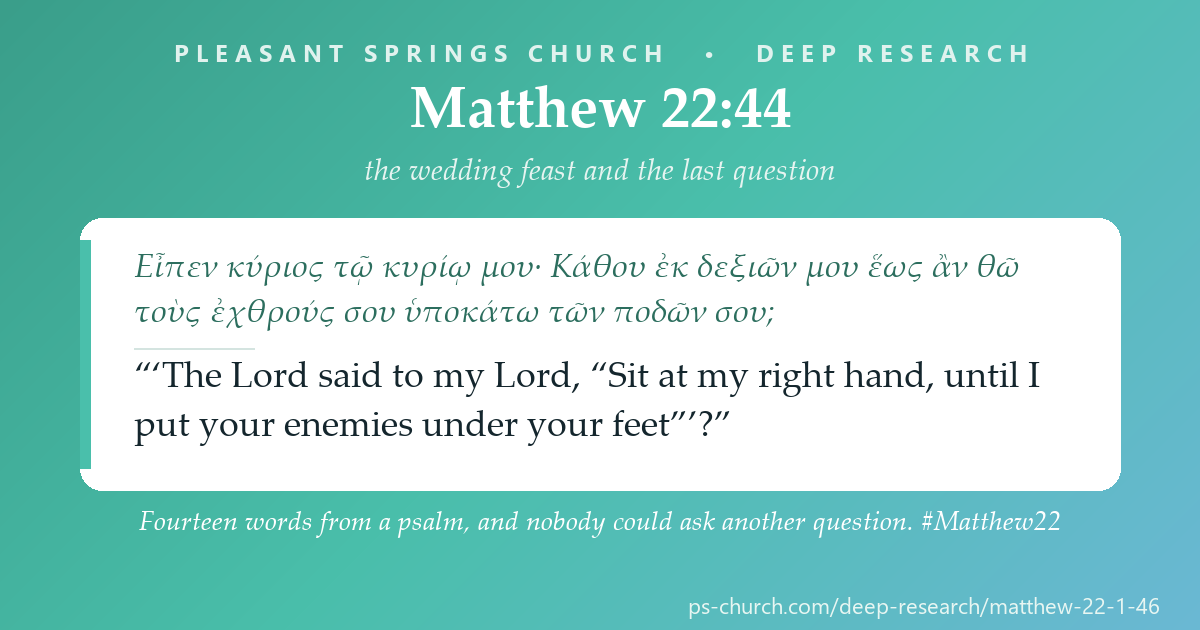
And then verse 44. κύριος τῷ κυρίῳ μου Κάθου ἐκ δεξιῶν μου ἕως ἂν θῶ τοὺς ἐχθρούς σου — fourteen consecutive word forms shared with Psalm 109:1 in the Septuagint (110:1 in the Hebrew and the English), with a tie band of one. Nothing else in the Greek Old Testament comes near it.
How deep is fourteen, in context? We ran the same screen over the whole Gospel of Matthew — 1,068 verses against the same 30,637 verse units. Only one verse in Matthew goes deeper: 13:15, at 24 words, against Isaiah 6:10 (tie band 1) — and that is the long Isaiah quotation Matthew introduces with a fulfilment formula. Matthew 22:44 is the second-deepest verbatim contact any verse in this Gospel makes with the Greek Old Testament held here. Third is 13:14 (Isa 6:9, 13), then 3:3 (Isa 40:3, 13), then 12:40 (Jonah 2:1, 12).
Which is to say: the deepest scriptural contact in the chapter is not in any of the three answers. It is in the question Jesus asks after the answers are done.
Two counter-examples, printed against our own case
A page that only prints the numbers supporting its thesis is not measuring anything. Here are two results from the same screen that cut the other way.
- Verse 32’s deepest match in the whole Greek Old Testament is not the verse Jesus is quoting. Matthew 22:32 opens Ἐγώ εἰμι ὁ θεὸς Ἀβραὰμ καὶ ὁ θεὸς Ἰσαὰκ καὶ ὁ θεὸς Ἰακώβ. Against Exodus 3:6 it runs 4 (ἐγώ εἰμι ὁ θεός), because the Greek of Exodus continues τοῦ πατρός σου and then drops the articles: θεὸς Αβρααμ καὶ θεὸς Ισαακ. But screened against everything, the deepest hit for this verse is 6, tie band 1 — and it is Genesis 31:53: ὁ θεὸς Αβρααμ καὶ ὁ θεὸς Ναχωρ κρινεῖ ἀνὰ μέσον ἡμῶν. That is Laban’s oath, invoking the God of Abraham and the god of Nahor side by side. Nobody thinks Jesus is quoting Laban. The verse simply happens to carry the articled formula that Exodus 3:6 does not. Verbal depth is not citation.
- A tie band of one does not mean a connection. Matthew 22:38 — αὕτη ἐστὶν ἡ μεγάλη καὶ πρώτη ἐντολή — returns a run of 4 with a tie band of 1, which looks impressive until you read the match. It is Judges 16:5 (A-text), the Philistine lords bribing Delilah: ἰδὲ ἐν τίνι ἡ ἰσχὺς αὐτοῦ ἐστιν ἡ μεγάλη — “see in what his great strength lies.” Four words, unique in the corpus, and completely meaningless. Uniqueness is a property of a corpus, not of an author.
And one observation offered as nothing more than an observation. Verse 34 says the Pharisees συνήχθησαν ἐπὶ τὸ αὐτό, “gathered together.” That exact four-word sequence occurs in four verses of the Greek Old Testament held here — Judges 6:33 (both A and B texts), 2 Samuel 10:15, and Psalm 2:2, where the rulers gather together against the LORD and against his χριστός — and eight verses later Jesus asks these same men what they think περὶ τοῦ χριστοῦ. We have not seen this argued as a deliberate echo and we do not claim it as one: three of the four occurrences are ordinary military idiom for mustering. It is noted so a reader can weigh it, not lean on it.
The Sadducees quote a verse that is not the verse
This one is worth its own paragraph, because it is exhaustive and it is checkable.
At v.24 the Sadducees say “Moses said” and give the levirate rule: ἐπιγαμβρεύσει ὁ ἀδελφὸς αὐτοῦ τὴν γυναῖκα αὐτοῦ καὶ ἀναστήσει σπέρμα τῷ ἀδελφῷ αὐτοῦ. Everyone cites Deuteronomy 25:5. But:
- The verb ἐπιγαμβρεύω is a New Testament hapax (this verse only), and in the Greek Old Testament held here it occurs nine times — 1 Samuel 18 (four times), 1 Maccabees 10 (twice), Ezra–Nehemiah 9:14 (Ezra 9:14 in English), 2 Chronicles 18:1 (as the augmented ἐπεγαμβρεύσατο) and Genesis 34:9. Not once in Deuteronomy — though the simplex γαμβρεύω does stand at Deuteronomy 7:3.
- The Greek of Deuteronomy 25:5 does not use that verb at all: it reads λήμψεται αὐτὴν ἑαυτῷ γυναῖκα καὶ συνοικήσει αὐτῇ — “he shall take her to himself as wife and live with her.” The measured run between Matthew 22:24 and Deuteronomy 25:5 is 2.
- The phrase σπέρμα τῷ ἀδελφῷ occurs in exactly two verse units in the whole Greek Old Testament held here — Genesis 38:8 and 38:9 — and in exactly three verses of the Greek New Testament, which are the three synoptic versions of this same question (Matt 22:24; Mark 12:19; Luke 20:28).
- Genesis 38:8 LXX reads εἴσελθε πρὸς τὴν γυναῖκα τοῦ ἀδελφοῦ σου καὶ γάμβρευσαι αὐτὴν καὶ ἀνάστησον σπέρμα τῷ ἀδελφῷ σου — the same verb stem and the same clause.
The Sadducees’ “Moses said” is a composite summary: the legal content comes from Deuteronomy 25:5, but the wording that survives into Greek carries the vocabulary of Genesis 38:8 — Judah instructing Onan. We are not asserting a direction of influence, and we are not claiming Matthew consulted a Greek scroll of Genesis while writing. Nor can we check the Hebrew shape of any pre-Matthean formulation of this question. What is measured, and exhaustively so, is this: the two-word run to Deuteronomy 25:5 and the exclusive lexical tie of σπέρμα τῷ ἀδελφῷ to Genesis 38. If that holds, then the Sadducees frame their trick question in the language of the one Old Testament story where the levirate duty was refused — which is a quietly appropriate way to walk into a conversation about the resurrection.
The literature, the genuine cruxes, and an honest list of this page's weak points.
Davies–Allison, Luz and France for the technical spade-work; Hay for Psalm 110. Then the limits — because a page that only reports what it found is not reporting.
Commentaries & studies:
- Davies & Allison, Matthew 19–28 (ICC); Ulrich Luz, Matthew 21–28 (Hermeneia); R. T. France (NICNT); Craig Keener; John Nolland (NIGTC); Grant Osborne (ZECNT).
- David M. Hay, Glory at the Right Hand: Psalm 110 in Early Christianity (SBLMS 18) — the standard survey of how the psalm was used.
- Martin Hengel, “‘Sit at My Right Hand!’” in Studies in Early Christology; Richard Bauckham, Jesus and the God of Israel, on the session as a divine-identity claim.
- On the parable: Klyne Snodgrass, Stories with Intent; on the tax: J. D. M. Derrett, Law in the New Testament.
- Classic: Chrysostom, Homilies on Matthew 69–71; Augustine, Sermons 90 (on the wedding garment); Calvin, Harmony of the Evangelists.
Genuine cruxes, not smoothed over:
- The burned city (v.7). Many scholars read this detail as written with the fall of Jerusalem in AD 70 already in view; others hold it as ordinary parable furniture, since burning a rebel city is a stock ancient image. The verse cannot settle its own date and this page does not try to.
- Is the wedding-garment episode part of the same parable? Luke 14:16–24 has the banquet without it; the Gospel of Thomas 64 likewise. Some read vv.11–14 as a second parable joined to the first. Matthew, as we have him, presents it as one story, and the vocabulary (γάμος, ἀνακειμένους) is continuous — but the question is real.
- “Many are called, few are chosen” (v.14). This is where readers with different views of election dig in. The measured facts, which do not settle it: κλητός appears here and nowhere else in a Gospel; in Paul it usually means the effectually called (Rom 8:28), whereas here the κλητοί plainly include people who did not come and one who was thrown out. That difference of usage between Matthew and Paul is data. It is not an argument, and we do not pretend it is one.
- “Like angels in heaven” (v.30) says the resurrected neither marry nor are given in marriage. It does not say they become angels, and it does not comment on whether present marriages are remembered.
- The Davidic sonship question (vv.41–46) is not a denial. Jesus does not say the Christ is not David’s son — Matthew has spent his first chapter proving that he is (1:1). The question exposes an inadequacy, not an error.
What this page could not check — and where it is weakest
- No Hebrew screen was run for this page. Matthew is a Greek text and the measurements above are Greek-to-Greek. The Hebrew of Psalm 110:1 is relevant and we quote it in the next section, but we did not screen Matthew 22 against the Masoretic corpus, and no claim here rests on Hebrew wording.
- We hold one Greek Old Testament text, not a manuscript tradition. The screen runs against the CATSS/Rahlfs files on disk. Where Greek manuscripts of Deuteronomy differ — and they do, precisely at 6:5, where some witnesses read διανοίας where our text reads καρδίας — we cannot check them from here. That variant is directly relevant to the διάνοια observation in Stage 3, and it is the single place where this page’s Greek evidence is thinnest. Treat the διάνοια point as a text-form question that a full apparatus would have to settle, not as a settled result.
- The tie band is a property of the corpus searched, not of the ancient world. A band of one over 30,637 verse units is not a claim about every Greek text that existed. The deuterocanonical books are included in the count; the Greek of Isaiah, Jeremiah, Lamentations, Ezekiel and Daniel is now on disk, so this screen (unlike some earlier pages on this shelf) covers them.
- We did not consult a critical apparatus for Matthew. The SBLGNT text on our disk carries its editor’s variant markers — two of them sit in v.44 alone, and there are thirty-one more across the chapter, thirty-three variant units in all — but we hold the markers, not the apparatus itself, and we did not open one. That matters most at v.44, because both of that verse’s markers sit on the two words that bound the run — the opening Εἶπεν and the closing ὑποκάτω. On the first: the Byzantine/majority form of the v.44 citation reads Εἶπεν ὁ κύριος, with the article, as the Septuagint has it. The article is one of the two words that bound the fourteen-word run — so on that reading the run would be 15, not 14. We state the figure from the text we hold and flag the dependency rather than hiding it.
- We did not read the rabbinic sources in the original. The Talmudic references in Stage 2 (b. Gittin 57a, b. Makkot 23b–24a, b. Shabbat 31a) are cited from standard secondary discussions, and they postdate Matthew by centuries in their compiled form. They evidence a shared stock of Jewish discourse, not a source Jesus quoted.
- The “host provided the robes” claim is unsourced, and we say so above rather than repeating it. It is extremely common in preaching. We could not find a first-century attestation for it.
- Nothing here establishes direction of influence, and the page never asserts one. That Matthew and Mark share ὑποκάτω against Luke, Acts and Hebrews is a measured fact about the texts. Which way the borrowing ran, or whether both drew on a common form, is a synoptic question the measurement cannot decide.
From the fourteen words to Monday.
Name what you learned, why it matters, and one concrete response.
What should we carry away — and do?
- The chapter is about who gets to ask. Three delegations arrive with questions designed to close doors. Jesus answers all three, and then asks one of his own that nobody had prepared for — and the questioning stops. Matthew is not scoring debating points; he is showing you that the authority in the room was never on the side holding the questions.
- The deepest scripture in the chapter is in the question, not the answers. That is a measured fact, not a devotional flourish: fourteen words, tie band one, second-deepest in the whole Gospel. When Jesus wanted to say who he was, he did not construct an argument — he quoted a psalm and let them do the arithmetic.
- “Render to Caesar” is not a division of loyalties; it is a question about images. The coin carries Caesar’s εἰκών, so give it back to him. Jesus does not finish the sentence about what carries God’s image. Genesis 1:27 finished it a long time ago.
- The man without the garment is inside the hall. Matthew’s τὸ σκότος τὸ ἐξώτερον, the “outer darkness,” falls three times in the New Testament and all three are Matthew — the sons of the kingdom (8:12), the guest without the garment (22:13), the servant of the household (25:30). Every one of them was on the inside. This parable is not aimed at outsiders.
- You know neither the Scriptures nor the power of God (v.29) is the sharpest diagnosis in the chapter, and it is addressed to professional handlers of the Scriptures. Knowing the text and knowing what God can do are two different capacities, and the Sadducees were short of both.
Step in response: take the three questions in this chapter — money, death, and what matters most — and ask which one you have been using to avoid the fourth. Then read verses 41–46 out loud and notice that the last word in the chapter is silence, and that it belongs to everybody.
Matthew 22:44 · to share
Greek NT + ESVA run of fourteen has two ends, and both of them are one word wide. This section looks at exactly where the verbatim contact starts and where it stops — because that is where the interesting textual information lives.
Where the fourteen words begin and end
Set the two texts side by side. Septuagint Psalm 109:1 (= Psalm 110:1 in the Hebrew and the English):
εἶπεν ὁ κύριος τῷ κυρίῳ μου Κάθου ἐκ δεξιῶν μου ἕως ἂν θῶ τοὺς ἐχθρούς σου ὑποπόδιον τῶν ποδῶν σου
Matthew 22:44:
Εἶπεν κύριος τῷ κυρίῳ μου· Κάθου ἐκ δεξιῶν μου ἕως ἂν θῶ τοὺς ἐχθρούς σου ὑποκάτω τῶν ποδῶν σου
The shared run is κύριος τῷ κυρίῳ μου Κάθου ἐκ δεξιῶν μου ἕως ἂν θῶ τοὺς ἐχθρούς σου — fourteen forms. It is stopped at the front by one definite article (the Greek psalter has εἶπεν ὁ κύριος; Matthew has Εἶπεν κύριος) and at the back by one noun swapped for one adverb.
Caution, and it is not a small one: the article is exactly the sort of word manuscripts differ over, and the SBLGNT flags a variant at that very word — and a second at ὑποκάτω, the word that closes the run at the other end, which we cannot read from here at all. The Byzantine/majority form reads Εἶπεν ὁ κύριος, with the article — and on that reading the run would be fifteen, not fourteen. We report the figure from the text on disk, and Stage 5 says plainly that we did not open an apparatus.
The footstool, and who kept it
The Hebrew of Psalm 110:1 reads hadom le-raglekha — “a footstool for your feet.” The Septuagint renders it literally: ὑποπόδιον τῶν ποδῶν σου. Matthew has ὑποκάτω τῶν ποδῶν σου — “underneath your feet.” The image shifts from a piece of furniture to a position.
Who else does this? The exact sequence Κάθου ἐκ δεξιῶν μου occurs in five verses of the Greek New Testament, and no more — Matthew 22:44, Mark 12:36, Luke 20:42, Acts 2:34, Hebrews 1:13. Here is what each one does at the end of the line, an exhaustive result over 7,927 verses. (Luke and Acts carry the psalm across a verse division, so their closing words fall in the following verse.)
- Matthew 22:44 — ὑποκάτω τῶν ποδῶν σου
- Mark 12:36 — ὑποκάτω τῶν ποδῶν σου
- Luke 20:42–43 — ὑποπόδιον τῶν ποδῶν σου (with the Septuagint)
- Acts 2:34–35 — ὑποπόδιον τῶν ποδῶν σου (with the Septuagint)
- Hebrews 1:13 — ὑποπόδιον τῶν ποδῶν σου (with the Septuagint)
Matthew and Mark on one side; Luke, Acts and Hebrews on the other. That is a clean two-against-three split at a single word, and it is a fact about the texts we hold. It is not a claim about who copied whom: it may be a shared tradition, a shared source, an independent memory of a familiar saying, or a different Greek psalter than the one on our disk. The measurement cannot tell you which, and neither will we.
Matthew’s run against Mark 12:36 is 19 consecutive forms, tie band 1 — the deepest contact Matthew 22 makes anywhere in the New Testament outside Matthew. Against Luke 20:42 it is 9; against Acts 2:34, 8; against Hebrews 1:13, 10, and Hebrews shares the second half of the line rather than the first.
What the Greek can and cannot carry
The Hebrew keeps a distinction the Greek does not. Psalm 110:1 in the Masoretic text reads ne’um YHWH la-adoni — the divine name, and then adoni, “my lord,” an ordinary word for a human superior. Two different words. The Septuagint renders both with the same lexeme: εἶπεν ὁ κύριος τῷ κυρίῳ μου. The ESV represents the Hebrew distinction typographically in the Psalm (“The Lord says to my Lord”) and, following the Greek, prints Matthew’s citation without it.
Stated with the care it needs: Jesus’ question in vv.43–45 turns on David calling the Messiah lord while also being his ancestor, and that argument works in Hebrew and in Greek alike — the Hebrew adoni is already a title of superiority, and calling your own descendant that is already the puzzle. What we cannot do from here is tell you which language the exchange was conducted in. Matthew wrote it in Greek, and in Greek it lands on κύριος — a lexeme that occurs 713 times in the Greek New Testament (counted here, exhaustively, over the SBLGNT), of God and of Jesus and, occasionally, of ordinary masters. That is worth noticing without being turned into a proof.
Every question in this chapter was designed to make Jesus choose between two bad options. The tax: Rome or revolt. The resurrection: absurdity or denial. The commandments: pick one and be wrong about the rest. His counter-question does the same thing to them, and it does it with their own text: the Christ is David’s son, and David calls him Lord. Both are true, and no available category held both at once. That is why the chapter ends the way it does. Not because they were outargued, but because the answer to the last question was standing in front of them.
Every Deep Research page traces its passage across the whole sweep — the Old Testament, the Second-Temple world between the testaments (historical witnesses, not Scripture), and the New Testament. Follow the thread:
Pleasant Springs Church — Deep Research
Research method after Michael S. Heiser’s Bible Research Method (examine dictionaries → ancient literature → important words → textual connections → academic publications → share), with the Pleasant Springs “Author & Audience” foundation. Scripture set in the Hebrew, the Greek editions named on each page and the ESV (Old Testament), and the Greek New Testament and the ESV (New Testament), per the practice of Pleasant Springs Church. Matthew 22:1–46 research grounded in Davies–Allison, Luz, France, Keener and Nolland; Psalm 110 in early Christianity per David M. Hay; the census and Judas the Galilean per Josephus, Antiquities 18.1.1–6 and War 2.117–118. All run lengths, tie bands and word counts on this page were produced by the shelf’s own measurement substrate against the SBLGNT (MorphGNT) and the CATSS Greek Old Testament files held locally, and are re-derivable; the frozen normaliser folds accents, breathings and final sigma.
Scripture quotations marked ESV are from the ESV® Bible (The Holy Bible, English Standard Version®), © 2001 by Crossway, a publishing ministry of Good News Publishers. ESV Text Edition: 2016. Used by permission. All rights reserved. The ESV text may not be quoted in any publication made available to the public by a Creative Commons license, and the ESV may not be translated in whole or in part into any other language. www.esv.org
|
Did this study bless you today? 💚 Give to Support PS Church100% of gifts go to the General Fund — thank you. |