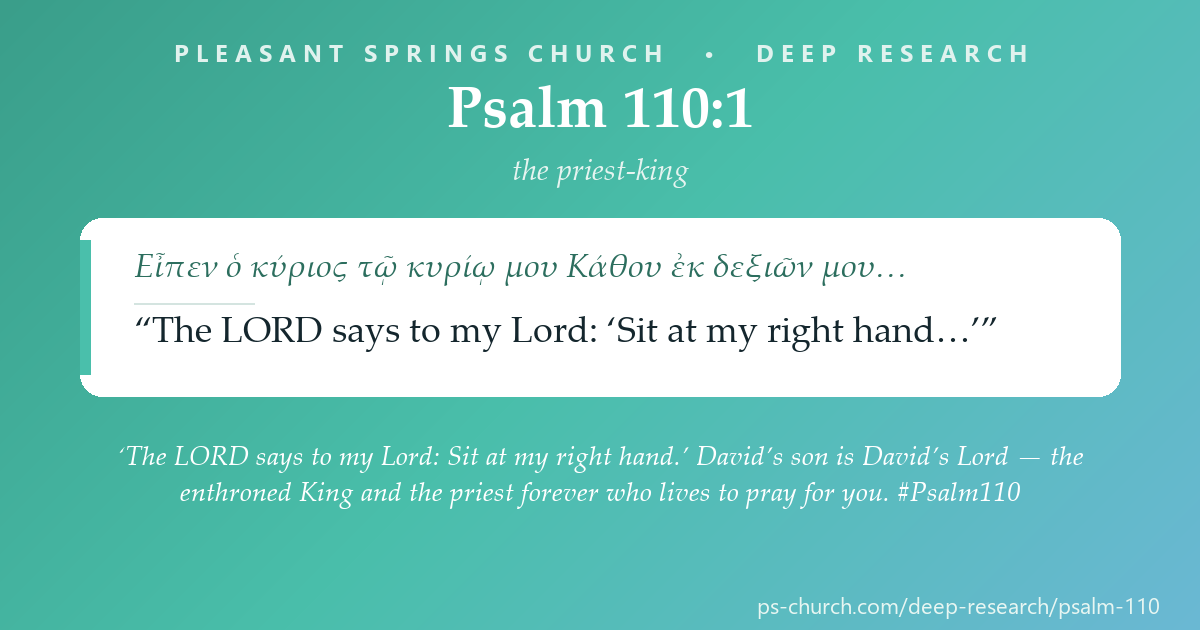
David overhears a conversation in heaven: “The Lord says to my Lord: Sit at my right hand.” And God swears an oath: this King is also “a priest forever, after the order of Melchizedek.” Priest and king in one — the offices Israel kept apart. No Old Testament text is quoted more often in the New: Jesus used it to reveal he is David’s Lord, and Hebrews built a whole priesthood on it. This study works Psalm 110 — the church’s shorthand for the exalted Christ. See the method →
Psalm 110:1–4 (selections)
Hebrew · LXX · ESVThe Shape of the Passage
Parallel panelsPsalm 110 is a royal psalm “of David” (superscription). Jesus treats David as its speaker and reads it of the Messiah (Mark 12:36). Compare the method template on Psalm 1.
Author
David, Israel’s king, speaks of one greater than himself. In the royal psalms the reigning king is celebrated; but this psalm strains past any mere son of David, for David calls the figure “my Lord” and hears God enthrone him at his own right hand and swear him an eternal priesthood. Kings were not priests (2 Chr 26:16–21); yet here is a king-priest on the pattern of Melchizedek (Gen 14). The psalm reaches for a Messiah who is more than David’s heir.
King and priest, by oath. Two divine speeches structure the psalm: an enthronement (“sit at my right hand,” v.1) and an oath (“you are a priest forever,” v.4). Together they promise a ruler who conquers and a priest who intercedes — permanently, unchangeably, because God has sworn it.
Audience
Israel at worship, and every generation awaiting the promised king. The psalm gave Israel a vision of a coming ruler seated beside God himself, victorious over his enemies, and a priest whose ministry would never end. It fed the messianic hope through the centuries and puzzled the interpreters: who could be both David’s son and David’s Lord?
How they heard it. By Jesus’ day the psalm was read messianically, which is why his question from it silenced his opponents (Mark 12:35–37). The earliest church seized on it above all others: to confess Jesus as “seated at the right hand of God” is to say Psalm 110 has come true, and to call him our great high priest is to read Psalm 110:4 fulfilled.
Orient on the royal psalm, the right hand, priesthood, and Melchizedek.
Search by topic: royal psalm, right hand of God, priesthood, Melchizedek, Messiah.
Which articles are relevant?
- Anchor Bible Dictionary — “Psalms,” “Melchizedek,” “Right Hand,” “Messiah.”
- Dictionary of the OT: Wisdom, Poetry & Writings — “Royal Psalms,” “Messianic Psalms,” “Kingship,” “Priesthood.”
- NIDOTTE / TDOT — אָדוֹן (ʾāḏôn, lord), יָמִין (yāmîn, right hand), כֹּהֵן (kōhēn, priest), מַלְכִּי־צֶדֶק (malkî-ṣeḏeq, Melchizedek).
Bibliography surfaced:
- Leslie C. Allen (WBC, Psalms 101–150), Derek Kidner (TOTC), John Goldingay on the Psalms.
- Studies of Psalm 110 in the NT (the most-cited OT text); the Melchizedek priesthood in Hebrews.
- Beale & Carson, Commentary on the NT Use of the OT (the Gospels; Acts; Hebrews).
The right hand, the king-priest, and David’s Lord.
Read the enthronement and the Melchizedek oath against their background, then follow the psalm into the New Testament’s Christology.
Which parallels shed light on religion and worldview?
The place of highest honor. In the ancient world the seat at a king’s right hand was the position of supreme honor and delegated authority. That God says to this figure, “sit at my right hand,” sets him beside God himself, sharing his rule — a status no ordinary king or angel holds.
King and priest together. Israel kept kingship (from Judah/David) and priesthood (from Levi/Aaron) strictly separate; King Uzziah was struck with leprosy for usurping priestly duties (2 Chr 26). The only earlier figure who was both king and priest is Melchizedek, “king of Salem… priest of God Most High,” who blessed Abraham (Gen 14:18–20). Psalm 110 promises a Messiah in that rare, older order — a priest-king whose priesthood does not depend on Levi at all.
- Genesis 14:18–20 — Melchizedek, king of Salem and priest of God Most High, blessing Abraham: the pattern of a priest-king older than the law.
- 2 Chronicles 26:16–21 — Uzziah judged for seizing the priesthood: why a king-priest required a different, God-sworn order.
- 11QMelchizedek (11Q13) (Dead Sea Scrolls — a witness, not Scripture) — an eschatological, heavenly Melchizedek who brings deliverance and atonement: a Second-Temple sign of the figure’s messianic pull (see Isaiah 61).
- ANE royal-enthronement imagery — the king seated at the deity’s right hand; here bent wholly toward the God of Israel and the Lord he enthrones.
Jesus turned Psalm 110:1 into a riddle that exposed who he is: “David himself, in the Holy Spirit, declared, ‘The Lord said to my Lord, Sit at my right hand…’ David himself calls him Lord. So how is he his son?” (Mark 12:35–37). The Messiah is David’s descendant and his superior — a puzzle solved only in one who is both truly human (son of David) and truly divine (David’s Lord). At Pentecost Peter announces the answer: God raised Jesus and seated him at his right hand, so that David’s words came true in him (Acts 2:34–36). And Hebrews takes the psalm’s fourth verse and builds on it: Jesus is “a priest forever, after the order of Melchizedek” (Heb 5:6; 6:20; 7:17) — a priest by God’s oath, without beginning or end of days in his office, who “always lives to make intercession” (7:25). King at the right hand, priest forever: Psalm 110 is the church’s shorthand for the exalted Christ.
The vocabulary of the right hand, the oath, and the eternal priesthood.
Watch “my Lord,” the “right hand,” and the sworn “priest forever.”
“The Lord says to my Lord” — YHWH addresses David’s ʾāḏôn (superior). David’s own “Lord” is the Messiah — his son yet his Lord (Mark 12:37).
“Sit at my right hand” — the place of supreme honor and shared rule beside God; the NT’s constant confession of the exalted Christ (Acts 2:33; Eph 1:20; Heb 1:3).
“A priest forever” — sworn by God, unchanging; a priesthood not from Levi but “after the order of Melchizedek,” permanent because its holder lives forever (Heb 7:24–25).
“Melchizedek” — “king of righteousness” (and king of Salem = peace), the priest-king of Genesis 14 whose order Christ fulfills (Heb 7:1–3).
How the New Testament reuses Psalm 110:
- Mark 12:35–37; Matthew 22:41–46; Luke 20:41–44 — Jesus’ question: how is the Christ both David’s son and David’s Lord?
- Acts 2:34–36; Hebrews 1:13; 1 Corinthians 15:25; Ephesians 1:20; Colossians 3:1 — Christ “seated at the right hand” (110:1), reigning until every enemy is subdued.
- Hebrews 5:6; 6:20; 7:11–28 — Christ “a priest forever after the order of Melchizedek” (110:4): a better, permanent, oath-sworn priesthood.
- Mark 14:62; Acts 7:55–56 — the Son of Man at God’s right hand (Ps 110 fused with Dan 7; see Daniel 7).
From Melchizedek to the great high priest at God’s right hand.
Trace the king-priest from Genesis 14 through Psalm 110 to Hebrews, and the “right hand” across the New Testament.
Which cross-references matter?
- Genesis 14:18–20 — Melchizedek the priest-king who blesses Abraham: the type Psalm 110 names and Hebrews expounds.
- 2 Samuel 7:12–16; Zechariah 6:12–13 — the Davidic king and the “Branch” who is priest on his throne (see the Davidic covenant).
- Daniel 7:13–14 — the Son of Man given dominion; fused with Psalm 110:1 in Jesus’ trial answer (see Daniel 7).
- Hebrews 5–7; 8:1; 10:12–13; 12:2 — the great high priest “seated at the right hand” who intercedes forever.
- Psalm 2:6–9 — the anointed King enthroned on Zion, ruling the nations: a companion royal psalm.
Psalm 110 is the New Testament’s single most-cited Old Testament passage, and the two halves of the psalm carry two great confessions. Verse 1 (“sit at my right hand”) grounds the church’s language of Christ’s exaltation and reign: raised, enthroned, and ruling until every enemy is a footstool (Acts 2; 1 Cor 15:25). Verse 4 (“a priest forever after the order of Melchizedek”) grounds Hebrews’ argument for Christ’s priesthood: superior to Aaron’s because it rests on an oath, needs no successor (he lives forever), and offers one sufficient sacrifice. Jesus himself sets the interpretation in motion by pressing v.1’s “my Lord” — the Messiah is David’s Lord, not merely his son. The psalm thus holds together the whole gospel of the ascended Christ: reigning King and interceding Priest, both by the sworn word of God.
The scholarship on Psalm 110.
The commentators on the Psalms; the studies of Psalm 110’s NT use and Melchizedek; Beale & Carson.
Commentaries & studies:
- Leslie C. Allen (WBC, Psalms 101–150), Derek Kidner (TOTC), John Goldingay (Psalms) on the Psalms.
- David M. Hay, Glory at the Right Hand: Psalm 110 in Early Christianity; studies of Melchizedek in Hebrews.
- G. K. Beale & D. A. Carson, eds., Commentary on the New Testament Use of the Old Testament.
Interpretation notes worth keeping:
- “My Lord” is the key. David’s calling the figure ʾāḏôn is what makes the Messiah more than a son of David; the Hebrew distinguishes YHWH (the Lord) from the enthroned ʾāḏôn (my Lord).
- Melchizedek typology, not identity. Hebrews reads Melchizedek as a type — “resembling the Son of God” (Heb 7:3) — not as a pre-incarnate appearance of Christ; the point is an eternal, non-Levitical priesthood.
- King and priest united. What Israel kept apart, and what Uzziah was judged for seizing, God sworn-joins in the Messiah: the one who reigns is the one who intercedes.
From the right hand of God to your daily confidence.
Name what you learned, why it matters, and one concrete response.
What should we carry away — and do?
- Your King is already enthroned. Jesus is not waiting to reign; he is seated at God’s right hand now, ruling until every enemy is a footstool. History is under the feet of the crucified and risen Lord.
- Your Priest never stops praying for you. Christ “always lives to make intercession” (Heb 7:25). You are not held by your own grip on God but by his unending priestly hold on you.
- King and Priest in one. The one who has all authority is the one who gave himself for you. Power and mercy meet in the priest-king at the right hand.
Step in response: when you feel overwhelmed by opposition or by your own failures, preach Psalm 110 to yourself — your Lord is enthroned and interceding — and bring a specific fear or sin to the great high priest who lives to pray for you, resting in his finished work and his unending reign.
Psalm 110:1 · to share
LXX + ESVEvery Deep Research page traces its passage across the whole sweep — the Old Testament, the Second-Temple world between the testaments (historical witnesses, not Scripture), and the New Testament. Follow the thread:
Pleasant Springs Church — Deep Research
Research method after Michael S. Heiser’s Bible Research Method (examine dictionaries → ancient literature → important words → textual connections → academic publications → share), with the Pleasant Springs “Author & Audience” foundation. Scripture set in the Hebrew, the Greek editions named on each page and the ESV (Old Testament), and the Greek New Testament and the ESV (New Testament), per the practice of Pleasant Springs Church. Psalm 110 research grounded in Allen, Kidner, Goldingay, and David Hay (Glory at the Right Hand), with Beale & Carson on the New Testament use; ANE enthronement background; Second-Temple material per 11QMelchizedek (read as a witness, not Scripture).
Scripture quotations marked ESV are from the ESV® Bible (The Holy Bible, English Standard Version®), © 2001 by Crossway, a publishing ministry of Good News Publishers. ESV Text Edition: 2016. Used by permission. All rights reserved. The ESV text may not be quoted in any publication made available to the public by a Creative Commons license, and the ESV may not be translated in whole or in part into any other language. www.esv.org
|
Did this study bless you today? 💚 Give to Support PS Church100% of gifts go to the General Fund — thank you. |