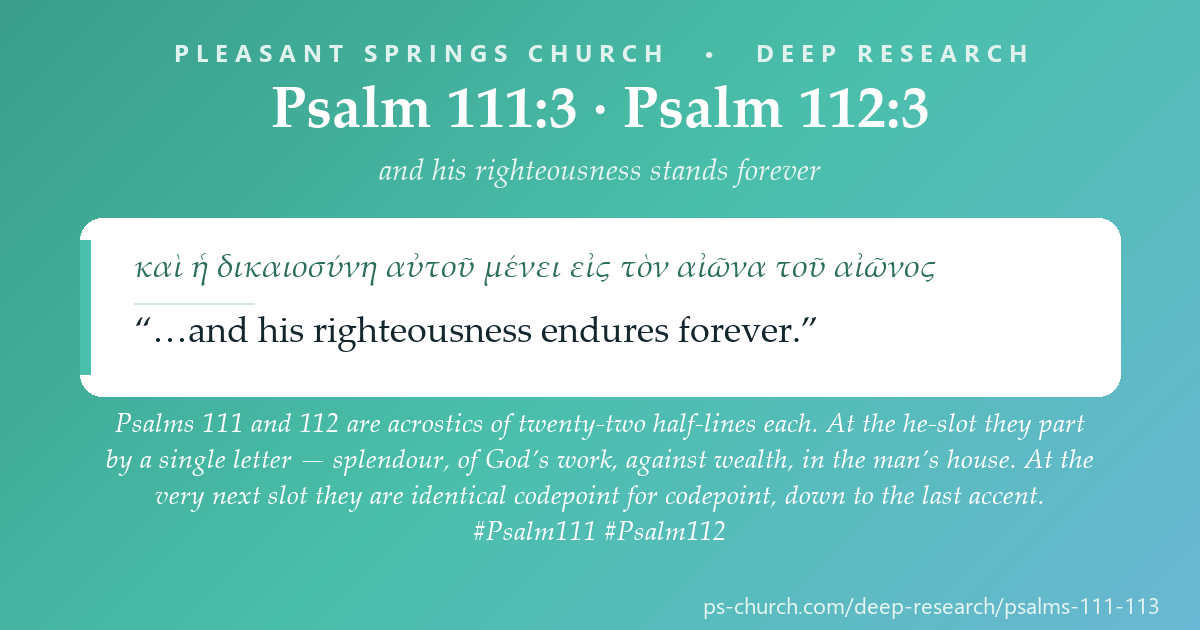
Psalms 111 and 112 are acrostics of twenty-two half-lines each — not twenty-two verses, and the Masoretic accents mark every division, with zero mismatches in either psalm. Laid slot against slot, the two are mostly strangers: only three of the twenty-two slots share even one word. But at the ה-slot each psalm opens with a single word, and the two words are the same length and differ in one letter — splendour, of God's work, against wealth, in the man's house. And the very next slot is identical in both psalms, codepoint for codepoint, down to the last accent: and his righteousness stands forever — God's in one psalm, the man's in the other, with nothing in the wording to mark the change. Along the way: what 2 Corinthians 9:9's eleven words can and cannot identify, the verse of Psalm 113 that stands almost word for word in 1 Samuel, and four claims about these psalms that do not survive being measured. See the method →
Psalms 111–113 (selections)
Hebrew · Greek (Rahlfs’ Psalter) · ESVThe verse-initial test fails: taking the first letter of each of the ten verses recovers only ten of the twenty-two alphabet slots — positions 1, 3, 5, 7, 9, 11, 13, 15, 17 and 20. It is not a simple every-other-letter pattern, and the reason it breaks at the end is that verse 9 takes three slots, so verse 10 opens on the twentieth letter rather than the nineteenth. Enumerating every possible way to cut each psalm into twenty-two contiguous blocks spelling aleph to tav gives twelve solutions per psalm — and all twelve agree on the same distribution: two slots per verse for verses 1 to 8, and three each for verses 9 and 10.
The accents then pick one of the twelve, and it comes out perfect. Split each verse at its atnach, and split the front half of the two three-slot verses at its revia. That rule produces zero letter mismatches across all twenty-two slots in both psalms.
⚠️ Laid slot against slot, the two psalms are mostly strangers. Only three of the twenty-two slots share even one word, and only six words in total stand at matching slots.
⚠️ But one slot is identical. Slot six, the vav-slot, is the same in both psalms codepoint for codepoint — every consonant, every vowel, and every accent, including the tsinnorit, the revia and the munah:
The identity is a fact about the accent-selected division. Twelve partitions of each psalm satisfy the alphabet; the accents choose one of the twelve, and under that one — and only that one — a slot pair comes out identical.
111:3b וְ֝צִדְקָת֗וֹ עֹמֶ֥דֶת לָעַֽד
112:3b וְ֝צִדְקָת֗וֹ עֹמֶ֥דֶת לָעַֽד
(the second half of each verse — and no other slot of the twenty-two is identical)
⚠️ And the slot immediately before it is a near-miss. The he-slot is three words in both psalms and shares nothing — but its first word is one word in each, the same length, differing in a single letter:
הוֹד — splendour, of God’s work · הוֹן — wealth, in the man’s house
So the two psalms part at one slot and meet at the next — and the slot they meet at says and his righteousness stands forever, which in Psalm 111 is God’s and in Psalm 112 is the man’s. The pronoun is the same three letters in both places. Nothing in the wording tells you the referent changes; only the psalm around it does. This page reports where the words stand and leaves that to the reader.
⚠️ What the counting will and will not carry. Against 50,000 reshuffles of Psalm 112’s own twenty-two half-lines — which preserves every word and destroys only the slot alignment — six shared words at matching slots lands at p = 0.0030. The weaker measure, three slots sharing a word, lands at p = 0.0325, which is marginal. The honest summary is that most of what these two psalms share by wording falls at a matching slot. Across the acrostic bodies they share ten word-forms and twelve words in all — and six of the forms and six of the words stand at a matching slot. That is exactly half the words and sixty per cent of the forms. Counted over the acrostic bodies, which is the psalms minus the two-word rubric each opens with. Counted over the whole psalms instead, the totals are twelve forms and fourteen words, because the rubric itself is shared. And a scoping note the page owes you: Psalms 111 and 112 are not the most closely corresponding pair in the Psalter. Psalms 60 and 108 are far stronger — which is unsurprising, since Psalm 108 is built out of Psalm 60. What can be said without a tie is narrower: measured at the verse level, of the twenty-eight pairs of psalms in the book that both run to ten verses, 111 and 112 share more words at matching verse numbers than any other — eight, against a next-best five. What is distinctive here is not how much the twins share but where it falls.
The Shape of the Passage
Sequence — two acrostics and the psalm that opens the Hallel“Psalm 113 falls into three strophes — verses 1–3, 4–6, 7–9.” Scored on distinctive shared vocabulary against 20,000 reshuffles of the psalm’s own verses, that division returns p = 1.00. Not merely unsupported — the floor. And the strongest lexical link anywhere in Psalm 113 joins verse 1 to verse 9, an inclusio that the three-strophe division cuts straight through.
“Psalm 111 ends on the fear of the Lord and Psalm 112 opens on it.” Psalm 111 does not end there. The phrase is the third and fourth words of an eleven-word verse; the verse ends his praise stands forever. What is true is narrower and better: of the 149 junctions between psalms in this book, 111→112 is the only one where a fear-of-the-Lord form stands in both the last verse of one psalm and the first verse of the next. The effect is real and slight — p = 0.041.
“Psalms 111 and 112 are the same length.” Same number of verses, and not the same length: 74 words against 79.
Psalm 113 is not an acrostic under any reading. Its verse-initial letters are not an alphabetic sequence and are not a subsequence of one, and a permissive scan of its whole word-stream recovers only two of the twenty-two letters in order before the psalm runs out.
None of the three psalms carries a heading in Hebrew. Each opens straight into הַ֥לְלוּ יָ֨הּ, and Rahlfs opens each of the three with αλληλουια. All three Greek instances have a Hebrew counterpart standing in the same place.
Author
Anonymous, all three. No name, no occasion, no musical direction.
And both acrostics are complete. Every one of the twenty-two slots is filled in each psalm, with no letter skipped. That is worth saying because the Psalter’s other famous acrostic is not — Psalm 145 has no nun line in the Hebrew, and Rahlfs’ Greek Psalter carries an extra verse at exactly that point, the only verse in the whole file whose label is not a plain number.
Two of them are built to a shape. Twenty-two half-lines each, aleph to tav, with the Masoretic accents marking every division. A poet who wrote to that constraint twice, and then made the two halves answer each other at one slot.
And the psalms are typographically plain. No ketiv/qere, no Selah, no enlarged or suspended letters, no inverted nun anywhere in the three. Three vertical bars each, and a closing section marker on the last verse of all three. The Masoretic Psalter in this edition uses the petuhah marker only — 165 of them and not one setumah. Exactly six psalms carry no closing marker at all: 41, 72, 89, 106, 114 and 150. Five of the six are book boundaries, which leaves Psalm 114 as the only psalm in the book lacking one that is not.
They name God sparingly and unevenly. Psalm 111 has the divine name four times and its short form once; Psalm 112 has it twice and the short form once; Psalm 113 has it six times, the short form twice, and one God. Counted with prefixes allowed. A search for the bare form alone undercounts this unit by two — it misses the prefixed forms at 112:7 and 113:5.
Audience
People who could hear an alphabet. Twenty-two half-lines is a form you notice aloud and lose on the page in translation. No English version of these psalms can show you the slot that matches.
Someone weighing a life against God’s. Psalm 111 is about what God does; Psalm 112 is about what a man who fears him does. They use the same sentence for both.
And then a congregation, at a festival. Praise, O servants of the Lord. Psalm 113 opens the group of psalms sung at the great feasts.
The poor, the needy and a childless woman. He raises the poor from the dust… he gives the barren woman a home. The last thing Psalm 113 says before it says hallelujah is about somebody with nothing.
Orient on acrostics, on the Hallel, and on the righteousness that endures.
Search by topic: acrostic psalms; alphabetic poems; the Egyptian Hallel; tsedaqah; 2 Corinthians 9 and the collection.
Which articles are relevant?
- Anchor Bible Dictionary — “Acrostics,” “Hallel,” “Righteousness (OT),” “Poetry, Hebrew.”
- Dictionary of the OT: Wisdom, Poetry & Writings (IVP) — “Acrostic,” “Wisdom Psalms,” “Hymns.”
- NIDOTTE / TDOT — הוֹד (hōḏ, splendour), הוֹן (hōn, wealth), עֲקֶ֬רֶת (ʿăqereḏ, barren).
- On the Greek — the NETS Psalms introduction, with Rahlfs 110:3, 111:3 and 111:9 read side by side before 2 Corinthians 9 is opened.
- On the accents — any treatment of atnach and revia as verse dividers, which is what makes the acrostic division of these two psalms checkable.
Bibliography surfaced:
- John Goldingay, Psalms 90–150; Robert Alter, The Book of Psalms.
- Frank-Lothar Hossfeld and Erich Zenger, Psalms 3 (Hermeneia).
- Wilfred G. E. Watson, Classical Hebrew Poetry — for acrostic technique and colon division.
A phrase that lives in two psalms, a verse that lives in two books, and four claims that fail.
Every count below is of exact consonantal forms across the thirty-nine book Hebrew corpus this library holds, with the spelling variant stated wherever it changes the answer.
Which parallels shed light on these psalms?
The phrase these two psalms share lives almost nowhere else. The two-word run stands forever, spelled as these psalms spell it, occurs at exactly four places in the whole Hebrew Bible — Psalm 111:3, 111:10, 112:3 and 112:9. All four are inside the twins. That four is a spelling count, and the page owes you the qualification: allow the fuller spelling of the same participle and there is a fifth, at Psalm 19:10 — where the subject is the fear of the Lord, and where the Greek renders it with a different verb and a different phrase altogether. A page that printed four, and only four without saying which spelling it counted would be reporting an artefact.
And Psalm 113 has a verse that stands almost word for word in another book. Psalm 113:7–8 and 1 Samuel 2:8 are as close as two non-identical passages get: nine words align one to one, seven are identical, and the two exceptions differ by a single letter each. The five-word run they share, and two of its phrases, occur at exactly these two verses and nowhere else in the Hebrew Bible. In Greek the two texts are much further apart — and they put the two nouns for the poor in opposite order to each other.
- Psalm 112:9 → 2 Corinthians 9:9. Eleven unbroken Greek words. The only quotation in the unit.
- 1 Samuel 2:8 → Psalm 113:7–8. Seven of nine words identical in Hebrew — and the Greek pair inverted.
- Psalm 19:10 → Psalms 111–112. The fifth stands forever, under the fuller spelling.
- Psalms 86:15, 103:8, 145:8 → Psalms 111:4, 112:4. The gracious-and-merciful pair stands five times in the Psalter, and two of the five are these twins.
“Psalm 111:4 quotes the self-revelation of Exodus 34:6.” It carries the pair in the common order — eight of its eleven occurrences — while Exodus 34:6 carries the unusual one, three of eleven. The psalm does not follow Exodus’s word order. That was a Hebrew-side observation, and this page used to warn that it might not carry into the Greek — at Psalm 145:8 the Hebrew has the same order as our two psalms and Rahlfs 144:8 reverses the Greek pair. ★ On 2026-08-30 Greek Exodus reached this shelf and the question can be settled instead of hedged. Greek Exodus 34:6 reads οἰκτίρμων καὶ ἐλεήμων. Rahlfs 110:4 — our Psalm 111:4 — reads ἐλεήμων καὶ οἰκτίρμων, and so does Rahlfs 111:4, our Psalm 112:4. The Greek of the twins reverses the Greek of Exodus, exactly as the Hebrew of the twins reverses the Hebrew of Exodus. Measured as a run, Greek Exodus 34:6 against Rahlfs 110:4 reaches one word — καί. Across all 30,348 screened units the Exodus order stands in five (Exodus 34:6, Rahlfs 85:15, 102:8, 144:8, and Sirach 2:11, which is a witness held here for measurement and not Scripture) and the twins’ order in seven (2 Chronicles 30:9, 2 Esdras 19:17 and 19:31, Joel 2:13, Jonah 4:2, Rahlfs 110:4 and 111:4). Both columns say the same thing, and the page no longer has to say it in one language only.
“His righteousness endures forever stands three times across the twins.” Only if you ignore the conjunction. As an exact word run, the form with and stands twice and the form without stands once — and the two counts must not be added into a single three.
“Psalm 113 stands behind the Magnificat, or behind Galatians 4:27.” No verse of Psalm 113 reaches five shared words with any New Testament verse. Its ceiling anywhere in the New Testament is four. And Galatians 4:27 can now be placed, because Greek Isaiah reached this shelf on 19 August 2026. Galatians 4:27 runs twenty-three unbroken words with Rahlfs’ Isaiah 54:1 — ⚠️ this page said thirteen. Thirteen is what the screen returned before the comparison layer began applying the edition’s own 106 declared spelling equivalences to both sides; a fold can only break a run and never invent one, so the old figure was too low and the correction runs upward. The shelf’s regression lock now pins this number at 23. — and against Rahlfs 112:9 it shares not one word — not even the barren woman, since Isaiah and Paul both read στεῖρα and the psalm reads στεῖραν. The two verses speak of the same person and share no wording at all.
⚠️ AND THE MAGNIFICAT IS WHERE THIS SHELF NEARLY MEASURED LUKE AGAINST LUKE. THE PAGE PRINTS THE TRAP RATHER THAN JUST THE ANSWER. On 2026-08-30 twenty CATSS files landed, and among them was Odes — the fourteen liturgical canticles bound after the Greek Psalter. Ode 9 is Luke 1. It is the Magnificat and the Benedictus, copied into a Greek Old Testament shelfmark because the church sang them at morning prayer. Ode 13 is Luke 2, the Nunc Dimittis. For a few hours this shelf would have answered the question at the top of this paragraph — what stands behind the Magnificat? — like this:
| verse | deepest partner with the Odes in the screen | deepest partner in the 30,348 screened rows |
|---|---|---|
| Luke 1:46 | Ode 9:46 at 6, band 1 | six Psalter rows at 5 — Rahlfs 102:1, 102:2, 102:22, 103:1, 103:35, 145:1 — band 6 |
| Luke 1:47 | Ode 9:47 at 11, band 1 | Habakkuk 3:18 and Micah 7:7 at 6, band 2 |
| Luke 1:48 | Ode 9:48 at 18, band 1 | 1 Kingdoms 1:11 at 5, band 1 |
| Luke 1:51 | Ode 9:51 at 10, band 1 | Deuteronomy 26:8 and Sirach 38:30 at 3, band 2 |
| Luke 1:55 | Ode 9:55 at 12, band 1 | Baruch 2:34, Deuteronomy 9:5 and 21 more at 4, band 23 |
| Luke 1:68 | Ode 9:68 at 14, band 1 | Genesis 9:26, Genesis 24:27 and five more at 5, band 7 |
| Luke 1:79 | Ode 9:79 at 16, band 1 | Rahlfs 106:10 (our 107:10) at 5, band 1 |
| Luke 2:29 | Ode 13:29 at 12, band 1 | 1 Kingdoms 3:12, 17:13 and six more at 4, band 8 |
“Psalm 113:3 and Malachi 1:11 are an allusion to each other.” The phrase they share is stock: the identical merism stands at Psalm 50:1 as well. A phrase in three places cannot point from one of them to another. ★ And on 2026-08-30 it stopped being three places and became fifteen. The Greek shelf grew from 44 files and 23,061 verse units to 64 and 30,637 (30,348 of them screened once the Odes came out, and the answer below is the same on either count) — Exodus, Leviticus, Numbers, Joshua (A and B) and the deuterocanon — and the three-word run ἀπὸ ἀνατολῶν ἡλίου was re-run over all of it. It now stands in fifteen verse units: Rahlfs 49:1 and 112:3 and Malachi 1:11, which this page already named, plus Deuteronomy 4:41, Isaiah 45:6 and 59:19, Judges 20:43 (A) and 11:18 (B), six places in Joshua (A 19:27, 19:34; B 1:15, 13:5, 19:27, 19:34) — where it is a surveyor’s phrase for the eastern boundary of a tribal allotment, not a doxology at all — and 3 Maccabees 4:15, which is a witness held here for measurement and not Scripture. The finding is not weakened by this; it is five times stronger. The page argued that a phrase in three places cannot point from one of them to another. It is in fifteen, and in most of them it is ordinary Greek for where the sun comes up.
Two words one letter apart, one pronoun that changes owner, and a Greek phrase that keeps its word.
Every count below was run on this library’s own texts and is stated with its scope and its spelling rule, so a reader can repeat it and get the same number or show that it is wrong.
“Splendour, majesty.” The first word of Psalm 111’s he-slot. It stands here of God’s work. The word opposite it in the twin psalm is the same length and differs in one letter.
“Wealth, riches.” The first word of Psalm 112’s he-slot. It stands here of what is in the house of the man who fears God. The two slots share no word at all. What they share is a position and a shape.
“His righteousness.” The same three letters in all three places, and the referent is not the same. In Psalm 111 it is God’s; in Psalm 112 it is the man’s. Nothing in the wording marks the change.
“Endures forever and ever.” This six-word run stands at exactly four verses of Rahlfs’ Greek Psalter — and, re-run on 19 August 2026 across forty-four Greek Old Testament files and again on 30 August 2026 across all sixty-four, at exactly those four in the whole Greek Old Testament — and they are the four verses where the Hebrew has stands forever. Its subject is ἡ δικαιοσύνη αὐτοῦ three times and ἡ αἴνεσις αὐτοῦ once. Inside these two psalms the correspondence is one Hebrew phrase to one Greek phrase, verse for verse. Across the whole Psalter it is not: only eight of the twenty-two Greek occurrences stand opposite a Hebrew lāʿaḏ, and only eight of the thirteen Hebrew ones stand opposite that Greek phrase. The equation holds here and fails as a general rule.
“Barren.” Rahlfs has στεῖραν. The last person Psalm 113 names before its closing word is a woman with no children — and the verse before it is about a beggar being seated with princes.
The division. Twenty-two contiguous half-lines per psalm. Verse boundaries are always slot boundaries. Verses 1 to 8 carry two slots each and verses 9 and 10 carry three. Split at the atnach; for the two three-slot verses, split the front half at its revia. Zero letter mismatches in either psalm.
The correspondence. Slots sharing at least one word-form: 3 of 22 — slot 1 sharing the divine name, slot 6 sharing all three of its words, slot 8 sharing two. Total words standing at matching slots: 6.
The null. Permute Psalm 112’s twenty-two half-lines among themselves, keeping Psalm 111 fixed; every word survives and only the alignment is destroyed. 50,000 draws, seed 20260805. Six shared words at matching slots: p = 0.0030, against a null expecting one. Three slots sharing a form: p = 0.0325.
What that supports and what it does not. It supports the statement that the shared material is positioned rather than scattered — half of everything the two psalms share by wording falls at a matching slot. It does not support calling the twins the most closely related pair in the book: Psalms 60 and 108 are far closer, and 111/112 ranks twelfth of 413 equal-length pairs at the verse level.
And one thing no measure of shared words can see. The he-slot shares nothing, so it contributes zero to every figure above. It is still the most striking slot in the pair.
One quotation, and what its eleven words can and cannot identify.
The New Testament sweep is exhaustive: every verse of the three psalms against all 7,927 verses of the SBL edition, under one normalisation applied to both sides.
Where does the New Testament take up these psalms?
Once, and it is worth measuring carefully. Across all twenty-nine verses of the unit and all 7,927 New Testament verses, exactly two New Testament verses reach a five-word run: 2 Corinthians 9:9 and Hebrews 1:8. And Hebrews 1:8 clears it on a stock doxological formula while quoting Psalm 45.
2 Corinthians 9:9 runs eleven unbroken words with Psalm 112:9. Measured against the four candidate verses separately it gives eleven, seven, seven and five. Which means the last seven words of Paul’s quotation cannot tell you which verse he took. Three verses of these psalms carry his righteousness endures forever identically in Greek. Four words identify it — ἐσκόρπισεν ἔδωκεν τοῖς πένησιν, he scattered, he gave to the poor — and those four stand at 112:9 alone, and at 112:9 alone in the whole sixty-four-file Greek Old Testament, re-checked 19 August 2026 across 23,061 verse units and again on 30 August 2026 across all 30,348 screened of the 30,637 now held. It still stands at Rahlfs 111:9 and nowhere else — on both counts, since no canticle carries it.
And the quotation stops one phrase short. Where Rahlfs 111:9 reads εἰς τὸν αἰῶνα τοῦ αἰῶνος, 2 Corinthians 9:9 has εἰς τὸν αἰῶνα. The six-word Greek run that stands four times in the Psalter occurs nowhere in the New Testament. And the shorter ending Paul does have is not a departure from Psalter language: μένει εἰς τὸν αἰῶνα, without the second αἰῶνος, stands in the Greek Psalter too — at Rahlfs 116:2, our Psalm 117:2, where the subject is the truth of the Lord. Re-run on 19 August 2026 across forty-four Greek Old Testament files, and again on 30 August 2026 across all sixty-four — 30,348 screened verse units of the 30,637 now held, with Exodus, Leviticus, Numbers, Joshua and the deuterocanon on the shelf and the Odes excluded from the screen — the four-word run still stands at seven places and no more: the four twin verses, where it is the head of the longer phrase, and three where the phrase is not extended: Rahlfs 116:2, Isaiah 40:8, and Sirach 42:23, which is a witness held here for measurement and not Scripture. 1 Peter 1:25 carries the same four words. The page names the places and does not rank the readings. The page reports the difference and does not call it an alteration.
- Psalm 112:9 → 2 Corinthians 9:9. 11 words, of which 4 are identifying and 7 are ambiguous across three verses.
- Psalms 111:3, 111:10, 112:3 → 2 Corinthians 9:9. 7, 5 and 7 words. Not the source, and indistinguishable from it on the tail alone.
- Psalm 113 → the whole New Testament. Ceiling: 4 words. Neither the Magnificat nor Galatians 4:27 survives measurement.
- Galatians 4:27 → Rahlfs’ Isaiah 54:1. 13 unbroken words — against not one shared word with Rahlfs 112:9. Measured 19 August 2026, once Greek Isaiah was on disk.
- Psalms 111:3, 111:8, 111:10, 112:3, 112:9 → Hebrews 1:8. A trap. Five verses of the unit match Hebrews 1:8 on the same stock phrase, and Hebrews 1:8 is quoting Psalm 45.
- Psalm 112:1 → James 1:12 · Romans 4:8. The Greek beatitude opens six psalms, so it points nowhere in particular.
What is settled, what is contested, and what this page refuses to decide.
What is the state of the discussion?
Settled: that Psalms 111 and 112 are twenty-two-slot acrostics and that the accents mark the divisions. Zero mismatches in either psalm; anyone can check it.
Settled: that 2 Corinthians 9:9 quotes Psalm 112:9. What is worth adding is that only four of its eleven words establish that.
Contested, and left contested: whether the identical slot is design or convergence. The null says the shared material is positioned rather than scattered. It does not say who positioned it, or why. And the marginal figure is reported alongside the strong one, because a page that printed p = 0.0030 without also printing p = 0.0325 would be showing a filtered result.
Not settled, and not asserted: any relation of root or lemma between the twins beyond shared word-forms. This library holds no Hebrew lemmatiser — the morphology files on disk are for the Greek. Every Hebrew figure on this page is a form count, and the page says so rather than implying a lexical analysis it did not do.
- Hossfeld and Zenger, Psalms 3 (Hermeneia) — on the twins and the Hallel.
- Goldingay, Psalms 90–150 — on the acrostic form.
- The NETS Psalms volume — for Rahlfs 112:5–9 read as translation.
Where this lands.
What is worth carrying out of Psalms 111–113?
The same sentence is said about God and about a man. And his righteousness stands forever — once in the psalm about God, once in the psalm about the man who fears him, at the same letter of the alphabet. The Hebrew gives no signal that the owner has changed.
The slot before it is the one that stings. Splendour and majesty are his work. Wealth and riches are in his house. One letter apart, and the second psalm never pretends the two are the same thing.
One concrete response. Read Psalm 111 and Psalm 112 back to back, slowly, and stop at verse 3 in each. That is the whole argument of the pair, and it takes about forty seconds.
Every Deep Research page traces its passage across the whole sweep — the Old Testament, the Second-Temple world between the testaments (historical witnesses, not Scripture), and the New Testament. Follow the thread:
Pleasant Springs Church — Deep Research
Research method after Michael S. Heiser’s Bible Research Method (examine dictionaries → ancient literature → important words → textual connections → academic publications → share), with the Pleasant Springs “Author & Audience” foundation. Scripture set in the Hebrew, the Greek editions named on each page and the ESV (Old Testament), and the Greek New Testament and the ESV (New Testament), per the practice of Pleasant Springs Church. Psalms 111–113 research grounded in Goldingay (Psalms 90–150), Hossfeld and Zenger (Psalms 3), Watson and Alter. Text: Hebrew from the Masoretic text as printed in the editions consulted — Sefaria’s Miqra according to the Masorah; no critical apparatus was consulted for the Hebrew, and none of the three psalms carries a ketiv/qere, a Selah, a special letter-form or an inverted nun. Greek from Rahlfs’ Greek Psalter (CATSS digitization); Greek New Testament from the SBL edition. The standing caution for this shelf applies: these pages say “Rahlfs’ Greek Psalter reads…” and never call a Greek reading early or late. ⚠️ The acrostic division, stated so it can be repeated. The verse-initial test recovers only 10 of 22 slots — alphabet positions 1, 3, 5, 7, 9, 11, 13, 15, 17 and 20, not a simple odd-numbered series, because v.9 carries three slots. A backtracking enumeration of every contiguous 22-block partition spelling aleph to tav returns 12 valid solutions per psalm, all agreeing on 2 slots for each of verses 1–8 and 3 each for verses 9 and 10. Splitting at the atnach, and splitting the pre-atnach half of the two three-slot verses at its revia, selects one of the 12 and yields 0 letter mismatches across all 22 slots in both psalms. ⚠️ The slot correspondence and its null. Word type = consonantal form. Slots sharing at least one type: 3 of 22 (slot 1, slot 6, slot 8). Words at matching slots: 6. Slot 6 is the only pair identical as a string, and it is identical under NFC including every vowel and accent. Null: permute Psalm 112’s 22 cola among themselves with Psalm 111 fixed, preserving all vocabulary and destroying only alignment; 50,000 draws, seed 20260805. p(≥6 shared words) = 0.0030 against a null mean of 1.05; p(≥3 shared-type slots) = 0.0325 against a null mean of 0.77. Both are printed, including the marginal one. Scoping: at the verse level against all 413 pairs of psalms with equal verse counts, 111/112 ranks 12th on shared words per verse; Psalms 60 and 108 rank far higher. ⚠️ The spelling qualification on stands forever. The two-word consonantal run as spelled in these psalms stands at exactly 4 loci in the 39 books, all in Pss 111–112. Allowing the plene spelling of the same participle yields a fifth, Ps 19:10, whose Greek is different. With the conjunction the three-word run stands twice; without it, once; the two counts are disjoint and must not be summed. ⚠️ The 2 Corinthians 9:9 measurement. Every figure is a longest unbroken run of tokens under one rule applied to both sides — accents stripped by Unicode decomposition, final sigma folded, and both the movable nu and elision resolved. 2 Cor 9:9 against Rahlfs 111:9 = 11; against 110:3 = 7; against 111:3 = 7; against 110:10 = 5. Resolving the movable-nu marker is load-bearing here: without it the 11 reads 7 and the quotation becomes unidentifiable. Exactly two NT verses reach 5 or more against any verse of the unit. ⚠️ The structure tests. Psalm 113’s three-strophe division scored on distinctive shared vocabulary against 20,000 within-psalm reshuffles returns p = 1.00. The 111→112 seam is the only one of 149 psalm junctions carrying a fear-of-the-Lord form in both the last verse of one psalm and the first of the next, at p = 0.041. Both are reported as measured, including the failure. ⚠️ Hebrew counts are FORM counts. This library holds no Hebrew lemmatiser — the morphology files on disk are Greek — so no root or lemma claim is made anywhere on this page. Word counts split on whitespace and maqqef, which makes halləlû-yāh two words; that rule reproduces a Psalter total of exactly 19,586 words. Ps 111 = 74, Ps 112 = 79, Ps 113 = 60. Divine names were counted with prefixes allowed; a bare-form search undercounts this unit by two. ⚠️ Absolute negatives are scoped. Hebrew claims of the form nowhere else are scoped to the thirty-nine book Hebrew corpus in Sefaria’s MAM, and to the spelling stated. ⚠️ This caveat used to end “Greek Exodus is not held here, so no claim is made about how it reads”, and on 30 August 2026 that stopped being true. The Greek shelf grew from 44 files and 23,061 verse units to 64 files and 30,637 held, of which 30,348 are screened — Exodus, Leviticus, Numbers, Joshua (A and B) and the deuterocanon (Judith, Tobit, Wisdom, Baruch, the Letter of Jeremiah, 2–4 Maccabees, Susanna, Bel, Odes, Psalms of Solomon), the last of which are held as measurement witnesses and not as Scripture and are named as such wherever a hit lands in one. ⚠️ The 289-row gap between held and screened is the Odes, and this page is one of the places where that mattered — see the Magnificat panel in stage 2. The canticles stay on disk and came off the screening corpus on 2026-08-30, because Ode 9 is Luke 1 and Ode 13 is Luke 2, and because ten more are second copies of passages already counted. Every Greek figure on this page was re-run against the screened corpus on 2026-08-30 and not one of them moved. Greek Exodus 34:6 has been read, and it is reported above: it reads οἰκτίρμων καὶ ἐλεήμων where Rahlfs 110:4 and 111:4 read ἐλεήμων καὶ οἰκτίρμων, so the Greek reverses where the Hebrew reverses and the word-order finding holds in both columns. The enlargement also moved one count on this page: the three-word merism ἀπὸ ἀνατολῶν ἡλίου went from three verse units to fifteen, six of them in Joshua. Everything measured against the Greek New Testament is unchanged, because the New Testament did not grow. ⚠️ An earlier version of this caveat also named Isaiah and Malachi, and it should not have. On 19 August 2026 the Greek shelf grew from 35 files to 44 — Isaiah, Jeremiah, Lamentations, Ezekiel and both Greek Daniels — and Greek Malachi had in fact been on disk all along. Both have now been read, and both are reported above: Greek Malachi 1:11 shares the three-word run ἀπὸ ἀνατολῶν ἡλίου with Rahlfs 112:3, and Rahlfs 49:1 — our Psalm 50:1 — shares the same three, so the Greek says what the Hebrew said and the merism is stock in both languages; and Greek Isaiah 54:1 settles the Galatians 4:27 question this page had until now to leave standing on a New Testament ceiling alone. ⚠️ What was not consulted. No Qumran manuscript of these psalms, no Cairo Geniza fragment, no Syriac, no Vulgate or Gallican Psalter, no Aquila, Symmachus or Theodotion, and no critical apparatus for any text compared. Verse counts verified in all three columns (Hebrew 10, 10, 9; Rahlfs 10, 10, 9; ESV 10, 10, 9 — the English offset is zero for all three). Typology is handled per the house position: what the text says, what the New Testament itself draws, and what we see from this side of the cross — with the seeing left to the reader.
Scripture quotations marked ESV are from the ESV® Bible (The Holy Bible, English Standard Version®), © 2001 by Crossway, a publishing ministry of Good News Publishers. ESV Text Edition: 2016. Used by permission. All rights reserved. The ESV text may not be quoted in any publication made available to the public by a Creative Commons license, and the ESV may not be translated in whole or in part into any other language. www.esv.org
|
Did this study bless you today? 💚 Give to Support PS Church100% of gifts go to the General Fund — thank you. |